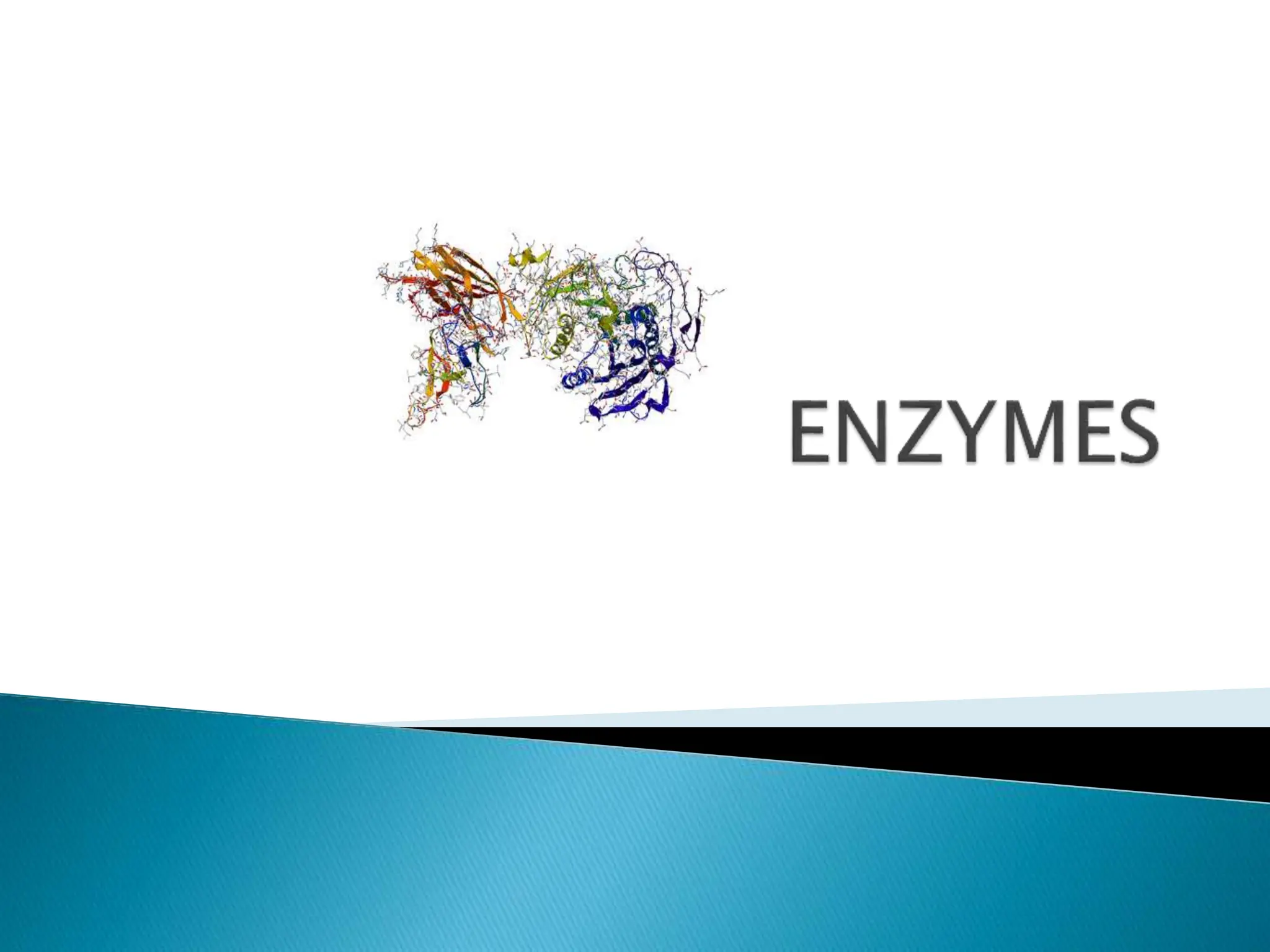
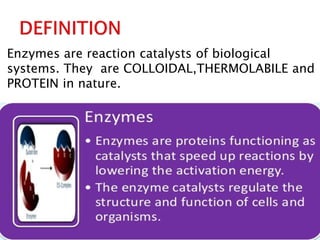
Enzymes are reaction catalysts of biological
systems. They are COLLOIDAL,THERMOLABILE and
PROTEIN in nature.
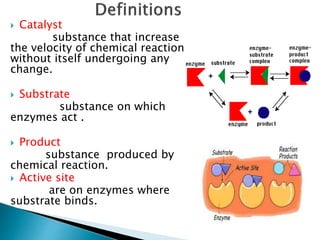
 Catalyst
substance that increase
the velocity of chemical reaction
without itself undergoing any
change.
 Substrate
substance on which
enzymes act .
 Product
substance produced by
chemical reaction.
 Active site
are on enzymes where
substrate binds.
 Enzymes are important group of biomolecules
synthesized by the living cells.
 Enzymes only accelerate the rate of chemical
reaction, but do not initiate them, chemical
reactions can take place without enzymes, but
then reactions will be extremely slow.
 Actions of most enzymes are under strict
regulation in a variety of ways.
 Enzymes that catalyze the conversion of one or
more compounds (substrates) into one or more
different compounds (products) enhance the rates
of the corresponding non-catalyzed reaction by
factors of at least 10.
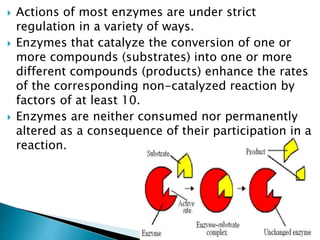
 Enzymes are neither consumed nor permanently
altered as a consequence of their participation in a
reaction.
 Each enzyme has its own tertiary structure and
specific conformation.
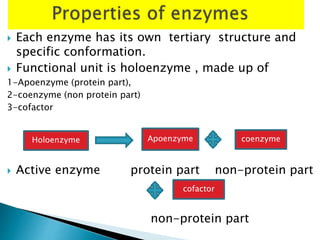
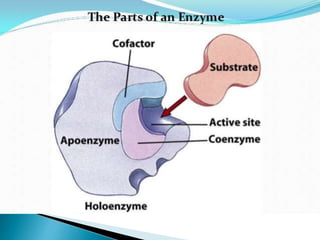
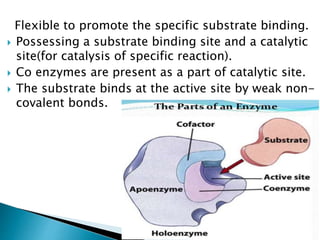
 Functional unit is holoenzyme , made up of
1-Apoenzyme (protein part),
2-coenzyme (non protein part)
3-cofactor
 Active enzyme protein part non-protein part
non-protein part
Holoenzyme Apoenzyme coenzyme
cofactor
 Highly efficient
 Extremely selective catalysts
 Enzymes are specific both for the type of reaction
catalyzed and for a single substrate or a small set
of closely related substrates.
 Enzymes are also stereospecific , typically catalyze
reaction of only one sterio-isomer of a given
compound , e.g D but not L sugars but not D amino
acids.
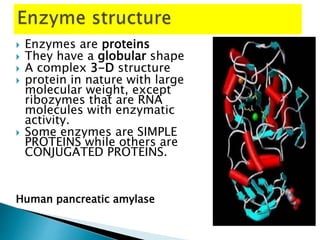
 Enzymes are proteins
 They have a globular shape
 A complex 3-D structure
 protein in nature with large
molecular weight, except
ribozymes that are RNA
molecules with enzymatic
activity.
 Some enzymes are SIMPLE
PROTEINS while others are
CONJUGATED PROTEINS.
Human pancreatic amylase
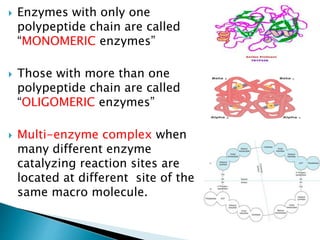
 Enzymes with only one
polypeptide chain are called
“MONOMERIC enzymes”
 Those with more than one
polypeptide chain are called
“OLIGOMERIC enzymes”
 Multi-enzyme complex when
many different enzyme
catalyzing reaction sites are
located at different site of the
same macro molecule.
© 2007 Paul Billiet ODWS
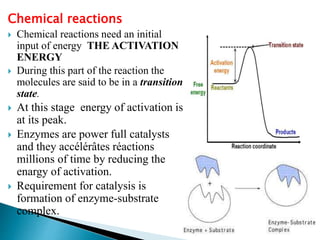
Chemical reactions
 Chemical reactions need an initial
input of energy THE ACTIVATION
ENERGY
 During this part of the reaction the
molecules are said to be in a transition
state.
 At this stage energy of activation is
at its peak.
 Enzymes are power full catalysts
and they accélérâtes réactions
millions of time by reducing the
enargy of activation.
 Requirement for catalysis is
formation of enzyme-substrate
complex.
 Increasing the temperature make molecules
move faster
 Biological systems are very sensitive to
temperature changes.
 Enzymes can increase the rate of reactions
without increasing the temperature.
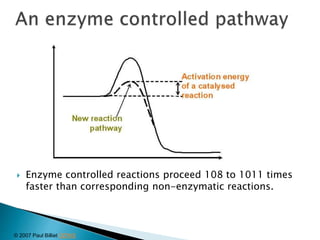
 They do this by lowering the activation
energy.
 They create a new reaction pathway “a short
cut”
© 2007 Paul Billiet ODWS
 Enzyme controlled reactions proceed 108 to 1011 times
faster than corresponding non-enzymatic reactions.
© 2007 Paul Billiet ODWS
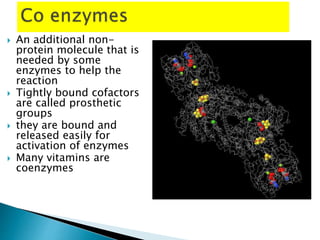
 An additional non-
protein molecule that is
needed by some
enzymes to help the
reaction
 Tightly bound cofactors
are called prosthetic
groups
 they are bound and
released easily for
activation of enzymes
 Many vitamins are
coenzymes
 Co enzymes are regarded as co-substrate or
second-substrate
 Coenzymes undergo alteration during the
enzymatic reaction, which are later regenerated,
while substrate is converted to product.
 Participate in various reactions involving transfer
of atoms or groups like hydrogen, keto ,amino,
acyl, methyl carbon dioxide etc.
 Specificity of enzyme is mostly dependent on the
apoenzyme and not on co enzyme.
 In the early 20th century it was observed that
presence of substrates renders enzymes more
resistant to the denaturing effects of elevated
temperature
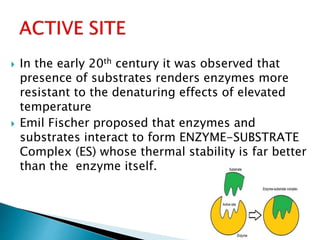
 Emil Fischer proposed that enzymes and
substrates interact to form ENZYME-SUBSTRATE
Complex (ES) whose thermal stability is far better
than the enzyme itself.
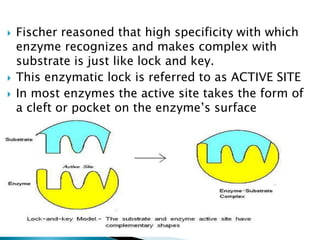
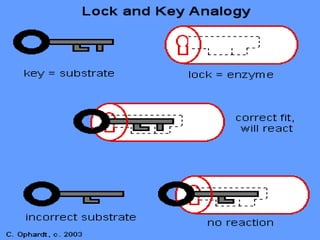
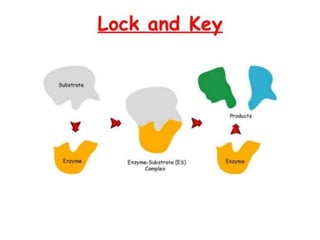
 Fischer reasoned that high specificity with which
enzyme recognizes and makes complex with
substrate is just like lock and key.
 This enzymatic lock is referred to as ACTIVE SITE
 In most enzymes the active site takes the form of
a cleft or pocket on the enzyme’s surface
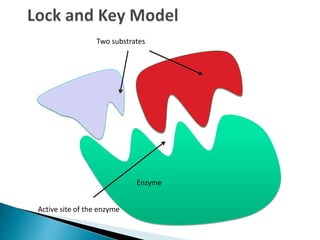
Active site of the enzyme
Two substrates
Enzyme
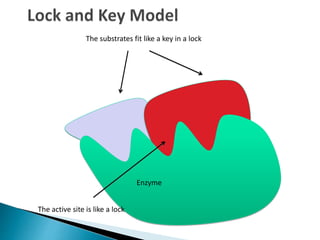
The active site is like a lock
The substrates fit like a key in a lock
Enzyme
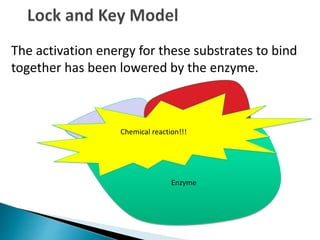
The activation energy for these substrates to bind
together has been lowered by the enzyme.
Enzyme
Chemical reaction!!!
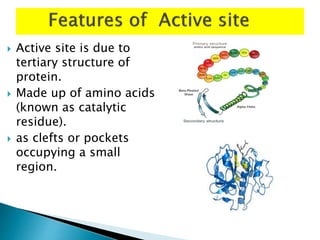
 Active site is due to
tertiary structure of
protein.
 Made up of amino acids
(known as catalytic
residue).
 as clefts or pockets
occupying a small
region.
Flexible to promote the specific substrate binding.
 Possessing a substrate binding site and a catalytic
site(for catalysis of specific reaction).
 Co enzymes are present as a part of catalytic site.
 The substrate binds at the active site by weak non-
covalent bonds.
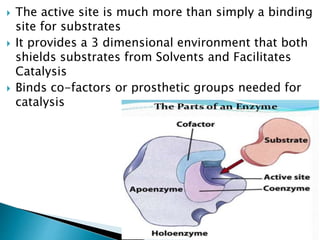
 The active site is much more than simply a binding
site for substrates
 It provides a 3 dimensional environment that both
shields substrates from Solvents and Facilitates
Catalysis
 Binds co-factors or prosthetic groups needed for
catalysis
 Within active site substrates are aligned in close
proximity and optimal orientation to the co-factors
and prosthetic groups responsible for catalysis and
their chemical transformation into PRODUCTS.
 Product have a diffèrent shape and chemical
composition then the substrate
 Once formed, they are released from the active site
 Leaving it free to become attached to another
substrate
 Fischer’s lock & key model showed specificity for
enzyme-substrate interactions
 But because of the rigidity of the active site it failed to
account for the dynamic changes accompanying
catalysis.
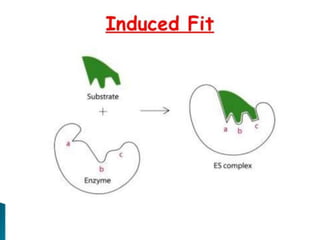
 To overcome this drawback, Daniel Koshland
introduced INDUCED FIT MODEL.
 Daniel proposed that when substrate approaches and
binds to the enzyme they induce a conformational
change which is analogous to placing a hand
(SUBSTRATE) into a glove (ENZYME)
 The enzyme brings about reciprocal changes in the
substrates, by decreasing the energy of activation to
facilitate the transformation of SUBSTRATES into
PRODUCTS
For identification of enzymes , International Union
of Biochemistry(IUB) adopted a nomenclature
system for enzymes , based on type of chemical
reaction and mechanism of reaction.
 Enzymes are grouped into six classes
 Each enzyme has a code number (EC No)
comprising four figures (digits) separated by
points
THE IUB CLASSIFICATION OF ENZYMES
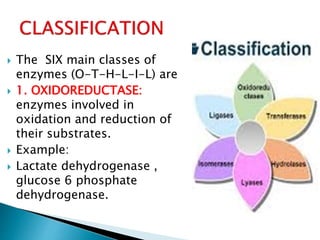
 The SIX main classes of
enzymes (O-T-H-L-I-L) are
 1. OXIDOREDUCTASE:
enzymes involved in
oxidation and reduction of
their substrates.
 Example:
 Lactate dehydrogenase ,
glucose 6 phosphate
dehydrogenase.
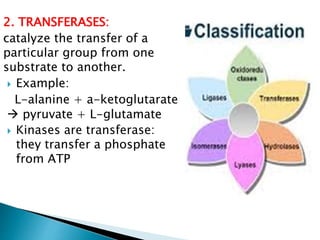
2. TRANSFERASES:
catalyze the transfer of a
particular group from one
substrate to another.
 Example:
L-alanine + a-ketoglutarate
 pyruvate + L-glutamate
 Kinases are transferase:
they transfer a phosphate
from ATP
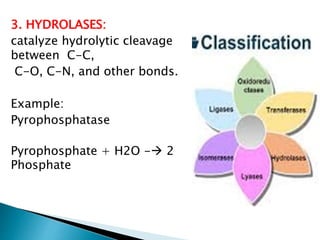
3. HYDROLASES:
catalyze hydrolytic cleavage
between C-C,
C-O, C-N, and other bonds.
Example:
Pyrophosphatase
Pyrophosphate + H2O - 2
Phosphate
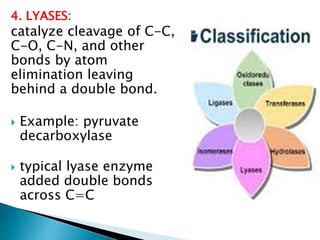
4. LYASES:
catalyze cleavage of C-C,
C-O, C-N, and other
bonds by atom
elimination leaving
behind a double bond.
 Example: pyruvate
decarboxylase
 typical lyase enzyme
added double bonds
across C=C
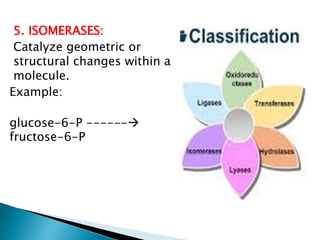
5. ISOMERASES:
Catalyze geometric or
structural changes within a
molecule.
Example:
glucose-6-P ------
fructose-6-P
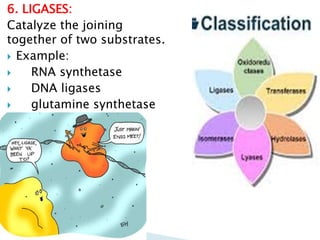
6. LIGASES:
Catalyze the joining
together of two substrates.
 Example:
 RNA synthetase
 DNA ligases
 glutamine synthetase
 Enzymes use various combinations of four general
mechanisms to achieve catalysis.
 1. CATALYSIS BY PROXIMITY:
For molecules to react they must come within bond
forming distance of one another. The higher their
concentration the more frequently they will
encounter one another, and the greater will be the
rate of their reaction.
2. ACID-BASE CATALYSIS:
 The ionizable functional groups of aminoacyl
side chains and of prosthetic groups present on
active site contribute to catalysis by acting as
acids or bases. Acid-base catalysis can either
be SPECIFIC or GENERAL.
 In specific acid or specific base catalysis, the
rate of reaction will be sensitive to changes in
the concentration of protons but independent
of concentration of other acids(proton donors)
or bases(proton acceptors) present in solution
or active site.
Reactions of whose rates are responsive to all acids
or bases present are termed as general acid or
general base catalysis.
 3. CATALYSIS BY STRAIN:
 Enzymes that catalyze -lytic reactions that
involve breaking a covalent bond, typically bind
their substrates in a conformation slightly
unfavorable for the bond that will undergo
cleavage.
 The resulting strain distorts the targeted bond,
weakening it and making it more vulnerable to
cleavage.
4 COVALENT CATALYSIS:
 The process of covalent catalysis involves the
formation of a covalent bond between the
enzyme and one or more substrates.
 The modified enzyme then becomes a reactant
 Covalent catalysis introduces a new reaction
pathway whose activation energy is low and
therefore is faster than the reaction pathway in
homogenous solution.
 The chemical modification of enzyme is
transient and on completion of the chemical
reaction the enzyme returns back to its
original unmodified state. Enzyme role is
purely catalytic, this type is for group transfer
reactions.
ENZYMES -enzymes biochemistry.slideshare.pptx

ENZYMES -enzymes biochemistry.slideshare.pptx

  • 3.
    Enzymes are reactioncatalysts of biological systems. They are COLLOIDAL,THERMOLABILE and PROTEIN in nature.
  • 4.
     Catalyst substance thatincrease the velocity of chemical reaction without itself undergoing any change.  Substrate substance on which enzymes act .  Product substance produced by chemical reaction.  Active site are on enzymes where substrate binds.
  • 5.
     Enzymes areimportant group of biomolecules synthesized by the living cells.  Enzymes only accelerate the rate of chemical reaction, but do not initiate them, chemical reactions can take place without enzymes, but then reactions will be extremely slow.
  • 6.
     Actions ofmost enzymes are under strict regulation in a variety of ways.  Enzymes that catalyze the conversion of one or more compounds (substrates) into one or more different compounds (products) enhance the rates of the corresponding non-catalyzed reaction by factors of at least 10.  Enzymes are neither consumed nor permanently altered as a consequence of their participation in a reaction.
  • 7.
     Each enzymehas its own tertiary structure and specific conformation.  Functional unit is holoenzyme , made up of 1-Apoenzyme (protein part), 2-coenzyme (non protein part) 3-cofactor  Active enzyme protein part non-protein part non-protein part Holoenzyme Apoenzyme coenzyme cofactor
  • 9.
     Highly efficient Extremely selective catalysts  Enzymes are specific both for the type of reaction catalyzed and for a single substrate or a small set of closely related substrates.  Enzymes are also stereospecific , typically catalyze reaction of only one sterio-isomer of a given compound , e.g D but not L sugars but not D amino acids.
  • 10.
     Enzymes areproteins  They have a globular shape  A complex 3-D structure  protein in nature with large molecular weight, except ribozymes that are RNA molecules with enzymatic activity.  Some enzymes are SIMPLE PROTEINS while others are CONJUGATED PROTEINS. Human pancreatic amylase
  • 11.
     Enzymes withonly one polypeptide chain are called “MONOMERIC enzymes”  Those with more than one polypeptide chain are called “OLIGOMERIC enzymes”  Multi-enzyme complex when many different enzyme catalyzing reaction sites are located at different site of the same macro molecule.
  • 12.
    © 2007 PaulBilliet ODWS
  • 13.
    Chemical reactions  Chemicalreactions need an initial input of energy THE ACTIVATION ENERGY  During this part of the reaction the molecules are said to be in a transition state.  At this stage energy of activation is at its peak.  Enzymes are power full catalysts and they accélérâtes réactions millions of time by reducing the enargy of activation.  Requirement for catalysis is formation of enzyme-substrate complex.
  • 14.
     Increasing thetemperature make molecules move faster  Biological systems are very sensitive to temperature changes.  Enzymes can increase the rate of reactions without increasing the temperature.  They do this by lowering the activation energy.  They create a new reaction pathway “a short cut” © 2007 Paul Billiet ODWS
  • 15.
     Enzyme controlledreactions proceed 108 to 1011 times faster than corresponding non-enzymatic reactions. © 2007 Paul Billiet ODWS
  • 16.
     An additionalnon- protein molecule that is needed by some enzymes to help the reaction  Tightly bound cofactors are called prosthetic groups  they are bound and released easily for activation of enzymes  Many vitamins are coenzymes
  • 17.
     Co enzymesare regarded as co-substrate or second-substrate  Coenzymes undergo alteration during the enzymatic reaction, which are later regenerated, while substrate is converted to product.  Participate in various reactions involving transfer of atoms or groups like hydrogen, keto ,amino, acyl, methyl carbon dioxide etc.  Specificity of enzyme is mostly dependent on the apoenzyme and not on co enzyme.
  • 18.
     In theearly 20th century it was observed that presence of substrates renders enzymes more resistant to the denaturing effects of elevated temperature  Emil Fischer proposed that enzymes and substrates interact to form ENZYME-SUBSTRATE Complex (ES) whose thermal stability is far better than the enzyme itself.
  • 19.
     Fischer reasonedthat high specificity with which enzyme recognizes and makes complex with substrate is just like lock and key.  This enzymatic lock is referred to as ACTIVE SITE  In most enzymes the active site takes the form of a cleft or pocket on the enzyme’s surface
  • 21.
    Active site ofthe enzyme Two substrates Enzyme
  • 22.
    The active siteis like a lock The substrates fit like a key in a lock Enzyme
  • 23.
    The activation energyfor these substrates to bind together has been lowered by the enzyme. Enzyme Chemical reaction!!!
  • 25.
     Active siteis due to tertiary structure of protein.  Made up of amino acids (known as catalytic residue).  as clefts or pockets occupying a small region.
  • 26.
    Flexible to promotethe specific substrate binding.  Possessing a substrate binding site and a catalytic site(for catalysis of specific reaction).  Co enzymes are present as a part of catalytic site.  The substrate binds at the active site by weak non- covalent bonds.
  • 27.
     The activesite is much more than simply a binding site for substrates  It provides a 3 dimensional environment that both shields substrates from Solvents and Facilitates Catalysis  Binds co-factors or prosthetic groups needed for catalysis
  • 28.
     Within activesite substrates are aligned in close proximity and optimal orientation to the co-factors and prosthetic groups responsible for catalysis and their chemical transformation into PRODUCTS.  Product have a diffèrent shape and chemical composition then the substrate  Once formed, they are released from the active site  Leaving it free to become attached to another substrate
  • 29.
     Fischer’s lock& key model showed specificity for enzyme-substrate interactions  But because of the rigidity of the active site it failed to account for the dynamic changes accompanying catalysis.  To overcome this drawback, Daniel Koshland introduced INDUCED FIT MODEL.  Daniel proposed that when substrate approaches and binds to the enzyme they induce a conformational change which is analogous to placing a hand (SUBSTRATE) into a glove (ENZYME)  The enzyme brings about reciprocal changes in the substrates, by decreasing the energy of activation to facilitate the transformation of SUBSTRATES into PRODUCTS
  • 31.
    For identification ofenzymes , International Union of Biochemistry(IUB) adopted a nomenclature system for enzymes , based on type of chemical reaction and mechanism of reaction.  Enzymes are grouped into six classes  Each enzyme has a code number (EC No) comprising four figures (digits) separated by points THE IUB CLASSIFICATION OF ENZYMES
  • 33.
     The SIXmain classes of enzymes (O-T-H-L-I-L) are  1. OXIDOREDUCTASE: enzymes involved in oxidation and reduction of their substrates.  Example:  Lactate dehydrogenase , glucose 6 phosphate dehydrogenase.
  • 34.
    2. TRANSFERASES: catalyze thetransfer of a particular group from one substrate to another.  Example: L-alanine + a-ketoglutarate  pyruvate + L-glutamate  Kinases are transferase: they transfer a phosphate from ATP
  • 35.
    3. HYDROLASES: catalyze hydrolyticcleavage between C-C, C-O, C-N, and other bonds. Example: Pyrophosphatase Pyrophosphate + H2O - 2 Phosphate
  • 36.
    4. LYASES: catalyze cleavageof C-C, C-O, C-N, and other bonds by atom elimination leaving behind a double bond.  Example: pyruvate decarboxylase  typical lyase enzyme added double bonds across C=C
  • 37.
    5. ISOMERASES: Catalyze geometricor structural changes within a molecule. Example: glucose-6-P ------ fructose-6-P
  • 38.
    6. LIGASES: Catalyze thejoining together of two substrates.  Example:  RNA synthetase  DNA ligases  glutamine synthetase
  • 39.
     Enzymes usevarious combinations of four general mechanisms to achieve catalysis.  1. CATALYSIS BY PROXIMITY: For molecules to react they must come within bond forming distance of one another. The higher their concentration the more frequently they will encounter one another, and the greater will be the rate of their reaction.
  • 40.
    2. ACID-BASE CATALYSIS: The ionizable functional groups of aminoacyl side chains and of prosthetic groups present on active site contribute to catalysis by acting as acids or bases. Acid-base catalysis can either be SPECIFIC or GENERAL.  In specific acid or specific base catalysis, the rate of reaction will be sensitive to changes in the concentration of protons but independent of concentration of other acids(proton donors) or bases(proton acceptors) present in solution or active site.
  • 41.
    Reactions of whoserates are responsive to all acids or bases present are termed as general acid or general base catalysis.  3. CATALYSIS BY STRAIN:  Enzymes that catalyze -lytic reactions that involve breaking a covalent bond, typically bind their substrates in a conformation slightly unfavorable for the bond that will undergo cleavage.  The resulting strain distorts the targeted bond, weakening it and making it more vulnerable to cleavage.
  • 42.
    4 COVALENT CATALYSIS: The process of covalent catalysis involves the formation of a covalent bond between the enzyme and one or more substrates.  The modified enzyme then becomes a reactant  Covalent catalysis introduces a new reaction pathway whose activation energy is low and therefore is faster than the reaction pathway in homogenous solution.
  • 43.
     The chemicalmodification of enzyme is transient and on completion of the chemical reaction the enzyme returns back to its original unmodified state. Enzyme role is purely catalytic, this type is for group transfer reactions.