LIP RECONSTRUCTION
Dr. Akshai George Paul
• The lips are the principal aesthetic unit of the lower
third of the face
• Have significant functional, aesthetic, and social
importance.
• Subtle changes visible at conversational distance
• Restoration needs to restore function and
aesthetics
TOPOGRAPHY/EXTERNAL
ANATOMY
• The boundaries of the upper lip are defined by the
base of the nose centrally and by the nasolabial
folds laterally.
• The inferior margin of the lower lip is defined by
the mental crease (labiomental crease) that
separates the lip from the chin.
Layers
Skin
Sc tissue
Muscle
Mucosa
Aesthetic subuits of Lip:
MUSCULAR/INTERNAL ANATOMY
VACULAR ANATOMY
LYMPHATICS
NEUROANATOMY
Etiology
• Congenital defects
• Trauma
• Burns
• Vasculitis
• Neoplasm
• Infections
GOALS OF RECONSTRUCTION
PRIMARY CLOSURE
Indication:
• Less than one third of lip absent
• Advantages:
• • Single-stage procedure
• • Innervated
• • Muscular continuity
Disadvantages:
• For Small lip defects
• Limited use in upper lip since it Obliterates Cupid’s
bow and/or philtral elements
Wedge Excision of Lesions
ABBES LIP SWITCH FLAP
• Indication
• One third to one half of lip absent
• Commissure preserved
• Advantages:
• • Muscular continuity
• • Primary closure of donor site
Disadvantages:
• Two -stage procedure
• Requires patient compliance
• • Insensate
• Important points:
• • Flap design
• Half the width of the defect
• Full thickness
• Rotation point should allow adequate mouth opening between first and second
stages.
• Leave a small cuff of muscle around the vascular pedicle.
• Blood supply
• Ipsilateral labial artery of opposite lip
• Second-stage timing
• 2 to 3 weeks
• Test flap viability before flap take down.
• Wedge resection may improve lip advancement
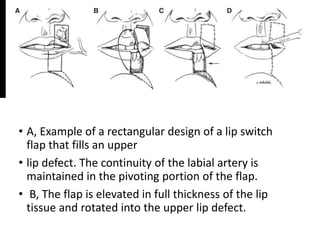
• A, Example of a rectangular design of a lip switch
flap that fills an upper
• lip defect. The continuity of the labial artery is
maintained in the pivoting portion of the flap.
• B, The flap is elevated in full thickness of the lip
tissue and rotated into the upper lip defect.
C Excision
• of a Burow’s triangle at the base of the donor site
allows medial advancement of the lower lateral
• lip flap and primary closure of the donor site similar
to the single-barrel excision.
• D. The pedicle is divided and inset at 14-21 days.
ESLANDER FLAP
• Indication
• One half to two thirds of lip absent
• •Commissure affected
• Advantage
• Possible for single-stage procedure
•
• Disadvantages
• Insensate
• Distortion of oral animation
• Modiolus altered
• May require secondary commissuroplasty
• •Tenuous vascular supply
• Important points:
• Flap design
• One third to one half the size of the defect
• Full thickness
• Leave a small cuff of muscle around the vascular
pedicle.
• Blood supply-Contralateral labial artery of opposite
lip
KARPANDZIC FLAP
Indication
• • One third to two thirds of the lip absent
• • Central defect
• Advantages
• Single-stage procedure
• Sensate
• Muscular continuity
• Oral sphincter competence
• Preserves the philtrum and modiolus
Disadvantages
• • Microstomia in large defects (greater than two thirds of lip)
• • Upper lip may appear tight.
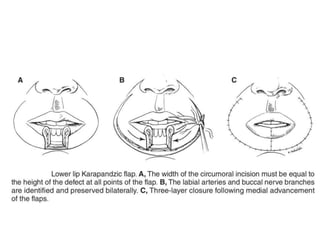
• Important points
• Flap design
• Rotational, circumoral flaps
• Intramuscular dissection to preserve vascular pedicle
• Blood supply
• Bilateral labial arteries
• Technically, a modification of the Gillies fan flap that preserves
neurovascular structures
BERNARD-BUROW CHEILOPLASTY
Indication
• • Greater than two thirds of the lip absent
• • Central defect
• Advantages
• • Single-stage procedure
• •Local tissue flap reconstruction
• Disadvantages
• • Little or no muscle function
• • Oral sphincter incompetence
• • Insensate
• • Microstomia
• Important points
• Flap design
• Burow’s triangles allow medial advancement of lateral
cheeks.
• Designed after completing lip excision
• Placed along anatomic subunit divisions (e.g., nasolabial fold
and labiomental
• crease)
• Buccal mucosal flaps can be used to reconstruct the
vermilion.
• • Blood supply
• Dermal plexus
• • Webster modification
• Excise skin and subcutaneous tissue only in Burow’s
triangles.
• Preserves muscular innervation
• Triangular excisions are located more laterally.
• Paramental Burow’s triangles are excised.
• Advance inferior cheek skin.
TOTAL LIP RECONSTRUCTION
• Total lip reconstruction can be performed with a radial forearm and palmaris longus
composite free flap
• Indication
• Total or near total loss of the lip
• Advantages
• • Well-vascularized coverage
• • Possible to include sensory innervation
• Disadvantages
• • No motor innervation
• • Poor color match
• • Difficult to reconstruct anatomic landmarks and vermilion
• Flap design
• Palmaris longus forms a sling to maintain lower lip
height
• Blood supply-Radial artery
• Innervation-Lateral antebrachial cutaneous nerve
• Excellent choice if local tissues have been
irradiated
POST OPERATIVE CARE
• NUTRITION
• Proper sized peizes pr liquid diet
• ORAL HYGIENE
• Patient can swish and expectorate with oral
solution if they have oral competance
• Gentle intraoral cleaning is performed with swab or
soft bristle brush
THANK YOU
Lip Reconstruction.pptx

Lip Reconstruction.pptx

  • 1.
  • 2.
    • The lipsare the principal aesthetic unit of the lower third of the face • Have significant functional, aesthetic, and social importance. • Subtle changes visible at conversational distance • Restoration needs to restore function and aesthetics
  • 3.
  • 4.
    • The boundariesof the upper lip are defined by the base of the nose centrally and by the nasolabial folds laterally. • The inferior margin of the lower lip is defined by the mental crease (labiomental crease) that separates the lip from the chin.
  • 5.
  • 6.
  • 7.
  • 9.
  • 10.
  • 11.
  • 13.
    Etiology • Congenital defects •Trauma • Burns • Vasculitis • Neoplasm • Infections
  • 14.
  • 18.
    PRIMARY CLOSURE Indication: • Lessthan one third of lip absent • Advantages: • • Single-stage procedure • • Innervated • • Muscular continuity
  • 19.
    Disadvantages: • For Smalllip defects • Limited use in upper lip since it Obliterates Cupid’s bow and/or philtral elements
  • 20.
  • 21.
    ABBES LIP SWITCHFLAP • Indication • One third to one half of lip absent • Commissure preserved • Advantages: • • Muscular continuity • • Primary closure of donor site
  • 22.
    Disadvantages: • Two -stageprocedure • Requires patient compliance • • Insensate • Important points: • • Flap design • Half the width of the defect • Full thickness • Rotation point should allow adequate mouth opening between first and second stages. • Leave a small cuff of muscle around the vascular pedicle.
  • 23.
    • Blood supply •Ipsilateral labial artery of opposite lip • Second-stage timing • 2 to 3 weeks • Test flap viability before flap take down. • Wedge resection may improve lip advancement
  • 24.
    • A, Exampleof a rectangular design of a lip switch flap that fills an upper • lip defect. The continuity of the labial artery is maintained in the pivoting portion of the flap. • B, The flap is elevated in full thickness of the lip tissue and rotated into the upper lip defect.
  • 25.
    C Excision • ofa Burow’s triangle at the base of the donor site allows medial advancement of the lower lateral • lip flap and primary closure of the donor site similar to the single-barrel excision. • D. The pedicle is divided and inset at 14-21 days.
  • 26.
    ESLANDER FLAP • Indication •One half to two thirds of lip absent • •Commissure affected • Advantage • Possible for single-stage procedure • • Disadvantages • Insensate • Distortion of oral animation • Modiolus altered • May require secondary commissuroplasty • •Tenuous vascular supply
  • 27.
    • Important points: •Flap design • One third to one half the size of the defect • Full thickness • Leave a small cuff of muscle around the vascular pedicle. • Blood supply-Contralateral labial artery of opposite lip
  • 30.
    KARPANDZIC FLAP Indication • •One third to two thirds of the lip absent • • Central defect • Advantages • Single-stage procedure • Sensate • Muscular continuity • Oral sphincter competence • Preserves the philtrum and modiolus
  • 31.
    Disadvantages • • Microstomiain large defects (greater than two thirds of lip) • • Upper lip may appear tight. • Important points • Flap design • Rotational, circumoral flaps • Intramuscular dissection to preserve vascular pedicle • Blood supply • Bilateral labial arteries • Technically, a modification of the Gillies fan flap that preserves neurovascular structures
  • 34.
    BERNARD-BUROW CHEILOPLASTY Indication • •Greater than two thirds of the lip absent • • Central defect • Advantages • • Single-stage procedure • •Local tissue flap reconstruction • Disadvantages • • Little or no muscle function • • Oral sphincter incompetence • • Insensate • • Microstomia
  • 35.
    • Important points •Flap design • Burow’s triangles allow medial advancement of lateral cheeks. • Designed after completing lip excision • Placed along anatomic subunit divisions (e.g., nasolabial fold and labiomental • crease) • Buccal mucosal flaps can be used to reconstruct the vermilion.
  • 36.
    • • Bloodsupply • Dermal plexus • • Webster modification • Excise skin and subcutaneous tissue only in Burow’s triangles. • Preserves muscular innervation • Triangular excisions are located more laterally. • Paramental Burow’s triangles are excised. • Advance inferior cheek skin.
  • 38.
    TOTAL LIP RECONSTRUCTION •Total lip reconstruction can be performed with a radial forearm and palmaris longus composite free flap • Indication • Total or near total loss of the lip • Advantages • • Well-vascularized coverage • • Possible to include sensory innervation • Disadvantages • • No motor innervation • • Poor color match • • Difficult to reconstruct anatomic landmarks and vermilion
  • 39.
    • Flap design •Palmaris longus forms a sling to maintain lower lip height • Blood supply-Radial artery • Innervation-Lateral antebrachial cutaneous nerve • Excellent choice if local tissues have been irradiated
  • 41.
    POST OPERATIVE CARE •NUTRITION • Proper sized peizes pr liquid diet • ORAL HYGIENE • Patient can swish and expectorate with oral solution if they have oral competance • Gentle intraoral cleaning is performed with swab or soft bristle brush
  • 42.