1
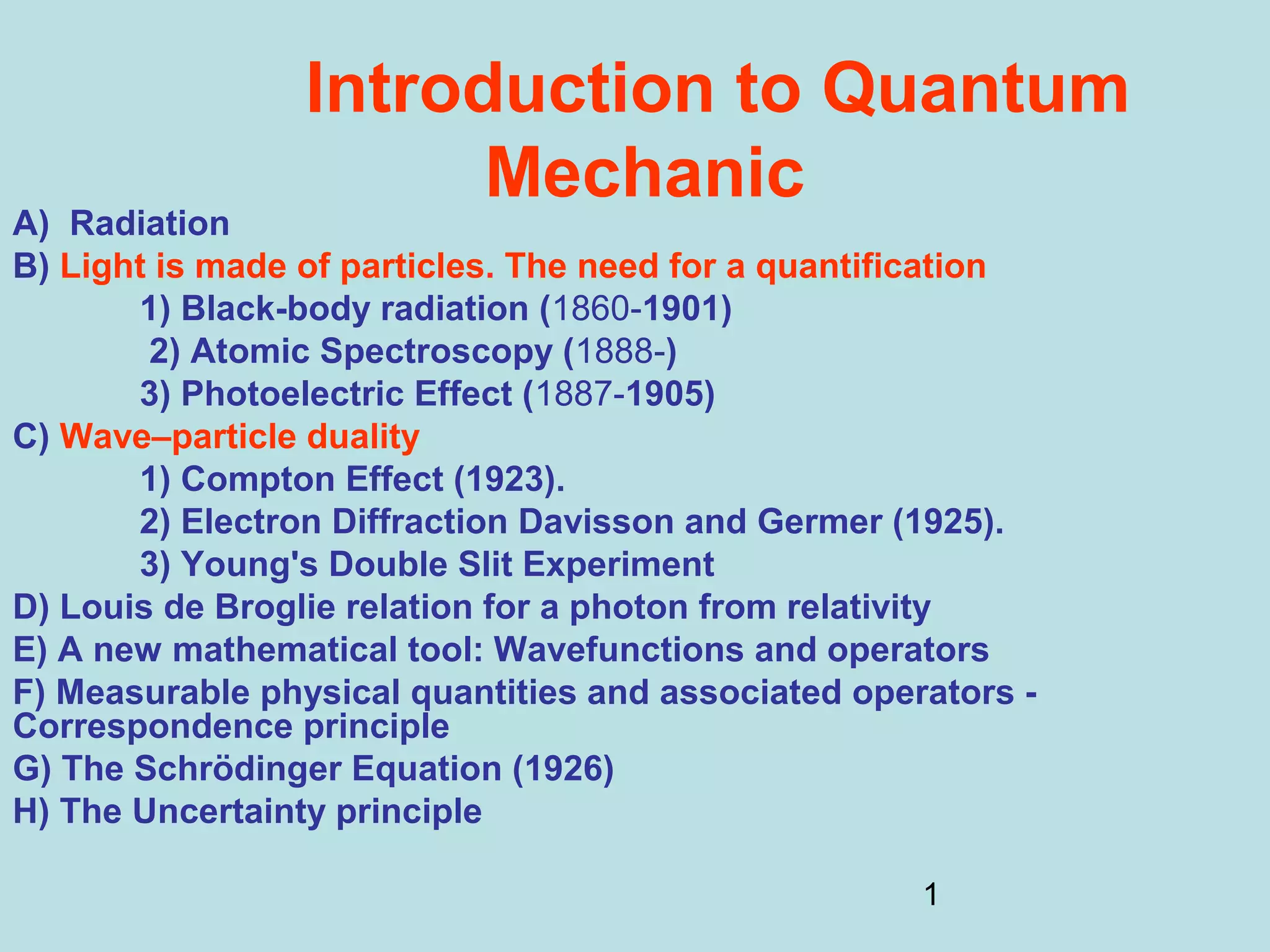
Introduction to Quantum
Mechanic
A) Radiation
B) Light is made of particles. The need for a quantification
1) Black-body radiation (1860-1901)
2) Atomic Spectroscopy (1888-)
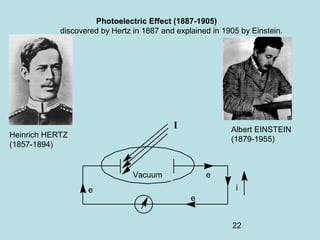
3) Photoelectric Effect (1887-1905)
C) Wave–particle duality
1) Compton Effect (1923).
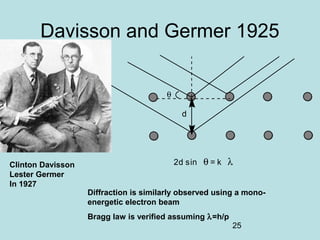
2) Electron Diffraction Davisson and Germer (1925).
3) Young's Double Slit Experiment
D) Louis de Broglie relation for a photon from relativity
E) A new mathematical tool: Wavefunctions and operators
F) Measurable physical quantities and associated operators -
Correspondence principle
G) The Schrödinger Equation (1926)
H) The Uncertainty principle
2
When you find this image, you may
skip this part
This is less important
3
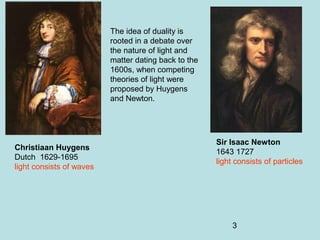
The idea of duality is
rooted in a debate over
the nature of light and
matter dating back to the
1600s, when competing
theories of light were
proposed by Huygens
and Newton.
Christiaan Huygens
Dutch 1629-1695
light consists of waves
Sir Isaac Newton
1643 1727
light consists of particles
4
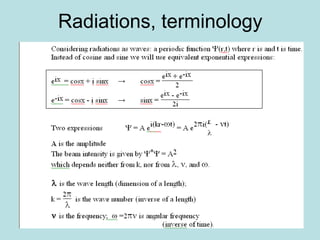
Radiations, terminology
5
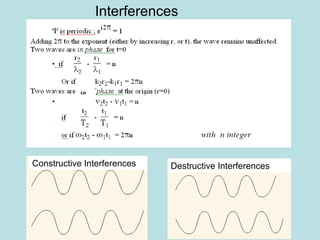
Interferences
Constructive Interferences Destructive Interferences
in
6
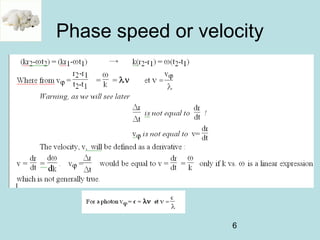
Phase speed or velocity
7
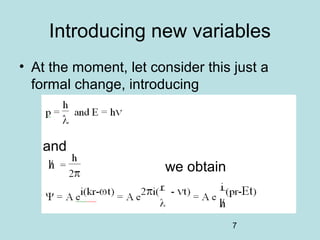
Introducing new variables
• At the moment, let consider this just a
formal change, introducing
and
we obtain
8
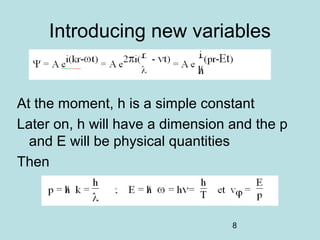
Introducing new variables
At the moment, h is a simple constant
Later on, h will have a dimension and the p
and E will be physical quantities
Then
9
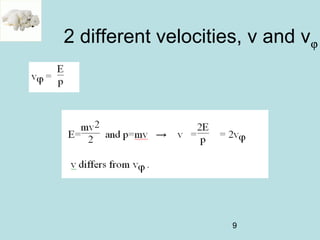
2 different velocities, v and vϕ
10
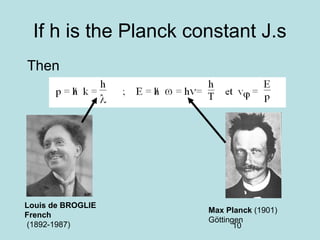
If h is the Planck constant J.s
Then
Louis de BROGLIE
French
(1892-1987)
Max Planck (1901)
Göttingen
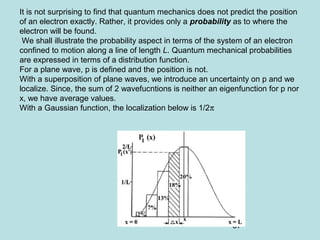
11
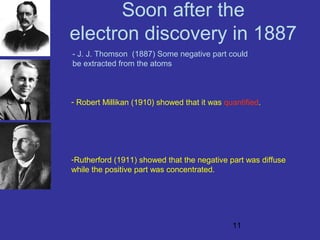
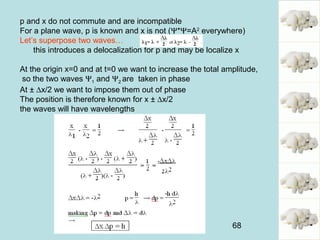
- Robert Millikan (1910) showed that it was quantified.
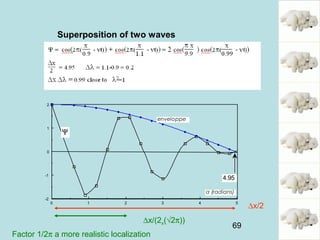
-Rutherford (1911) showed that the negative part was diffuse
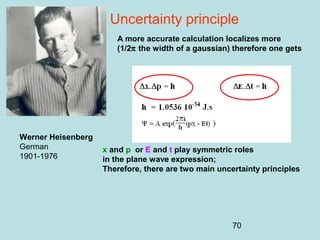
while the positive part was concentrated.
Soon after the
electron discovery in 1887
- J. J. Thomson (1887) Some negative part could
be extracted from the atoms
12
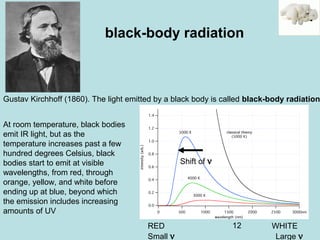
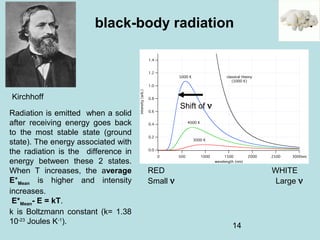
Gustav Kirchhoff (1860). The light emitted by a black body is called black-body radiation
black-body radiation
At room temperature, black bodies
emit IR light, but as the
temperature increases past a few
hundred degrees Celsius, black
bodies start to emit at visible
wavelengths, from red, through
orange, yellow, and white before
ending up at blue, beyond which
the emission includes increasing
amounts of UV
RED WHITE
Small ν Large ν
Shift of ν
13
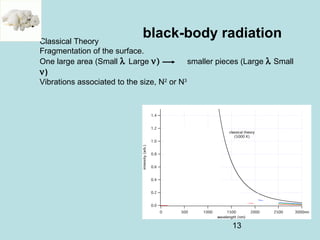
black-body radiationClassical Theory
Fragmentation of the surface.
One large area (Small λ Large ν) smaller pieces (Large λ Small
ν)
Vibrations associated to the size, N2
or N3
14
Kirchhoff
black-body radiation
RED WHITE
Small ν Large ν
Shift of ν
Radiation is emitted when a solid
after receiving energy goes back
to the most stable state (ground
state). The energy associated with
the radiation is the difference in
energy between these 2 states.
When T increases, the average
E*Mean is higher and intensity
increases.
E*Mean- E = kT.
k is Boltzmann constant (k= 1.38
10-23
Joules K-1
).
15
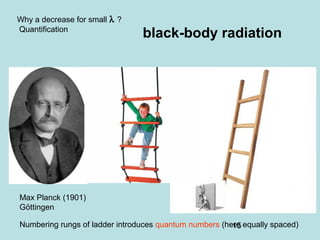
black-body radiation
Max Planck (1901)
Göttingen
Why a decrease for small λ ?
Quantification
Numbering rungs of ladder introduces quantum numbers (here equally spaced)
16
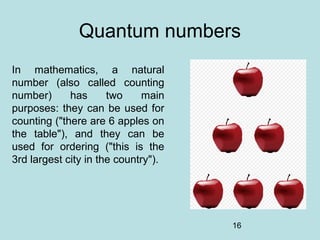
Quantum numbers
In mathematics, a natural
number (also called counting
number) has two main
purposes: they can be used for
counting ("there are 6 apples on
the table"), and they can be
used for ordering ("this is the
3rd largest city in the country").
17
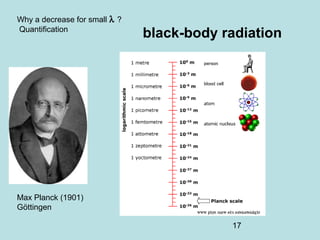
black-body radiation
Max Planck (1901)
Göttingen
Why a decrease for small λ ?
Quantification
18
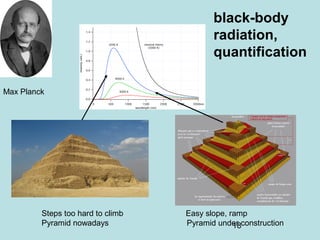
black-body
radiation,
quantification
Max Planck
Steps too hard to climb Easy slope, ramp
Pyramid nowadays Pyramid under construction
19
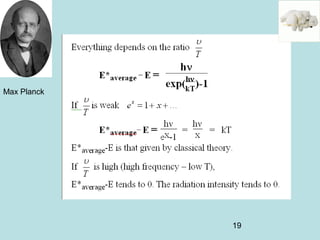
Max Planck
20
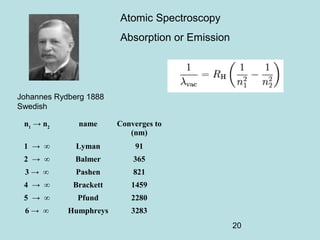
Johannes Rydberg 1888
Swedish
n1
→ n2
name Converges to
(nm)
1 → ∞ Lyman 91
2 → ∞ Balmer 365
3 → ∞ Pashen 821
4 → ∞ Brackett 1459
5 → ∞ Pfund 2280
6 → ∞ Humphreys 3283
Atomic Spectroscopy
Absorption or Emission
21
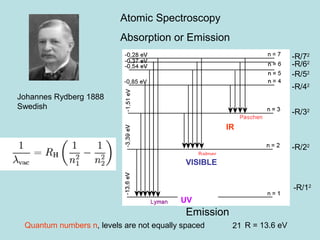
Johannes Rydberg 1888
Swedish
IR
VISIBLE
UV
Atomic Spectroscopy
Absorption or Emission
Emission
-R/12
-R/22
-R/32
-R/42
-R/52
-R/62
-R/72
Quantum numbers n, levels are not equally spaced R = 13.6 eV
22
Photoelectric Effect (1887-1905)
discovered by Hertz in 1887 and explained in 1905 by Einstein.
Vide
I
i
e
e
e
Vacuum
Heinrich HERTZ
(1857-1894)
Albert EINSTEIN
(1879-1955)
23
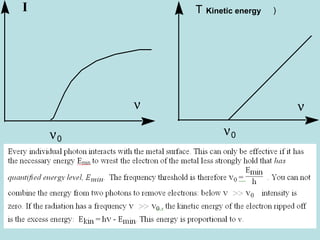
I
ν0
ν0
ν ν
T (énergie cinétique)Kinetic energy
24
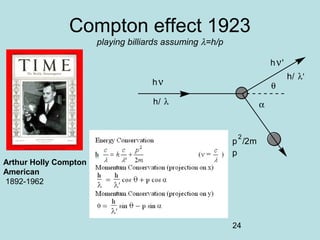
Compton effect 1923
playing billiards assuming λ=h/p
p
h/ λ'
h/ λ
p
2
/2m
hν'
hν
α
θ
Arthur Holly Compton
American
1892-1962
25
Davisson and Germer 1925
Clinton Davisson
Lester Germer
In 1927
d
θ
2d sin θ = k λ
Diffraction is similarly observed using a mono-
energetic electron beam
Bragg law is verified assuming λ=h/p
26
Wave-particle Equivalence.
•Compton Effect (1923).
•Electron Diffraction Davisson and Germer (1925)
•Young's Double Slit Experiment
In physics and chemistry, wave–particle duality is the concept that all matter and
energy exhibits both wave-like and particle-like properties. A central concept of
quantum mechanics, duality, addresses the inadequacy of classical concepts like
"particle" and "wave" in fully describing the behavior of small-scale objects. Various
interpretations of quantum mechanics attempt to explain this apparent paradox.
Wave–particle duality
27
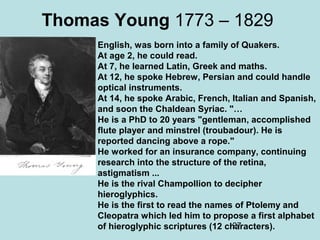
Thomas Young 1773 – 1829
English, was born into a family of Quakers.
At age 2, he could read.
At 7, he learned Latin, Greek and maths.
At 12, he spoke Hebrew, Persian and could handle
optical instruments.
At 14, he spoke Arabic, French, Italian and Spanish,
and soon the Chaldean Syriac. "…
He is a PhD to 20 years "gentleman, accomplished
flute player and minstrel (troubadour). He is
reported dancing above a rope."
He worked for an insurance company, continuing
research into the structure of the retina,
astigmatism ...
He is the rival Champollion to decipher
hieroglyphics.
He is the first to read the names of Ptolemy and
Cleopatra which led him to propose a first alphabet
of hieroglyphic scriptures (12 characters).
28
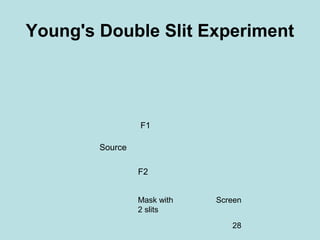
Young's Double Slit Experiment
Ecran Plaque photo
F2
F1
Source
ScreenMask with
2 slits
29
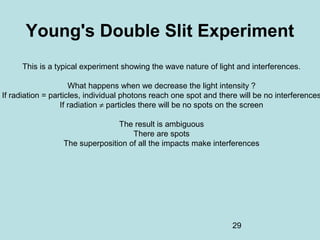
Young's Double Slit Experiment
This is a typical experiment showing the wave nature of light and interferences.
What happens when we decrease the light intensity ?
If radiation = particles, individual photons reach one spot and there will be no interferences
If radiation ≠ particles there will be no spots on the screen
The result is ambiguous
There are spots
The superposition of all the impacts make interferences
30
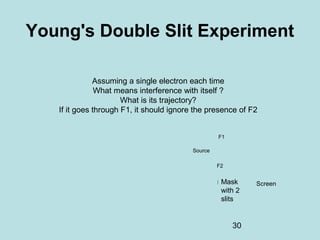
Young's Double Slit Experiment
Assuming a single electron each time
What means interference with itself ?
What is its trajectory?
If it goes through F1, it should ignore the presence of F2
Ecran Plaque photo
F2
F1
Source
ScreenMask
with 2
slits
31
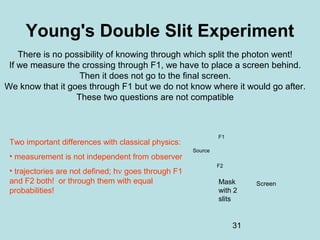
Young's Double Slit Experiment
There is no possibility of knowing through which split the photon went!
If we measure the crossing through F1, we have to place a screen behind.
Then it does not go to the final screen.
We know that it goes through F1 but we do not know where it would go after.
These two questions are not compatible
Ecran Plaque photo
F2
F1
Source
ScreenMask
with 2
slits
Two important differences with classical physics:
• measurement is not independent from observer
• trajectories are not defined; hν goes through F1
and F2 both! or through them with equal
probabilities!
32
Macroscopic world:
A basket of cherries
Many of them (identical)
We can see them and taste others
Taking one has negligible effect
Cherries are both red and good
Microscopic world:
A single cherry
Either we look at it without eating
It is red
Or we eat it, it is good
You can not try both at the same time
The cherry could not be good and red at
the same time
33
Slot machine “one-arm bandit”
After introducing a coin, you have
0 coin or X coins.
A measure of the profit has been
made: profit = X
34
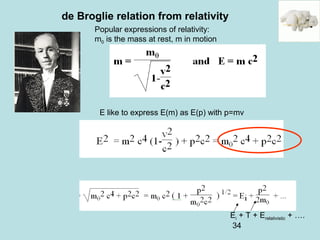
de Broglie relation from relativity
Popular expressions of relativity:
m0 is the mass at rest, m in motion
E like to express E(m) as E(p) with p=mv
Ei + T + Erelativistic + ….
35
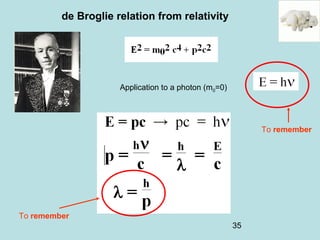
de Broglie relation from relativity
Application to a photon (m0=0)
To remember
To remember
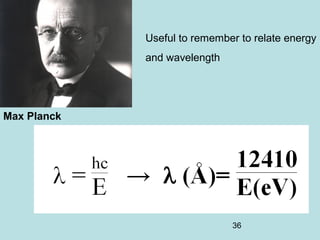
36
Max Planck
Useful to remember to relate energy
and wavelength
37
A New mathematical tool:
Wave functions and Operators
Each particle may be described by a wave function Ψ(x,y,z,t), real or complex,
having a single value when position (x,y,z) and time (t) are defined.
If it is not time-dependent, it is called stationary.
The expression Ψ=Aei(pr-Et)
does not represent one molecule but a flow of
particles: a plane wave
38
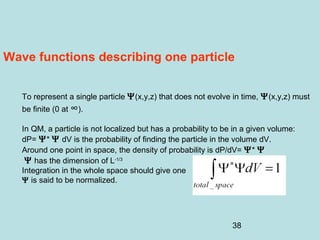
Wave functions describing one particle
To represent a single particle Ψ(x,y,z) that does not evolve in time, Ψ(x,y,z) must
be finite (0 at ∞).
In QM, a particle is not localized but has a probability to be in a given volume:
dP= Ψ* Ψ dV is the probability of finding the particle in the volume dV.
Around one point in space, the density of probability is dP/dV= Ψ* Ψ
Ψ has the dimension of L-1/3
Integration in the whole space should give one
Ψ is said to be normalized.
39
Operators associated to physical quantities
We cannot use functions (otherwise we would end with classical mechanics)
Any physical quantity is associated with an operator.
An operator O is “the recipe to transform Ψ into Ψ’ ”
We write: O Ψ = Ψ’
If O Ψ = oΨ (o is a number, meaning that O does not modify Ψ, just a scaling
factor), we say that Ψ is an eigenfunction of O and o is the eigenvalue.
We have solved the wave equation O Ψ = oΨ by finding simultaneously Ψ and o
that satisfy the equation.
o is the measure of O for the particle in the state described by Ψ.
40
Slot machine (one-arm bandit)
Introducing a coin, you have 0
coin or X coins.
A measure of the profit has been
made: profit = X
O is a Vending machine (cans)
Introducing a coin, you get one
can.
No measure of the gain is made
unless you sell the can (return to
coins)
41
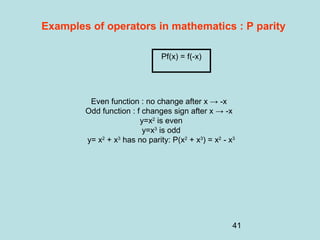
Examples of operators in mathematics : P parity
Even function : no change after x → -x
Odd function : f changes sign after x → -x
y=x2
is even
y=x3
is odd
y= x2
+ x3
has no parity: P(x2
+ x3
) = x2
- x3
Pf(x) = f(-x)
42
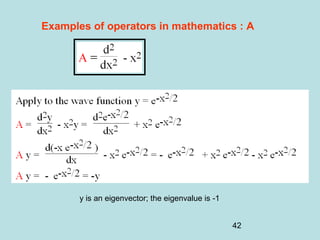
Examples of operators in mathematics : A
y is an eigenvector; the eigenvalue is -1
43
Linearity
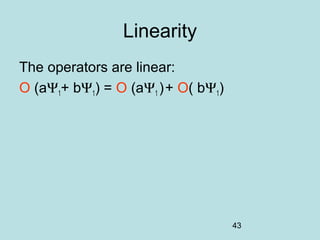
The operators are linear:
O (aΨ1+ bΨ1) = O (aΨ1 )+ O( bΨ1)
44
Normalization
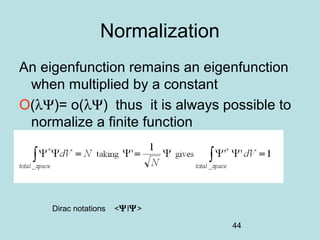
An eigenfunction remains an eigenfunction
when multiplied by a constant
O(λΨ)= o(λΨ) thus it is always possible to
normalize a finite function
Dirac notations <ΨIΨ>
45
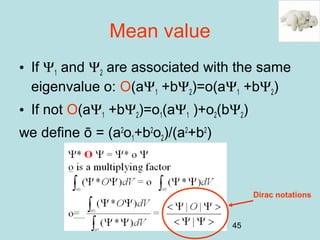
Mean value
• If Ψ1 and Ψ2 are associated with the same
eigenvalue o: O(aΨ1 +bΨ2)=o(aΨ1 +bΨ2)
• If not O(aΨ1 +bΨ2)=o1(aΨ1 )+o2(bΨ2)
we define ō = (a2
o1+b2
o2)/(a2
+b2
)
Dirac notations
46
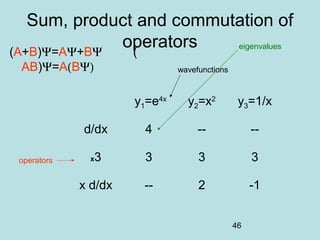
Sum, product and commutation of
operators(A+B)Ψ=AΨ+BΨ (
AB)Ψ=A(BΨ)
y1=e4x
y2=x2
y3=1/x
d/dx 4 -- --
x3 3 3 3
x d/dx -- 2 -1
operators
wavefunctions
eigenvalues
47
Sum, product and commutation of operators
y1=e4x
y2=x2
y3=1/x
A = d/dx 4 -- --
B = x3 3 3 3
C= x d/dx -- 2 -1
not compatible
operators
[A,C]=AC-CA≠0
[A,B]=AB-BA=0
[B,C]=BC-CB=0
48
Compatibility, incompatibility of operators
y1=e4x
y2=x2
y3=1/x
A = d/dx 4 -- --
B = x3 3 3 3
C= x d/dx -- 2 -1
not compatible
operators
[A,C]=AC-CA≠0
[A,B]=AB-BA=0
[B,C]=BC-CB=0
When operators commute, the physical quantities
may be simultaneously defined (compatibility)
When operators do not commute, the physical
quantities can not be simultaneously defined
(incompatibility)
compatible
operators
49
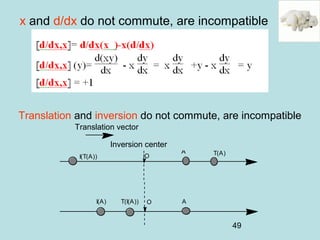
x and d/dx do not commute, are incompatible
Translation and inversion do not commute, are incompatible
A T(A)
I(T(A))
I(A) AT(I(A))
vecteur de translation
O
Centre d'inversion
O
Translation vector
Inversion center
50
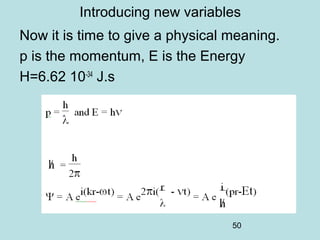
Introducing new variables
Now it is time to give a physical meaning.
p is the momentum, E is the Energy
H=6.62 10-34
J.s
51
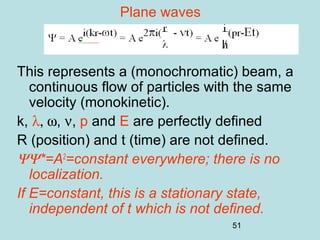
Plane waves
This represents a (monochromatic) beam, a
continuous flow of particles with the same
velocity (monokinetic).
k, λ, ω, ν, p and E are perfectly defined
R (position) and t (time) are not defined.
ΨΨ*=A2
=constant everywhere; there is no
localization.
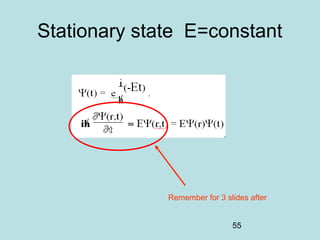
If E=constant, this is a stationary state,
independent of t which is not defined.
52
Niels Henrik David Bohr
Danish
1885-1962
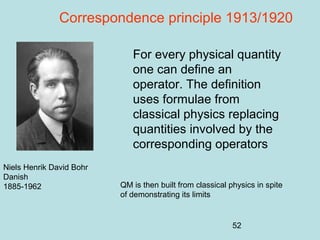
Correspondence principle 1913/1920
For every physical quantity
one can define an
operator. The definition
uses formulae from
classical physics replacing
quantities involved by the
corresponding operators
QM is then built from classical physics in spite
of demonstrating its limits
53
Operators p and H
We use the expression of the plane wave
which allows defining exactly p and E.
54
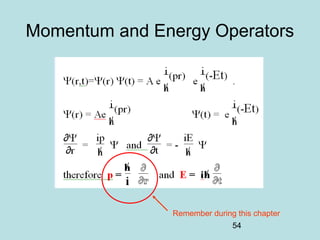
Momentum and Energy Operators
Remember during this chapter
55
Stationary state E=constant
Remember for 3 slides after
56
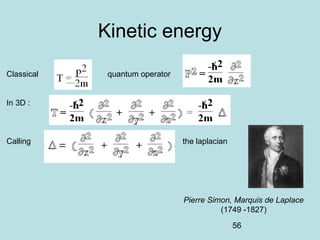
Kinetic energy
Classical quantum operator
In 3D :
Calling the laplacian
Pierre Simon, Marquis de Laplace
(1749 -1827)
57
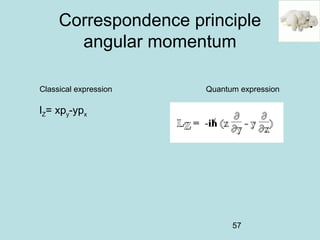
Correspondence principle
angular momentum
Classical expression Quantum expression
lZ= xpy-ypx
58
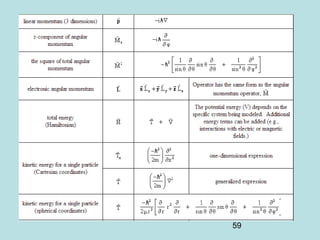
59
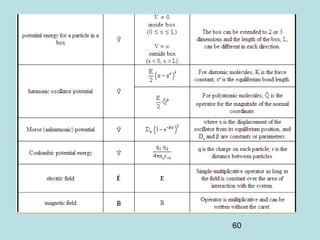
60
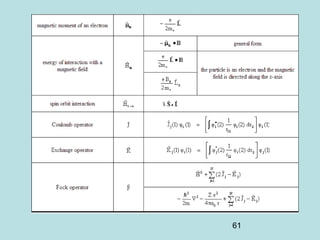
61
62
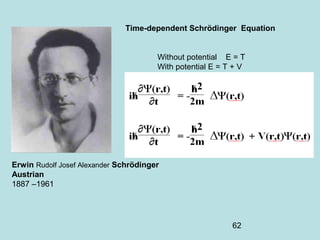
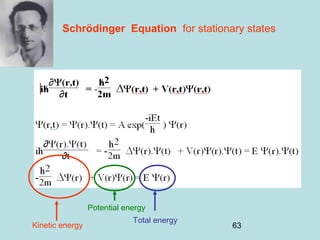
Erwin Rudolf Josef Alexander Schrödinger
Austrian
1887 –1961
Without potential E = T
With potential E = T + V
Time-dependent Schrödinger Equation
63
Schrödinger Equation for stationary states
Kinetic energy
Total energy
Potential energy
64
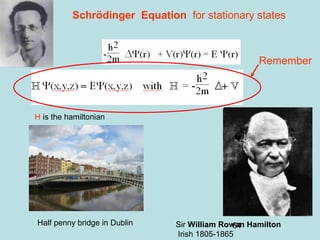
Schrödinger Equation for stationary states
H is the hamiltonian
Sir William Rowan Hamilton
Irish 1805-1865
Half penny bridge in Dublin
Remember
65
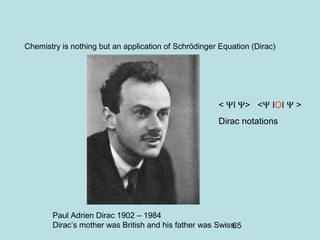
Chemistry is nothing but an application of Schrödinger Equation (Dirac)
Paul Adrien Dirac 1902 – 1984
Dirac’s mother was British and his father was Swiss.
< ΨI Ψ> <Ψ IOI Ψ >
Dirac notations
66
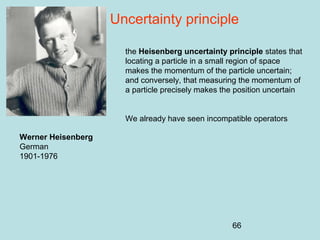
Uncertainty principle
the Heisenberg uncertainty principle states that
locating a particle in a small region of space
makes the momentum of the particle uncertain;
and conversely, that measuring the momentum of
a particle precisely makes the position uncertain
We already have seen incompatible operators
Werner Heisenberg
German
1901-1976
67
It is not surprising to find that quantum mechanics does not predict the position
of an electron exactly. Rather, it provides only a probability as to where the
electron will be found.
We shall illustrate the probability aspect in terms of the system of an electron
confined to motion along a line of length L. Quantum mechanical probabilities
are expressed in terms of a distribution function.
For a plane wave, p is defined and the position is not.
With a superposition of plane waves, we introduce an uncertainty on p and we
localize. Since, the sum of 2 wavefucntions is neither an eigenfunction for p nor
x, we have average values.
With a Gaussian function, the localization below is 1/2π
68
p and x do not commute and are incompatible
For a plane wave, p is known and x is not (Ψ*Ψ=A2
everywhere)
Let’s superpose two waves…
this introduces a delocalization for p and may be localize x
At the origin x=0 and at t=0 we want to increase the total amplitude,
so the two waves Ψ1 and Ψ2 are taken in phase
At ± ∆x/2 we want to impose them out of phase
The position is therefore known for x ± ∆x/2
the waves will have wavelengths
69
Superposition of two waves
0 1 2 3 4 5
-2
-1
0
1
2
a (radians)
Ψ
4.95
enveloppe
∆x/2
∆x/(2x(√2π))
Factor 1/2π a more realistic localization
70
Uncertainty principle
Werner Heisenberg
German
1901-1976
A more accurate calculation localizes more
(1/2π the width of a gaussian) therefore one gets
x and p or E and t play symmetric roles
in the plane wave expression;
Therefore, there are two main uncertainty principles

Introduction2 qm

  • 1.
    1 Introduction to Quantum Mechanic A)Radiation B) Light is made of particles. The need for a quantification 1) Black-body radiation (1860-1901) 2) Atomic Spectroscopy (1888-) 3) Photoelectric Effect (1887-1905) C) Wave–particle duality 1) Compton Effect (1923). 2) Electron Diffraction Davisson and Germer (1925). 3) Young's Double Slit Experiment D) Louis de Broglie relation for a photon from relativity E) A new mathematical tool: Wavefunctions and operators F) Measurable physical quantities and associated operators - Correspondence principle G) The Schrödinger Equation (1926) H) The Uncertainty principle
  • 2.
    2 When you findthis image, you may skip this part This is less important
  • 3.
    3 The idea ofduality is rooted in a debate over the nature of light and matter dating back to the 1600s, when competing theories of light were proposed by Huygens and Newton. Christiaan Huygens Dutch 1629-1695 light consists of waves Sir Isaac Newton 1643 1727 light consists of particles
  • 4.
  • 5.
  • 6.
  • 7.
    7 Introducing new variables •At the moment, let consider this just a formal change, introducing and we obtain
  • 8.
    8 Introducing new variables Atthe moment, h is a simple constant Later on, h will have a dimension and the p and E will be physical quantities Then
  • 9.
  • 10.
    10 If h isthe Planck constant J.s Then Louis de BROGLIE French (1892-1987) Max Planck (1901) Göttingen
  • 11.
    11 - Robert Millikan(1910) showed that it was quantified. -Rutherford (1911) showed that the negative part was diffuse while the positive part was concentrated. Soon after the electron discovery in 1887 - J. J. Thomson (1887) Some negative part could be extracted from the atoms
  • 12.
    12 Gustav Kirchhoff (1860).The light emitted by a black body is called black-body radiation black-body radiation At room temperature, black bodies emit IR light, but as the temperature increases past a few hundred degrees Celsius, black bodies start to emit at visible wavelengths, from red, through orange, yellow, and white before ending up at blue, beyond which the emission includes increasing amounts of UV RED WHITE Small ν Large ν Shift of ν
  • 13.
    13 black-body radiationClassical Theory Fragmentationof the surface. One large area (Small λ Large ν) smaller pieces (Large λ Small ν) Vibrations associated to the size, N2 or N3
  • 14.
    14 Kirchhoff black-body radiation RED WHITE Smallν Large ν Shift of ν Radiation is emitted when a solid after receiving energy goes back to the most stable state (ground state). The energy associated with the radiation is the difference in energy between these 2 states. When T increases, the average E*Mean is higher and intensity increases. E*Mean- E = kT. k is Boltzmann constant (k= 1.38 10-23 Joules K-1 ).
  • 15.
    15 black-body radiation Max Planck(1901) Göttingen Why a decrease for small λ ? Quantification Numbering rungs of ladder introduces quantum numbers (here equally spaced)
  • 16.
    16 Quantum numbers In mathematics,a natural number (also called counting number) has two main purposes: they can be used for counting ("there are 6 apples on the table"), and they can be used for ordering ("this is the 3rd largest city in the country").
  • 17.
    17 black-body radiation Max Planck(1901) Göttingen Why a decrease for small λ ? Quantification
  • 18.
    18 black-body radiation, quantification Max Planck Steps toohard to climb Easy slope, ramp Pyramid nowadays Pyramid under construction
  • 19.
  • 20.
    20 Johannes Rydberg 1888 Swedish n1 →n2 name Converges to (nm) 1 → ∞ Lyman 91 2 → ∞ Balmer 365 3 → ∞ Pashen 821 4 → ∞ Brackett 1459 5 → ∞ Pfund 2280 6 → ∞ Humphreys 3283 Atomic Spectroscopy Absorption or Emission
  • 21.
    21 Johannes Rydberg 1888 Swedish IR VISIBLE UV AtomicSpectroscopy Absorption or Emission Emission -R/12 -R/22 -R/32 -R/42 -R/52 -R/62 -R/72 Quantum numbers n, levels are not equally spaced R = 13.6 eV
  • 22.
    22 Photoelectric Effect (1887-1905) discoveredby Hertz in 1887 and explained in 1905 by Einstein. Vide I i e e e Vacuum Heinrich HERTZ (1857-1894) Albert EINSTEIN (1879-1955)
  • 23.
    23 I ν0 ν0 ν ν T (énergiecinétique)Kinetic energy
  • 24.
    24 Compton effect 1923 playingbilliards assuming λ=h/p p h/ λ' h/ λ p 2 /2m hν' hν α θ Arthur Holly Compton American 1892-1962
  • 25.
    25 Davisson and Germer1925 Clinton Davisson Lester Germer In 1927 d θ 2d sin θ = k λ Diffraction is similarly observed using a mono- energetic electron beam Bragg law is verified assuming λ=h/p
  • 26.
    26 Wave-particle Equivalence. •Compton Effect(1923). •Electron Diffraction Davisson and Germer (1925) •Young's Double Slit Experiment In physics and chemistry, wave–particle duality is the concept that all matter and energy exhibits both wave-like and particle-like properties. A central concept of quantum mechanics, duality, addresses the inadequacy of classical concepts like "particle" and "wave" in fully describing the behavior of small-scale objects. Various interpretations of quantum mechanics attempt to explain this apparent paradox. Wave–particle duality
  • 27.
    27 Thomas Young 1773– 1829 English, was born into a family of Quakers. At age 2, he could read. At 7, he learned Latin, Greek and maths. At 12, he spoke Hebrew, Persian and could handle optical instruments. At 14, he spoke Arabic, French, Italian and Spanish, and soon the Chaldean Syriac. "… He is a PhD to 20 years "gentleman, accomplished flute player and minstrel (troubadour). He is reported dancing above a rope." He worked for an insurance company, continuing research into the structure of the retina, astigmatism ... He is the rival Champollion to decipher hieroglyphics. He is the first to read the names of Ptolemy and Cleopatra which led him to propose a first alphabet of hieroglyphic scriptures (12 characters).
  • 28.
    28 Young's Double SlitExperiment Ecran Plaque photo F2 F1 Source ScreenMask with 2 slits
  • 29.
    29 Young's Double SlitExperiment This is a typical experiment showing the wave nature of light and interferences. What happens when we decrease the light intensity ? If radiation = particles, individual photons reach one spot and there will be no interferences If radiation ≠ particles there will be no spots on the screen The result is ambiguous There are spots The superposition of all the impacts make interferences
  • 30.
    30 Young's Double SlitExperiment Assuming a single electron each time What means interference with itself ? What is its trajectory? If it goes through F1, it should ignore the presence of F2 Ecran Plaque photo F2 F1 Source ScreenMask with 2 slits
  • 31.
    31 Young's Double SlitExperiment There is no possibility of knowing through which split the photon went! If we measure the crossing through F1, we have to place a screen behind. Then it does not go to the final screen. We know that it goes through F1 but we do not know where it would go after. These two questions are not compatible Ecran Plaque photo F2 F1 Source ScreenMask with 2 slits Two important differences with classical physics: • measurement is not independent from observer • trajectories are not defined; hν goes through F1 and F2 both! or through them with equal probabilities!
  • 32.
    32 Macroscopic world: A basketof cherries Many of them (identical) We can see them and taste others Taking one has negligible effect Cherries are both red and good Microscopic world: A single cherry Either we look at it without eating It is red Or we eat it, it is good You can not try both at the same time The cherry could not be good and red at the same time
  • 33.
    33 Slot machine “one-armbandit” After introducing a coin, you have 0 coin or X coins. A measure of the profit has been made: profit = X
  • 34.
    34 de Broglie relationfrom relativity Popular expressions of relativity: m0 is the mass at rest, m in motion E like to express E(m) as E(p) with p=mv Ei + T + Erelativistic + ….
  • 35.
    35 de Broglie relationfrom relativity Application to a photon (m0=0) To remember To remember
  • 36.
    36 Max Planck Useful toremember to relate energy and wavelength
  • 37.
    37 A New mathematicaltool: Wave functions and Operators Each particle may be described by a wave function Ψ(x,y,z,t), real or complex, having a single value when position (x,y,z) and time (t) are defined. If it is not time-dependent, it is called stationary. The expression Ψ=Aei(pr-Et) does not represent one molecule but a flow of particles: a plane wave
  • 38.
    38 Wave functions describingone particle To represent a single particle Ψ(x,y,z) that does not evolve in time, Ψ(x,y,z) must be finite (0 at ∞). In QM, a particle is not localized but has a probability to be in a given volume: dP= Ψ* Ψ dV is the probability of finding the particle in the volume dV. Around one point in space, the density of probability is dP/dV= Ψ* Ψ Ψ has the dimension of L-1/3 Integration in the whole space should give one Ψ is said to be normalized.
  • 39.
    39 Operators associated tophysical quantities We cannot use functions (otherwise we would end with classical mechanics) Any physical quantity is associated with an operator. An operator O is “the recipe to transform Ψ into Ψ’ ” We write: O Ψ = Ψ’ If O Ψ = oΨ (o is a number, meaning that O does not modify Ψ, just a scaling factor), we say that Ψ is an eigenfunction of O and o is the eigenvalue. We have solved the wave equation O Ψ = oΨ by finding simultaneously Ψ and o that satisfy the equation. o is the measure of O for the particle in the state described by Ψ.
  • 40.
    40 Slot machine (one-armbandit) Introducing a coin, you have 0 coin or X coins. A measure of the profit has been made: profit = X O is a Vending machine (cans) Introducing a coin, you get one can. No measure of the gain is made unless you sell the can (return to coins)
  • 41.
    41 Examples of operatorsin mathematics : P parity Even function : no change after x → -x Odd function : f changes sign after x → -x y=x2 is even y=x3 is odd y= x2 + x3 has no parity: P(x2 + x3 ) = x2 - x3 Pf(x) = f(-x)
  • 42.
    42 Examples of operatorsin mathematics : A y is an eigenvector; the eigenvalue is -1
  • 43.
    43 Linearity The operators arelinear: O (aΨ1+ bΨ1) = O (aΨ1 )+ O( bΨ1)
  • 44.
    44 Normalization An eigenfunction remainsan eigenfunction when multiplied by a constant O(λΨ)= o(λΨ) thus it is always possible to normalize a finite function Dirac notations <ΨIΨ>
  • 45.
    45 Mean value • IfΨ1 and Ψ2 are associated with the same eigenvalue o: O(aΨ1 +bΨ2)=o(aΨ1 +bΨ2) • If not O(aΨ1 +bΨ2)=o1(aΨ1 )+o2(bΨ2) we define ō = (a2 o1+b2 o2)/(a2 +b2 ) Dirac notations
  • 46.
    46 Sum, product andcommutation of operators(A+B)Ψ=AΨ+BΨ ( AB)Ψ=A(BΨ) y1=e4x y2=x2 y3=1/x d/dx 4 -- -- x3 3 3 3 x d/dx -- 2 -1 operators wavefunctions eigenvalues
  • 47.
    47 Sum, product andcommutation of operators y1=e4x y2=x2 y3=1/x A = d/dx 4 -- -- B = x3 3 3 3 C= x d/dx -- 2 -1 not compatible operators [A,C]=AC-CA≠0 [A,B]=AB-BA=0 [B,C]=BC-CB=0
  • 48.
    48 Compatibility, incompatibility ofoperators y1=e4x y2=x2 y3=1/x A = d/dx 4 -- -- B = x3 3 3 3 C= x d/dx -- 2 -1 not compatible operators [A,C]=AC-CA≠0 [A,B]=AB-BA=0 [B,C]=BC-CB=0 When operators commute, the physical quantities may be simultaneously defined (compatibility) When operators do not commute, the physical quantities can not be simultaneously defined (incompatibility) compatible operators
  • 49.
    49 x and d/dxdo not commute, are incompatible Translation and inversion do not commute, are incompatible A T(A) I(T(A)) I(A) AT(I(A)) vecteur de translation O Centre d'inversion O Translation vector Inversion center
  • 50.
    50 Introducing new variables Nowit is time to give a physical meaning. p is the momentum, E is the Energy H=6.62 10-34 J.s
  • 51.
    51 Plane waves This representsa (monochromatic) beam, a continuous flow of particles with the same velocity (monokinetic). k, λ, ω, ν, p and E are perfectly defined R (position) and t (time) are not defined. ΨΨ*=A2 =constant everywhere; there is no localization. If E=constant, this is a stationary state, independent of t which is not defined.
  • 52.
    52 Niels Henrik DavidBohr Danish 1885-1962 Correspondence principle 1913/1920 For every physical quantity one can define an operator. The definition uses formulae from classical physics replacing quantities involved by the corresponding operators QM is then built from classical physics in spite of demonstrating its limits
  • 53.
    53 Operators p andH We use the expression of the plane wave which allows defining exactly p and E.
  • 54.
    54 Momentum and EnergyOperators Remember during this chapter
  • 55.
  • 56.
    56 Kinetic energy Classical quantumoperator In 3D : Calling the laplacian Pierre Simon, Marquis de Laplace (1749 -1827)
  • 57.
    57 Correspondence principle angular momentum Classicalexpression Quantum expression lZ= xpy-ypx
  • 58.
  • 59.
  • 60.
  • 61.
  • 62.
    62 Erwin Rudolf JosefAlexander Schrödinger Austrian 1887 –1961 Without potential E = T With potential E = T + V Time-dependent Schrödinger Equation
  • 63.
    63 Schrödinger Equation forstationary states Kinetic energy Total energy Potential energy
  • 64.
    64 Schrödinger Equation forstationary states H is the hamiltonian Sir William Rowan Hamilton Irish 1805-1865 Half penny bridge in Dublin Remember
  • 65.
    65 Chemistry is nothingbut an application of Schrödinger Equation (Dirac) Paul Adrien Dirac 1902 – 1984 Dirac’s mother was British and his father was Swiss. < ΨI Ψ> <Ψ IOI Ψ > Dirac notations
  • 66.
    66 Uncertainty principle the Heisenberguncertainty principle states that locating a particle in a small region of space makes the momentum of the particle uncertain; and conversely, that measuring the momentum of a particle precisely makes the position uncertain We already have seen incompatible operators Werner Heisenberg German 1901-1976
  • 67.
    67 It is notsurprising to find that quantum mechanics does not predict the position of an electron exactly. Rather, it provides only a probability as to where the electron will be found. We shall illustrate the probability aspect in terms of the system of an electron confined to motion along a line of length L. Quantum mechanical probabilities are expressed in terms of a distribution function. For a plane wave, p is defined and the position is not. With a superposition of plane waves, we introduce an uncertainty on p and we localize. Since, the sum of 2 wavefucntions is neither an eigenfunction for p nor x, we have average values. With a Gaussian function, the localization below is 1/2π
  • 68.
    68 p and xdo not commute and are incompatible For a plane wave, p is known and x is not (Ψ*Ψ=A2 everywhere) Let’s superpose two waves… this introduces a delocalization for p and may be localize x At the origin x=0 and at t=0 we want to increase the total amplitude, so the two waves Ψ1 and Ψ2 are taken in phase At ± ∆x/2 we want to impose them out of phase The position is therefore known for x ± ∆x/2 the waves will have wavelengths
  • 69.
    69 Superposition of twowaves 0 1 2 3 4 5 -2 -1 0 1 2 a (radians) Ψ 4.95 enveloppe ∆x/2 ∆x/(2x(√2π)) Factor 1/2π a more realistic localization
  • 70.
    70 Uncertainty principle Werner Heisenberg German 1901-1976 Amore accurate calculation localizes more (1/2π the width of a gaussian) therefore one gets x and p or E and t play symmetric roles in the plane wave expression; Therefore, there are two main uncertainty principles