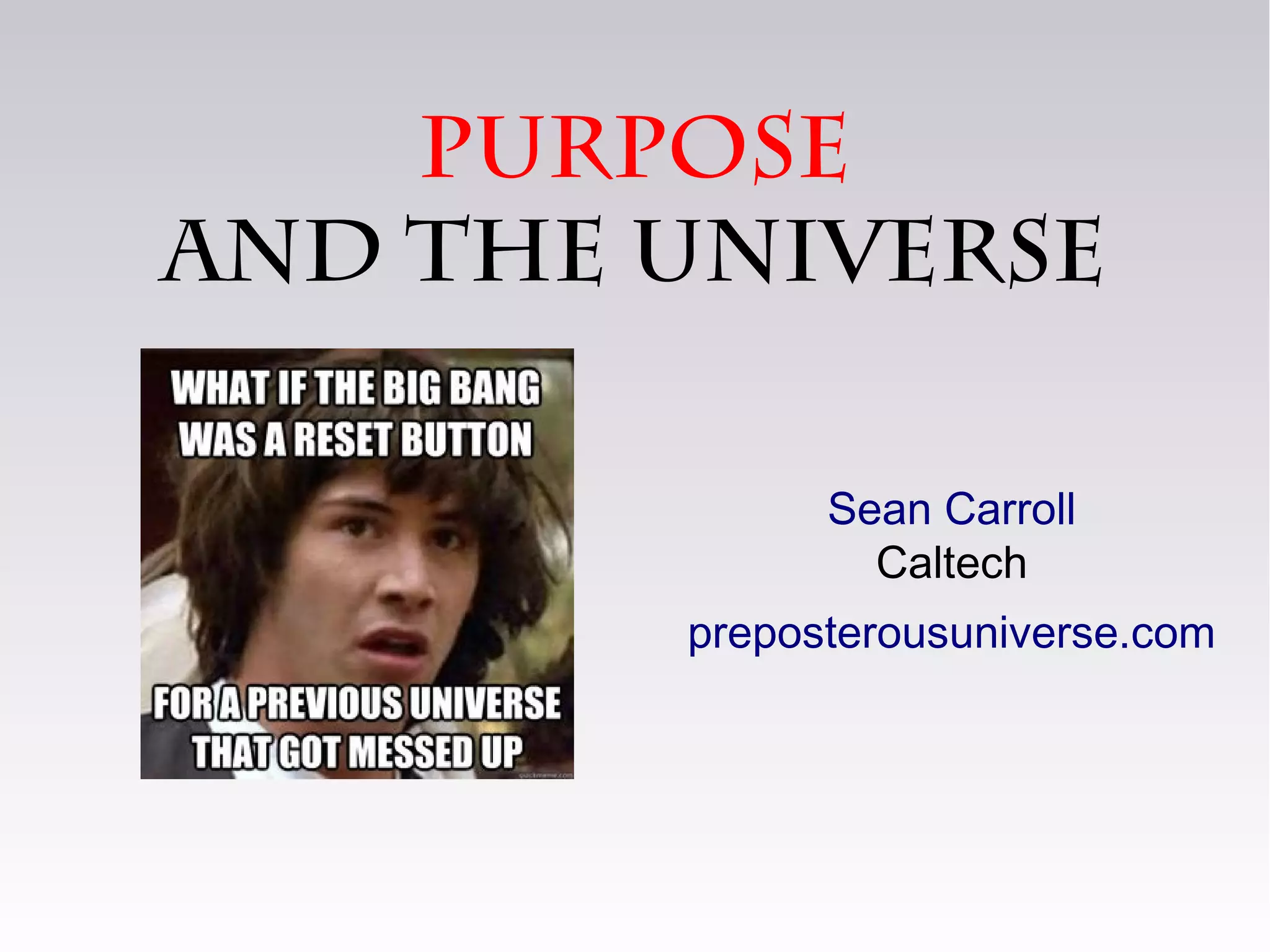
purpose
and the universe
Sean Carroll
Caltech
preposterousuniverse.com
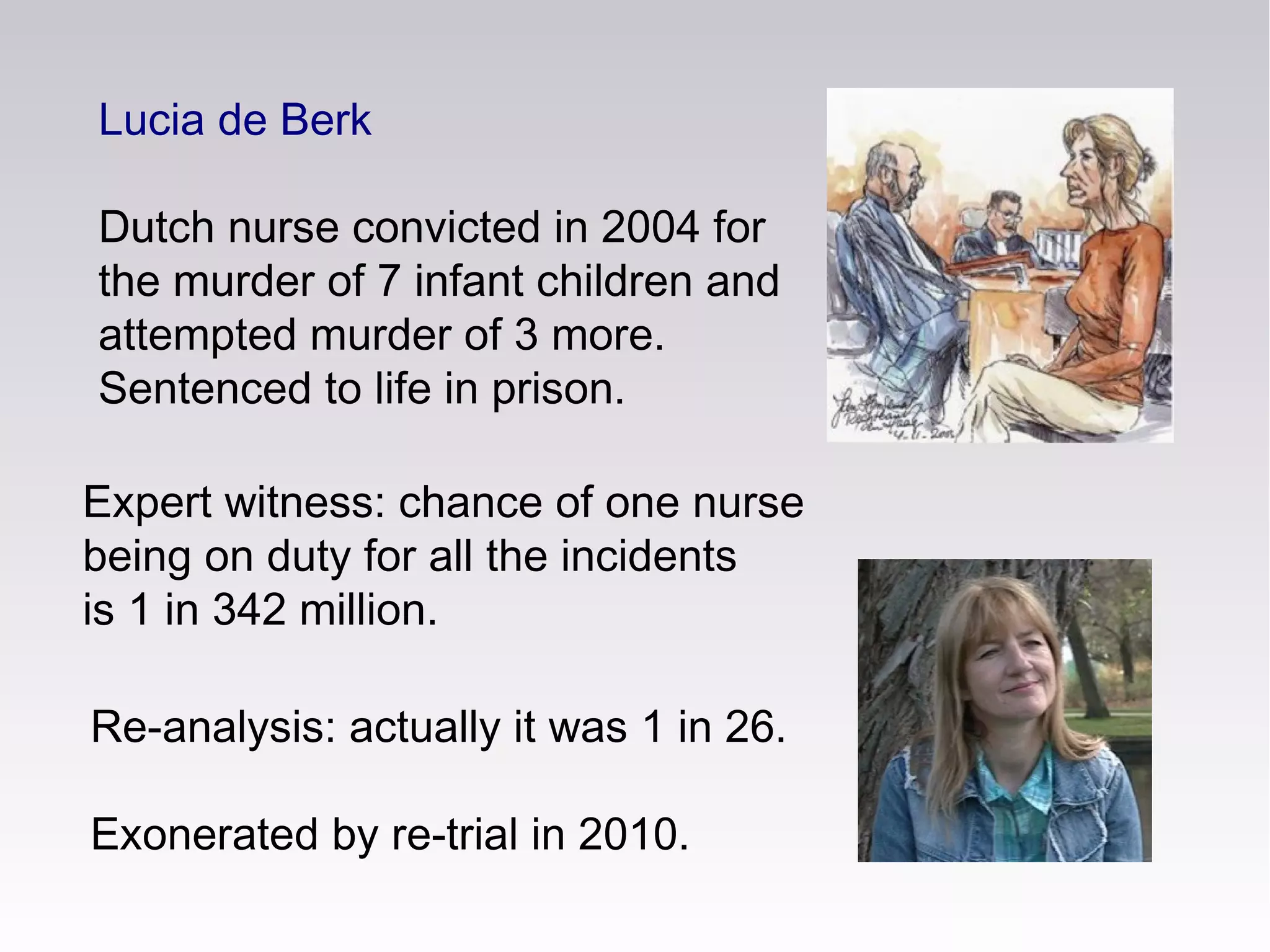
Lucia de Berk
Dutch nurse convicted in 2004 for
the murder of 7 infant children and
attempted murder of 3 more.
Sentenced to life in prison.
Expert witness: chance of one nurse
being on duty for all the incidents
is 1 in 342 million.
Re-analysis: actually it was 1 in 26.
Exonerated by re-trial in 2010.
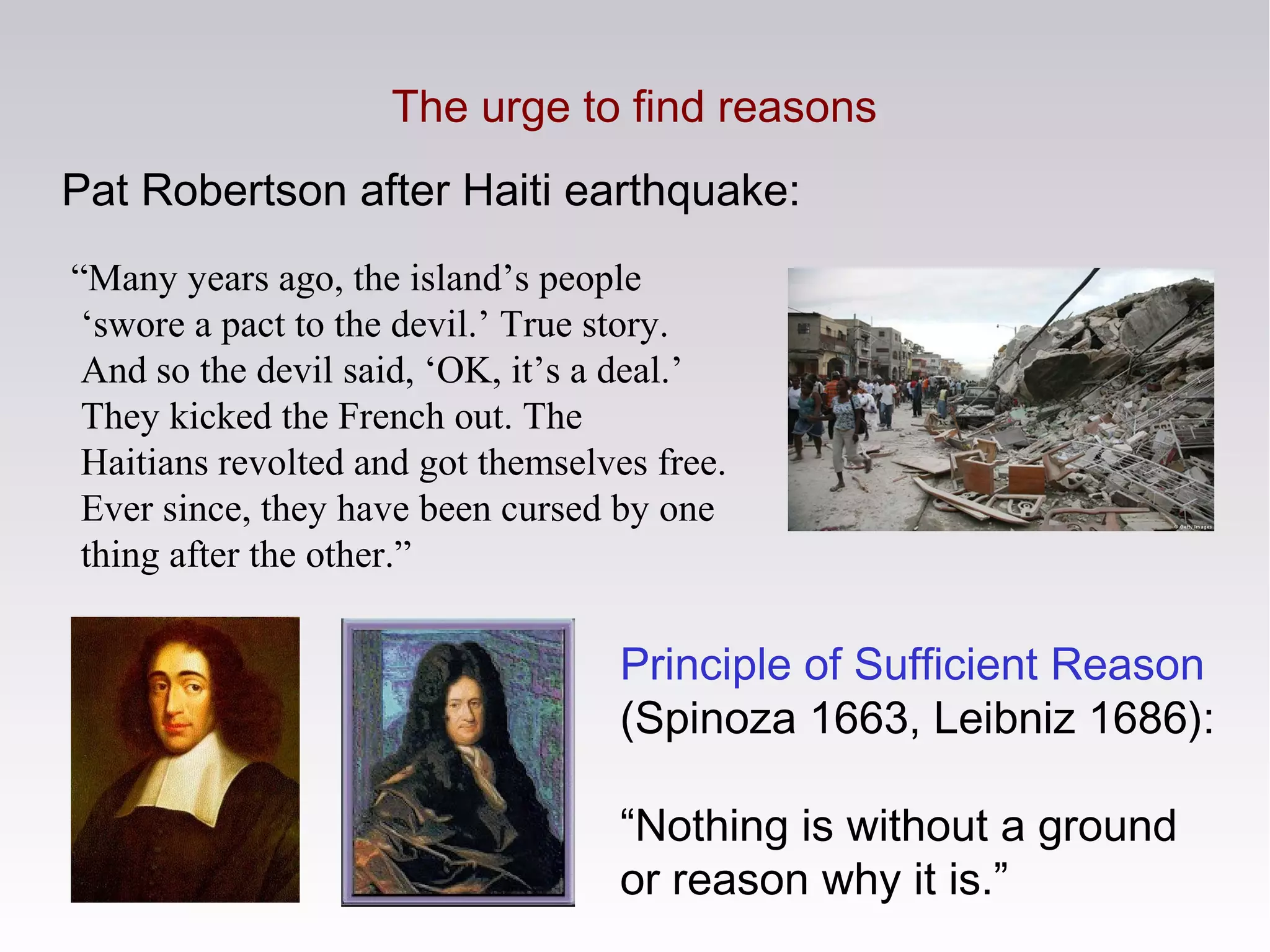
Pat Robertson after Haiti earthquake:
“Many years ago, the island’s people
‘swore a pact to the devil.’ True story.
And so the devil said, ‘OK, it’s a deal.’
They kicked the French out. The
Haitians revolted and got themselves free.
Ever since, they have been cursed by one
thing after the other.”
The urge to find reasons
Principle of Sufficient Reason
(Spinoza 1663, Leibniz 1686):
“Nothing is without a ground
or reason why it is.”
The Ethos of Science
We do not get to place demands on the universe.
We cannot discover how things work by pure thought.
What we want to be true doesn’t matter.
We gain understanding by considering every
possible way things could be, testing them against
observation and experiment, and deciding what
best accounts for the data.
Purpose from a Designer (God)
Why did God make us? God made us to show
forth His goodness and to share with us His
everlasting happiness in heaven.
- The Baltimore Catechism
It’s not about you… You were born by
[God’s] purpose and for his purpose.
- Rick Warren, The Purpose Driven Life
That which has come into existence must
necessarily, as we say, have come into
existence by reason of some Cause.
- Plato, Timaeus
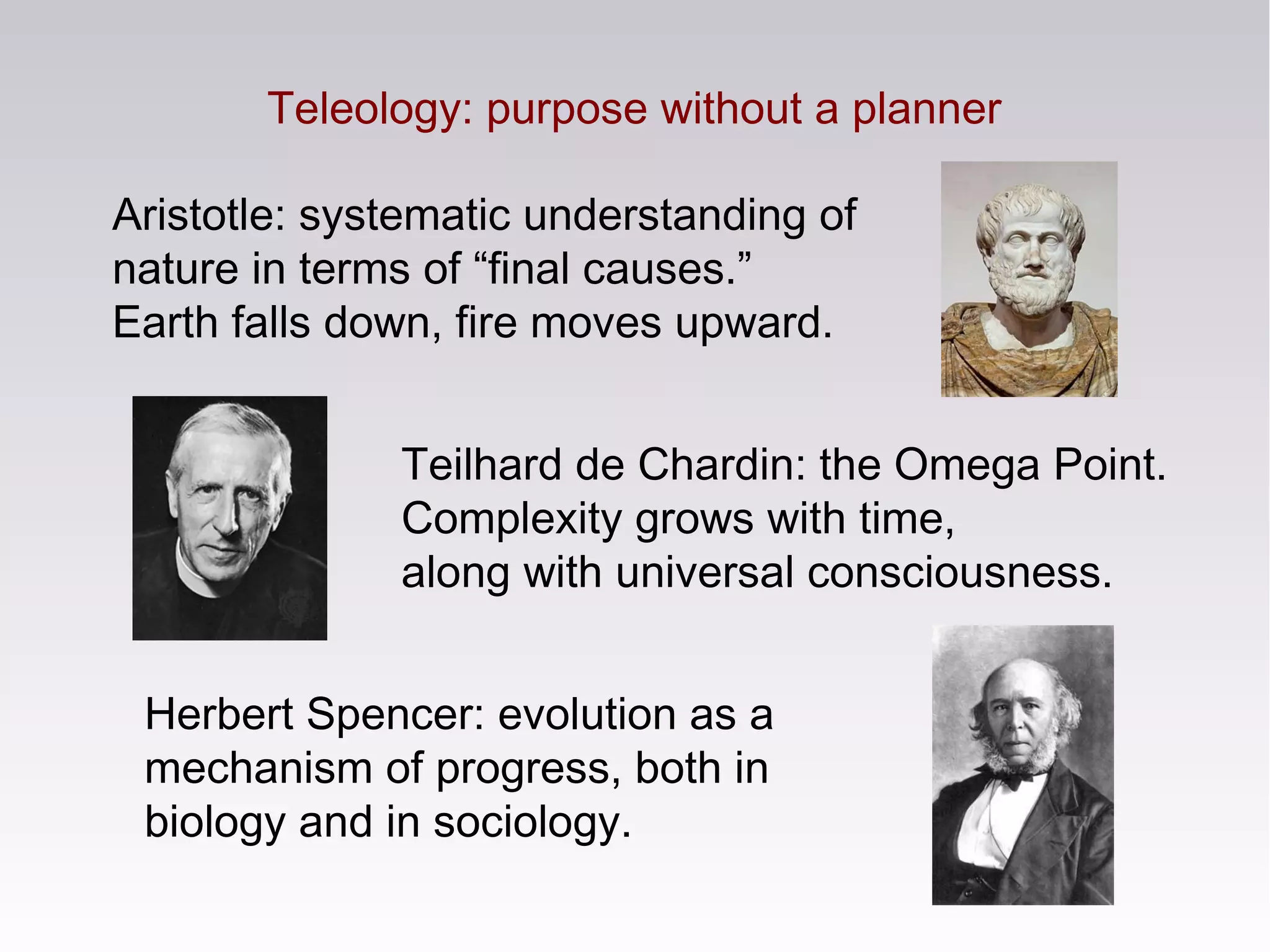
Aristotle: systematic understanding of
nature in terms of “final causes.”
Earth falls down, fire moves upward.
Teilhard de Chardin: the Omega Point.
Complexity grows with time,
along with universal consciousness.
Teleology: purpose without a planner
Herbert Spencer: evolution as a
mechanism of progress, both in
biology and in sociology.
Ancient anti-teleological approaches (atomism)
Democritus, however, neglecting the final cause,
reduces to necessity all the operations of nature.
Now they are necessary, it is true, but yet they
are for a final cause and for the sake of what is
best in each case.
- Aristotle, Generation of Animals
[Atoms] shuffled and jumbled in many
ways, and in the course of endless time they
are buffeted, driven along, chancing upon
all motions and combinations.
At last they fall into such an arrangement
as would create this universe…
- Lucretius, De Rerum Natura
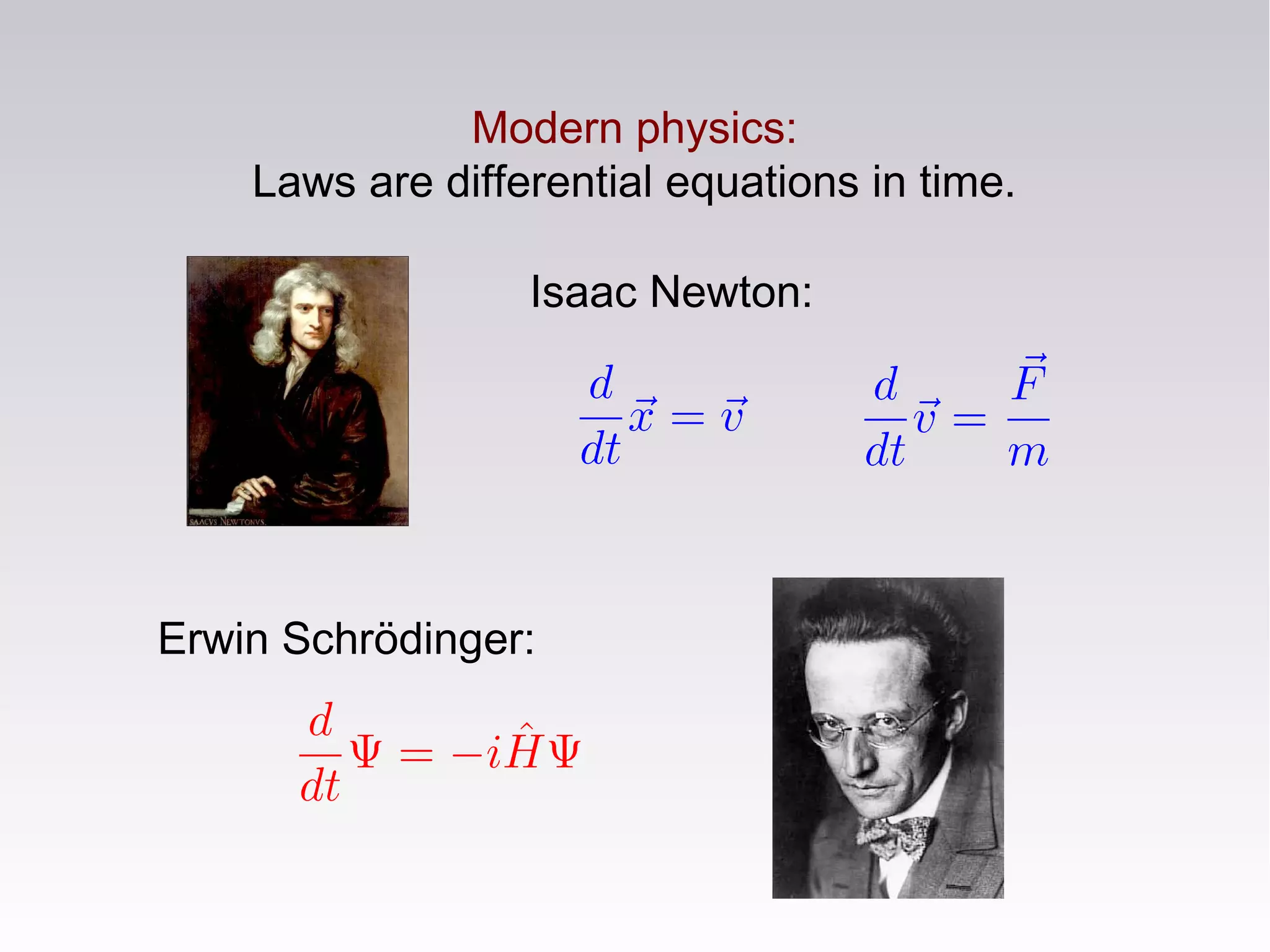
Modern physics:
Laws are differential equations in time.
Isaac Newton:
Erwin Schrödinger:
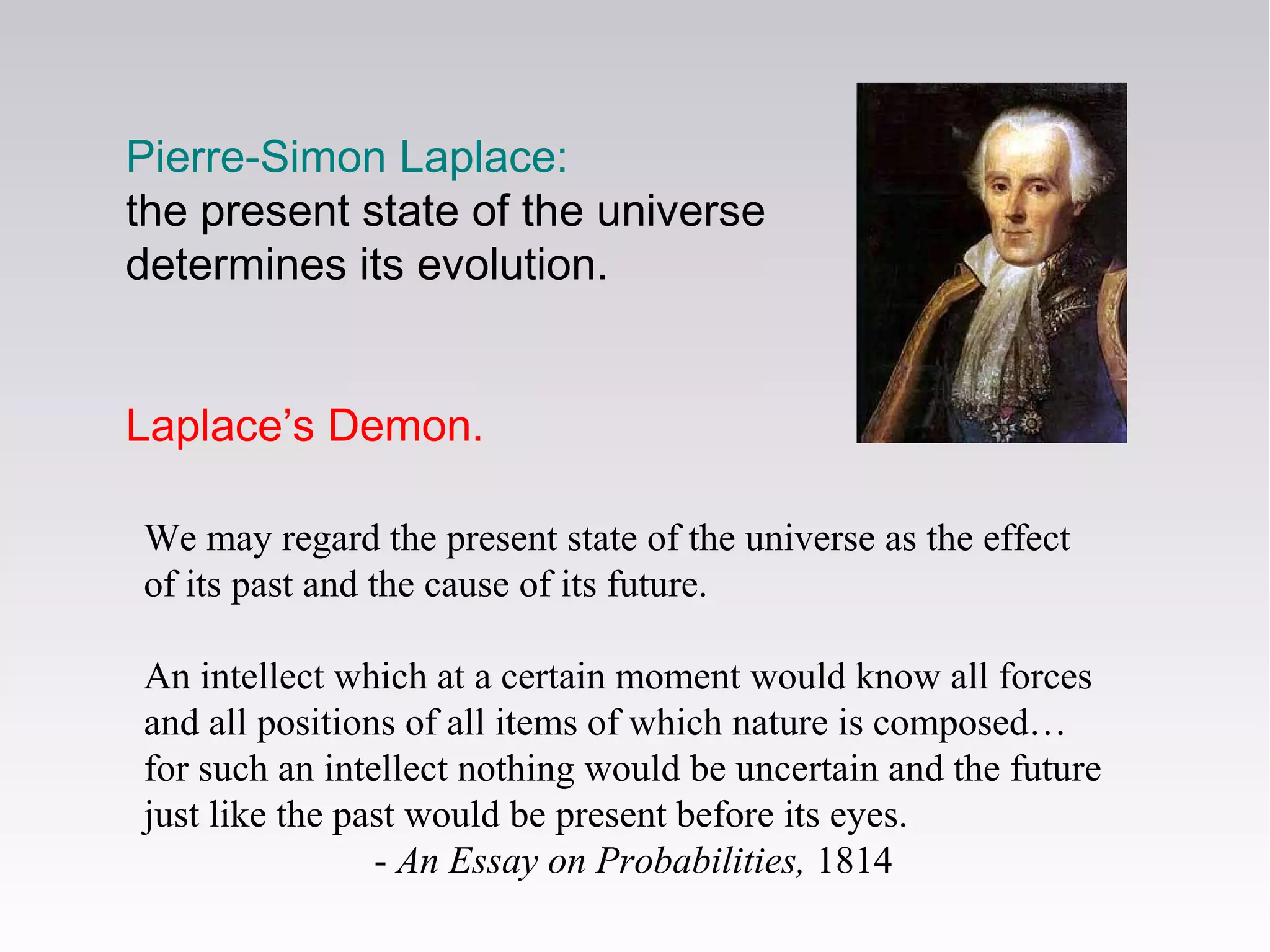
We may regard the present state of the universe as the effect
of its past and the cause of its future.
An intellect which at a certain moment would know all forces
and all positions of all items of which nature is composed…
for such an intellect nothing would be uncertain and the future
just like the past would be present before its eyes.
- An Essay on Probabilities, 1814
Pierre-Simon Laplace:
the present state of the universe
determines its evolution.
Laplace’s Demon.
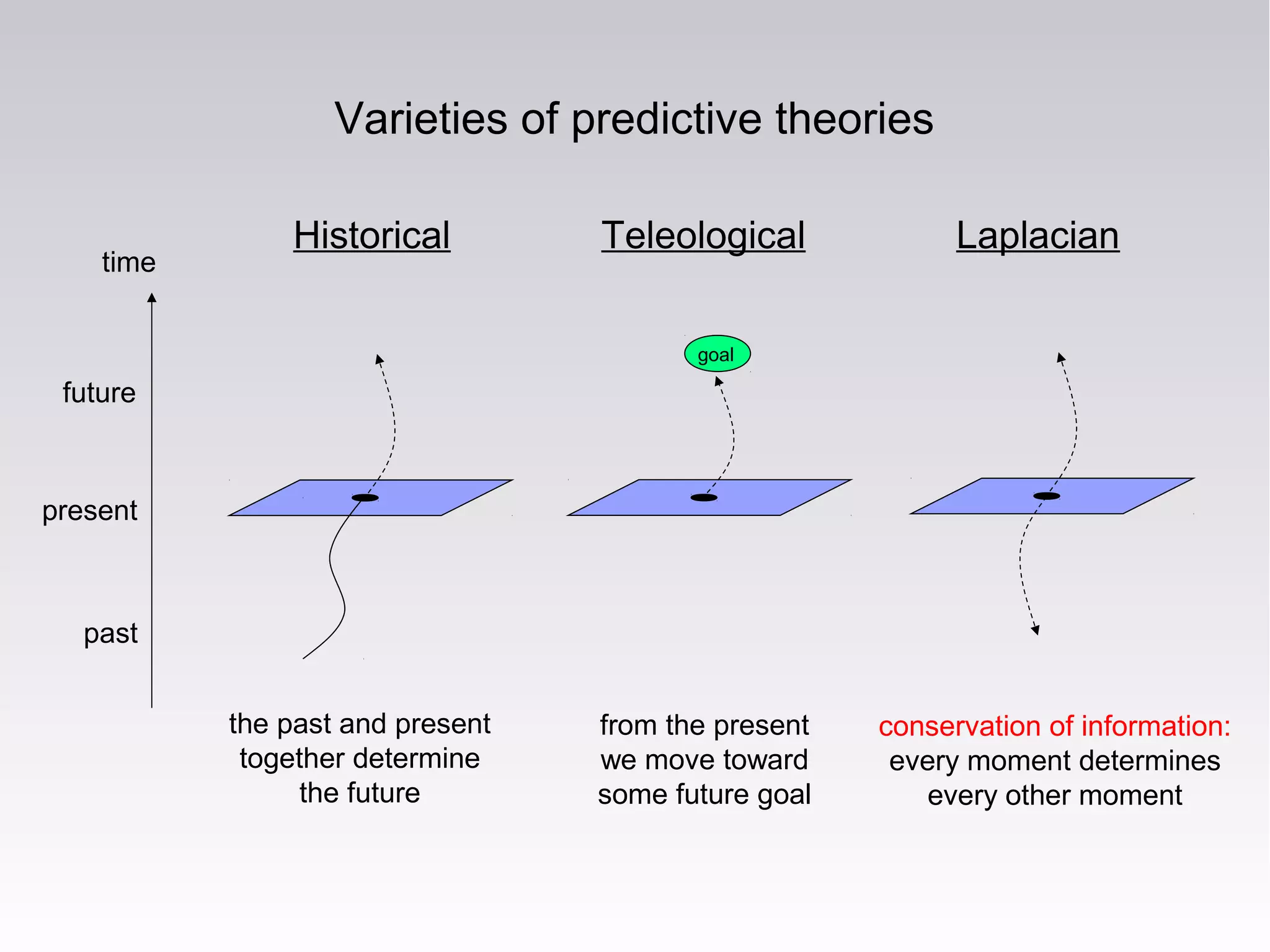
Varieties of predictive theories
Historical Teleological Laplacian
time
future
present
past
goal
the past and present
together determine
the future
from the present
we move toward
some future goal
conservation of information:
every moment determines
every other moment
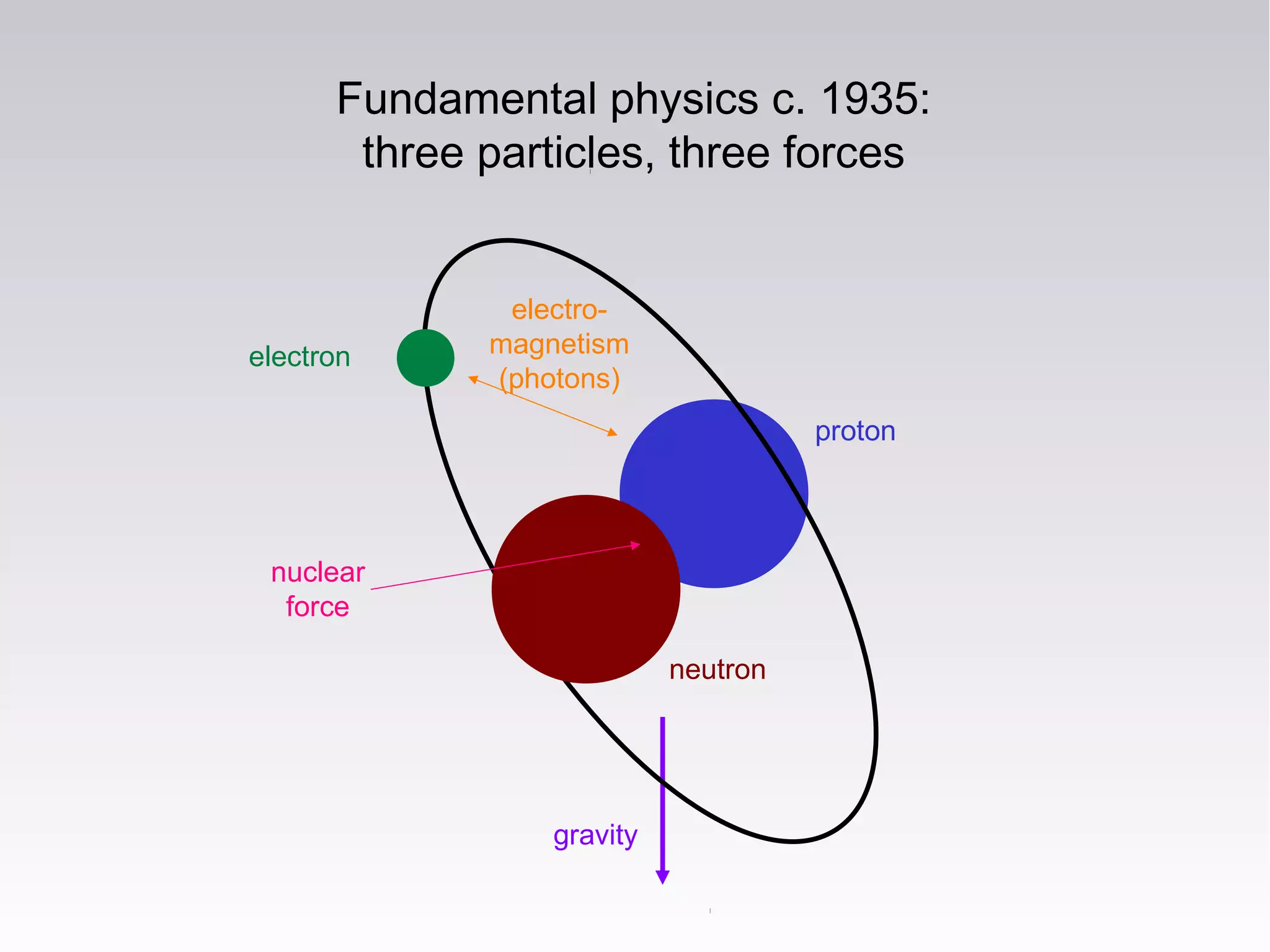
electron
proton
gravity
electro-
magnetism
(photons)
nuclear
force
Fundamental physics c. 1935:
three particles, three forces
neutron
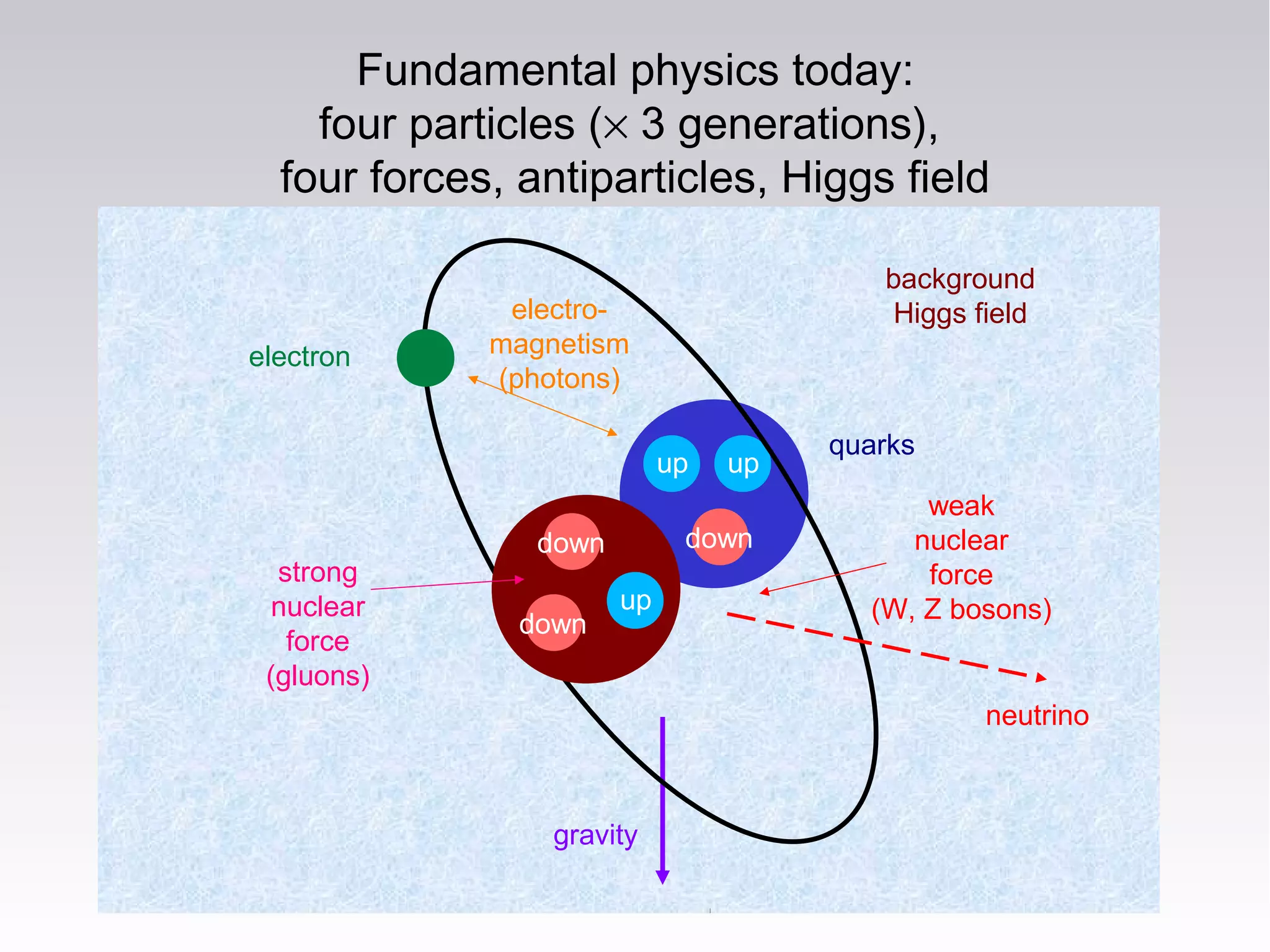
electron
quarks
gravity
electro-
magnetism
(photons)
strong
nuclear
force
(gluons)
down
upup
up
down
down
weak
nuclear
force
(W, Z bosons)
neutrino
Fundamental physics today:
four particles (× 3 generations),
four forces, antiparticles, Higgs field
background
Higgs field
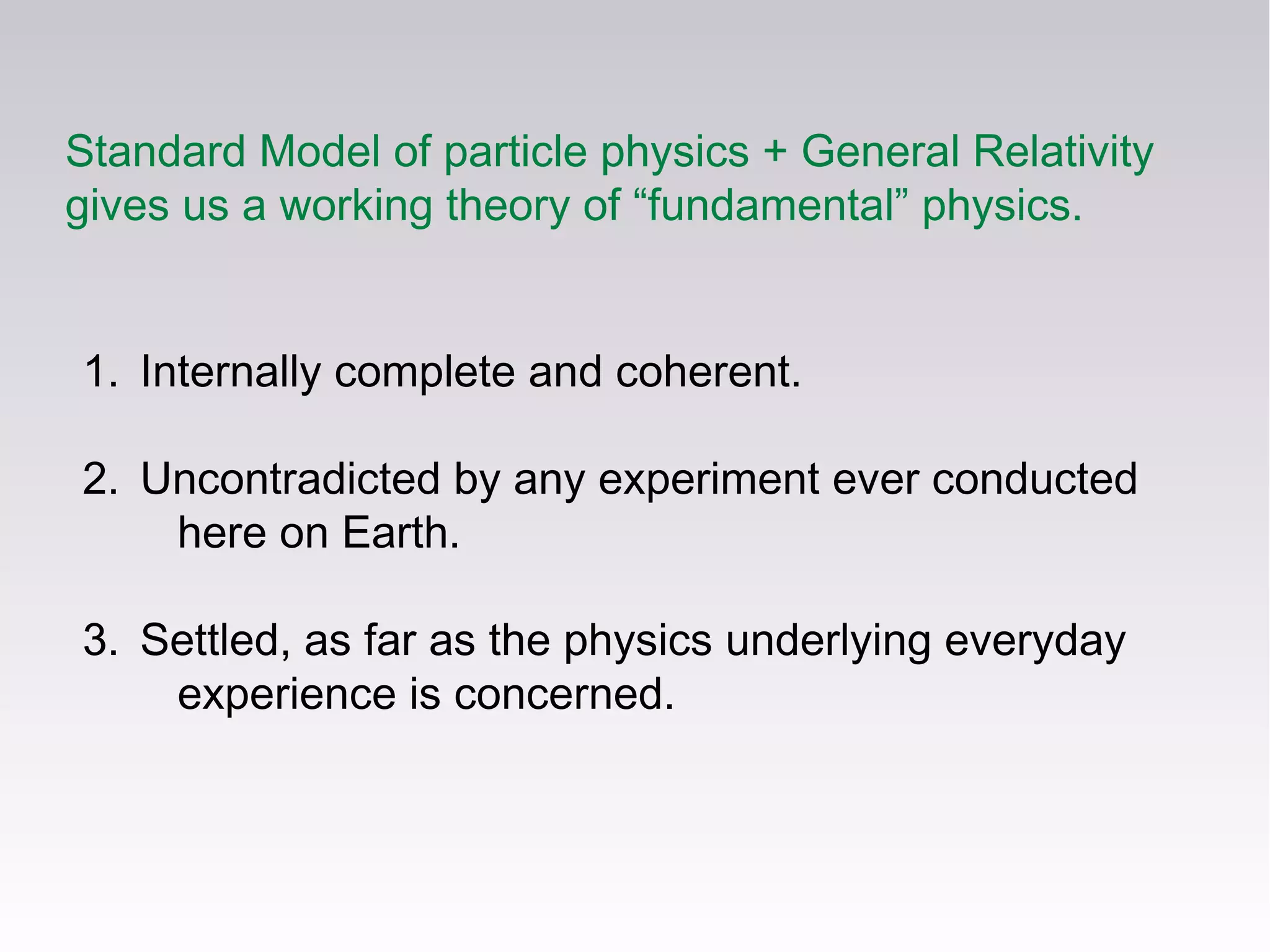
Standard Model of particle physics + General Relativity
gives us a working theory of “fundamental” physics.
1. Internally complete and coherent.
2. Uncontradicted by any experiment ever conducted
here on Earth.
3. Settled, as far as the physics underlying everyday
experience is concerned.
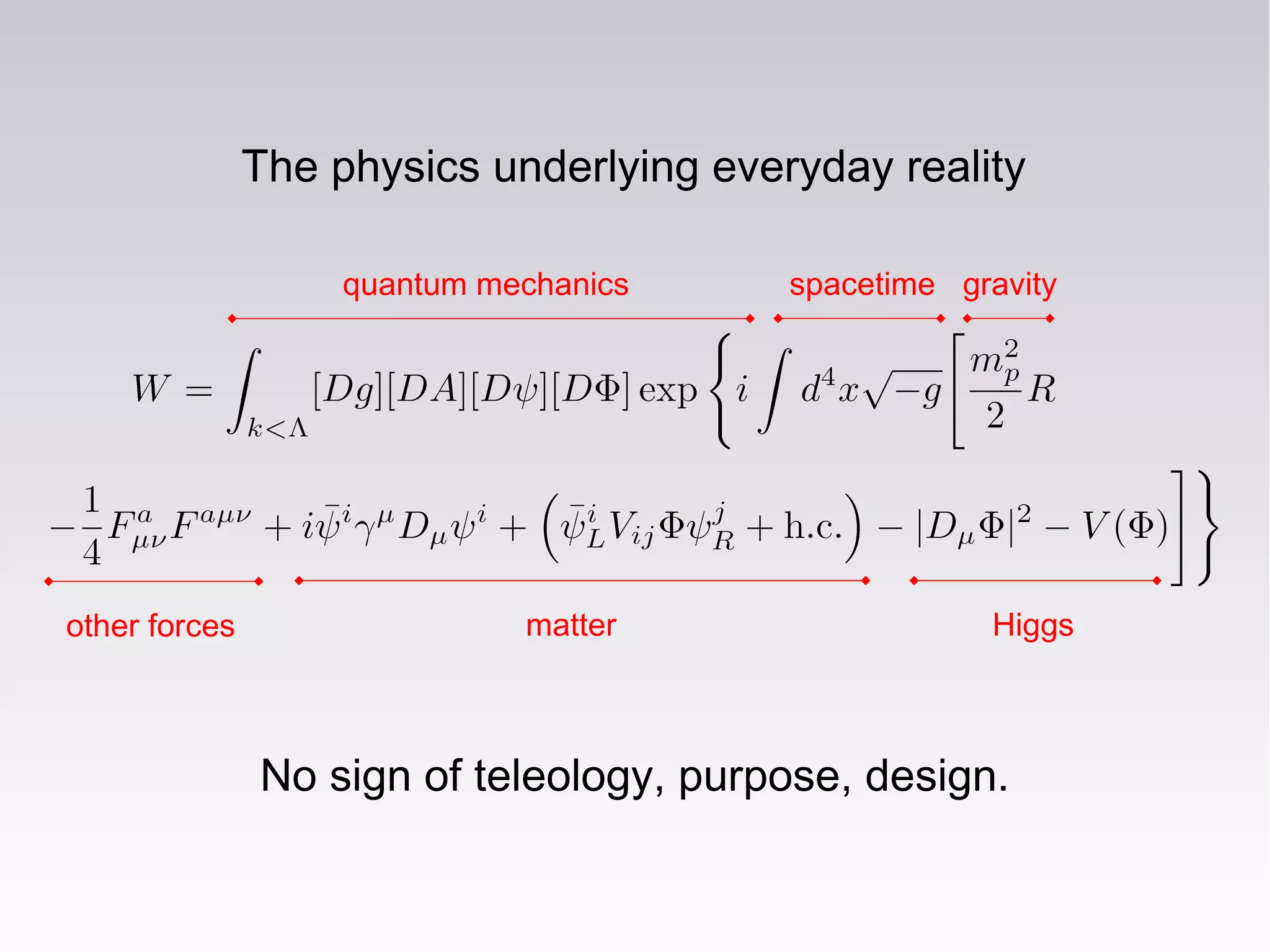
gravity
other forces matter Higgs
quantum mechanics spacetime
The physics underlying everyday reality
No sign of teleology, purpose, design.
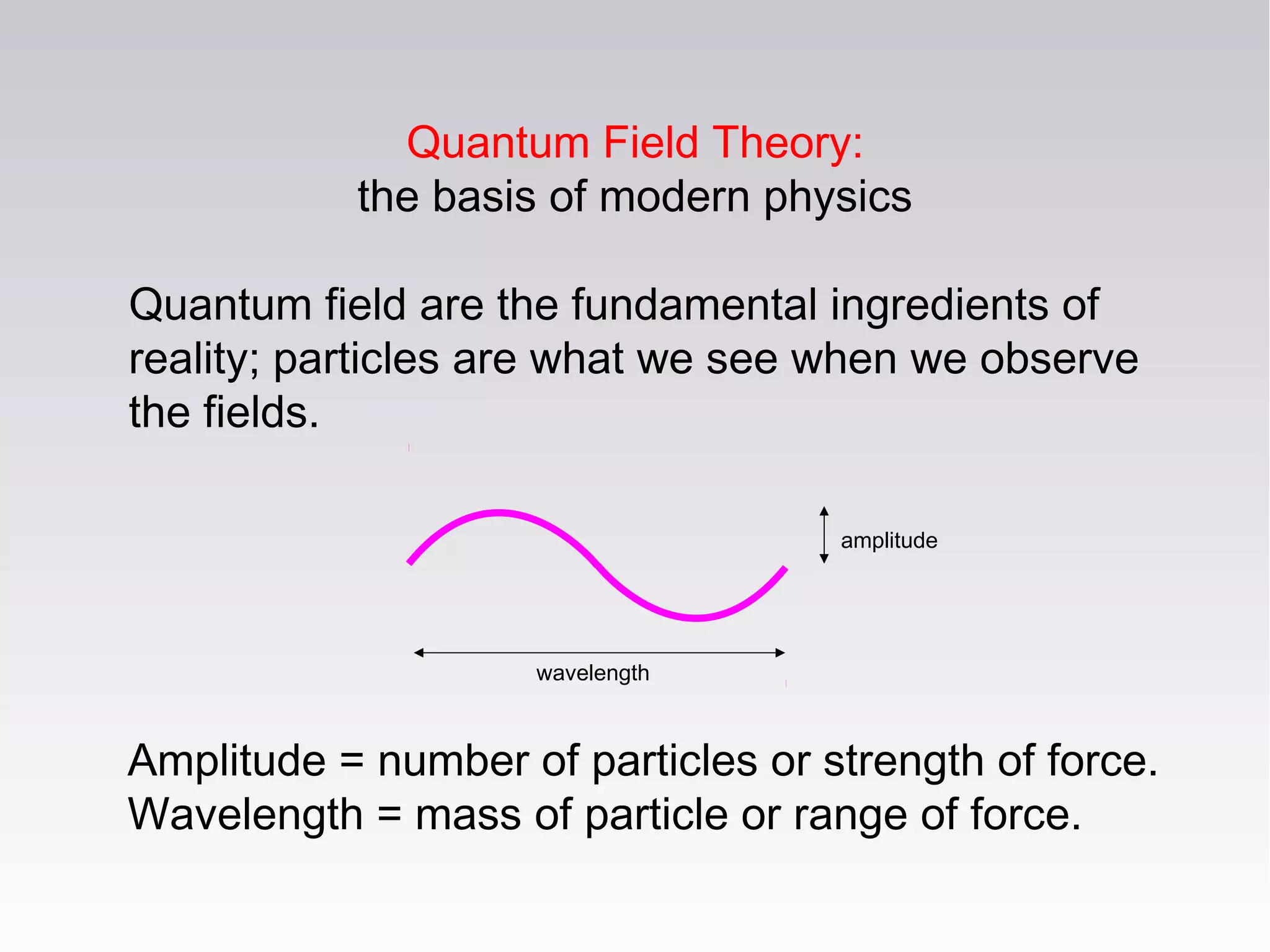
Amplitude = number of particles or strength of force.
Wavelength = mass of particle or range of force.
wavelength
amplitude
Quantum Field Theory:
the basis of modern physics
Quantum field are the fundamental ingredients of
reality; particles are what we see when we observe
the fields.
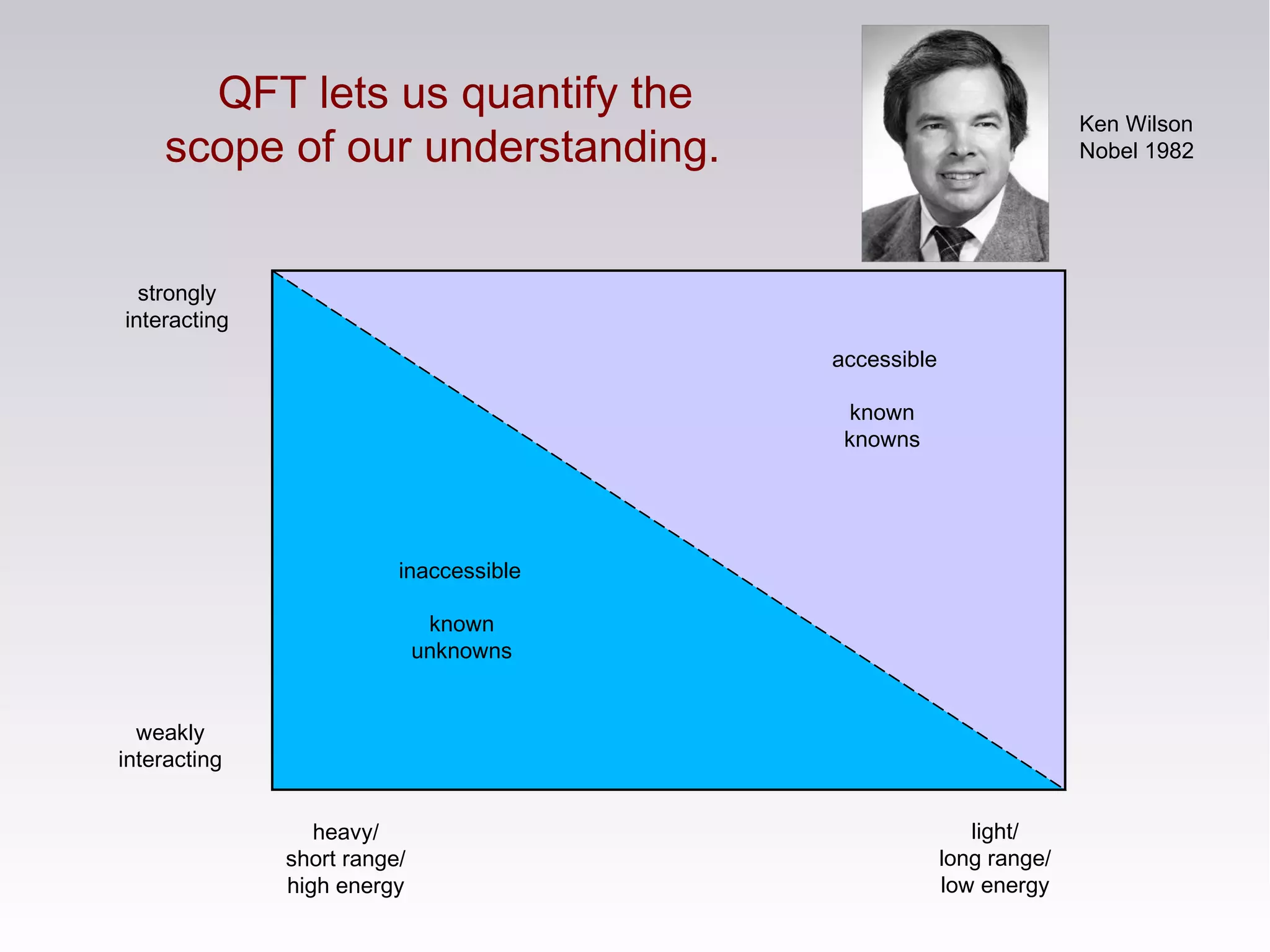
QFT lets us quantify the
scope of our understanding.
strongly
interacting
light/
long range/
low energy
heavy/
short range/
high energy
weakly
interacting
accessible
inaccessible
known
knowns
known
unknowns
Ken Wilson
Nobel 1982
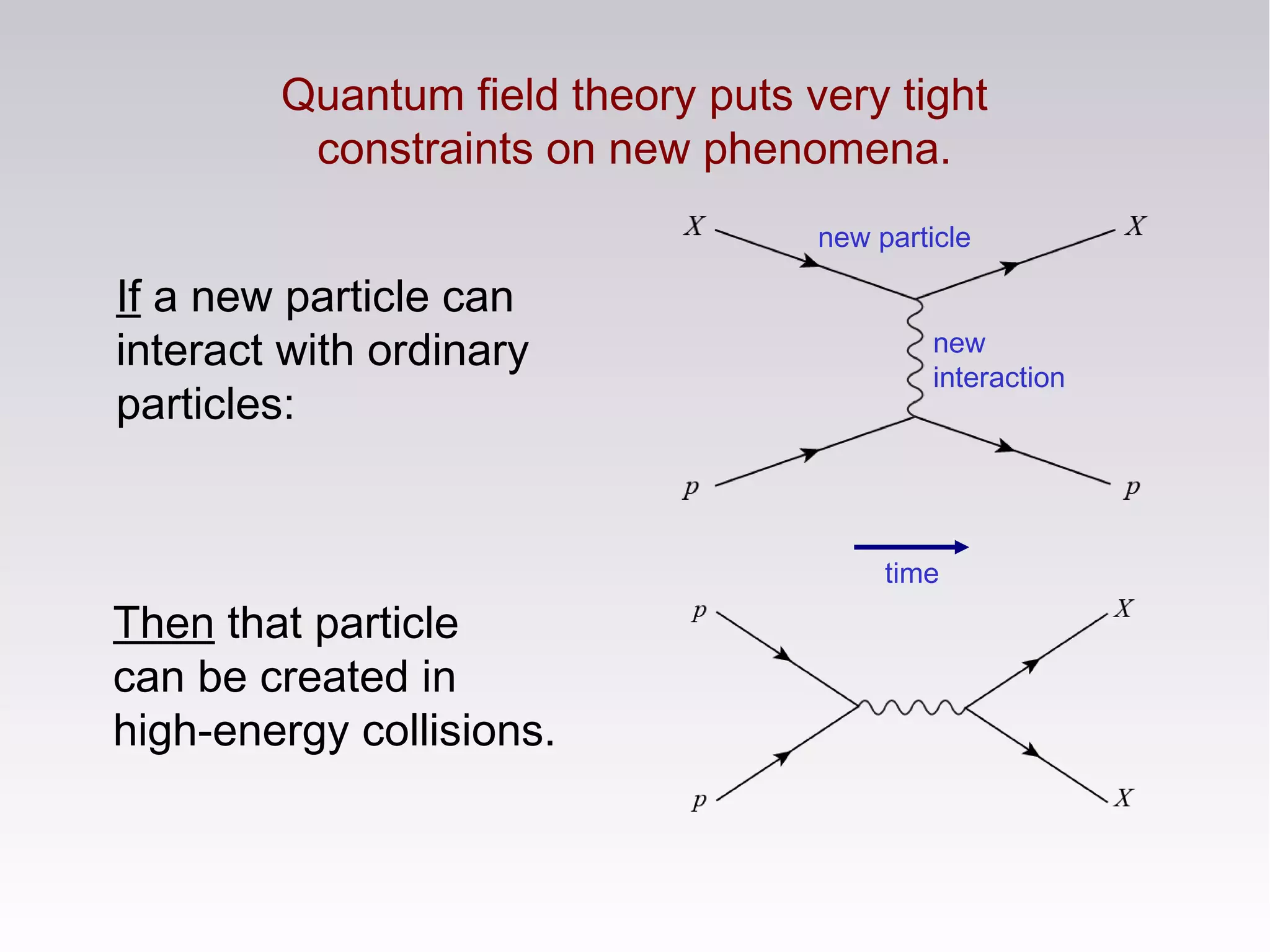
Quantum field theory puts very tight
constraints on new phenomena.
time
new particle
new
interaction
If a new particle can
interact with ordinary
particles:
Then that particle
can be created in
high-energy collisions.
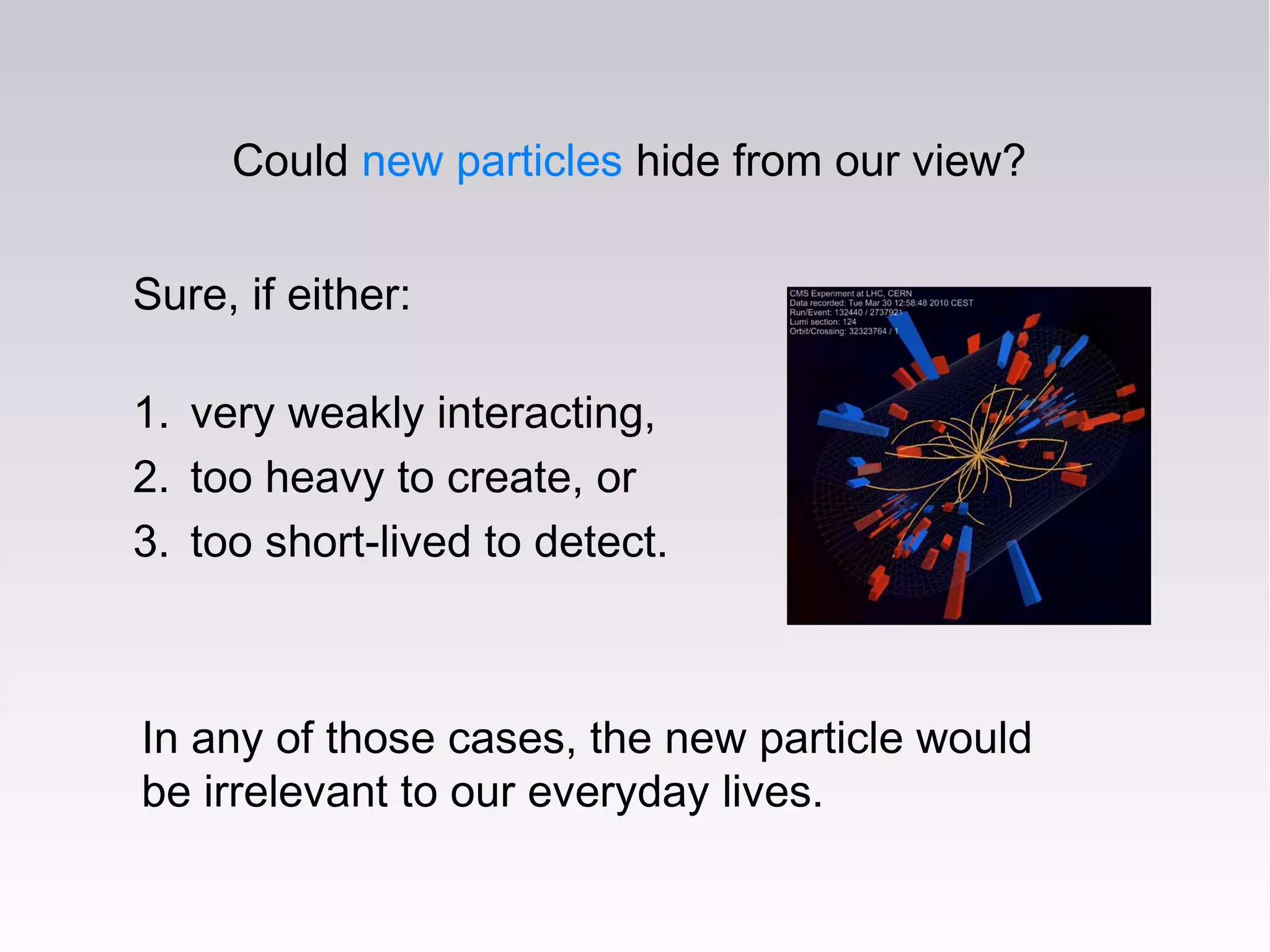
Could new particles hide from our view?
Sure, if either:
1. very weakly interacting,
2. too heavy to create, or
3. too short-lived to detect.
In any of those cases, the new particle would
be irrelevant to our everyday lives.
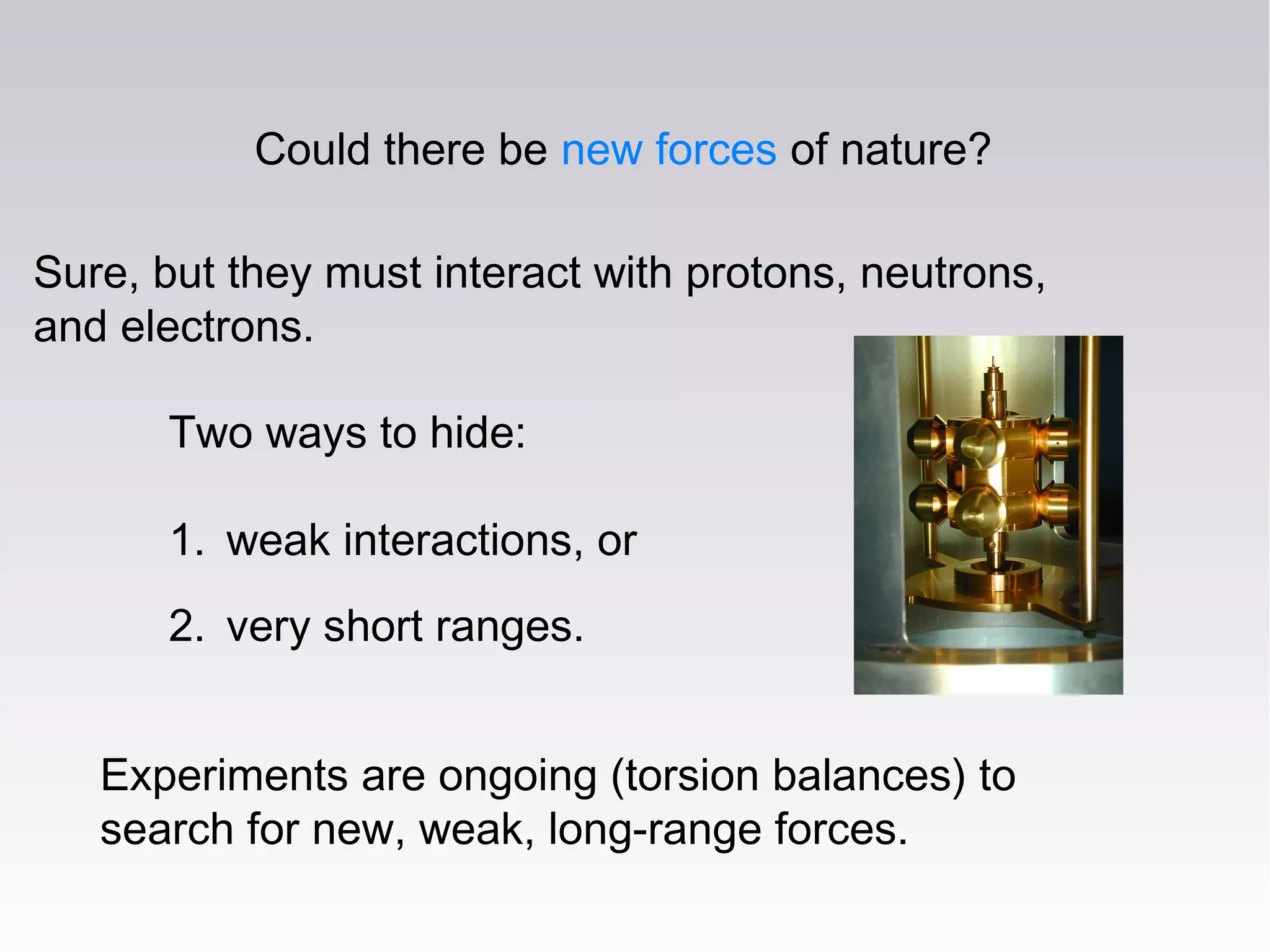
Could there be new forces of nature?
Sure, but they must interact with protons, neutrons,
and electrons.
Experiments are ongoing (torsion balances) to
search for new, weak, long-range forces.
Two ways to hide:
1. weak interactions, or
2. very short ranges.
Experimental constraints on new forces.
Strength(relativetogravity)
Range [Schlamminger et al. 2008]
Allowed
Ruled Out
Laws of physics underlying
the experiences of our everyday lives
are completely known.
We don’t understand all of fundamental physics
by any means!
Perfectly obvious but necessary caveats
“Fundamental” doesn’t mean “interesting.”
It certainly doesn’t mean “useful.” Lower-level
knowledge is often useless at higher level.
“Deriving” higher-level theories is often not a
worthwhile endeavor.
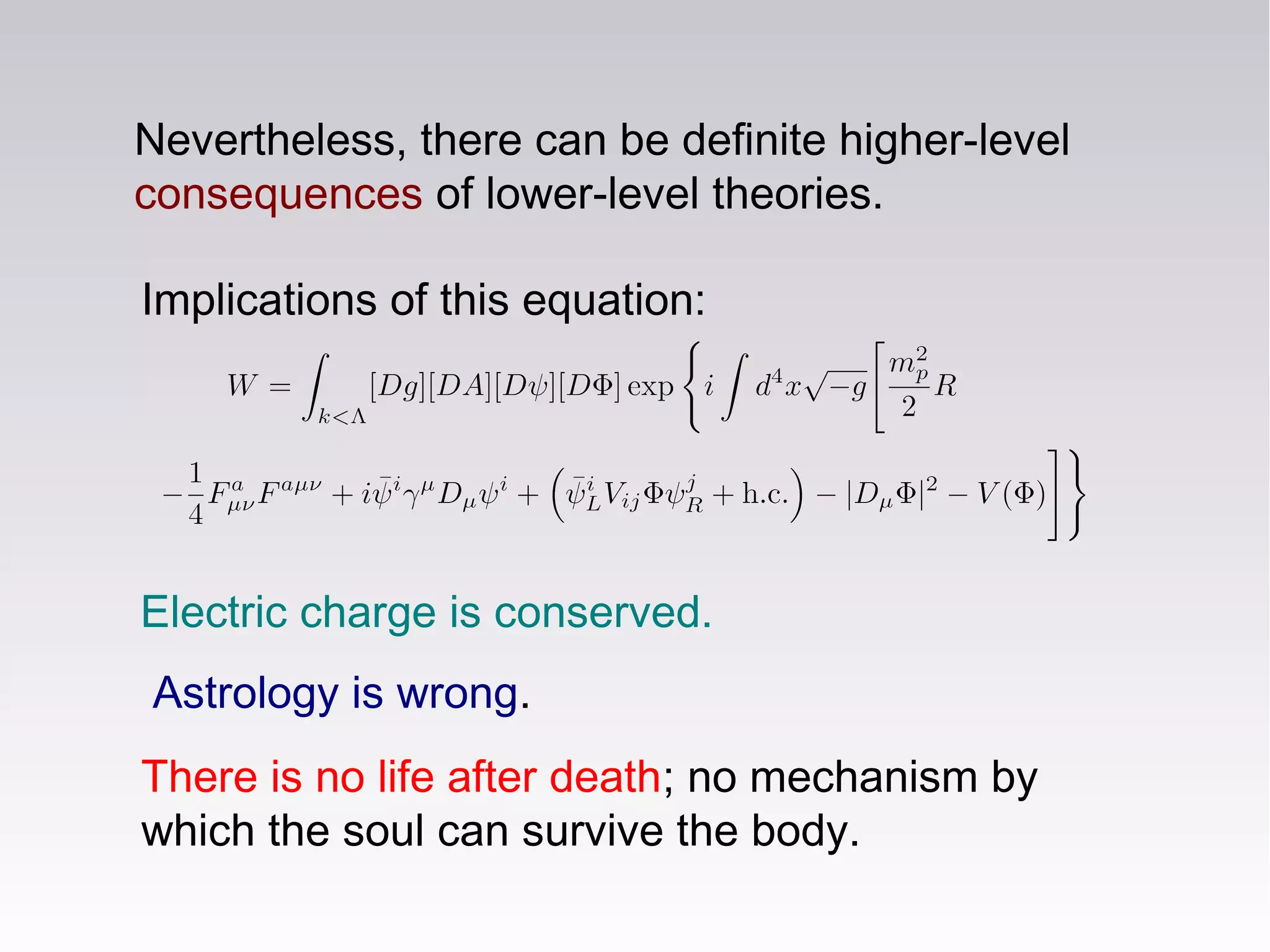
Implications of this equation:
Nevertheless, there can be definite higher-level
consequences of lower-level theories.
There is no life after death; no mechanism by
which the soul can survive the body.
Astrology is wrong.
Electric charge is conserved.
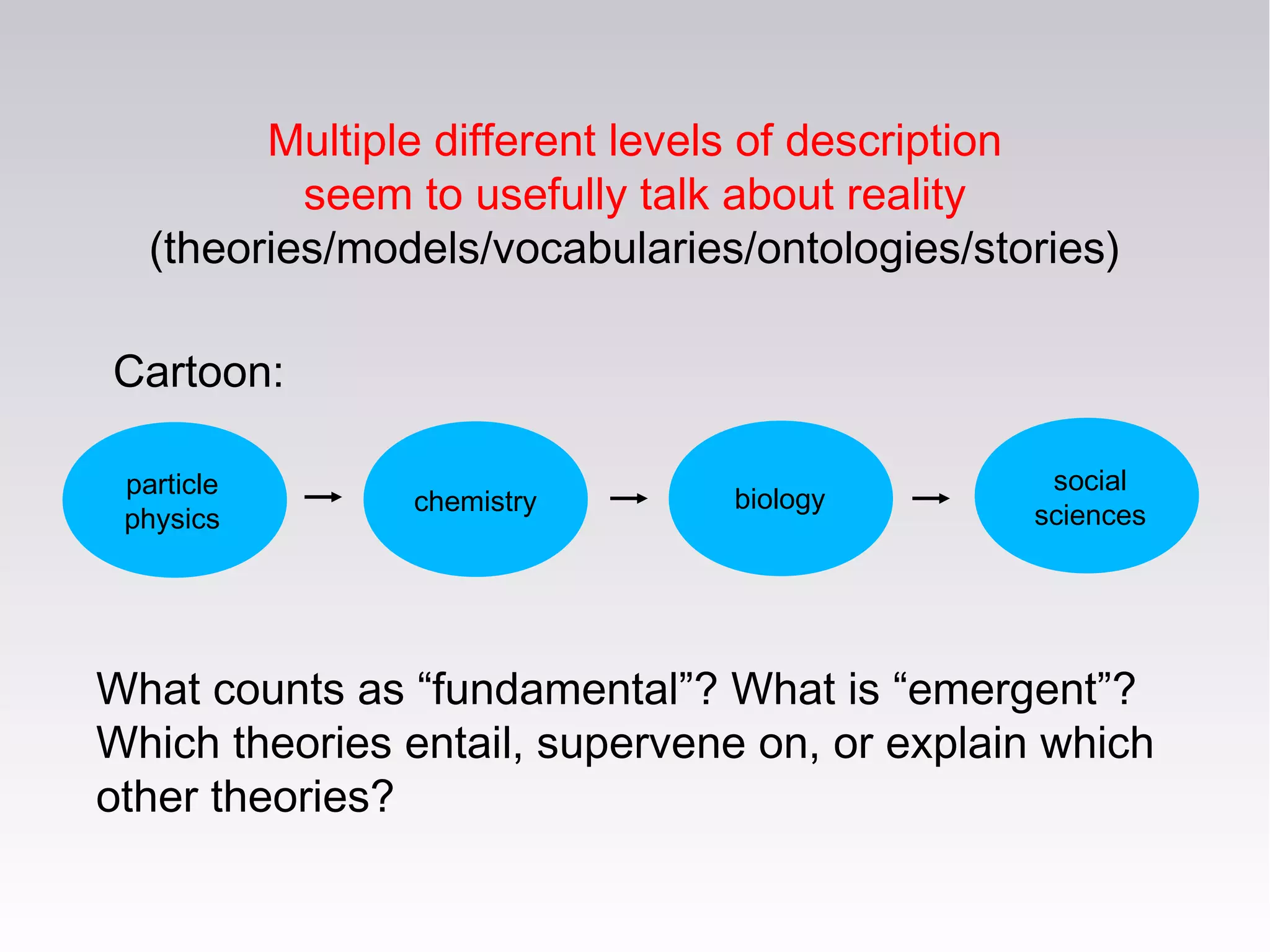
Multiple different levels of description
seem to usefully talk about reality
(theories/models/vocabularies/ontologies/stories)
Cartoon:
particle
physics
chemistry biology
social
sciences
What counts as “fundamental”? What is “emergent”?
Which theories entail, supervene on, or explain which
other theories?
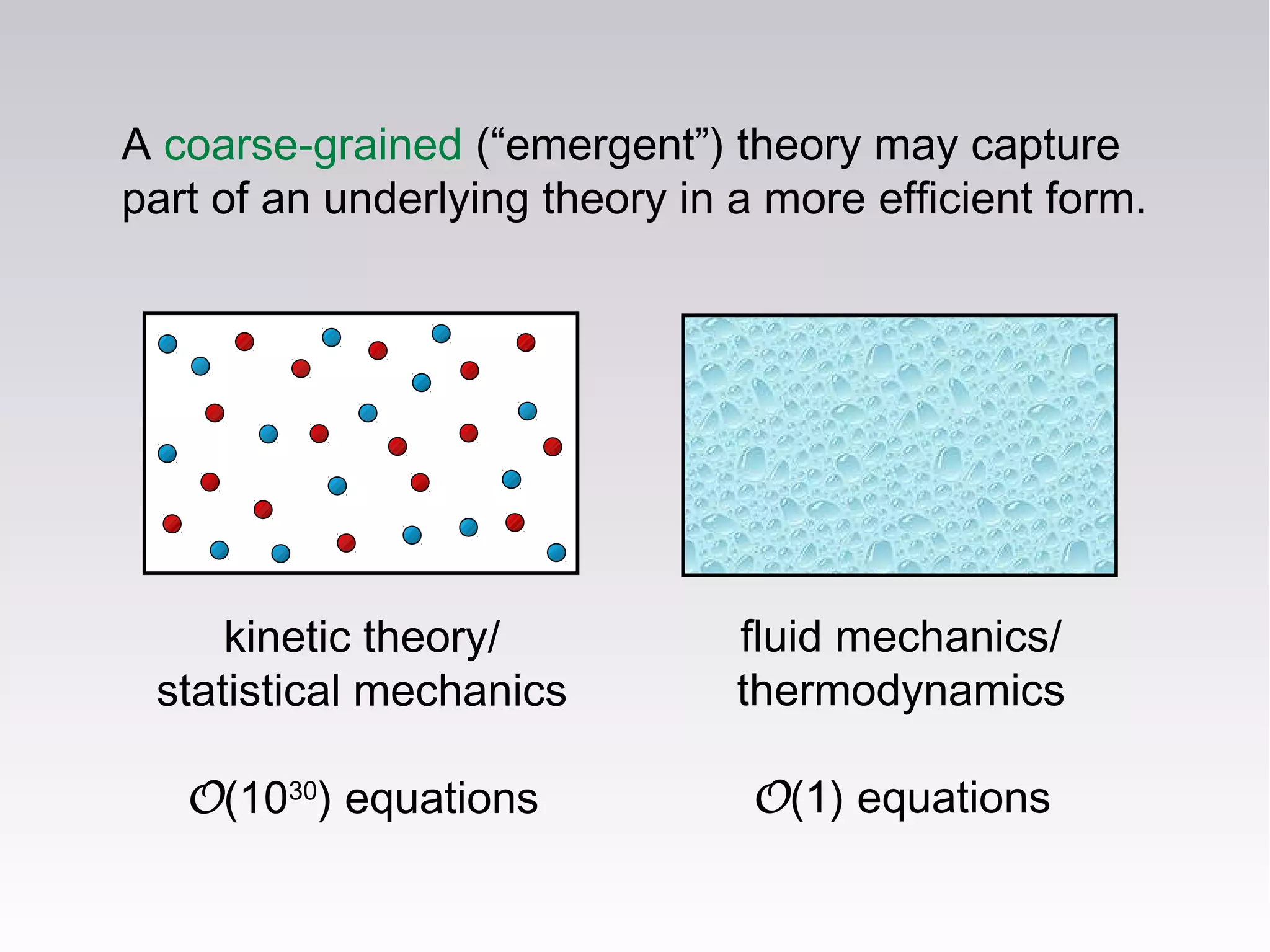
A coarse-grained (“emergent”) theory may capture
part of an underlying theory in a more efficient form.
kinetic theory/
statistical mechanics
O(1030
) equations
fluid mechanics/
thermodynamics
O(1) equations
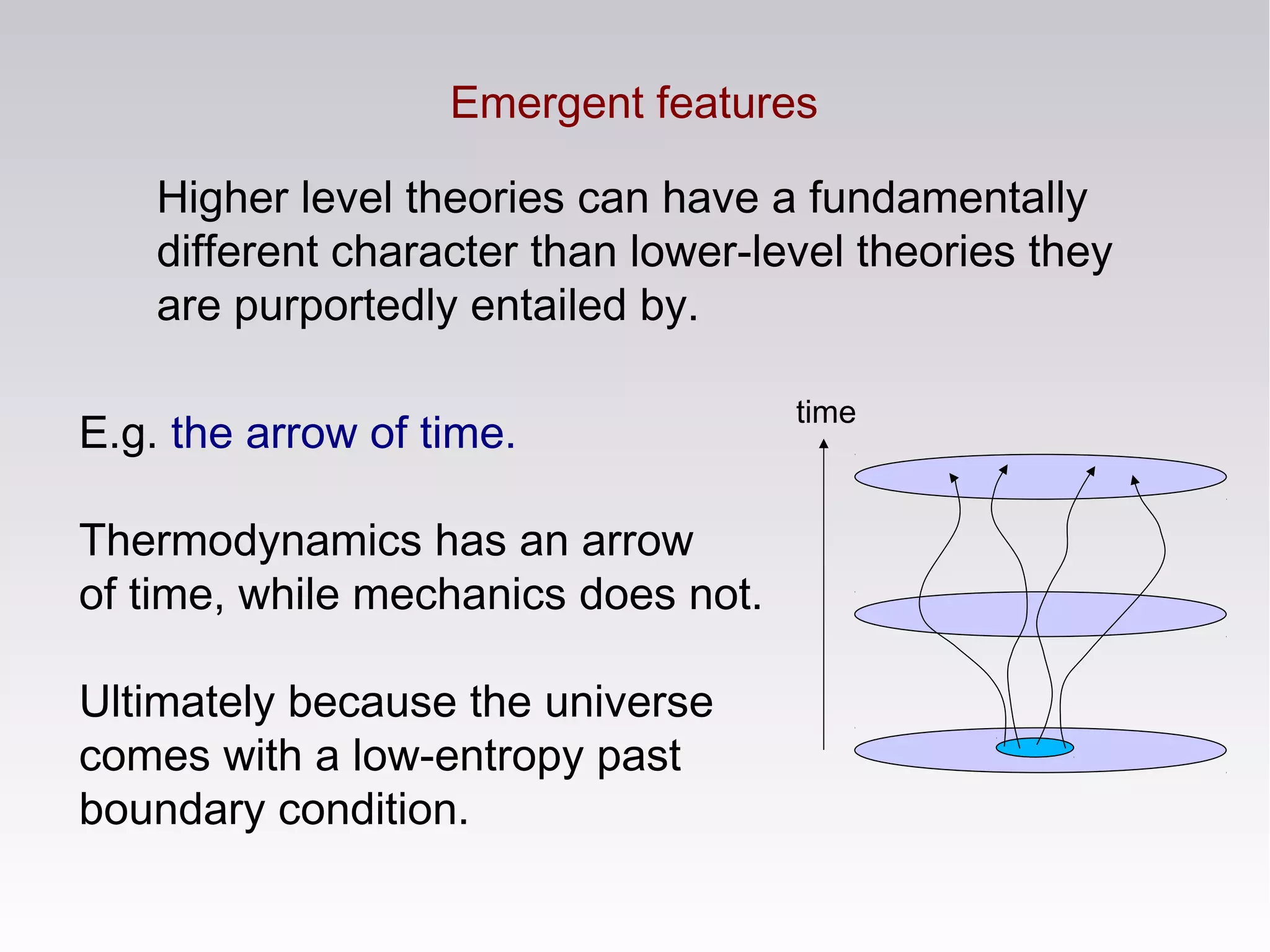
Higher level theories can have a fundamentally
different character than lower-level theories they
are purportedly entailed by.
Emergent features
E.g. the arrow of time.
Thermodynamics has an arrow
of time, while mechanics does not.
Ultimately because the universe
comes with a low-entropy past
boundary condition.
time
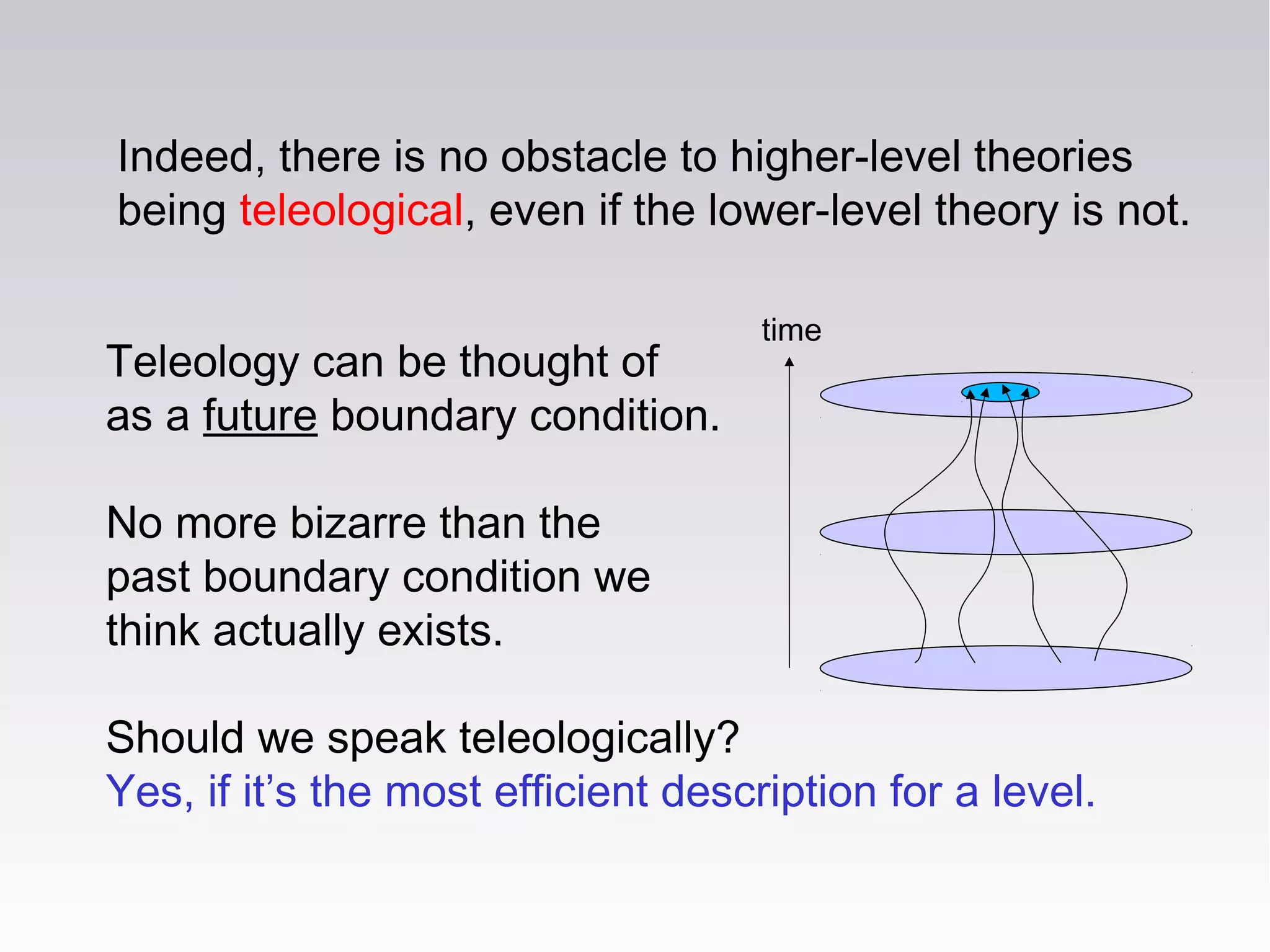
time
Indeed, there is no obstacle to higher-level theories
being teleological, even if the lower-level theory is not.
Teleology can be thought of
as a future boundary condition.
No more bizarre than the
past boundary condition we
think actually exists.
Should we speak teleologically?
Yes, if it’s the most efficient description for a level.
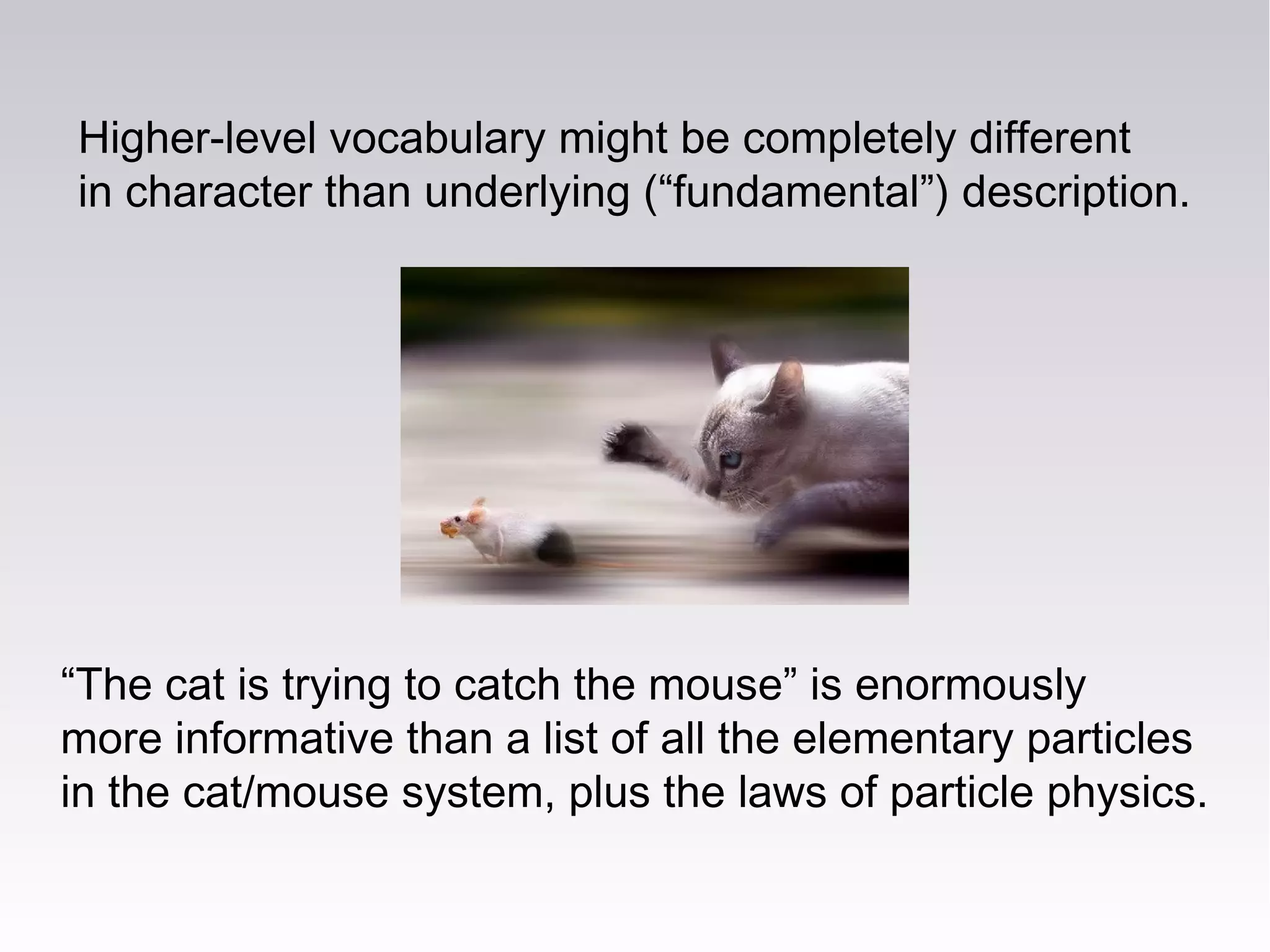
Higher-level vocabulary might be completely different
in character than underlying (“fundamental”) description.
“The cat is trying to catch the mouse” is enormously
more informative than a list of all the elementary particles
in the cat/mouse system, plus the laws of particle physics.
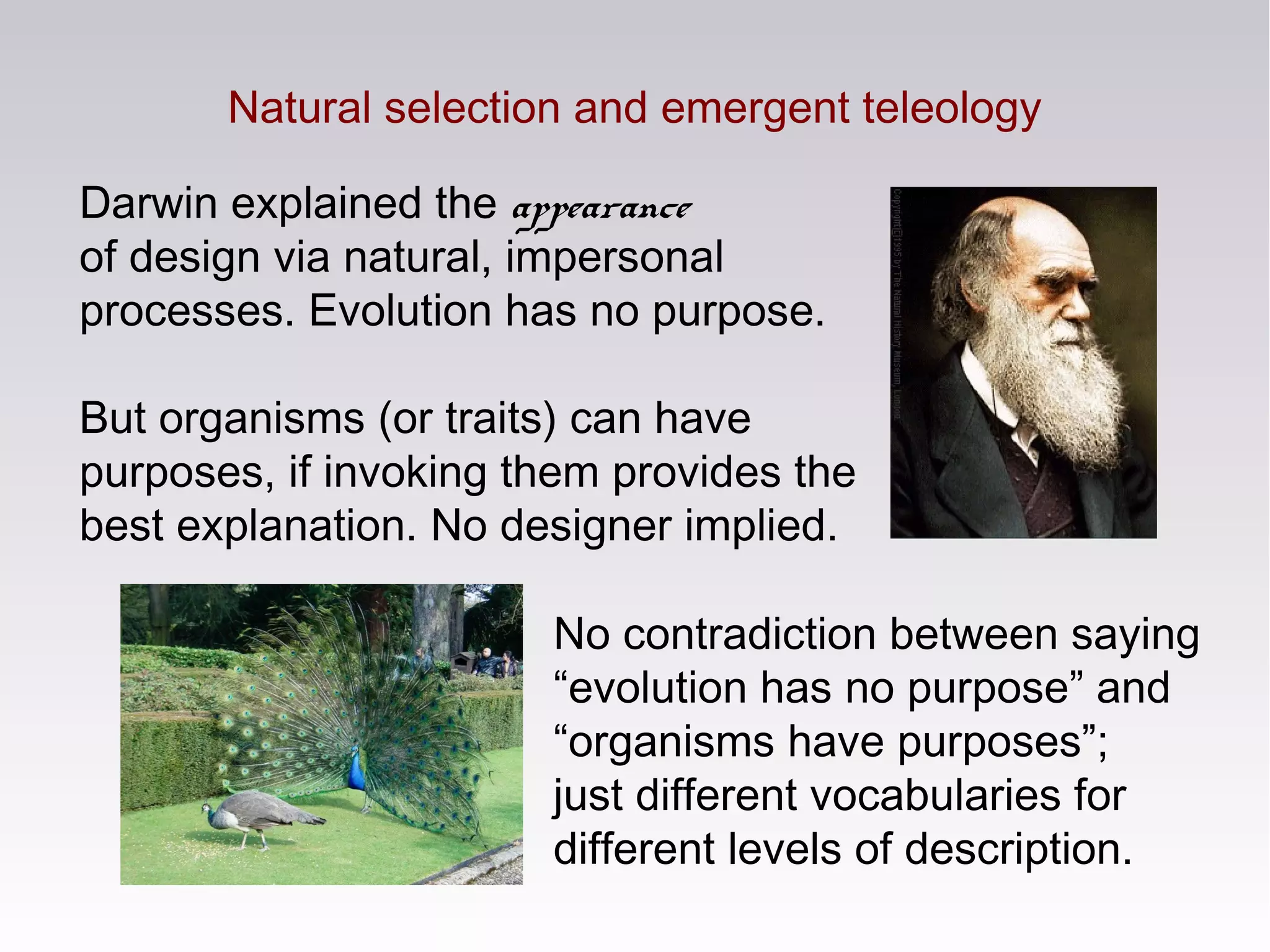
Natural selection and emergent teleology
Darwin explained the appearance
of design via natural, impersonal
processes. Evolution has no purpose.
But organisms (or traits) can have
purposes, if invoking them provides the
best explanation. No designer implied.
No contradiction between saying
“evolution has no purpose” and
“organisms have purposes”;
just different vocabularies for
different levels of description.
The job of science is to describe the world.
There are other things we might want to do.
Judgment, aesthetics. Ethics, morality.
The meaning of life.
An entirely different kind of story. Must be
compatible with science, but not reducible to it.
Resist the temptation to think science is all there is.
Science and values:
description vs. prescription
Where do judgments come from?
(Good without God.)
Lots of places. Human beings are not blank slates.
They come equipped with desires, aspirations,
preferences, emotional reactions. From biology
as well as from culture.
Moral philosophy isn’t about proving universal
truths. It’s about taking our existing moral feelings
and developing them into something logical,
systematic, and compatible with those of other
people.
Developing theories of value is a matter of telling the
stories that best encapsulate our existing desires etc.
Subjective, but not arbitrary!
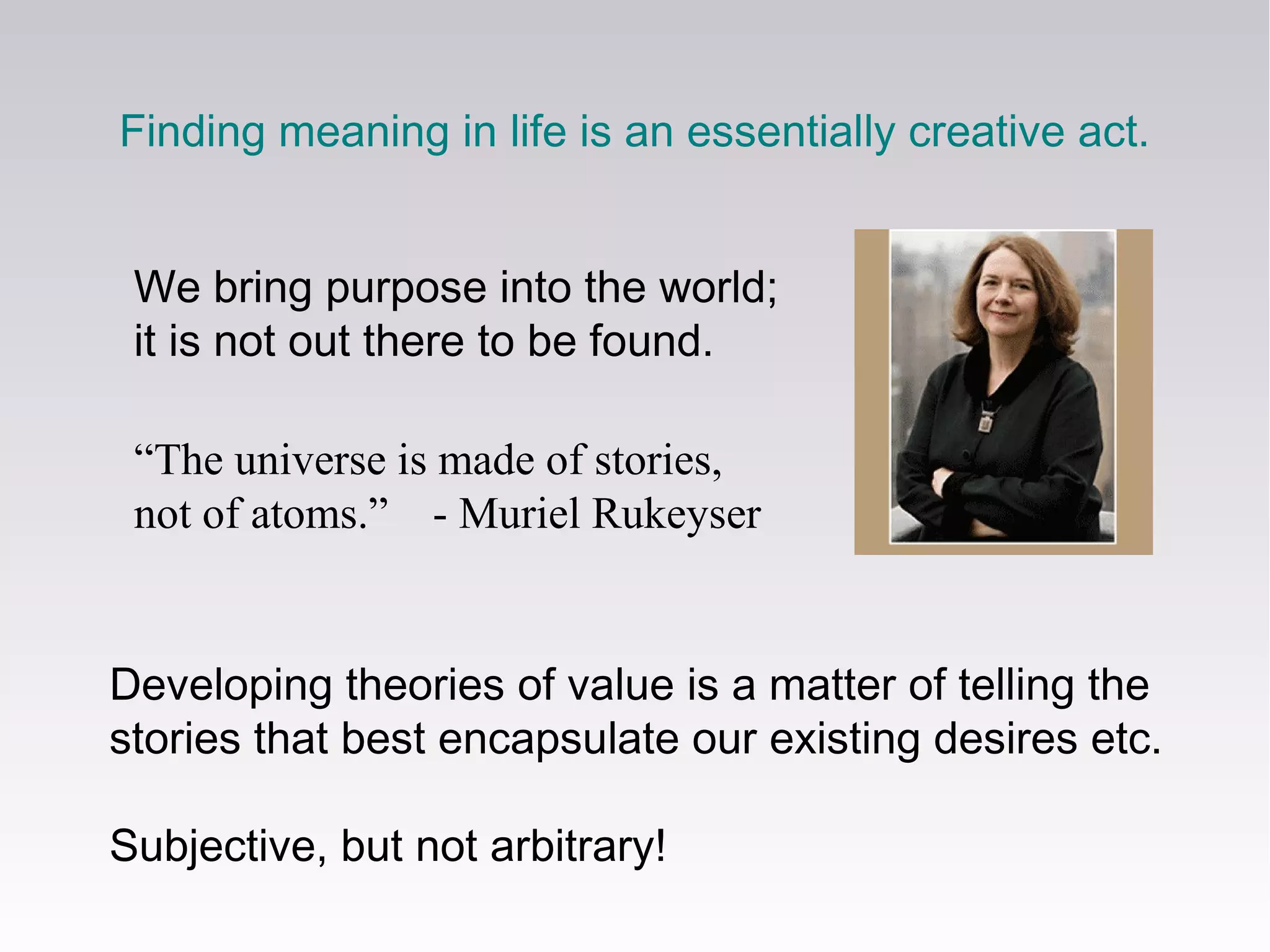
“The universe is made of stories,
not of atoms.” - Muriel Rukeyser
Finding meaning in life is an essentially creative act.
We bring purpose into the world;
it is not out there to be found.
Consider chess.
The rules of chess don’t inhere in
the fundamental laws of physics.
We invented them; they could be
otherwise. They are subjective.
But they are not arbitrary. They are carefully adjusted
to serve a purpose: the most interesting game.
Likewise for (e.g.) morality. Invented, but not at all
arbitrary. Our notions of morality are carefully adjusted
to serve a purpose: our notions of justice and fairness.
[Alan Light/Wikipedia]
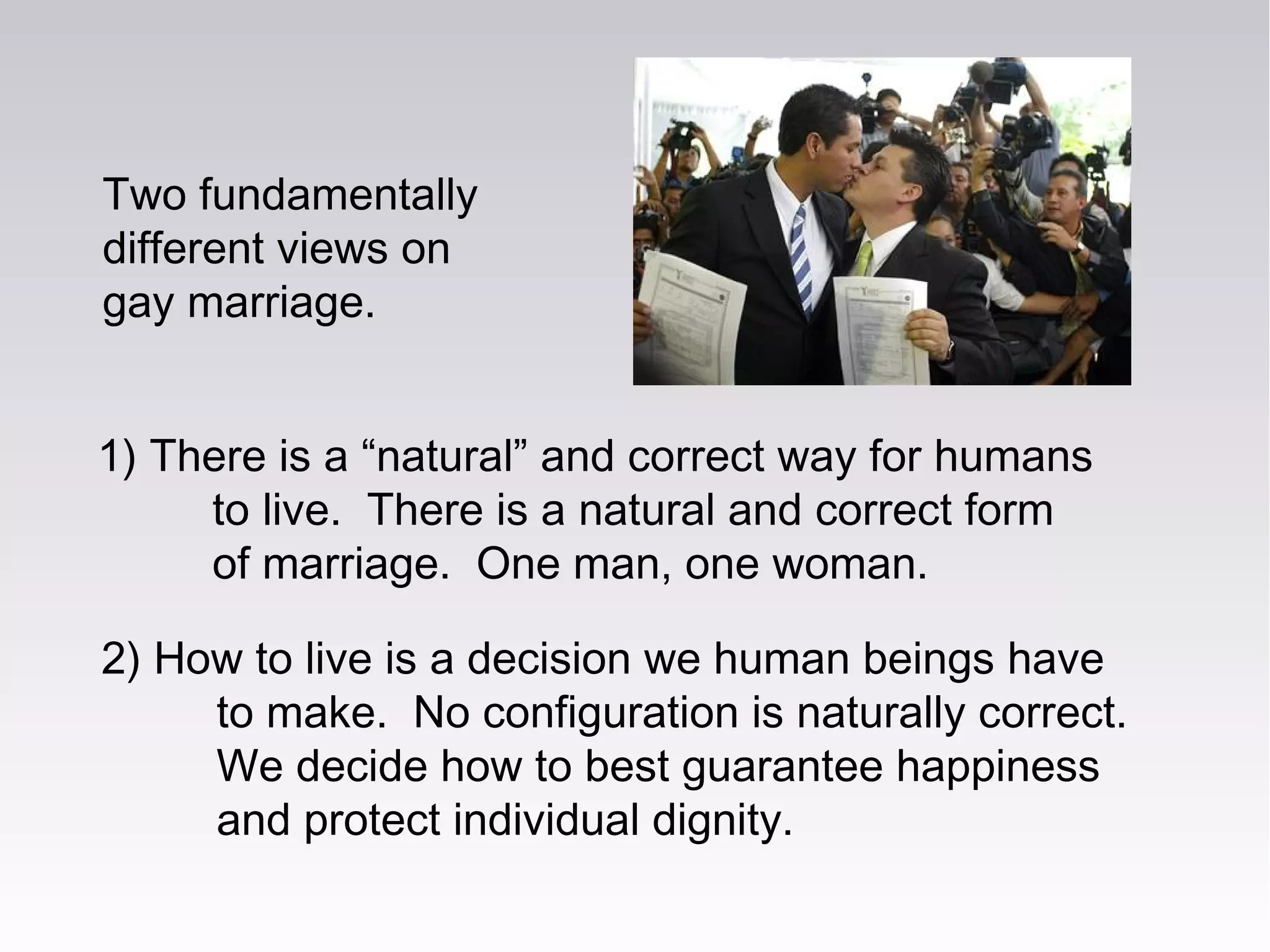
Two fundamentally
different views on
gay marriage.
2) How to live is a decision we human beings have
to make. No configuration is naturally correct.
We decide how to best guarantee happiness
and protect individual dignity.
1) There is a “natural” and correct way for humans
to live. There is a natural and correct form
of marriage. One man, one woman.
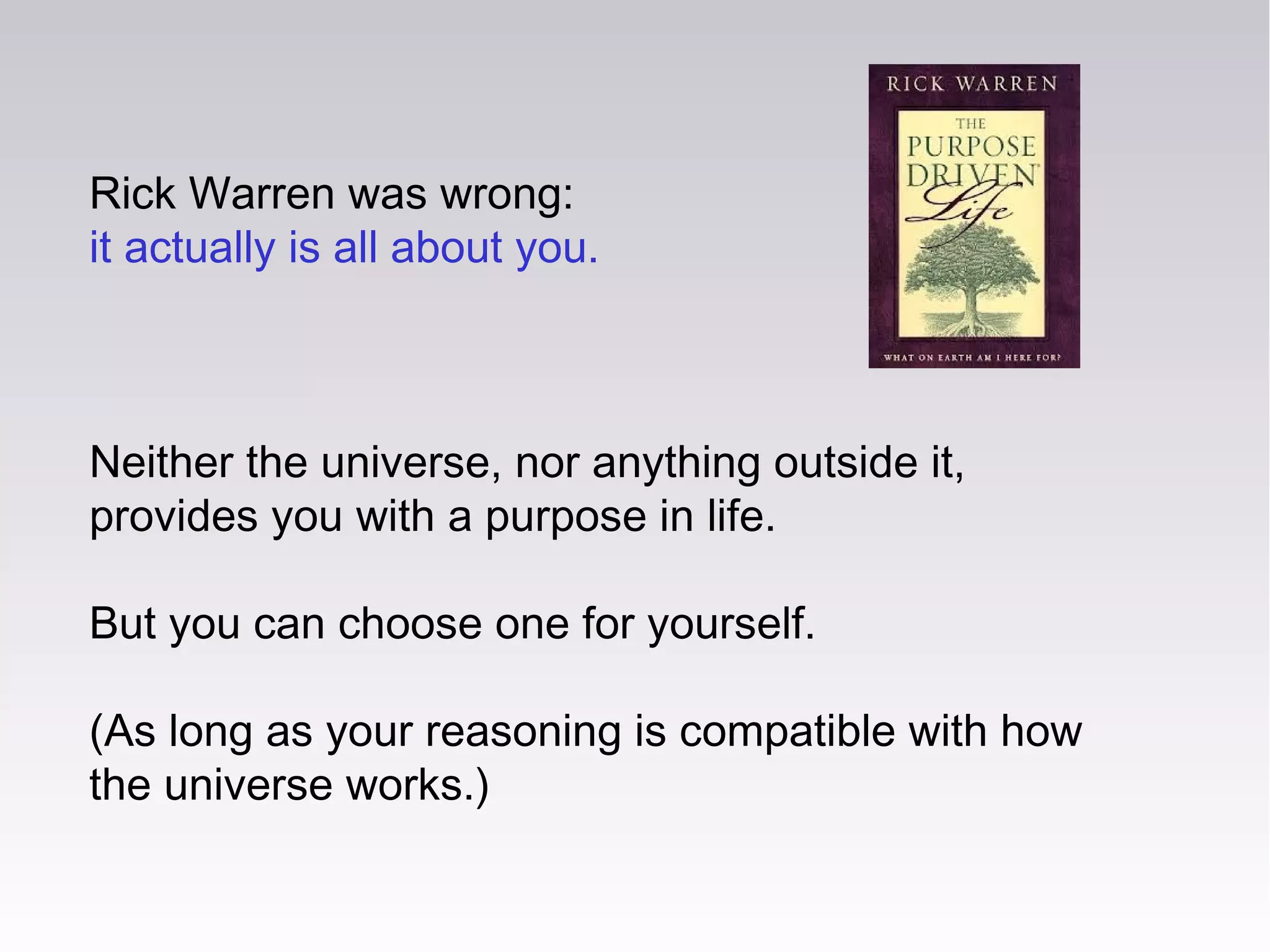
Rick Warren was wrong:
it actually is all about you.
Neither the universe, nor anything outside it,
provides you with a purpose in life.
But you can choose one for yourself.
(As long as your reasoning is compatible with how
the universe works.)
Purpose and the Universe

Purpose and the Universe

  • 1.
    purpose and the universe SeanCarroll Caltech preposterousuniverse.com
  • 2.
    Lucia de Berk Dutchnurse convicted in 2004 for the murder of 7 infant children and attempted murder of 3 more. Sentenced to life in prison. Expert witness: chance of one nurse being on duty for all the incidents is 1 in 342 million. Re-analysis: actually it was 1 in 26. Exonerated by re-trial in 2010.
  • 3.
    Pat Robertson afterHaiti earthquake: “Many years ago, the island’s people ‘swore a pact to the devil.’ True story. And so the devil said, ‘OK, it’s a deal.’ They kicked the French out. The Haitians revolted and got themselves free. Ever since, they have been cursed by one thing after the other.” The urge to find reasons Principle of Sufficient Reason (Spinoza 1663, Leibniz 1686): “Nothing is without a ground or reason why it is.”
  • 4.
    The Ethos ofScience We do not get to place demands on the universe. We cannot discover how things work by pure thought. What we want to be true doesn’t matter. We gain understanding by considering every possible way things could be, testing them against observation and experiment, and deciding what best accounts for the data.
  • 5.
    Purpose from aDesigner (God) Why did God make us? God made us to show forth His goodness and to share with us His everlasting happiness in heaven. - The Baltimore Catechism It’s not about you… You were born by [God’s] purpose and for his purpose. - Rick Warren, The Purpose Driven Life That which has come into existence must necessarily, as we say, have come into existence by reason of some Cause. - Plato, Timaeus
  • 6.
    Aristotle: systematic understandingof nature in terms of “final causes.” Earth falls down, fire moves upward. Teilhard de Chardin: the Omega Point. Complexity grows with time, along with universal consciousness. Teleology: purpose without a planner Herbert Spencer: evolution as a mechanism of progress, both in biology and in sociology.
  • 7.
    Ancient anti-teleological approaches(atomism) Democritus, however, neglecting the final cause, reduces to necessity all the operations of nature. Now they are necessary, it is true, but yet they are for a final cause and for the sake of what is best in each case. - Aristotle, Generation of Animals [Atoms] shuffled and jumbled in many ways, and in the course of endless time they are buffeted, driven along, chancing upon all motions and combinations. At last they fall into such an arrangement as would create this universe… - Lucretius, De Rerum Natura
  • 8.
    Modern physics: Laws aredifferential equations in time. Isaac Newton: Erwin Schrödinger:
  • 9.
    We may regardthe present state of the universe as the effect of its past and the cause of its future. An intellect which at a certain moment would know all forces and all positions of all items of which nature is composed… for such an intellect nothing would be uncertain and the future just like the past would be present before its eyes. - An Essay on Probabilities, 1814 Pierre-Simon Laplace: the present state of the universe determines its evolution. Laplace’s Demon.
  • 10.
    Varieties of predictivetheories Historical Teleological Laplacian time future present past goal the past and present together determine the future from the present we move toward some future goal conservation of information: every moment determines every other moment
  • 11.
  • 12.
    electron quarks gravity electro- magnetism (photons) strong nuclear force (gluons) down upup up down down weak nuclear force (W, Z bosons) neutrino Fundamentalphysics today: four particles (× 3 generations), four forces, antiparticles, Higgs field background Higgs field
  • 13.
    Standard Model ofparticle physics + General Relativity gives us a working theory of “fundamental” physics. 1. Internally complete and coherent. 2. Uncontradicted by any experiment ever conducted here on Earth. 3. Settled, as far as the physics underlying everyday experience is concerned.
  • 14.
    gravity other forces matterHiggs quantum mechanics spacetime The physics underlying everyday reality No sign of teleology, purpose, design.
  • 15.
    Amplitude = numberof particles or strength of force. Wavelength = mass of particle or range of force. wavelength amplitude Quantum Field Theory: the basis of modern physics Quantum field are the fundamental ingredients of reality; particles are what we see when we observe the fields.
  • 16.
    QFT lets usquantify the scope of our understanding. strongly interacting light/ long range/ low energy heavy/ short range/ high energy weakly interacting accessible inaccessible known knowns known unknowns Ken Wilson Nobel 1982
  • 17.
    Quantum field theoryputs very tight constraints on new phenomena. time new particle new interaction If a new particle can interact with ordinary particles: Then that particle can be created in high-energy collisions.
  • 18.
    Could new particleshide from our view? Sure, if either: 1. very weakly interacting, 2. too heavy to create, or 3. too short-lived to detect. In any of those cases, the new particle would be irrelevant to our everyday lives.
  • 19.
    Could there benew forces of nature? Sure, but they must interact with protons, neutrons, and electrons. Experiments are ongoing (torsion balances) to search for new, weak, long-range forces. Two ways to hide: 1. weak interactions, or 2. very short ranges.
  • 20.
    Experimental constraints onnew forces. Strength(relativetogravity) Range [Schlamminger et al. 2008] Allowed Ruled Out
  • 21.
    Laws of physicsunderlying the experiences of our everyday lives are completely known.
  • 22.
    We don’t understandall of fundamental physics by any means! Perfectly obvious but necessary caveats “Fundamental” doesn’t mean “interesting.” It certainly doesn’t mean “useful.” Lower-level knowledge is often useless at higher level. “Deriving” higher-level theories is often not a worthwhile endeavor.
  • 23.
    Implications of thisequation: Nevertheless, there can be definite higher-level consequences of lower-level theories. There is no life after death; no mechanism by which the soul can survive the body. Astrology is wrong. Electric charge is conserved.
  • 24.
    Multiple different levelsof description seem to usefully talk about reality (theories/models/vocabularies/ontologies/stories) Cartoon: particle physics chemistry biology social sciences What counts as “fundamental”? What is “emergent”? Which theories entail, supervene on, or explain which other theories?
  • 25.
    A coarse-grained (“emergent”)theory may capture part of an underlying theory in a more efficient form. kinetic theory/ statistical mechanics O(1030 ) equations fluid mechanics/ thermodynamics O(1) equations
  • 26.
    Higher level theoriescan have a fundamentally different character than lower-level theories they are purportedly entailed by. Emergent features E.g. the arrow of time. Thermodynamics has an arrow of time, while mechanics does not. Ultimately because the universe comes with a low-entropy past boundary condition. time
  • 27.
    time Indeed, there isno obstacle to higher-level theories being teleological, even if the lower-level theory is not. Teleology can be thought of as a future boundary condition. No more bizarre than the past boundary condition we think actually exists. Should we speak teleologically? Yes, if it’s the most efficient description for a level.
  • 28.
    Higher-level vocabulary mightbe completely different in character than underlying (“fundamental”) description. “The cat is trying to catch the mouse” is enormously more informative than a list of all the elementary particles in the cat/mouse system, plus the laws of particle physics.
  • 29.
    Natural selection andemergent teleology Darwin explained the appearance of design via natural, impersonal processes. Evolution has no purpose. But organisms (or traits) can have purposes, if invoking them provides the best explanation. No designer implied. No contradiction between saying “evolution has no purpose” and “organisms have purposes”; just different vocabularies for different levels of description.
  • 30.
    The job ofscience is to describe the world. There are other things we might want to do. Judgment, aesthetics. Ethics, morality. The meaning of life. An entirely different kind of story. Must be compatible with science, but not reducible to it. Resist the temptation to think science is all there is. Science and values: description vs. prescription
  • 31.
    Where do judgmentscome from? (Good without God.) Lots of places. Human beings are not blank slates. They come equipped with desires, aspirations, preferences, emotional reactions. From biology as well as from culture. Moral philosophy isn’t about proving universal truths. It’s about taking our existing moral feelings and developing them into something logical, systematic, and compatible with those of other people.
  • 32.
    Developing theories ofvalue is a matter of telling the stories that best encapsulate our existing desires etc. Subjective, but not arbitrary! “The universe is made of stories, not of atoms.” - Muriel Rukeyser Finding meaning in life is an essentially creative act. We bring purpose into the world; it is not out there to be found.
  • 33.
    Consider chess. The rulesof chess don’t inhere in the fundamental laws of physics. We invented them; they could be otherwise. They are subjective. But they are not arbitrary. They are carefully adjusted to serve a purpose: the most interesting game. Likewise for (e.g.) morality. Invented, but not at all arbitrary. Our notions of morality are carefully adjusted to serve a purpose: our notions of justice and fairness. [Alan Light/Wikipedia]
  • 34.
    Two fundamentally different viewson gay marriage. 2) How to live is a decision we human beings have to make. No configuration is naturally correct. We decide how to best guarantee happiness and protect individual dignity. 1) There is a “natural” and correct way for humans to live. There is a natural and correct form of marriage. One man, one woman.
  • 35.
    Rick Warren waswrong: it actually is all about you. Neither the universe, nor anything outside it, provides you with a purpose in life. But you can choose one for yourself. (As long as your reasoning is compatible with how the universe works.)

Editor's Notes

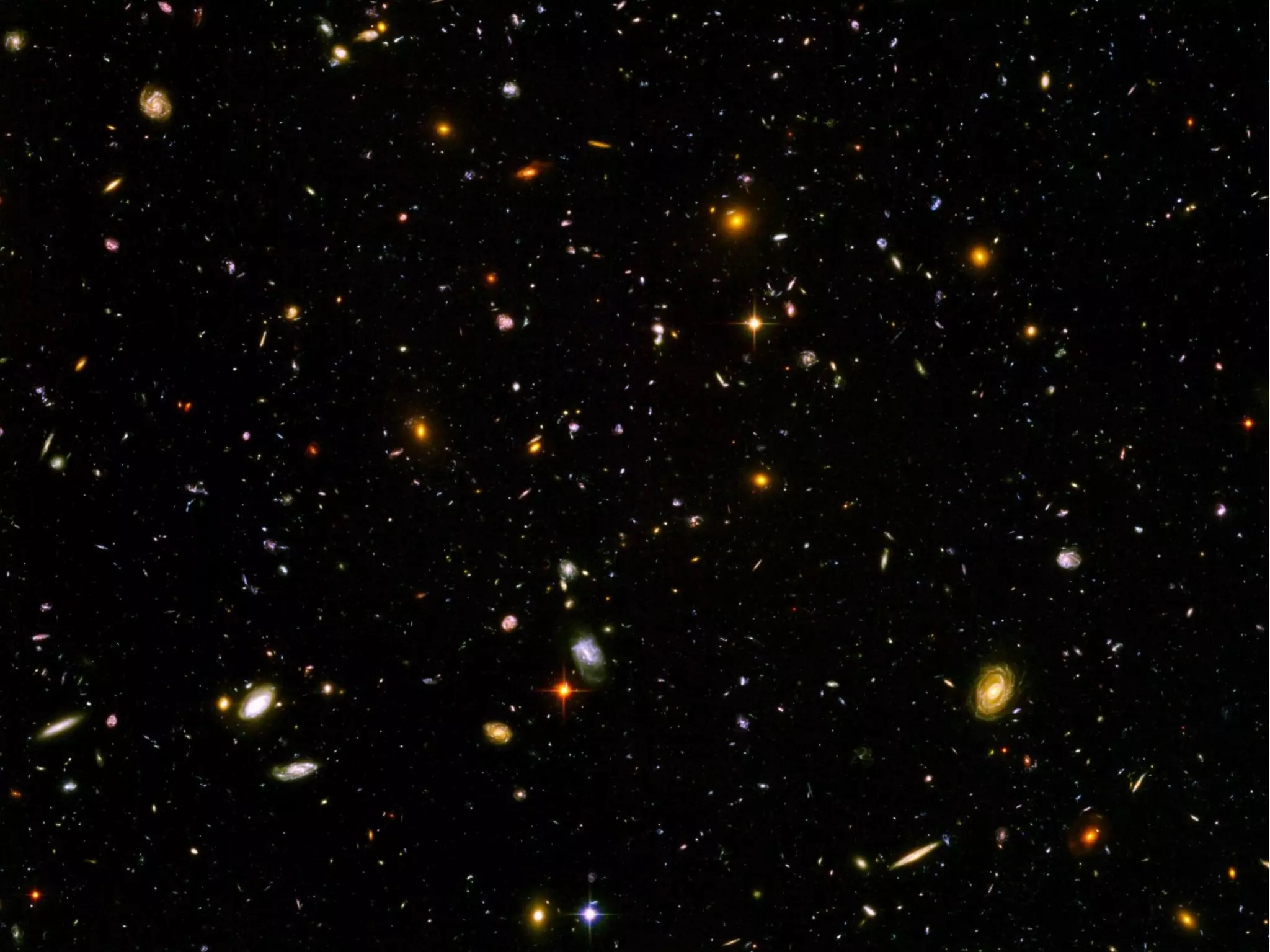
  • #37 The universe is big, and there’s a lot we don’t understand.
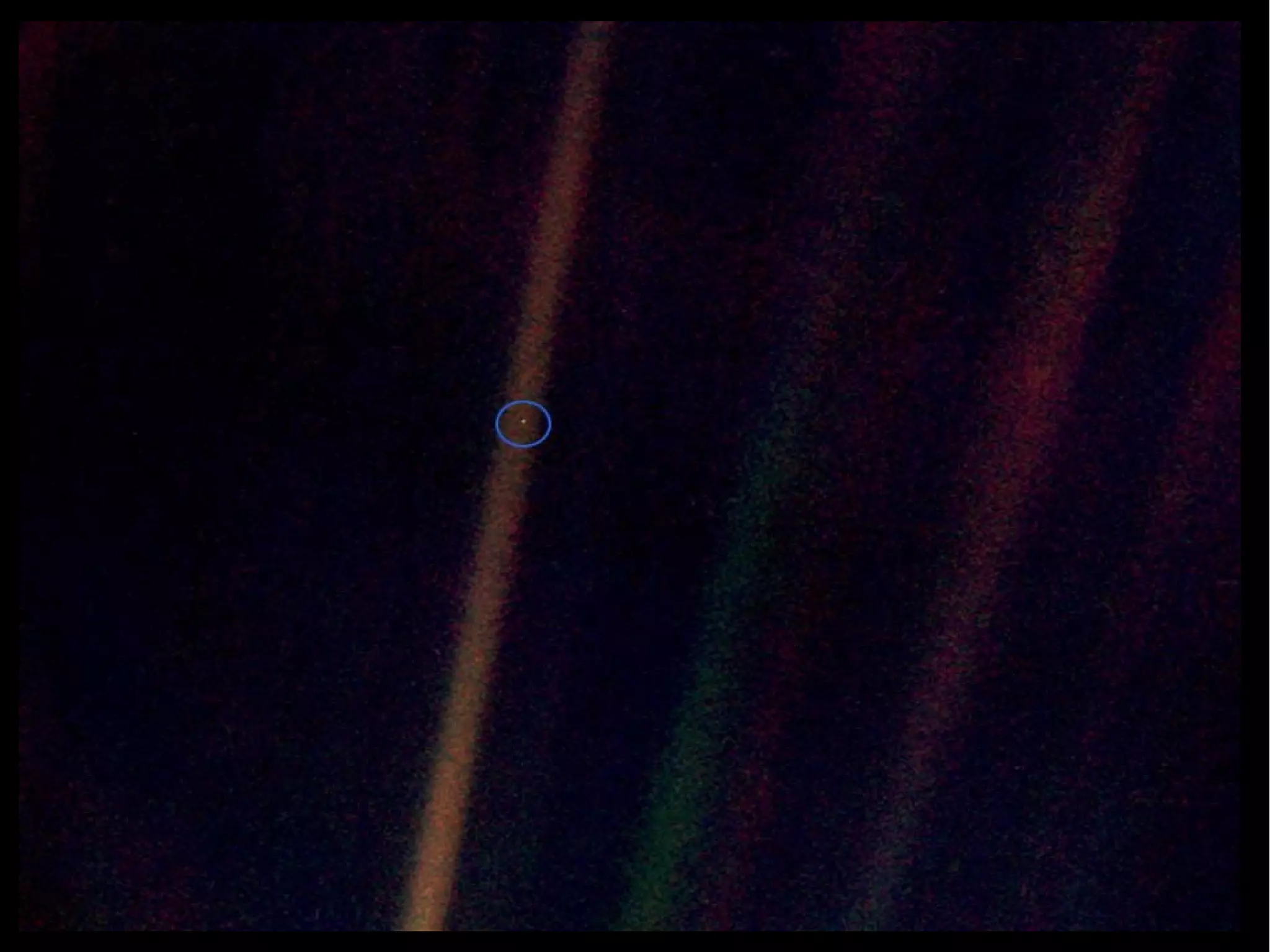
  • #38 Voyager 1, 4 billion miles away. We have turned the tables on the universe: we can understand it.