(Geospatial Semantics – Week 8)
ANUSURIYA DEVARAJU
Institute for Geoinformatics,
University of Muenster.University of Muenster.
(anusuriya.devaraju@uni-muenster.de)
Introduce the principles and key features of Linked
Data(LD).( )
Describes the procedures to publish LD.
Provides examples of existing datasets, tools available for
publishing and using LD.
Introduces the Linked Geo-Data, Linked Geo-Sensor data.
2
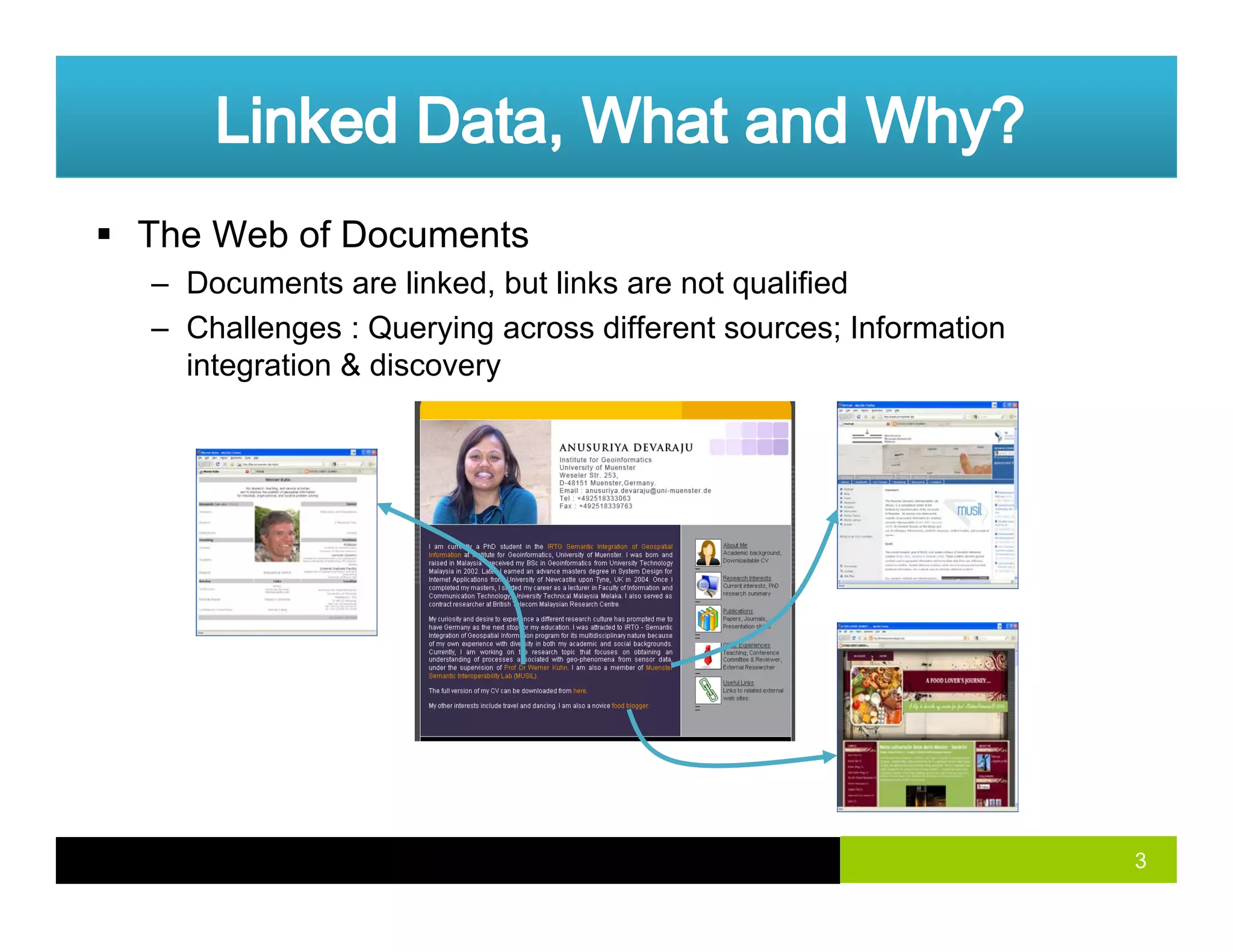
The Web of Documents
– Documents are linked, but links are not qualified, q
– Challenges : Querying across different sources; Information
integration & discovery
3
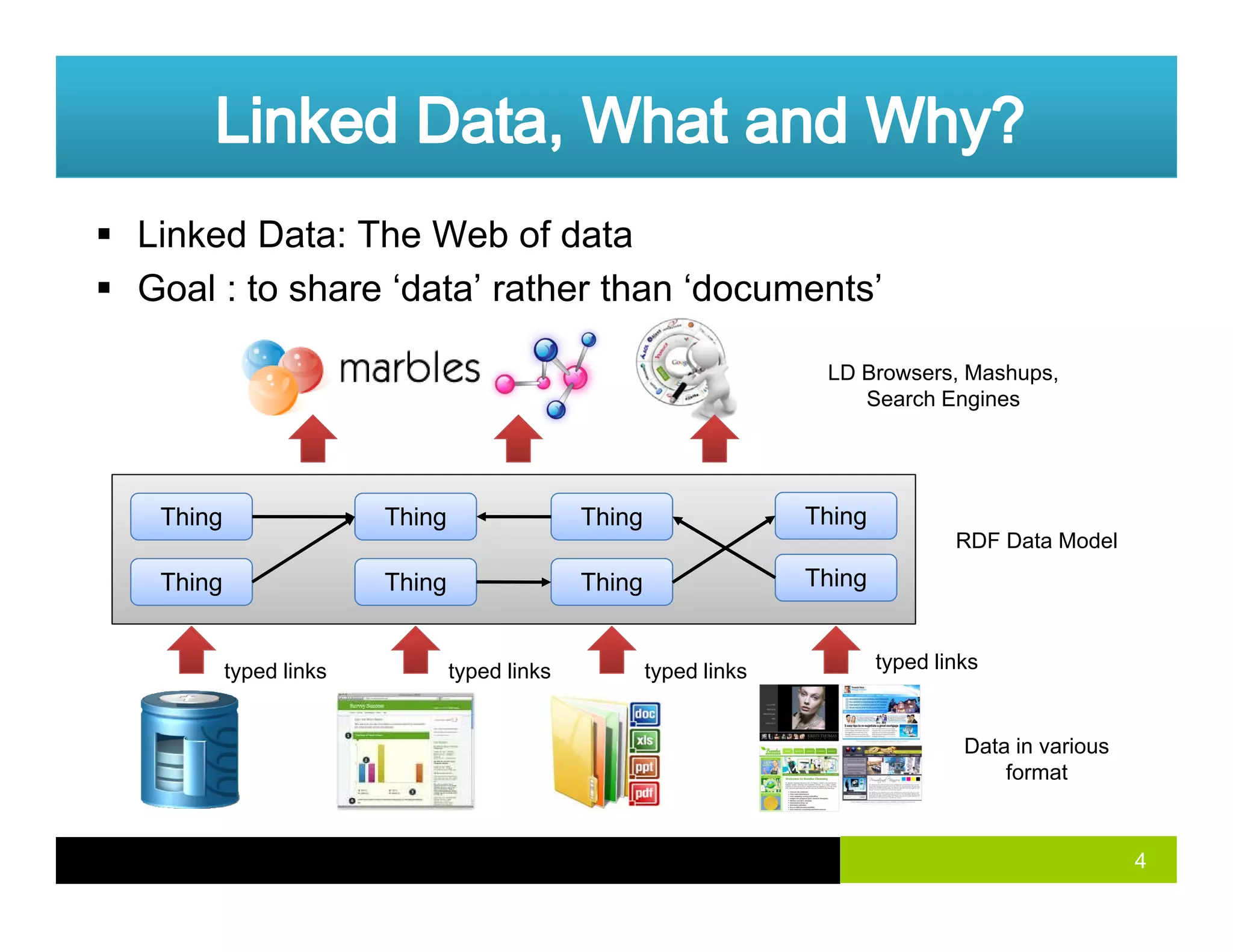
Linked Data: The Web of data
Goal : to share ‘data’ rather than ‘documents’
LD Browsers, Mashups,
Search Engines
Goal : to share data rather than documents
Thing Thing Thing Thing
RDF D t M d l
Thing Thing Thing Thing
RDF Data Model
t d li k
Data in various
format
typed linkstyped linkstyped linkstyped links
format
4
The four rules…
– Use URIs as names for things (anything not just documents)– Use URIs as names for things (anything, not just documents)
– Use HTTP URIs so that people can look up those names.
– When someone looks up a URI, provide useful information, using the
standards (e g RDF SPARQL)standards (e.g., RDF, SPARQL)
– Include RDF links to other URIs to enable the discovery of related
information
5*Reference: http://www.w3.org/DesignIssues/LinkedData.html
Linked data is a style of publishing and interlinking
structured data on the Web that :
– Promotes reuse and reduces redundancy
– Ease of discovery
Ease of consumption due to standards based data sharing– Ease of consumption due to standards-based data sharing
– Added value : build ecosystems around your data/content
6*Reference: http://www.ecom-icom.hku.hk/seminar/20100913/WhiteBebo.pdf
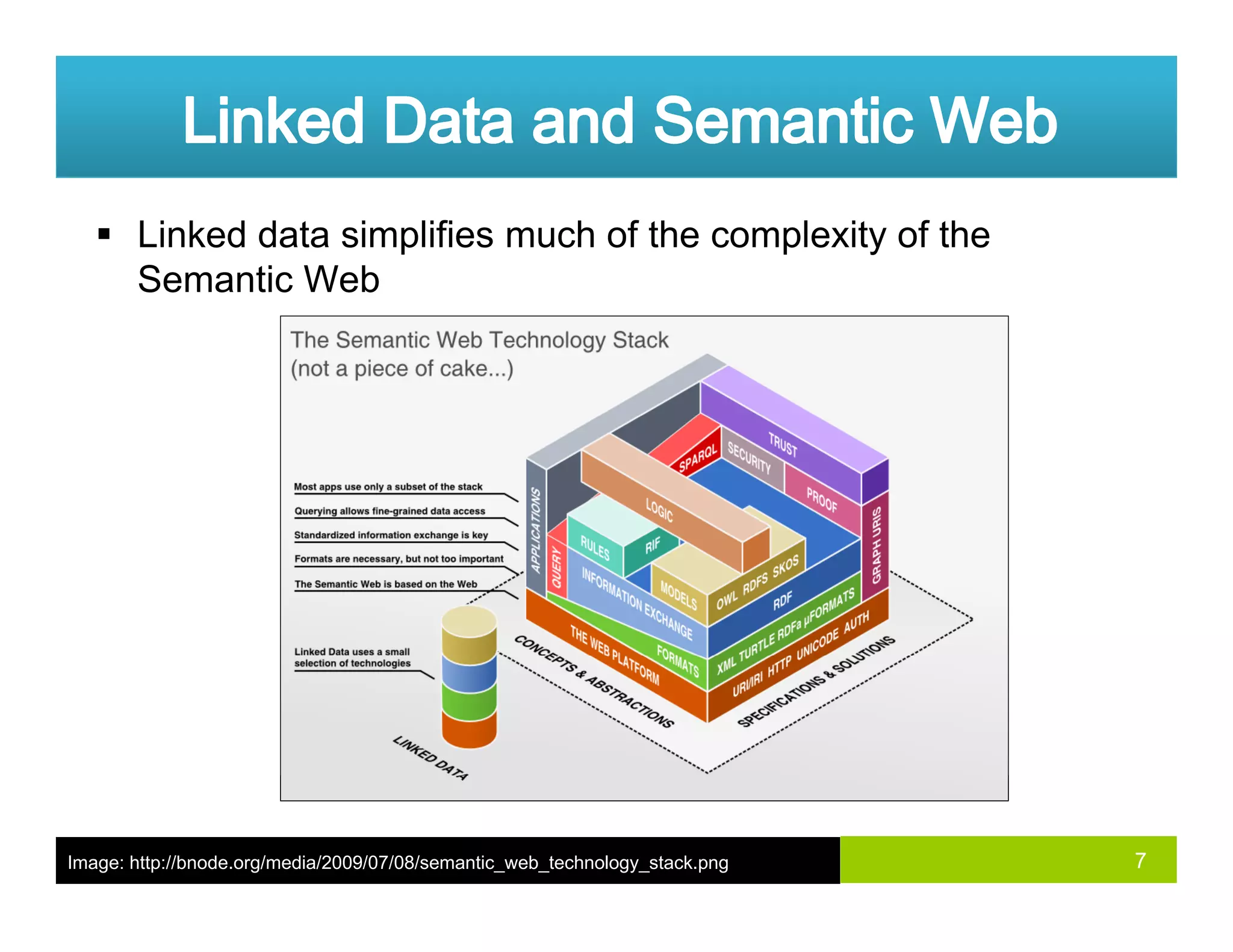
Linked data simplifies much of the complexity of the
Semantic Web
7Image: http://bnode.org/media/2009/07/08/semantic_web_technology_stack.png
Community effort to publish existing datasets as Linked
Data on the WebData on the Web
Interlink things between different data sources
Develop clients that consume Linked Data from the Webp
8http://esw.w3.org/SweoIG/TaskForces/CommunityProjects/LinkingOpenData
Is it used somewhere as well? Ja!
More datasets available at http://linkeddata.org/data‐sets
LOD on the Web Visualization : http://www.webknox.com/blog/2010/05/linked‐
9
open‐data‐on‐the‐web‐visualization/
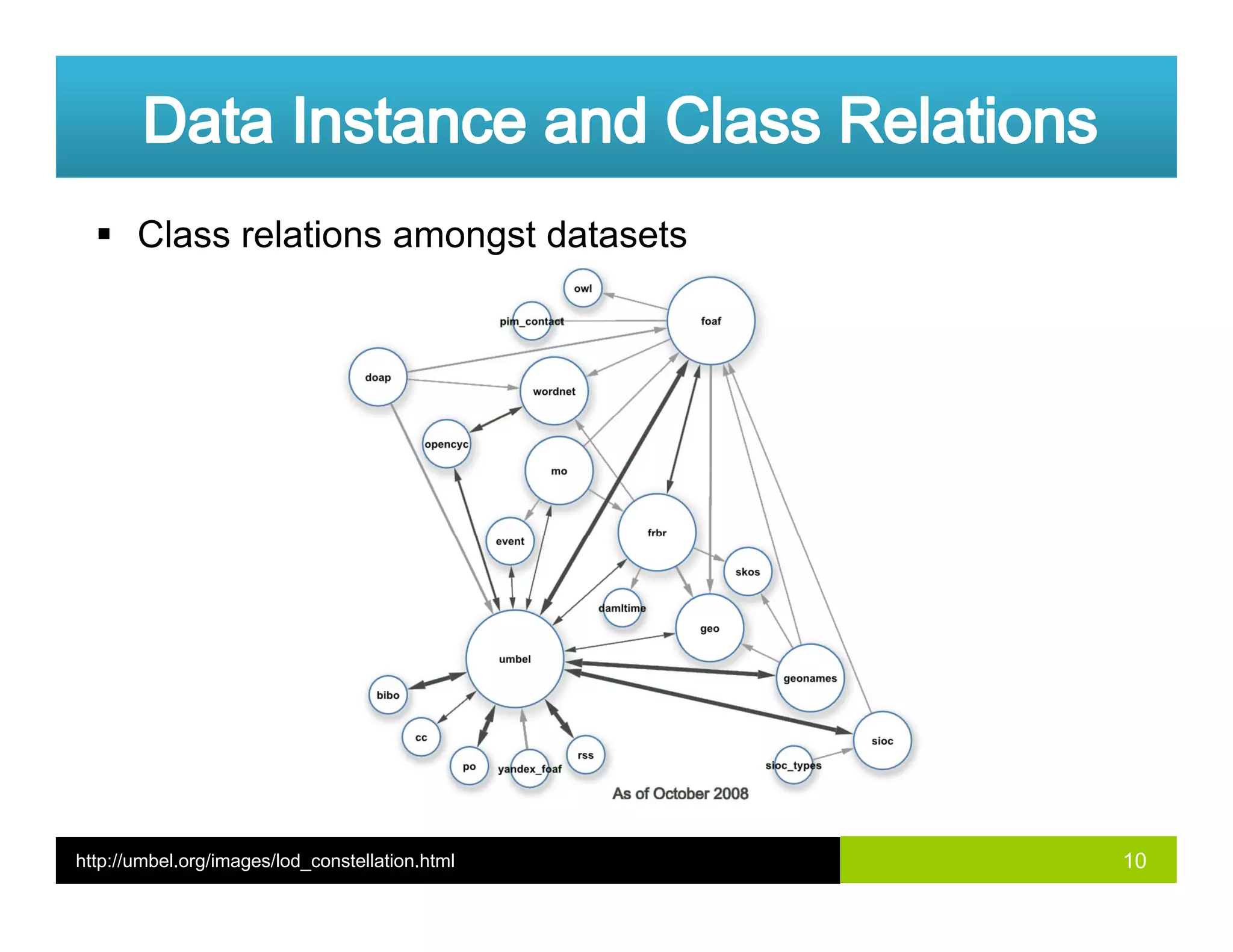
Class relations amongst datasets
10http://umbel.org/images/lod_constellation.html
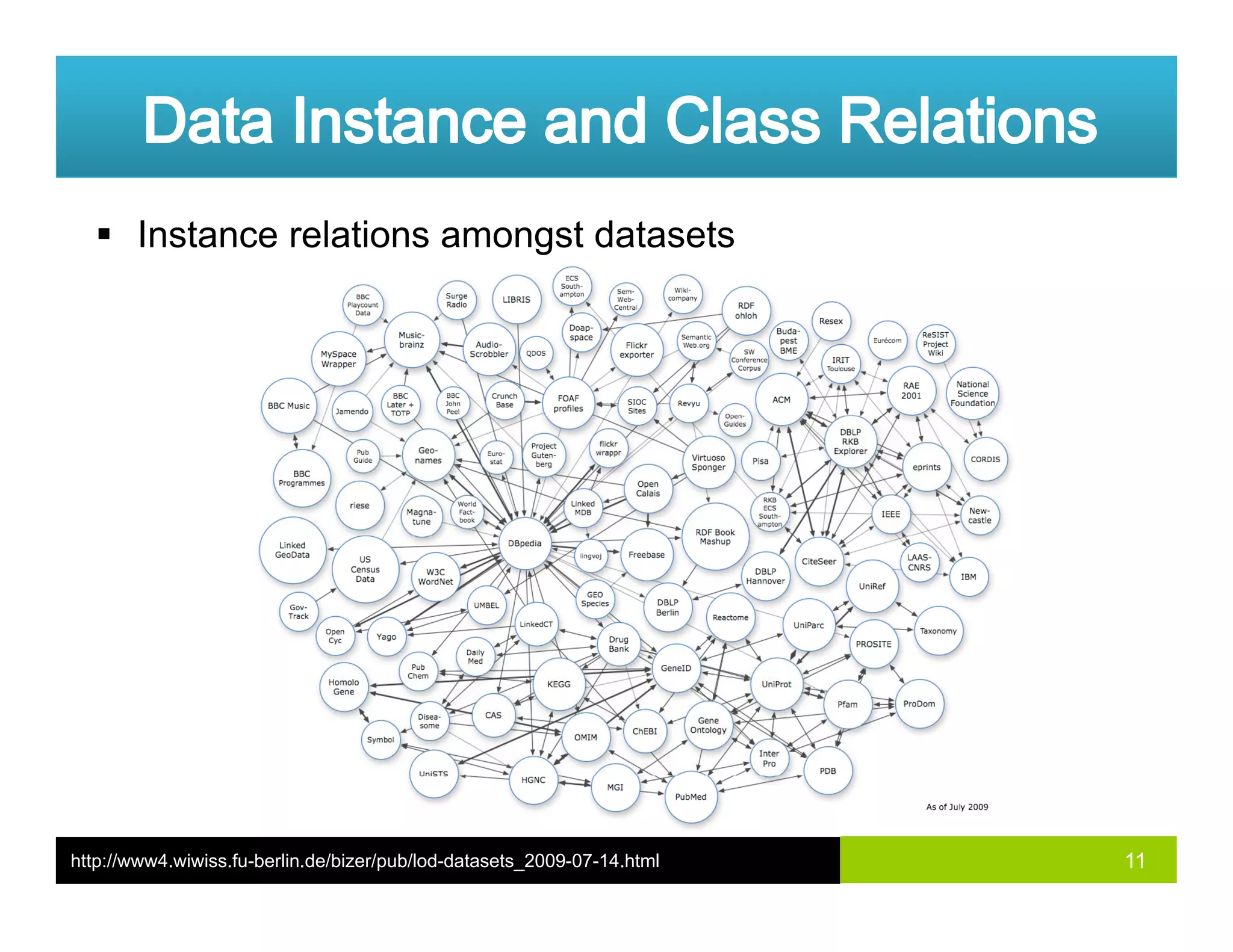
Instance relations amongst datasets
11http://www4.wiwiss.fu-berlin.de/bizer/pub/lod-datasets_2009-07-14.html
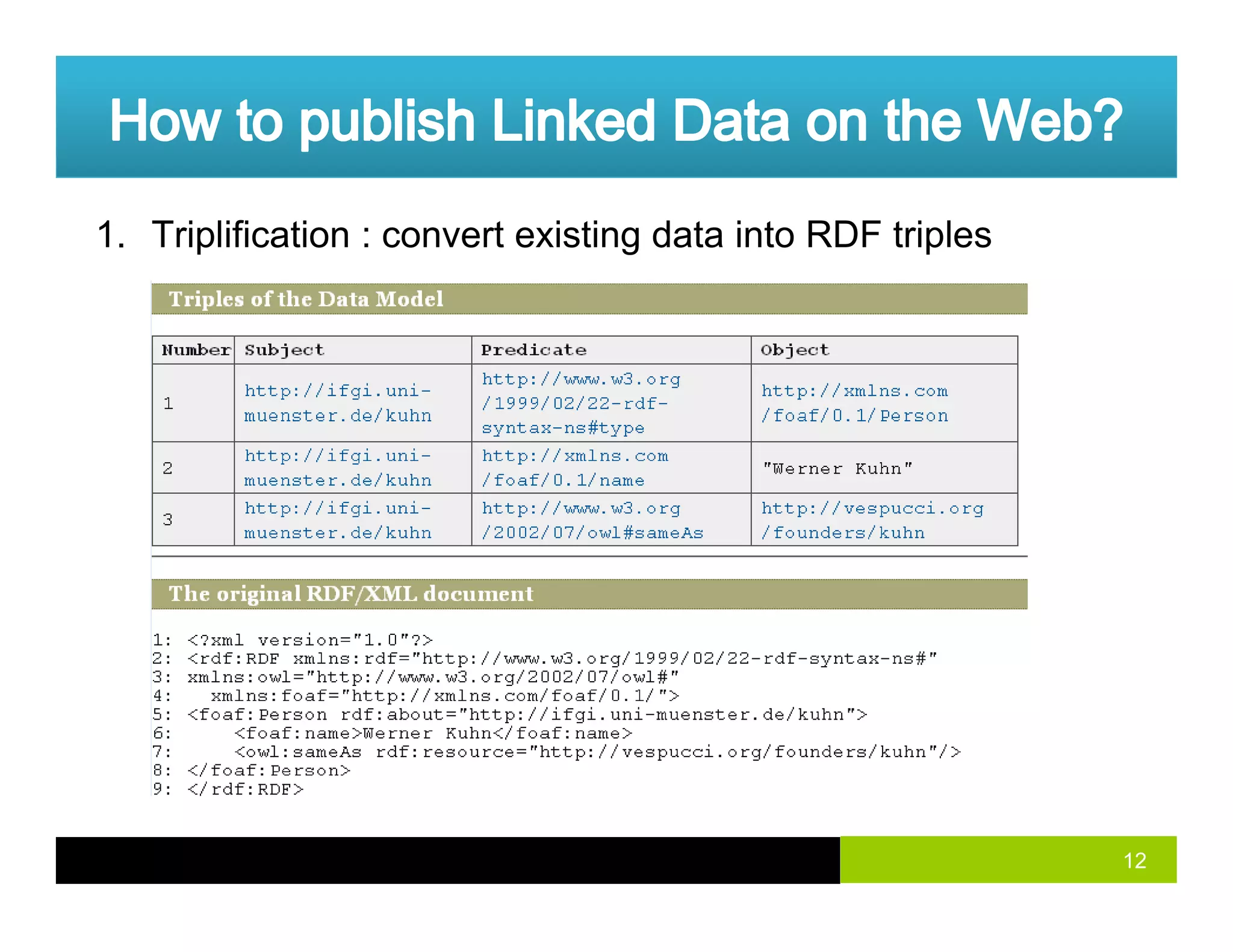
1. Triplification : convert existing data into RDF triples
12
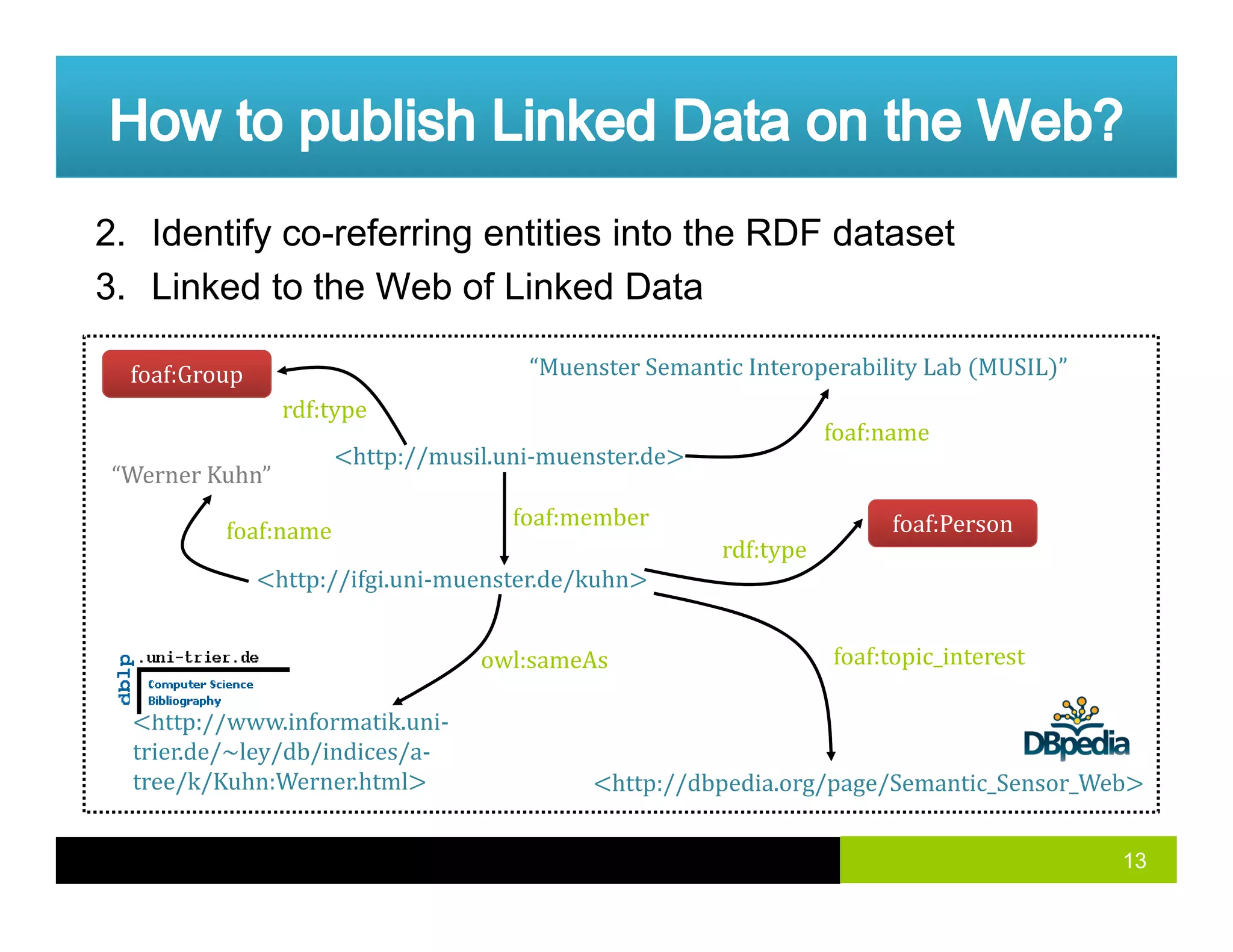
2. Identify co-referring entities into the RDF dataset
3. Linked to the Web of Linked Data3. Linked to the Web of Linked Data
foaf:Groupfoaf:Group
rdf:type
“Muenster Semantic Interoperability Lab  MUSIL ”
foaf:Person
http://musil.uni‐muenster.de
rdf:type
foaf:member
foaf:name
“Werner Kuhn”
foaf:name
http://ifgi.uni‐muenster.de/kuhn
rdf:type
foaf:name
l A foaf:topic interestowl:sameAs
http://www.informatik.uni‐
trier.de/~ley/db/indices/a‐
t /k/K h W ht l h //db di / /S i S W b
foaf:topic_interest
13
tree/k/Kuhn:Werner.html http://dbpedia.org/page/Semantic_Sensor_Web
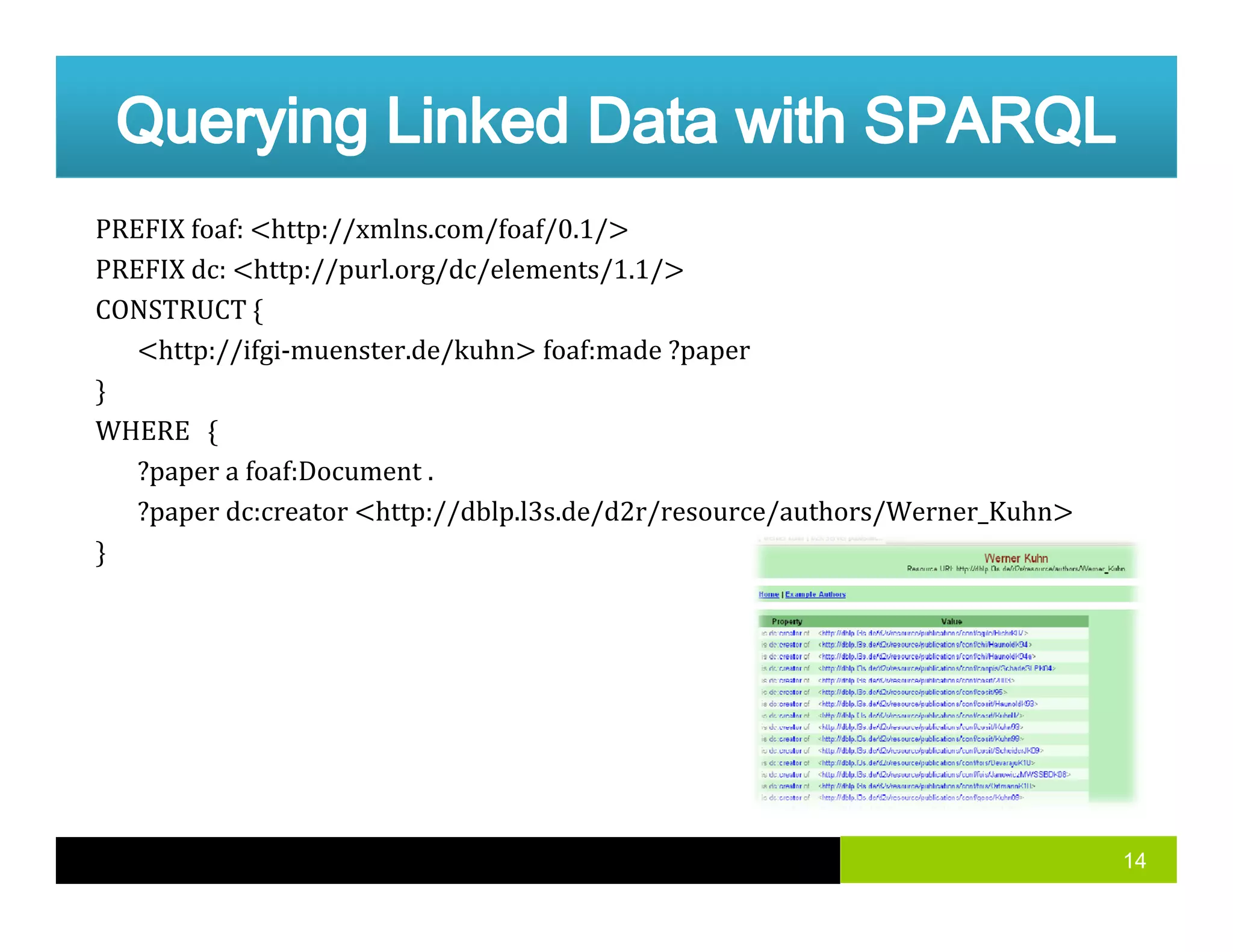
PREFIX foaf:  http://xmlns.com/foaf/0.1/  
PREFIX dc:  http://purl.org/dc/elements/1.1/  
CONSTRUCT   
http://ifgi‐muenster.de/kuhn  foaf:made ?paper 
 
WHERE   
?paper a foaf:Document . 
?paper dc:creator http://dblp.l3s.de/d2r/resource/authors/Werner_Kuhn  
14
Linked Data Browsers, Mashups and other Client
ApplicationsApplications
http://esw.w3.org/TaskForces/CommunityProjects/LinkingOpenData/SemWebC
lients
Linked Data Publishing Platforms/Frameworks D2R Server, 
Pubby, Paget, Talis Platform, etc.
Linked Data/RDF Editors and ValidatorsLinked Data/RDF Editors and Validators Hyena, Vapour
Semantic Web Search Engines
http://esw w3 org/TaskForces/CommunityProjects/LinkingOpenData/Semantichttp://esw.w3.org/TaskForces/CommunityProjects/LinkingOpenData/Semantic
WebSearchEngines
15
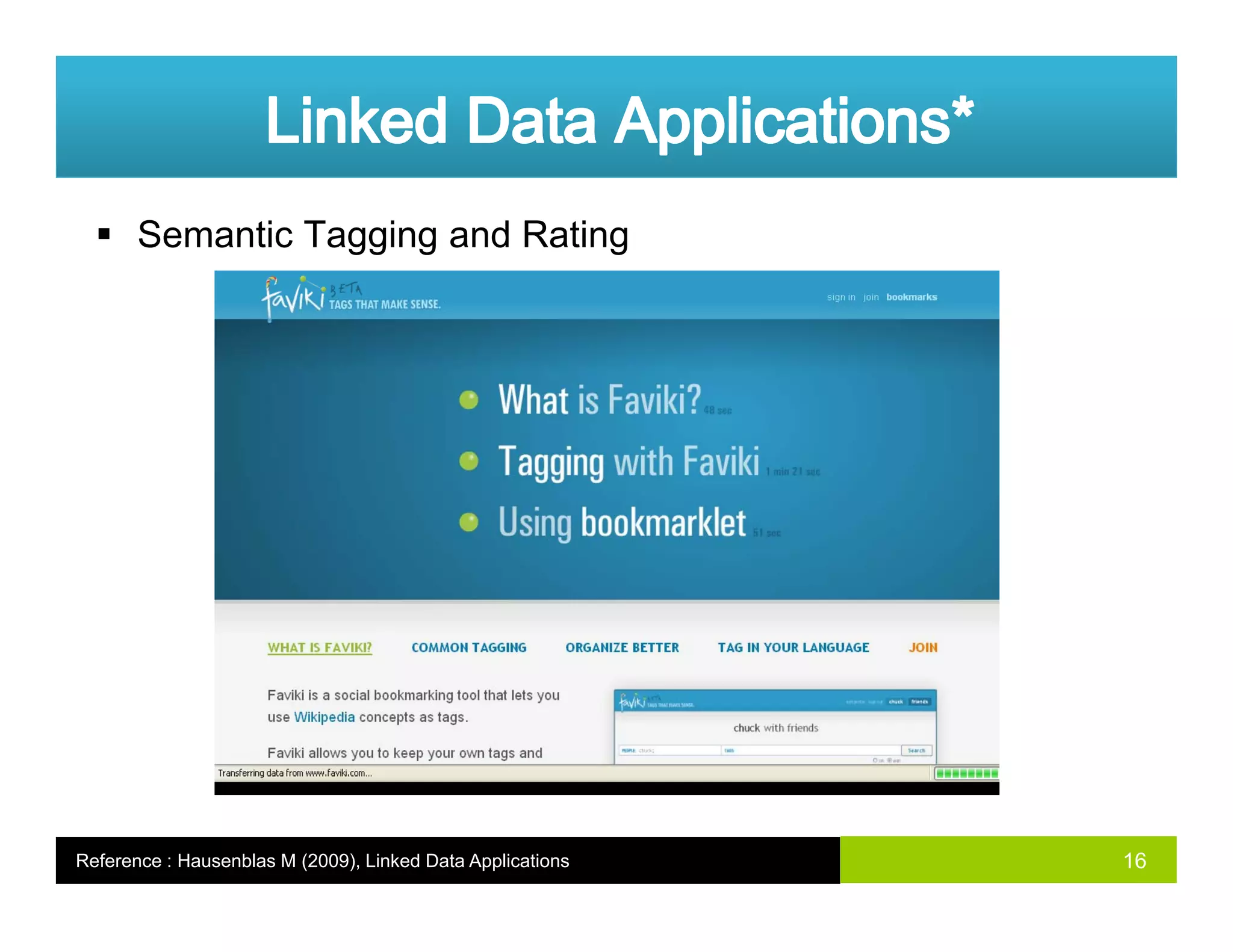
Semantic Tagging and Rating
16Reference : Hausenblas M (2009), Linked Data Applications
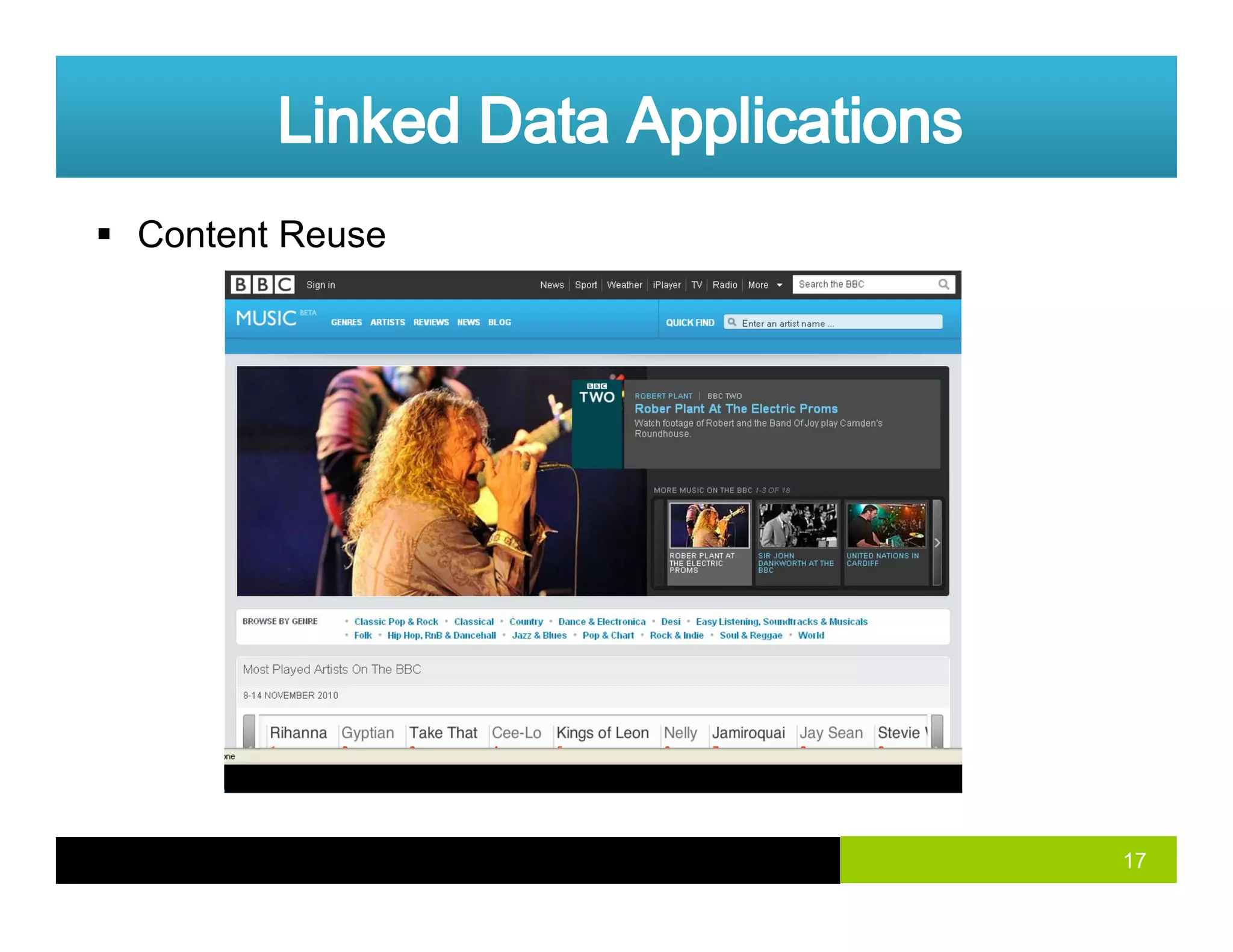
Content Reuse
17
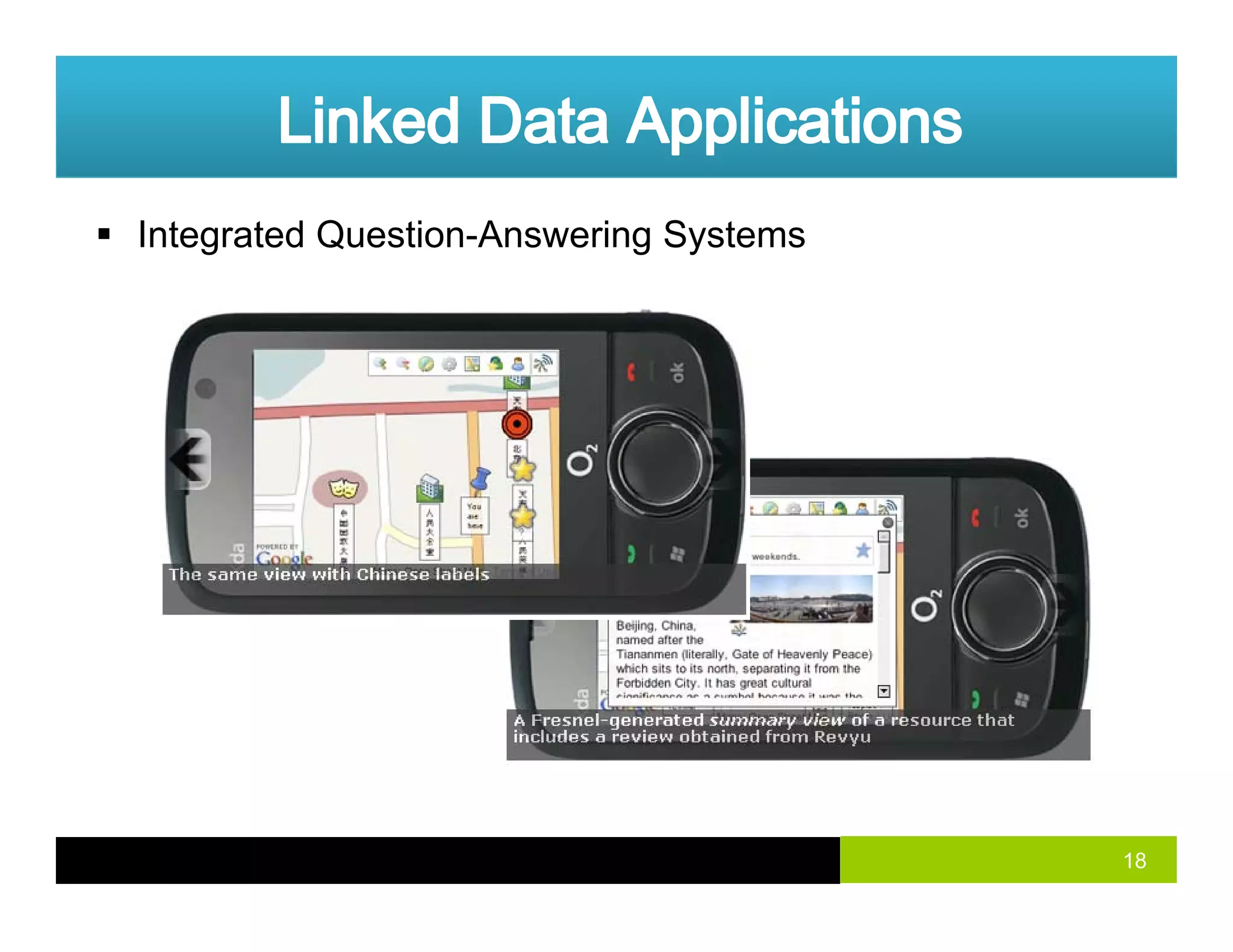
Integrated Question-Answering Systems
18
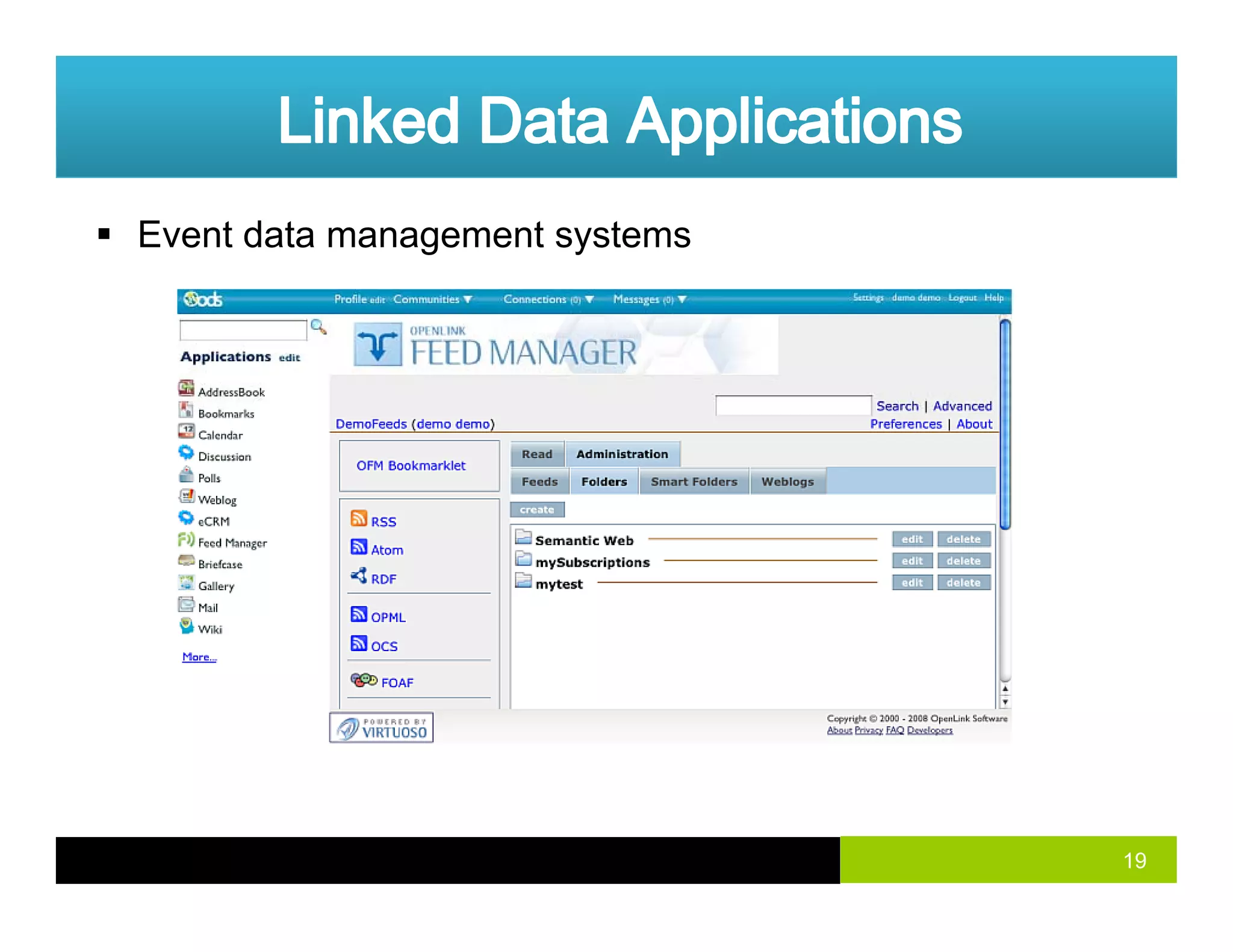
Event data management systems
19
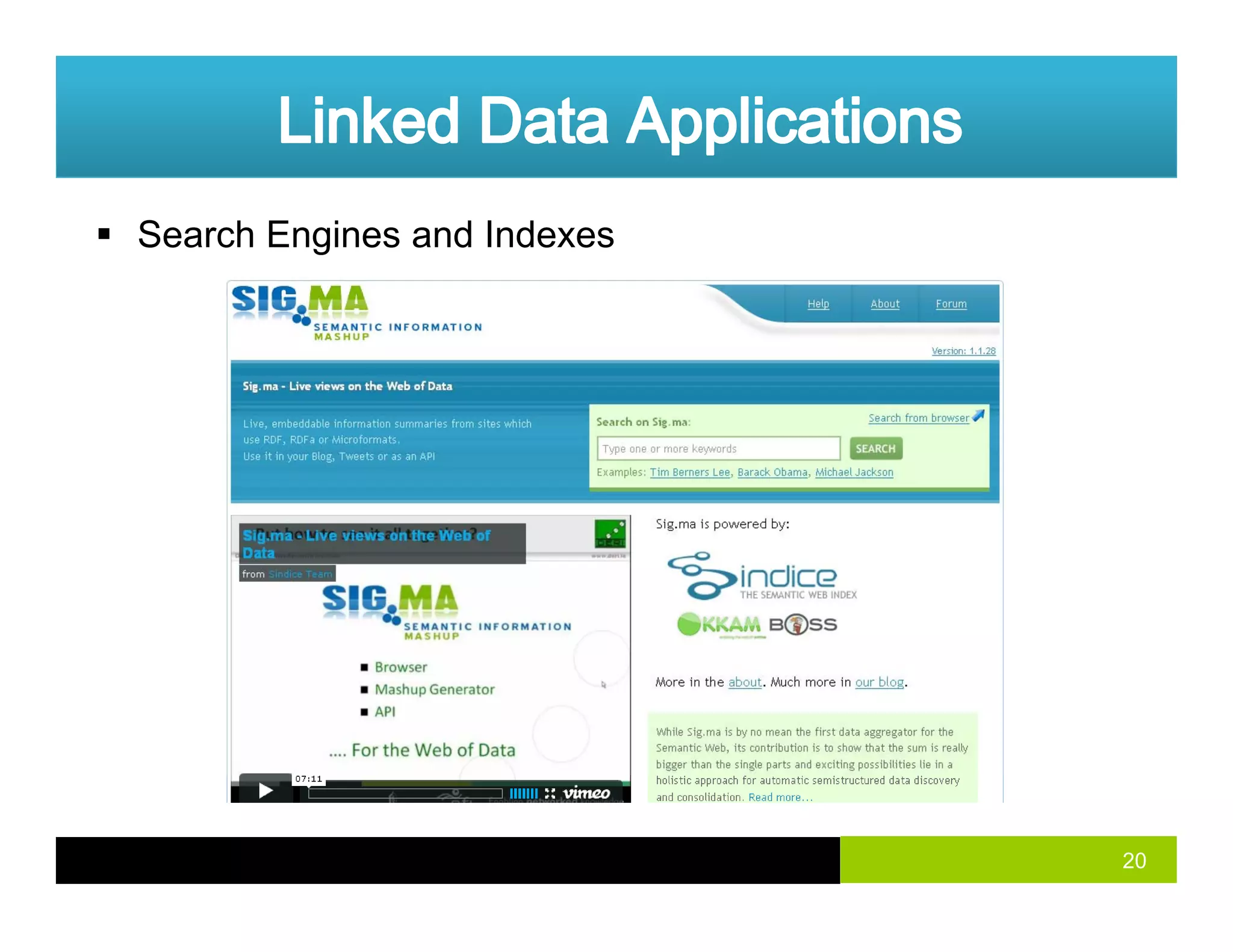
Search Engines and Indexes
20
User Interfaces and Interaction Paradigms
– Navigation controls in a LD browserg
Application Architecture
– Scalability problems with on-the-fly link traversal and federated
queryingquerying
Schema Mapping and Data Fusion
– Resolving semantic conflicts (e.g., mix terminology from different
vocabularies)vocabularies)
Link maintenance
– Dead links, informing link sources about changes via subscription
modelsmodels
21Reference: Bizer C (2009), Linked Data – The Story So Far
Licensing : Data reused and republished
Trust, Quality and RelevanceTrust, Quality and Relevance
– Data relevant or appropriate to the user’s need
– Integrated view of data provenance and trustworthiness
PrivacyPrivacy
– Higher awareness of the users about the data
– Information accountability
22Reference: Bizer C (2009), Linked Data – The Story So Far
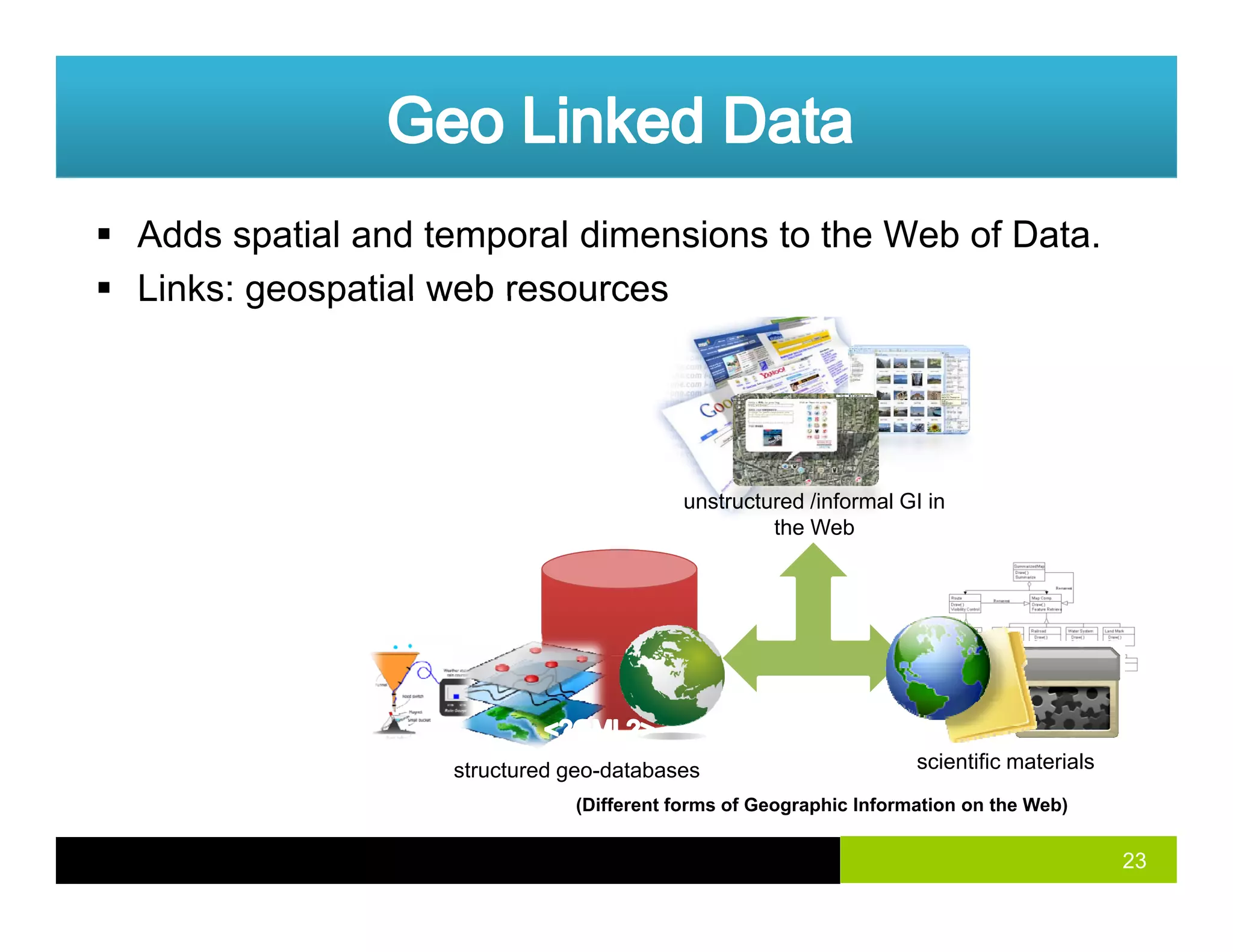
Adds spatial and temporal dimensions to the Web of Data.
Links: geospatial web resourcesLinks: geospatial web resources
unstructured /informal GI in
the Web
structured geo-databases scientific materials
23
structured geo databases
(Different forms of Geographic Information on the Web)
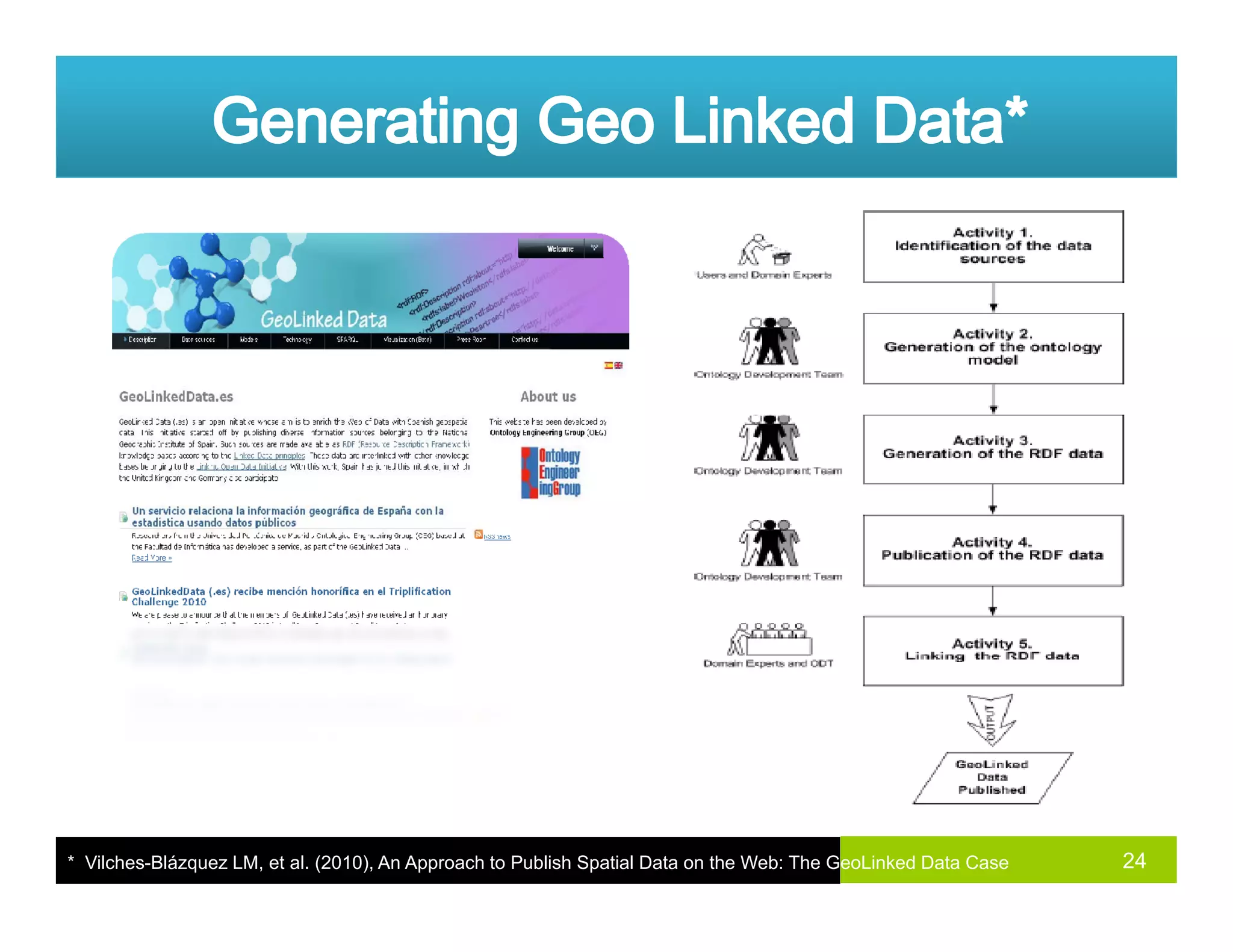
24* Vilches-Blázquez LM, et al. (2010), An Approach to Publish Spatial Data on the Web: The GeoLinked Data Case
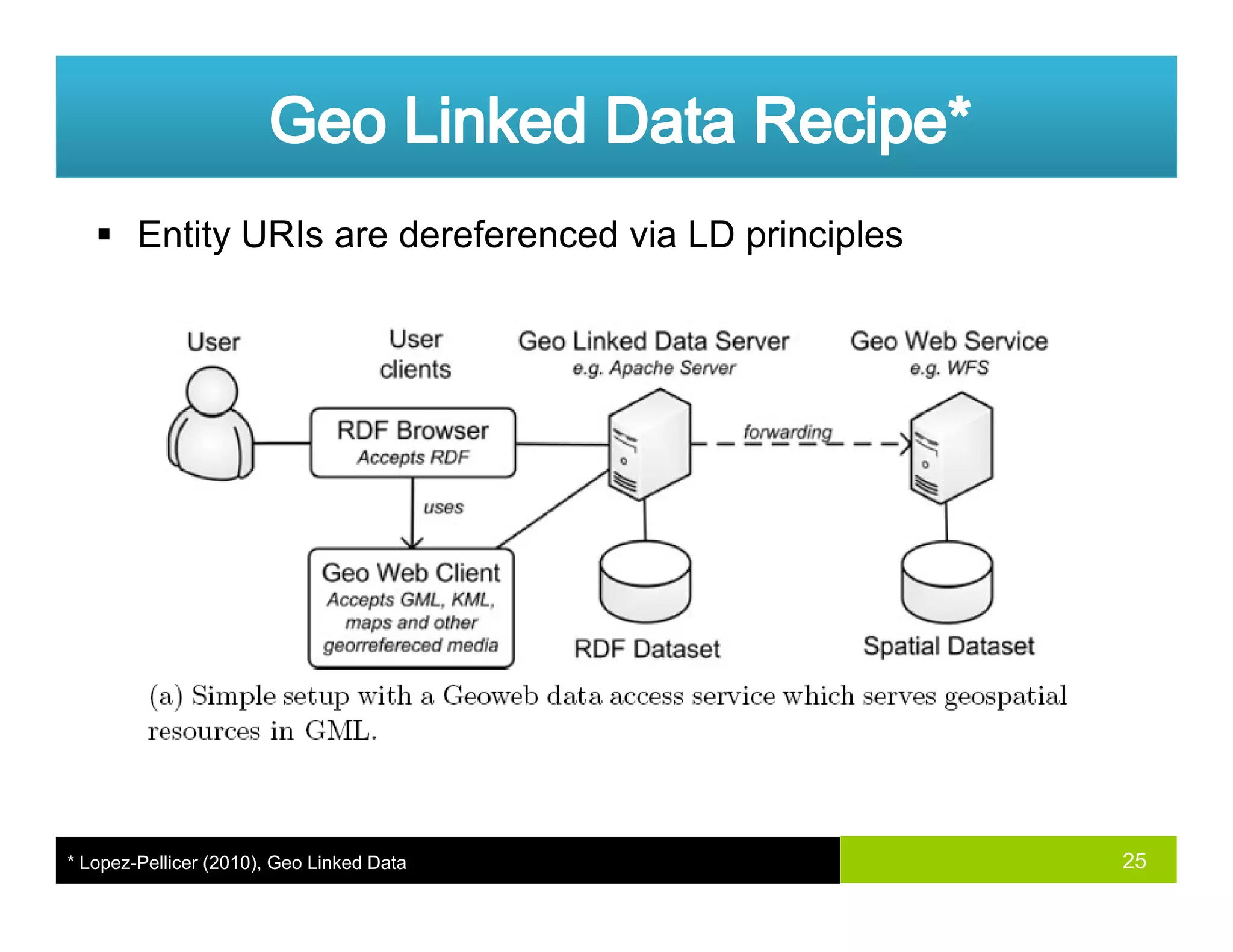
Entity URIs are dereferenced via LD principles
25* Lopez-Pellicer (2010), Geo Linked Data
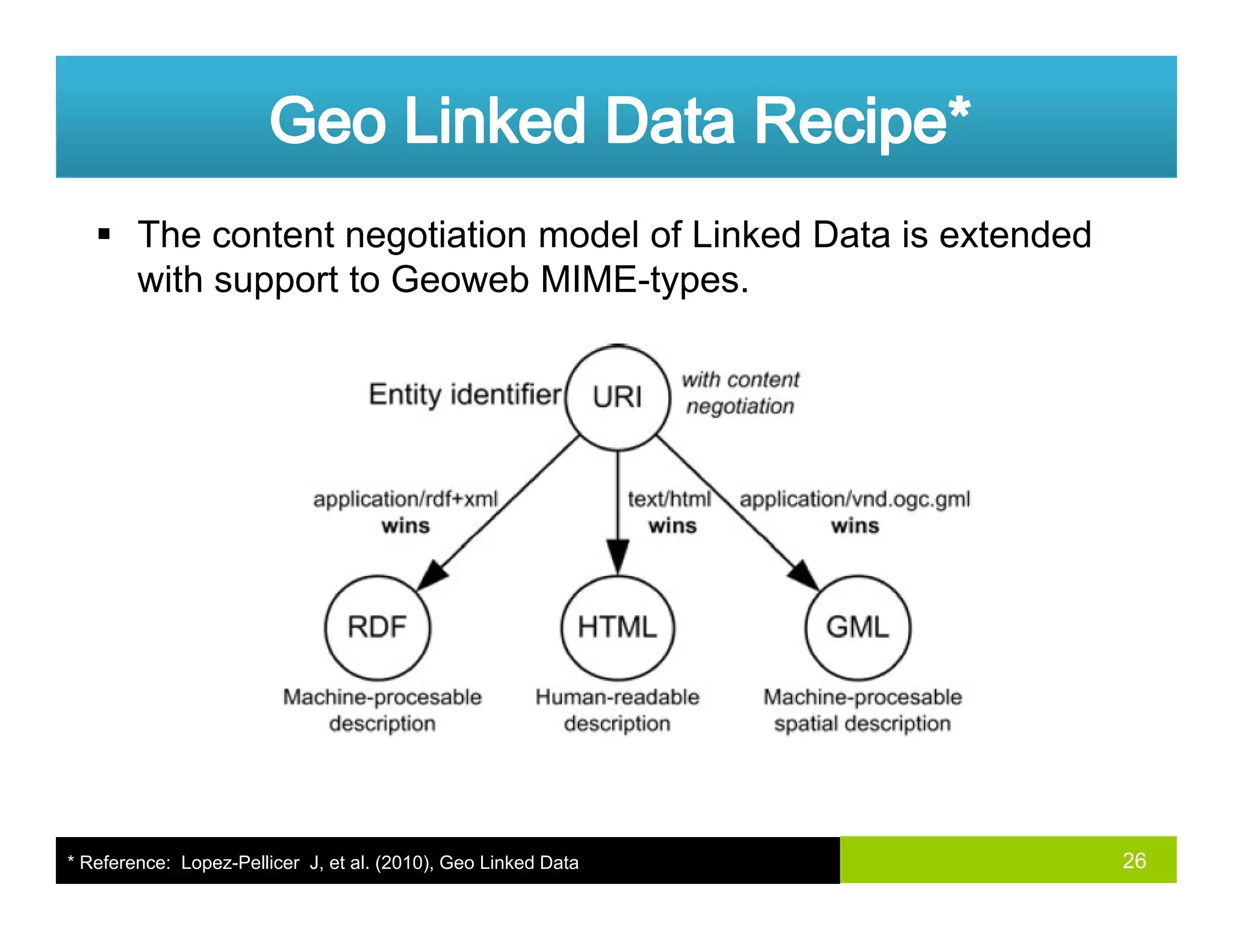
The content negotiation model of Linked Data is extended
with support to Geoweb MIME-types.pp yp
26* Reference: Lopez-Pellicer J, et al. (2010), Geo Linked Data
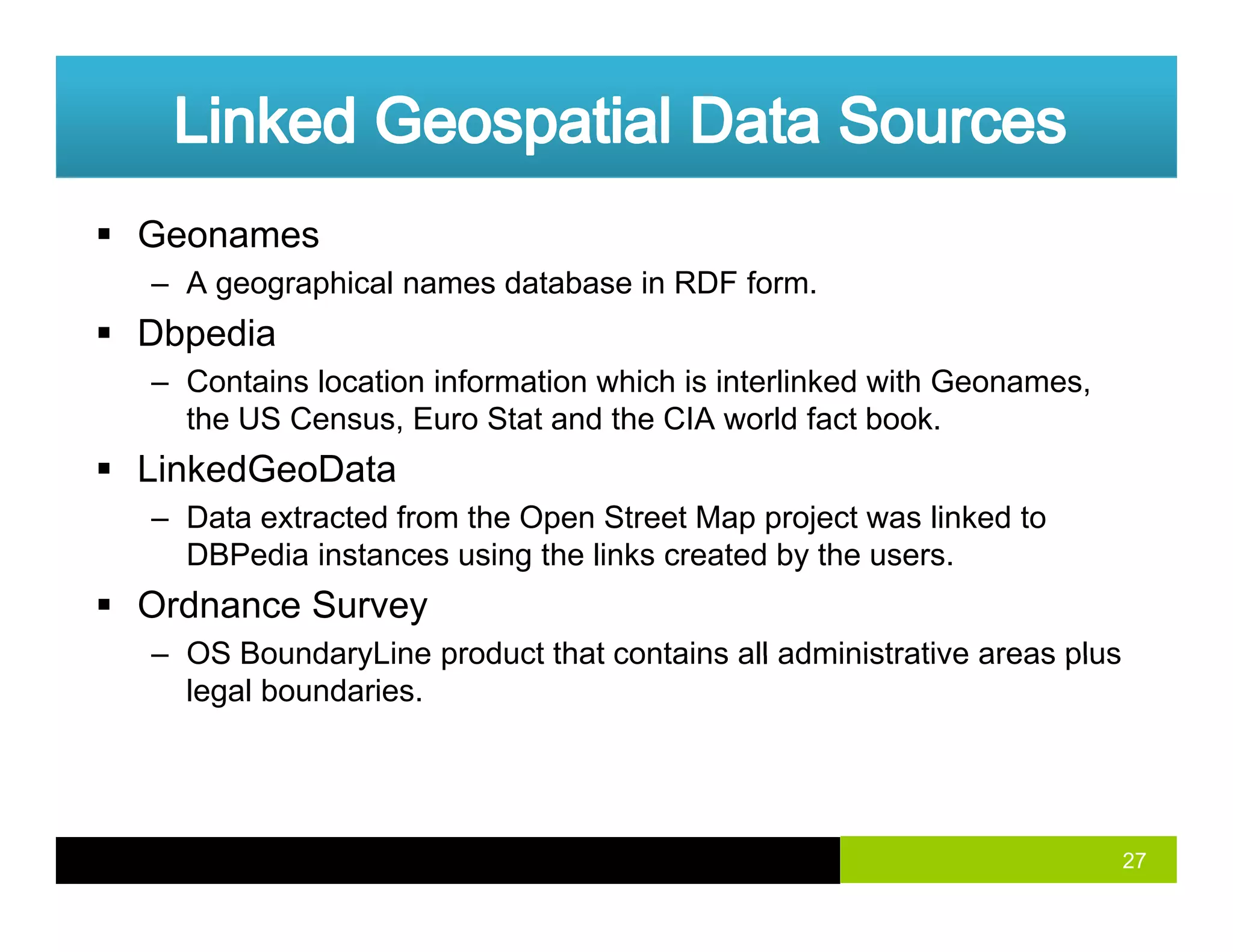
Geonames
– A geographical names database in RDF form.g g p
Dbpedia
– Contains location information which is interlinked with Geonames,
the US Census Euro Stat and the CIA world fact bookthe US Census, Euro Stat and the CIA world fact book.
LinkedGeoData
– Data extracted from the Open Street Map project was linked to
DBPedia instances using the links created by the users.
Ordnance Survey
– OS BoundaryLine product that contains all administrative areas plus– OS BoundaryLine product that contains all administrative areas plus
legal boundaries.
27
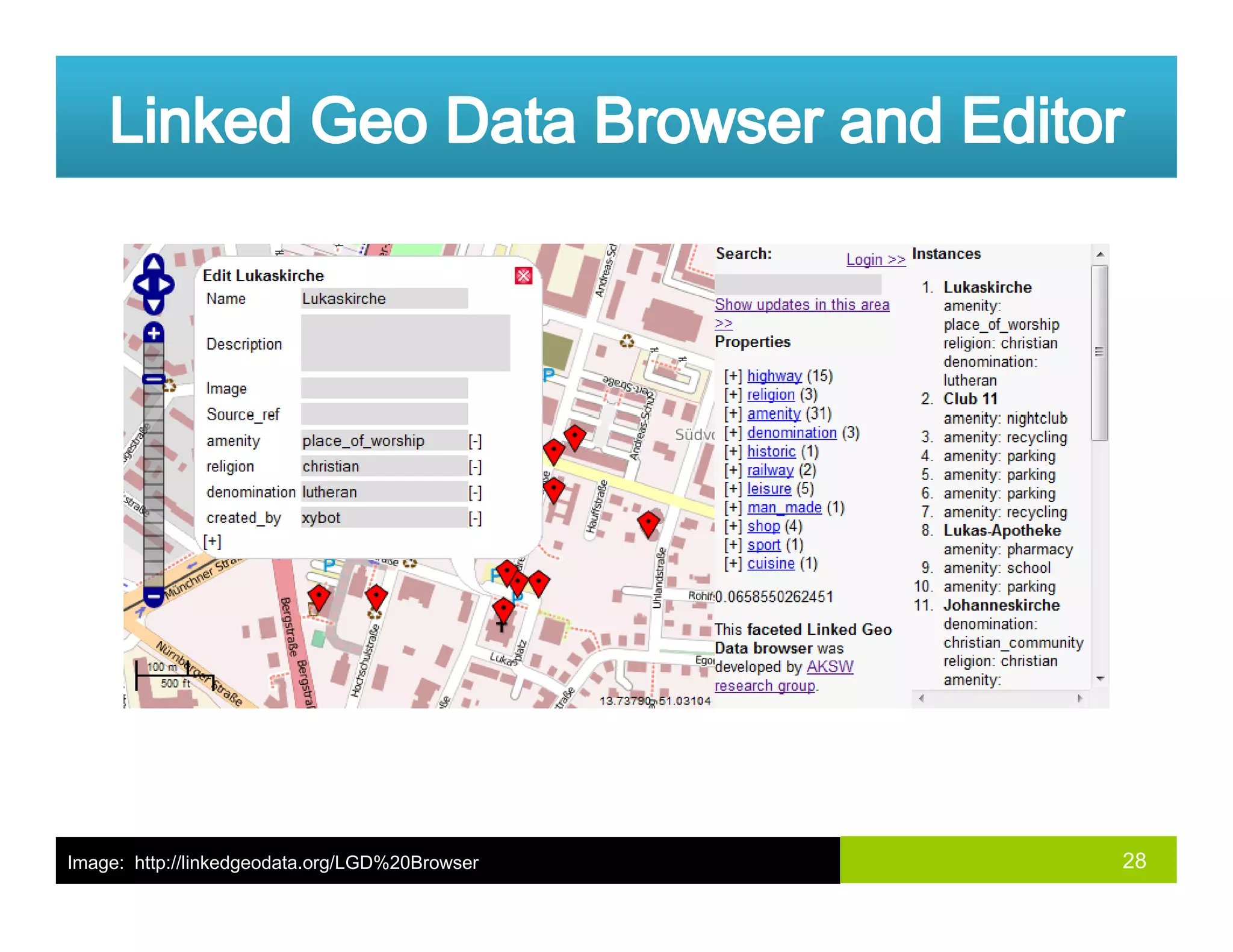
28Image: http://linkedgeodata.org/LGD%20Browser
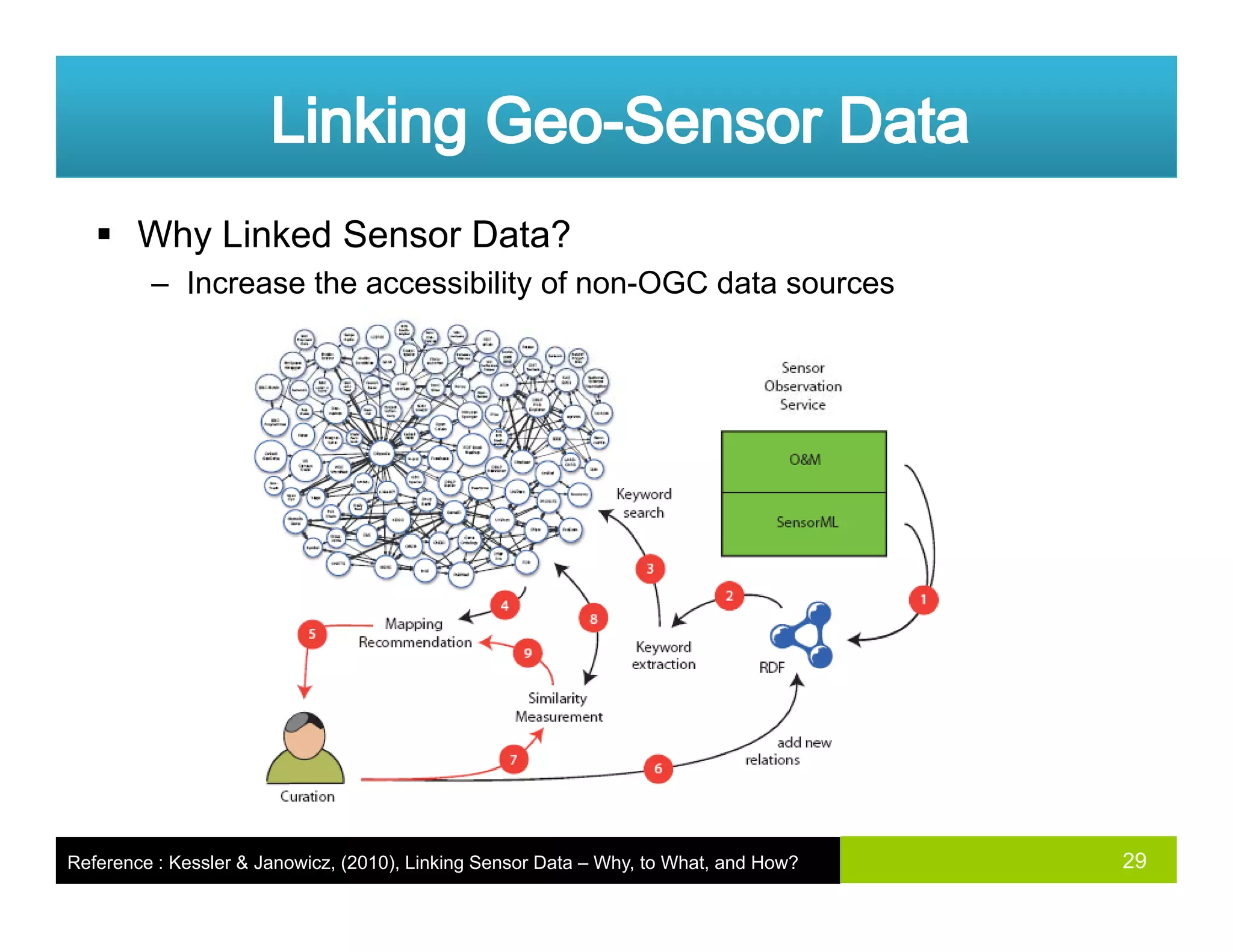
Why Linked Sensor Data?
– Increase the accessibility of non-OGC data sourcesy
29Reference : Kessler & Janowicz, (2010), Linking Sensor Data – Why, to What, and How?
Inclusion of spatial operators in the current Linked Data model
to support complex queries.pp p q
Transformation from geometries to an RDF-based
representation adds complexity.
N dl d d d t d t– Needless and redundant data
‘Browse’ pattern allows the discovery by subsequent links;
‘Query’ pattern is user specified [Schade & Lutz, 2010]Q y p p [ , ]
How both approaches can be combined?
Quality of links
Undefined vocabulary terms, mismatched semantics, etc.
30Reference : Kessler & Janowicz, (2010), Linking Sensor Data – Why, to What, and How?

Linked Data

  • 1.
    (Geospatial Semantics –Week 8) ANUSURIYA DEVARAJU Institute for Geoinformatics, University of Muenster.University of Muenster. (anusuriya.devaraju@uni-muenster.de)
  • 2.
    Introduce the principlesand key features of Linked Data(LD).( ) Describes the procedures to publish LD. Provides examples of existing datasets, tools available for publishing and using LD. Introduces the Linked Geo-Data, Linked Geo-Sensor data. 2
  • 3.
    The Web ofDocuments – Documents are linked, but links are not qualified, q – Challenges : Querying across different sources; Information integration & discovery 3
  • 4.
    Linked Data: TheWeb of data Goal : to share ‘data’ rather than ‘documents’ LD Browsers, Mashups, Search Engines Goal : to share data rather than documents Thing Thing Thing Thing RDF D t M d l Thing Thing Thing Thing RDF Data Model t d li k Data in various format typed linkstyped linkstyped linkstyped links format 4
  • 5.
    The four rules… –Use URIs as names for things (anything not just documents)– Use URIs as names for things (anything, not just documents) – Use HTTP URIs so that people can look up those names. – When someone looks up a URI, provide useful information, using the standards (e g RDF SPARQL)standards (e.g., RDF, SPARQL) – Include RDF links to other URIs to enable the discovery of related information 5*Reference: http://www.w3.org/DesignIssues/LinkedData.html
  • 6.
    Linked data isa style of publishing and interlinking structured data on the Web that : – Promotes reuse and reduces redundancy – Ease of discovery Ease of consumption due to standards based data sharing– Ease of consumption due to standards-based data sharing – Added value : build ecosystems around your data/content 6*Reference: http://www.ecom-icom.hku.hk/seminar/20100913/WhiteBebo.pdf
  • 7.
    Linked data simplifiesmuch of the complexity of the Semantic Web 7Image: http://bnode.org/media/2009/07/08/semantic_web_technology_stack.png
  • 8.
    Community effort topublish existing datasets as Linked Data on the WebData on the Web Interlink things between different data sources Develop clients that consume Linked Data from the Webp 8http://esw.w3.org/SweoIG/TaskForces/CommunityProjects/LinkingOpenData
  • 9.
    Is it usedsomewhere as well? Ja! More datasets available at http://linkeddata.org/data‐sets LOD on the Web Visualization : http://www.webknox.com/blog/2010/05/linked‐ 9 open‐data‐on‐the‐web‐visualization/
  • 10.
    Class relations amongstdatasets 10http://umbel.org/images/lod_constellation.html
  • 11.
    Instance relations amongstdatasets 11http://www4.wiwiss.fu-berlin.de/bizer/pub/lod-datasets_2009-07-14.html
  • 12.
    1. Triplification :convert existing data into RDF triples 12
  • 13.
    2. Identify co-referringentities into the RDF dataset 3. Linked to the Web of Linked Data3. Linked to the Web of Linked Data foaf:Groupfoaf:Group rdf:type “Muenster Semantic Interoperability Lab  MUSIL ” foaf:Person http://musil.uni‐muenster.de rdf:type foaf:member foaf:name “Werner Kuhn” foaf:name http://ifgi.uni‐muenster.de/kuhn rdf:type foaf:name l A foaf:topic interestowl:sameAs http://www.informatik.uni‐ trier.de/~ley/db/indices/a‐ t /k/K h W ht l h //db di / /S i S W b foaf:topic_interest 13 tree/k/Kuhn:Werner.html http://dbpedia.org/page/Semantic_Sensor_Web
  • 14.
    PREFIX foaf:  http://xmlns.com/foaf/0.1/   PREFIX dc: http://purl.org/dc/elements/1.1/   CONSTRUCT    http://ifgi‐muenster.de/kuhn  foaf:made ?paper    WHERE    ?paper a foaf:Document .  ?paper dc:creator http://dblp.l3s.de/d2r/resource/authors/Werner_Kuhn   14
  • 15.
    Linked Data Browsers,Mashups and other Client ApplicationsApplications http://esw.w3.org/TaskForces/CommunityProjects/LinkingOpenData/SemWebC lients Linked Data Publishing Platforms/Frameworks D2R Server,  Pubby, Paget, Talis Platform, etc. Linked Data/RDF Editors and ValidatorsLinked Data/RDF Editors and Validators Hyena, Vapour Semantic Web Search Engines http://esw w3 org/TaskForces/CommunityProjects/LinkingOpenData/Semantichttp://esw.w3.org/TaskForces/CommunityProjects/LinkingOpenData/Semantic WebSearchEngines 15
  • 16.
    Semantic Tagging andRating 16Reference : Hausenblas M (2009), Linked Data Applications
  • 17.
  • 18.
  • 19.
  • 20.
  • 21.
    User Interfaces andInteraction Paradigms – Navigation controls in a LD browserg Application Architecture – Scalability problems with on-the-fly link traversal and federated queryingquerying Schema Mapping and Data Fusion – Resolving semantic conflicts (e.g., mix terminology from different vocabularies)vocabularies) Link maintenance – Dead links, informing link sources about changes via subscription modelsmodels 21Reference: Bizer C (2009), Linked Data – The Story So Far
  • 22.
    Licensing : Datareused and republished Trust, Quality and RelevanceTrust, Quality and Relevance – Data relevant or appropriate to the user’s need – Integrated view of data provenance and trustworthiness PrivacyPrivacy – Higher awareness of the users about the data – Information accountability 22Reference: Bizer C (2009), Linked Data – The Story So Far
  • 23.
    Adds spatial andtemporal dimensions to the Web of Data. Links: geospatial web resourcesLinks: geospatial web resources unstructured /informal GI in the Web structured geo-databases scientific materials 23 structured geo databases (Different forms of Geographic Information on the Web)
  • 24.
    24* Vilches-Blázquez LM,et al. (2010), An Approach to Publish Spatial Data on the Web: The GeoLinked Data Case
  • 25.
    Entity URIs aredereferenced via LD principles 25* Lopez-Pellicer (2010), Geo Linked Data
  • 26.
    The content negotiationmodel of Linked Data is extended with support to Geoweb MIME-types.pp yp 26* Reference: Lopez-Pellicer J, et al. (2010), Geo Linked Data
  • 27.
    Geonames – A geographicalnames database in RDF form.g g p Dbpedia – Contains location information which is interlinked with Geonames, the US Census Euro Stat and the CIA world fact bookthe US Census, Euro Stat and the CIA world fact book. LinkedGeoData – Data extracted from the Open Street Map project was linked to DBPedia instances using the links created by the users. Ordnance Survey – OS BoundaryLine product that contains all administrative areas plus– OS BoundaryLine product that contains all administrative areas plus legal boundaries. 27
  • 28.
  • 29.
    Why Linked SensorData? – Increase the accessibility of non-OGC data sourcesy 29Reference : Kessler & Janowicz, (2010), Linking Sensor Data – Why, to What, and How?
  • 30.
    Inclusion of spatialoperators in the current Linked Data model to support complex queries.pp p q Transformation from geometries to an RDF-based representation adds complexity. N dl d d d t d t– Needless and redundant data ‘Browse’ pattern allows the discovery by subsequent links; ‘Query’ pattern is user specified [Schade & Lutz, 2010]Q y p p [ , ] How both approaches can be combined? Quality of links Undefined vocabulary terms, mismatched semantics, etc. 30Reference : Kessler & Janowicz, (2010), Linking Sensor Data – Why, to What, and How?