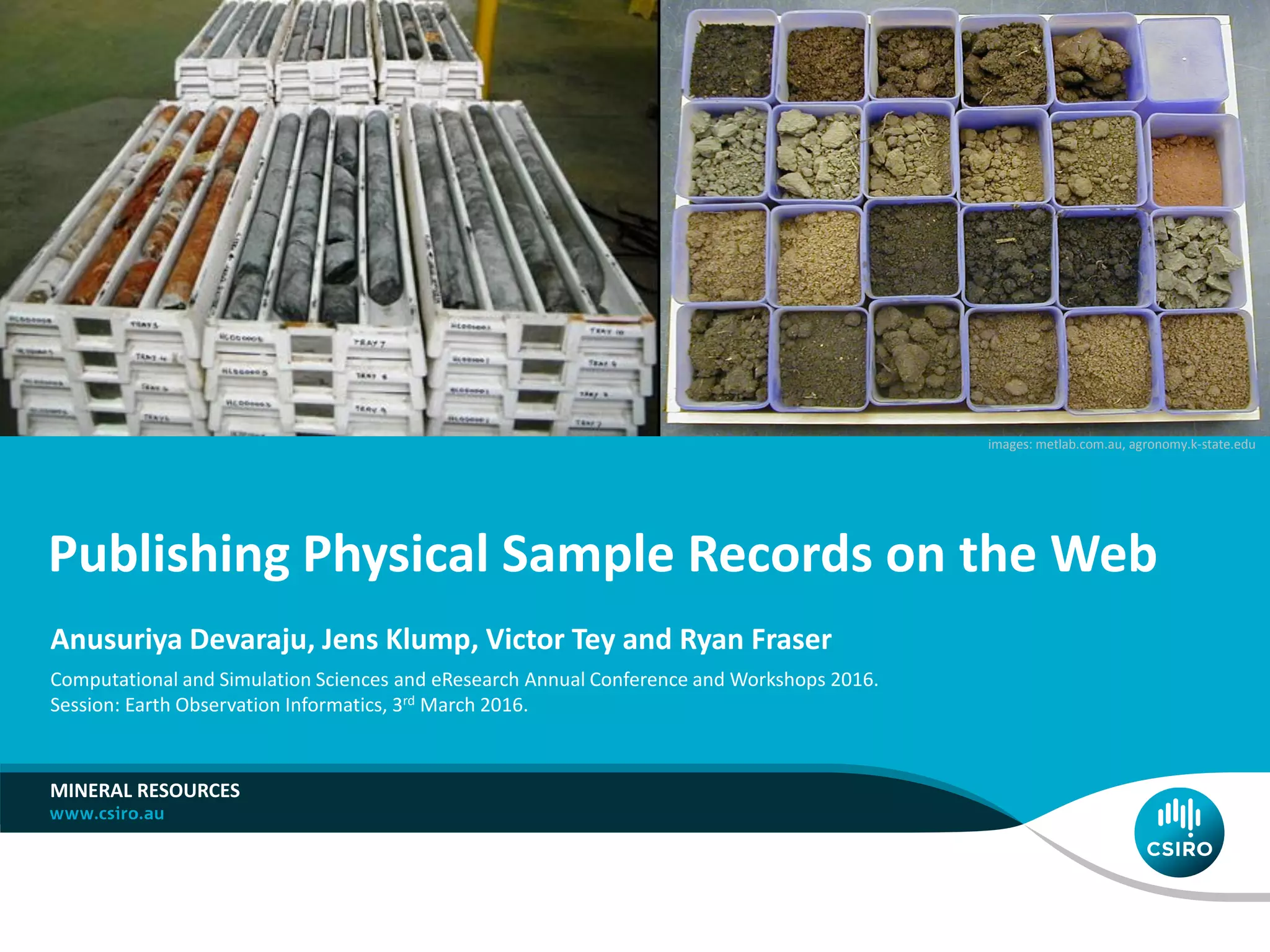
Publishing Physical Sample Records on the Web
MINERAL RESOURCES
Anusuriya Devaraju, Jens Klump, Victor Tey and Ryan Fraser
Computational and Simulation Sciences and eResearch Annual Conference and Workshops 2016.
Session: Earth Observation Informatics, 3rd March 2016.
images: metlab.com.au, agronomy.k-state.edu
Introduction
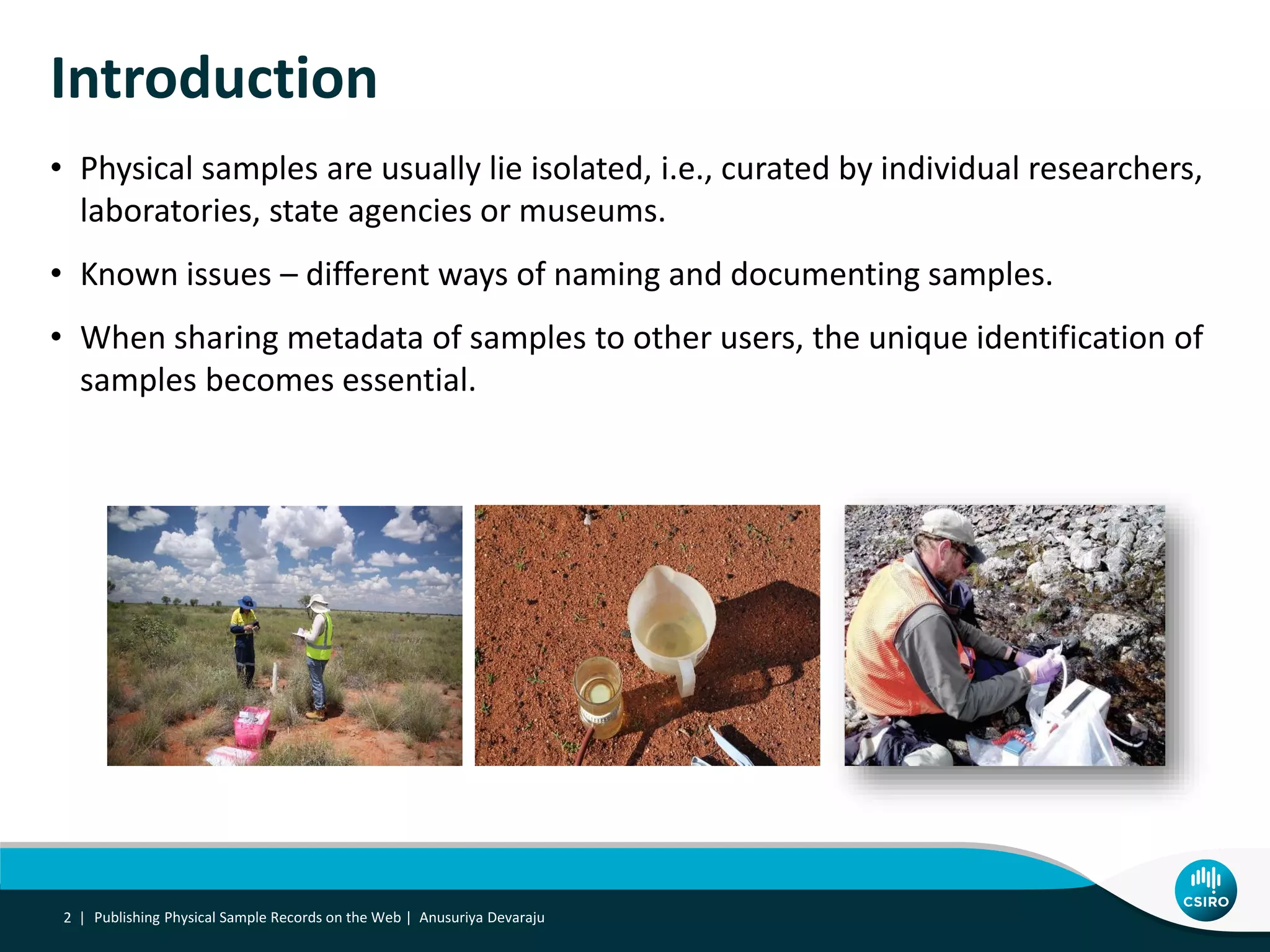
• Physical samples are usually lie isolated, i.e., curated by individual researchers,
laboratories, state agencies or museums.
• Known issues – different ways of naming and documenting samples.
• When sharing metadata of samples to other users, the unique identification of
samples becomes essential.
2 | Publishing Physical Sample Records on the Web | Anusuriya Devaraju
Examples: Naming Ambiguity of Samples
Publishing Physical Sample Records on the Web | Anusuriya Devaraju3 |
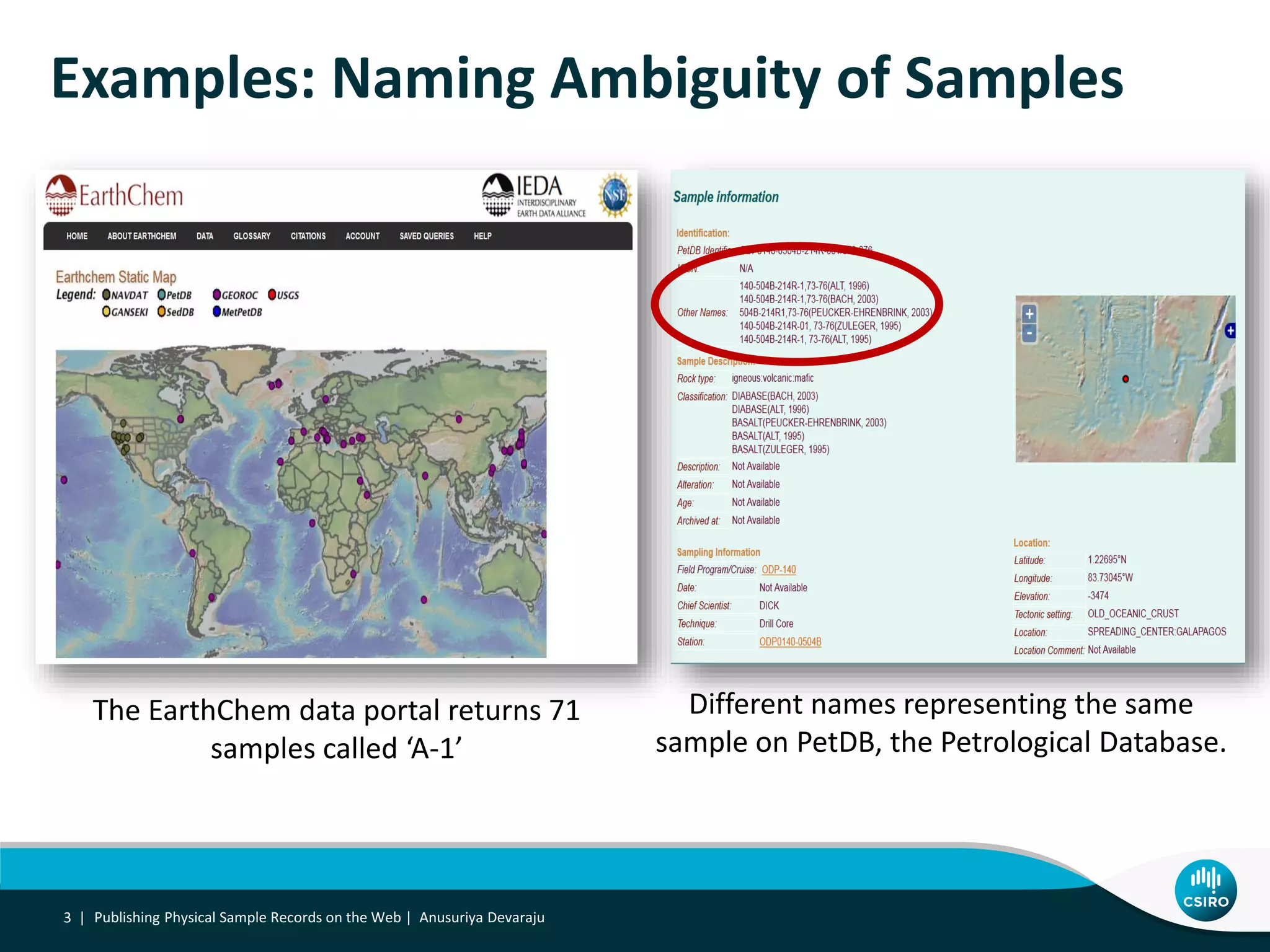
Different names representing the same
sample on PetDB, the Petrological Database.
The EarthChem data portal returns 71
samples called ‘A-1’
International Geo Sample Number (IGSN)
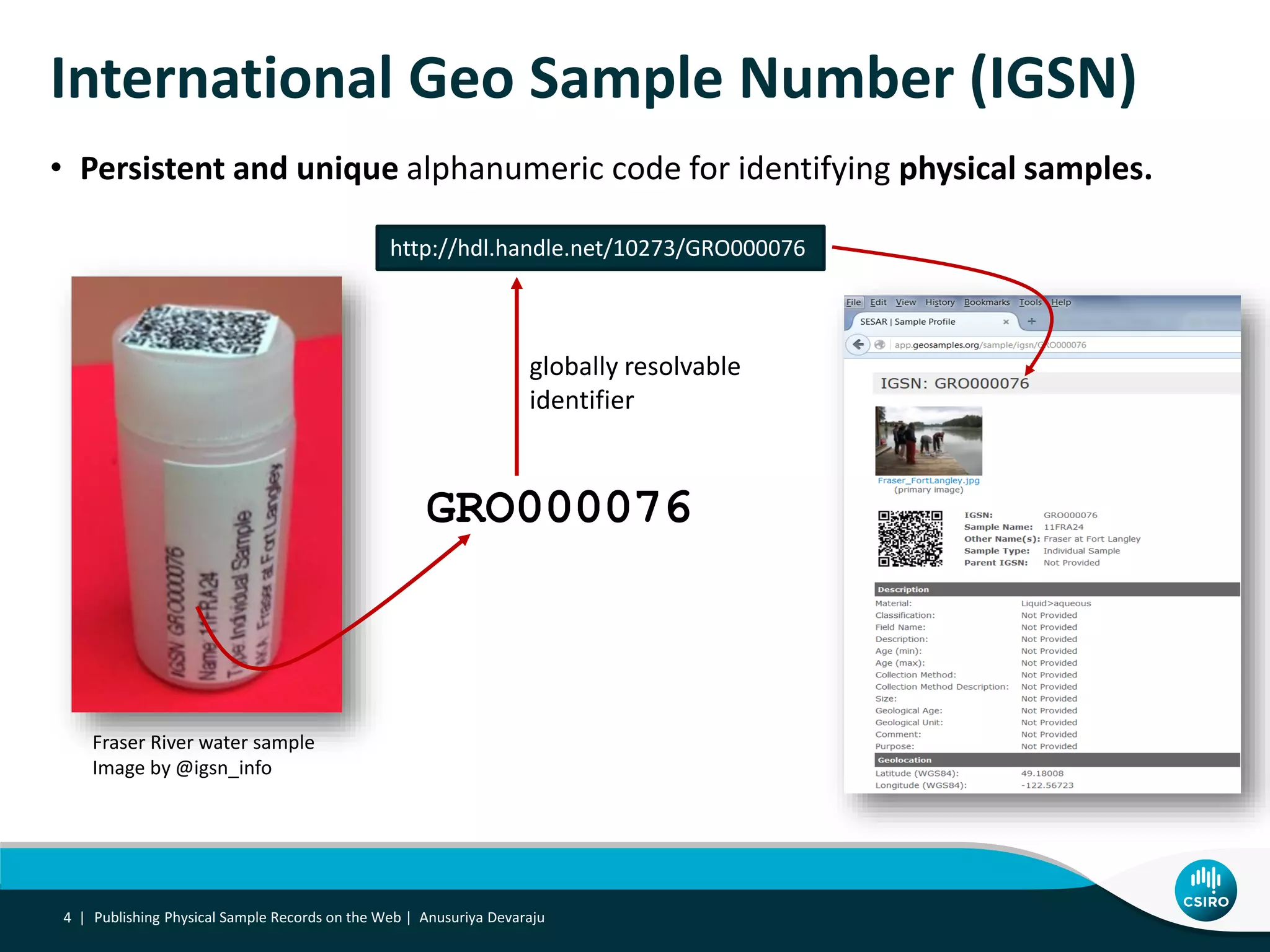
• Persistent and unique alphanumeric code for identifying physical samples.
Publishing Physical Sample Records on the Web | Anusuriya Devaraju4 |
GRO000076
Fraser River water sample
Image by @igsn_info
http://hdl.handle.net/10273/GRO000076
globally resolvable
identifier
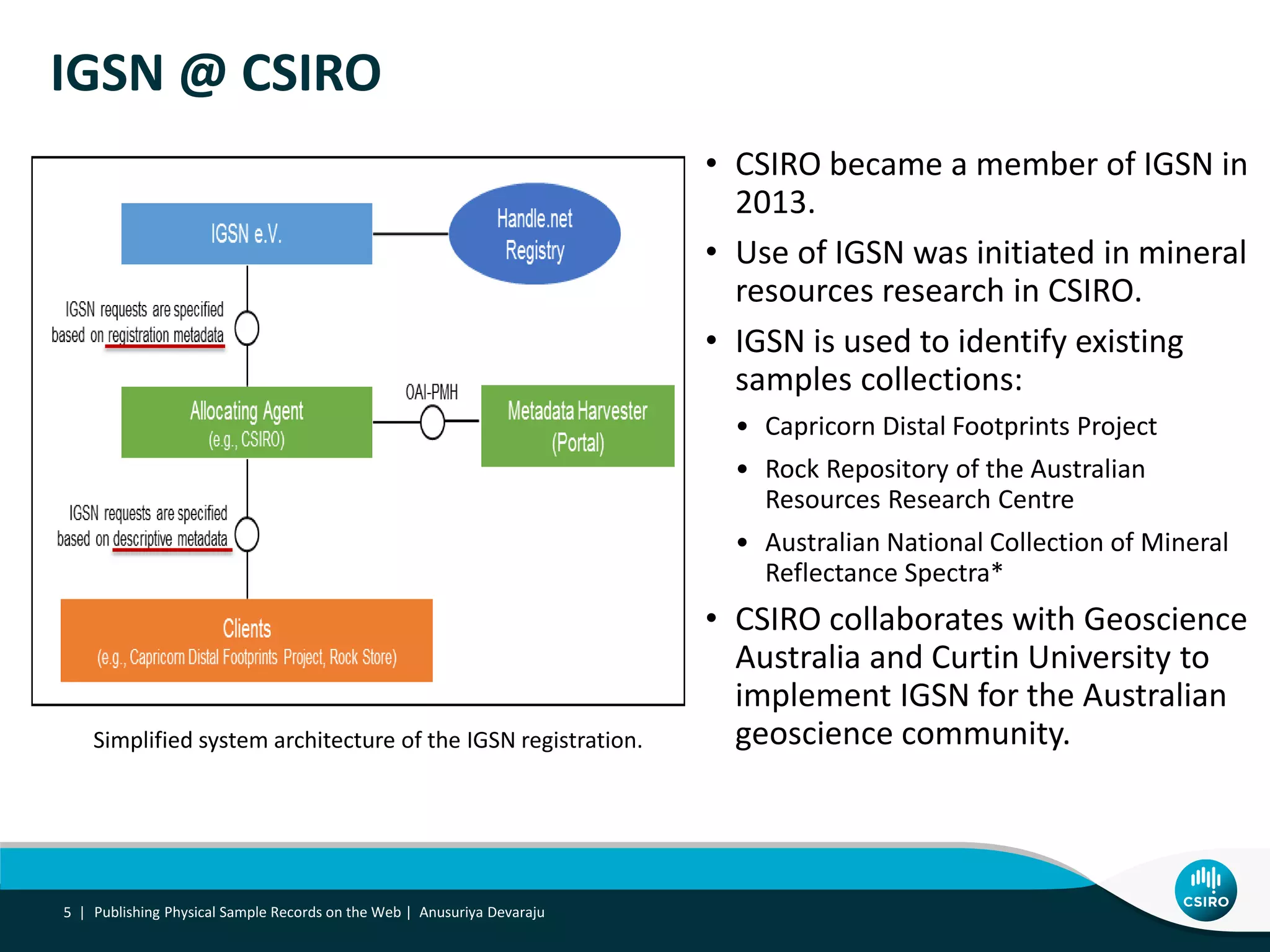
IGSN @ CSIRO
5 |
• CSIRO became a member of IGSN in
2013.
• Use of IGSN was initiated in mineral
resources research in CSIRO.
• IGSN is used to identify existing
samples collections:
• Capricorn Distal Footprints Project
• Rock Repository of the Australian
Resources Research Centre
• Australian National Collection of Mineral
Reflectance Spectra*
• CSIRO collaborates with Geoscience
Australia and Curtin University to
implement IGSN for the Australian
geoscience community.Simplified system architecture of the IGSN registration.
Publishing Physical Sample Records on the Web | Anusuriya Devaraju
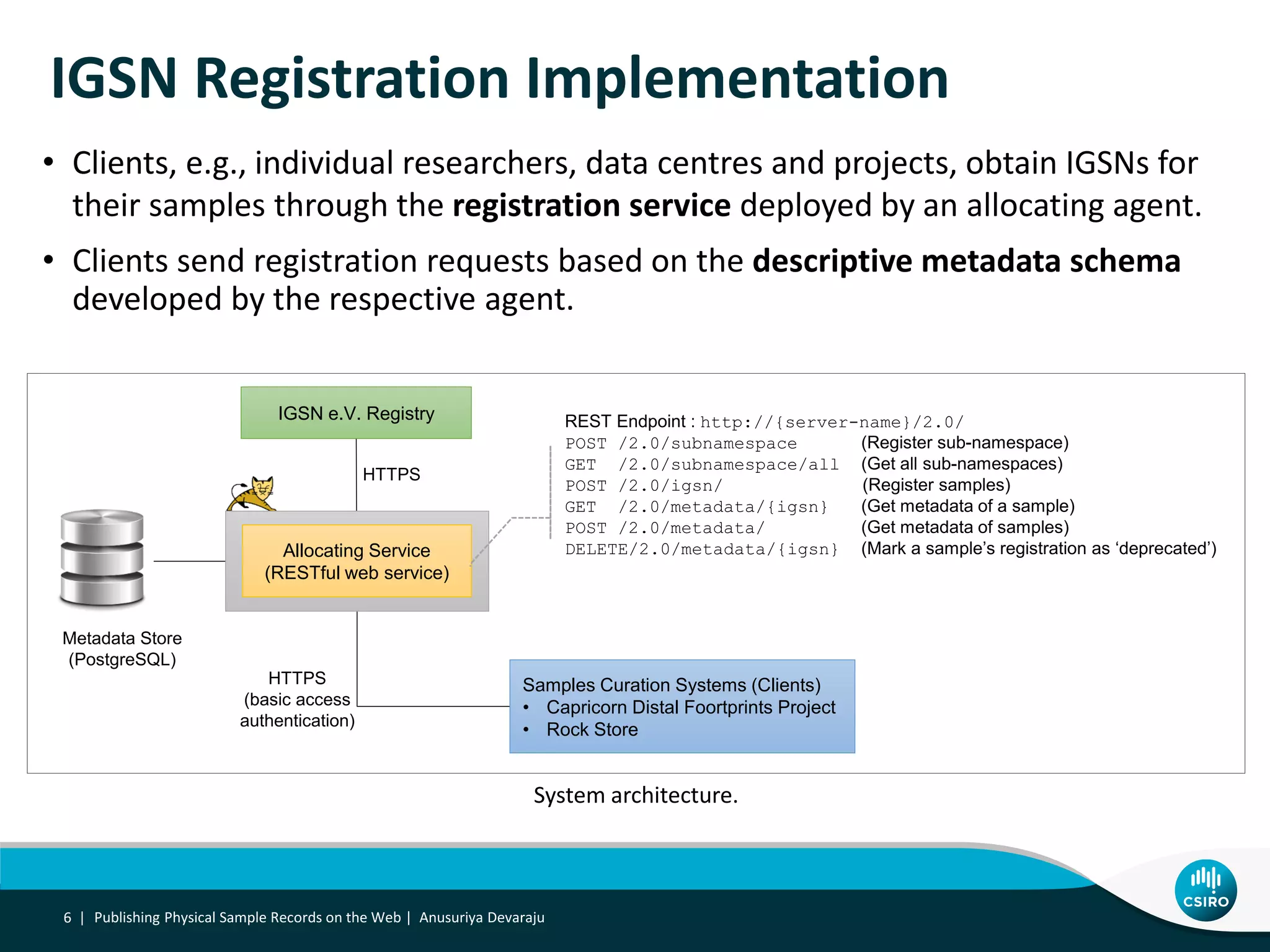
IGSN Registration Implementation
Publishing Physical Sample Records on the Web | Anusuriya Devaraju6 |
System architecture.
IGSN e.V. Registry
Metadata Store
(PostgreSQL)
HTTPS
HTTPS
(basic access
authentication)
Allocating Service
(RESTful web service)
REST Endpoint : http://{server-name}/2.0/
POST /2.0/subnamespace (Register sub-namespace)
GET /2.0/subnamespace/all (Get all sub-namespaces)
POST /2.0/igsn/ (Register samples)
GET /2.0/metadata/{igsn} (Get metadata of a sample)
POST /2.0/metadata/ (Get metadata of samples)
DELETE/2.0/metadata/{igsn} (Mark a sample’s registration as ‘deprecated’)
Samples Curation Systems (Clients)
• Capricorn Distal Foortprints Project
• Rock Store
• Clients, e.g., individual researchers, data centres and projects, obtain IGSNs for
their samples through the registration service deployed by an allocating agent.
• Clients send registration requests based on the descriptive metadata schema
developed by the respective agent.
Publishing Physical Sample Records on the Web | Anusuriya Devaraju7 |
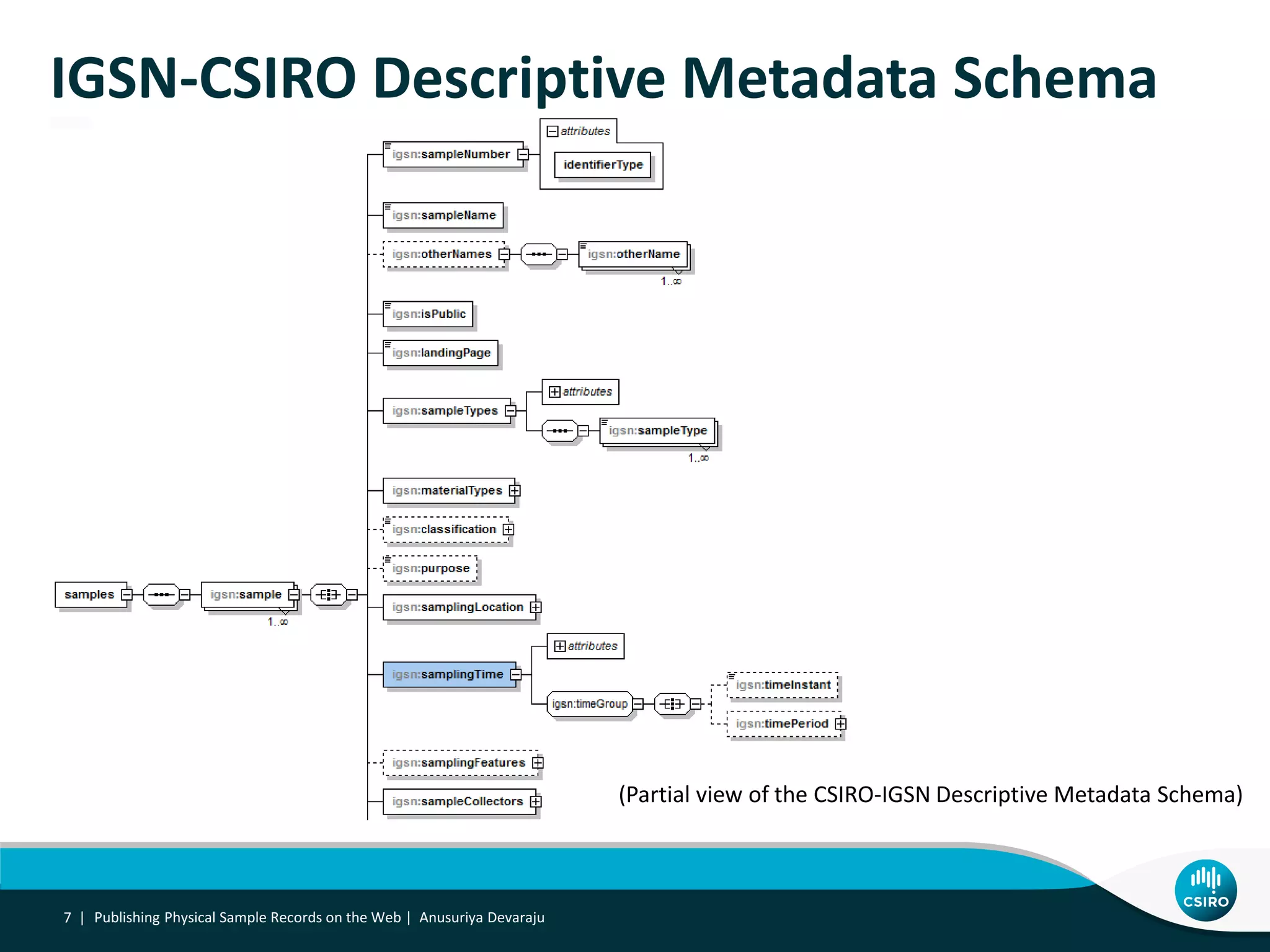
IGSN-CSIRO Descriptive Metadata Schema
(Partial view of the CSIRO-IGSN Descriptive Metadata Schema)
Publishing Physical Sample Records on the Web | Anusuriya Devaraju8 |
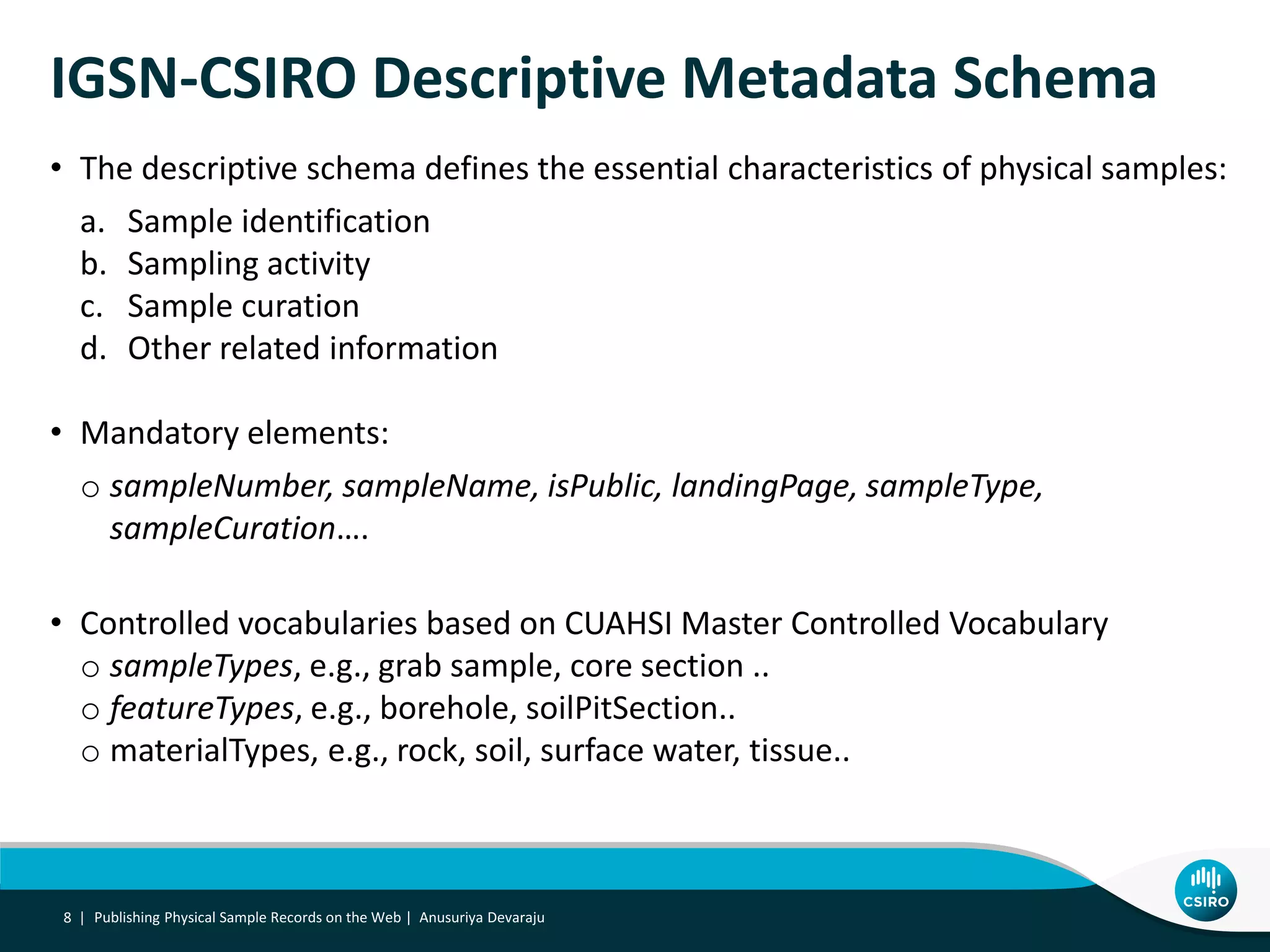
IGSN-CSIRO Descriptive Metadata Schema
• The descriptive schema defines the essential characteristics of physical samples:
a. Sample identification
b. Sampling activity
c. Sample curation
d. Other related information
• Mandatory elements:
o sampleNumber, sampleName, isPublic, landingPage, sampleType,
sampleCuration….
• Controlled vocabularies based on CUAHSI Master Controlled Vocabulary
o sampleTypes, e.g., grab sample, core section ..
o featureTypes, e.g., borehole, soilPitSection..
o materialTypes, e.g., rock, soil, surface water, tissue..
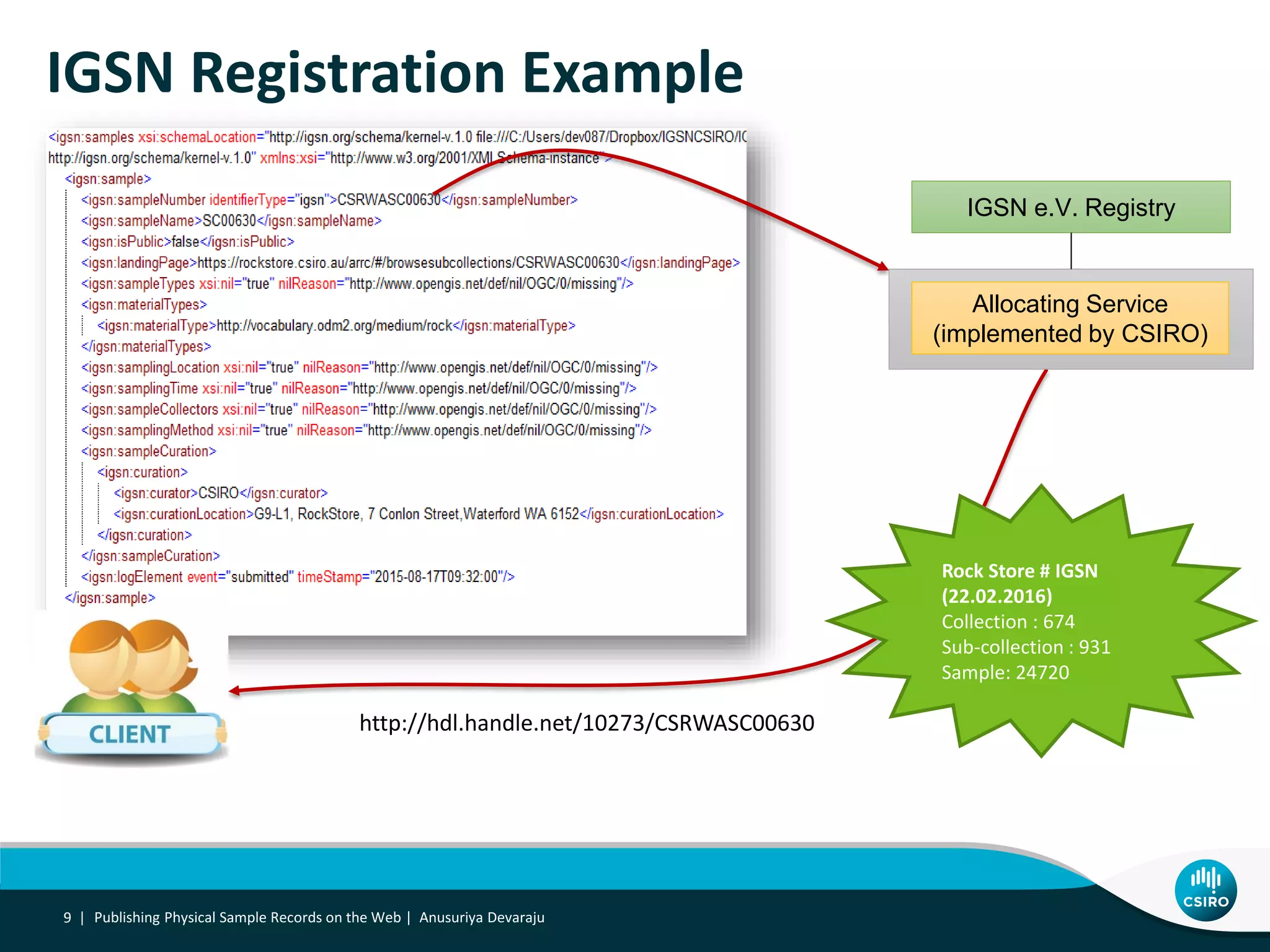
IGSN Registration Example
9 |
IGSN e.V. Registry
Allocating Service
(implemented by CSIRO)
http://hdl.handle.net/10273/CSRWASC00630
Publishing Physical Sample Records on the Web | Anusuriya Devaraju
Rock Store # IGSN
(22.02.2016)
Collection : 674
Sub-collection : 931
Sample: 24720
Publishing Physical Sample Records on the Web | Anusuriya Devaraju10 |
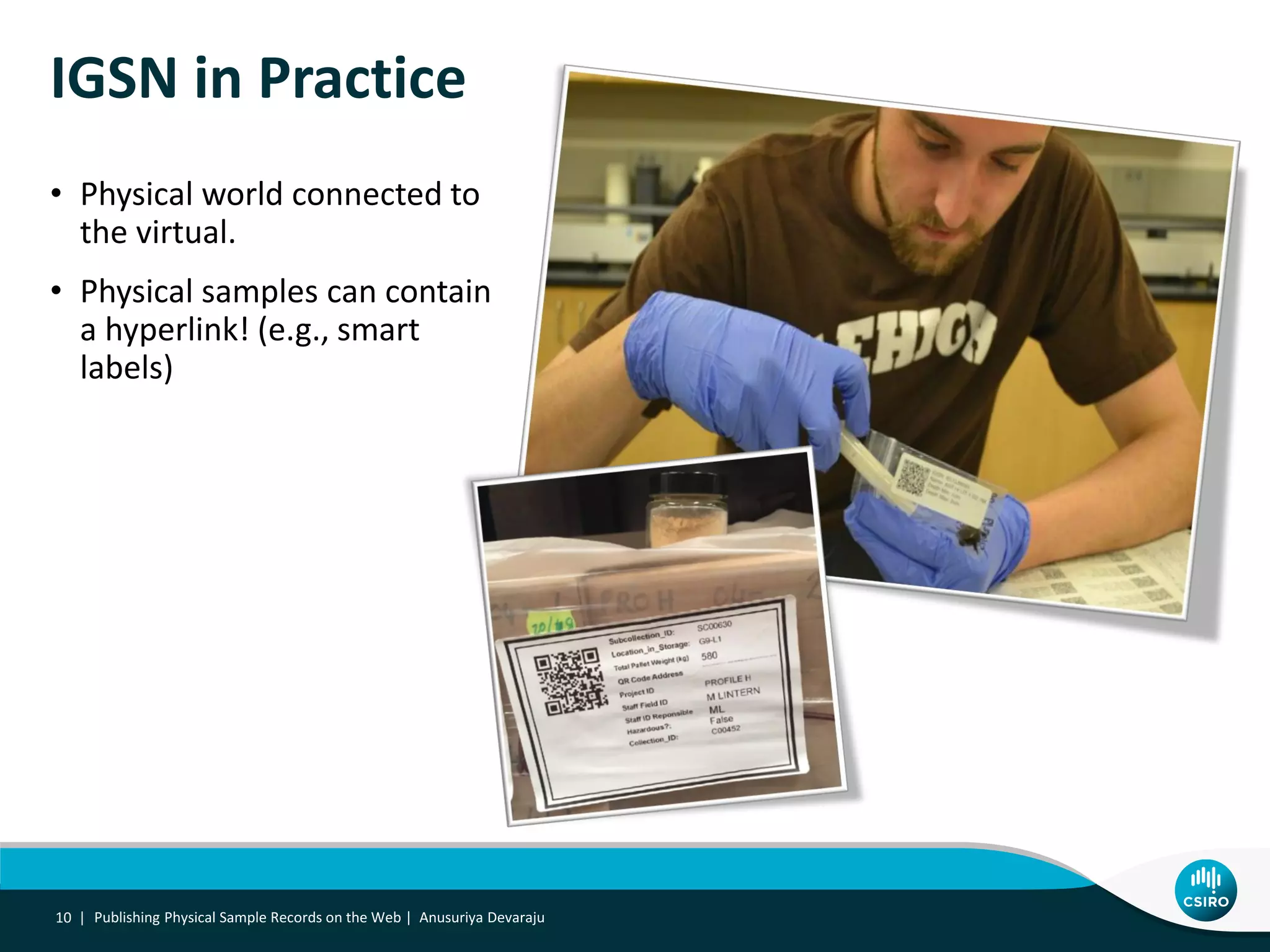
IGSN in Practice
• Physical world connected to
the virtual.
• Physical samples can contain
a hyperlink! (e.g., smart
labels)
Publishing Physical Sample Records on the Web | Anusuriya Devaraju11 |
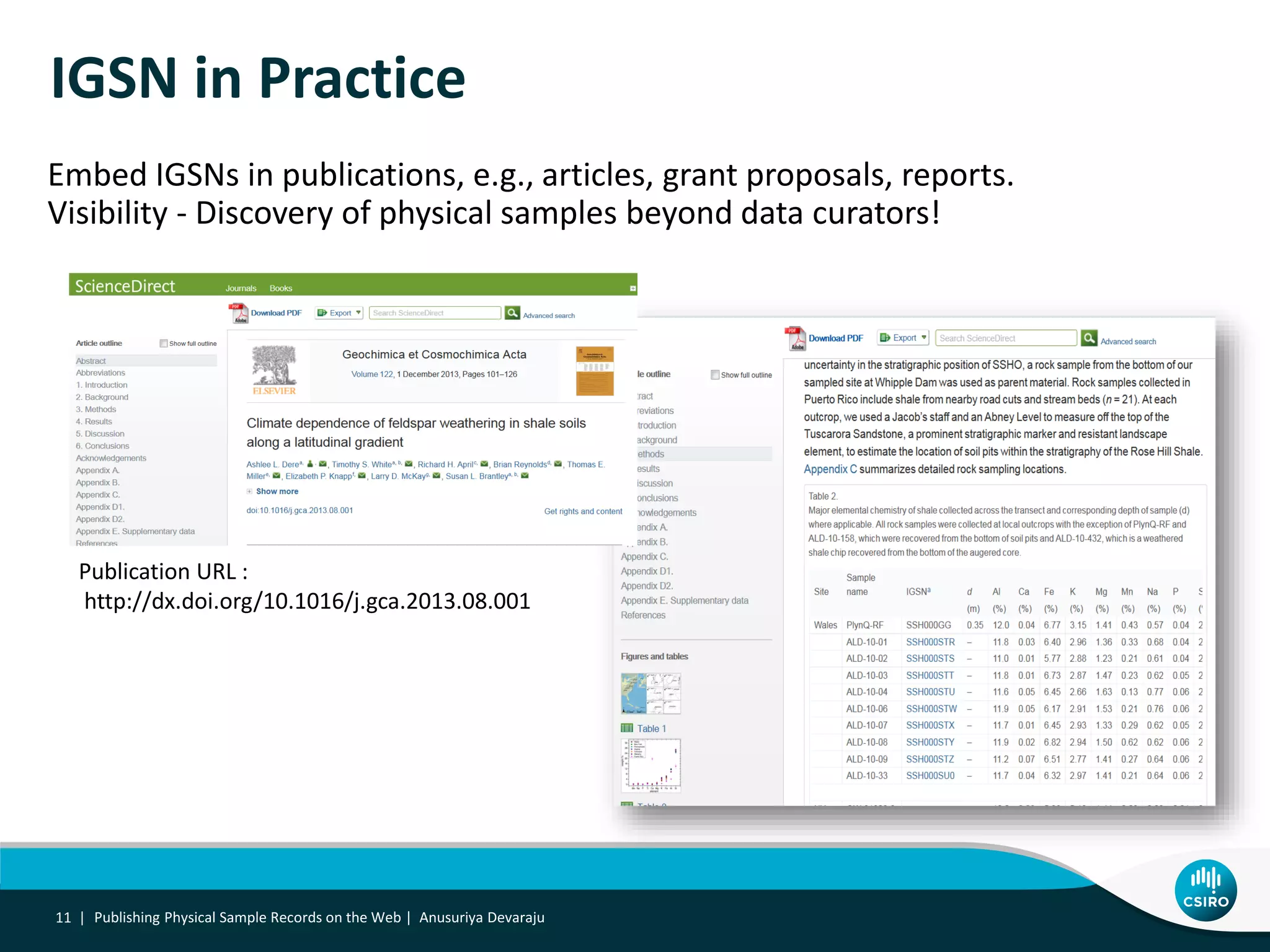
IGSN in Practice
Embed IGSNs in publications, e.g., articles, grant proposals, reports.
Visibility - Discovery of physical samples beyond data curators!
Publication URL :
http://dx.doi.org/10.1016/j.gca.2013.08.001
• Registration and management of physical samples based on IGSN in CSIRO.
o The descriptive metadata schema may be adapted to different types of physical samples.
o The solutions developed are useful to identify samples unambiguously and to facilitate sharing of
samples metadata on the Web in a systematic manner.
• Ongoing work
o Apply the solutions developed to other sample stores in CSIRO
o Support different ways of registering samples, e.g., LIMS, field apps, csv importer
o Develop a web portal and a metadata harvester to gather samples from different allocating
agents in Australia via the Open Archives Initiative Protocol for Metadata Harvesting (OAI-PMH).
o Interested?
o Primary contact in CSIRO: Dr Jens Klump (Mineral Resources)
o IGSN Implementing Organization : http://www.igsn.org/
o Technical documentation of the CSIRO-IGSN system:
https://confluence.csiro.au/display/AusIGSN/CSIRO+IGSN+IMPLEMENTATION
Conclusions
12 | Publishing Physical Sample Records on the Web | Anusuriya Devaraju
Anusuriya Devaraju
Postdoctoral Research Fellow
t +61 8 6436 8703
e anusuriya.devaraju@csiro.au
w http://www.anusuriya.com
MINERAL RESOURCES
Thank You

Publishing Physical Sample Records on the Web

  • 1.
    Publishing Physical SampleRecords on the Web MINERAL RESOURCES Anusuriya Devaraju, Jens Klump, Victor Tey and Ryan Fraser Computational and Simulation Sciences and eResearch Annual Conference and Workshops 2016. Session: Earth Observation Informatics, 3rd March 2016. images: metlab.com.au, agronomy.k-state.edu
  • 2.
    Introduction • Physical samplesare usually lie isolated, i.e., curated by individual researchers, laboratories, state agencies or museums. • Known issues – different ways of naming and documenting samples. • When sharing metadata of samples to other users, the unique identification of samples becomes essential. 2 | Publishing Physical Sample Records on the Web | Anusuriya Devaraju
  • 3.
    Examples: Naming Ambiguityof Samples Publishing Physical Sample Records on the Web | Anusuriya Devaraju3 | Different names representing the same sample on PetDB, the Petrological Database. The EarthChem data portal returns 71 samples called ‘A-1’
  • 4.
    International Geo SampleNumber (IGSN) • Persistent and unique alphanumeric code for identifying physical samples. Publishing Physical Sample Records on the Web | Anusuriya Devaraju4 | GRO000076 Fraser River water sample Image by @igsn_info http://hdl.handle.net/10273/GRO000076 globally resolvable identifier
  • 5.
    IGSN @ CSIRO 5| • CSIRO became a member of IGSN in 2013. • Use of IGSN was initiated in mineral resources research in CSIRO. • IGSN is used to identify existing samples collections: • Capricorn Distal Footprints Project • Rock Repository of the Australian Resources Research Centre • Australian National Collection of Mineral Reflectance Spectra* • CSIRO collaborates with Geoscience Australia and Curtin University to implement IGSN for the Australian geoscience community.Simplified system architecture of the IGSN registration. Publishing Physical Sample Records on the Web | Anusuriya Devaraju
  • 6.
    IGSN Registration Implementation PublishingPhysical Sample Records on the Web | Anusuriya Devaraju6 | System architecture. IGSN e.V. Registry Metadata Store (PostgreSQL) HTTPS HTTPS (basic access authentication) Allocating Service (RESTful web service) REST Endpoint : http://{server-name}/2.0/ POST /2.0/subnamespace (Register sub-namespace) GET /2.0/subnamespace/all (Get all sub-namespaces) POST /2.0/igsn/ (Register samples) GET /2.0/metadata/{igsn} (Get metadata of a sample) POST /2.0/metadata/ (Get metadata of samples) DELETE/2.0/metadata/{igsn} (Mark a sample’s registration as ‘deprecated’) Samples Curation Systems (Clients) • Capricorn Distal Foortprints Project • Rock Store • Clients, e.g., individual researchers, data centres and projects, obtain IGSNs for their samples through the registration service deployed by an allocating agent. • Clients send registration requests based on the descriptive metadata schema developed by the respective agent.
  • 7.
    Publishing Physical SampleRecords on the Web | Anusuriya Devaraju7 | IGSN-CSIRO Descriptive Metadata Schema (Partial view of the CSIRO-IGSN Descriptive Metadata Schema)
  • 8.
    Publishing Physical SampleRecords on the Web | Anusuriya Devaraju8 | IGSN-CSIRO Descriptive Metadata Schema • The descriptive schema defines the essential characteristics of physical samples: a. Sample identification b. Sampling activity c. Sample curation d. Other related information • Mandatory elements: o sampleNumber, sampleName, isPublic, landingPage, sampleType, sampleCuration…. • Controlled vocabularies based on CUAHSI Master Controlled Vocabulary o sampleTypes, e.g., grab sample, core section .. o featureTypes, e.g., borehole, soilPitSection.. o materialTypes, e.g., rock, soil, surface water, tissue..
  • 9.
    IGSN Registration Example 9| IGSN e.V. Registry Allocating Service (implemented by CSIRO) http://hdl.handle.net/10273/CSRWASC00630 Publishing Physical Sample Records on the Web | Anusuriya Devaraju Rock Store # IGSN (22.02.2016) Collection : 674 Sub-collection : 931 Sample: 24720
  • 10.
    Publishing Physical SampleRecords on the Web | Anusuriya Devaraju10 | IGSN in Practice • Physical world connected to the virtual. • Physical samples can contain a hyperlink! (e.g., smart labels)
  • 11.
    Publishing Physical SampleRecords on the Web | Anusuriya Devaraju11 | IGSN in Practice Embed IGSNs in publications, e.g., articles, grant proposals, reports. Visibility - Discovery of physical samples beyond data curators! Publication URL : http://dx.doi.org/10.1016/j.gca.2013.08.001
  • 12.
    • Registration andmanagement of physical samples based on IGSN in CSIRO. o The descriptive metadata schema may be adapted to different types of physical samples. o The solutions developed are useful to identify samples unambiguously and to facilitate sharing of samples metadata on the Web in a systematic manner. • Ongoing work o Apply the solutions developed to other sample stores in CSIRO o Support different ways of registering samples, e.g., LIMS, field apps, csv importer o Develop a web portal and a metadata harvester to gather samples from different allocating agents in Australia via the Open Archives Initiative Protocol for Metadata Harvesting (OAI-PMH). o Interested? o Primary contact in CSIRO: Dr Jens Klump (Mineral Resources) o IGSN Implementing Organization : http://www.igsn.org/ o Technical documentation of the CSIRO-IGSN system: https://confluence.csiro.au/display/AusIGSN/CSIRO+IGSN+IMPLEMENTATION Conclusions 12 | Publishing Physical Sample Records on the Web | Anusuriya Devaraju
  • 13.
    Anusuriya Devaraju Postdoctoral ResearchFellow t +61 8 6436 8703 e anusuriya.devaraju@csiro.au w http://www.anusuriya.com MINERAL RESOURCES Thank You