Linked Data -
Evolving the Web into a Global Data Space
Anja Jentzsch - @anjeve
Hasso-Plattner-Institute, Potsdam, Germany
1st Linked Data Meetup @ Foo Café, Malmö
2103/05/23
Outline
1. Foundations of Linked Data
• What is the vision and goal?
2. The Web of Linked Data
• What data is out there?
• What is being done with the data?
3. How to publish and consume Linked Data?
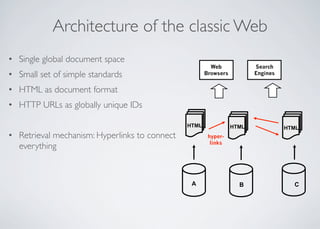
Architecture of the classic Web
B C
HTMLHTML
Web
Browsers
Search
Engines
hyper-
links
A
HTML
• Single global document space
• Small set of simple standards
• HTML as document format
• HTTP URLs as globally unique IDs
• Retrieval mechanism: Hyperlinks to connect
everything
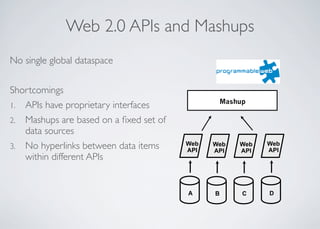
Web 2.0 APIs and Mashups
No single global dataspace
Shortcomings
1. APIs have proprietary interfaces
2. Mashups are based on a fixed set of
data sources
3. No hyperlinks between data items
within different APIs
Web
API
A
Mashup
Web
API
B
Web
API
C
Web
API
D
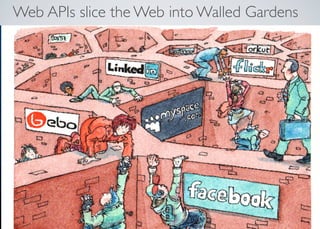
Web APIs slice the Web into Walled Gardens
Image: Bob Jagensdorf, http://flickr.com/photos/darwinbell/, CC-BY
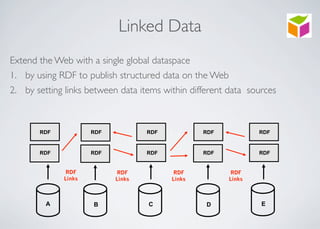
Extend the Web with a single global dataspace
1. by using RDF to publish structured data on the Web
2. by setting links between data items within different data sources
Linked Data
B C
RDF
RDF
Links
A D E
RDF
Links
RDF
Links
RDF
Links
RDF
RDF
RDF
RDF
RDF RDF
RDF
RDF
RDF
Linked Data Principles
Set of best practices for publishing structured data on the Web in
accordance with the general architecture of the Web.
1. Use URIs as names for things.
2. Use HTTP URIs so that people can look up those names.
3. When someone looks up a URI, provide useful RDF information.
4. Include RDF statements that link to other URIs so that they can discover
related things.
Tim Berners-Lee, http://www.w3.org/DesignIssues/LinkedData.html, 2006
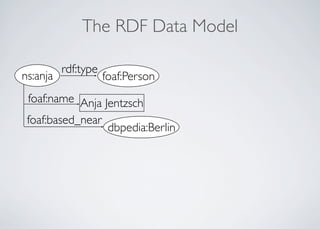
The RDF Data Model
Anja Jentzsch
dbpedia:Berlin
foaf:name
foaf:based_near
foaf:Person
rdf:type
ns:anja
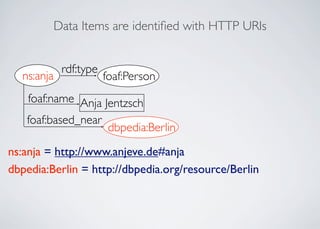
Data Items are identified with HTTP URIs
ns:anja = http://www.anjeve.de#anja
dbpedia:Berlin = http://dbpedia.org/resource/Berlin
foaf:name
foaf:based_near
foaf:Person
rdf:type
ns:anja
dbpedia:Berlin
Anja Jentzsch
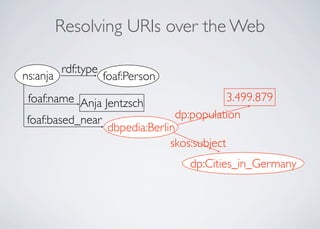
Resolving URIs over the Web
dp:Cities_in_Germany
3.499.879
dp:population
skos:subject
dbpedia:Berlin
foaf:name
foaf:based_near
foaf:Person
rdf:type
ns:anja
Anja Jentzsch
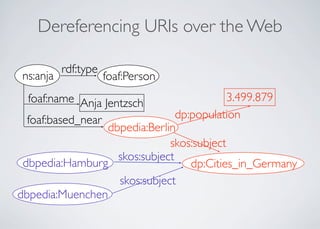
Dereferencing URIs over the Web
dbpedia:Hamburg
dbpedia:Muenchen
skos:subject
skos:subject
dp:Cities_in_Germany
3.499.879
dp:population
skos:subject
dbpedia:Berlin
foaf:name
foaf:based_near
foaf:Person
rdf:type
ns:anja
Anja Jentzsch
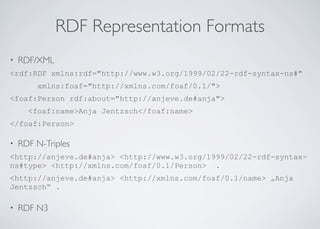
RDF Representation Formats
• RDF/XML
<rdf:RDF xmlns:rdf="http://www.w3.org/1999/02/22-rdf-syntax-ns#"
xmlns:foaf="http://xmlns.com/foaf/0.1/">
<foaf:Person rdf:about="http://anjeve.de#anja">
<foaf:name>Anja Jentzsch</foaf:name>
</foaf:Person>
• RDF N-Triples
<http://anjeve.de#anja> <http://www.w3.org/1999/02/22-rdf-syntax-
ns#type> <http://xmlns.com/foaf/0.1/Person> .
<http://anjeve.de#anja> <http://xmlns.com/foaf/0.1/name> „Anja
Jentzsch“ .
• RDF N3
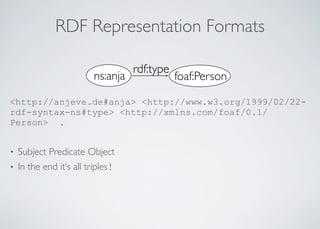
RDF Representation Formats
<http://anjeve.de#anja> <http://www.w3.org/1999/02/22-
rdf-syntax-ns#type> <http://xmlns.com/foaf/0.1/
Person> .
• Subject Predicate Object
• In the end it‘s all triples!
foaf:Person
rdf:type
ns:anja
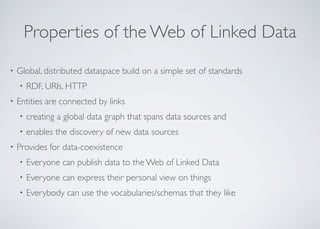
Properties of the Web of Linked Data
• Global, distributed dataspace build on a simple set of standards
• RDF, URIs, HTTP
• Entities are connected by links
• creating a global data graph that spans data sources and
• enables the discovery of new data sources
• Provides for data-coexistence
• Everyone can publish data to the Web of Linked Data
• Everyone can express their personal view on things
• Everybody can use the vocabularies/schemas that they like
W3C Linking Open Data Project
• Grassroots community effort to
• publish existing open license datasets as Linked Data on the Web
• interlink things between different data sources
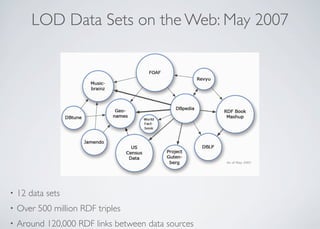
LOD Data Sets on the Web: May 2007
• 12 data sets
• Over 500 million RDF triples
• Around 120,000 RDF links between data sources
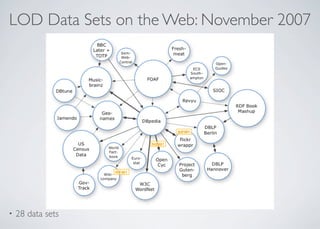
LOD Data Sets on the Web: November 2007
• 28 data sets
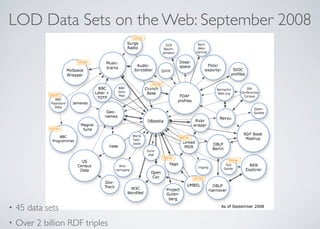
LOD Data Sets on the Web: September 2008
• 45 data sets
• Over 2 billion RDF triples
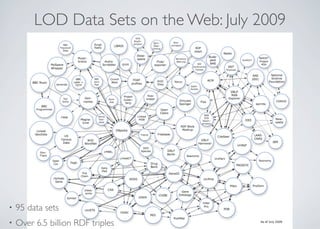
LOD Data Sets on the Web: July 2009
• 95 data sets
• Over 6.5 billion RDF triples
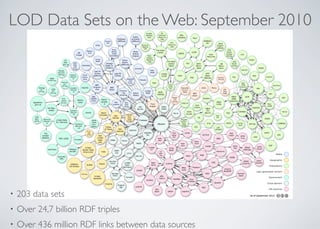
LOD Data Sets on the Web: September 2010
• 203 data sets
• Over 24,7 billion RDF triples
• Over 436 million RDF links between data sources
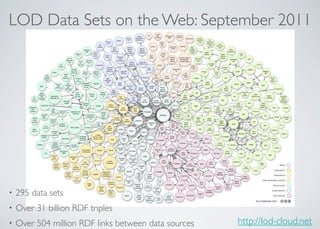
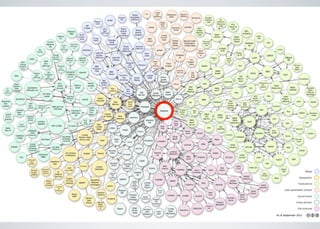
LOD Data Sets on the Web: September 2011
• 295 data sets
• Over 31 billion RDF triples
• Over 504 million RDF links between data sources http://lod-cloud.net
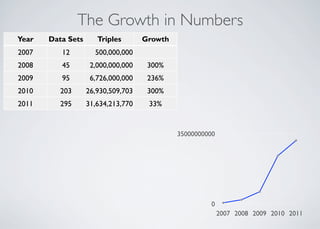
The Growth in Numbers
0
35000000000
2007 2008 2009 2010 2011
Year Data Sets Triples Growth
2007 12 500,000,000
2008 45 2,000,000,000 300%
2009 95 6,726,000,000 236%
2010 203 26,930,509,703 300%
2011 295 31,634,213,770 33%
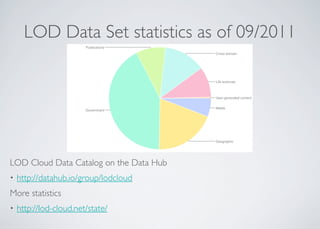
LOD Data Set statistics as of 09/2011
LOD Cloud Data Catalog on the Data Hub
• http://datahub.io/group/lodcloud
More statistics
• http://lod-cloud.net/state/
DBpedia –The Hub
on the Web of Data
• DBpedia is a joint project with the following goals
• extracting structured information from Wikipedia
• publish this information under an open license on the Web
• setting links to other data sources
• Partners
• Freie Universität Berlin (Germany)
• Universität Leipzig (Germany)
• OpenLink Software (UK)
• neofonie (Germany)
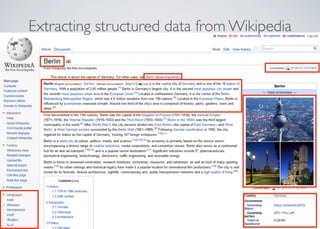
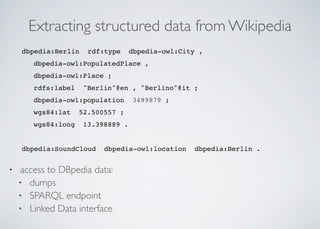
Extracting structured data from Wikipedia
dbpedia:Berlin rdf:type dbpedia-owl:City ,
dbpedia-owl:PopulatedPlace ,
dbpedia-owl:Place ;
rdfs:label "Berlin"@en , "Berlino"@it ;
dbpedia-owl:population 3499879 ;
wgs84:lat 52.500557 ;
wgs84:long 13.398889 .
!
dbpedia:SoundCloud dbpedia-owl:location dbpedia:Berlin .
• access to DBpedia data:
• dumps
• SPARQL endpoint
• Linked Data interface
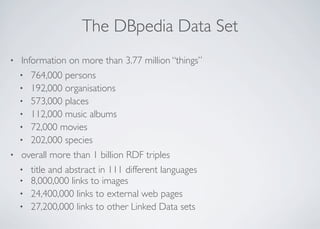
The DBpedia Data Set
• Information on more than 3.77 million “things”
• 764,000 persons
• 192,000 organisations
• 573,000 places
• 112,000 music albums
• 72,000 movies
• 202,000 species
• overall more than 1 billion RDF triples
• title and abstract in 111 different languages
• 8,000,000 links to images
• 24,400,000 links to external web pages
• 27,200,000 links to other Linked Data sets
DBpedia Mappings
• since March 2010 collaborative editing of
• DBpedia ontology
• mappings from Wikipedia infoboxes and tables to DBpedia ontology
• curated in a public wiki with instant validation methods
• http://mappings.dbpedia.org
• multi-langual mappings to the DBpedia ontology:
• ar, bg, bn, ca, cs, de, el, en, es, et, eu, fr, ga, hi, hr, hu, it, ja, ko, nl, pl, pt, ru, sl,
tr
• allows for a significant increase of the extracted data’s quality
• each domain has its experts
DBpedia Use Cases
1. Improvement of Wikipedia search
2. Data source for applications and mashups
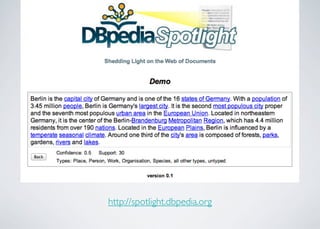
3. Text analysis and annotation
4. Hub for the growing Web of Data
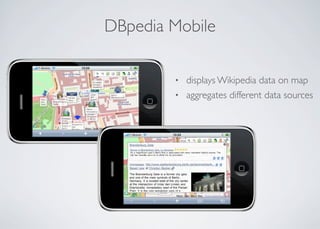
DBpedia Mobile
• displays Wikipedia data on map
• aggregates different data sources
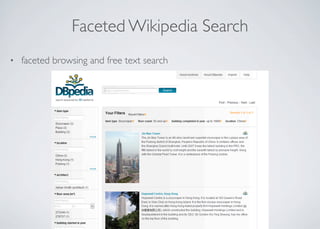
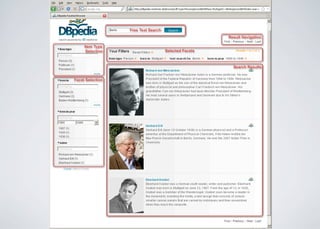
Faceted Wikipedia Search
• faceted browsing and free text search
http://spotlight.dbpedia.org
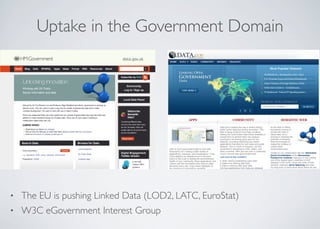
Uptake in the Government Domain
• The EU is pushing Linked Data (LOD2, LATC, EuroStat)
• W3C eGovernment Interest Group
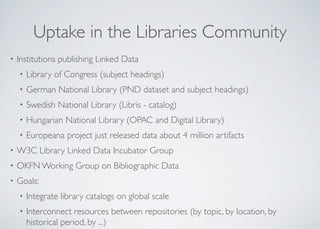
Uptake in the Libraries Community
• Institutions publishing Linked Data
• Library of Congress (subject headings)
• German National Library (PND dataset and subject headings)
• Swedish National Library (Libris - catalog)
• Hungarian National Library (OPAC and Digital Library)
• Europeana project just released data about 4 million artifacts
• W3C Library Linked Data Incubator Group
• OKFN Working Group on Bibliographic Data
• Goals:
• Integrate library catalogs on global scale
• Interconnect resources between repositories (by topic, by location, by
historical period, by ...)
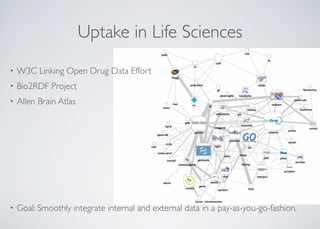
Uptake in Life Sciences
• W3C Linking Open Drug Data Effort
• Bio2RDF Project
• Allen Brain Atlas
• Goal: Smoothly integrate internal and external data in a pay-as-you-go-fashion.
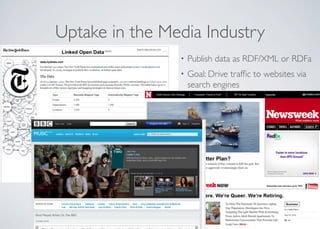
Uptake in the Media Industry
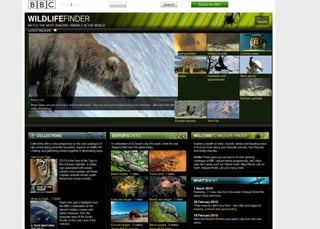
• Publish data as RDF/XML or RDFa
• Goal: Drive traffic to websites via
search engines
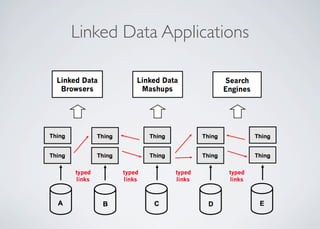
Linked Data Applications
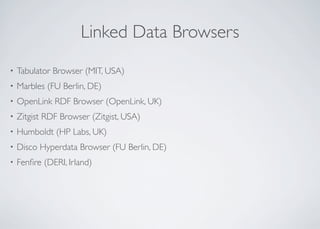
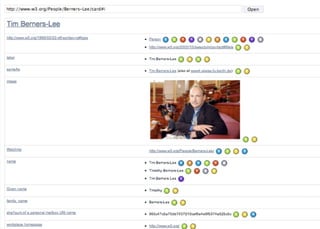
Linked Data Browsers
• Tabulator Browser (MIT, USA)
• Marbles (FU Berlin, DE)
• OpenLink RDF Browser (OpenLink, UK)
• Zitgist RDF Browser (Zitgist, USA)
• Humboldt (HP Labs, UK)
• Disco Hyperdata Browser (FU Berlin, DE)
• Fenfire (DERI, Irland)
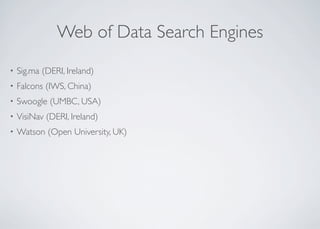
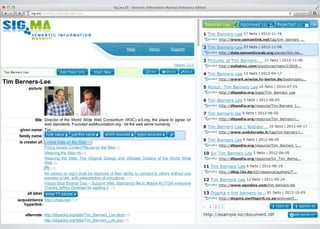
Web of Data Search Engines
• Sig.ma (DERI, Ireland)
• Falcons (IWS, China)
• Swoogle (UMBC, USA)
• VisiNav (DERI, Ireland)
• Watson (Open University, UK)
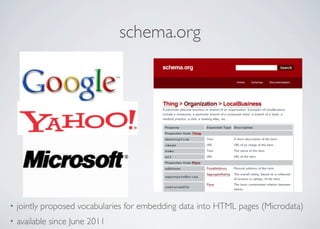
schema.org
• jointly proposed vocabularies for embedding data into HTML pages (Microdata)
• available since June 2011
• What does Linked Data mean to startups?
Economic Opportunities
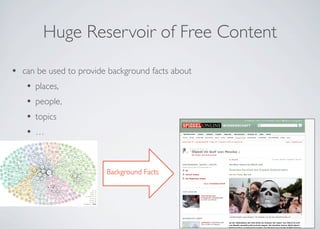
Huge Reservoir of Free Content
• can be used to provide background facts about
• places,
• people,
• topics
• …
Background Facts
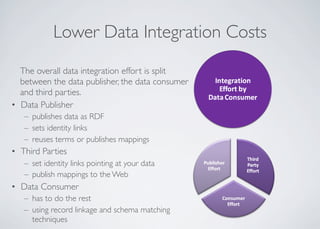
Lower Data Integration Costs
The overall data integration effort is split
between the data publisher, the data consumer
and third parties.
• Data Publisher
– publishes data as RDF
– sets identity links
– reuses terms or publishes mappings
• Third Parties
– set identity links pointing at your data
– publish mappings to the Web
• Data Consumer
– has to do the rest
– using record linkage and schema matching
techniques
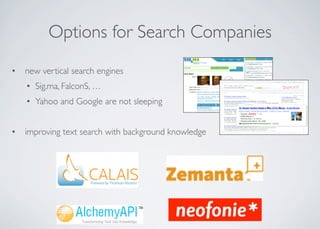
Options for Search Companies
• new vertical search engines
• Sig.ma, FalconS, …
• Yahoo and Google are not sleeping
• improving text search with background knowledge
Options for Data Integration Intermediaries
• business model
• crawl, integrate and clean Web data
• sell clean data to subscribers
• existing Linked Data integration intermediaries
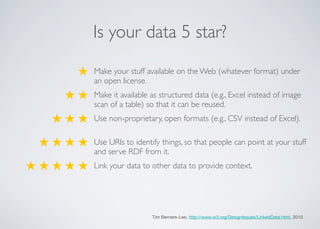
Is your data 5 star?
Tim Berners-Lee, http://www.w3.org/DesignIssues/LinkedData.html, 2010
Make your stuff available on the Web (whatever format) under
an open license.
Make it available as structured data (e.g., Excel instead of image
scan of a table) so that it can be reused.
Use non-proprietary, open formats (e.g., CSV instead of Excel).
Use URIs to identify things, so that people can point at your stuff
and serve RDF from it.
Link your data to other data to provide context.
★
★ ★
★ ★ ★
★ ★ ★ ★
★ ★ ★ ★ ★
How to publish Linked Data
1. Tasks: Make data available as RDF via HTTP
2. Set RDF links pointing at other data sources
3. Make your data self-descriptive
4. Reuse common vocabularies
Tom Heath, Christian Bizer: Linked Data: Evolving the Web into a Global Data Space
http://linkeddatabook.com/
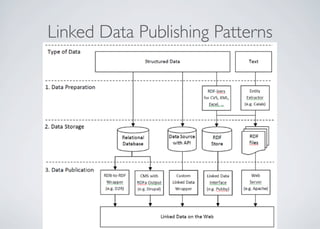
Linked Data Publishing Patterns
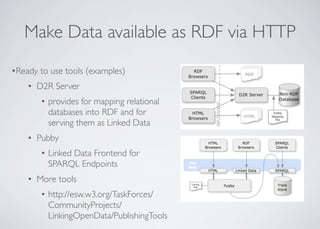
Make Data available as RDF via HTTP
•Ready to use tools (examples)
• D2R Server
• provides for mapping relational
databases into RDF and for
serving them as Linked Data
• Pubby
• Linked Data Frontend for
SPARQL Endpoints
• More tools
• http://esw.w3.org/TaskForces/
CommunityProjects/
LinkingOpenData/PublishingTools
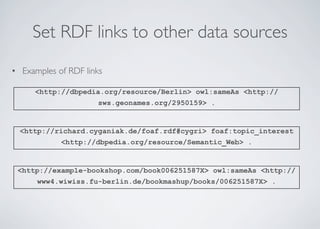
Set RDF links to other data sources
• Examples of RDF links
<http://dbpedia.org/resource/Berlin> owl:sameAs <http://
sws.geonames.org/2950159> .
<http://richard.cyganiak.de/foaf.rdf#cygri> foaf:topic_interest
<http://dbpedia.org/resource/Semantic_Web> .
<http://example-bookshop.com/book006251587X> owl:sameAs <http://
www4.wiwiss.fu-berlin.de/bookmashup/books/006251587X> .
How to generate RDF links?
• Pattern-based approaches
• Exploit naming conventions within URIs (for instance ISBNs, ISINs, …)
• Similarity-based approaches
• Compare items within different data sources using various similarity metrics
• Ready to use tools (Examples)
• Silk Link Discovery Framework
• provides a declarative language for specifying link conditions
which may combine different similarity metrics
• Silk Single Machine, Silk MapReduce
• More tools
• http://esw.w3.org/TaskForces/CommunityProjects/LinkingOpenData/
Make your Data Self-Descriptive
• Increase the usefulness of your data and ease data integration
• Aspects of self-descriptiveness
• Enable clients to retrieve the schema
• Reuse terms from common vocabularies
• Publish schema mappings for proprietary terms
• Provide provenance metadata
• Provide licensing metadata
• Provide data-set-level metadata using voiD
• Refer to additional access methods using voiD
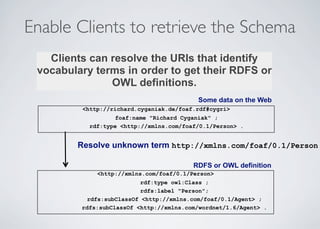
Enable Clients to retrieve the Schema
Clients can resolve the URIs that identify
vocabulary terms in order to get their RDFS or
OWL definitions.
<http://xmlns.com/foaf/0.1/Person>
rdf:type owl:Class ;
rdfs:label "Person";
rdfs:subClassOf <http://xmlns.com/foaf/0.1/Agent> ;
rdfs:subClassOf <http://xmlns.com/wordnet/1.6/Agent> .
<http://richard.cyganiak.de/foaf.rdf#cygri>
foaf:name "Richard Cyganiak" ;
rdf:type <http://xmlns.com/foaf/0.1/Person> .
RDFS or OWL definition
Some data on the Web
Resolve unknown term http://xmlns.com/foaf/0.1/Person
ReuseTerms from CommonVocabularies
• CommonVocabularies
• Friend-of-a-Friend for describing people and their social network
• SIOC for describing forums and blogs
• SKOS for representing topic taxonomies
• Organization Ontology for describing the structure of organizations
• GoodRelations provides terms for describing products and business entities
• Music Ontology for describing artists, albums, and performances
• ReviewVocabulary provides terms for representing reviews
• Common sources of identifiers (URIs) for real world objects
• LinkedGeoData and Geonames locations
• GeneID and UniProt life science identifiers
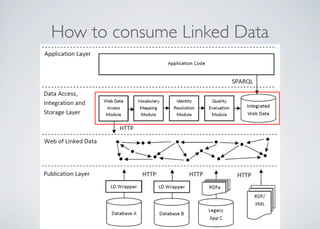
How to consume Linked Data
Integrated Linked Data Consumption
Tools
• LDIF – Linked Data Integration Framework
• provides for data translation and identity resolution
• http://www4.wiwiss.fu-berlin.de/bizer/ldif/
• ALOE - Assisted Linked Data Consumption framework
• provides for data translation and identity resolution
• http://aksw.org/projects/aloe
• Information Workbench
• provides for visualization and application development
• http://iwb.fluidops.com/
62
Finding Linked Data sets
• Search engines
• find data sets based on keywords
• Data catalogs / directories
• explore data sets and faceted search
• Data Marketplaces
• explore and consume data sets
63
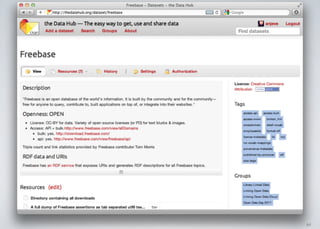
The Data Hub
• Manually curated list of (>3.500) data sets, at least 356 Linked Data Sets
• Various metadata for each data set
64
Conclusion
• The Web of Data is growing fast
• Linked Data provides a standardized data access interface
• Linked Data allows for the development of a variety of tools to integrate,
enhance and and view the data
• Web search is evolving into query answering
• Search engines will increasingly rely on structured data from the Web
• Next step: Linked Data within enterprises
• alternative to data warehouses and EAI middleware
• advantages: schema-less data model, pay-as-you go data integration
Thanks!
References:
• Tom Heath, Christian Bizer: Linked Data: Evolving the Web into a Global Data Space
http://linkeddatabook.com/
• Linking Open Data Project Wiki
http://esw.w3.org/topic/SweoIG/TaskForces/CommunityProjects/LinkingOpenData
Email: anja@anjeve.de
Twitter: @anjeve

Linked Data (1st Linked Data Meetup Malmö)

  • 1.
    Linked Data - Evolvingthe Web into a Global Data Space Anja Jentzsch - @anjeve Hasso-Plattner-Institute, Potsdam, Germany 1st Linked Data Meetup @ Foo Café, Malmö 2103/05/23
  • 2.
    Outline 1. Foundations ofLinked Data • What is the vision and goal? 2. The Web of Linked Data • What data is out there? • What is being done with the data? 3. How to publish and consume Linked Data?
  • 3.
    Architecture of theclassic Web B C HTMLHTML Web Browsers Search Engines hyper- links A HTML • Single global document space • Small set of simple standards • HTML as document format • HTTP URLs as globally unique IDs • Retrieval mechanism: Hyperlinks to connect everything
  • 4.
    Web 2.0 APIsand Mashups No single global dataspace Shortcomings 1. APIs have proprietary interfaces 2. Mashups are based on a fixed set of data sources 3. No hyperlinks between data items within different APIs Web API A Mashup Web API B Web API C Web API D
  • 5.
    Web APIs slicethe Web into Walled Gardens Image: Bob Jagensdorf, http://flickr.com/photos/darwinbell/, CC-BY
  • 6.
    Extend the Webwith a single global dataspace 1. by using RDF to publish structured data on the Web 2. by setting links between data items within different data sources Linked Data B C RDF RDF Links A D E RDF Links RDF Links RDF Links RDF RDF RDF RDF RDF RDF RDF RDF RDF
  • 7.
    Linked Data Principles Setof best practices for publishing structured data on the Web in accordance with the general architecture of the Web. 1. Use URIs as names for things. 2. Use HTTP URIs so that people can look up those names. 3. When someone looks up a URI, provide useful RDF information. 4. Include RDF statements that link to other URIs so that they can discover related things. Tim Berners-Lee, http://www.w3.org/DesignIssues/LinkedData.html, 2006
  • 8.
    The RDF DataModel Anja Jentzsch dbpedia:Berlin foaf:name foaf:based_near foaf:Person rdf:type ns:anja
  • 9.
    Data Items areidentified with HTTP URIs ns:anja = http://www.anjeve.de#anja dbpedia:Berlin = http://dbpedia.org/resource/Berlin foaf:name foaf:based_near foaf:Person rdf:type ns:anja dbpedia:Berlin Anja Jentzsch
  • 10.
    Resolving URIs overthe Web dp:Cities_in_Germany 3.499.879 dp:population skos:subject dbpedia:Berlin foaf:name foaf:based_near foaf:Person rdf:type ns:anja Anja Jentzsch
  • 11.
    Dereferencing URIs overthe Web dbpedia:Hamburg dbpedia:Muenchen skos:subject skos:subject dp:Cities_in_Germany 3.499.879 dp:population skos:subject dbpedia:Berlin foaf:name foaf:based_near foaf:Person rdf:type ns:anja Anja Jentzsch
  • 12.
    RDF Representation Formats •RDF/XML <rdf:RDF xmlns:rdf="http://www.w3.org/1999/02/22-rdf-syntax-ns#" xmlns:foaf="http://xmlns.com/foaf/0.1/"> <foaf:Person rdf:about="http://anjeve.de#anja"> <foaf:name>Anja Jentzsch</foaf:name> </foaf:Person> • RDF N-Triples <http://anjeve.de#anja> <http://www.w3.org/1999/02/22-rdf-syntax- ns#type> <http://xmlns.com/foaf/0.1/Person> . <http://anjeve.de#anja> <http://xmlns.com/foaf/0.1/name> „Anja Jentzsch“ . • RDF N3
  • 13.
    RDF Representation Formats <http://anjeve.de#anja><http://www.w3.org/1999/02/22- rdf-syntax-ns#type> <http://xmlns.com/foaf/0.1/ Person> . • Subject Predicate Object • In the end it‘s all triples! foaf:Person rdf:type ns:anja
  • 14.
    Properties of theWeb of Linked Data • Global, distributed dataspace build on a simple set of standards • RDF, URIs, HTTP • Entities are connected by links • creating a global data graph that spans data sources and • enables the discovery of new data sources • Provides for data-coexistence • Everyone can publish data to the Web of Linked Data • Everyone can express their personal view on things • Everybody can use the vocabularies/schemas that they like
  • 15.
    W3C Linking OpenData Project • Grassroots community effort to • publish existing open license datasets as Linked Data on the Web • interlink things between different data sources
  • 16.
    LOD Data Setson the Web: May 2007 • 12 data sets • Over 500 million RDF triples • Around 120,000 RDF links between data sources
  • 17.
    LOD Data Setson the Web: November 2007 • 28 data sets
  • 18.
    LOD Data Setson the Web: September 2008 • 45 data sets • Over 2 billion RDF triples
  • 19.
    LOD Data Setson the Web: July 2009 • 95 data sets • Over 6.5 billion RDF triples
  • 20.
    LOD Data Setson the Web: September 2010 • 203 data sets • Over 24,7 billion RDF triples • Over 436 million RDF links between data sources
  • 21.
    LOD Data Setson the Web: September 2011 • 295 data sets • Over 31 billion RDF triples • Over 504 million RDF links between data sources http://lod-cloud.net
  • 22.
    The Growth inNumbers 0 35000000000 2007 2008 2009 2010 2011 Year Data Sets Triples Growth 2007 12 500,000,000 2008 45 2,000,000,000 300% 2009 95 6,726,000,000 236% 2010 203 26,930,509,703 300% 2011 295 31,634,213,770 33%
  • 23.
    LOD Data Setstatistics as of 09/2011 LOD Cloud Data Catalog on the Data Hub • http://datahub.io/group/lodcloud More statistics • http://lod-cloud.net/state/
  • 24.
    DBpedia –The Hub onthe Web of Data • DBpedia is a joint project with the following goals • extracting structured information from Wikipedia • publish this information under an open license on the Web • setting links to other data sources • Partners • Freie Universität Berlin (Germany) • Universität Leipzig (Germany) • OpenLink Software (UK) • neofonie (Germany)
  • 25.
  • 26.
    Extracting structured datafrom Wikipedia dbpedia:Berlin rdf:type dbpedia-owl:City , dbpedia-owl:PopulatedPlace , dbpedia-owl:Place ; rdfs:label "Berlin"@en , "Berlino"@it ; dbpedia-owl:population 3499879 ; wgs84:lat 52.500557 ; wgs84:long 13.398889 . ! dbpedia:SoundCloud dbpedia-owl:location dbpedia:Berlin . • access to DBpedia data: • dumps • SPARQL endpoint • Linked Data interface
  • 27.
    The DBpedia DataSet • Information on more than 3.77 million “things” • 764,000 persons • 192,000 organisations • 573,000 places • 112,000 music albums • 72,000 movies • 202,000 species • overall more than 1 billion RDF triples • title and abstract in 111 different languages • 8,000,000 links to images • 24,400,000 links to external web pages • 27,200,000 links to other Linked Data sets
  • 28.
    DBpedia Mappings • sinceMarch 2010 collaborative editing of • DBpedia ontology • mappings from Wikipedia infoboxes and tables to DBpedia ontology • curated in a public wiki with instant validation methods • http://mappings.dbpedia.org • multi-langual mappings to the DBpedia ontology: • ar, bg, bn, ca, cs, de, el, en, es, et, eu, fr, ga, hi, hr, hu, it, ja, ko, nl, pl, pt, ru, sl, tr • allows for a significant increase of the extracted data’s quality • each domain has its experts
  • 29.
    DBpedia Use Cases 1.Improvement of Wikipedia search 2. Data source for applications and mashups 3. Text analysis and annotation 4. Hub for the growing Web of Data
  • 31.
    DBpedia Mobile • displaysWikipedia data on map • aggregates different data sources
  • 32.
    Faceted Wikipedia Search •faceted browsing and free text search
  • 34.
  • 35.
    Uptake in theGovernment Domain • The EU is pushing Linked Data (LOD2, LATC, EuroStat) • W3C eGovernment Interest Group
  • 36.
    Uptake in theLibraries Community • Institutions publishing Linked Data • Library of Congress (subject headings) • German National Library (PND dataset and subject headings) • Swedish National Library (Libris - catalog) • Hungarian National Library (OPAC and Digital Library) • Europeana project just released data about 4 million artifacts • W3C Library Linked Data Incubator Group • OKFN Working Group on Bibliographic Data • Goals: • Integrate library catalogs on global scale • Interconnect resources between repositories (by topic, by location, by historical period, by ...)
  • 37.
    Uptake in LifeSciences • W3C Linking Open Drug Data Effort • Bio2RDF Project • Allen Brain Atlas • Goal: Smoothly integrate internal and external data in a pay-as-you-go-fashion.
  • 38.
    Uptake in theMedia Industry • Publish data as RDF/XML or RDFa • Goal: Drive traffic to websites via search engines
  • 39.
  • 40.
    Linked Data Browsers •Tabulator Browser (MIT, USA) • Marbles (FU Berlin, DE) • OpenLink RDF Browser (OpenLink, UK) • Zitgist RDF Browser (Zitgist, USA) • Humboldt (HP Labs, UK) • Disco Hyperdata Browser (FU Berlin, DE) • Fenfire (DERI, Irland)
  • 42.
    Web of DataSearch Engines • Sig.ma (DERI, Ireland) • Falcons (IWS, China) • Swoogle (UMBC, USA) • VisiNav (DERI, Ireland) • Watson (Open University, UK)
  • 45.
    schema.org • jointly proposedvocabularies for embedding data into HTML pages (Microdata) • available since June 2011
  • 46.
    • What doesLinked Data mean to startups? Economic Opportunities
  • 47.
    Huge Reservoir ofFree Content • can be used to provide background facts about • places, • people, • topics • … Background Facts
  • 48.
    Lower Data IntegrationCosts The overall data integration effort is split between the data publisher, the data consumer and third parties. • Data Publisher – publishes data as RDF – sets identity links – reuses terms or publishes mappings • Third Parties – set identity links pointing at your data – publish mappings to the Web • Data Consumer – has to do the rest – using record linkage and schema matching techniques
  • 49.
    Options for SearchCompanies • new vertical search engines • Sig.ma, FalconS, … • Yahoo and Google are not sleeping • improving text search with background knowledge
  • 50.
    Options for DataIntegration Intermediaries • business model • crawl, integrate and clean Web data • sell clean data to subscribers • existing Linked Data integration intermediaries
  • 51.
    Is your data5 star? Tim Berners-Lee, http://www.w3.org/DesignIssues/LinkedData.html, 2010 Make your stuff available on the Web (whatever format) under an open license. Make it available as structured data (e.g., Excel instead of image scan of a table) so that it can be reused. Use non-proprietary, open formats (e.g., CSV instead of Excel). Use URIs to identify things, so that people can point at your stuff and serve RDF from it. Link your data to other data to provide context. ★ ★ ★ ★ ★ ★ ★ ★ ★ ★ ★ ★ ★ ★ ★
  • 52.
    How to publishLinked Data 1. Tasks: Make data available as RDF via HTTP 2. Set RDF links pointing at other data sources 3. Make your data self-descriptive 4. Reuse common vocabularies Tom Heath, Christian Bizer: Linked Data: Evolving the Web into a Global Data Space http://linkeddatabook.com/
  • 53.
  • 54.
    Make Data availableas RDF via HTTP •Ready to use tools (examples) • D2R Server • provides for mapping relational databases into RDF and for serving them as Linked Data • Pubby • Linked Data Frontend for SPARQL Endpoints • More tools • http://esw.w3.org/TaskForces/ CommunityProjects/ LinkingOpenData/PublishingTools
  • 55.
    Set RDF linksto other data sources • Examples of RDF links <http://dbpedia.org/resource/Berlin> owl:sameAs <http:// sws.geonames.org/2950159> . <http://richard.cyganiak.de/foaf.rdf#cygri> foaf:topic_interest <http://dbpedia.org/resource/Semantic_Web> . <http://example-bookshop.com/book006251587X> owl:sameAs <http:// www4.wiwiss.fu-berlin.de/bookmashup/books/006251587X> .
  • 56.
    How to generateRDF links? • Pattern-based approaches • Exploit naming conventions within URIs (for instance ISBNs, ISINs, …) • Similarity-based approaches • Compare items within different data sources using various similarity metrics • Ready to use tools (Examples) • Silk Link Discovery Framework • provides a declarative language for specifying link conditions which may combine different similarity metrics • Silk Single Machine, Silk MapReduce • More tools • http://esw.w3.org/TaskForces/CommunityProjects/LinkingOpenData/
  • 57.
    Make your DataSelf-Descriptive • Increase the usefulness of your data and ease data integration • Aspects of self-descriptiveness • Enable clients to retrieve the schema • Reuse terms from common vocabularies • Publish schema mappings for proprietary terms • Provide provenance metadata • Provide licensing metadata • Provide data-set-level metadata using voiD • Refer to additional access methods using voiD
  • 58.
    Enable Clients toretrieve the Schema Clients can resolve the URIs that identify vocabulary terms in order to get their RDFS or OWL definitions. <http://xmlns.com/foaf/0.1/Person> rdf:type owl:Class ; rdfs:label "Person"; rdfs:subClassOf <http://xmlns.com/foaf/0.1/Agent> ; rdfs:subClassOf <http://xmlns.com/wordnet/1.6/Agent> . <http://richard.cyganiak.de/foaf.rdf#cygri> foaf:name "Richard Cyganiak" ; rdf:type <http://xmlns.com/foaf/0.1/Person> . RDFS or OWL definition Some data on the Web Resolve unknown term http://xmlns.com/foaf/0.1/Person
  • 59.
    ReuseTerms from CommonVocabularies •CommonVocabularies • Friend-of-a-Friend for describing people and their social network • SIOC for describing forums and blogs • SKOS for representing topic taxonomies • Organization Ontology for describing the structure of organizations • GoodRelations provides terms for describing products and business entities • Music Ontology for describing artists, albums, and performances • ReviewVocabulary provides terms for representing reviews • Common sources of identifiers (URIs) for real world objects • LinkedGeoData and Geonames locations • GeneID and UniProt life science identifiers
  • 60.
    How to consumeLinked Data
  • 61.
    Integrated Linked DataConsumption Tools • LDIF – Linked Data Integration Framework • provides for data translation and identity resolution • http://www4.wiwiss.fu-berlin.de/bizer/ldif/ • ALOE - Assisted Linked Data Consumption framework • provides for data translation and identity resolution • http://aksw.org/projects/aloe • Information Workbench • provides for visualization and application development • http://iwb.fluidops.com/
  • 62.
    62 Finding Linked Datasets • Search engines • find data sets based on keywords • Data catalogs / directories • explore data sets and faceted search • Data Marketplaces • explore and consume data sets
  • 63.
    63 The Data Hub •Manually curated list of (>3.500) data sets, at least 356 Linked Data Sets • Various metadata for each data set
  • 64.
  • 65.
    Conclusion • The Webof Data is growing fast • Linked Data provides a standardized data access interface • Linked Data allows for the development of a variety of tools to integrate, enhance and and view the data • Web search is evolving into query answering • Search engines will increasingly rely on structured data from the Web • Next step: Linked Data within enterprises • alternative to data warehouses and EAI middleware • advantages: schema-less data model, pay-as-you go data integration
  • 66.
    Thanks! References: • Tom Heath,Christian Bizer: Linked Data: Evolving the Web into a Global Data Space http://linkeddatabook.com/ • Linking Open Data Project Wiki http://esw.w3.org/topic/SweoIG/TaskForces/CommunityProjects/LinkingOpenData Email: anja@anjeve.de Twitter: @anjeve