(Geospatial Semantics – Week 4)


                                        ANUSURIYA DEVARAJU
                                             Institute for Geoinformatics,
                                                   University of Muenster.
                                  (anusuriya.devaraju@uni-muenster.de)
Here are some of the things you can expect to learn…
  What i i t
  Wh t is interoperability? H
                    bilit ? How d
                                does i t
                                     interoperability diff f
                                               bilit differ from
  integration?
  Types of heterogeneities
  Standards vs. Interpretation
  Semantic underpinning : Semantic Web Stack
  Geospatial Semantic Web : Broadening the current vision of Semantic
        p                                g
  Web to include geospatial data representation


                                                                        2
Semantics
– study of meaning ; focuses on the relation between symbols (e g
                                                             (e.g.
  words) and what they stand for [wikipedia]
– Our context : relations between the computer representations and
  the corresponding real world features
                               features.

Interoperability
– Ability of diverse ‘systems’ to operate effectively and efficiently in
  conjunction, on the exchange and reuse of available resources,
  services, procedures, and information, according to the intended use
  of their providers … [Kavouras et al 2010]
                                 et.al.

– ‘System’ do not refer strictly to technical systems.


                                                                           3
Interoperability may occur at any six levels


               Levels of interoperability [Bishr 2010]


                                                         4
Semantic Interoperability
– Focuses on preserving the semantics between communicating
               p        g                                         g
  entities.
– Information is properly interpreted by the ‘receiver’ in the same
  sense as intended by ‘sender’.
                      y

Information perspective : Integration vs. Interoperability
-   A fully interoperable solution also requires information integration to
          y       p                       q                      g
    deal with interpretation of data.

Semantic Integration
– Subset of semantic interoperability [Kavouras et.al. 2010]
– Necessitates the reconciliation of mismatches, heterogeneities, etc.


                                                                              5
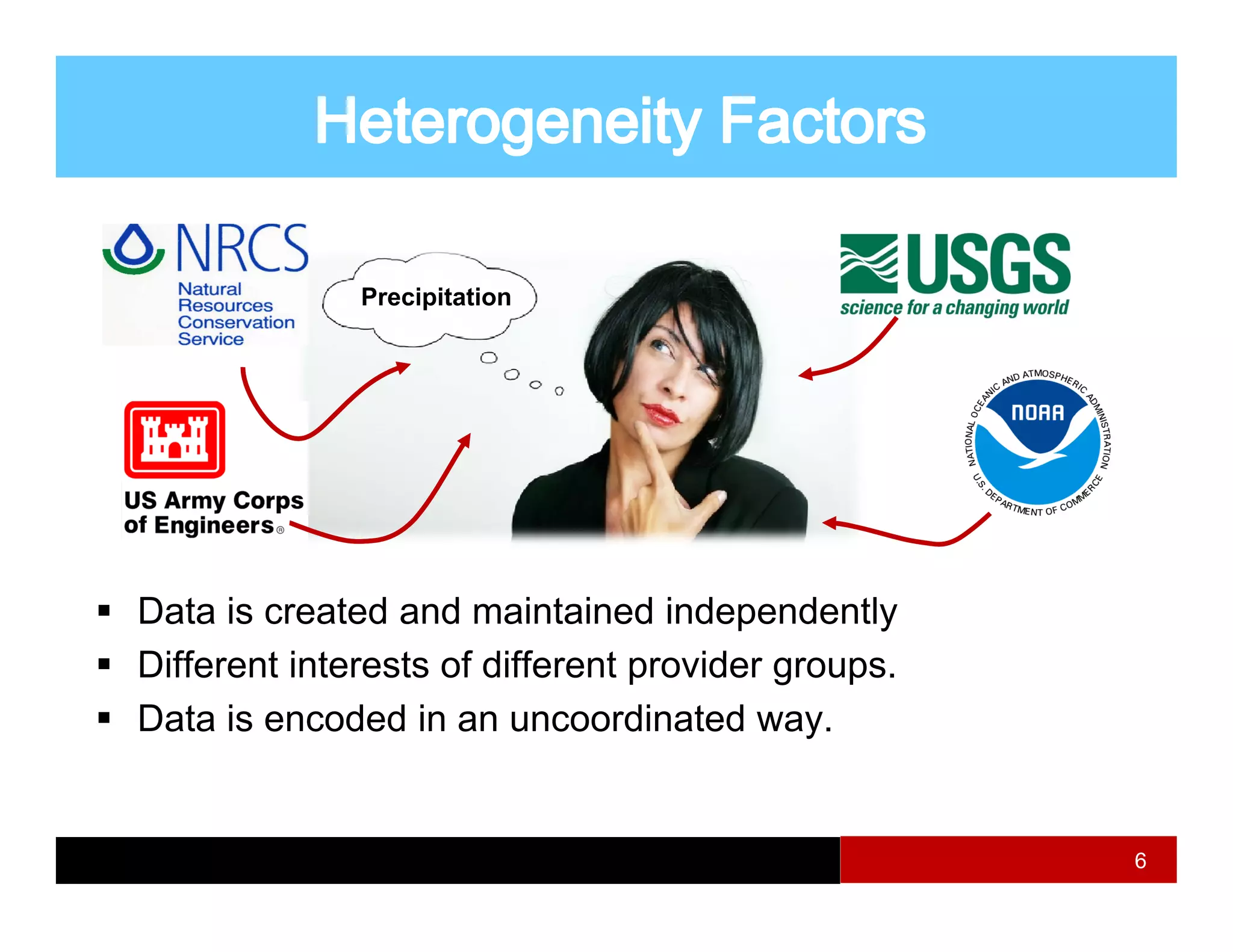
Precipitation


Data is created and maintained independently
Different interests of different provider groups.
Diff    ti t     t f diff      t     id
Data is encoded in an uncoordinated way.


                                                    6
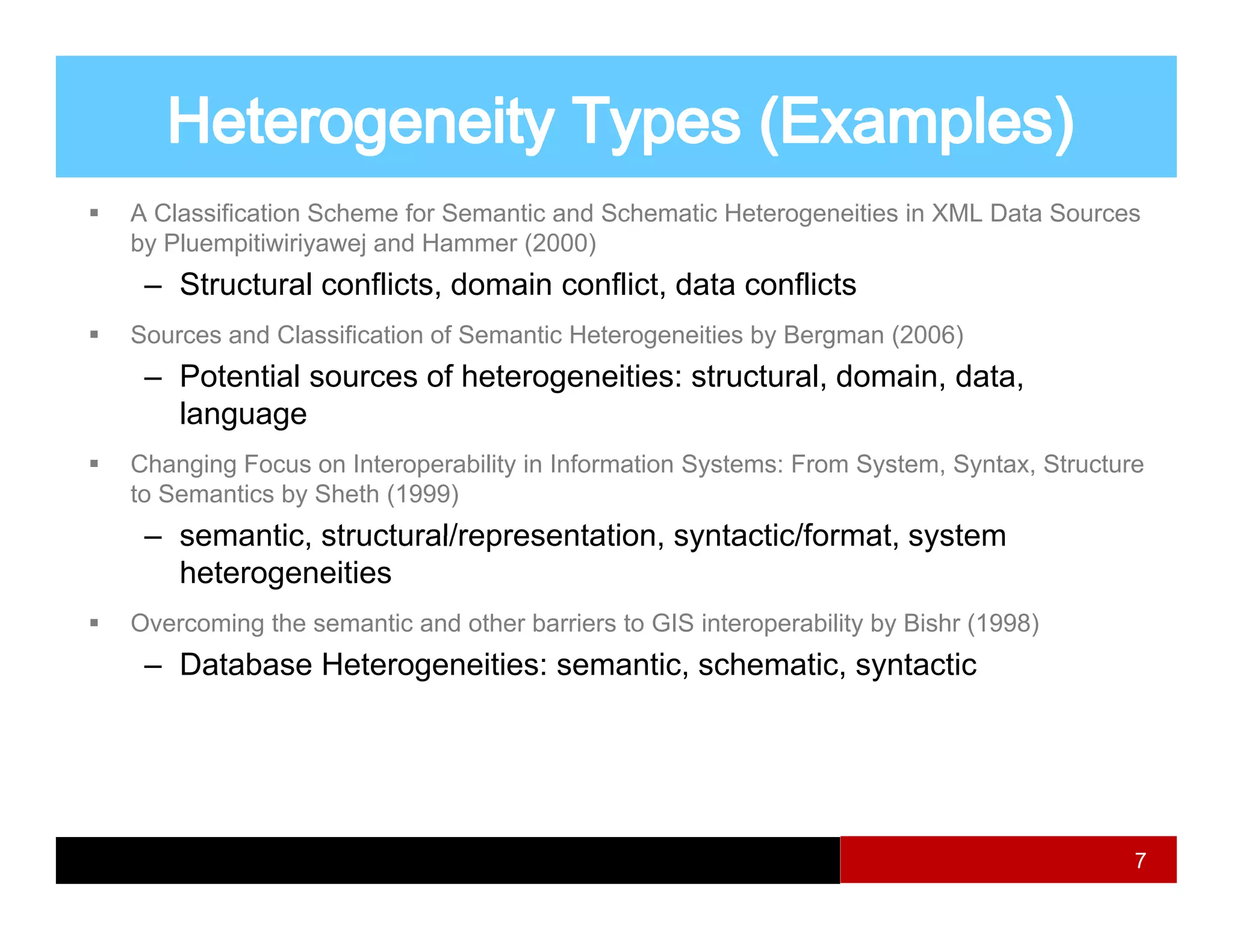
A Classification Scheme for Semantic and Schematic Heterogeneities in XML Data Sources
by Pluempitiwiriyawej and Hammer (2000)
 – Structural conflicts, domain conflict, data conflicts
                       ,                ,
Sources and Classification of Semantic Heterogeneities by Bergman (2006)
 – Potential sources of heterogeneities: structural, domain, data,
   language
Changing Focus on Interoperability in Information Systems: From System, Syntax, Structure
to Semantics by Sheth (1999)
 – semantic structural/representation, syntactic/format, system
   semantic, structural/representation syntactic/format
   heterogeneities
Overcoming the semantic and other barriers to GIS interoperability by Bishr (1998)
 – D t b
   Database H t
            Heterogeneities: semantic, schematic, syntactic
                      iti         ti     h   ti      t ti


                                                                                        7
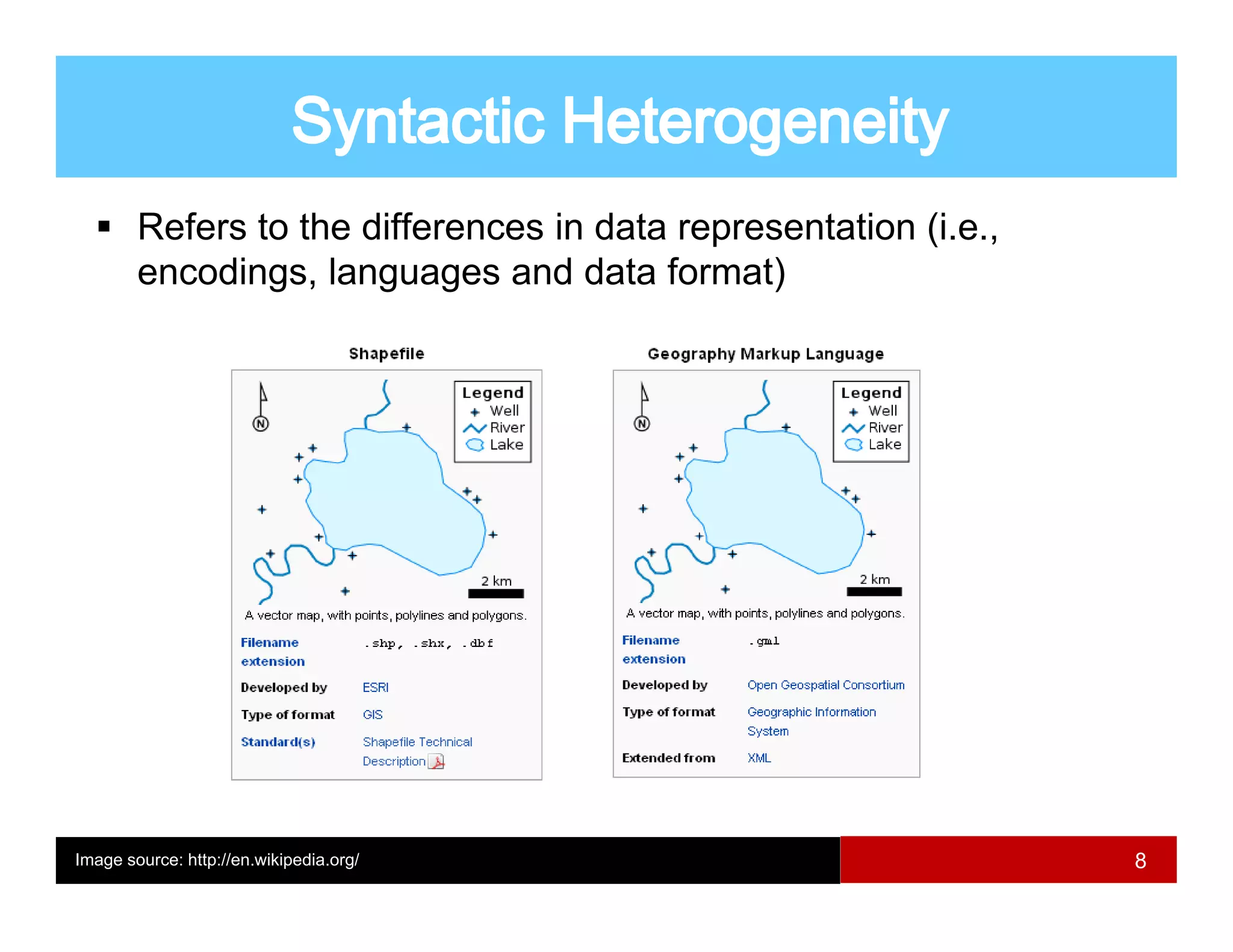
Refers to the differences in data representation (i.e.,
        encodings, languages and data format)


Image source: http://en.wikipedia.org/                            8
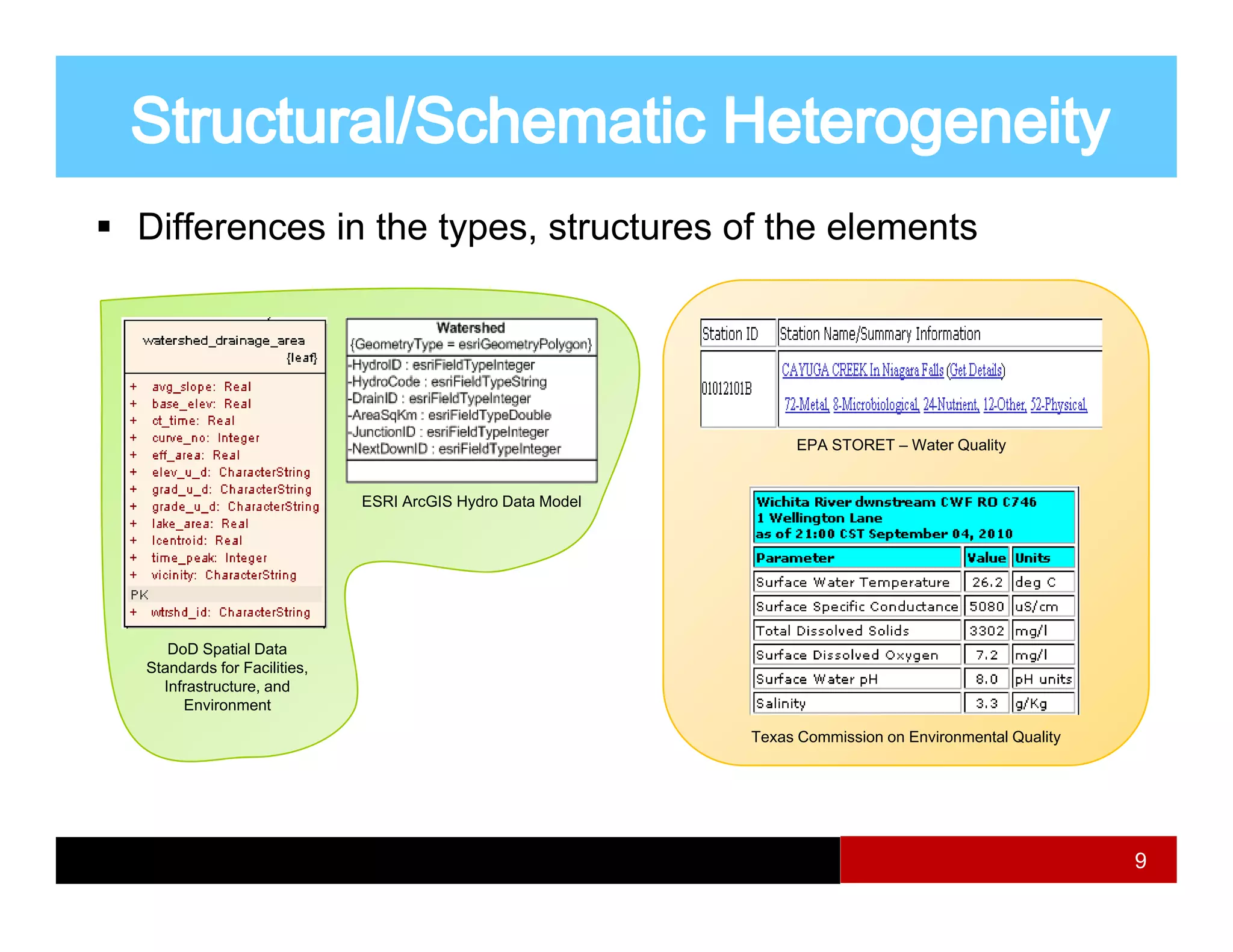
Differences in the types, structures of the elements


                                                                EPA STORET – Water Quality


                            ESRI ArcGIS Hydro Data Model


   DoD Spatial Data
          p
Standards for Facilities,
  Infrastructure, and
     Environment

                                                           Texas Commission on Environmental Quality


                                                                                                       9
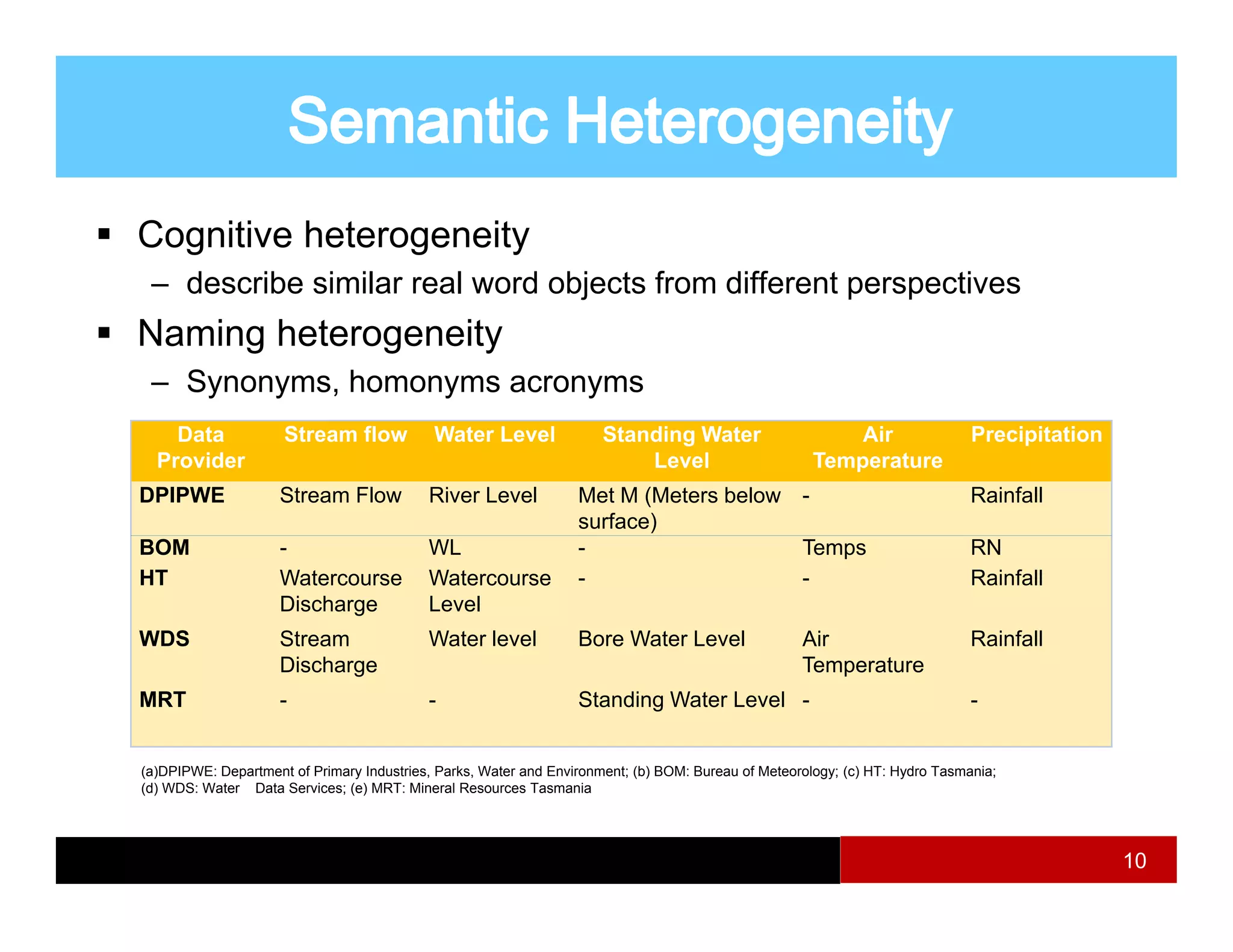
Cognitive heterogeneity
 – describe similar real word objects from different p p
                                j                    perspectives
Naming heterogeneity
 – Synonyms, homonyms acronyms
    Data             Stream flow            Water Level               Standing Water                      Air                 Precipitation
  Provider                                                                Level                       Temperature
DPIPWE               Stream Flow           River Level            Met M (Meters below -                                       Rainfall
                                                                  surface)
BOM                  -                     WL                     -                   Temps                                   RN
HT                   Watercourse           Watercourse            -                   -                                       Rainfall
                     Discharge             Level
WDS                  Stream                Water level            Bore Water Level                  Air                       Rainfall
                     Discharge                                                                      Temperature
MRT                  -                     -                      Standing Water Level -                                      -


(a)DPIPWE: Department of Primary Industries, Parks, Water and Environment; (b) BOM: Bureau of Meteorology; (c) HT: Hydro Tasmania;
(d) WDS: Water Data Services; (e) MRT: Mineral Resources Tasmania


                                                                                                                                              10
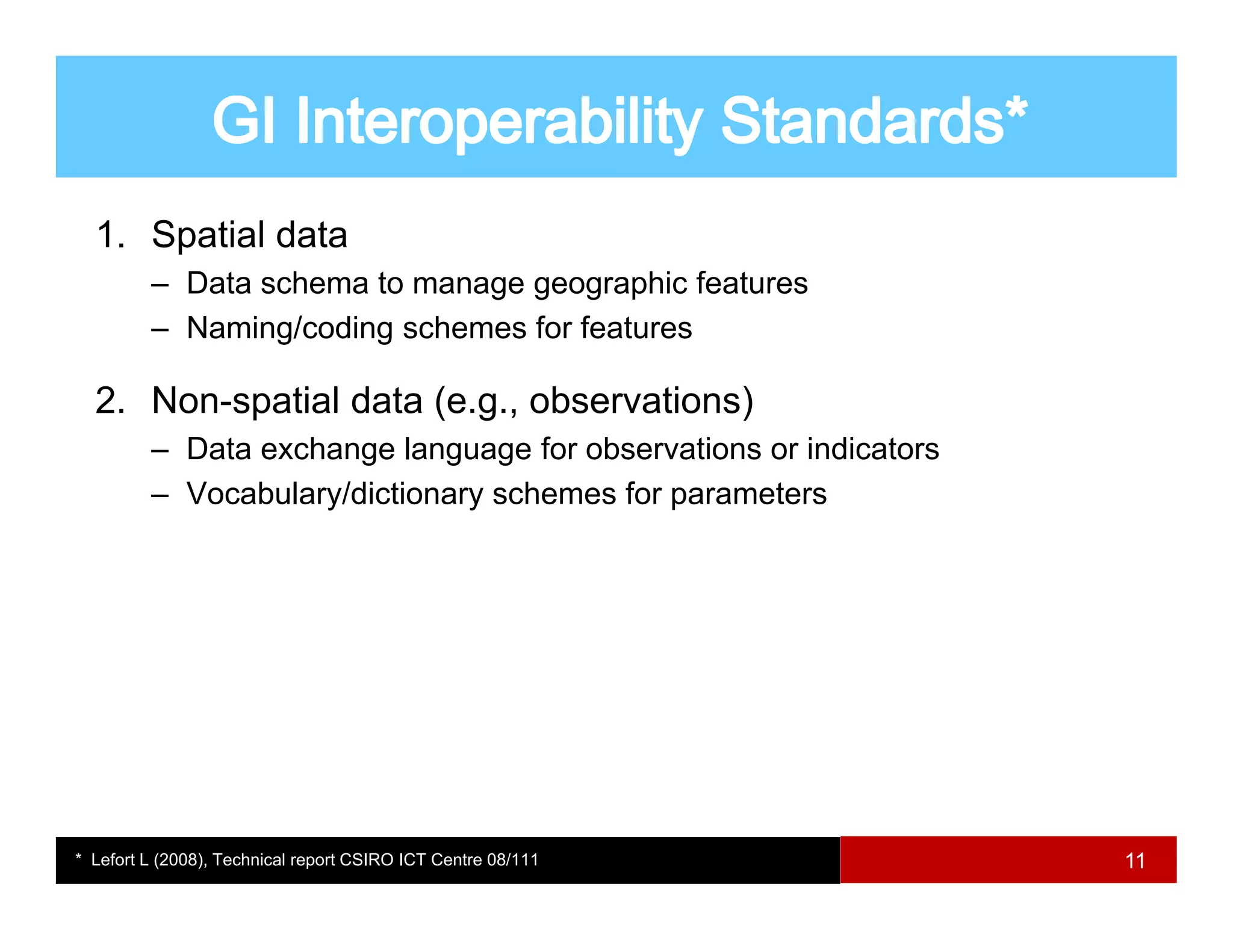
1. Spatial data
         – Data schema to manage g g p
                              g geographic features
         – Naming/coding schemes for features

  2. Non-spatial data ( g , observations)
          p           (e.g.,            )
         – Data exchange language for observations or indicators
         – Vocabulary/dictionary schemes for parameters


* Lefort L (2008), Technical report CSIRO ICT Centre 08/111        11
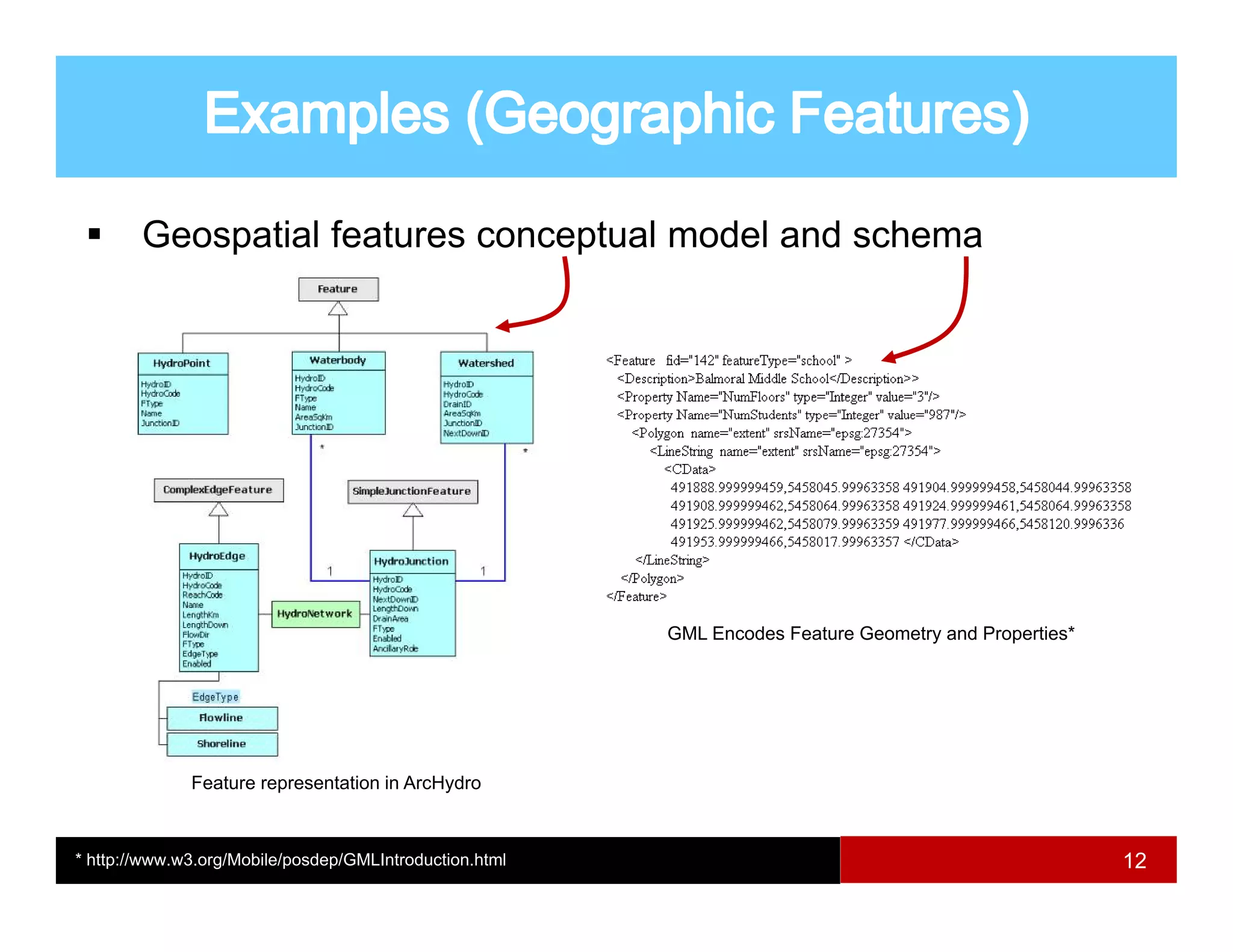
Geospatial features conceptual model and schema


                                                         GML Encodes Feature Geometry and Properties*


              Feature representation in ArcHydro


* http://www.w3.org/Mobile/posdep/GMLIntroduction.html                                                  12
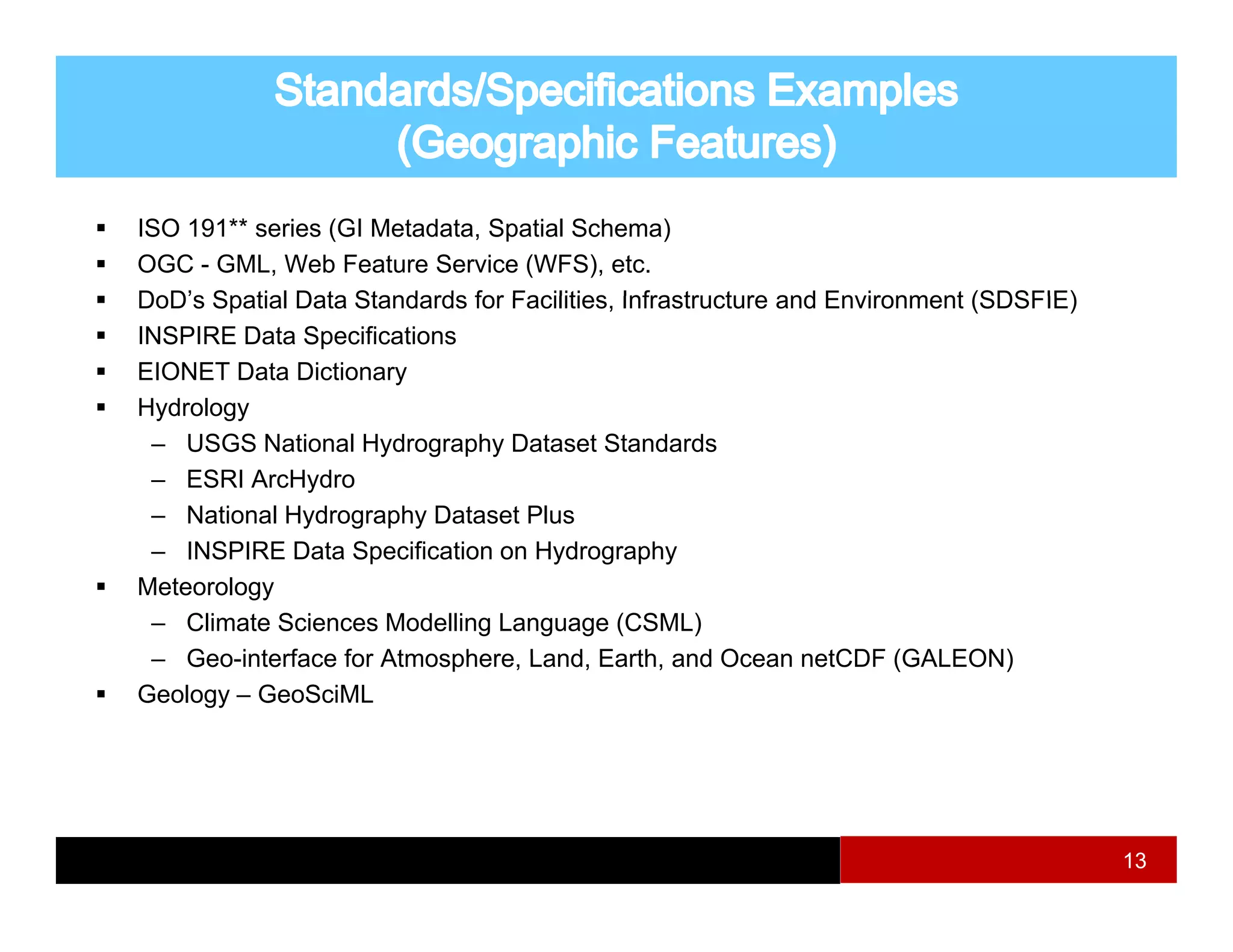
ISO 191** series (GI Metadata, Spatial Schema)
OGC - GML, Web Feature Service (WFS), etc.
DoD’s Spatial Data Standards for Facilities, Infrastructure and Environment (SDSFIE)
                                 Facilities
INSPIRE Data Specifications
EIONET Data Dictionary
Hydrology
 – USGS National Hydrography Dataset Standards
 – ESRI ArcHydro
 – National Hydrography Dataset Plus
 – INSPIRE Data Specification on Hydrography
Meteorology
 – Climate Sciences Modelling Language (CSML)
 – Geo interface for Atmosphere Land Earth and Ocean netCDF (GALEON)
    Geo-interface    Atmosphere, Land, Earth,
Geology – GeoSciML


                                                                                       13
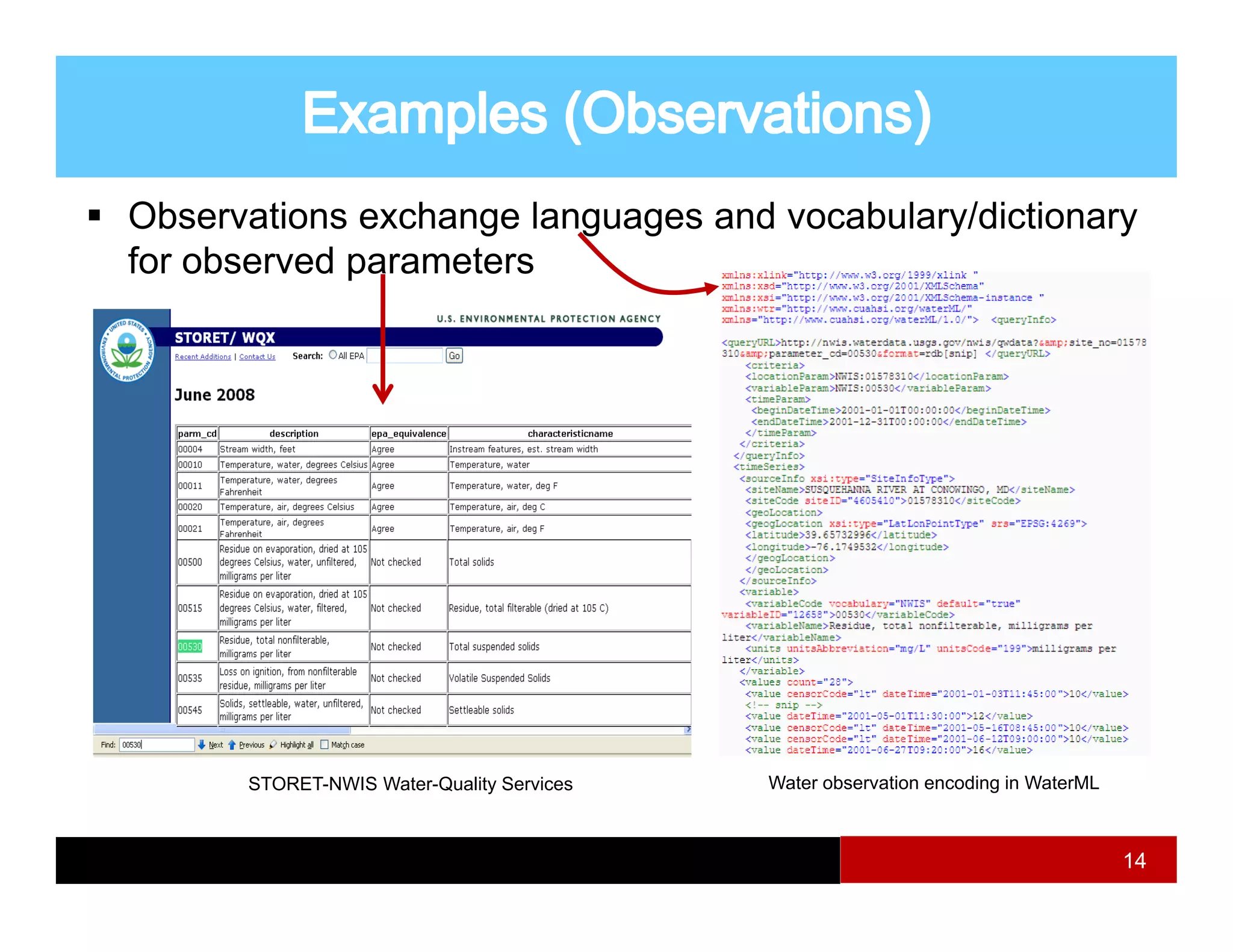
Observations exchange languages and vocabulary/dictionary
for observed parameters


      STORET-NWIS Water-Quality Services   Water observation encoding in WaterML


                                                                                   14
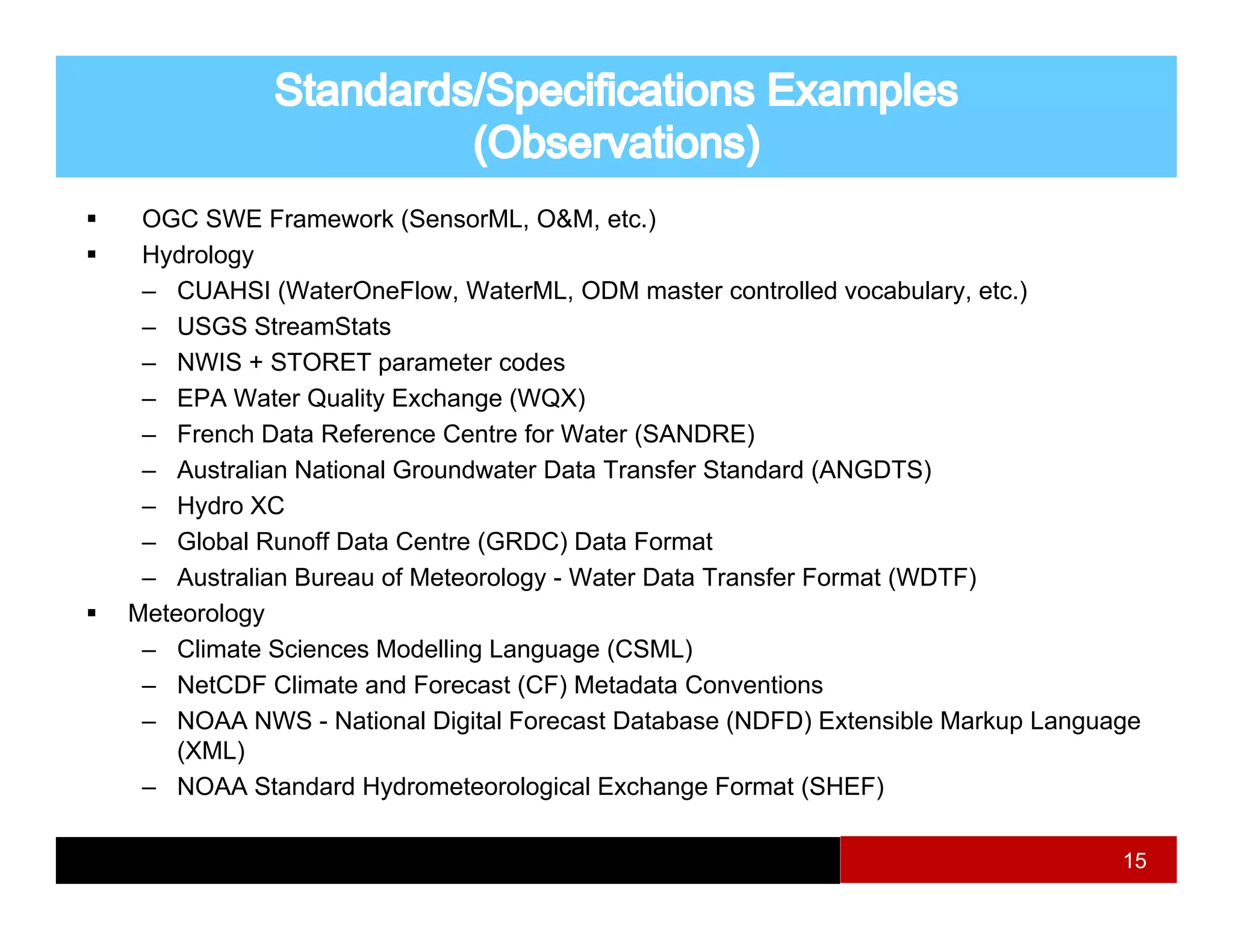
OGC SWE Framework (SensorML, O&M, etc.)
 Hydrology
 – CUAHSI (WaterOneFlow WaterML ODM master controlled vocabulary etc )
            (WaterOneFlow, WaterML,                          vocabulary, etc.)
 – USGS StreamStats
 – NWIS + STORET parameter codes
 – EPA Water Quality Exchange (WQX)
 – French Data Reference Centre for Water (SANDRE)
 – Australian National Groundwater Data Transfer Standard (ANGDTS)
 – Hydro XC
 – Gl b l R
    Global Runoff D t C t (GRDC) D t F
               ff Data Centre         Data Formatt
 – Australian Bureau of Meteorology - Water Data Transfer Format (WDTF)
Meteorology
 – Climate Sciences Modelling Language (CSML)
 – NetCDF Climate and Forecast (CF) Metadata Conventions
 – NOAA NWS - National Digital Forecast Database (NDFD) Extensible Markup Language
    (XML)
 – NOAA Standard Hydrometeorological Exchange Format (SHEF)

                                                                                15
Standards/specifications provide a syntactic approach to
encoding geospatial information [Doerr 2004]
 – Source information needs adaptation to the standard.
 – Symbols in a data schema need to be interpreted by users.
 – A standard is one for its domain It cannot be optimal for all
                             domain.
   applications.

Semantic interoperability requires [Kavouras et.al. 2010]]
               p        y q        [

 – Existing heterogeneities identification
 – Their importance and priority analysis
 – A systematic strategy too resolve them


                                                                   16
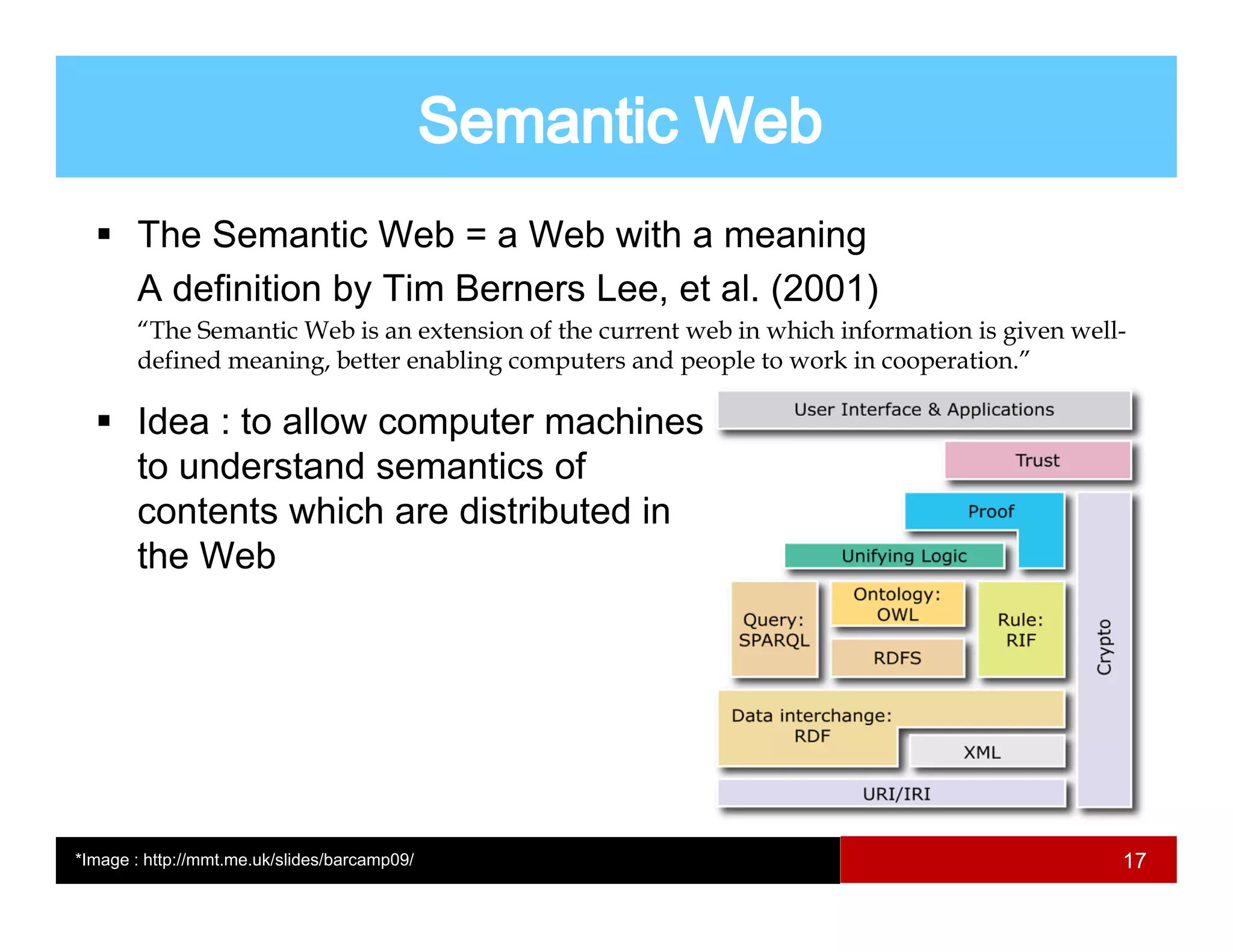
The Semantic Web = a Web with a meaning
       A definition by Tim Berners Lee et al. (2001)
                                   Lee, al
       “The Semantic Web is an extension of the current web in which information is given well-
       defined meaning, better enabling computers and people to work in cooperation.”

       Idea : to allow computer machines
       to understand semantics of
       contents which are distributed in
       the Web


*Image : http://mmt.me.uk/slides/barcamp09/                                                   17
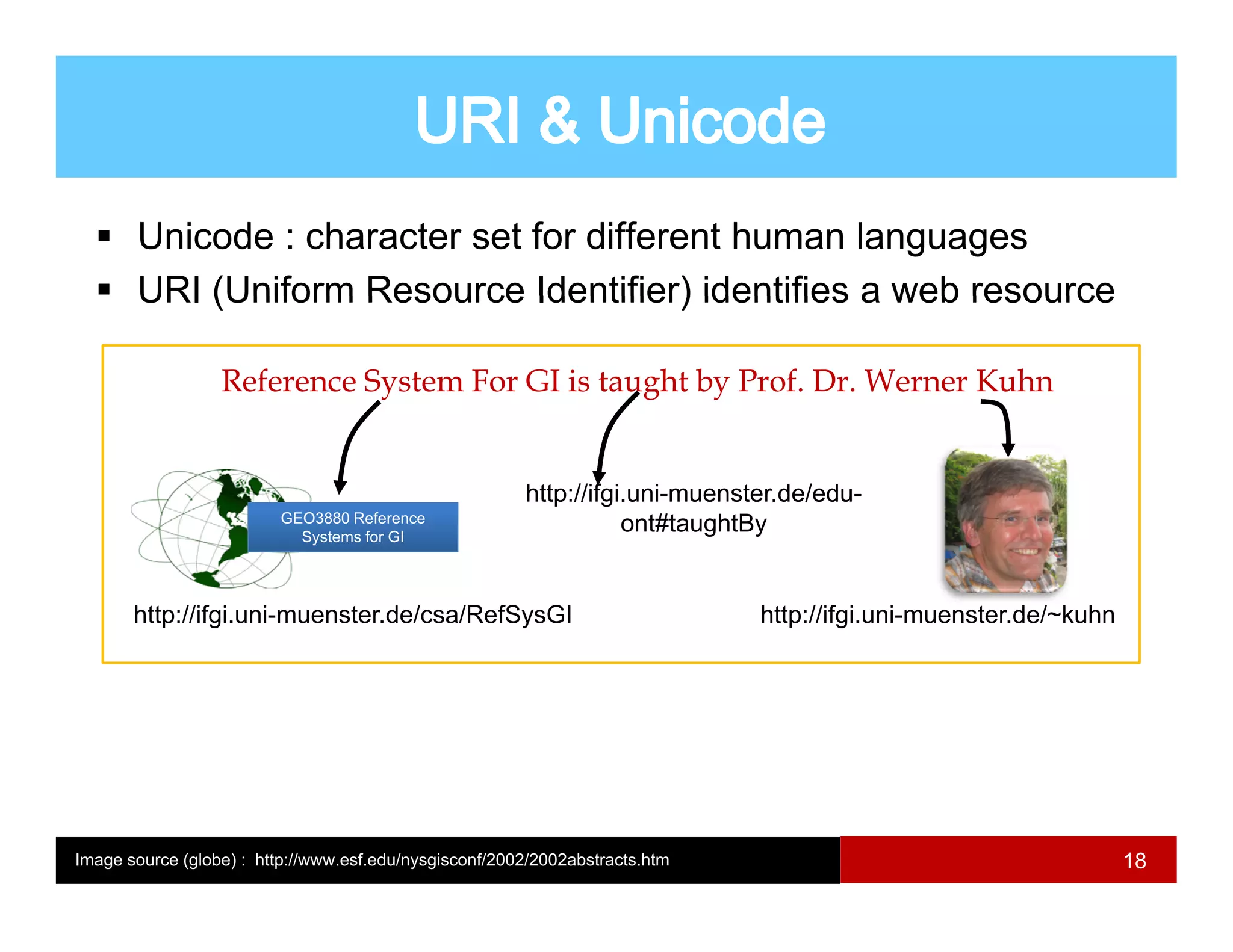
Unicode : character set for different human languages
       URI (Uniform Resource Identifier) identifies a web resource

                  Reference System For GI is taught by Prof. Dr. Werner Kuhn


                                                        http://ifgi.uni-muenster.de/edu-
                         GEO3880 Reference
                           Systems for GI
                                                                   ont#taughtBy
                                                                          g y


       http://ifgi.uni-muenster.de/csa/RefSysGI                               http://ifgi.uni-muenster.de/~kuhn


Image source (globe) : http://www.esf.edu/nysgisconf/2002/2002abstracts.htm                                       18
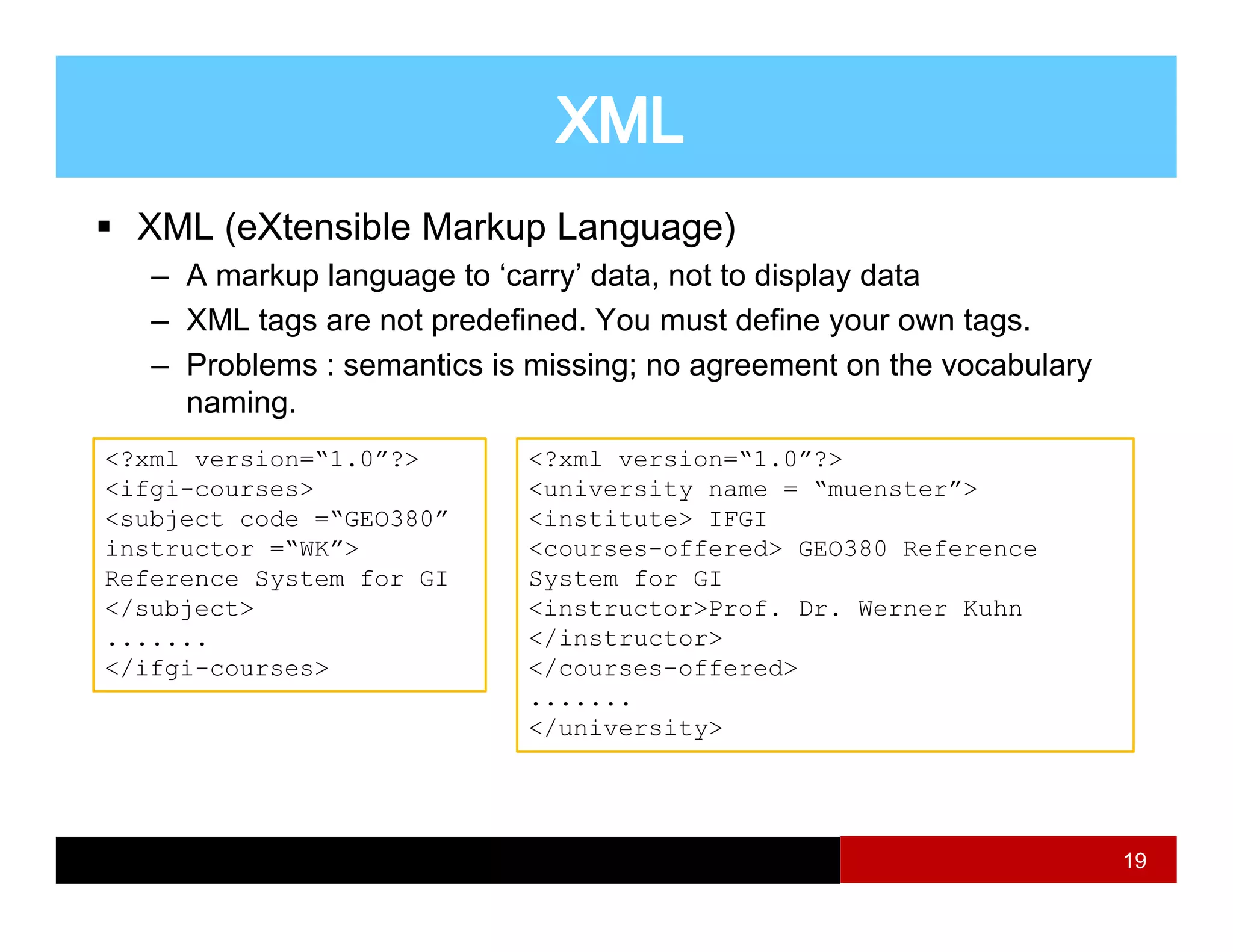
XML (eXtensible Markup Language)
   – A markup language to ‘carry’ data, not to display data
   – XML tags are not predefined. You must define your own tags.
   – Problems : semantics is missing; no agreement on the vocabulary
     naming.
           g
<?xml version=“1.0”?>        <?xml version=“1.0”?>
<ifgi-courses>               <university name = “muenster”>
<subject code =“GEO380”      <institute> IFGI
instructor =“WK”>            <courses-offered> GEO380 Reference
Reference System for GI      System for GI
</subject>                   <instructor>Prof. Dr. Werner Kuhn
.......                      </instructor>
</ifgi-courses>              </courses-offered>
                             .......
                             </university>


                                                                       19
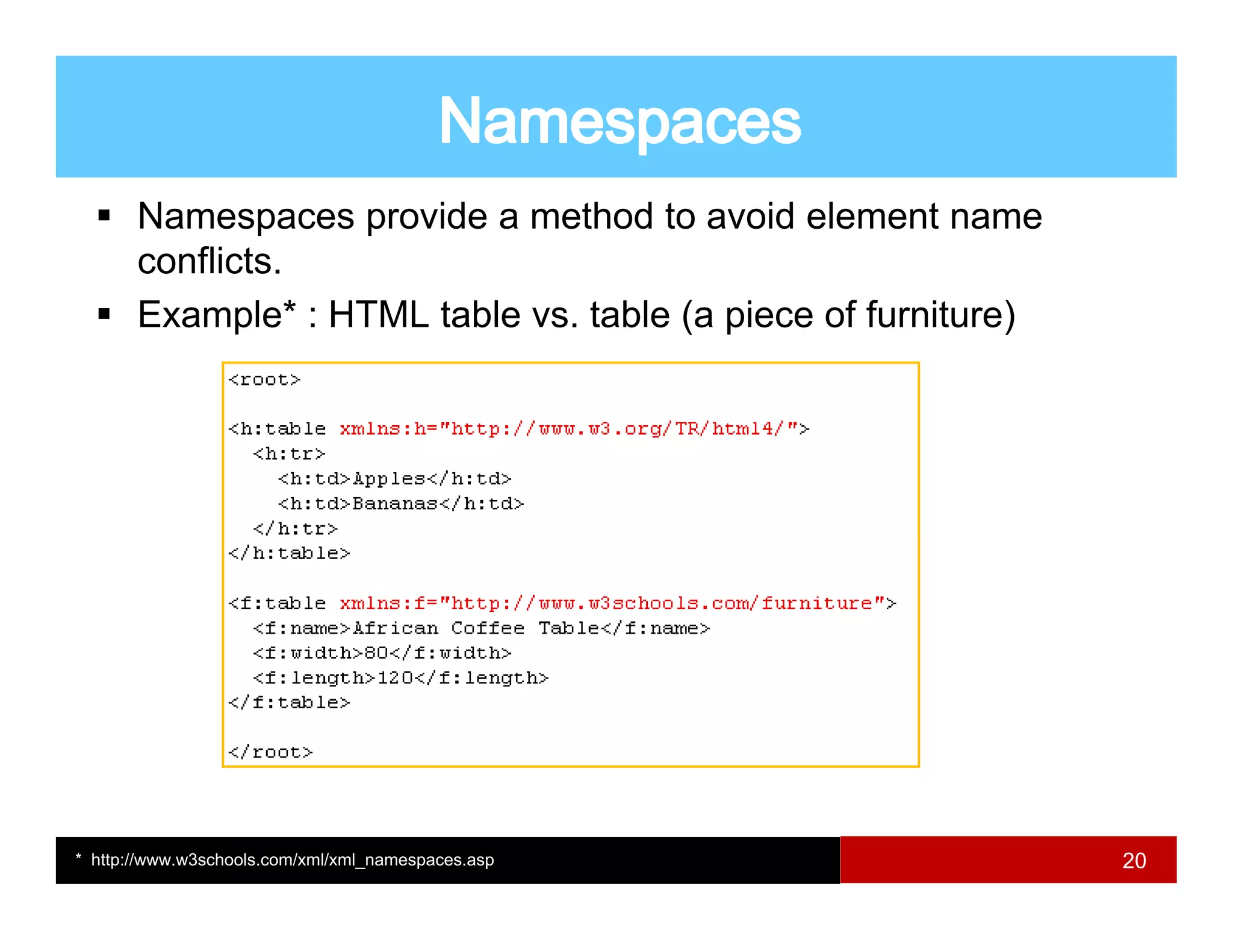
Namespaces provide a method to avoid element name
       conflicts.
       Example* : HTML table vs. table (a piece of furniture)


* http://www.w3schools.com/xml/xml_namespaces.asp               20
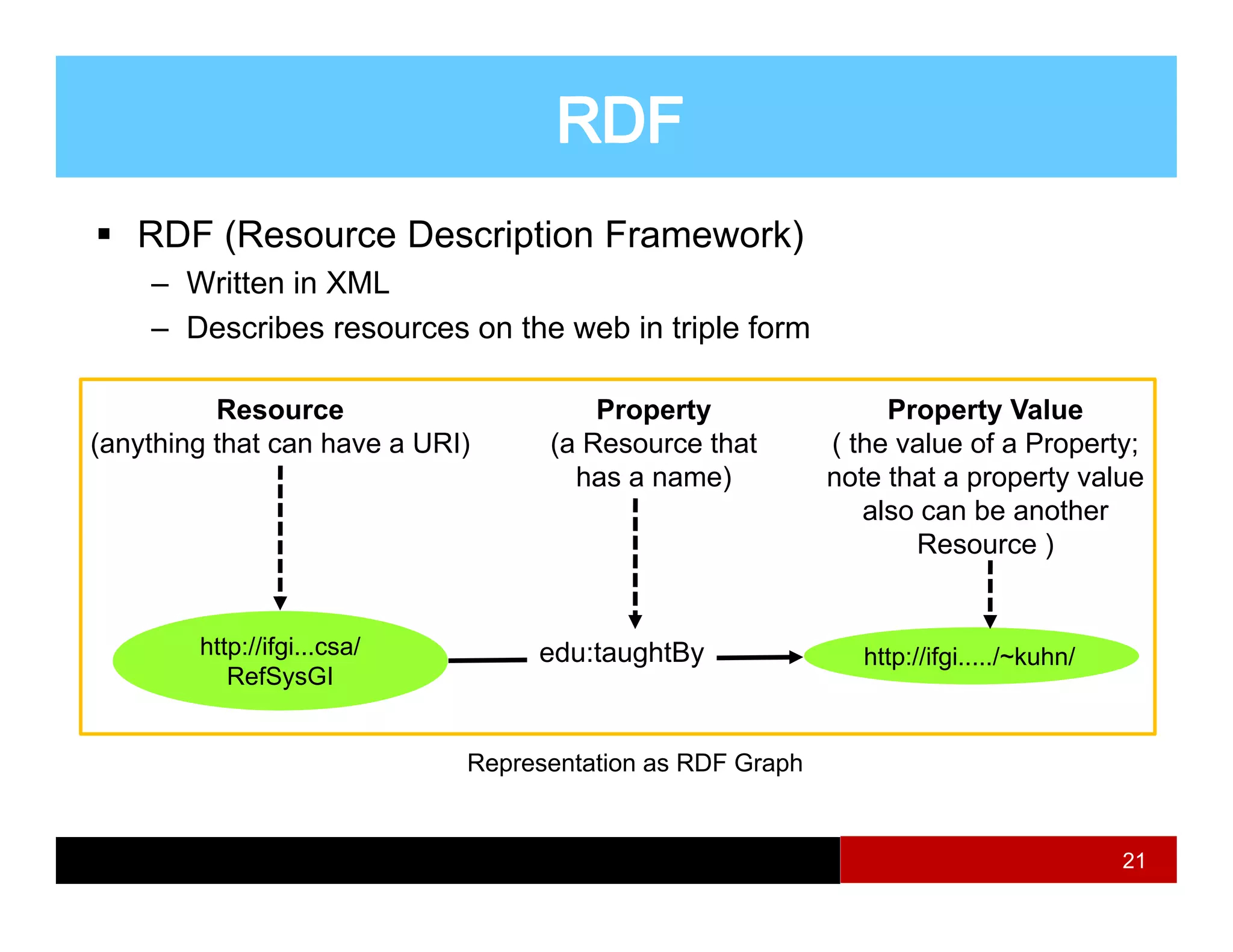
RDF (Resource Description Framework)
    – Written in XML
    – Describes resources on the web in triple form

          Resource                     Property                 Property Value
(anything that can have a URI)     (a Resource that        ( the value of a Property;
                                     has a name)           note that a property value
                                                              also can be another
                                                                  Resource )
                                                                  R


        http://ifgi...csa/
           p g                    edu:taughtBy                http://ifgi...../~kuhn/
                                                              http://ifgi /~kuhn/
           RefSysGI


                             Representation as RDF Graph
                               p                      p


                                                                                        21
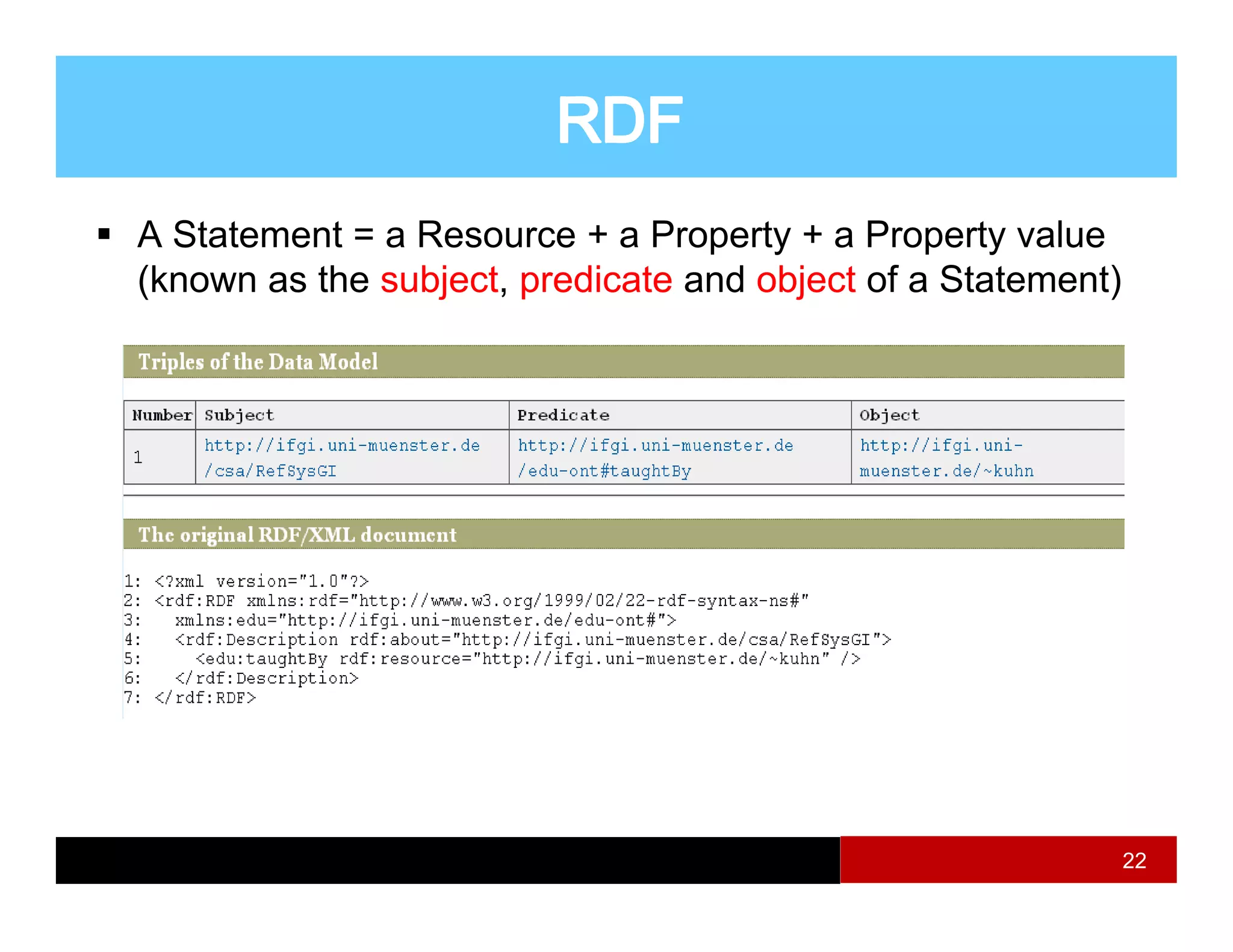
A Statement = a Resource + a Property + a Property value
(
(known as the subject, predicate and object of a Statement)
                 j ,p                  j                  )


                                                              22
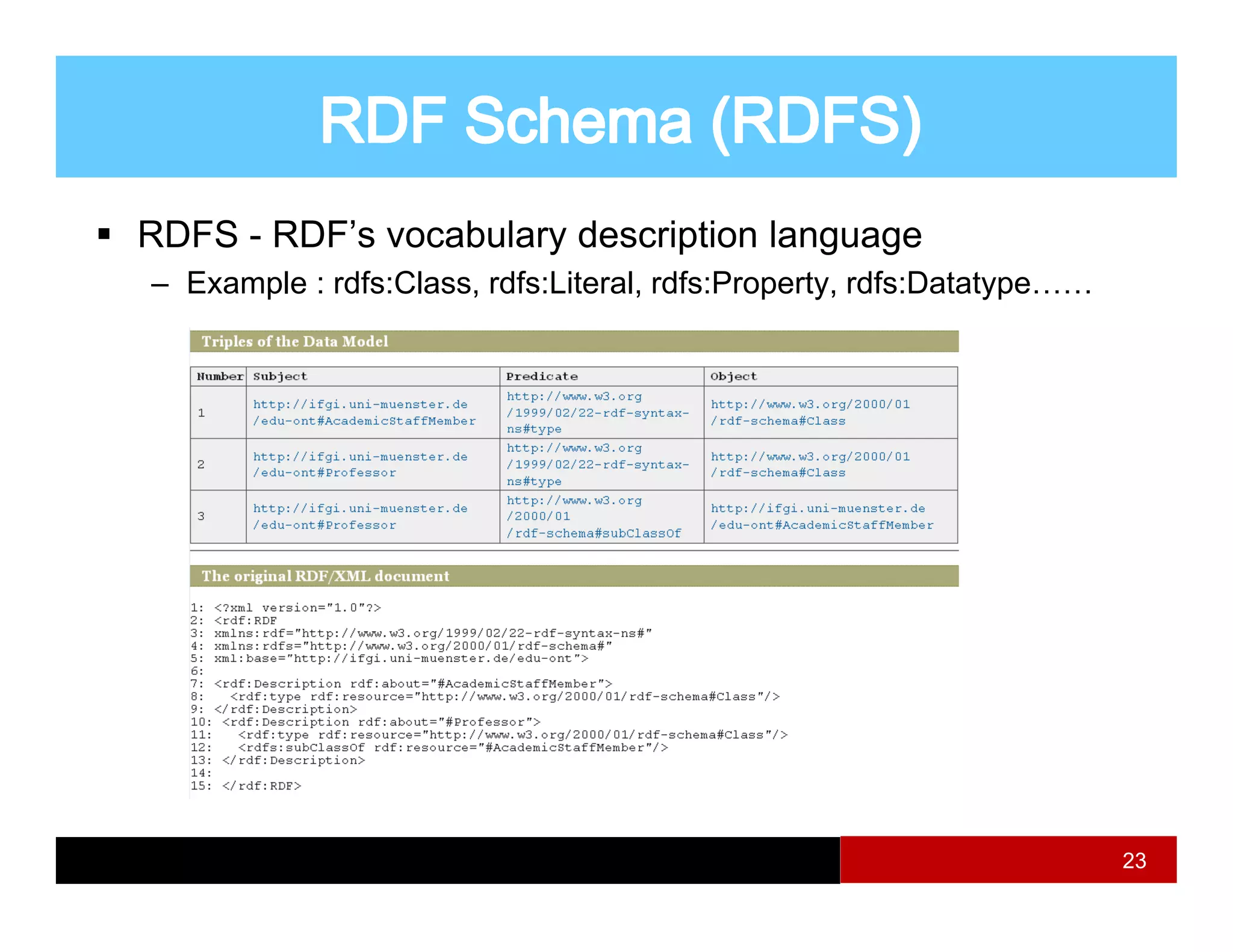
RDFS - RDF’s vocabulary description language
– Example : rdfs:Class, rdfs:Literal, rdfs:Property, rdfs:Datatype……
      p               ,             ,         p y,             yp


                                                                       23
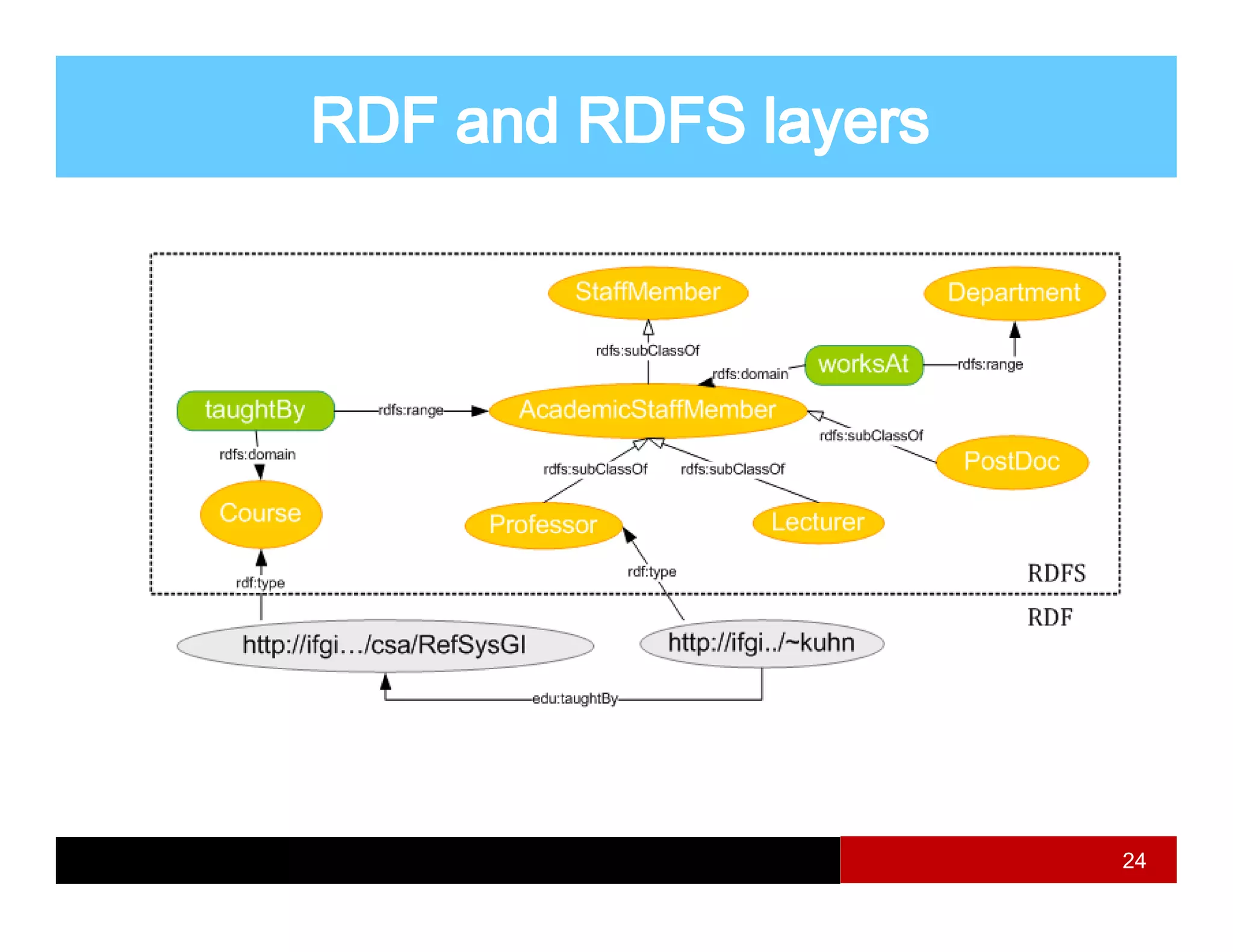
24
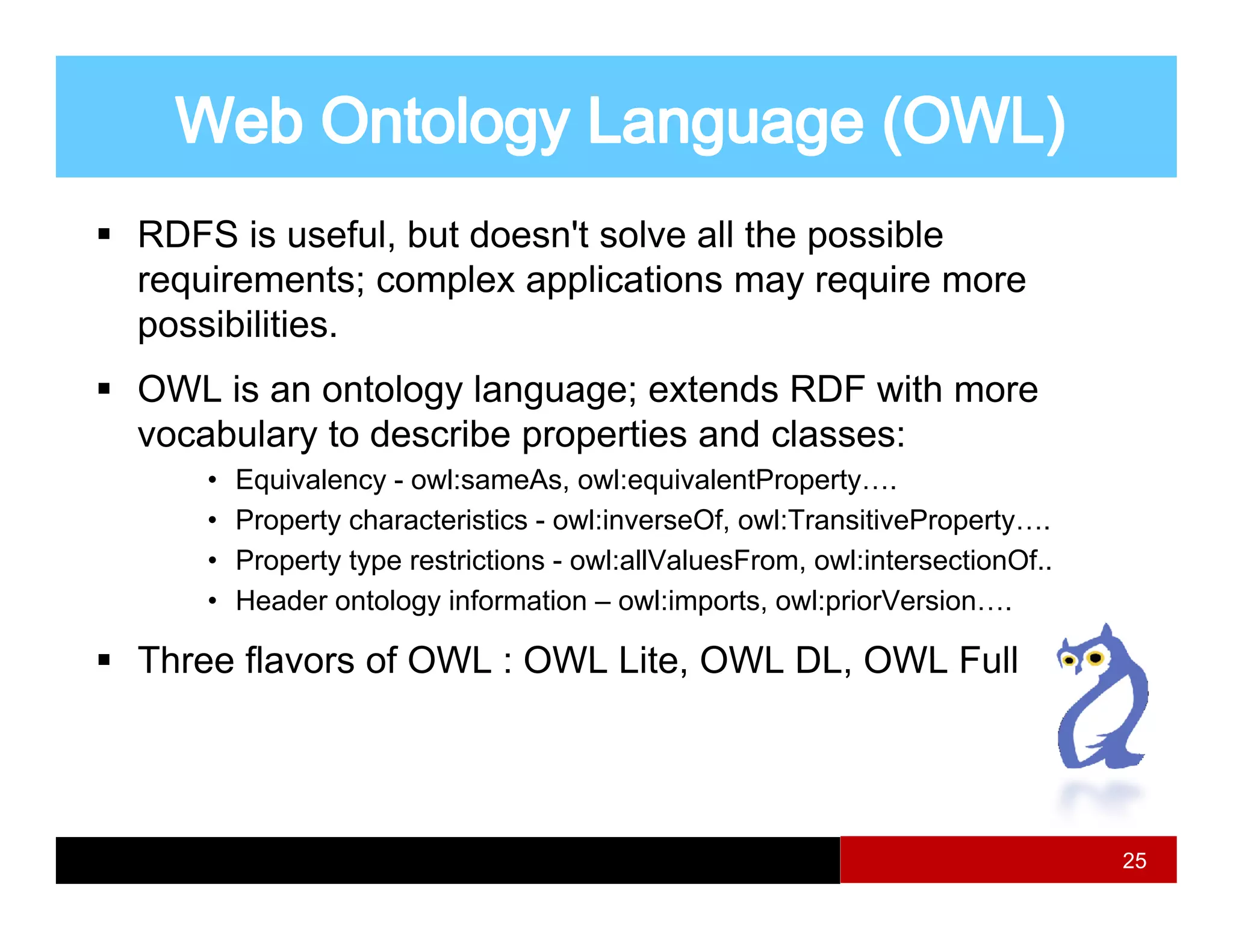
RDFS is useful, but doesn't solve all the possible
requirements; complex applications may require more
  q            ;  p     pp              y q
possibilities.
OWL is an ontology language; extends RDF with more
vocabulary to describe properties and classes:
    •   Equivalency - owl:sameAs, owl:equivalentProperty….
    •   Property characteristics - owl:inverseOf, owl:TransitiveProperty….
    •   Property type restrictions - owl:allValuesFrom, owl:intersectionOf..
    •   Header ontology information – owl:imports, owl:priorVersion….

Three flavors of OWL : OWL Lite OWL DL OWL Full
                           Lite,    DL,


                                                                               25
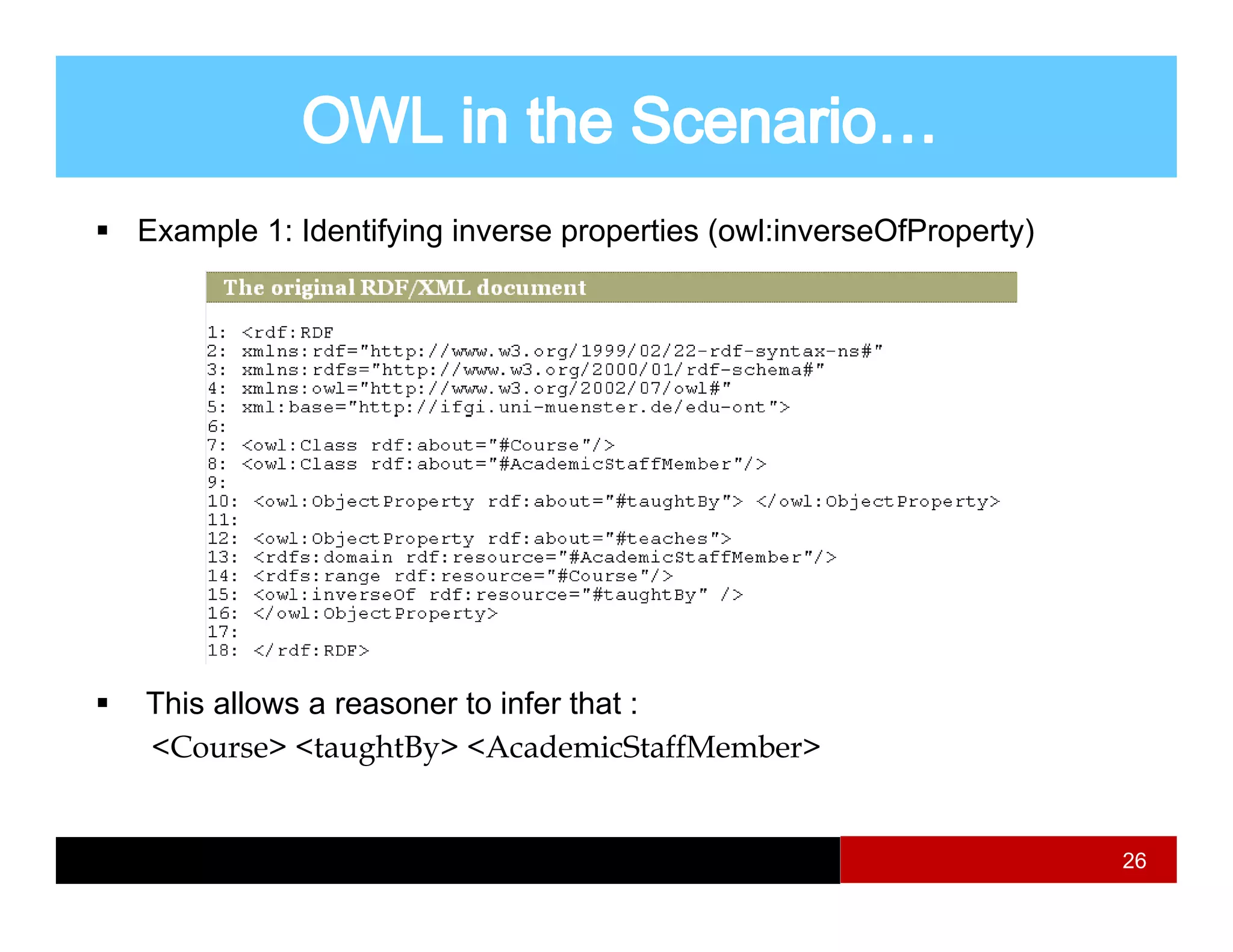
Example 1: Identifying inverse properties (owl:inverseOfProperty)


This allows a reasoner to infer that :
<Course> <taughtBy> <AcademicStaffMember>


                                                                    26
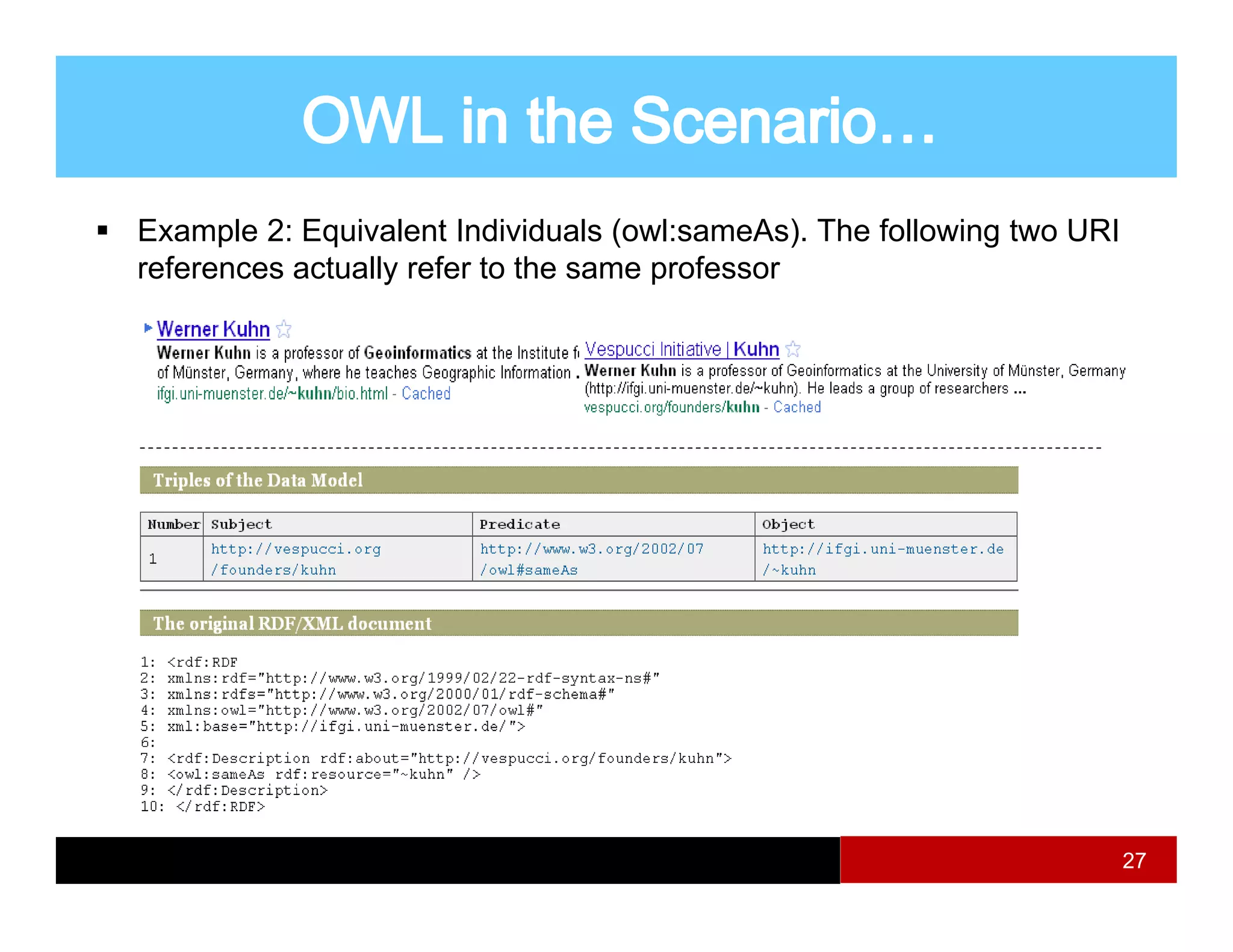
Example 2: Equivalent Individuals (owl:sameAs). The following two URI
references actually refer to the same professor


                                                                        27
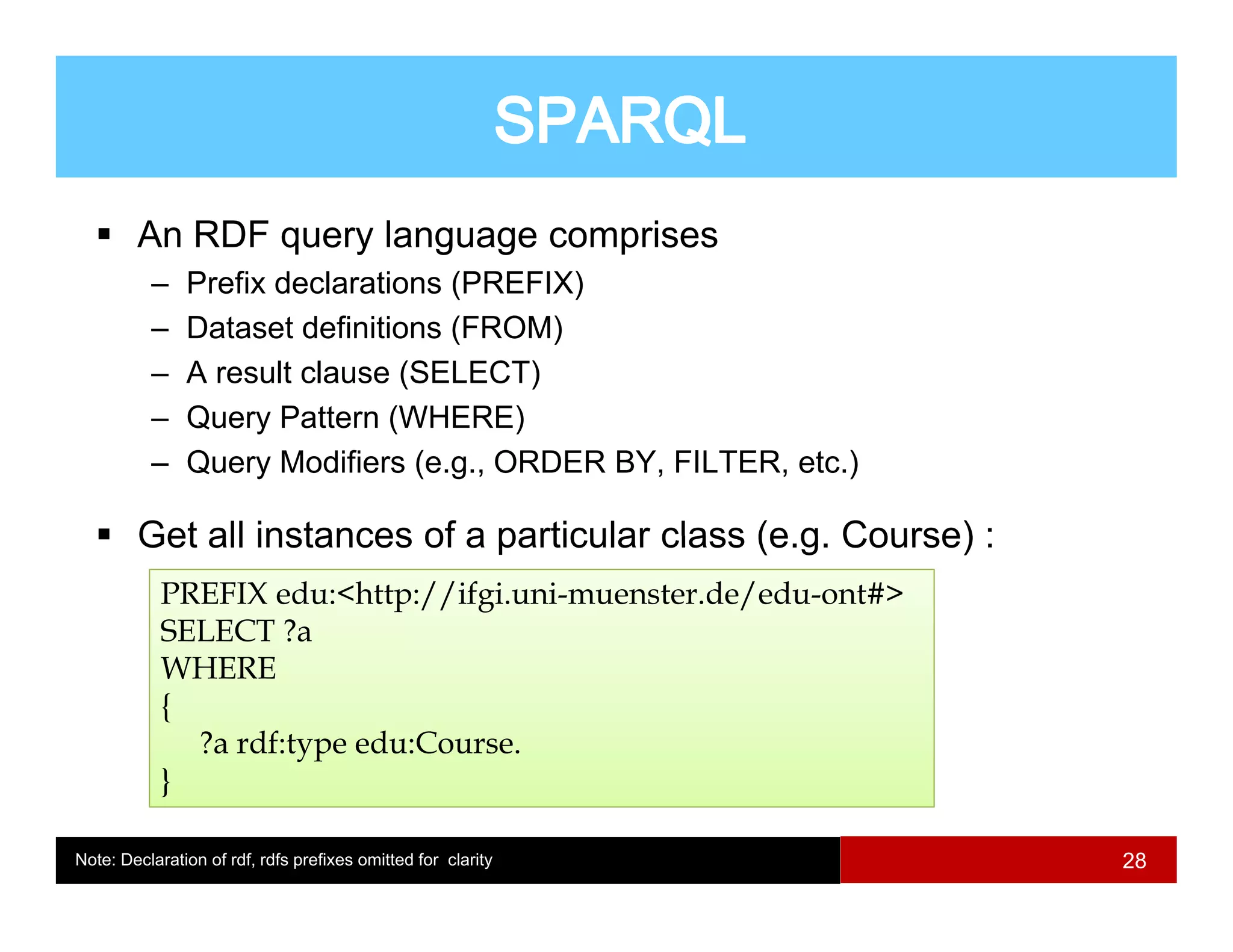
An RDF query language comprises
          –    Prefix declarations (PREFIX)
                                   (      )
          –    Dataset definitions (FROM)
          –    A result clause (SELECT)
          –    Query Pattern (WHERE)
          –    Query Modifiers (e.g., ORDER BY, FILTER, etc.)

        Get all instances of a particular class (e g Course) :
                                                (e.g.
            PREFIX edu:<http://ifgi.uni-muenster.de/edu-ont#>
            SELECT ?a
            WHERE
            {
              ?a rdf:type edu:Course.
            }

Note: Declaration of rdf, rdfs prefixes omitted for clarity      28
An RDF query language comprises
          –    Prefix declarations (PREFIX)
                                   (      )
          –    Dataset definitions (FROM)
          –    A result clause (SELECT)
          –    Query Pattern (WHERE)
          –    Query Modifiers (e.g., ORDER BY, FILTER, etc.)

        Get all instances of a particular class (e g Course) :
                                                (e.g.
            PREFIX edu:<http://ifgi.uni-muenster.de/edu-ont#>
            SELECT ?a
            WHERE
            {
              ?a rdf:type edu:Course.
            }

Note: Declaration of rdf, rdfs prefixes omitted for clarity      29
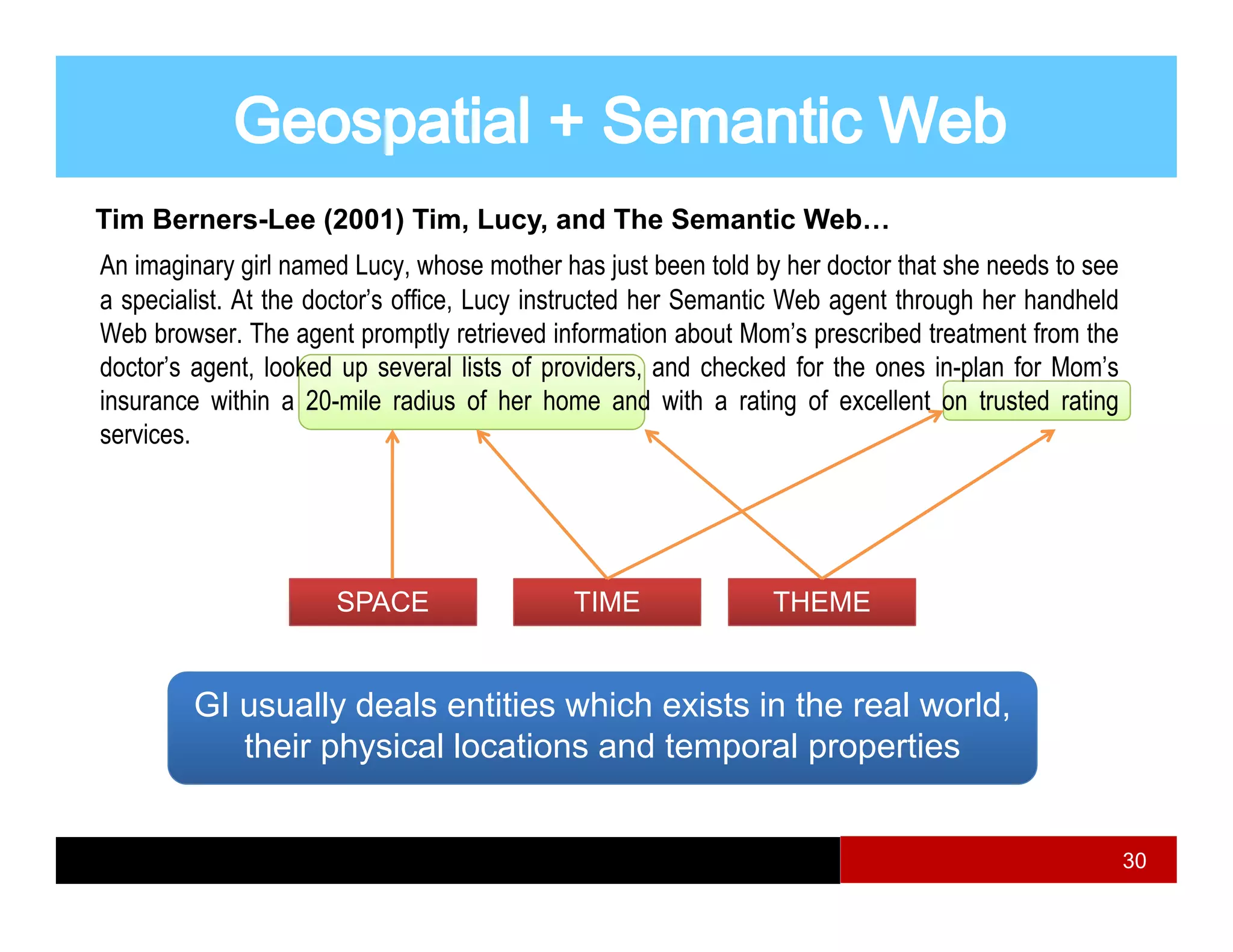
Tim Berners-Lee (2001) Tim, Lucy, and The Semantic Web…
An imaginary girl named Lucy, whose mother has just been told by her doctor that she needs to see
a specialist At the doctor’s office Lucy instructed her Semantic Web agent through her handheld
  specialist.       doctor s office,
Web browser. The agent promptly retrieved information about Mom’s prescribed treatment from the
doctor’s agent, looked up several lists of providers, and checked for the ones in-plan for Mom’s
insurance within a 20-mile radius of her home and with a rating of excellent on trusted rating
                                                                  g                             g
services.


                      SPACE                  TIME               THEME


        GI usually deals entities which exists in the real world,
           their physical locations and temporal properties


                                                                                                    30
River in Newcastle…


                                                      Newcastle UK

Newcastle
Australia


The need for spatial component within Semantic Web
  Example : geospatial data + spatial operator [Egenhofer, 2002]

                                                                     31
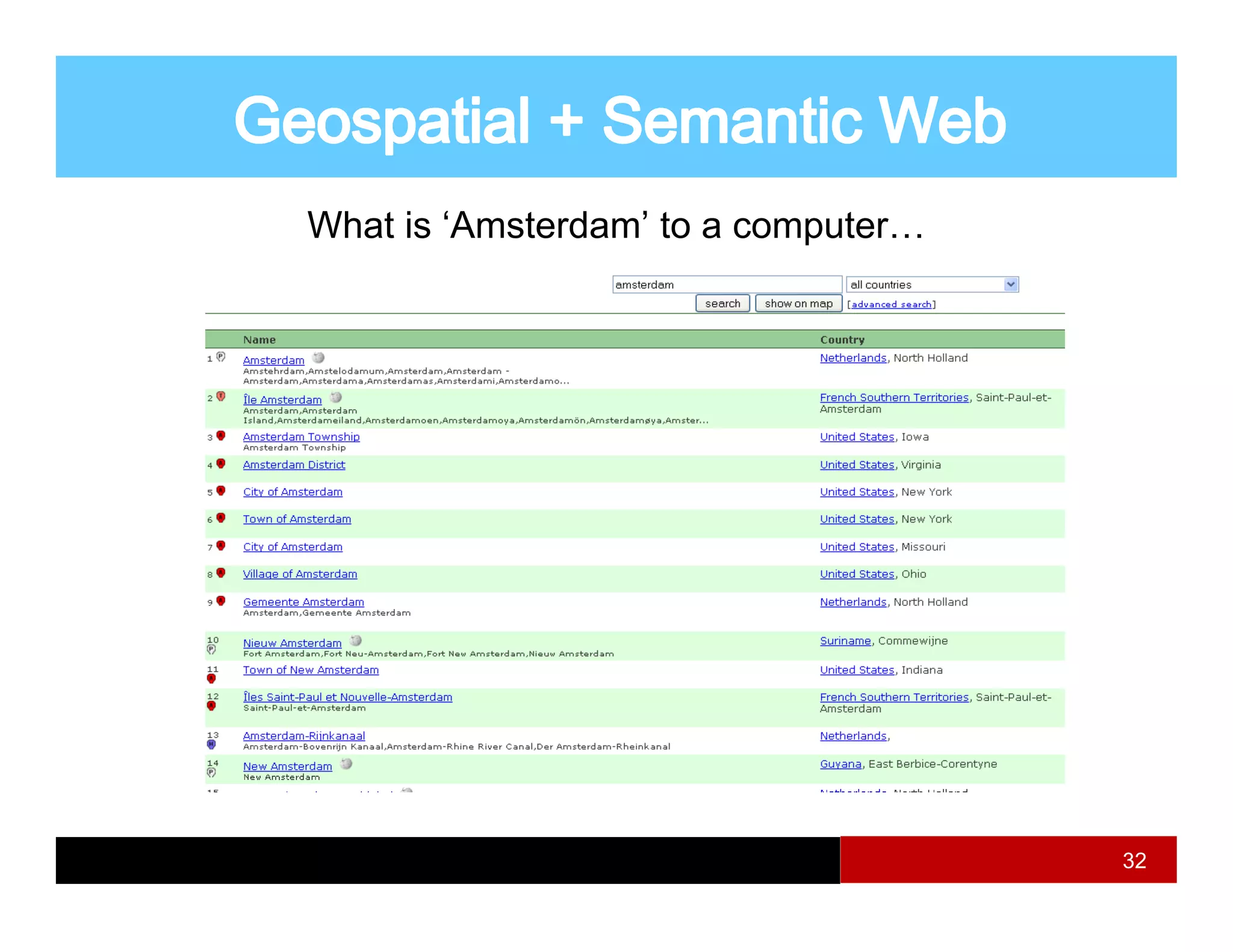
What is ‘Amsterdam’ to a computer…


                                     32
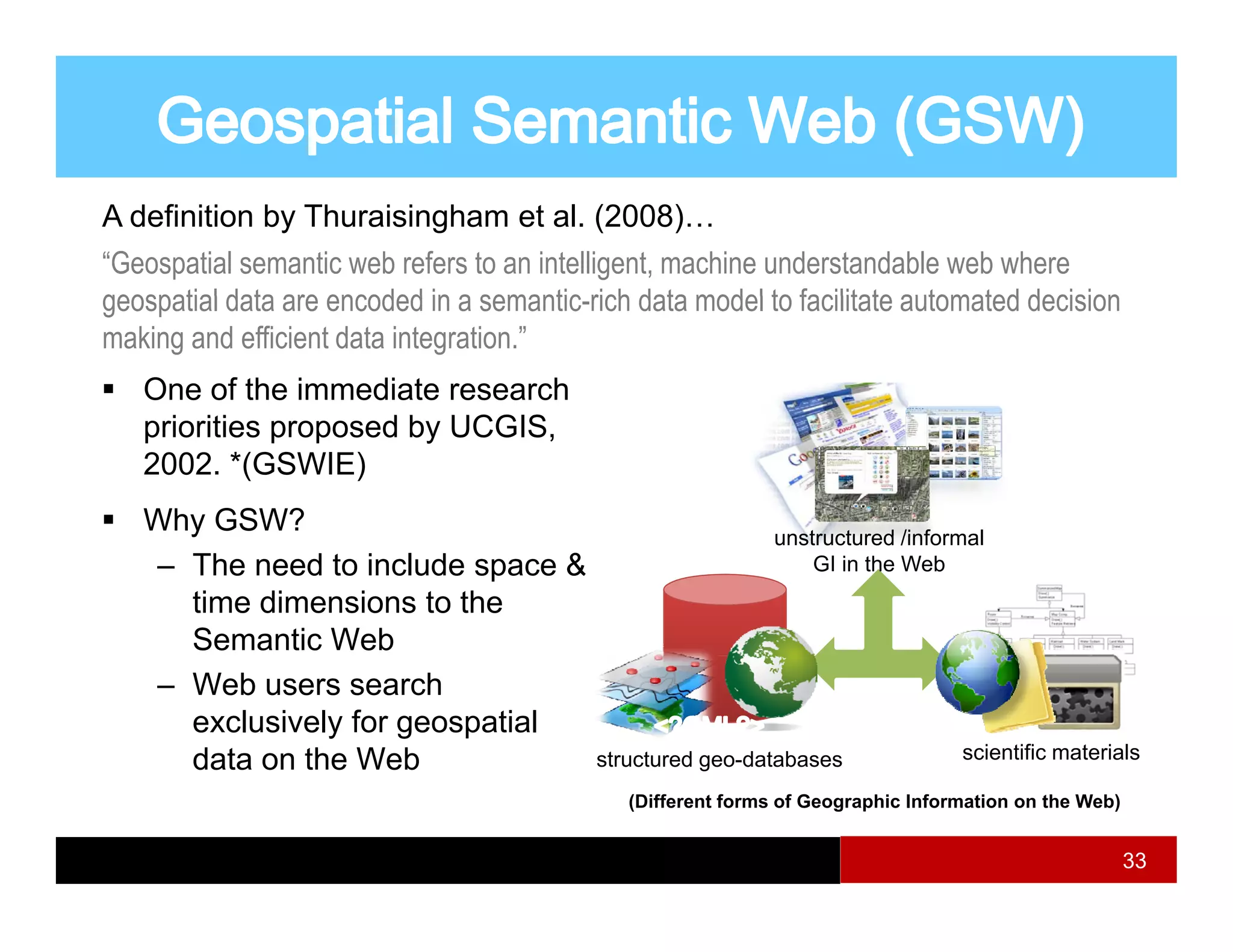
A definition by Thuraisingham et al. (2008)…
“Geospatial semantic web refers to an intelligent, machine understandable web where
geospatial data are encoded in a semantic rich data model to facilitate automated decision
                                  semantic-rich
making and efficient data integration.”
   One of the immediate research
   priorities proposed b UCGIS
     i iti           d by UCGIS,
   2002. *(GSWIE)
   Why GSW?
     y                                                       unstructured /informal
   – The need to include space &                                 GI in the Web
     time dimensions to the
     Semantic Web
   – Web users search
     exclusively for geospatial
     data on the Web                       structured geo-databases               scientific materials

                                              (Different forms of Geographic Information on the Web)


                                                                                                       33
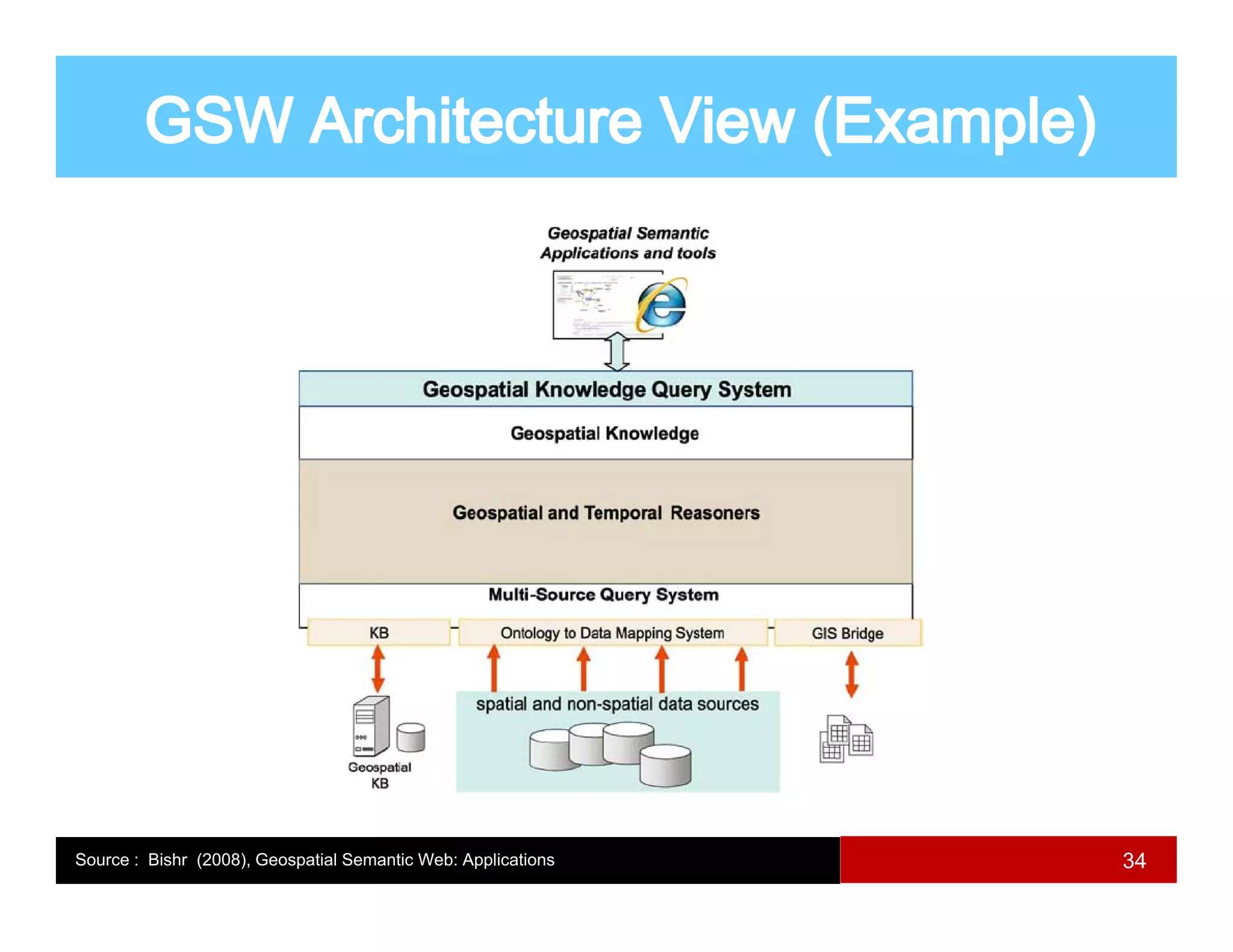
Source : Bishr (2008), Geospatial Semantic Web: Applications   34
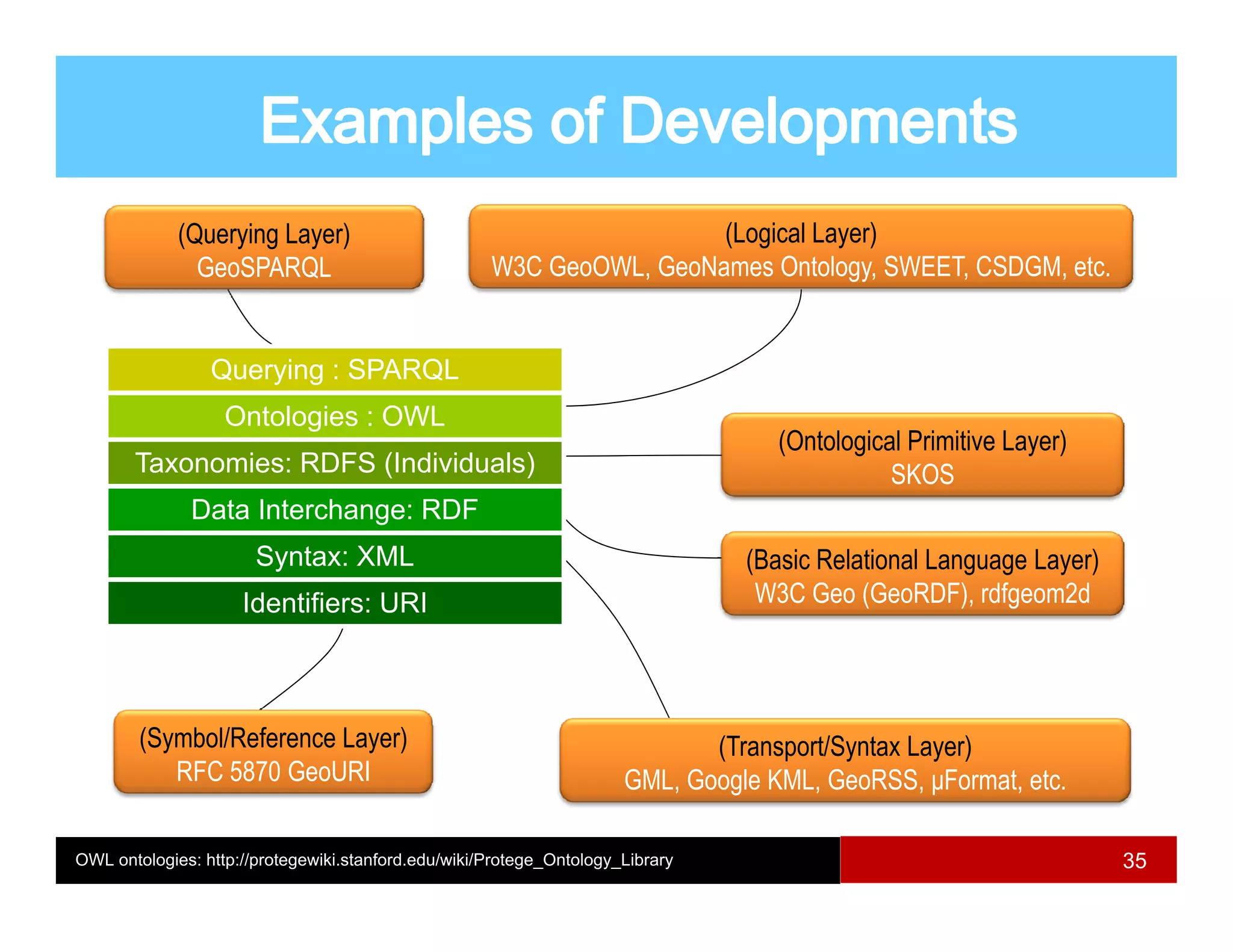
(Querying Layer)                                         (Logical Layer)
               GeoSPARQL                             W3C GeoOWL, GeoNames Ontology, SWEET, CSDGM, etc.


                 Querying : SPARQL
                   Ontologies : OWL
                                                                                   (Ontological Primitive Layer)
       Taxonomies: RDFS (Individuals)                                                         SKOS
              Data Interchange: RDF
                       Syntax: XML                                              (Basic Relational Language Layer)
                     Identifiers: URI                                            W3C Geo (GeoRDF), rdfgeom2d


        (Symbol/Reference Layer)                                            (Transport/Syntax Layer)
           RFC 5870 GeoURI                                            GML Google KML GeoRSS μFormat etc.
                                                                      GML,       KML, GeoRSS, μFormat, etc

OWL ontologies: http://protegewiki.stanford.edu/wiki/Protege_Ontology_Library                                       35
Building highly formalized representations (e.g., ontologies)
of the available geographic information resources
                 g g p
Linking and mapping informal geo-centric resources to the
highly formalized representation structures being built by the
Semantic Web
Geospatial query – formulate geospatial request, represent
the results (URI or real spatial data)
            (             p          )
Geo-data distribution policy and legal issues


                                                             36

Semantic interoperability

  • 1.
    (Geospatial Semantics –Week 4) ANUSURIYA DEVARAJU Institute for Geoinformatics, University of Muenster. (anusuriya.devaraju@uni-muenster.de)
  • 2.
    Here are someof the things you can expect to learn… What i i t Wh t is interoperability? H bilit ? How d does i t interoperability diff f bilit differ from integration? Types of heterogeneities Standards vs. Interpretation Semantic underpinning : Semantic Web Stack Geospatial Semantic Web : Broadening the current vision of Semantic p g Web to include geospatial data representation 2
  • 3.
    Semantics – study ofmeaning ; focuses on the relation between symbols (e g (e.g. words) and what they stand for [wikipedia] – Our context : relations between the computer representations and the corresponding real world features features. Interoperability – Ability of diverse ‘systems’ to operate effectively and efficiently in conjunction, on the exchange and reuse of available resources, services, procedures, and information, according to the intended use of their providers … [Kavouras et al 2010] et.al. – ‘System’ do not refer strictly to technical systems. 3
  • 4.
    Interoperability may occurat any six levels Levels of interoperability [Bishr 2010] 4
  • 5.
    Semantic Interoperability – Focuseson preserving the semantics between communicating p g g entities. – Information is properly interpreted by the ‘receiver’ in the same sense as intended by ‘sender’. y Information perspective : Integration vs. Interoperability - A fully interoperable solution also requires information integration to y p q g deal with interpretation of data. Semantic Integration – Subset of semantic interoperability [Kavouras et.al. 2010] – Necessitates the reconciliation of mismatches, heterogeneities, etc. 5
  • 6.
    Precipitation Data is createdand maintained independently Different interests of different provider groups. Diff ti t t f diff t id Data is encoded in an uncoordinated way. 6
  • 7.
    A Classification Schemefor Semantic and Schematic Heterogeneities in XML Data Sources by Pluempitiwiriyawej and Hammer (2000) – Structural conflicts, domain conflict, data conflicts , , Sources and Classification of Semantic Heterogeneities by Bergman (2006) – Potential sources of heterogeneities: structural, domain, data, language Changing Focus on Interoperability in Information Systems: From System, Syntax, Structure to Semantics by Sheth (1999) – semantic structural/representation, syntactic/format, system semantic, structural/representation syntactic/format heterogeneities Overcoming the semantic and other barriers to GIS interoperability by Bishr (1998) – D t b Database H t Heterogeneities: semantic, schematic, syntactic iti ti h ti t ti 7
  • 8.
    Refers to thedifferences in data representation (i.e., encodings, languages and data format) Image source: http://en.wikipedia.org/ 8
  • 9.
    Differences in thetypes, structures of the elements EPA STORET – Water Quality ESRI ArcGIS Hydro Data Model DoD Spatial Data p Standards for Facilities, Infrastructure, and Environment Texas Commission on Environmental Quality 9
  • 10.
    Cognitive heterogeneity –describe similar real word objects from different p p j perspectives Naming heterogeneity – Synonyms, homonyms acronyms Data Stream flow Water Level Standing Water Air Precipitation Provider Level Temperature DPIPWE Stream Flow River Level Met M (Meters below - Rainfall surface) BOM - WL - Temps RN HT Watercourse Watercourse - - Rainfall Discharge Level WDS Stream Water level Bore Water Level Air Rainfall Discharge Temperature MRT - - Standing Water Level - - (a)DPIPWE: Department of Primary Industries, Parks, Water and Environment; (b) BOM: Bureau of Meteorology; (c) HT: Hydro Tasmania; (d) WDS: Water Data Services; (e) MRT: Mineral Resources Tasmania 10
  • 11.
    1. Spatial data – Data schema to manage g g p g geographic features – Naming/coding schemes for features 2. Non-spatial data ( g , observations) p (e.g., ) – Data exchange language for observations or indicators – Vocabulary/dictionary schemes for parameters * Lefort L (2008), Technical report CSIRO ICT Centre 08/111 11
  • 12.
    Geospatial features conceptualmodel and schema GML Encodes Feature Geometry and Properties* Feature representation in ArcHydro * http://www.w3.org/Mobile/posdep/GMLIntroduction.html 12
  • 13.
    ISO 191** series(GI Metadata, Spatial Schema) OGC - GML, Web Feature Service (WFS), etc. DoD’s Spatial Data Standards for Facilities, Infrastructure and Environment (SDSFIE) Facilities INSPIRE Data Specifications EIONET Data Dictionary Hydrology – USGS National Hydrography Dataset Standards – ESRI ArcHydro – National Hydrography Dataset Plus – INSPIRE Data Specification on Hydrography Meteorology – Climate Sciences Modelling Language (CSML) – Geo interface for Atmosphere Land Earth and Ocean netCDF (GALEON) Geo-interface Atmosphere, Land, Earth, Geology – GeoSciML 13
  • 14.
    Observations exchange languagesand vocabulary/dictionary for observed parameters STORET-NWIS Water-Quality Services Water observation encoding in WaterML 14
  • 15.
    OGC SWE Framework(SensorML, O&M, etc.) Hydrology – CUAHSI (WaterOneFlow WaterML ODM master controlled vocabulary etc ) (WaterOneFlow, WaterML, vocabulary, etc.) – USGS StreamStats – NWIS + STORET parameter codes – EPA Water Quality Exchange (WQX) – French Data Reference Centre for Water (SANDRE) – Australian National Groundwater Data Transfer Standard (ANGDTS) – Hydro XC – Gl b l R Global Runoff D t C t (GRDC) D t F ff Data Centre Data Formatt – Australian Bureau of Meteorology - Water Data Transfer Format (WDTF) Meteorology – Climate Sciences Modelling Language (CSML) – NetCDF Climate and Forecast (CF) Metadata Conventions – NOAA NWS - National Digital Forecast Database (NDFD) Extensible Markup Language (XML) – NOAA Standard Hydrometeorological Exchange Format (SHEF) 15
  • 16.
    Standards/specifications provide asyntactic approach to encoding geospatial information [Doerr 2004] – Source information needs adaptation to the standard. – Symbols in a data schema need to be interpreted by users. – A standard is one for its domain It cannot be optimal for all domain. applications. Semantic interoperability requires [Kavouras et.al. 2010]] p y q [ – Existing heterogeneities identification – Their importance and priority analysis – A systematic strategy too resolve them 16
  • 17.
    The Semantic Web= a Web with a meaning A definition by Tim Berners Lee et al. (2001) Lee, al “The Semantic Web is an extension of the current web in which information is given well- defined meaning, better enabling computers and people to work in cooperation.” Idea : to allow computer machines to understand semantics of contents which are distributed in the Web *Image : http://mmt.me.uk/slides/barcamp09/ 17
  • 18.
    Unicode : characterset for different human languages URI (Uniform Resource Identifier) identifies a web resource Reference System For GI is taught by Prof. Dr. Werner Kuhn http://ifgi.uni-muenster.de/edu- GEO3880 Reference Systems for GI ont#taughtBy g y http://ifgi.uni-muenster.de/csa/RefSysGI http://ifgi.uni-muenster.de/~kuhn Image source (globe) : http://www.esf.edu/nysgisconf/2002/2002abstracts.htm 18
  • 19.
    XML (eXtensible MarkupLanguage) – A markup language to ‘carry’ data, not to display data – XML tags are not predefined. You must define your own tags. – Problems : semantics is missing; no agreement on the vocabulary naming. g <?xml version=“1.0”?> <?xml version=“1.0”?> <ifgi-courses> <university name = “muenster”> <subject code =“GEO380” <institute> IFGI instructor =“WK”> <courses-offered> GEO380 Reference Reference System for GI System for GI </subject> <instructor>Prof. Dr. Werner Kuhn ....... </instructor> </ifgi-courses> </courses-offered> ....... </university> 19
  • 20.
    Namespaces provide amethod to avoid element name conflicts. Example* : HTML table vs. table (a piece of furniture) * http://www.w3schools.com/xml/xml_namespaces.asp 20
  • 21.
    RDF (Resource DescriptionFramework) – Written in XML – Describes resources on the web in triple form Resource Property Property Value (anything that can have a URI) (a Resource that ( the value of a Property; has a name) note that a property value also can be another Resource ) R http://ifgi...csa/ p g edu:taughtBy http://ifgi...../~kuhn/ http://ifgi /~kuhn/ RefSysGI Representation as RDF Graph p p 21
  • 22.
    A Statement =a Resource + a Property + a Property value ( (known as the subject, predicate and object of a Statement) j ,p j ) 22
  • 23.
    RDFS - RDF’svocabulary description language – Example : rdfs:Class, rdfs:Literal, rdfs:Property, rdfs:Datatype…… p , , p y, yp 23
  • 24.
  • 25.
    RDFS is useful,but doesn't solve all the possible requirements; complex applications may require more q ; p pp y q possibilities. OWL is an ontology language; extends RDF with more vocabulary to describe properties and classes: • Equivalency - owl:sameAs, owl:equivalentProperty…. • Property characteristics - owl:inverseOf, owl:TransitiveProperty…. • Property type restrictions - owl:allValuesFrom, owl:intersectionOf.. • Header ontology information – owl:imports, owl:priorVersion…. Three flavors of OWL : OWL Lite OWL DL OWL Full Lite, DL, 25
  • 26.
    Example 1: Identifyinginverse properties (owl:inverseOfProperty) This allows a reasoner to infer that : <Course> <taughtBy> <AcademicStaffMember> 26
  • 27.
    Example 2: EquivalentIndividuals (owl:sameAs). The following two URI references actually refer to the same professor 27
  • 28.
    An RDF querylanguage comprises – Prefix declarations (PREFIX) ( ) – Dataset definitions (FROM) – A result clause (SELECT) – Query Pattern (WHERE) – Query Modifiers (e.g., ORDER BY, FILTER, etc.) Get all instances of a particular class (e g Course) : (e.g. PREFIX edu:<http://ifgi.uni-muenster.de/edu-ont#> SELECT ?a WHERE { ?a rdf:type edu:Course. } Note: Declaration of rdf, rdfs prefixes omitted for clarity 28
  • 29.
    An RDF querylanguage comprises – Prefix declarations (PREFIX) ( ) – Dataset definitions (FROM) – A result clause (SELECT) – Query Pattern (WHERE) – Query Modifiers (e.g., ORDER BY, FILTER, etc.) Get all instances of a particular class (e g Course) : (e.g. PREFIX edu:<http://ifgi.uni-muenster.de/edu-ont#> SELECT ?a WHERE { ?a rdf:type edu:Course. } Note: Declaration of rdf, rdfs prefixes omitted for clarity 29
  • 30.
    Tim Berners-Lee (2001)Tim, Lucy, and The Semantic Web… An imaginary girl named Lucy, whose mother has just been told by her doctor that she needs to see a specialist At the doctor’s office Lucy instructed her Semantic Web agent through her handheld specialist. doctor s office, Web browser. The agent promptly retrieved information about Mom’s prescribed treatment from the doctor’s agent, looked up several lists of providers, and checked for the ones in-plan for Mom’s insurance within a 20-mile radius of her home and with a rating of excellent on trusted rating g g services. SPACE TIME THEME GI usually deals entities which exists in the real world, their physical locations and temporal properties 30
  • 31.
    River in Newcastle… Newcastle UK Newcastle Australia The need for spatial component within Semantic Web Example : geospatial data + spatial operator [Egenhofer, 2002] 31
  • 32.
    What is ‘Amsterdam’to a computer… 32
  • 33.
    A definition byThuraisingham et al. (2008)… “Geospatial semantic web refers to an intelligent, machine understandable web where geospatial data are encoded in a semantic rich data model to facilitate automated decision semantic-rich making and efficient data integration.” One of the immediate research priorities proposed b UCGIS i iti d by UCGIS, 2002. *(GSWIE) Why GSW? y unstructured /informal – The need to include space & GI in the Web time dimensions to the Semantic Web – Web users search exclusively for geospatial data on the Web structured geo-databases scientific materials (Different forms of Geographic Information on the Web) 33
  • 34.
    Source : Bishr(2008), Geospatial Semantic Web: Applications 34
  • 35.
    (Querying Layer) (Logical Layer) GeoSPARQL W3C GeoOWL, GeoNames Ontology, SWEET, CSDGM, etc. Querying : SPARQL Ontologies : OWL (Ontological Primitive Layer) Taxonomies: RDFS (Individuals) SKOS Data Interchange: RDF Syntax: XML (Basic Relational Language Layer) Identifiers: URI W3C Geo (GeoRDF), rdfgeom2d (Symbol/Reference Layer) (Transport/Syntax Layer) RFC 5870 GeoURI GML Google KML GeoRSS μFormat etc. GML, KML, GeoRSS, μFormat, etc OWL ontologies: http://protegewiki.stanford.edu/wiki/Protege_Ontology_Library 35
  • 36.
    Building highly formalizedrepresentations (e.g., ontologies) of the available geographic information resources g g p Linking and mapping informal geo-centric resources to the highly formalized representation structures being built by the Semantic Web Geospatial query – formulate geospatial request, represent the results (URI or real spatial data) ( p ) Geo-data distribution policy and legal issues 36