
The Sentence
Word order (Sub+verb+obj+Adverb.)
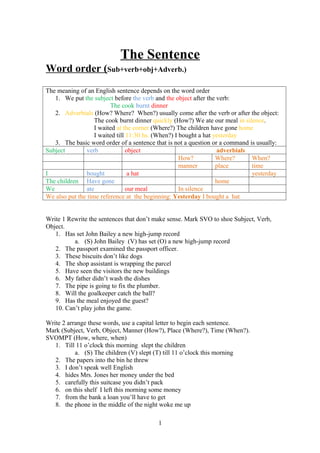
The meaning of an English sentence depends on the word order
   1. We put the subject before the verb and the object after the verb:
                         The cook burnt dinner
   2. Adverbials (How? Where? When?) usually come after the verb or after the object:
                   The cook burnt dinner quickly (How?) We ate our meal in silence.
                   I waited at the corner (Where?) The children have gone home
                   I waited till 11:30 hs. (When?) I bought a hat yesterday
   3. The basic word order of a sentence that is not a question or a command is usually:
Subject        verb              object                            adverbials
                                                     How?          Where?     When?
                                                     manner        place      time
I              bought             a hat                                       yesterday
The children Have gone                                             home
We             ate               our meal            In silence
We also put the time reference at the beginning: Yesterday I bought a hat


Write 1 Rewrite the sentences that don’t make sense. Mark SVO to shoe Subject, Verb,
Object.
   1. Has set John Bailey a new high-jump record
          a. (S) John Bailey (V) has set (O) a new high-jump record
   2. The passport examined the passport officer.
   3. These biscuits don’t like dogs
   4. The shop assistant is wrapping the parcel
   5. Have seen the visitors the new buildings
   6. My father didn’t wash the dishes
   7. The pipe is going to fix the plumber.
   8. Will the goalkeeper catch the ball?
   9. Has the meal enjoyed the guest?
   10. Can’t play john the game.

Write 2 arrange these words, use a capital letter to begin each sentence.
Mark (Subject, Verb, Object, Manner (How?), Place (Where?), Time (When?).
SVOMPT (How, where, when)
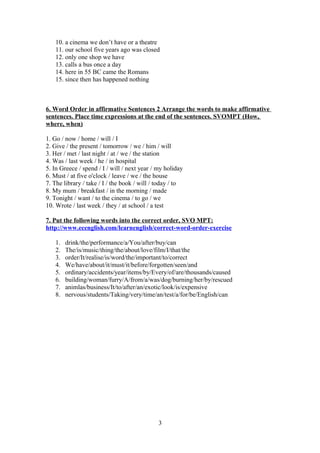
   1. Till 11 o’clock this morning slept the children
           a. (S) The children (V) slept (T) till 11 o’clock this morning
   2. The papers into the bin he threw
   3. I don’t speak well English
   4. hides Mrs. Jones her money under the bed
   5. carefully this suitcase you didn’t pack
   6. on this shelf I left this morning some money
   7. from the bank a loan you’ll have to get
   8. the phone in the middle of the night woke me up

                                          1
9. in the park you shouldn’t walk at night
   10. your food you should eat slowly
   11. my term begins in October
   12. your article I quickly last night in bed read

The forms of a sentence
1. A sentence can take any one of four forms:
   • A statement: The shops close / don’t close at 7 tonight
   • A question: Do the shops close at 7 tonight?
   • A command: Shut the door. / Don’t shut the door.
   • An exclamation: What a slow train this is!
2. When we write a sentence, we must begin with a capital letter and end with a full stop
   (.), a question mark (?), or an exclamation mark (!).
   If there are quotation marks (‘…’) or (“…”) around spoken words in a sentence, we put
   other punctuation marks ‘inside’ them:
   ‘I´m tired,’ she said. ( Not ‘I’m tired’, she said)


Arrange these groups of words in the right order add (.), (?) or (!)
Describe each sentence as statement, question, command or exclamation SQCE
   1. the coffee don’t spill
           a. Don’t spill the coffee (c)
   2. today’s papers have you seen
   3. do meet you how nice
   4. my umbrella where did you put
   5. arrived the train fifteen minutes late
   6. on time the plane won’t arrive
   7. this electricity bill I can’t pay
   8. for me please open the door
   9. the nearest hotel where’s he asked
   10. the bill can’t pay I he cried


Context
Read this story and arrange the words in each sentence in the right order.
Add Arrange words Put (,), (.), (!) or (?) in the right places
   1. My car I parked in the center of the village.
   2. near s bus stop an old man I saw
   3. beautiful village what a I exclaimed
   4. live here how many people
   5. seventeen people there are the old man said
   6. here have you lived how long
   7. all my life I have lived here
   8. isn’t it it’s a quiet sort of place
   9. here a quiet life we live

                                             2
10. a cinema we don’t have or a theatre
   11. our school five years ago was closed
   12. only one shop we have
   13. calls a bus once a day
   14. here in 55 BC came the Romans
   15. since then has happened nothing


6. Word Order in affirmative Sentences 2 Arrange the words to make affirmative
sentences. Place time expressions at the end of the sentences. SVOMPT (How,
where, when)

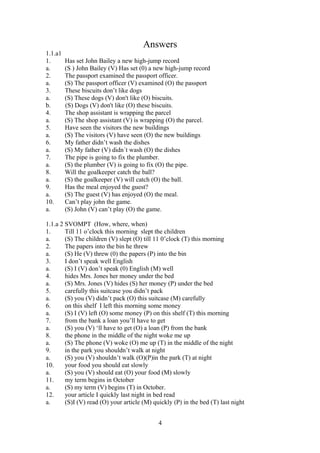
1. Go / now / home / will / I
2. Give / the present / tomorrow / we / him / will
3. Her / met / last night / at / we / the station
4. Was / last week / he / in hospital
5. In Greece / spend / I / will / next year / my holiday
6. Must / at five o'clock / leave / we / the house
7. The library / take / I / the book / will / today / to
8. My mum / breakfast / in the morning / made
9. Tonight / want / to the cinema / to go / we
10. Wrote / last week / they / at school / a test

7. Put the following words into the correct order, SVO MPT:
http://www.ecenglish.com/learnenglish/correct-word-order-exercise

   1.   drink/the/performance/a/You/after/buy/can
   2.   The/is/music/thing/the/about/love/film/I/that/the
   3.   order/It/realise/is/word/the/important/to/correct
   4.   We/have/about/it/must/it/before/forgotten/seen/and
   5.   ordinary/accidents/year/items/by/Every/of/are/thousands/caused
   6.   building/woman/furry/A/from/a/was/dog/burning/her/by/rescued
   7.   animlas/business/It/to/after/an/exotic/look/is/expensive
   8.   nervous/students/Taking/very/time/an/test/a/for/be/English/can


                                              3
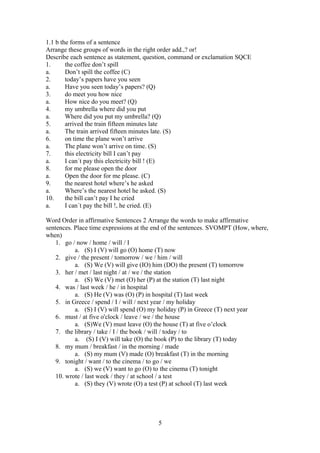
Answers
1.1.a1
1.       Has set John Bailey a new high-jump record
a.       (S ) John Bailey (V) Has set (0) a new high-jump record
2.       The passport examined the passport officer.
a.       (S) The passport officer (V) examined (O) the passport
3.       These biscuits don’t like dogs
a.       (S) These dogs (V) don't like (O) biscuits.
b.       (S) Dogs (V) don't like (O) these biscuits.
4.       The shop assistant is wrapping the parcel
a.       (S) The shop assistant (V) is wrapping (O) the parcel.
5.       Have seen the visitors the new buildings
a.       (S) The visitors (V) have seen (O) the new buildings
6.       My father didn’t wash the dishes
a.       (S) My father (V) didn´t wash (O) the dishes
7.       The pipe is going to fix the plumber.
a.       (S) the plumber (V) is going to fix (O) the pipe.
8.       Will the goalkeeper catch the ball?
a.       (S) the goalkeeper (V) will catch (O) the ball.
9.       Has the meal enjoyed the guest?
a.       (S) The guest (V) has enjoyed (O) the meal.
10.      Can’t play john the game.
a.       (S) John (V) can’t play (O) the game.

1.1.a 2 SVOMPT (How, where, when)
1.      Till 11 o’clock this morning slept the children
a.      (S) The children (V) slept (O) till 11 0’clock (T) this morning
2.      The papers into the bin he threw
a.      (S) He (V) threw (0) the papers (P) into the bin
3.      I don’t speak well English
a.      (S) I (V) don’t speak (0) English (M) well
4.      hides Mrs. Jones her money under the bed
a.      (S) Mrs. Jones (V) hides (S) her money (P) under the bed
5.      carefully this suitcase you didn’t pack
a.      (S) you (V) didn’t pack (O) this suitcase (M) carefully
6.      on this shelf I left this morning some money
a.      (S) I (V) left (O) some money (P) on this shelf (T) this morning
7.      from the bank a loan you’ll have to get
a.      (S) you (V) ‘ll have to get (O) a loan (P) from the bank
8.      the phone in the middle of the night woke me up
a.      (S) The phone (V) woke (O) me up (T) in the middle of the night
9.      in the park you shouldn’t walk at night
a.      (S) you (V) shouldn’t walk (O)(P)in the park (T) at night
10.     your food you should eat slowly
a.      (S) you (V) should eat (O) your food (M) slowly
11.     my term begins in October
a.      (S) my term (V) begins (T) in October.
12.     your article I quickly last night in bed read
a.      (S)I (V) read (O) your article (M) quickly (P) in the bed (T) last night


                                             4
1.1 b the forms of a sentence
Arrange these groups of words in the right order add.,? or!
Describe each sentence as statement, question, command or exclamation SQCE
1.      the coffee don’t spill
a.      Don’t spill the coffee (C)
2.      today’s papers have you seen
a.      Have you seen today’s papers? (Q)
3.      do meet you how nice
a.      How nice do you meet? (Q)
4.      my umbrella where did you put
a.      Where did you put my umbrella? (Q)
5.      arrived the train fifteen minutes late
a.      The train arrived fifteen minutes late. (S)
6.      on time the plane won’t arrive
a.      The plane won’t arrive on time. (S)
7.      this electricity bill I can’t pay
a.      I can´t pay this electricity bill ! (E)
8.      for me please open the door
a.      Open the door for me please. (C)
9.      the nearest hotel where’s he asked
a.      Where’s the nearest hotel he asked. (S)
10.     the bill can’t pay I he cried
a.      I can´t pay the bill !, he cried. (E)

Word Order in affirmative Sentences 2 Arrange the words to make affirmative
sentences. Place time expressions at the end of the sentences. SVOMPT (How, where,
when)
    1. go / now / home / will / I
           a. (S) I (V) will go (O) home (T) now
    2. give / the present / tomorrow / we / him / will
           a. (S) We (V) will give (IO) him (DO) the present (T) tomorrow
    3. her / met / last night / at / we / the station
           a. (S) We (V) met (O) her (P) at the station (T) last night
    4. was / last week / he / in hospital
           a. (S) He (V) was (O) (P) in hospital (T) last week
    5. in Greece / spend / I / will / next year / my holiday
           a. (S) I (V) will spend (O) my holiday (P) in Greece (T) next year
    6. must / at five o'clock / leave / we / the house
           a. (S)We (V) must leave (O) the house (T) at five o’clock
    7. the library / take / I / the book / will / today / to
           a. (S) I (V) will take (O) the book (P) to the library (T) today
    8. my mum / breakfast / in the morning / made
           a. (S) my mum (V) made (O) breakfast (T) in the morning
    9. tonight / want / to the cinema / to go / we
           a. (S) we (V) want to go (O) to the cinema (T) tonight
    10. wrote / last week / they / at school / a test
           a. (S) they (V) wrote (O) a test (P) at school (T) last week


                                         5
6
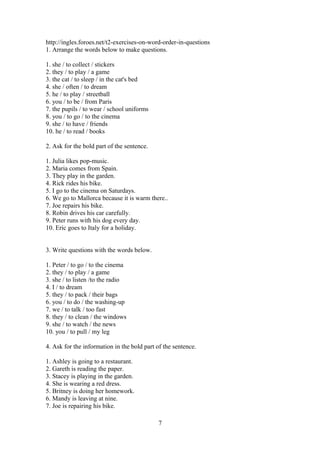
http://ingles.foroes.net/t2-exercises-on-word-order-in-questions
1. Arrange the words below to make questions.

1. she / to collect / stickers
2. they / to play / a game
3. the cat / to sleep / in the cat's bed
4. she / often / to dream
5. he / to play / streetball
6. you / to be / from Paris
7. the pupils / to wear / school uniforms
8. you / to go / to the cinema
9. she / to have / friends
10. he / to read / books

2. Ask for the bold part of the sentence.

1. Julia likes pop-music.
2. Maria comes from Spain.
3. They play in the garden.
4. Rick rides his bike.
5. I go to the cinema on Saturdays.
6. We go to Mallorca because it is warm there..
7. Joe repairs his bike.
8. Robin drives his car carefully.
9. Peter runs with his dog every day.
10. Eric goes to Italy for a holiday.


3. Write questions with the words below.

1. Peter / to go / to the cinema
2. they / to play / a game
3. she / to listen /to the radio
4. I / to dream
5. they / to pack / their bags
6. you / to do / the washing-up
7. we / to talk / too fast
8. they / to clean / the windows
9. she / to watch / the news
10. you / to pull / my leg

4. Ask for the information in the bold part of the sentence.

1. Ashley is going to a restaurant.
2. Gareth is reading the paper.
3. Stacey is playing in the garden.
4. She is wearing a red dress.
5. Britney is doing her homework.
6. Mandy is leaving at nine.
7. Joe is repairing his bike.

                                             7
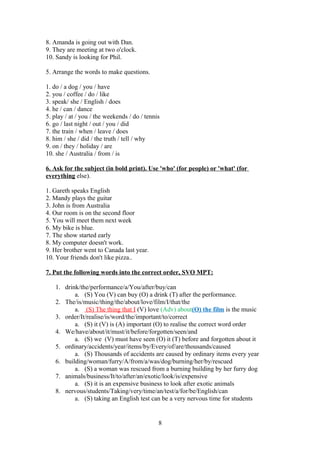
8. Amanda is going out with Dan.
9. They are meeting at two o'clock.
10. Sandy is looking for Phil.

5. Arrange the words to make questions.

1. do / a dog / you / have
2. you / coffee / do / like
3. speak/ she / English / does
4. he / can / dance
5. play / at / you / the weekends / do / tennis
6. go / last night / out / you / did
7. the train / when / leave / does
8. him / she / did / the truth / tell / why
9. on / they / holiday / are
10. she / Australia / from / is

6. Ask for the subject (in bold print). Use 'who' (for people) or 'what' (for
everything else).

1. Gareth speaks English
2. Mandy plays the guitar
3. John is from Australia
4. Our room is on the second floor
5. You will meet them next week
6. My bike is blue.
7. The show started early
8. My computer doesn't work.
9. Her brother went to Canada last year.
10. Your friends don't like pizza..

7. Put the following words into the correct order, SVO MPT:

    1. drink/the/performance/a/You/after/buy/can
           a. (S) You (V) can buy (O) a drink (T) after the performance.
    2. The/is/music/thing/the/about/love/film/I/that/the
           a. (S) The thing that I (V) love (Adv) about(O) the film is the music
    3. order/It/realise/is/word/the/important/to/correct
           a. (S) it (V) is (A) important (O) to realise the correct word order
    4. We/have/about/it/must/it/before/forgotten/seen/and
           a. (S) we (V) must have seen (O) it (T) before and forgotten about it
    5. ordinary/accidents/year/items/by/Every/of/are/thousands/caused
           a. (S) Thousands of accidents are caused by ordinary items every year
    6. building/woman/furry/A/from/a/was/dog/burning/her/by/rescued
           a. (S) a woman was rescued from a burning building by her furry dog
    7. animals/business/It/to/after/an/exotic/look/is/expensive
           a. (S) it is an expensive business to look after exotic animals
    8. nervous/students/Taking/very/time/an/test/a/for/be/English/can
           a. (S) taking an English test can be a very nervous time for students


                                              8

The sentence - word order

  • 1.
    The Sentence Word order(Sub+verb+obj+Adverb.) The meaning of an English sentence depends on the word order 1. We put the subject before the verb and the object after the verb: The cook burnt dinner 2. Adverbials (How? Where? When?) usually come after the verb or after the object: The cook burnt dinner quickly (How?) We ate our meal in silence. I waited at the corner (Where?) The children have gone home I waited till 11:30 hs. (When?) I bought a hat yesterday 3. The basic word order of a sentence that is not a question or a command is usually: Subject verb object adverbials How? Where? When? manner place time I bought a hat yesterday The children Have gone home We ate our meal In silence We also put the time reference at the beginning: Yesterday I bought a hat Write 1 Rewrite the sentences that don’t make sense. Mark SVO to shoe Subject, Verb, Object. 1. Has set John Bailey a new high-jump record a. (S) John Bailey (V) has set (O) a new high-jump record 2. The passport examined the passport officer. 3. These biscuits don’t like dogs 4. The shop assistant is wrapping the parcel 5. Have seen the visitors the new buildings 6. My father didn’t wash the dishes 7. The pipe is going to fix the plumber. 8. Will the goalkeeper catch the ball? 9. Has the meal enjoyed the guest? 10. Can’t play john the game. Write 2 arrange these words, use a capital letter to begin each sentence. Mark (Subject, Verb, Object, Manner (How?), Place (Where?), Time (When?). SVOMPT (How, where, when) 1. Till 11 o’clock this morning slept the children a. (S) The children (V) slept (T) till 11 o’clock this morning 2. The papers into the bin he threw 3. I don’t speak well English 4. hides Mrs. Jones her money under the bed 5. carefully this suitcase you didn’t pack 6. on this shelf I left this morning some money 7. from the bank a loan you’ll have to get 8. the phone in the middle of the night woke me up 1
  • 2.
    9. in thepark you shouldn’t walk at night 10. your food you should eat slowly 11. my term begins in October 12. your article I quickly last night in bed read The forms of a sentence 1. A sentence can take any one of four forms: • A statement: The shops close / don’t close at 7 tonight • A question: Do the shops close at 7 tonight? • A command: Shut the door. / Don’t shut the door. • An exclamation: What a slow train this is! 2. When we write a sentence, we must begin with a capital letter and end with a full stop (.), a question mark (?), or an exclamation mark (!). If there are quotation marks (‘…’) or (“…”) around spoken words in a sentence, we put other punctuation marks ‘inside’ them: ‘I´m tired,’ she said. ( Not ‘I’m tired’, she said) Arrange these groups of words in the right order add (.), (?) or (!) Describe each sentence as statement, question, command or exclamation SQCE 1. the coffee don’t spill a. Don’t spill the coffee (c) 2. today’s papers have you seen 3. do meet you how nice 4. my umbrella where did you put 5. arrived the train fifteen minutes late 6. on time the plane won’t arrive 7. this electricity bill I can’t pay 8. for me please open the door 9. the nearest hotel where’s he asked 10. the bill can’t pay I he cried Context Read this story and arrange the words in each sentence in the right order. Add Arrange words Put (,), (.), (!) or (?) in the right places 1. My car I parked in the center of the village. 2. near s bus stop an old man I saw 3. beautiful village what a I exclaimed 4. live here how many people 5. seventeen people there are the old man said 6. here have you lived how long 7. all my life I have lived here 8. isn’t it it’s a quiet sort of place 9. here a quiet life we live 2
  • 3.
    10. a cinemawe don’t have or a theatre 11. our school five years ago was closed 12. only one shop we have 13. calls a bus once a day 14. here in 55 BC came the Romans 15. since then has happened nothing 6. Word Order in affirmative Sentences 2 Arrange the words to make affirmative sentences. Place time expressions at the end of the sentences. SVOMPT (How, where, when) 1. Go / now / home / will / I 2. Give / the present / tomorrow / we / him / will 3. Her / met / last night / at / we / the station 4. Was / last week / he / in hospital 5. In Greece / spend / I / will / next year / my holiday 6. Must / at five o'clock / leave / we / the house 7. The library / take / I / the book / will / today / to 8. My mum / breakfast / in the morning / made 9. Tonight / want / to the cinema / to go / we 10. Wrote / last week / they / at school / a test 7. Put the following words into the correct order, SVO MPT: http://www.ecenglish.com/learnenglish/correct-word-order-exercise 1. drink/the/performance/a/You/after/buy/can 2. The/is/music/thing/the/about/love/film/I/that/the 3. order/It/realise/is/word/the/important/to/correct 4. We/have/about/it/must/it/before/forgotten/seen/and 5. ordinary/accidents/year/items/by/Every/of/are/thousands/caused 6. building/woman/furry/A/from/a/was/dog/burning/her/by/rescued 7. animlas/business/It/to/after/an/exotic/look/is/expensive 8. nervous/students/Taking/very/time/an/test/a/for/be/English/can 3
  • 4.
    Answers 1.1.a1 1. Has set John Bailey a new high-jump record a. (S ) John Bailey (V) Has set (0) a new high-jump record 2. The passport examined the passport officer. a. (S) The passport officer (V) examined (O) the passport 3. These biscuits don’t like dogs a. (S) These dogs (V) don't like (O) biscuits. b. (S) Dogs (V) don't like (O) these biscuits. 4. The shop assistant is wrapping the parcel a. (S) The shop assistant (V) is wrapping (O) the parcel. 5. Have seen the visitors the new buildings a. (S) The visitors (V) have seen (O) the new buildings 6. My father didn’t wash the dishes a. (S) My father (V) didn´t wash (O) the dishes 7. The pipe is going to fix the plumber. a. (S) the plumber (V) is going to fix (O) the pipe. 8. Will the goalkeeper catch the ball? a. (S) the goalkeeper (V) will catch (O) the ball. 9. Has the meal enjoyed the guest? a. (S) The guest (V) has enjoyed (O) the meal. 10. Can’t play john the game. a. (S) John (V) can’t play (O) the game. 1.1.a 2 SVOMPT (How, where, when) 1. Till 11 o’clock this morning slept the children a. (S) The children (V) slept (O) till 11 0’clock (T) this morning 2. The papers into the bin he threw a. (S) He (V) threw (0) the papers (P) into the bin 3. I don’t speak well English a. (S) I (V) don’t speak (0) English (M) well 4. hides Mrs. Jones her money under the bed a. (S) Mrs. Jones (V) hides (S) her money (P) under the bed 5. carefully this suitcase you didn’t pack a. (S) you (V) didn’t pack (O) this suitcase (M) carefully 6. on this shelf I left this morning some money a. (S) I (V) left (O) some money (P) on this shelf (T) this morning 7. from the bank a loan you’ll have to get a. (S) you (V) ‘ll have to get (O) a loan (P) from the bank 8. the phone in the middle of the night woke me up a. (S) The phone (V) woke (O) me up (T) in the middle of the night 9. in the park you shouldn’t walk at night a. (S) you (V) shouldn’t walk (O)(P)in the park (T) at night 10. your food you should eat slowly a. (S) you (V) should eat (O) your food (M) slowly 11. my term begins in October a. (S) my term (V) begins (T) in October. 12. your article I quickly last night in bed read a. (S)I (V) read (O) your article (M) quickly (P) in the bed (T) last night 4
  • 5.
    1.1 b theforms of a sentence Arrange these groups of words in the right order add.,? or! Describe each sentence as statement, question, command or exclamation SQCE 1. the coffee don’t spill a. Don’t spill the coffee (C) 2. today’s papers have you seen a. Have you seen today’s papers? (Q) 3. do meet you how nice a. How nice do you meet? (Q) 4. my umbrella where did you put a. Where did you put my umbrella? (Q) 5. arrived the train fifteen minutes late a. The train arrived fifteen minutes late. (S) 6. on time the plane won’t arrive a. The plane won’t arrive on time. (S) 7. this electricity bill I can’t pay a. I can´t pay this electricity bill ! (E) 8. for me please open the door a. Open the door for me please. (C) 9. the nearest hotel where’s he asked a. Where’s the nearest hotel he asked. (S) 10. the bill can’t pay I he cried a. I can´t pay the bill !, he cried. (E) Word Order in affirmative Sentences 2 Arrange the words to make affirmative sentences. Place time expressions at the end of the sentences. SVOMPT (How, where, when) 1. go / now / home / will / I a. (S) I (V) will go (O) home (T) now 2. give / the present / tomorrow / we / him / will a. (S) We (V) will give (IO) him (DO) the present (T) tomorrow 3. her / met / last night / at / we / the station a. (S) We (V) met (O) her (P) at the station (T) last night 4. was / last week / he / in hospital a. (S) He (V) was (O) (P) in hospital (T) last week 5. in Greece / spend / I / will / next year / my holiday a. (S) I (V) will spend (O) my holiday (P) in Greece (T) next year 6. must / at five o'clock / leave / we / the house a. (S)We (V) must leave (O) the house (T) at five o’clock 7. the library / take / I / the book / will / today / to a. (S) I (V) will take (O) the book (P) to the library (T) today 8. my mum / breakfast / in the morning / made a. (S) my mum (V) made (O) breakfast (T) in the morning 9. tonight / want / to the cinema / to go / we a. (S) we (V) want to go (O) to the cinema (T) tonight 10. wrote / last week / they / at school / a test a. (S) they (V) wrote (O) a test (P) at school (T) last week 5
  • 6.
  • 7.
    http://ingles.foroes.net/t2-exercises-on-word-order-in-questions 1. Arrange thewords below to make questions. 1. she / to collect / stickers 2. they / to play / a game 3. the cat / to sleep / in the cat's bed 4. she / often / to dream 5. he / to play / streetball 6. you / to be / from Paris 7. the pupils / to wear / school uniforms 8. you / to go / to the cinema 9. she / to have / friends 10. he / to read / books 2. Ask for the bold part of the sentence. 1. Julia likes pop-music. 2. Maria comes from Spain. 3. They play in the garden. 4. Rick rides his bike. 5. I go to the cinema on Saturdays. 6. We go to Mallorca because it is warm there.. 7. Joe repairs his bike. 8. Robin drives his car carefully. 9. Peter runs with his dog every day. 10. Eric goes to Italy for a holiday. 3. Write questions with the words below. 1. Peter / to go / to the cinema 2. they / to play / a game 3. she / to listen /to the radio 4. I / to dream 5. they / to pack / their bags 6. you / to do / the washing-up 7. we / to talk / too fast 8. they / to clean / the windows 9. she / to watch / the news 10. you / to pull / my leg 4. Ask for the information in the bold part of the sentence. 1. Ashley is going to a restaurant. 2. Gareth is reading the paper. 3. Stacey is playing in the garden. 4. She is wearing a red dress. 5. Britney is doing her homework. 6. Mandy is leaving at nine. 7. Joe is repairing his bike. 7
  • 8.
    8. Amanda isgoing out with Dan. 9. They are meeting at two o'clock. 10. Sandy is looking for Phil. 5. Arrange the words to make questions. 1. do / a dog / you / have 2. you / coffee / do / like 3. speak/ she / English / does 4. he / can / dance 5. play / at / you / the weekends / do / tennis 6. go / last night / out / you / did 7. the train / when / leave / does 8. him / she / did / the truth / tell / why 9. on / they / holiday / are 10. she / Australia / from / is 6. Ask for the subject (in bold print). Use 'who' (for people) or 'what' (for everything else). 1. Gareth speaks English 2. Mandy plays the guitar 3. John is from Australia 4. Our room is on the second floor 5. You will meet them next week 6. My bike is blue. 7. The show started early 8. My computer doesn't work. 9. Her brother went to Canada last year. 10. Your friends don't like pizza.. 7. Put the following words into the correct order, SVO MPT: 1. drink/the/performance/a/You/after/buy/can a. (S) You (V) can buy (O) a drink (T) after the performance. 2. The/is/music/thing/the/about/love/film/I/that/the a. (S) The thing that I (V) love (Adv) about(O) the film is the music 3. order/It/realise/is/word/the/important/to/correct a. (S) it (V) is (A) important (O) to realise the correct word order 4. We/have/about/it/must/it/before/forgotten/seen/and a. (S) we (V) must have seen (O) it (T) before and forgotten about it 5. ordinary/accidents/year/items/by/Every/of/are/thousands/caused a. (S) Thousands of accidents are caused by ordinary items every year 6. building/woman/furry/A/from/a/was/dog/burning/her/by/rescued a. (S) a woman was rescued from a burning building by her furry dog 7. animals/business/It/to/after/an/exotic/look/is/expensive a. (S) it is an expensive business to look after exotic animals 8. nervous/students/Taking/very/time/an/test/a/for/be/English/can a. (S) taking an English test can be a very nervous time for students 8