NADAR SARASWATHI COLLEGE
OF ARTS AND SCIENCE
DIG DATA ANALYTICS
MAPREDUCE PARADIGM
SUBMITTED BY
S.VIJAYALAKSHMI.
MAP REDUCE
 Map Reduce is a processing technique and a program model
for distributed computing based on java.
 The Map Reduce algorithm contains two important tasks,
namely Map and Reduce.
 Map takes a set of data and converts it into another set of
data, where individual elements are broken down into tuples
(key/value pairs). Secondly, reduce task, which takes the
output from a map as an input and combines those data
tuples into a smaller set of tuples
 As the sequence of the name Map Reduce implies, the
reduce task is always performed after the map job
MapReduce programs work in two phases:
 Map phase
 Reduce phase.
 An input to each phase is key-value pairs. In addition, every
programmer needs to specify two functions:
1. map function and
2. reduce function.
MapReduce program executes in three stages, namely map stage,
shuffle stage, and reduce stage.
 Map stage − The map or mapper’s job is to process the input data.
Generally the input data is in the form of file or directory and is
stored in the Hadoop file system (HDFS). The input file is passed to
the mapper function line by line. The mapper processes the data and
creates several small chunks of data.
 Reduce stage − This stage is the combination of the Shuffle stage
and the Reduce stage. The Reducer’s job is to process the data that
comes from the mapper. After processing, it produces a new set of
output, which will be stored in the HDFS.
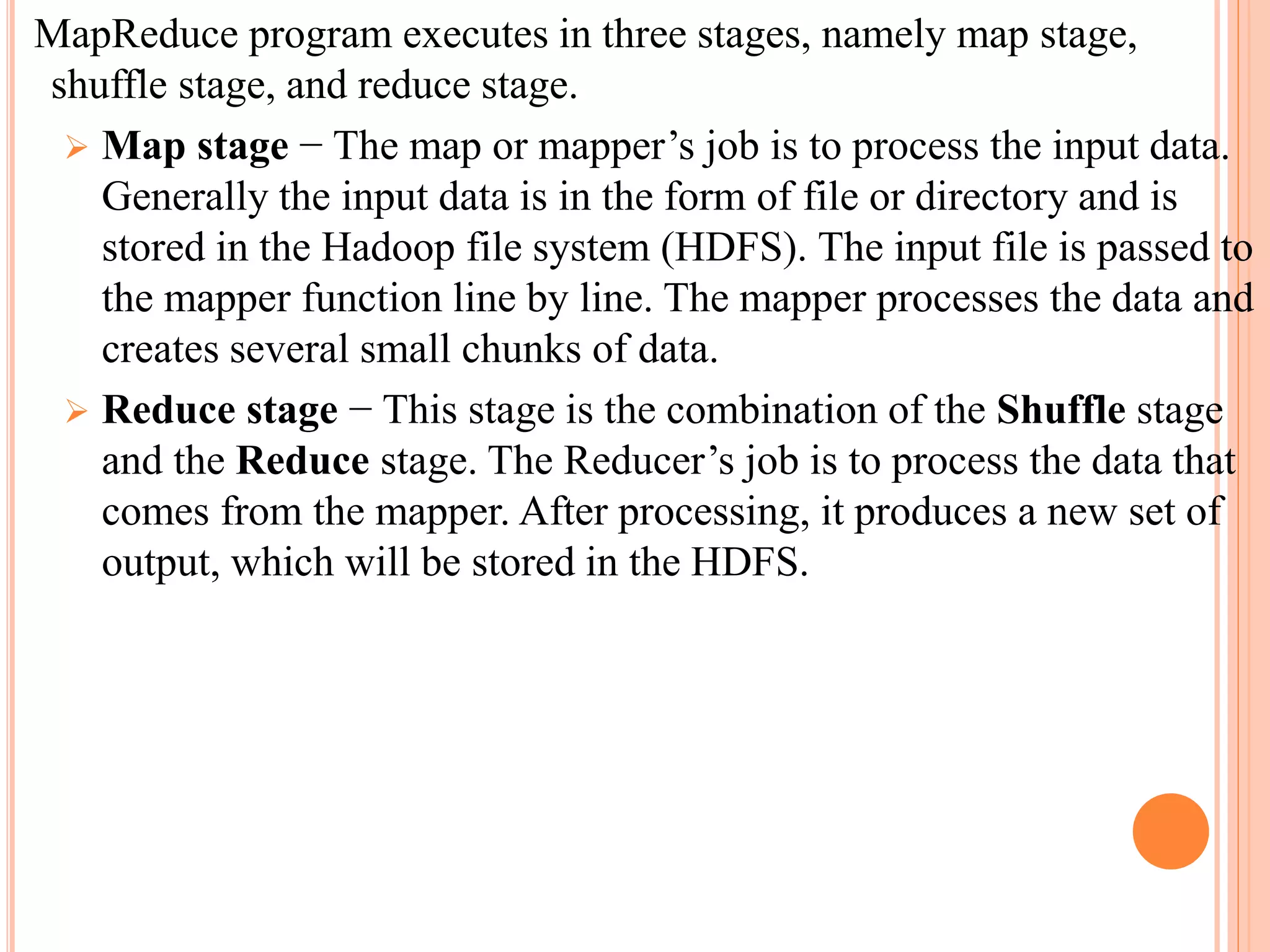
Input Splits:
 An input to a MapReduce job is divided into fixed-size pieces
called input splits Input split is a chunk of the input that is consumed
by a single map
Mapping
 This is the very first phase in the execution of map-reduce program. In
this phase data in each split is passed to a mapping function to produce
output values. In our example, a job of mapping phase is to count a
number of occurrences of each word from input splits.
Shuffling
 This phase consumes the output of Mapping phase. Its task is to
consolidate the relevant records from Mapping phase output. In our
example, the same words are clubed together along with their
respective frequency.
Reducing
 In this phase, output values from the Shuffling phase are aggregated.
This phase combines values from Shuffling phase and returns a single
output value. In short, this phase summarizes the complete dataset.
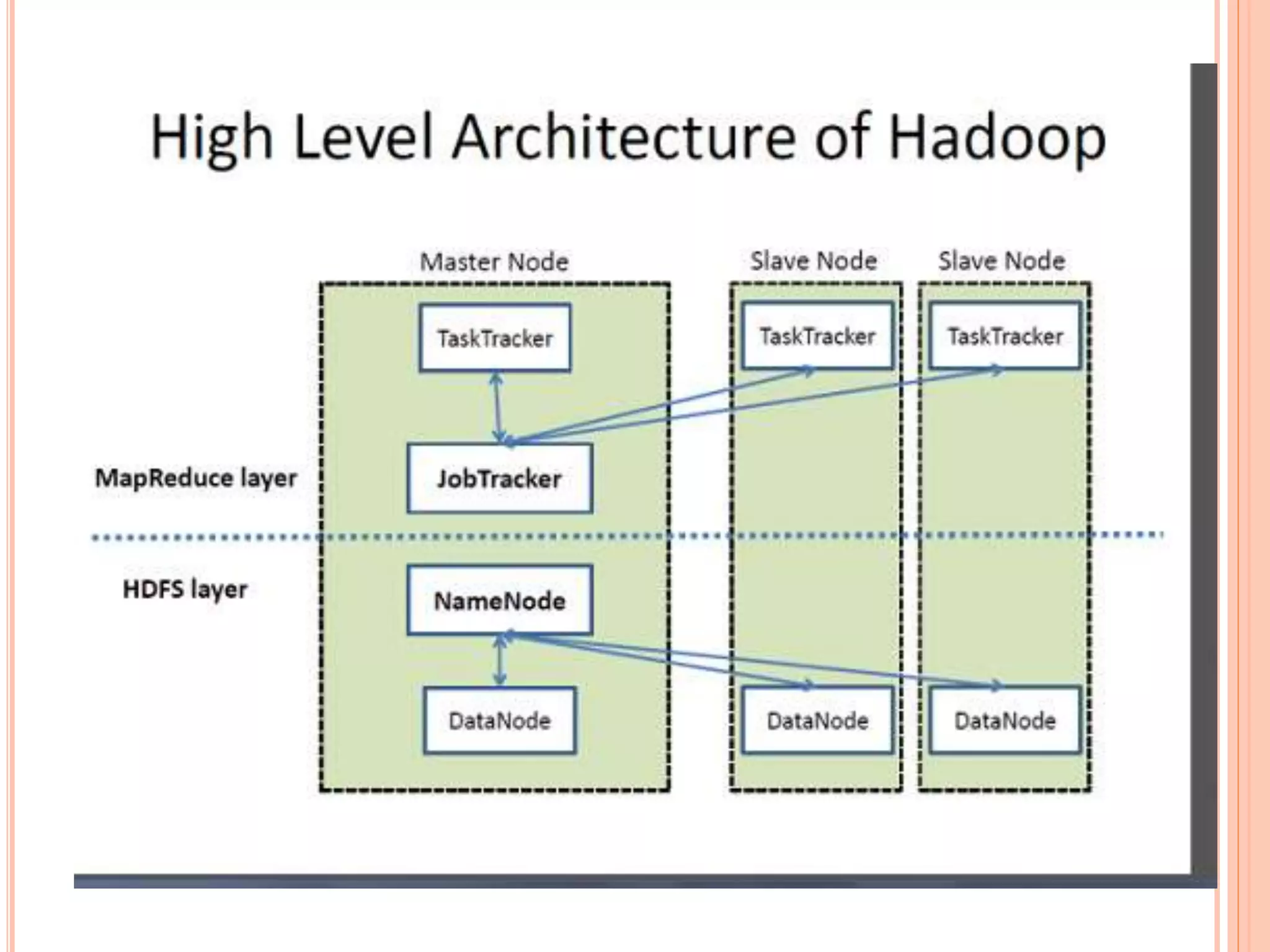
Hadoop Architecture
Hadoop MapReduce
 Single master node, many worker nodes
 Client submits a job to master node
 Master splits each job into tasks (MapReduce),
 and assigns tasks to worker nodes
Hadoop Distributed File System (HDFS)
 Single name node, many data nodes
 Files stored as large, fixed-size (e.g. 64MB) blocks
 HDFS typically holds map input and reduce output
THANK YOU

MapReduce Paradigm

  • 1.
    NADAR SARASWATHI COLLEGE OFARTS AND SCIENCE DIG DATA ANALYTICS MAPREDUCE PARADIGM SUBMITTED BY S.VIJAYALAKSHMI.
  • 2.
    MAP REDUCE  MapReduce is a processing technique and a program model for distributed computing based on java.  The Map Reduce algorithm contains two important tasks, namely Map and Reduce.  Map takes a set of data and converts it into another set of data, where individual elements are broken down into tuples (key/value pairs). Secondly, reduce task, which takes the output from a map as an input and combines those data tuples into a smaller set of tuples  As the sequence of the name Map Reduce implies, the reduce task is always performed after the map job
  • 3.
    MapReduce programs workin two phases:  Map phase  Reduce phase.  An input to each phase is key-value pairs. In addition, every programmer needs to specify two functions: 1. map function and 2. reduce function.
  • 5.
    MapReduce program executesin three stages, namely map stage, shuffle stage, and reduce stage.  Map stage − The map or mapper’s job is to process the input data. Generally the input data is in the form of file or directory and is stored in the Hadoop file system (HDFS). The input file is passed to the mapper function line by line. The mapper processes the data and creates several small chunks of data.  Reduce stage − This stage is the combination of the Shuffle stage and the Reduce stage. The Reducer’s job is to process the data that comes from the mapper. After processing, it produces a new set of output, which will be stored in the HDFS.
  • 6.
    Input Splits:  Aninput to a MapReduce job is divided into fixed-size pieces called input splits Input split is a chunk of the input that is consumed by a single map Mapping  This is the very first phase in the execution of map-reduce program. In this phase data in each split is passed to a mapping function to produce output values. In our example, a job of mapping phase is to count a number of occurrences of each word from input splits. Shuffling  This phase consumes the output of Mapping phase. Its task is to consolidate the relevant records from Mapping phase output. In our example, the same words are clubed together along with their respective frequency.
  • 7.
    Reducing  In thisphase, output values from the Shuffling phase are aggregated. This phase combines values from Shuffling phase and returns a single output value. In short, this phase summarizes the complete dataset. Hadoop Architecture Hadoop MapReduce  Single master node, many worker nodes  Client submits a job to master node  Master splits each job into tasks (MapReduce),  and assigns tasks to worker nodes
  • 8.
    Hadoop Distributed FileSystem (HDFS)  Single name node, many data nodes  Files stored as large, fixed-size (e.g. 64MB) blocks  HDFS typically holds map input and reduce output
  • 10.