“
”
USER OPERATING SYSTEM INTERFACE
ADVANCEDOPERATINGSYSTEM
Nadar Saraswathi College of Arts & Science
Submitted By,
N. Nagapandiyammal,
M. Sc (CS)
CONTENT
 USER INTERFACE(UI)
 COMMAND-LINE INTERFACE
 HISTORY AND FEATURES OF CLI
 CLI ADVANTAGES AND DISADVANTAGES
 GRAPHICAL USER INTERFACE(GUI)
 THE BENEFITS OF GUI
 THE EXAMPLES OF A GUI OPERATING SYSTEM
USER INTERFACE (UI)
In information technology, the user interface (UI) is everything designed into an information device
with which a person may interact. This can include display screens, keyboards, a mouse and the appearance of
a desktop. It is also the way through which a user interacts with an application or a website. The growing
dependence of many companies on web applications and mobile applications has led many companies to
place increased priority on UI in an effort to improve the user's overall experience.
COMMAND-LINE INTERFACE
 A command-line interface or command language interpreter (CLI), also known as command-line user
interface, console user interface and character user interface (CUI), is a means of interacting with a computer
program where the user (or client) issues commands to the program in the form of successive lines of text (command
lines). A program which handles the interface is called a command language interpreter or shell (computing).
 The CLI was the primary means of interaction with most computer systems on computer terminals in the mid-
1960s, and continued to be used throughout the 1970s and 1980s on OpenVMS, Unix systems and personal [computer
systems including MS-DOS, CP/M and apple DOS. The interface is usually implemented with a command line shell,
which is a program that accepts commands as text input and converts commands into appropriate operating system
functions.
HISTORYAND FEATURES OF CLI
• Before the mouse, users interacted with an operating system (OS) or application with a keyboard. Users typed commands
in the command line interface to run tasks on a computer.
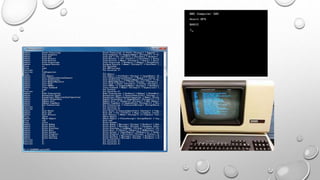
• Typically, the command line interface features a black box with white text. The user responds to a prompt in the
command line interface by typing a command. The output or response from the system can include a message, table, list,
or some other confirmation of a system or application action.
• Today, most users prefer the graphical user interface (GUI) offered by operating systems such as windows, Linux and
Macos. Most current Unix-based systems offer both a command line interface and a graphical user interface.
• The MS-DOS operating system and the command shell in the windows operating system are examples of command line
interfaces. In addition, programming languages can support command line interfaces, such as python.
CLI ADVANTAGES AND DISADVANTAGES
 The advantages of a command line interface are:
• Granular control of an OS or application;
• Faster management of a large number of operating systems;
• Ability to store scripts to automate regular tasks; and
• Basic command line interface knowledge to help with troubleshooting, such as network connection issues.
THE DISADVANTAGES OF A COMMAND LINE INTERFACE ARE:
• GUI is more user-friendly;
• Steeper learning curve associated with memorizing commands and complex syntax/arguments; and
• Different commands used in different shells.
GRAPHICAL USER INTERFACE(GUI)
 Short for graphical user interface, a GUI is an interface that uses icons or other visual indicators to interact
with electronic devices, rather than only text via a command line. For example, all versions of Microsoft windows is a
GUI, whereas MS-DOS is a command line.
 The GUI was first developed at xerox PARC by Alan Kay, Douglas Engelhard, and a group of other researchers
in 1981. Later, apple introduced the Lisa computer with a GUI on January 19, 1983.
THE BENEFITS OF GUI
Unlike a command line operating system or CUI, like Unix or MS-DOS, GUI operating systems are much easier
to learn and use because commands do not need to be memorized. Additionally, users do not need to know any
programming languages. Because of their ease of use, GUI operating systems have become the dominant operating
system used by today's end-users.
THE EXAMPLES OFA GUI OPERATING SYSTEM
• Microsoft windows
• Apple system 7 and Macos
• Chrome OS
• Linux variants like Ubuntu using a GUI interface.
MANY SYSTEMS NOW INCLUDE BOTH CLI AND GUI INTERFACES
 Microsoft windows is GUI with CLI ―command‖ shell
 Apple Mac OS X as ―aqua‖ GUI interface with UNIX kernel underneath and shells available
 Solaris is CLI with optional GUI interfaces (java desktop, KDE)
THANK YOU

Operating system

  • 1.
    “ ” USER OPERATING SYSTEMINTERFACE ADVANCEDOPERATINGSYSTEM Nadar Saraswathi College of Arts & Science Submitted By, N. Nagapandiyammal, M. Sc (CS)
  • 2.
    CONTENT  USER INTERFACE(UI) COMMAND-LINE INTERFACE  HISTORY AND FEATURES OF CLI  CLI ADVANTAGES AND DISADVANTAGES  GRAPHICAL USER INTERFACE(GUI)  THE BENEFITS OF GUI  THE EXAMPLES OF A GUI OPERATING SYSTEM
  • 3.
    USER INTERFACE (UI) Ininformation technology, the user interface (UI) is everything designed into an information device with which a person may interact. This can include display screens, keyboards, a mouse and the appearance of a desktop. It is also the way through which a user interacts with an application or a website. The growing dependence of many companies on web applications and mobile applications has led many companies to place increased priority on UI in an effort to improve the user's overall experience.
  • 4.
    COMMAND-LINE INTERFACE  Acommand-line interface or command language interpreter (CLI), also known as command-line user interface, console user interface and character user interface (CUI), is a means of interacting with a computer program where the user (or client) issues commands to the program in the form of successive lines of text (command lines). A program which handles the interface is called a command language interpreter or shell (computing).  The CLI was the primary means of interaction with most computer systems on computer terminals in the mid- 1960s, and continued to be used throughout the 1970s and 1980s on OpenVMS, Unix systems and personal [computer systems including MS-DOS, CP/M and apple DOS. The interface is usually implemented with a command line shell, which is a program that accepts commands as text input and converts commands into appropriate operating system functions.
  • 5.
    HISTORYAND FEATURES OFCLI • Before the mouse, users interacted with an operating system (OS) or application with a keyboard. Users typed commands in the command line interface to run tasks on a computer. • Typically, the command line interface features a black box with white text. The user responds to a prompt in the command line interface by typing a command. The output or response from the system can include a message, table, list, or some other confirmation of a system or application action. • Today, most users prefer the graphical user interface (GUI) offered by operating systems such as windows, Linux and Macos. Most current Unix-based systems offer both a command line interface and a graphical user interface. • The MS-DOS operating system and the command shell in the windows operating system are examples of command line interfaces. In addition, programming languages can support command line interfaces, such as python.
  • 6.
    CLI ADVANTAGES ANDDISADVANTAGES  The advantages of a command line interface are: • Granular control of an OS or application; • Faster management of a large number of operating systems; • Ability to store scripts to automate regular tasks; and • Basic command line interface knowledge to help with troubleshooting, such as network connection issues.
  • 7.
    THE DISADVANTAGES OFA COMMAND LINE INTERFACE ARE: • GUI is more user-friendly; • Steeper learning curve associated with memorizing commands and complex syntax/arguments; and • Different commands used in different shells.
  • 9.
    GRAPHICAL USER INTERFACE(GUI) Short for graphical user interface, a GUI is an interface that uses icons or other visual indicators to interact with electronic devices, rather than only text via a command line. For example, all versions of Microsoft windows is a GUI, whereas MS-DOS is a command line.  The GUI was first developed at xerox PARC by Alan Kay, Douglas Engelhard, and a group of other researchers in 1981. Later, apple introduced the Lisa computer with a GUI on January 19, 1983.
  • 10.
    THE BENEFITS OFGUI Unlike a command line operating system or CUI, like Unix or MS-DOS, GUI operating systems are much easier to learn and use because commands do not need to be memorized. Additionally, users do not need to know any programming languages. Because of their ease of use, GUI operating systems have become the dominant operating system used by today's end-users.
  • 11.
    THE EXAMPLES OFAGUI OPERATING SYSTEM • Microsoft windows • Apple system 7 and Macos • Chrome OS • Linux variants like Ubuntu using a GUI interface.
  • 12.
    MANY SYSTEMS NOWINCLUDE BOTH CLI AND GUI INTERFACES  Microsoft windows is GUI with CLI ―command‖ shell  Apple Mac OS X as ―aqua‖ GUI interface with UNIX kernel underneath and shells available  Solaris is CLI with optional GUI interfaces (java desktop, KDE)
  • 13.