
ELECTRONIC INTERMEDIARIES
AND
E-ENABLED LOGISTIC MANAGEMENT
AND TRACKING SYSTEM
PRESENTED BY
MITHISAR
BASUMATARY
WHAT IS LOGISTICS MANAGEMENT?
Logistics management involves the integration of
i. transportation,
ii. inventory,
iii. facilities and
iv. communications
to provide a level of logistics service desired by
customers and middlemen at the lowest
possible cost.
APPROPRIATE LOGISTICS SYSTEM
• An appropriate logistics system requires
A. an appropriate physical distribution design,
B. efficient inventory management and
C. an excellent customer service level.
WHAT IS PHYSICAL DISTRIBUTION?
• According to Kotler-
“Physical distribution involves planning, implementing
and controlling the physical flows of materials and final
goods from points of use to meet customer requirements
at a profit.”
• It can also be said that physical distribution relates to the
physical flow of goods from the manufacturers to the
consumers and also between the producers to the
marketing middlemen.
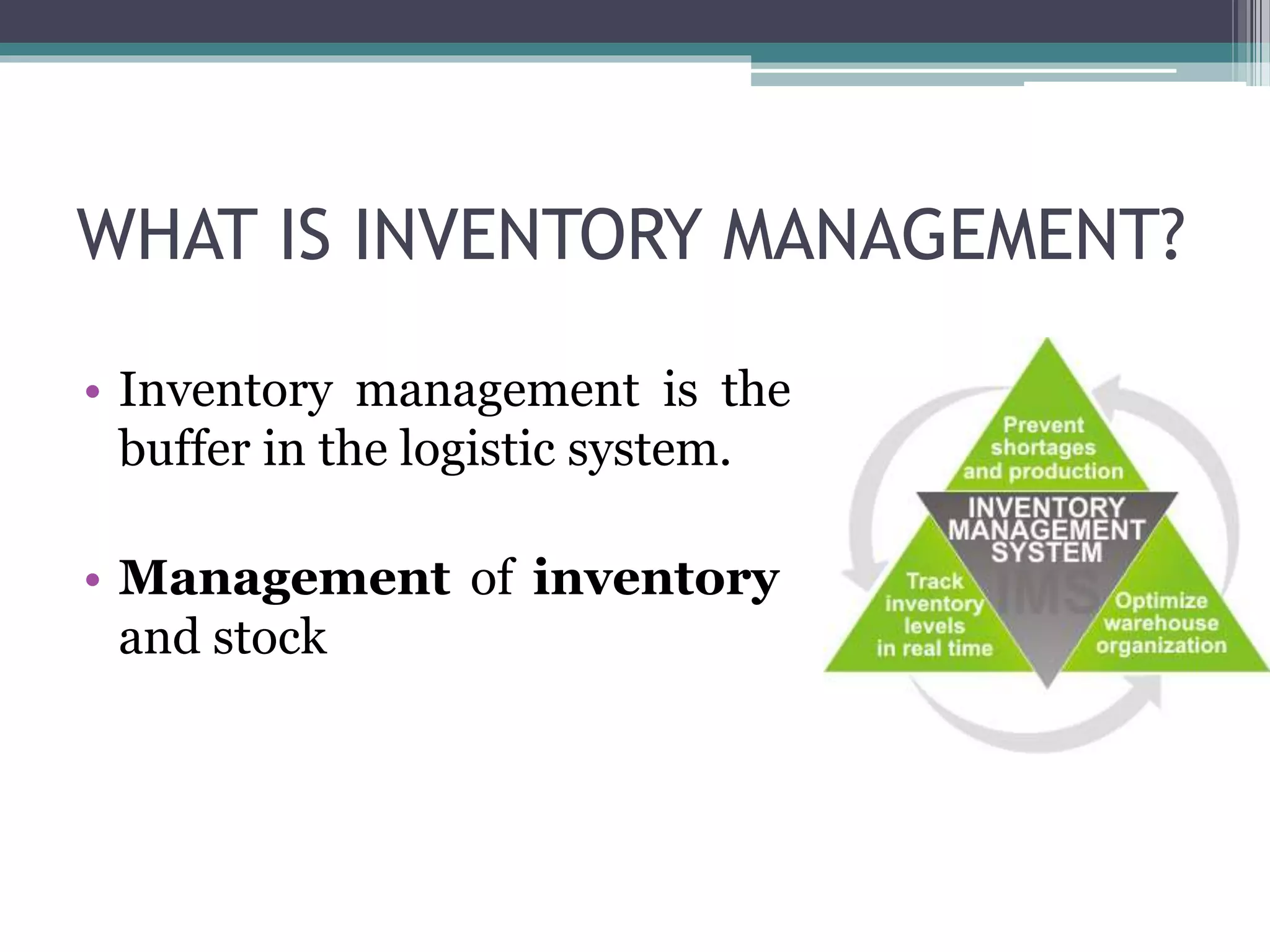
WHAT IS INVENTORY MANAGEMENT?
• Inventory management is the
buffer in the logistic system.
• Management of inventory
and stock
WHAT IS CUSTOMER SERVICE LEVEL?
• The Customer service level is a physical distribution
system (PDS) design, that yield the highest
contribution of sales minus physical distribution
costs must be identified.
• The principal constraint in doing this is the
difficulty of measuring customer service and
estimating sales response to service level.
• A predetermined customer service level is selected
as a minimum, and the system is designed to meet
this level with a minimum of cost.
E-ENABLED LOGISTICS MANAGEMENT
• Logistics Management is now a days dependent
on information technology to optimise storage
and movement of inventory.
• Therefore the logistics industry is undergoing a
transformation as it is becoming more and
more e-enabled.
AUTOMATIC IDENTIFICATION
TECHNOLOGY
• Auto ID describes the direct entry of data or
information in the computer system without
operating a keyboard.
• Auto ID is used for tracking containers,
packages, products, cartons and even trucks
carrying goods.
• The benefits of Auto ID are: Accuracy, Cost
Saving, Speed and Convinience.
Auto ID Technologies are:
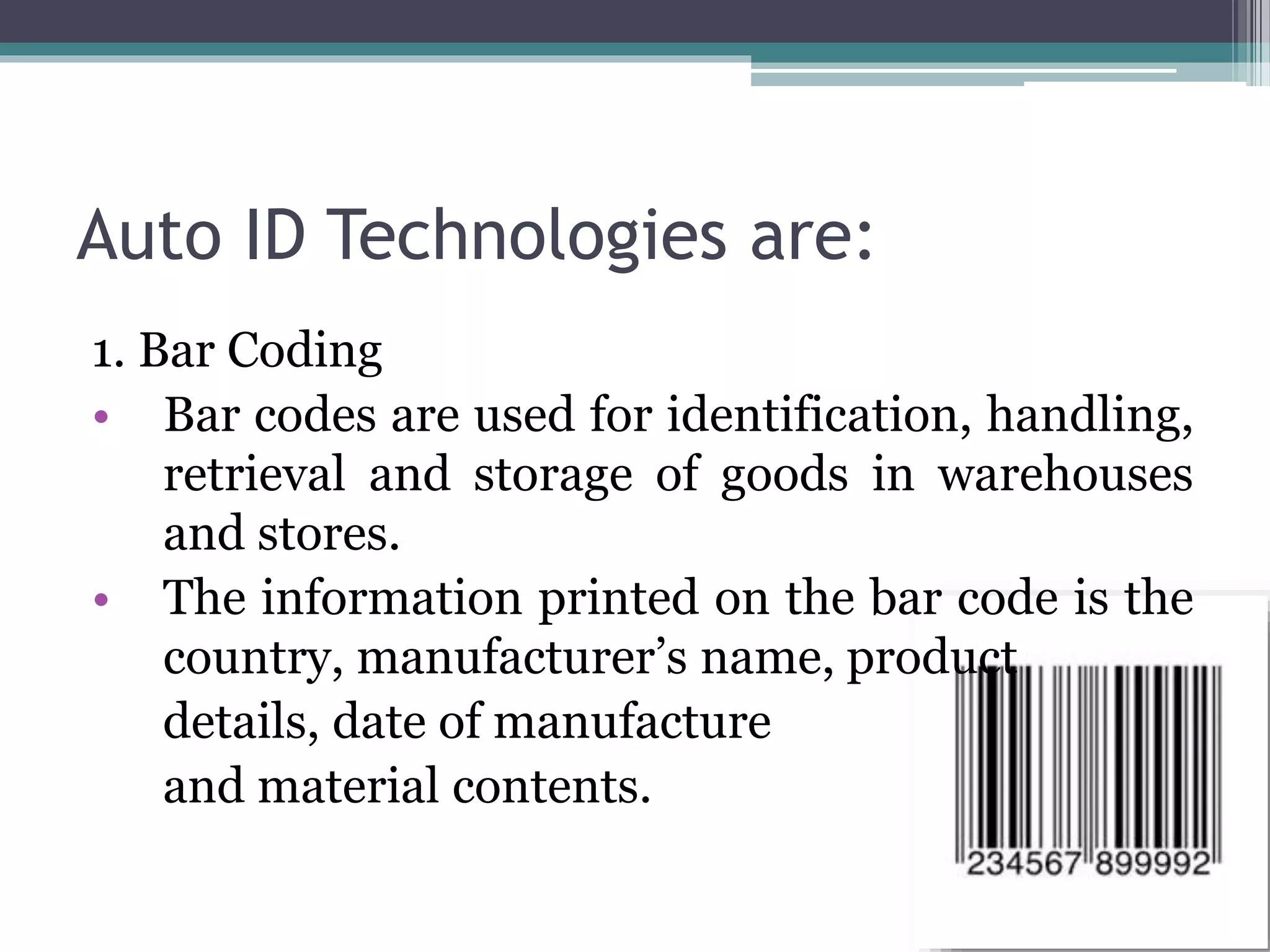
1. Bar Coding
• Bar codes are used for identification, handling,
retrieval and storage of goods in warehouses
and stores.
• The information printed on the bar code is the
country, manufacturer’s name, product
details, date of manufacture
and material contents.
Contd….
• Bar codes increase productivity through speed,
accuracy and reliability. They do the following:
▫ Provide ease in identification of inventory.
▫ Reduce paper work.
▫ Facilitate cost reduction.
▫ Reduce human error.
▫ Increase in logistics efficiency.
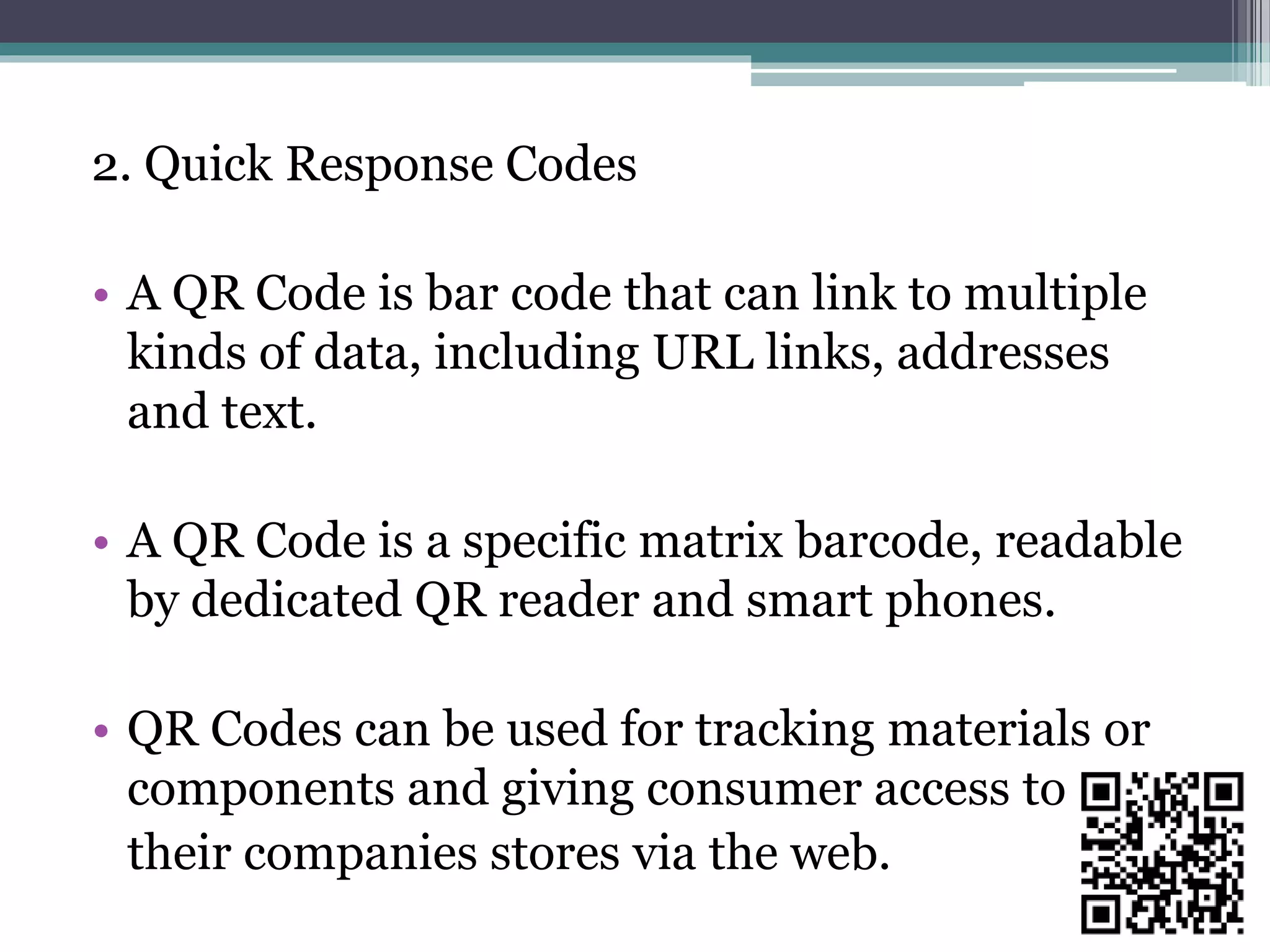
2. Quick Response Codes
• A QR Code is bar code that can link to multiple
kinds of data, including URL links, addresses
and text.
• A QR Code is a specific matrix barcode, readable
by dedicated QR reader and smart phones.
• QR Codes can be used for tracking materials or
components and giving consumer access to
their companies stores via the web.
3. Radio Frequency Identification
• RFID is a technology used for auto identification
of goods in manufacturing, retailing and
logistics.
• It is used to communicate inventory data via
radio waves.
• It is a chip in which data is data is stored in
coded form and communicated to a reader
through radio waves.
• RFID can be used in logistics for various
purpose:
▫ Real time visibility of goods for manufacturer and
retailers.
▫ Better management of stock held at various levels,
facilitating quick movement.
▫ Improve the distribution and supply of food item.
▫ Improve the tracking system of transport, courier
and logistics companies.
▫ Improves efficiency in toll collection on the
highways leading to faster clearances.
4. Voice Interactive System
• A voice interactive system allows the worker or
operator to communicate data to a central
computer without using the keyboard, keeping
hands free to handle goods.
5. Electronic Data Interchange
• EDI is an automated method of placing
electronic transactions.
• This technology is used for transfer of business
documents from one computer to another.
E-ENABLED TRACKING SYSTEM
• The term tracking in logistics management
means getting information about the status of
inventory and the location of inventory carrying
vehicles etc.
• When this information or tracking system uses
some electronic devices for it then it is called e-
enabled tracking system.
E-TRACKING TECHNOLOGIES
1. VERY SMALL APERTURE TERMINAL(VSAT)
• VSAT helps to communicate through satellite
communication.
• For trace and track of goods carrier, a dish
antenna is fixed on the vehicle, which allow
communication between the driver, consignor
and consignee.
2. GEOGRAPHICAL POSITIONING
SYSTEM(GPS)
• GPS is used to trace vehicle with the help of geo-
stationary satellites.
• Data from these helps to locate the latitude and
longitude of a vehicle to an accuracy of one
meter.
3. GEOGRAPHICAL INFORMATION SYSTEM(GIS)
• GIS helps in visualization of spatial features of
locations.
• Data relating to locations is stored in database and
GIS integrates the different types of data in different
databases into a detailed, clear visualization of data
with respect to a location.
• GIS in integration with GPS is used in logistical
operation for tracking and tracing of the
consignment location to the extend of road or street
in particular city.
3. WEB BASED TRACKING
• Courier companies and logistics service
providers such as FedEx, Blue Dart etc provide
the service of web based tracking of
consignments to their clients
• The Client can simply log on and track their
consignments and their information helps in
planning the dispatch schedule and also making
follow up with client for payment collection.
4. AUTOMATED GUIDED VEHICLE
SYSTEM(AGVS)
• AGVS is an automated material handling system
that makes use of a magnetic or optical guidance
system.
• The magnetic system uses an energised wire laid
on the warehouse floor for guiding the material
handling equipment, thus eliminating the
operator.
5. INFORMATION DIRECTED SYSTEM(IDS)
• In IDS, a central computer controls the material
handling equipment.
• IDS can perform variety of complex material
handling jobs such as multiple order picking and
multiple vehicle loading by the same material
handling job equipment.
Electronic intermediaries &; e enabled logistic management &; tracking system

Electronic intermediaries &; e enabled logistic management &; tracking system

  • 1.
    ELECTRONIC INTERMEDIARIES AND E-ENABLED LOGISTICMANAGEMENT AND TRACKING SYSTEM PRESENTED BY MITHISAR BASUMATARY
  • 2.
    WHAT IS LOGISTICSMANAGEMENT? Logistics management involves the integration of i. transportation, ii. inventory, iii. facilities and iv. communications to provide a level of logistics service desired by customers and middlemen at the lowest possible cost.
  • 3.
    APPROPRIATE LOGISTICS SYSTEM •An appropriate logistics system requires A. an appropriate physical distribution design, B. efficient inventory management and C. an excellent customer service level.
  • 4.
    WHAT IS PHYSICALDISTRIBUTION? • According to Kotler- “Physical distribution involves planning, implementing and controlling the physical flows of materials and final goods from points of use to meet customer requirements at a profit.” • It can also be said that physical distribution relates to the physical flow of goods from the manufacturers to the consumers and also between the producers to the marketing middlemen.
  • 5.
    WHAT IS INVENTORYMANAGEMENT? • Inventory management is the buffer in the logistic system. • Management of inventory and stock
  • 6.
    WHAT IS CUSTOMERSERVICE LEVEL? • The Customer service level is a physical distribution system (PDS) design, that yield the highest contribution of sales minus physical distribution costs must be identified. • The principal constraint in doing this is the difficulty of measuring customer service and estimating sales response to service level. • A predetermined customer service level is selected as a minimum, and the system is designed to meet this level with a minimum of cost.
  • 7.
    E-ENABLED LOGISTICS MANAGEMENT •Logistics Management is now a days dependent on information technology to optimise storage and movement of inventory. • Therefore the logistics industry is undergoing a transformation as it is becoming more and more e-enabled.
  • 8.
    AUTOMATIC IDENTIFICATION TECHNOLOGY • AutoID describes the direct entry of data or information in the computer system without operating a keyboard. • Auto ID is used for tracking containers, packages, products, cartons and even trucks carrying goods. • The benefits of Auto ID are: Accuracy, Cost Saving, Speed and Convinience.
  • 9.
    Auto ID Technologiesare: 1. Bar Coding • Bar codes are used for identification, handling, retrieval and storage of goods in warehouses and stores. • The information printed on the bar code is the country, manufacturer’s name, product details, date of manufacture and material contents.
  • 10.
    Contd…. • Bar codesincrease productivity through speed, accuracy and reliability. They do the following: ▫ Provide ease in identification of inventory. ▫ Reduce paper work. ▫ Facilitate cost reduction. ▫ Reduce human error. ▫ Increase in logistics efficiency.
  • 11.
    2. Quick ResponseCodes • A QR Code is bar code that can link to multiple kinds of data, including URL links, addresses and text. • A QR Code is a specific matrix barcode, readable by dedicated QR reader and smart phones. • QR Codes can be used for tracking materials or components and giving consumer access to their companies stores via the web.
  • 12.
    3. Radio FrequencyIdentification • RFID is a technology used for auto identification of goods in manufacturing, retailing and logistics. • It is used to communicate inventory data via radio waves. • It is a chip in which data is data is stored in coded form and communicated to a reader through radio waves.
  • 13.
    • RFID canbe used in logistics for various purpose: ▫ Real time visibility of goods for manufacturer and retailers. ▫ Better management of stock held at various levels, facilitating quick movement. ▫ Improve the distribution and supply of food item. ▫ Improve the tracking system of transport, courier and logistics companies. ▫ Improves efficiency in toll collection on the highways leading to faster clearances.
  • 14.
    4. Voice InteractiveSystem • A voice interactive system allows the worker or operator to communicate data to a central computer without using the keyboard, keeping hands free to handle goods. 5. Electronic Data Interchange • EDI is an automated method of placing electronic transactions. • This technology is used for transfer of business documents from one computer to another.
  • 15.
    E-ENABLED TRACKING SYSTEM •The term tracking in logistics management means getting information about the status of inventory and the location of inventory carrying vehicles etc. • When this information or tracking system uses some electronic devices for it then it is called e- enabled tracking system.
  • 16.
    E-TRACKING TECHNOLOGIES 1. VERYSMALL APERTURE TERMINAL(VSAT) • VSAT helps to communicate through satellite communication. • For trace and track of goods carrier, a dish antenna is fixed on the vehicle, which allow communication between the driver, consignor and consignee.
  • 17.
    2. GEOGRAPHICAL POSITIONING SYSTEM(GPS) •GPS is used to trace vehicle with the help of geo- stationary satellites. • Data from these helps to locate the latitude and longitude of a vehicle to an accuracy of one meter.
  • 18.
    3. GEOGRAPHICAL INFORMATIONSYSTEM(GIS) • GIS helps in visualization of spatial features of locations. • Data relating to locations is stored in database and GIS integrates the different types of data in different databases into a detailed, clear visualization of data with respect to a location. • GIS in integration with GPS is used in logistical operation for tracking and tracing of the consignment location to the extend of road or street in particular city.
  • 19.
    3. WEB BASEDTRACKING • Courier companies and logistics service providers such as FedEx, Blue Dart etc provide the service of web based tracking of consignments to their clients • The Client can simply log on and track their consignments and their information helps in planning the dispatch schedule and also making follow up with client for payment collection.
  • 20.
    4. AUTOMATED GUIDEDVEHICLE SYSTEM(AGVS) • AGVS is an automated material handling system that makes use of a magnetic or optical guidance system. • The magnetic system uses an energised wire laid on the warehouse floor for guiding the material handling equipment, thus eliminating the operator.
  • 21.
    5. INFORMATION DIRECTEDSYSTEM(IDS) • In IDS, a central computer controls the material handling equipment. • IDS can perform variety of complex material handling jobs such as multiple order picking and multiple vehicle loading by the same material handling job equipment.