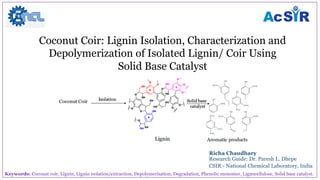
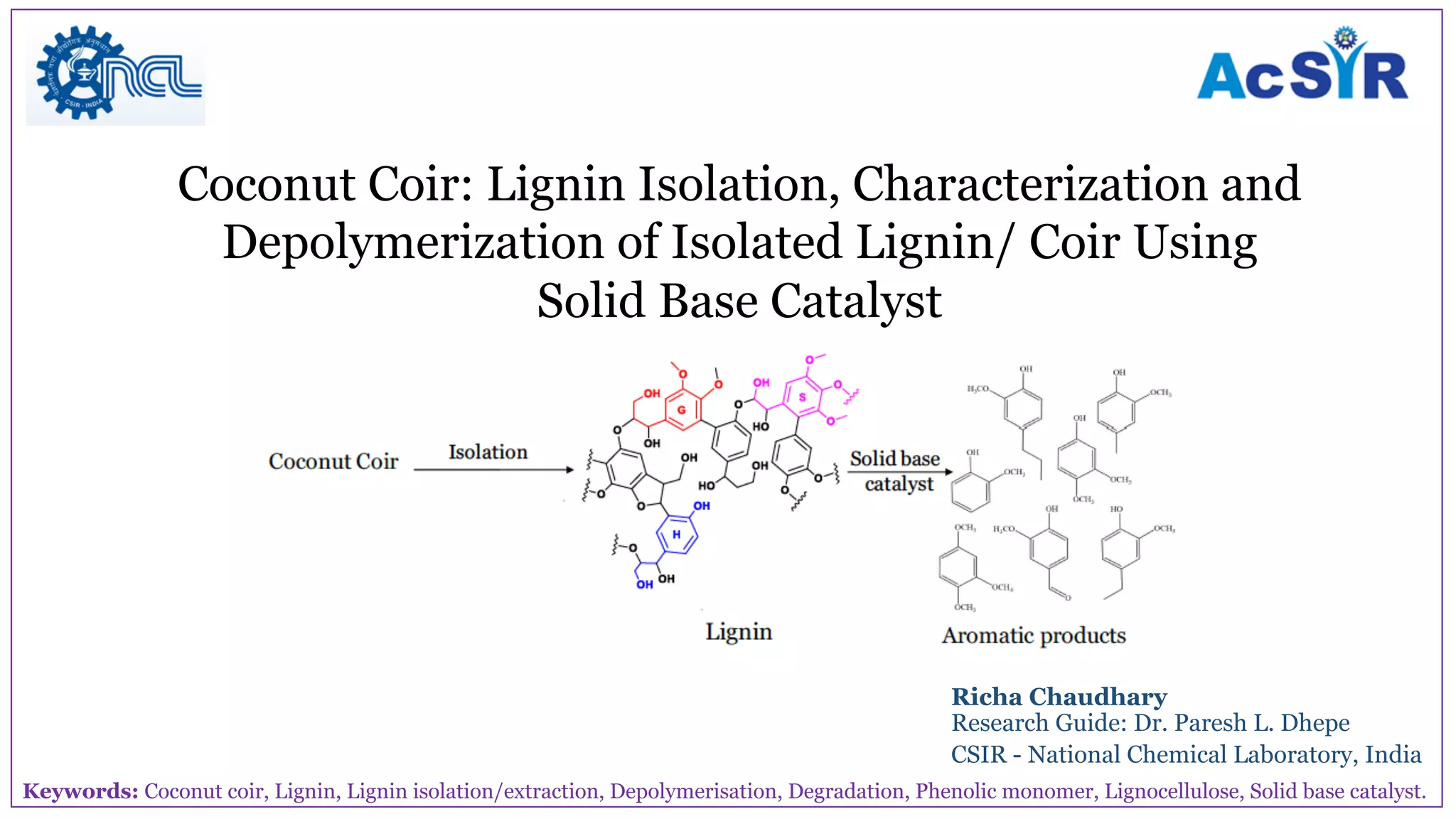
Coconut Coir: Lignin Isolation, Characterization and
Depolymerization of Isolated Lignin/ Coir Using
Solid Base Catalyst
Richa Chaudhary
Research Guide: Dr. Paresh L. Dhepe
CSIR - National Chemical Laboratory, India
Keywords: Coconut coir, Lignin, Lignin isolation/extraction, Depolymerisation, Degradation, Phenolic monomer, Lignocellulose, Solid base catalyst.
Coconut Coir
Composition
Water soluble ~5%
Pectin & related
compounds
3-4%
Hemicellulose 0.15-15%
Cellulose 33-43%
Lignin 32-46%
Ash 2-4%
Table: Chemical composition of coir fibre*
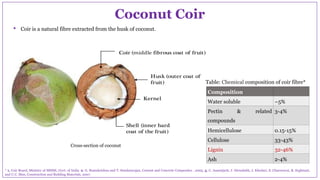
• Coir is a natural fibre extracted from the husk of coconut.
* 1. Coir Board, Ministry of MSME, Govt. of India. 2. G. Ramakrishna and T. Sundararajan, Cement and Concrete Composites , 2005, 3. C. Asasutjarit, J. Hirunlabh, J. Khedari, S. Charoenvai, B. Zeghmati,
and U.C. Shin, Construction and Building Materials, 2007.
Cross-section of coconut
Husk (outer coat of
fruit)
Kernel
Shell (inner hard
coat of the fruit)
Coir (middle fibrous coat of fruit)
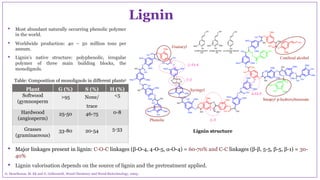
Lignin structure
• Major linkages present in lignin: C-O-C linkages (β-O-4, 4-O-5, α-O-4) = 60-70% and C-C linkages (β-β, 5-5, β-5, β-1) = 30-
40%
• Lignin valorisation depends on the source of lignin and the pretreatment applied.
• Most abundant naturally occurring phenolic polymer
in the world.
• Worldwide production: 40 – 50 million tons per
annum.
• Lignin’s native structure: polyphenolic, irregular
polymer of three main building blocks, the
monolignols.
Lignin
Table: Composition of monolignols in different plants2
G. Henriksson, M. Ek and G. Gellerstedt, Wood Chemistry and Wood Biotechnology, 2005..
Plant G (%) S (%) H (%)
Softwood
(gymnosperm
>95 None/
trace
<5
Hardwood
(angiosperm)
25-50 46-75 0-8
Grasses
(graminaceous)
33-80 20-54 5-33
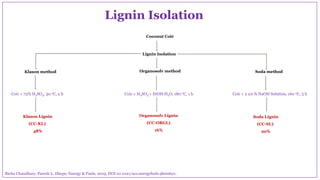
Lignin Isolation
Coir + 72% H2SO4, 30 oC, 2 h
Klason Lignin
(CC-KL)
48%
Coir + H2SO4 + EtOH:H2O, 180 oC, 1 h
Organosolv Lignin
(CC-ORGL)
16%
Coir + 2 wt.% NaOH Solution, 160 oC, 5 h
Soda Lignin
(CC-SL)
20%
Coconut Coir
Lignin Isolation
Organosolv method Soda methodKlason method
Richa Chaudhary, Paresh L. Dhepe, Energy & Fuels, 2019, DOI:10.1021/acs.energyfuels.9b00621.
Microanalysis
Microanalysis Coconut Coir
(CC)
Organosolv Lignin
(CC-ORGL)
Soda Lignin
(CC-SL)
Klason Lignin
(CC-KL)
C (%) 45.35 60.78 63.58 63.59
H (%) 4.86 5.41 6.08 6.12
O (%) 49.79 33.81 29.34 29.39
O/C 1.09 0.56 0.46 0.46
H/C 0.11 0.09 0.10 0.10
HHV (MJ/kg) (a) 13.4 22.3 24.8 24.9
DBE (b) 2.18 5.8 5.6 5.6
MMF (c) C7.6H8.84O6.22 C10.1H10.7O4.2 C10.6H12.1O3.8 C10.6H12.1O3.8
pH (d) 6.4 6.3 5.9 2.95
(a) Higher heat value (HHV) = [0.3383 x C + 1.442 x [H-(O/8)] + 9.248 x S] where C, H, O and S are wt.% of carbon, hydrogen, oxygen and sulphur; (b) Double bond
equivalence (DBE) = [C – (H/2) + (N/2) + 1] where C, H and N are number of carbon, hydrogen and nitrogen atoms found from monomer molecular formula (c)
Monomer
molecular formula (MMF) = 100 - (‘C’ wt.% + ‘H’ wt.% + ‘O’ wt.%). (d)
pH was measured by dissolving 0.08 g sample in 5 mL water
Characterizations: Coir & Isolated Lignin
X-ray Diffraction
XRD patterns of CC and isolated lignin {organosolv (CC-
ORGL), soda (CC-SL), and Klason (CC-KL) lignin},
XRD shows a broad peak at 2θ = 21.7º, characteristics of
cellulose crystalline phase and a small peak at 2θ = 16.7º
for the amorphous phase of cellulose.
Confirms the amorphous nature of lignin.
XRD patterns of different samples of coconut coir
(CC-1-4)
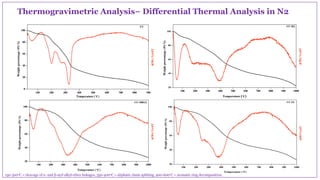
Thermogravimetric Analysis− Differential Thermal Analysis in N2
150-300oC = cleavage of α- and β-aryl-alkyl-ether linkages, 350-400oC = aliphatic chain splitting, 400-600oC = aromatic ring decomposition.
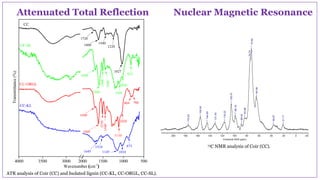
Attenuated Total Reflection
ATR analysis of Coir (CC) and Isolated lignin (CC-KL, CC-ORGL, CC-SL).
Nuclear Magnetic Resonance
13C NMR analysis of Coir (CC).
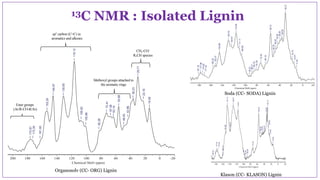
13C NMR : Isolated Lignin
Organosolv (CC- ORG) Lignin
Soda (CC- SODA) Lignin
sp2 carbon (C=C) in
aromatics and alkenes
Methoxyl groups attached to
the aromatic rings
CH3-CO/
R3CH species
Ester groups
(Ar/R-CO-R/Ar)
Klason (CC- KLASON) Lignin
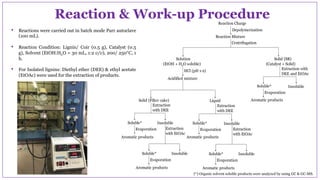
Reaction & Work-up Procedure
(*) Organic solvent soluble products were analyzed by using GC & GC-MS.
• Reactions were carried out in batch mode Parr autoclave
(100 mL).
• Reaction Condition: Lignin/ Coir (0.5 g), Catalyst (0.5
g), Solvent (EtOH:H2O = 30 mL, 1:2 v/v), 200/ 250°C, 1
h.
• For Isolated lignins: Diethyl ether (DEE) & ethyl acetate
(EtOAc) were used for the extraction of products.
Extraction
with DEE
Reaction Mixture
Centrifugation
Solid (SR)
(Catalyst + Solid)
Solution
(EtOH + H2O soluble)
Acidified mixture
HCl (pH 1-2)
Reaction Charge
Depolymerization
Liquid
InsolubleSoluble*
Evaporation
Solid (Filter cake)
Extraction
with DEE
InsolubleSoluble*
Evaporation
Aromatic products Aromatic products
Extraction
with EtOAc
Extraction
with EtOAc
InsolubleSoluble*
Evaporation
Aromatic products
InsolubleSoluble*
Evaporation
Aromatic products
Extraction with
DEE and EtOAc
InsolubleSoluble*
Evaporation
Aromatic products
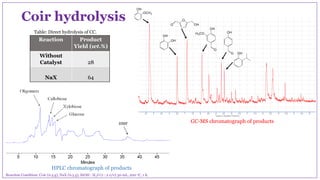
Coir hydrolysis
Table: Direct hydrolysis of CC.
Reaction Condition: Coir (0.5 g), NaX (0.5 g), EtOH : H2O (1 : 2 v/v) 30 mL, 200 oC, 1 h.
GC-MS chromatograph of products
HPLC chromatograph of products
Reaction Product
Yield (wt.%)
Without
Catalyst 28
NaX 64
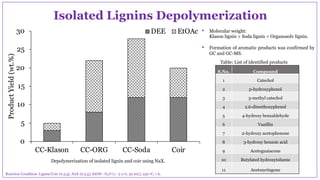
Isolated Lignins Depolymerization
• Molecular weight:
Klason lignin > Soda lignin > Organosolv lignin.
• Formation of aromatic products was confirmed by
GC and GC-MS.
Depolymerization of isolated lignin and coir using NaX.
S.No. Compound
1 Catechol
2 p-hydroxyphenol
3 3-methyl catechol
4 2,6-dimethoxyphenol
5 4-hydroxy benzaldehyde
6 Vanillin
7 2-hydroxy acetophenone
8 3-hydroxy benzoic acid
9 Acetoguaiacone
10 Butylated hydroxytoluene
11 Acetosyringone
Table: List of identified products
Reaction Condition: Lignin/Coir (0.5 g), NaX (0.5 g), EtOH : H2O (1 : 2 v/v, 30 mL), 250 oC, 1 h.
0
5
10
15
20
25
30
CC-Klason CC-ORG CC-Soda Coir
ProductYield(wt.%)
DEE EtOAc
Conclusions
1. Isolation of lignin from coconut coir and detailed characterization of lignin (Organosolv, Klason and Soda) were done.
• Klason method is effective for isolating maximum amount lignin (48%).
2. Variation in the structure of isolated lignins were explained with the help of various techniques like ATR, 13C NMR,
microanalysis, etc.
• It was observed that coir is rich in guaiacyl type of units.
3. Depolymerization of isolated lignin (Organosolv, Klason and Soda) were done using NaX.
• Shows a maximum yield of 28% with Soda lignin.
4. Direct hydrolysis of coir was shown with 64% of products yield.
• Reveals that Solid base (NaX) is effective for the depolymerization of real biomass also at milder conditions
(T≤ 200°C, atmospheric pressure).
1. Depolymerization of Lignin Using a Solid Base Catalyst.
Richa Chaudhary, Paresh L. Dhepe, Energy & Fuels, 2019, DOI:10.1021/acs.energyfuels.9b00621.
https://pubs.acs.org/doi/10.1021/acs.energyfuels.9b00621
2. Solid base catalyzed depolymerization of lignin into low molecular weight products.
Richa Chaudhary, Paresh L. Dhepe, Green Chemistry, 2016, DOI:10.1039/C6GC02701F.
http://pubs.rsc.org/en/content/articlelanding/2017/gc/c6gc02701f#!divAbstract
3. An improved heterogeneous base catalyzed process for depolymerization of lignin.
Paresh L. Dhepe and Km. Richa, Council of Scientific and Industrial Research, 2016, INDIAN Patent Application no.
201611007650.
4. Group Webpage: http://academic.ncl.res.in/pl.dhepe
Further readings

Lignin isolation from coconut coir, characterization and depolymerization using solid base catalyst

  • 1.
    Coconut Coir: LigninIsolation, Characterization and Depolymerization of Isolated Lignin/ Coir Using Solid Base Catalyst Richa Chaudhary Research Guide: Dr. Paresh L. Dhepe CSIR - National Chemical Laboratory, India Keywords: Coconut coir, Lignin, Lignin isolation/extraction, Depolymerisation, Degradation, Phenolic monomer, Lignocellulose, Solid base catalyst.
  • 2.
    Coconut Coir Composition Water soluble~5% Pectin & related compounds 3-4% Hemicellulose 0.15-15% Cellulose 33-43% Lignin 32-46% Ash 2-4% Table: Chemical composition of coir fibre* • Coir is a natural fibre extracted from the husk of coconut. * 1. Coir Board, Ministry of MSME, Govt. of India. 2. G. Ramakrishna and T. Sundararajan, Cement and Concrete Composites , 2005, 3. C. Asasutjarit, J. Hirunlabh, J. Khedari, S. Charoenvai, B. Zeghmati, and U.C. Shin, Construction and Building Materials, 2007. Cross-section of coconut Husk (outer coat of fruit) Kernel Shell (inner hard coat of the fruit) Coir (middle fibrous coat of fruit)
  • 3.
    Lignin structure • Majorlinkages present in lignin: C-O-C linkages (β-O-4, 4-O-5, α-O-4) = 60-70% and C-C linkages (β-β, 5-5, β-5, β-1) = 30- 40% • Lignin valorisation depends on the source of lignin and the pretreatment applied. • Most abundant naturally occurring phenolic polymer in the world. • Worldwide production: 40 – 50 million tons per annum. • Lignin’s native structure: polyphenolic, irregular polymer of three main building blocks, the monolignols. Lignin Table: Composition of monolignols in different plants2 G. Henriksson, M. Ek and G. Gellerstedt, Wood Chemistry and Wood Biotechnology, 2005.. Plant G (%) S (%) H (%) Softwood (gymnosperm >95 None/ trace <5 Hardwood (angiosperm) 25-50 46-75 0-8 Grasses (graminaceous) 33-80 20-54 5-33
  • 4.
    Lignin Isolation Coir +72% H2SO4, 30 oC, 2 h Klason Lignin (CC-KL) 48% Coir + H2SO4 + EtOH:H2O, 180 oC, 1 h Organosolv Lignin (CC-ORGL) 16% Coir + 2 wt.% NaOH Solution, 160 oC, 5 h Soda Lignin (CC-SL) 20% Coconut Coir Lignin Isolation Organosolv method Soda methodKlason method Richa Chaudhary, Paresh L. Dhepe, Energy & Fuels, 2019, DOI:10.1021/acs.energyfuels.9b00621.
  • 5.
    Microanalysis Microanalysis Coconut Coir (CC) OrganosolvLignin (CC-ORGL) Soda Lignin (CC-SL) Klason Lignin (CC-KL) C (%) 45.35 60.78 63.58 63.59 H (%) 4.86 5.41 6.08 6.12 O (%) 49.79 33.81 29.34 29.39 O/C 1.09 0.56 0.46 0.46 H/C 0.11 0.09 0.10 0.10 HHV (MJ/kg) (a) 13.4 22.3 24.8 24.9 DBE (b) 2.18 5.8 5.6 5.6 MMF (c) C7.6H8.84O6.22 C10.1H10.7O4.2 C10.6H12.1O3.8 C10.6H12.1O3.8 pH (d) 6.4 6.3 5.9 2.95 (a) Higher heat value (HHV) = [0.3383 x C + 1.442 x [H-(O/8)] + 9.248 x S] where C, H, O and S are wt.% of carbon, hydrogen, oxygen and sulphur; (b) Double bond equivalence (DBE) = [C – (H/2) + (N/2) + 1] where C, H and N are number of carbon, hydrogen and nitrogen atoms found from monomer molecular formula (c) Monomer molecular formula (MMF) = 100 - (‘C’ wt.% + ‘H’ wt.% + ‘O’ wt.%). (d) pH was measured by dissolving 0.08 g sample in 5 mL water Characterizations: Coir & Isolated Lignin
  • 6.
    X-ray Diffraction XRD patternsof CC and isolated lignin {organosolv (CC- ORGL), soda (CC-SL), and Klason (CC-KL) lignin}, XRD shows a broad peak at 2θ = 21.7º, characteristics of cellulose crystalline phase and a small peak at 2θ = 16.7º for the amorphous phase of cellulose. Confirms the amorphous nature of lignin. XRD patterns of different samples of coconut coir (CC-1-4)
  • 7.
    Thermogravimetric Analysis− DifferentialThermal Analysis in N2 150-300oC = cleavage of α- and β-aryl-alkyl-ether linkages, 350-400oC = aliphatic chain splitting, 400-600oC = aromatic ring decomposition.
  • 8.
    Attenuated Total Reflection ATRanalysis of Coir (CC) and Isolated lignin (CC-KL, CC-ORGL, CC-SL). Nuclear Magnetic Resonance 13C NMR analysis of Coir (CC).
  • 9.
    13C NMR :Isolated Lignin Organosolv (CC- ORG) Lignin Soda (CC- SODA) Lignin sp2 carbon (C=C) in aromatics and alkenes Methoxyl groups attached to the aromatic rings CH3-CO/ R3CH species Ester groups (Ar/R-CO-R/Ar) Klason (CC- KLASON) Lignin
  • 10.
    Reaction & Work-upProcedure (*) Organic solvent soluble products were analyzed by using GC & GC-MS. • Reactions were carried out in batch mode Parr autoclave (100 mL). • Reaction Condition: Lignin/ Coir (0.5 g), Catalyst (0.5 g), Solvent (EtOH:H2O = 30 mL, 1:2 v/v), 200/ 250°C, 1 h. • For Isolated lignins: Diethyl ether (DEE) & ethyl acetate (EtOAc) were used for the extraction of products. Extraction with DEE Reaction Mixture Centrifugation Solid (SR) (Catalyst + Solid) Solution (EtOH + H2O soluble) Acidified mixture HCl (pH 1-2) Reaction Charge Depolymerization Liquid InsolubleSoluble* Evaporation Solid (Filter cake) Extraction with DEE InsolubleSoluble* Evaporation Aromatic products Aromatic products Extraction with EtOAc Extraction with EtOAc InsolubleSoluble* Evaporation Aromatic products InsolubleSoluble* Evaporation Aromatic products Extraction with DEE and EtOAc InsolubleSoluble* Evaporation Aromatic products
  • 11.
    Coir hydrolysis Table: Directhydrolysis of CC. Reaction Condition: Coir (0.5 g), NaX (0.5 g), EtOH : H2O (1 : 2 v/v) 30 mL, 200 oC, 1 h. GC-MS chromatograph of products HPLC chromatograph of products Reaction Product Yield (wt.%) Without Catalyst 28 NaX 64
  • 12.
    Isolated Lignins Depolymerization •Molecular weight: Klason lignin > Soda lignin > Organosolv lignin. • Formation of aromatic products was confirmed by GC and GC-MS. Depolymerization of isolated lignin and coir using NaX. S.No. Compound 1 Catechol 2 p-hydroxyphenol 3 3-methyl catechol 4 2,6-dimethoxyphenol 5 4-hydroxy benzaldehyde 6 Vanillin 7 2-hydroxy acetophenone 8 3-hydroxy benzoic acid 9 Acetoguaiacone 10 Butylated hydroxytoluene 11 Acetosyringone Table: List of identified products Reaction Condition: Lignin/Coir (0.5 g), NaX (0.5 g), EtOH : H2O (1 : 2 v/v, 30 mL), 250 oC, 1 h. 0 5 10 15 20 25 30 CC-Klason CC-ORG CC-Soda Coir ProductYield(wt.%) DEE EtOAc
  • 13.
    Conclusions 1. Isolation oflignin from coconut coir and detailed characterization of lignin (Organosolv, Klason and Soda) were done. • Klason method is effective for isolating maximum amount lignin (48%). 2. Variation in the structure of isolated lignins were explained with the help of various techniques like ATR, 13C NMR, microanalysis, etc. • It was observed that coir is rich in guaiacyl type of units. 3. Depolymerization of isolated lignin (Organosolv, Klason and Soda) were done using NaX. • Shows a maximum yield of 28% with Soda lignin. 4. Direct hydrolysis of coir was shown with 64% of products yield. • Reveals that Solid base (NaX) is effective for the depolymerization of real biomass also at milder conditions (T≤ 200°C, atmospheric pressure).
  • 14.
    1. Depolymerization ofLignin Using a Solid Base Catalyst. Richa Chaudhary, Paresh L. Dhepe, Energy & Fuels, 2019, DOI:10.1021/acs.energyfuels.9b00621. https://pubs.acs.org/doi/10.1021/acs.energyfuels.9b00621 2. Solid base catalyzed depolymerization of lignin into low molecular weight products. Richa Chaudhary, Paresh L. Dhepe, Green Chemistry, 2016, DOI:10.1039/C6GC02701F. http://pubs.rsc.org/en/content/articlelanding/2017/gc/c6gc02701f#!divAbstract 3. An improved heterogeneous base catalyzed process for depolymerization of lignin. Paresh L. Dhepe and Km. Richa, Council of Scientific and Industrial Research, 2016, INDIAN Patent Application no. 201611007650. 4. Group Webpage: http://academic.ncl.res.in/pl.dhepe Further readings