Depolymerization of lignin over
heterogeneous catalyst having acidic
functionality
Presented by,
A. K. Deepa
Research guide: Dr. Paresh L. Dhepe
Catalysis & Inorganic Chemistry Division
CSIR-National Chemical Laboratory, Pune, India
Tel. 91-20-25902024, Fax. 91-20-25902633,
Email: pl.dhepe@ncl.res.in
Group Webpage: http://academic.ncl.res.in/pl.dhepe
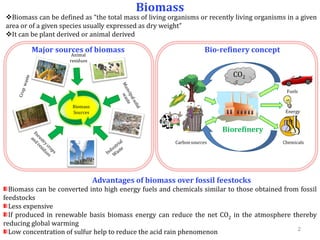
Biomass
Biomass can be defined as “the total mass of living organisms or recently living organisms in a given
area or of a given species usually expressed as dry weight”
It can be plant derived or animal derived
Biomass can be converted into high energy fuels and chemicals similar to those obtained from fossil
feedstocks
Less expensive
If produced in renewable basis biomass energy can reduce the net CO2 in the atmosphere thereby
reducing global warming
Low concentration of sulfur help to reduce the acid rain phenomenon
Major sources of biomass Bio-refinery concept
Advantages of biomass over fossil feestocks
Biomass
Sources
Animal
residues
CO2
Chemicals
Energy
Fuels
Carbonsources
Biorefinery
2
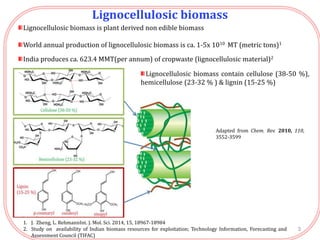
Lignocellulosic biomass
1. J. Zheng, L. RehmannInt. J. Mol. Sci. 2014, 15, 18967-18984
2. Study on availability of Indian biomass resources for exploitation; Technology Information, Forecasting and
Assessment Council (TIFAC)
Lignocellulosic biomass is plant derived non edible biomass
World annual production of lignocellulosic biomass is ca. 1-5x 10¹⁰ MT (metric tons)1
India produces ca. 623.4 MMT(per annum) of cropwaste (lignocellulosic material)2
Adapted from Chem. Rev. 2010, 110,
3552-3599
3
Lignocellulosic biomass contain cellulose (38-50 %),
hemicellulose (23-32 % ) & lignin (15-25 %)
Adapted from, B. Kamm, P. Gruber, and M. Kamm, Biorefineries-Industrial Processes and Products, pages 165
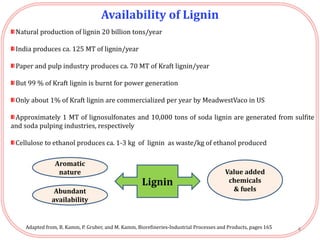
Natural production of lignin 20 billion tons/year
India produces ca. 125 MT of lignin/year
Paper and pulp industry produces ca. 70 MT of Kraft lignin/year
But 99 % of Kraft lignin is burnt for power generation
Only about 1% of Kraft lignin are commercialized per year by MeadwestVaco in US
Approximately 1 MT of lignosulfonates and 10,000 tons of soda lignin are generated from sulfite
and soda pulping industries, respectively
Cellulose to ethanol produces ca. 1-3 kg of lignin as waste/kg of ethanol produced
Availability of Lignin
Aromatic
nature
Abundant
availability
Lignin
Value added
chemicals
& fuels
4
Adapted from, Sakakibari, A., Wood Sci. Technology, 1980, 14, 89.
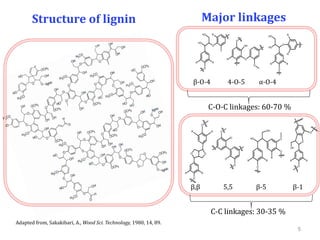
Structure of lignin Major linkages
5
β-O-4 4-O-5 α-O-4
β,β 5,5 β-5 β-1
C-O-C linkages: 60-70 %
C-C linkages: 30-35 %
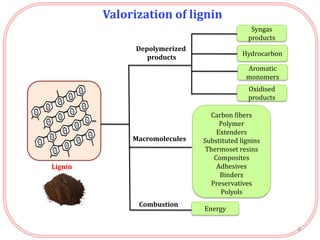
Valorization of lignin
Lignin
Carbon fibers
Polymer
Extenders
Substituted lignins
Thermoset resins
Composites
Adhesives
Binders
Preservatives
Polyols
Macromolecules
Combustion
Energy
Aromatic
monomers
Oxidised
products
Hydrocarbon
Syngas
products
Depolymerized
products
6
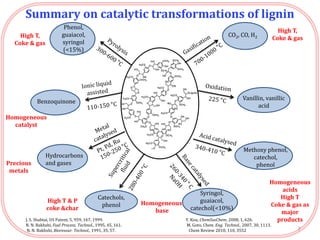
Summary on catalytic transformations of lignin
Phenol,
guaiacol,
syringol
(<15%)
CO2, CO, H2
Methoxy phenol,
catechol,
phenol
Syringol,
guaiacol,
catechol(<10%)
Catechols,
phenol
Hydrocarbons
and gases
Vanillin, vanillic
acid
Benzoquinone
J. S. Shabtai, US Patent, 5, 959, 167, 1999. Y. Kou, ChemSusChem, 2008, 1, 626.
N. N. Bakhshi, Fuel Process. Technol., 1995, 45, 161. M. Goto, Chem. Eng. Technol., 2007, 30, 1113.
N. N. Bakhshi, Bioresour. Technol., 1991, 35, 57. Chem Review 2010, 110, 3552
High T,
Coke & gas
Homogeneous
catalyst
Precious
metals
High T,
Coke & gas
Homogeneous
acids
High T
Coke & gas as
major
products
Homogeneous
base
High T & P
coke &char
7
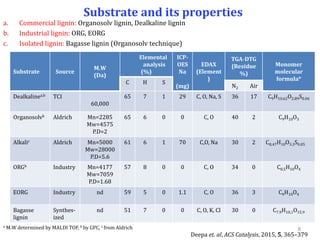
a. Commercial lignin: Organosolv lignin, Dealkaline lignin
b. Industrial lignin: ORG, EORG
c. Isolated lignin: Bagasse lignin (Organosolv technique)
Substrate and its properties
a M.W determined by MALDI TOF, b by GPC, c from Aldrich
Deepa et. al, ACS Catalysis, 2015, 5, 365–379
Substrate Source
M.W
(Da)
Elemental
analysis
(%)
ICP-
OES
Na
(mg)
EDAX
(Element
)
TGA-DTG
(Residue
%)
Monomer
molecular
formula*
C H S
N2 Air
Dealkalinea,b TCI
60,000
65 7 1 29 C, O, Na, S 36 17 C9H10.62O2.89S0.06
Organosolvb Aldrich Mn=2285
Mw=4575
P.D=2
65 6 0 0 C, O 40 2 C9H10O3
Alkalic Aldrich Mn=5000
Mw=28000
P.D=5.6
61 6 1 70 C,O, Na 30 2 C8.47H10O3.3S0.05
ORGb Industry Mn=4177
Mw=7059
P.D=1.68
57 8 0 0 C, O 34 0 C8.5H10O4
EORG Industry nd 59 5 0 1.1 C, O 36 3 C9H10O4
Bagasse
lignin
Synthes-
ized
nd 51 7 0 0 C, O, K, Cl 30 0 C7.9H10.1O15.9
8
Properties of solid acids (for lignin depolymerization)
aBrunauer–Emmett–Teller surface area, bPorevolume, bPorediameter [Autosorb1C Quantachrome, instrument]
dAcidity measured by means of TPD of NH3[Micrometrics Autochem-2910 instrument] .
Catalyst Structure
Nitrogen sorption NH3-TPDd
BET SAa
(m2g-1)
Vb
(cm3g-1)
Dc
(nm)
Weak acid
sites
(mmolg-1)
Stong acid
sites
(mmolg-1)
Total
acidity
(mmolg-1)
H-USY (Si/Al=15) Micro 873 0.45 0.61 0.06 0.49 0.55
H-ZSM-5 (Si/Al=11.5) Micro 423 0.22 0.60 0.37 0.61 0.97
H-BEA (Si/Al=19) Micro 761 0.34 0.60 0.25 0.66 0.91
H-MOR (Si/Al=10) Micro 528 0.22 0.59 0.5 0.65 1.18
Nb2O5 -- 115 -- -- 0.30 -- 0.30
SO42-/ZrO2 -- 84 0.02 -- nd nd nd
Clay (K10) Layered 246 0.3 -- 0.09 0.33 0.42
Al pillared clay Layered nd nd nd nd nd nd
SiO2-Al2O3 Micro-meso 532 0.82 4.90 0.17 0.46 0.63
10%MoO3/SiO2 Nonporous nd nd nd 0.09 - 0.09
9
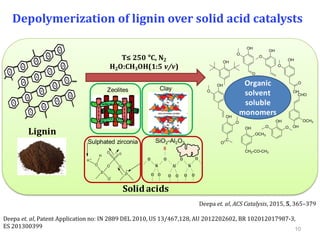
Depolymerization of lignin over solid acid catalysts
Lignin
Solidacids
T≤ 250 C, N2
H2O:CH3OH(1:5 v/v)
Zeolites Clay
Sulphated zirconia SiO2-Al2O3
O O
Si Al
O
Si
H
O
O O O O OO
Organic
solvent
soluble
monomers
10
Deepa et. al, ACS Catalysis, 2015, 5, 365–379
Deepa et. al, Patent Application no: IN 2889 DEL 2010, US 13/467,128, AU 2012202602, BR 102012017987-3,
ES 201300399
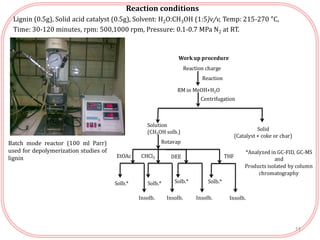
Reaction conditions
Lignin (0.5g), Solid acid catalyst (0.5g), Solvent: H2O:CH3OH (1:5)v/v, Temp: 215-270 °C,
Time: 30-120 minutes, rpm: 500,1000 rpm, Pressure: 0.1-0.7 MPa N2 at RT.
Batch mode reactor (100 ml Parr)
used for depolymerization studies of
lignin
11
Reaction charge
Reaction
RM in MeOH+H2O
Centrifugation
Solid
(Catalyst + coke or char)
Solution
(CH3OH solb.)
Rotavap
EtOAc CHCl3 DEE
Solb.*
THF
Solb.*Solb.*
Insolb. Insolb. Insolb.
*Analyzed in GC-FID, GC-MS
and
Products isolated by column
chromatography
Solb.*
Insolb.
Work up procedure
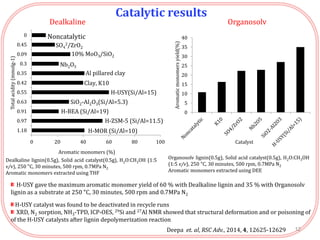
H-USY gave the maximum aromatic monomer yield of 60 % with Dealkaline lignin and 35 % with Organosolv
lignin as a substrate at 250 °C, 30 minutes, 500 rpm and 0.7MPa N2
H-USY catalyst was found to be deactivated in recycle runs
XRD, N2 sorption, NH3-TPD, ICP-OES, 29Si and 27Al NMR showed that structural deformation and or poisoning of
of the H-USY catalysts after lignin depolymerization reaction
Dealkaline lignin(0.5g), Solid acid catalyst(0.5g), H2O:CH3OH (1:5
v/v), 250 °C, 30 minutes, 500 rpm, 0.7MPa N2
Aromatic monomers extracted using THF
Dealkaline Organosolv
Catalytic results
0 20 40 60 80 100
1.18
0.97
0.91
0.63
0.55
0.42
0.35
0.3
0.09
0.45
0
Aromatic monomers (%)
Totalacidity(mmolg-1)
Noncatalytic
SO4
2/ZrO2
10% MoO3/SiO2
Nb2O5
Al pillared clay
Clay, K10
H-USY(Si/Al=15)
SiO2-Al2O3(Si/Al=5.3)
H-BEA (Si/Al=19)
H-ZSM-5 (Si/Al=11.5)
H-MOR (Si/Al=10)
0
5
10
15
20
25
30
35
40
Aromaticmonomersyield(%)
Catalyst
Organosolv lignin(0.5g), Solid acid catalyst(0.5g), H2O:CH3OH
(1:5 v/v), 250 °C, 30 minutes, 500 rpm, 0.7MPa N2
Aromatic monomers extracted using DEE
12Deepa et. al, RSC Adv., 2014, 4, 12625-12629
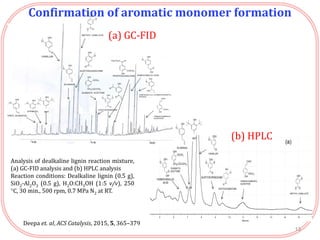
Confirmation of aromatic monomer formation
Analysis of dealkaline lignin reaction mixture,
(a) GC-FID analysis and (b) HPLC analysis
Reaction conditions: Dealkaline lignin (0.5 g),
SiO2-Al2O3 (0.5 g), H2O:CH3OH (1:5 v/v), 250
°C, 30 min., 500 rpm, 0.7 MPa N2 at RT.
nRIU
-10000
-5000
0
5000
10000
15000
20000
25000
30000
35000
40000
45000
50000
RID: RI Signal
12 percTHF solb 40 58 2 comp 0.8ml rep
Retention Time
Area
Width
Minutes
4 5 6 7 8 9 10 11 12 13 14 15 16
nRIU
-10000
-5000
0
5000
10000
15000
20000
25000
30000
35000
40000
45000
50000
RID: RI Signal
12 percTHF solb 40 58 2 comp 0.8ml rep
Retention Time
Area
Width
(a)
(b)
(b) HPLC
Minutes
4 5 6 7 8 9 10 11 12 13 14 15 16 17 18
-10000
-5000
0
-10000
-5000
0
Minutes
4 5 6 7 8 9 10 11 12 13 14 15 16 17 18
Minutes
(b)
(a) GC-FID
13
Deepa et. al, ACS Catalysis, 2015, 5, 365–379
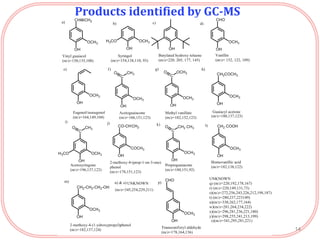
Products identified by GC-MS
14
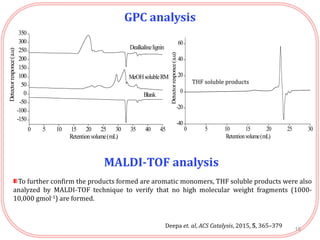
GPC analysis
0 5 10 15 20 25 30 35 40 45
-150
-100
-50
0
50
100
150
200
250
300
350
Detectorresponce(a.u)
Retentionvolume(mL)
Blank
MeOHsolubleRM
Dealkalinelignin
To further confirm the products formed are aromatic monomers, THF soluble products were also
analyzed by MALDI-TOF technique to verify that no high molecular weight fragments (1000-
10,000 gmol-1) are formed.
MALDI-TOF analysis
0 5 10 15 20 25 30
-40
-20
0
20
40
60
Retentionvolume(mL)
Detectorresponce(a.u)
THF soluble products
15
Deepa et. al, ACS Catalysis, 2015, 5, 365–379
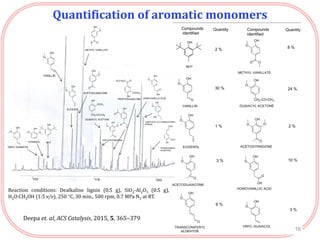
Quantification of aromatic monomers
Minutes
4 5 6 7 8 9 10 11 12 13 14 15 16 17 18
-10000
-5000
0
-10000
-5000
0
Minutes
4 5 6 7 8 9 10 11 12 13 14 15 16 17 18
Minutes
(b)
Reaction conditions: Dealkaline lignin (0.5 g), SiO2-Al2O3 (0.5 g),
H2O:CH3OH (1:5 v/v), 250 °C, 30 min., 500 rpm, 0.7 MPa N2 at RT.
16
Deepa et. al, ACS Catalysis, 2015, 5, 365–379
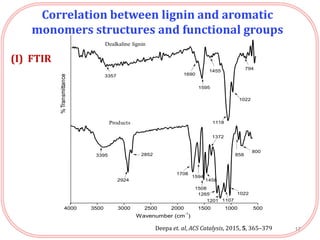
Correlation between lignin and aromatic
monomers structures and functional groups
4000 3500 3000 2500 2000 1500 1000 500
800
858
1022
11071201
1265
1372
1458
1508
1594
1708
2852
2924
3395
Wavenumber (cm
-1
)
794
1022
1118
1455
1595
16903357
Dealkaline lignin
Products
%Transmittance
(I) FTIR
17Deepa et. al, ACS Catalysis, 2015, 5, 365–379
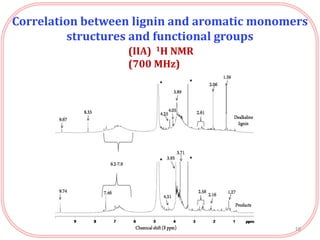
Correlation between lignin and aromatic monomers
structures and functional groups
(IIA) 1H NMR
(700 MHz)
18
19
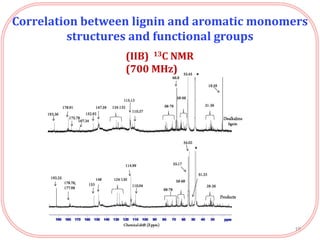
Correlation between lignin and aromatic monomers
structures and functional groups
(IIB) 13C NMR
(700 MHz)
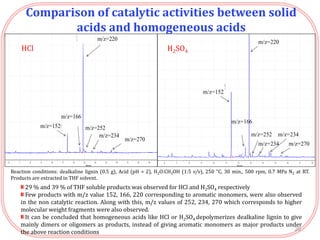
Comparison of catalytic activities between solid
acids and homogeneous acids
Minutes
6 7 8 9 10 11 12 13 14 15 16 17 18 19 20 21
0
10
20
30
40
50
60
70
80
90
00
pA
0
10
20
30
40
50
60
70
80
90
100
11.319
12.773
Retention Time
m/z=220
m/z=166
m/z=252
m/z=234
m/z=270
m/z=152
Minutes
6 7 8 9 10 11 12 13 14 15 16 17 18
pA
0
10
20
30
40
50
60
70
80
90
100
110
120
130
140
11.320
12.781
Front Signal
HCl THF solb
Retention Time
m/z=220
m/z=166
m/z=152
m/z=252
m/z=234 m/z=270
m/z=234
Reaction conditions: dealkaline lignin (0.5 g), Acid (pH = 2), H2O:CH3OH (1:5 v/v), 250 °C, 30 min., 500 rpm, 0.7 MPa N2 at RT.
Products are extracted in THF solvent.
HCl H2SO4
29 % and 39 % of THF soluble products was observed for HCl and H2SO4 respectively
Few products with m/z value 152, 166, 220 corresponding to aromatic monomers, were also observed
in the non catalytic reaction. Along with this, m/z values of 252, 234, 270 which corresponds to higher
molecular weight fragments were also observed.
It can be concluded that homogeneous acids like HCl or H2SO4 depolymerizes dealkaline lignin to give
mainly dimers or oligomers as products, instead of giving aromatic monomers as major products under
the above reaction conditions 20
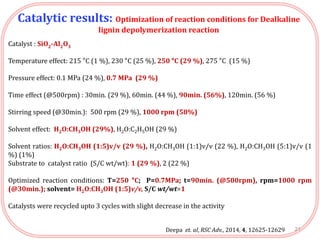
Catalytic results: Optimization of reaction conditions for Dealkaline
lignin depolymerization reaction
Catalyst : SiO2-Al2O3
Temperature effect: 215 °C (1 %), 230 °C (25 %), 250 °C (29 %), 275 °C (15 %)
Pressure effect: 0.1 MPa (24 %), 0.7 MPa (29 %)
Time effect (@500rpm) : 30min. (29 %), 60min. (44 %), 90min. (56%), 120min. (56 %)
Stirring speed (@30min.): 500 rpm (29 %), 1000 rpm (58%)
Solvent effect: H2O:CH3OH (29%), H2O:C2H5OH (29 %)
Solvent ratios: H2O:CH3OH (1:5)v/v (29 %), H2O:CH3OH (1:1)v/v (22 %), H2O:CH3OH (5:1)v/v (1
%) (1%)
Substrate to catalyst ratio (S/C wt/wt): 1 (29 %), 2 (22 %)
Optimized reaction conditions: T=250 °C; P=0.7MPa; t=90min. (@500rpm), rpm=1000 rpm
(@30min.); solvent= H2O:CH3OH (1:5)v/v, S/C wt/wt=1
Catalysts were recycled upto 3 cycles with slight decrease in the activity
21Deepa et. al, RSC Adv., 2014, 4, 12625-12629
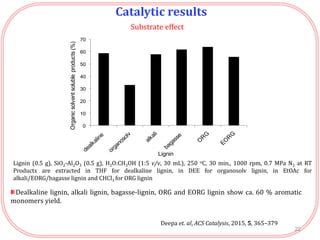
Catalytic results
Substrate effect
Dealkaline lignin, alkali lignin, bagasse-lignin, ORG and EORG lignin show ca. 60 % aromatic
monomers yield.
0
10
20
30
40
50
60
70
Organicsolventsolubleproducts(%)
Lignin
22
Deepa et. al, ACS Catalysis, 2015, 5, 365–379
Lignin (0.5 g), SiO2-Al2O3 (0.5 g), H2O:CH3OH (1:5 v/v, 30 mL), 250 oC, 30 min., 1000 rpm, 0.7 MPa N2 at RT
Products are extracted in THF for dealkaline lignin, in DEE for organosolv lignin, in EtOAc for
alkali/EORG/bagasse lignin and CHCl3 for ORG lignin
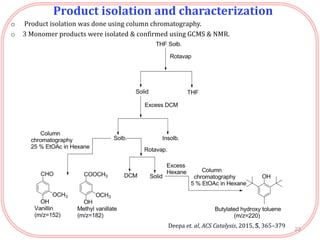
Product isolation and characterization
o Product isolation was done using column chromatography.
o 3 Monomer products were isolated & confirmed using GCMS & NMR.
23
Deepa et. al, ACS Catalysis, 2015, 5, 365–379
In summary, for the first time that lignin can be converted to aromatic monomers below 250 °C
using bare solid acid catalysts
Even the lignin having molecular weight of 60,000 Da was successful depolymerized into value
added aromatic monomers with very high yields (60%) using solid acid catalysts under inert
atmosphere
A variety of catalysts ranging from crystalline to amorphous were used in the study and it was
observed that catalysts having well defined structure were prone to undergo alterations
Monomers were isolated using column chromatography (3 nos)
Conclusions
24
Solid acid catalysed depolymerization of lignin into value added aromatic monomers.
A. K. Deepa and Paresh L. Dhepe, RSC Adv., 2014, 4, 12625-12629.
http://pubs.rsc.org/en/Content/ArticleLanding/2014/RA/c3ra47818a#!divAbstract
Lignin depolymerization into aromatic monomers over solid acid catalysts.
A. K. Deepa and Paresh L. Dhepe, ACS Catalysis, 2015, 5, 365–379.
http://pubs.acs.org/doi/abs/10.1021/cs501371q
Depolymerization of lignin using solid acid catalysts.
A. K. Deepa and Paresh L. Dhepe, Patent Application no: IN 2889 DEL 2010, US 13/467,128,
AU 2012202602, BR 102012017987-3, ES 201300399.
http://www.google.com/patents/US20120302796
For further reading………

Lignin-depolymerization-aromatic monomers-solid acid-heterogeneous catalyst-A. K. Deepa-Paresh Dhepe-NCL

  • 1.
    Depolymerization of ligninover heterogeneous catalyst having acidic functionality Presented by, A. K. Deepa Research guide: Dr. Paresh L. Dhepe Catalysis & Inorganic Chemistry Division CSIR-National Chemical Laboratory, Pune, India Tel. 91-20-25902024, Fax. 91-20-25902633, Email: pl.dhepe@ncl.res.in Group Webpage: http://academic.ncl.res.in/pl.dhepe
  • 2.
    Biomass Biomass can bedefined as “the total mass of living organisms or recently living organisms in a given area or of a given species usually expressed as dry weight” It can be plant derived or animal derived Biomass can be converted into high energy fuels and chemicals similar to those obtained from fossil feedstocks Less expensive If produced in renewable basis biomass energy can reduce the net CO2 in the atmosphere thereby reducing global warming Low concentration of sulfur help to reduce the acid rain phenomenon Major sources of biomass Bio-refinery concept Advantages of biomass over fossil feestocks Biomass Sources Animal residues CO2 Chemicals Energy Fuels Carbonsources Biorefinery 2
  • 3.
    Lignocellulosic biomass 1. J.Zheng, L. RehmannInt. J. Mol. Sci. 2014, 15, 18967-18984 2. Study on availability of Indian biomass resources for exploitation; Technology Information, Forecasting and Assessment Council (TIFAC) Lignocellulosic biomass is plant derived non edible biomass World annual production of lignocellulosic biomass is ca. 1-5x 10¹⁰ MT (metric tons)1 India produces ca. 623.4 MMT(per annum) of cropwaste (lignocellulosic material)2 Adapted from Chem. Rev. 2010, 110, 3552-3599 3 Lignocellulosic biomass contain cellulose (38-50 %), hemicellulose (23-32 % ) & lignin (15-25 %)
  • 4.
    Adapted from, B.Kamm, P. Gruber, and M. Kamm, Biorefineries-Industrial Processes and Products, pages 165 Natural production of lignin 20 billion tons/year India produces ca. 125 MT of lignin/year Paper and pulp industry produces ca. 70 MT of Kraft lignin/year But 99 % of Kraft lignin is burnt for power generation Only about 1% of Kraft lignin are commercialized per year by MeadwestVaco in US Approximately 1 MT of lignosulfonates and 10,000 tons of soda lignin are generated from sulfite and soda pulping industries, respectively Cellulose to ethanol produces ca. 1-3 kg of lignin as waste/kg of ethanol produced Availability of Lignin Aromatic nature Abundant availability Lignin Value added chemicals & fuels 4
  • 5.
    Adapted from, Sakakibari,A., Wood Sci. Technology, 1980, 14, 89. Structure of lignin Major linkages 5 β-O-4 4-O-5 α-O-4 β,β 5,5 β-5 β-1 C-O-C linkages: 60-70 % C-C linkages: 30-35 %
  • 6.
    Valorization of lignin Lignin Carbonfibers Polymer Extenders Substituted lignins Thermoset resins Composites Adhesives Binders Preservatives Polyols Macromolecules Combustion Energy Aromatic monomers Oxidised products Hydrocarbon Syngas products Depolymerized products 6
  • 7.
    Summary on catalytictransformations of lignin Phenol, guaiacol, syringol (<15%) CO2, CO, H2 Methoxy phenol, catechol, phenol Syringol, guaiacol, catechol(<10%) Catechols, phenol Hydrocarbons and gases Vanillin, vanillic acid Benzoquinone J. S. Shabtai, US Patent, 5, 959, 167, 1999. Y. Kou, ChemSusChem, 2008, 1, 626. N. N. Bakhshi, Fuel Process. Technol., 1995, 45, 161. M. Goto, Chem. Eng. Technol., 2007, 30, 1113. N. N. Bakhshi, Bioresour. Technol., 1991, 35, 57. Chem Review 2010, 110, 3552 High T, Coke & gas Homogeneous catalyst Precious metals High T, Coke & gas Homogeneous acids High T Coke & gas as major products Homogeneous base High T & P coke &char 7
  • 8.
    a. Commercial lignin:Organosolv lignin, Dealkaline lignin b. Industrial lignin: ORG, EORG c. Isolated lignin: Bagasse lignin (Organosolv technique) Substrate and its properties a M.W determined by MALDI TOF, b by GPC, c from Aldrich Deepa et. al, ACS Catalysis, 2015, 5, 365–379 Substrate Source M.W (Da) Elemental analysis (%) ICP- OES Na (mg) EDAX (Element ) TGA-DTG (Residue %) Monomer molecular formula* C H S N2 Air Dealkalinea,b TCI 60,000 65 7 1 29 C, O, Na, S 36 17 C9H10.62O2.89S0.06 Organosolvb Aldrich Mn=2285 Mw=4575 P.D=2 65 6 0 0 C, O 40 2 C9H10O3 Alkalic Aldrich Mn=5000 Mw=28000 P.D=5.6 61 6 1 70 C,O, Na 30 2 C8.47H10O3.3S0.05 ORGb Industry Mn=4177 Mw=7059 P.D=1.68 57 8 0 0 C, O 34 0 C8.5H10O4 EORG Industry nd 59 5 0 1.1 C, O 36 3 C9H10O4 Bagasse lignin Synthes- ized nd 51 7 0 0 C, O, K, Cl 30 0 C7.9H10.1O15.9 8
  • 9.
    Properties of solidacids (for lignin depolymerization) aBrunauer–Emmett–Teller surface area, bPorevolume, bPorediameter [Autosorb1C Quantachrome, instrument] dAcidity measured by means of TPD of NH3[Micrometrics Autochem-2910 instrument] . Catalyst Structure Nitrogen sorption NH3-TPDd BET SAa (m2g-1) Vb (cm3g-1) Dc (nm) Weak acid sites (mmolg-1) Stong acid sites (mmolg-1) Total acidity (mmolg-1) H-USY (Si/Al=15) Micro 873 0.45 0.61 0.06 0.49 0.55 H-ZSM-5 (Si/Al=11.5) Micro 423 0.22 0.60 0.37 0.61 0.97 H-BEA (Si/Al=19) Micro 761 0.34 0.60 0.25 0.66 0.91 H-MOR (Si/Al=10) Micro 528 0.22 0.59 0.5 0.65 1.18 Nb2O5 -- 115 -- -- 0.30 -- 0.30 SO42-/ZrO2 -- 84 0.02 -- nd nd nd Clay (K10) Layered 246 0.3 -- 0.09 0.33 0.42 Al pillared clay Layered nd nd nd nd nd nd SiO2-Al2O3 Micro-meso 532 0.82 4.90 0.17 0.46 0.63 10%MoO3/SiO2 Nonporous nd nd nd 0.09 - 0.09 9
  • 10.
    Depolymerization of ligninover solid acid catalysts Lignin Solidacids T≤ 250 C, N2 H2O:CH3OH(1:5 v/v) Zeolites Clay Sulphated zirconia SiO2-Al2O3 O O Si Al O Si H O O O O O OO Organic solvent soluble monomers 10 Deepa et. al, ACS Catalysis, 2015, 5, 365–379 Deepa et. al, Patent Application no: IN 2889 DEL 2010, US 13/467,128, AU 2012202602, BR 102012017987-3, ES 201300399
  • 11.
    Reaction conditions Lignin (0.5g),Solid acid catalyst (0.5g), Solvent: H2O:CH3OH (1:5)v/v, Temp: 215-270 °C, Time: 30-120 minutes, rpm: 500,1000 rpm, Pressure: 0.1-0.7 MPa N2 at RT. Batch mode reactor (100 ml Parr) used for depolymerization studies of lignin 11 Reaction charge Reaction RM in MeOH+H2O Centrifugation Solid (Catalyst + coke or char) Solution (CH3OH solb.) Rotavap EtOAc CHCl3 DEE Solb.* THF Solb.*Solb.* Insolb. Insolb. Insolb. *Analyzed in GC-FID, GC-MS and Products isolated by column chromatography Solb.* Insolb. Work up procedure
  • 12.
    H-USY gave themaximum aromatic monomer yield of 60 % with Dealkaline lignin and 35 % with Organosolv lignin as a substrate at 250 °C, 30 minutes, 500 rpm and 0.7MPa N2 H-USY catalyst was found to be deactivated in recycle runs XRD, N2 sorption, NH3-TPD, ICP-OES, 29Si and 27Al NMR showed that structural deformation and or poisoning of of the H-USY catalysts after lignin depolymerization reaction Dealkaline lignin(0.5g), Solid acid catalyst(0.5g), H2O:CH3OH (1:5 v/v), 250 °C, 30 minutes, 500 rpm, 0.7MPa N2 Aromatic monomers extracted using THF Dealkaline Organosolv Catalytic results 0 20 40 60 80 100 1.18 0.97 0.91 0.63 0.55 0.42 0.35 0.3 0.09 0.45 0 Aromatic monomers (%) Totalacidity(mmolg-1) Noncatalytic SO4 2/ZrO2 10% MoO3/SiO2 Nb2O5 Al pillared clay Clay, K10 H-USY(Si/Al=15) SiO2-Al2O3(Si/Al=5.3) H-BEA (Si/Al=19) H-ZSM-5 (Si/Al=11.5) H-MOR (Si/Al=10) 0 5 10 15 20 25 30 35 40 Aromaticmonomersyield(%) Catalyst Organosolv lignin(0.5g), Solid acid catalyst(0.5g), H2O:CH3OH (1:5 v/v), 250 °C, 30 minutes, 500 rpm, 0.7MPa N2 Aromatic monomers extracted using DEE 12Deepa et. al, RSC Adv., 2014, 4, 12625-12629
  • 13.
    Confirmation of aromaticmonomer formation Analysis of dealkaline lignin reaction mixture, (a) GC-FID analysis and (b) HPLC analysis Reaction conditions: Dealkaline lignin (0.5 g), SiO2-Al2O3 (0.5 g), H2O:CH3OH (1:5 v/v), 250 °C, 30 min., 500 rpm, 0.7 MPa N2 at RT. nRIU -10000 -5000 0 5000 10000 15000 20000 25000 30000 35000 40000 45000 50000 RID: RI Signal 12 percTHF solb 40 58 2 comp 0.8ml rep Retention Time Area Width Minutes 4 5 6 7 8 9 10 11 12 13 14 15 16 nRIU -10000 -5000 0 5000 10000 15000 20000 25000 30000 35000 40000 45000 50000 RID: RI Signal 12 percTHF solb 40 58 2 comp 0.8ml rep Retention Time Area Width (a) (b) (b) HPLC Minutes 4 5 6 7 8 9 10 11 12 13 14 15 16 17 18 -10000 -5000 0 -10000 -5000 0 Minutes 4 5 6 7 8 9 10 11 12 13 14 15 16 17 18 Minutes (b) (a) GC-FID 13 Deepa et. al, ACS Catalysis, 2015, 5, 365–379
  • 14.
  • 15.
    GPC analysis 0 510 15 20 25 30 35 40 45 -150 -100 -50 0 50 100 150 200 250 300 350 Detectorresponce(a.u) Retentionvolume(mL) Blank MeOHsolubleRM Dealkalinelignin To further confirm the products formed are aromatic monomers, THF soluble products were also analyzed by MALDI-TOF technique to verify that no high molecular weight fragments (1000- 10,000 gmol-1) are formed. MALDI-TOF analysis 0 5 10 15 20 25 30 -40 -20 0 20 40 60 Retentionvolume(mL) Detectorresponce(a.u) THF soluble products 15 Deepa et. al, ACS Catalysis, 2015, 5, 365–379
  • 16.
    Quantification of aromaticmonomers Minutes 4 5 6 7 8 9 10 11 12 13 14 15 16 17 18 -10000 -5000 0 -10000 -5000 0 Minutes 4 5 6 7 8 9 10 11 12 13 14 15 16 17 18 Minutes (b) Reaction conditions: Dealkaline lignin (0.5 g), SiO2-Al2O3 (0.5 g), H2O:CH3OH (1:5 v/v), 250 °C, 30 min., 500 rpm, 0.7 MPa N2 at RT. 16 Deepa et. al, ACS Catalysis, 2015, 5, 365–379
  • 17.
    Correlation between ligninand aromatic monomers structures and functional groups 4000 3500 3000 2500 2000 1500 1000 500 800 858 1022 11071201 1265 1372 1458 1508 1594 1708 2852 2924 3395 Wavenumber (cm -1 ) 794 1022 1118 1455 1595 16903357 Dealkaline lignin Products %Transmittance (I) FTIR 17Deepa et. al, ACS Catalysis, 2015, 5, 365–379
  • 18.
    Correlation between ligninand aromatic monomers structures and functional groups (IIA) 1H NMR (700 MHz) 18
  • 19.
    19 Correlation between ligninand aromatic monomers structures and functional groups (IIB) 13C NMR (700 MHz)
  • 20.
    Comparison of catalyticactivities between solid acids and homogeneous acids Minutes 6 7 8 9 10 11 12 13 14 15 16 17 18 19 20 21 0 10 20 30 40 50 60 70 80 90 00 pA 0 10 20 30 40 50 60 70 80 90 100 11.319 12.773 Retention Time m/z=220 m/z=166 m/z=252 m/z=234 m/z=270 m/z=152 Minutes 6 7 8 9 10 11 12 13 14 15 16 17 18 pA 0 10 20 30 40 50 60 70 80 90 100 110 120 130 140 11.320 12.781 Front Signal HCl THF solb Retention Time m/z=220 m/z=166 m/z=152 m/z=252 m/z=234 m/z=270 m/z=234 Reaction conditions: dealkaline lignin (0.5 g), Acid (pH = 2), H2O:CH3OH (1:5 v/v), 250 °C, 30 min., 500 rpm, 0.7 MPa N2 at RT. Products are extracted in THF solvent. HCl H2SO4 29 % and 39 % of THF soluble products was observed for HCl and H2SO4 respectively Few products with m/z value 152, 166, 220 corresponding to aromatic monomers, were also observed in the non catalytic reaction. Along with this, m/z values of 252, 234, 270 which corresponds to higher molecular weight fragments were also observed. It can be concluded that homogeneous acids like HCl or H2SO4 depolymerizes dealkaline lignin to give mainly dimers or oligomers as products, instead of giving aromatic monomers as major products under the above reaction conditions 20
  • 21.
    Catalytic results: Optimizationof reaction conditions for Dealkaline lignin depolymerization reaction Catalyst : SiO2-Al2O3 Temperature effect: 215 °C (1 %), 230 °C (25 %), 250 °C (29 %), 275 °C (15 %) Pressure effect: 0.1 MPa (24 %), 0.7 MPa (29 %) Time effect (@500rpm) : 30min. (29 %), 60min. (44 %), 90min. (56%), 120min. (56 %) Stirring speed (@30min.): 500 rpm (29 %), 1000 rpm (58%) Solvent effect: H2O:CH3OH (29%), H2O:C2H5OH (29 %) Solvent ratios: H2O:CH3OH (1:5)v/v (29 %), H2O:CH3OH (1:1)v/v (22 %), H2O:CH3OH (5:1)v/v (1 %) (1%) Substrate to catalyst ratio (S/C wt/wt): 1 (29 %), 2 (22 %) Optimized reaction conditions: T=250 °C; P=0.7MPa; t=90min. (@500rpm), rpm=1000 rpm (@30min.); solvent= H2O:CH3OH (1:5)v/v, S/C wt/wt=1 Catalysts were recycled upto 3 cycles with slight decrease in the activity 21Deepa et. al, RSC Adv., 2014, 4, 12625-12629
  • 22.
    Catalytic results Substrate effect Dealkalinelignin, alkali lignin, bagasse-lignin, ORG and EORG lignin show ca. 60 % aromatic monomers yield. 0 10 20 30 40 50 60 70 Organicsolventsolubleproducts(%) Lignin 22 Deepa et. al, ACS Catalysis, 2015, 5, 365–379 Lignin (0.5 g), SiO2-Al2O3 (0.5 g), H2O:CH3OH (1:5 v/v, 30 mL), 250 oC, 30 min., 1000 rpm, 0.7 MPa N2 at RT Products are extracted in THF for dealkaline lignin, in DEE for organosolv lignin, in EtOAc for alkali/EORG/bagasse lignin and CHCl3 for ORG lignin
  • 23.
    Product isolation andcharacterization o Product isolation was done using column chromatography. o 3 Monomer products were isolated & confirmed using GCMS & NMR. 23 Deepa et. al, ACS Catalysis, 2015, 5, 365–379
  • 24.
    In summary, forthe first time that lignin can be converted to aromatic monomers below 250 °C using bare solid acid catalysts Even the lignin having molecular weight of 60,000 Da was successful depolymerized into value added aromatic monomers with very high yields (60%) using solid acid catalysts under inert atmosphere A variety of catalysts ranging from crystalline to amorphous were used in the study and it was observed that catalysts having well defined structure were prone to undergo alterations Monomers were isolated using column chromatography (3 nos) Conclusions 24 Solid acid catalysed depolymerization of lignin into value added aromatic monomers. A. K. Deepa and Paresh L. Dhepe, RSC Adv., 2014, 4, 12625-12629. http://pubs.rsc.org/en/Content/ArticleLanding/2014/RA/c3ra47818a#!divAbstract Lignin depolymerization into aromatic monomers over solid acid catalysts. A. K. Deepa and Paresh L. Dhepe, ACS Catalysis, 2015, 5, 365–379. http://pubs.acs.org/doi/abs/10.1021/cs501371q Depolymerization of lignin using solid acid catalysts. A. K. Deepa and Paresh L. Dhepe, Patent Application no: IN 2889 DEL 2010, US 13/467,128, AU 2012202602, BR 102012017987-3, ES 201300399. http://www.google.com/patents/US20120302796 For further reading………