1
E-mobility Vision Paper
June 2020
Context
In 2011, the European Commission concluded in its white paper “Roadmap to a Single
European Transport Area” that the phase-out of fossil fuels driven cars by 2050 was
necessary to achieve its energy and climate objectives. In 2019, as part of the
European Green Deal, the Commission is proposing to revise the regulation on CO2
standards for cars and vans, to ensure a clear pathway towards zero-emission mobility.
Greenhouse gas (GHG) emissions due to road transport have grown since 1990 by
20.5%, and now account for one-fifth of EU GHG emissions – and they keep growing.
The picture is similar regarding final energy consumption. Road transport uses 24% of
EU final energy, having grown by 28% since 1990.
The good news is that a zero-emission technology is ready today for market uptake:
the battery electric vehicle. From day one this vehicle completely cuts local GHG and
air pollutant emissions and emits three times less GHG emissions on a well-to-wheel
basis. On a life cycle basis (“cradle to grave”), a battery electric vehicle also generates
significantly less GHG emissions than cars using gasoline or diesel. Moreover, the full
decarbonisation of the electricity system, which is foreseen well before 2050, will
enable battery electric vehicles to make transport fully climate-neutral.
Electrifying road transport is also the fastest and most cost-effective way to achieve
energy efficiency goals because it is the asset with the highest replacing rate (average
car ownership period 5-7 years1
)and is currently at least 2.5 times more efficient than
alternative technologies.
On 28 November 2019 the European Parliament declared a climate emergency and its
Members asked for immediate and ambitious action to limit the effects of climate
change2
. Battery electric vehicles are ready to contribute to addressing this challenge.
What is needed now is to accelerate the deployment of full electric vehicles.
Copper is one of the main materials that makes this transition possible. On average a
battery electric vehicle requires three times more copper than a vehicle driven by a
combustion engine. Half of it is in the battery system, mainly as foil in the anode of the
cell working as current collector and heat dissipator. About one quarter is in the drive
motors and their control system, and the other quarter is in wire harness, connectors
and electronics. In addition, copper plays a role in the charging infrastructure and in the
generation of renewable electricity to power the vehicles.
1 https://ec.europa.eu/clima/sites/clima/files/transport/vehicles/docs/2nd_hand_cars_en.pdf
2 https://www.europarl.europa.eu/news/en/press-room/20191121IPR67110/the-european-parliament-declares-climate-emergency
2
Benefits
A battery electric vehicle (BEV)
 emits 3 times less CO2 than an equivalent vehicle driven by a combustion
engine, and this factor will increase to more than 4 times by 2030 (well-to-wheel
emissions, based on EU average energy mix, details in Annex I). This will
significantly contribute to reducing the growing share of road transport in CO2
emissions in the EU3
(currently 20%, since it increased by 20.5% over the
period 1990-20154
).
 emits no NOx or particulate matter (PM2.5), two drivers of air pollution that
cause 5.4% of deaths in Europe5
. If the city of Rome would electrify its fleet of
public and light-duty goods vehicles, emissions of NOx and particulate matter
would decrease by 34% and 22%6
respectively.
 at speeds below 30 km/h, emits significantly less noise than internal
combustion engine vehicles7
. For people aged over 65, the cardiovascular and
respiratory mortality due to urban diurnal noise could be even bigger than that
due to PM2.5
8
.
Electromobility improves also energy security. The EU imports 87% of its oil demand,
of which 47% is used for road transport9
.
In addition to decarbonisation, health and energy security, what really makes the BEV
the best zero emission technology currently available are two further elements:
 A battery electric vehicle is 2.5 times more energy efficient than a vehicle
powered by a combustion engine. This will increase to 3.3 times by 2030 (well-
to-wheel, based on EU average electricity mix, details in Annex I). Road
transport consumes 24.4% of final energy in EU10
, with a 28% increase in 2015
compared to 1990, and it continues to increase11
.
 BEVs perfectly match renewable electricity generation. In an “always
connected while parked” scenario, a BEV will be able to use or supply electricity
from/to the grid as required. Through an aggregated operation of many vehicle
connections, it will be possible to provide balancing services and intraday
storage for electricity markets, thus BEVs will also enable greater integration of
renewables.
3 https://www.eea.europa.eu/publications/analysis-of-key-trends-and/
4 https://ec.europa.eu/clima/policies/transport/vehicles_en
5
http://documents.worldbank.org/curated/en/781521473177013155/The-cost-of-air-pollution-strengthening-the-economic-case-for-action
6
http://www.aria.fr/PDFs/25ans/05_Vehicule%20Electrique.pdf
7
http://www.compett.org/documents/Conferencepapers/Noise_from_electric_vehicls_state_of_the_art_literature_survey.pdf
8
https://www.sciencedirect.com/science/article/pii/S0013935114004629?via%3Dihub
9
http://ec.europa.eu/eurostat/statistics-explained/index.php/Oil_and_petroleum_products_-_a_statistical_overview#Imports_of_crude_oil
10
http://ec.europa.eu/eurostat/statistics-explained/index.php/Consumption_of_energy 2015 Transport account for 33.1% final energy
https://www.eea.europa.eu/data-and-maps/indicators/transport-final-energy-consumption-by-mode/assessment-8 Road transport represents 74%
of final energy in transport.
11
https://www.eea.europa.eu/data-and-maps/indicators/transport-final-energy-consumption-by-mode/assessment-8
3
Vision for light-duty vehicles
The latest BEV models launched on the market offer a real range of around 400
km.12
.
Many BEVs already achieve a lower total cost of ownership than their equivalent
conventional ones13
. On top of that, BEVs provide grid services that will bring additional
revenues for both charging operators and vehicle owners.
For the average passenger car, a 3.7 kW charger suffices to replenish the energy
consumed during the day in less than 3 hours overnight14
. For heavy users and light
commercial vehicles, a 7.4 kW charger will be sufficient. Low power chargers are also
convenient to reduce the stress of the distribution grid and building installations, while
overnight charging makes better use of infrastructure already in place.
Many consumers are concerned about making a longer journey than 400 km with a
BEV because of the possible unavailability of chargers or a lengthy waiting time while
charging. Our proposal is to set European targets and national supporting schemes to
deploy 150 kW chargers every 60 km along the TEN-T Core Network (with a BEV
efficiency of 15 kWh/100 km, it will take 6 minutes to add a 100 km range). At final
destinations (hotels, residentials buildings, public areas, etc.), the more efficient
alternative is to charge at 3.7 kW.
To decarbonise road transport, it is necessary to convince consumers to shift to BEVs.
For this to happen, BEVs should be at least as convenient as conventional vehicles.
Regarding urban charging, the most convenient way is wireless charging, also known
as Park & Forget. Once parked, the vehicle will manage the charging session without
driver intervention, following the criteria predefined by the user (price range, state of
charge range, etc.). Artificial intelligence and authorised access to calendar
applications will provide a better consumer experience through improved management
of the energy requirements.
The reduction of the cost of batteries will enable the use of stationary batteries to offer
higher charging power while lowering the power of the connection to the grid. This
technology change, combined with a bigger fleet of electric vehicles on the roads, will
facilitate the business case to charge at 350 kW or higher and improve the user
experience.
As the share of renewable electricity generation grows, the more efficient charging
pattern will be to shift from overnight charging to an “always connected while parked”
scenario in which the vehicle will be available at any moment to offer services to the
12 https://www.fueleconomy.gov/feg/findacar.shtml
13
https://neo.ubs.com/shared/d1wkuDlEbYPjF/ page 10 based on 3-year lease, 14,400 km/year and 50% residual value after 3 years.
https://www.leaseplan.com/en-ix/global-fleet-insights/tco-ev/ 56% BEVs with lower TCO than ICEVs without doing smart charging (cost of electricity
only 54% lower than fuel cost for equivalent use)
14
http://www.trt.it/wp/wp-content/uploads/2012/12/driving-and-parking-patterns-final_online.pdf page 62 average daily driven distance 60 km,
with a BEV efficiency of 15 kWh/100 km it’s possible to replenish the energy consumed in less than 3 hours of overnight charging.
4
grid. This implies that many parking spaces will need to be equipped with a low power
wireless charger (7.4 kW). This charging technology will also be convenient for
autonomous vehicles.
Vision for heavy-duty vehicles
Battery-driven road freight transport (trailer trucks) will be commercially available from
2021.
These trucks will require a 500-700 kWh battery for a 400 km range (with a 45
minute stop every 400 km according to the EU regulation).
There is a need for 1 MW charging points along roads complemented by 100
kW charging points at overnight facilities.
Regarding battery-driven road public transport (buses), a number of models are
already available with overnight charging at the depot.
The total cost of ownership of full electric buses is already lower than the
equivalent diesel models15
.
12 large cities have already committed to only operate zero-emission buses
from 2025 onwards16
.
Other aspects
Life cycle CO2 emissions:
BEV vs Diesel: 88 vs 216 gCO2-eq/km (with EU 2015 grid electricity mix)17
.
BEV vs Gasoline: 280 vs 580 gCO2/mile (for a 265-mile battery electric
vehicle and a full-size gasoline car)18
.
Around 260,000 net jobs could be generated in the EU by 203019
.
15
https://data.bloomberglp.com/bnef/sites/14/2018/05/Electric-Buses-in-Cities-Report-BNEF-C40-Citi.pdf
16
http://www.c40.org/press_releases/mayors-of-12-pioneering-cities-commit-to-create-green-and-healthy-streets
17
https://www.transportenvironment.org/sites/te/files/publications/TE%20-%20draft%20report%20v04.pdf
18
https://www.ucsusa.org/sites/default/files/attach/2015/11/Cleaner-Cars-from-Cradle-to-Grave-exec-summary.pdf
19
https://europeanclimate.org/wp-content/uploads/2018/02/Fuelling-Europes-Future-2018-v1.0.pdf
5
With a market share of electric vehicles of 35% by 2030, 90% of electric
vehicles sold in the EU should be produced locally in order to maintain
employment within the automotive sector at the current level20
.
Main policy asks
To accelerate the adoption of full electric vehicles it is necessary to convince
consumers to choose them. For this to happen, electric vehicles must be at least as
convenient as conventional vehicles. This can be achieved by deploying the right
infrastructure:
 deploying 150 kW chargers on the TEN-T Core Network every 60 km to
enable long journeys (Annex II);
 making it easier to install a charging point for consumers with off-street parking:
Right to plug (Annex III);
 relieving consumers of the annoying task of charging the vehicle, especially for
those without off-street parking: Predictive urban public wireless 7.4 kW
charging infrastructure (Annex IV);
 simplifying consumer information to more easily know if a vehicle can access
the city centre: Low emission zones with CO2 thresholds (Annex V).
Additional policy asks
 establishing e-roaming across the EU (data interoperability of user
authentication and payment) in all charging points with public access (Annex
VI).
 implementing smart charging from day one. Mode 3 only for AC charging
(Annex VII).
 developing a price comparison methodology. Considerations for BEVs, as
around 90% of electricity is recharged at private charging points (Annex VIII).
 introducing a battery ID Code. A unique code on battery system, pack and
module to allow automatic dismantling and specific battery cell processing
(Annex IX).
 developing an integrated network of national vehicle registration systems.
In 2014 4.66 million vehicles – 39% of total End of Life Vehicles (ELV) – were at
‘unknown whereabouts’. Improving this situation would have a significant impact
on the availability of critical raw materials for new EVs (Annex X).
20
https://www.transportenvironment.org/sites/te/files/publications/Briefing%20-
%20How%20will%20electric%20vehicle%20transition%20impact%20EU%20jobs.pdf
6
ANNEX I
Greenhouse gas emissions and energy efficiency comparison
Year Primary Energy
Factor (entire
supply chain)21
CO2 at power
plant level per
unit of net
generation
CO2 from well at
LV level
CO2 from well at
LV level
gCO2eq/kWh gCO2eq/kWh gCO2eq/MJ
2015 1.9 326 429 119
2030 1.35 226 298 83
Glossary:
 LV: low voltage
Notes:
● 2015 GHG emissions from European Commission and Eurostat data, made available
through EUenergyApp22
.
● 2030 GHG emissions from Commission Staff Working Document Impact Assessment
accompanying the document Proposal for a Directive of the European Parliament and
of the Council amending Directive 2012/27/EU on Energy Efficiency23
.
● To obtain CO2eq emissions from well at low voltage, we have used the conversion
factor of 1.315 for all the years. This is the 2013 value, that should be much lower in
the 2030 scenario due to a higher penetration of renewables24
.
Code Year
data
WTT
energy
TTW
energy
WTW
energy
ratio
ICEV/BEV
WTW
GHG
ratio
ICEV/BEV
MJ/
100km
MJ/
100km
MJ/
100km
gCO2eq
/ km
Conventional
gasoline
COG1
2020+
DISI
2009 26 142 168 125
BEV EU-mix
low voltage
EMEL3
2020+
2009 86 38 124 1.4 57 2.2
BEV EU-mix
low voltage
EMEL3
2020+
2015 34 38 72 2.3 45 2.8
BEV EU-mix
low voltage
EMEL3
2020+
2030 13 38 51 3.3 31 4
21 https://ec.europa.eu/energy/sites/ener/files/documents/final_report_pef_eed.pdf page 5
22 http://energypost.eu/eu-energy/
23 http://eur-lex.europa.eu/legal-content/EN/TXT/?uri=CELEX:52016SC0405R(01) tables 8 to 17
24 https://www.sciencedirect.com/science/article/pii/S1361920916307933 Table 2 CI at LV / CI gross electricity production
7
Glossary:
 WTT: well to tank
 TTW: tank to wheel
 ICEV: internal combustion engine vehicle
 BEV: battery electric vehicle
 WTW: well to wheel
 GHG: greenhouse gas
Notes:
● Figures for 200925
.
● WTW energy for BEV calculated as TTW x PEF.
● WTW GHG emissions for BEV calculated as TTW energy x CO2 from well at LV level /
100 km.
● Glossary: WTT (Well-to-Tank), TTW (Tank-to-Wheel), WTW (Well-to-Wheel), GHG
(Greenhouse Gas) ICEV (Internal Combustion Engine Vehicle), BEV (Battery Electric
Vehicle), MJ (million Joules)
ANNEX II
To deploy 150 kW chargers on the TEN-T Core Network every 60 km
Rationale
 In order to make full electric vehicles convenient for long journeys too,
infrastructure deployment across Europe (TEN-T Core Network) is crucial. Two
equally important elements in this infrastructure: charging power (to limit
charging time) and even deployment (to remove range anxiety).
 With the current (limited) penetration of EVs, profitability of such infrastructure is
unsatisfactory (very long payback period). Therefore, private operators have
been reluctant to invest in 150 kW along major roads. Public financial support
is thus required.
 As part of the Green Deal, the EU Commission will support the deployment of
public recharging and refuelling points where persistent gaps exist, notably for
long-distance travel and in less densely populated areas, and will launch as
quickly as possible a new funding call to support this deployment.26
Policy ask
 Directive of Alternative Fuels Infrastructure
o Replacing the Directive by a Regulation. As a Regulation is directly
applicable, it ensures homogeneity and a shorter implementation time,
as no transposition into national law is required.
o Binding target: To have 150 kW stations with at least two chargers every
60 km or less along the TEN-T Core Network operational within 18
months after the publication of the revised Regulation.
 National support schemes where required:
25 https://iet.jrc.ec.europa.eu/about-jec/sites/iet.jrc.ec.europa.eu.about-jec/files/documents/wtw_app_1_v4a_march_2014_final.pdf
26 https://ec.europa.eu/info/sites/info/files/european-green-deal-communication_en.pdf
8
o Tender for locations on service or rest areas on Core Network, or on
eligible locations near Core Network with/without capex subsidies.
o At least in Spain, Poland, Portugal, Romania, Bulgaria and Greece.
Description of concept
 A national authority will define the locations, service or rest areas to be eligible
for public support. On the TEN-T Core Network, such locations should be
installed every 60 km27
, with access from both ways when possible and near
cities when applicable.
 Recommended configuration:
o At least two 150 kW chargers by location (upgradeable to four) to supply
that electric power simultaneously, to reduce the impact on customers if
one of the charging points is out of service.
o A 700 kWh stationary battery for every two chargers, to reduce the grid
access fees (main opex item), and eventually to implement another
revenue stream from grid services
o 200 kW feeding line, 50 kW for every charger.
 Quality of service:
o To set a maximum annual percentage of time out of service.
o To establish a mechanism (QR code and phone number) for users to
inform when they cannot use the charging point.
 Available financial support by the European Commission with a rolling call
under the Connecting Europe Facility (CEF) Blending Facility28
.
 References of tenders for service or rest areas: Switzerland29
, The
Netherlands30
 References of subsidy schemes: The Netherlands31,
Germany32
, Czech
Republic33
, Ireland34
, Canada35
, California36
, Norway37
ANNEX III
Right to plug
Rationale
 The aim is to make it easier to install a charging point for consumers with off-
street parking in existing residential buildings.
27 https://publications.europa.eu/en/publication-detail/-/publication/1533ba56-094e-11e7-8a35-01aa75ed71a1
28 https://ec.europa.eu/inea/en/news-events/newsroom/eu-launches-blending-facility-to-support-sustainable-transport-projects
29 https://www.electrive.com/2019/03/07/swiss-government-fedro-awards-fast-charging-network-contracts/
https://www.astra.admin.ch/astra/de/home/dokumentation/medienmitteilungen/anzeige-meldungen.msg-id-74223.html
30 https://zoek.officielebekendmakingen.nl/stcrt-2011-23149.html
https://english.rijksvastgoedbedrijf.nl/binaries/central-government-real-estate-agency/documents/publication/2019/04/01/auction-of-tenancy-
rights-to-petrol-stations-on-national-highways-in-the-netherlands-2019/Brochure+Veiling+Huurrechten+Benzinestations+2019.pdf
31 http://ec.europa.eu/competition/state_aid/cases/258489/258489_1710979_137_2.pdf
32 http://ec.europa.eu/competition/elojade/isef/case_details.cfm?proc_code=3_SA_46574
33 http://ec.europa.eu/competition/elojade/isef/case_details.cfm?proc_code=3_SA_45182
34 https://www.dccae.gov.ie/documents/Fast%20Chargers%20for%20Electric%20Vehicles%20in%20Ireland.pdf
35 https://www.nrcan.gc.ca/energy-efficiency/energy-efficiency-transportation/electric-vehicle-alternative-fuels-infrastructure-deployment-
initiative/18352
36 California https://calevip.org/incentive-project/southern-california
37 https://www.enova.no/bedrift/landtransport/stotte-til-infrastruktur/hurtiglading/
9
 As considered in the Commission Recommendation (EU) 2019/1019 Annex,
section 3.4.3.338
:
o Lengthy and complex approval procedures can be a major barrier to
owners and tenants installing recharging points in existing multi-tenant
residential and non-residential buildings. Obtaining the necessary
approvals can create delays or prevent installation.
o ‘Right to plug’ requirements ensure that any co-owner is able to install a
recharging point for an electric vehicle without having to obtain the
(potentially difficult) consent from the other co-owners.
o As reference, the Spanish legislation (Ley Propiedad Horizontal article
17.539
) allows a co-owner to install a recharging point for private use
when located in an individual parking place and when the association of
co-owners has been informed in advance. The co-owners cannot block
the installation. The cost of the installation and of the subsequent
electricity consumption is assumed by the individual who has installed
the recharging point.
Policy ask
 To include the “Right to Plug” in national legislation, at least in: Germany, UK,
Italy, Poland and Sweden.
Description of concept
 For most passenger cars, a 3.7 kW charger will suffice to replenish the average
energy used during the day in less than three hours (7.4 kW for heavy users).
 The charger should be connected to the home meter whenever possible, to
reduce grid access fees and facilitate the implementation of demand response
services. In older installations, an extension of the meter and an inspection of
the electrical installation may be required.
 At least one connector of type 2 (Mennekes) in mode 3 (remotely controlled),
and a Schuko for category L vehicles.
ANNEX IV
Predictive urban public wireless 7.4 kW charging infrastructure
Rationale
 The aim is to relieve consumers from the cumbersome task of charging the
vehicle, especially for those without off-street parking.
 Two-thirds of EU cars park overnight on the street or in public car parks40
.
 Benefits:
o For cities: an invisible charging infrastructure without space
requirements.
o For users, to forget about charging and having to deal with cables, apps
or tokens. This is especially convenient for disabled and elderly people.
Policy ask
 Directive of Alternative Fuels Infrastructure: introducing binding targets for cities
(and regional governments grouping several towns) to have awarded tenders
38 https://eur-lex.europa.eu/legal-content/EN/TXT/PDF/?uri=CELEX:32019H1019&from=EN
39 https://www.boe.es/buscar/act.php?id=BOE-A-1960-10906
40 https://publications.jrc.ec.europa.eu/repository/bitstream/JRC77079/driving%20and%20parking%20patterns%20-%20final_online.pdf
10
before 2025 to deploy charging points on at least 20% of public parking spaces
(on-street and car parks)41
, within no more than 300 metres from any residential
building.
 To promote wireless pilots among reference cities in order to include wireless
charging as a requirement for future tenders.
Description of concept
 The way wireless charging works is called Park & Forget (about charging), and
these are the basic steps:
o The driver parks and aligns the pads of the vehicle with the one in the
street. Depending on the model, the vehicle could do this by itself.
o Vehicle and charging point start authentication and data transfer.
o If authentication is confirmed, the charging session starts.
o The charging session finishes when planned or when the driver unlocks
the vehicle.
The charging process stops in case of detection of a living object (LOD)
or of a foreign object (FOD) and a warning message is sent to the user’s
mobile phone.
 Up to 7.4 kW for passenger cars and light commercial vehicles (gross vehicle
weight < 2,500 kg).
 Predictive versus on demand, because above a certain number of daily
requests of new chargers, it will not be feasible to deliver them on demand. Two
examples of algorithms:
o Optimal allocation of electric vehicle charging infrastructure in cities and
regions42
by JRC.
o Electric Vehicle Infrastructure Projection Tool (EVI-Pro) Lite43
by NREL.
 Wireless charging can reach an efficiency of 95%44
(the battery receives 95% of
the electricity supplied to the charging point), same actual efficiency as charging
with cables45
.
 The capital cost, under the hypothesis of mass production, of the additional
equipment to implement wireless charging is around 500€ for the vehicle, and
2,000€ for the charging point46
.
 Vehicle to Grid (V2G) capabilities, also available for wireless charging, could
reduce the cost of the electricity by up to 42%47
.
 Major car manufacturers have already included wireless charging in their car
platforms (for example VW48
, Toyota49
, Daimler50
).
 A retrofit is available to add wireless to vehicles51
and charging points52
.
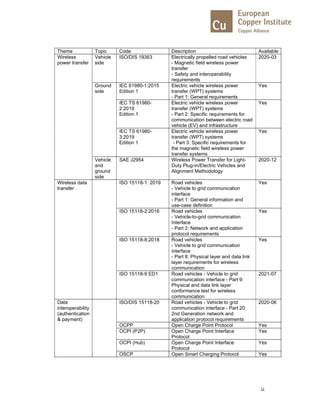
 All related standards and protocols will be ready in middle 2021:
41 https://www.nic.org.uk/wp-content/uploads/CCS001_CCS0618917350-001_NIC-NIA_Accessible.pdf page 90
42 http://publications.jrc.ec.europa.eu/repository/bitstream/JRC101040/allocatechargingpoints_sciencepolreport_eurreport_online.pdf
43 https://afdc.energy.gov/evi-pro-lite
44 https://www.magment.de/en-downloads-blog/2019/9/03-magment-wireless-charging-broschure-iaa-edition
45 https://www.adac.de/rund-ums-fahrzeug/tests/elektromobilitaet/stromverbrauch-elektroautos-adac-test/
46 Information collected from wireless equipment manufacturers
47 https://irena.org/-/media/Files/IRENA/Agency/Publication/2019/May/IRENA_Innovation_Outlook_EV_smart_charging_2019.pdf page 93
48 http://newsroom.vw.com/vehicles/meet-the-volkswagen-platform-designed-to-spawn-10-million-electric-vehicles/
49 https://www.lexus.com/documents/concept/LF-30-Electrified/2019-TMS-Lexus-LF-30_Press_Release.pdf
50 https://www.daimler.com/innovation/case/electric/concept-eq-2.html
51 https://www.theverge.com/2019/3/21/18276541/norway-oslo-wireless-charging-electric-taxis-car-zero-emissions-induction,
https://eandt.theiet.org/content/articles/2019/07/ev-wireless-charging-set-to-benefit-from-37m-government-funding/, http://www.volterio.com/,
http://www.intis.de/wireless-power-transfer.html
52 https://www.magment.de/en-downloads-blog/2018/8/16/magment-inductive-wireless-charging-upgrade-kit
11
Theme Topic Code Description Available
Wireless
power transfer
Vehicle
side
ISO/DIS 19363 Electrically propelled road vehicles
- Magnetic field wireless power
transfer
- Safety and interoperability
requirements
2020-03
Ground
side
IEC 61980-1:2015
Edition 1
Electric vehicle wireless power
transfer (WPT) systems
- Part 1: General requirements
Yes
IEC TS 61980-
2:2019
Edition 1
Electric vehicle wireless power
transfer (WPT) systems
- Part 2: Specific requirements for
communication between electric road
vehicle (EV) and infrastructure
Yes
IEC TS 61980-
3:2019
Edition 1
Electric vehicle wireless power
transfer (WPT) systems
- Part 3: Specific requirements for
the magnetic field wireless power
transfer systems
Yes
Vehicle
and
ground
side
SAE J2954 Wireless Power Transfer for Light-
Duty Plug-in/Electric Vehicles and
Alignment Methodology
2020-12
Wireless data
transfer
ISO 15118-1: 2019 Road vehicles
- Vehicle to grid communication
interface
- Part 1: General information and
use-case definition
Yes
ISO 15118-2:2016 Road vehicles
- Vehicle-to-grid communication
Interface
- Part 2: Network and application
protocol requirements
Yes
ISO 15118-8:2018 Road vehicles
- Vehicle to grid communication
interface
- Part 8: Physical layer and data link
layer requirements for wireless
communication
Yes
ISO 15118-9 ED1 Road vehicles - Vehicle to grid
communication interface - Part 9:
Physical and data link layer
conformance test for wireless
communication
2021-07
Data
interoperability
(authentication
& payment)
ISO/DIS 15118-20 Road vehicles - Vehicle to grid
communication interface - Part 20:
2nd Generation network and
application protocol requirements
2020-06
OCPP Open Charge Point Protocol Yes
OCPI (P2P) Open Charge Point Interface
Protocol
Yes
OCPI (Hub) Open Charge Point Interface
Protocol
Yes
OSCP Open Smart Charging Protocol Yes
12
ANNEX V
Low emission zones (LEZ) with CO2 thresholds
Rationale
 The aim is to stimulate consumers to shift to cleaner vehicles when planning to
travel to city centres.
 It is also a way to set a common framework for cities and governments, linking
air quality efforts (local focus) with climate change efforts (national focus).
 Local governments will improve air quality not only because of the direct effect
of the lower emissions from vehicles within LEZ but also because it will be a
permanent reminder to citizens that there are other vehicle technologies that
are cleaner and more convenient.
Policy ask
 Applicable to cities above 50,000 inhabitants.
 Central area, at least 1% of the city surface with a trajectory to increase it in
future.
 On duty 365 days/year, 24 hours/day.
 Automatic Number Plate Recognition. Stationary cameras on main access and
random controls with portable ones.
 Daily toll for access except for vehicles complying with LEZ standards:
o Light-duty vehicles (gross vehicle weight <=3,500 kg), <50 gCO2/km
o Heavy-duty vehicles:
 GVW <= 7,500 kg, class Euro 6.
 GVW >7,500 kg, <350 gCO2/km, or class Euro 6 if the vehicle
model was available before 1 January 2019.
Description of concept
 50,000 inhabitants or more because of the budget requirements to implement
the LEZ.
 CO2 threshold instead of air quality classes because:
o There is a strong correlation between CO2 and air pollutant emissions.
Three technologies emit below 50 gCO2: BEV, fuel cell electric vehicle
(FCEV) and most plug-in hybrid electric vehicles (PHEV) (page 38-3953
).
And most PHEVs made after Sept 2014, Euro 6 effective date (page
69).
o Easy for drivers: just two parameters; gross vehicle weight and CO2
emissions.
o Easy for local authorities: with the national database of registration
numbers, CO2.
o It would be an exercise of coherence between road tolls and urban tolls,
as included by the European Commission in its proposal for the new
Eurovignette Directive: shift of road charging of heavy duty vehicles
(HDV)from EURO classes to CO2 emissions (supported by the Council
in September 201954
).
 50 gCO2/km for light duty vehicles (LDV) from the revised CO2 for Cars
Regulation.
 350 gCO2/km for HDV from the revised CO2 for Trucks Regulation.
53 https://www.theicct.org/sites/default/files/publications/ICCT_Pocketbook_2018_Final_20181205.pdf
54 https://www.consilium.europa.eu/register/en/content/out?&typ=ENTRY&i=ADV&DOC_ID=ST-12008-2019-INIT
13
 As a reference, 4x2 Rigid 7.5-10t truck consumes 16.9 l/100km. Assuming that
all the carbon contained in the fuel is oxidized into CO2, that means 443
gCO2/km55
.
 The Monitoring and Reporting Regulation requires that, as of 1 January 2019,
truck manufacturers monitor and report annually to the Commission the CO2
emissions and fuel consumption of each new truck above 7.5 tonnes56
. The
scope is set to be amended in the future to also cover smaller trucks as well as
buses and coaches.
ANNEX VI
e-roaming across EU (data interoperability of user authentication and payment)
Rationale
 Charging interoperability is key for electric vehicle adoption. It has two parts: the
plug and, if required, to provide the recharging service on behalf of another
service provider. The current AFID establishes plug types by default. Now is the
time to extend interoperability to data (user authentication and payment).
Policy ask
 Directive of Alternative Fuels Infrastructure. The proposal is to change AFID
article 4.8 from
“Member States shall ensure that operators of recharging points accessible to
the public are free to purchase electricity from any Union electricity supplier,
subject to the supplier's agreement. The operators of recharging points shall be
allowed to provide electric vehicle recharging services to customers on a
contractual basis, including in the name and on behalf of other service
providers.”
to
“Member States shall ensure that operators of recharging points accessible to
the public are free to purchase electricity from any Union electricity supplier,
subject to the supplier's agreement. The operators of recharging points shall
provide electric vehicle recharging services to customers on a contractual basis,
when provided through new points after the publication of the revised Directive,
including in the name and on behalf of any other service provider operating in
the European Union, for interoperability purposes.”
Description of concept
 Precedents:
o In the Netherlands. e-roaming in its basic form – allowing EV drivers to
charge at every charging station – has been possible since 2011. In that
year, the Central Interoperability Register (CIR) was established,
containing all cards/tokens for public charge stations issued by all
service providers active in the Netherlands. This register, created with
the support of the Dutch government, was transferred to eViolin in 2012.
In March 2018, the role of the register was taken over by roaming
services.57
55 https://ec.europa.eu/clima/sites/clima/files/transport/vehicles/heavy/docs/hdv_2011_01_09_en.pdf page 173
56 https://ec.europa.eu/clima/policies/transport/vehicles/heavy_en
57 https://www.mdpi.com/2032-6653/9/4/50/htm
14
o In France, the ADVENIR programme offers a subsidy for public charging
point installations. It covers 40% of the cost per charging point. One of
the conditions for receiving financial aid is to be a part of the platform
Gireve58
.
o In the UK, major charging point operators reached an agreement to
implement e-roaming before the end of 201959
.
o In the USA, the California Air Resources Board approved a similar
measure, into force from July 202060
: ‘By one year after [insert the
effective date of the regulation], the EVSP shall meet, at a minimum,
and maintain the “California Open Charge Point Interface Interim Test
Procedures for Networked Electric Vehicle Supply Equipment for Level 2
and Direct Current Fast Charge Classes’.
o Report on the convenience to implement e-roaming (starting from
section 18.6 on page 33)61
.
ANNEX VII
Mode 3 only for AC charging
Rationale
 While the energy demand increase due to EVs will not be a challenge, power
demand will make a big impact on low voltage grids and on buildings’ electrical
infrastructure, as evidenced in the following studies:
o Imperial College London. Electrification of transport: Challenges and
opportunities62
.
o EDSO for Smart Grids. Smart charging: integrating a large widespread
of electric cars in electricity distribution grids63
.
o 50Hertz & Elia Grid International. E-Mobility and its future effect on
demand and flexibility64
.
o IRENA. Innovation Outlook: Smart charging for electric vehicles65
.
o Element Energy. Batteries on wheels66
.
 To avoid that impact, it is recommended to implement smart charging as soon
as possible, to control time and power of charging. One precondition is the
58 http://advenir.mobi/labellisation/les-offres-eligibles/
59 https://news.evbox.com/en-WW/182404-leading-charge-point-operators-plan-roaming-agreement-in-the-uk
60 https://ww2.arb.ca.gov/rulemaking/2019/evse2019
61 https://live.r-e-a.net/wp-content/uploads/2019/10/HI-RESInteroperability-report.pdf
62 https://www.iea.org/media/workshops/2015/esapworkshopvi/StrbacPapadaskaplopoulos.pdf
63 https://www.edsoforsmartgrids.eu/wp-content/uploads/EDSO-paper-on-electro-mobility-2.pdf
64 http://mobilityintegrationsymposium.org/wp-content/uploads/sites/7/2017/11/1_3_EMob17_190_paper_Roland_Bauer.pdf
65 https://www.irena.org/publications/2019/May/Innovation-Outlook-Smart-Charging
66 https://www.transportenvironment.org/publications/batteries-wheels-role-battery-electric-cars-eu-power-system-and-beyond
15
mode of charging. There are three modes of charging in Alternating Current
(AC)67
, but only Mode 3 remotely controlled allows smart charging.
Policy ask
 Directive of Alternative Fuels Infrastructure. All new public AC charging points
have to operate in mode 3.
Reference
 The UK only subsidises home chargers that are Mode 3 compliant68
.
ANNEX VIII
Price comparison methodology. Considerations for BEVs.
Rationale
 Article 7.3 of AFID69
says:
o Where appropriate, and in particular for natural gas and hydrogen, when
fuel prices are displayed at a fuel station, a comparison between the
relevant unit prices shall be displayed for information purposes. The
display of this information shall not mislead or confuse the user.
o In order to increase consumer awareness and provide for fuel price
transparency in a consistent way across the EU, the Commission shall
be empowered to adopt, by means of implementing acts, a common
methodology for a comparison of the unit prices of alternative fuels.
 The Commission approved this common methodology with the Implementing
Regulation (EU) 2018/73270
, which shall apply from June 2020.
 Unlike other alternative fuels, battery electric vehicles recharge at low power
charging points in 90% of the cases; most of them at private facilities (home or
place of work) instead of at fuel stations71
.
 The difference in the unit price of electricity between those low power urban
points when used overnight and the high-power chargers could easily reach a
factor 10.
 On the other hand, the range of performance (kWh/100 km) between electric
passenger cars is quite wide, even within the same class.
Policy ask
 For the type of vehicle, only use class B and for the performance, the weighted
average by sales of WLTP performance (kWh/100 km) corresponding to all the
electric models offered in that Member State.
 And, in order to calculate the cost of electricity, to make the weighted average
of prices in a specific Member State, with a weight of 85% for the electricity
supplied at low power at private facilities during overnight (1-7AM) as the period
most convenient for consumers.
ANNEX IX
Battery ID Code
67 https://nederlandelektrisch.nl/u/files/2018-11-ev-charging.pdf
68 https://www.electrive.com/2019/06/25/uk-new-requirements-for-chargepoints/
69 https://eur-lex.europa.eu/legal-content/EN/TXT/PDF/?uri=CELEX:32014L0094&from=en
70 https://eur-lex.europa.eu/legal-content/EN/TXT/PDF/?uri=CELEX:32018R0732&from=EN
71 https://www.toi.no/getfile.php/1343167/Publikasjoner/T%C3%98I%20rapporter/2016/1492-2016/Summary.pdf;
https://www.edsoforsmartgrids.eu/wp-content/uploads/EDSO-paper-on-electro-mobility-2.pdf
16
Rationale
 The Batteries Directive is the only piece of EU legislation that is entirely
dedicated to batteries. One of its two primary objectives is to minimise the
negative impact of batteries on the environment, including at their end of life.
And to ensure that targets for collection rates and recycling efficiencies are in
place.
 In the coming years a new battery application will account for the majority of the
battery capacity in use: traction batteries for electric vehicles. According to the
Task 7 Draft Report of the Preparatory Study on Ecodesign of Rechargeable
Electrochemical Batteries72
, the forecast for battery capacity stock in mobile
applications in the medium sales scenario for Europe in 2030 is 2.1 TWh.
 More effective than targets is to establish the conditions for making the
recycling process profitable for all the participants. Also, to include in the
recycling process the collection of the battery systems (typically from the
Authorised Treatment Facilities), their dismantling, and battery cell processing.
 For EV batteries, if it was possible to automate the dismantling, it would save
80-95% of dismantling costs and significantly facilitate making the full battery
recycling process profitable for all participants in the value chain. In addition,
knowing in advance the composition (chemistry) of the battery cells would allow
the recycling efficiency to be improved and, consequently, the profitability of
such recycling.
Policy ask
 The new Battery Directive should require, at least for EV batteries, a unique
Battery ID Code at all levels (pack, module and cell) for all the batteries
manufactured or introduced in Europe. This code will provide data on a server,
which the manufacturer or supplier will bear the responsibility of updating, and
which will be available to third-party accredited professionals in regard to the:
o composition in standardised categories (NMC, LFP, etc.), that will
facilitate identification of the main chemistry of the battery and the
substances it contains;
o dismantling information for recyclers in the form of safety instructions,
tools list, and a time-lapse video to show how a product can be
dismantled and allow recyclers to automate the process.
Reference
 In August 2018 China approved an initiative very similar to the Battery ID Code:
“Recovery and Use of Batteries for New Electric Vehicles”73
.
ANNEX X
Integrated network of national vehicle registration systems
72 https://ecodesignbatteries.eu/sites/ecodesignbatteries.eu/files/attachments/ED_Battery_Task%207_V17clean.pdf
73 http://www.tai-sen.cn/Industry_News/52.html
17
Rationale
 In 2014, 4.66 million end-of-life vehicles (ELV), representing 39% of the total
vehicles being decommissioned, were at ‘unknown whereabouts’74
, i.e. they
were deregistered but without a Certificate of Destruction (CoD) issued or
available to the authorities, also with no information that the vehicle has been
treated in an Authorized Treatment Facility (ATF) or has been exported.
 From 2007 at least, the ‘unknown whereabouts’ share has remained at a
constant level75
. This situation needs to be improved because:
o such ELVs with ‘unknown whereabouts’ can potentially cause significant
environmental and human health harm without proper treatment;
o the situation distorts the legal market through illegal activities;
o the materials contained in these ELVs are valuable, in particular the raw
materials that have become critical as consequence of the growing
share of electric vehicles (e.g. need to make new EV batteries).
 The two main elements that explain most of the issue with ELVs at ‘unknown
whereabouts’ are vehicle dismantling at illegal sites, and exporting of ELVs
outside of Europe as used cars. Our proposal for the former element is to
replicate the current Dutch system, with several improvements, in all Member
States in order to implement economic incentives to take ELVs to ATFs. For the
latter element, we propose to make the roadworthiness test a requirement for a
vehicle to be exported as used car, similar to the current situation in Italy and
Ireland.
 In 2008, around 20% (3.3 million of 16.3 million vehicles) of new registrations in
EU27 were used vehicles coming from other Member States76
.
Policy ask
 To establish in the ELV Directive that all Member States should implement a
registration system similar to the Dutch one.
 Vehicle holders will annually pay the vehicle insurance and the cost of technical
inspection. The road tax has not been included to simplify the implementation.
 Five possible conditions (non-cumulative) for the holder to stop paying:
o The Authorised Treatment Facility (ATF) issues a Certificate of
Destruction (CoD) in the registration system.
o In case of sale in the same Member State, the agent with access to the
registration system will update the name of the holder of the vehicle.
o In case of export to another Member State, the vehicle will not be
deregistered until it has been registered in the new Member State.
o In case of export outside the EU, the export agent with access to the
registration system will deregister the vehicle and enter the data of the
buyer.
o In case of stolen vehicles, the police will introduce this element and
deregister the vehicle in the registration system.
 To have the vehicle pass a roadworthiness test no earlier than 12 months prior
to the export operation outside the EU as a requirement for a vehicle to be
exported as used car.
Description of the concept
74 https://ec.europa.eu/environment/waste/elv/pdf/ELV_report.pdf
75 http://ec.europa.eu/environment/waste/pdf/target_review/Final Report Ex-Post.pdf
76 https://www.oeko.de/oekodoc/1114/2011-005-en.pdf
18
 The main elements of the Dutch system (more details in the report by
ADEME77
):
o Annually, 470,000 vehicles are deregistered: 220,000 ELVs and
250,000 exported as used vehicles.
o Less than 2.3% of ELVs are dismantled at illegal sites (1,000 – 5,000
vehicles). There are concerns on 30,000 exported used cars (12%)78
.
o The ‘holdership’ concept is applied, which means the vehicle obligations
in terms of taxation, inspection and insurance are related to holding the
vehicle, not to its use.
o One software platform run by the Department of Transport (RDW) tracks
any change of the vehicle status (unique relation VIN-license plate-
owner) since it first enters the market until it leaves it (export, destruction
or theft).
o Only authorised operators can update the vehicle status in the system
(dealers, ATFs, export agents, insurers, etc.). The involvement of the
automotive sector facilitates acceptance and crossed controls of the
shared data.
o Annually, the vehicle holder has to pay the road tax, vehicle insurance
and the roadworthiness test, until the vehicle is deregistered or sold to
another holder.
o The main area of improvement concerns import/exports as the system
does not keep track of buyer or seller outside of the Netherlands. A
mechanism to share data between Member States and collecting
additional data for exports outside EU should overcome this limitation.
77 https://partage.ademe.fr/public/e9e42c
78 https://elv.whereabouts.oeko.info/fileadmin/images/Consultation1_Docs/_3.3__Flashlights_NL_ELV_workshop.pdf

E-mobility Vision Paper

  • 1.
    1 E-mobility Vision Paper June2020 Context In 2011, the European Commission concluded in its white paper “Roadmap to a Single European Transport Area” that the phase-out of fossil fuels driven cars by 2050 was necessary to achieve its energy and climate objectives. In 2019, as part of the European Green Deal, the Commission is proposing to revise the regulation on CO2 standards for cars and vans, to ensure a clear pathway towards zero-emission mobility. Greenhouse gas (GHG) emissions due to road transport have grown since 1990 by 20.5%, and now account for one-fifth of EU GHG emissions – and they keep growing. The picture is similar regarding final energy consumption. Road transport uses 24% of EU final energy, having grown by 28% since 1990. The good news is that a zero-emission technology is ready today for market uptake: the battery electric vehicle. From day one this vehicle completely cuts local GHG and air pollutant emissions and emits three times less GHG emissions on a well-to-wheel basis. On a life cycle basis (“cradle to grave”), a battery electric vehicle also generates significantly less GHG emissions than cars using gasoline or diesel. Moreover, the full decarbonisation of the electricity system, which is foreseen well before 2050, will enable battery electric vehicles to make transport fully climate-neutral. Electrifying road transport is also the fastest and most cost-effective way to achieve energy efficiency goals because it is the asset with the highest replacing rate (average car ownership period 5-7 years1 )and is currently at least 2.5 times more efficient than alternative technologies. On 28 November 2019 the European Parliament declared a climate emergency and its Members asked for immediate and ambitious action to limit the effects of climate change2 . Battery electric vehicles are ready to contribute to addressing this challenge. What is needed now is to accelerate the deployment of full electric vehicles. Copper is one of the main materials that makes this transition possible. On average a battery electric vehicle requires three times more copper than a vehicle driven by a combustion engine. Half of it is in the battery system, mainly as foil in the anode of the cell working as current collector and heat dissipator. About one quarter is in the drive motors and their control system, and the other quarter is in wire harness, connectors and electronics. In addition, copper plays a role in the charging infrastructure and in the generation of renewable electricity to power the vehicles. 1 https://ec.europa.eu/clima/sites/clima/files/transport/vehicles/docs/2nd_hand_cars_en.pdf 2 https://www.europarl.europa.eu/news/en/press-room/20191121IPR67110/the-european-parliament-declares-climate-emergency
  • 2.
    2 Benefits A battery electricvehicle (BEV)  emits 3 times less CO2 than an equivalent vehicle driven by a combustion engine, and this factor will increase to more than 4 times by 2030 (well-to-wheel emissions, based on EU average energy mix, details in Annex I). This will significantly contribute to reducing the growing share of road transport in CO2 emissions in the EU3 (currently 20%, since it increased by 20.5% over the period 1990-20154 ).  emits no NOx or particulate matter (PM2.5), two drivers of air pollution that cause 5.4% of deaths in Europe5 . If the city of Rome would electrify its fleet of public and light-duty goods vehicles, emissions of NOx and particulate matter would decrease by 34% and 22%6 respectively.  at speeds below 30 km/h, emits significantly less noise than internal combustion engine vehicles7 . For people aged over 65, the cardiovascular and respiratory mortality due to urban diurnal noise could be even bigger than that due to PM2.5 8 . Electromobility improves also energy security. The EU imports 87% of its oil demand, of which 47% is used for road transport9 . In addition to decarbonisation, health and energy security, what really makes the BEV the best zero emission technology currently available are two further elements:  A battery electric vehicle is 2.5 times more energy efficient than a vehicle powered by a combustion engine. This will increase to 3.3 times by 2030 (well- to-wheel, based on EU average electricity mix, details in Annex I). Road transport consumes 24.4% of final energy in EU10 , with a 28% increase in 2015 compared to 1990, and it continues to increase11 .  BEVs perfectly match renewable electricity generation. In an “always connected while parked” scenario, a BEV will be able to use or supply electricity from/to the grid as required. Through an aggregated operation of many vehicle connections, it will be possible to provide balancing services and intraday storage for electricity markets, thus BEVs will also enable greater integration of renewables. 3 https://www.eea.europa.eu/publications/analysis-of-key-trends-and/ 4 https://ec.europa.eu/clima/policies/transport/vehicles_en 5 http://documents.worldbank.org/curated/en/781521473177013155/The-cost-of-air-pollution-strengthening-the-economic-case-for-action 6 http://www.aria.fr/PDFs/25ans/05_Vehicule%20Electrique.pdf 7 http://www.compett.org/documents/Conferencepapers/Noise_from_electric_vehicls_state_of_the_art_literature_survey.pdf 8 https://www.sciencedirect.com/science/article/pii/S0013935114004629?via%3Dihub 9 http://ec.europa.eu/eurostat/statistics-explained/index.php/Oil_and_petroleum_products_-_a_statistical_overview#Imports_of_crude_oil 10 http://ec.europa.eu/eurostat/statistics-explained/index.php/Consumption_of_energy 2015 Transport account for 33.1% final energy https://www.eea.europa.eu/data-and-maps/indicators/transport-final-energy-consumption-by-mode/assessment-8 Road transport represents 74% of final energy in transport. 11 https://www.eea.europa.eu/data-and-maps/indicators/transport-final-energy-consumption-by-mode/assessment-8
  • 3.
    3 Vision for light-dutyvehicles The latest BEV models launched on the market offer a real range of around 400 km.12 . Many BEVs already achieve a lower total cost of ownership than their equivalent conventional ones13 . On top of that, BEVs provide grid services that will bring additional revenues for both charging operators and vehicle owners. For the average passenger car, a 3.7 kW charger suffices to replenish the energy consumed during the day in less than 3 hours overnight14 . For heavy users and light commercial vehicles, a 7.4 kW charger will be sufficient. Low power chargers are also convenient to reduce the stress of the distribution grid and building installations, while overnight charging makes better use of infrastructure already in place. Many consumers are concerned about making a longer journey than 400 km with a BEV because of the possible unavailability of chargers or a lengthy waiting time while charging. Our proposal is to set European targets and national supporting schemes to deploy 150 kW chargers every 60 km along the TEN-T Core Network (with a BEV efficiency of 15 kWh/100 km, it will take 6 minutes to add a 100 km range). At final destinations (hotels, residentials buildings, public areas, etc.), the more efficient alternative is to charge at 3.7 kW. To decarbonise road transport, it is necessary to convince consumers to shift to BEVs. For this to happen, BEVs should be at least as convenient as conventional vehicles. Regarding urban charging, the most convenient way is wireless charging, also known as Park & Forget. Once parked, the vehicle will manage the charging session without driver intervention, following the criteria predefined by the user (price range, state of charge range, etc.). Artificial intelligence and authorised access to calendar applications will provide a better consumer experience through improved management of the energy requirements. The reduction of the cost of batteries will enable the use of stationary batteries to offer higher charging power while lowering the power of the connection to the grid. This technology change, combined with a bigger fleet of electric vehicles on the roads, will facilitate the business case to charge at 350 kW or higher and improve the user experience. As the share of renewable electricity generation grows, the more efficient charging pattern will be to shift from overnight charging to an “always connected while parked” scenario in which the vehicle will be available at any moment to offer services to the 12 https://www.fueleconomy.gov/feg/findacar.shtml 13 https://neo.ubs.com/shared/d1wkuDlEbYPjF/ page 10 based on 3-year lease, 14,400 km/year and 50% residual value after 3 years. https://www.leaseplan.com/en-ix/global-fleet-insights/tco-ev/ 56% BEVs with lower TCO than ICEVs without doing smart charging (cost of electricity only 54% lower than fuel cost for equivalent use) 14 http://www.trt.it/wp/wp-content/uploads/2012/12/driving-and-parking-patterns-final_online.pdf page 62 average daily driven distance 60 km, with a BEV efficiency of 15 kWh/100 km it’s possible to replenish the energy consumed in less than 3 hours of overnight charging.
  • 4.
    4 grid. This impliesthat many parking spaces will need to be equipped with a low power wireless charger (7.4 kW). This charging technology will also be convenient for autonomous vehicles. Vision for heavy-duty vehicles Battery-driven road freight transport (trailer trucks) will be commercially available from 2021. These trucks will require a 500-700 kWh battery for a 400 km range (with a 45 minute stop every 400 km according to the EU regulation). There is a need for 1 MW charging points along roads complemented by 100 kW charging points at overnight facilities. Regarding battery-driven road public transport (buses), a number of models are already available with overnight charging at the depot. The total cost of ownership of full electric buses is already lower than the equivalent diesel models15 . 12 large cities have already committed to only operate zero-emission buses from 2025 onwards16 . Other aspects Life cycle CO2 emissions: BEV vs Diesel: 88 vs 216 gCO2-eq/km (with EU 2015 grid electricity mix)17 . BEV vs Gasoline: 280 vs 580 gCO2/mile (for a 265-mile battery electric vehicle and a full-size gasoline car)18 . Around 260,000 net jobs could be generated in the EU by 203019 . 15 https://data.bloomberglp.com/bnef/sites/14/2018/05/Electric-Buses-in-Cities-Report-BNEF-C40-Citi.pdf 16 http://www.c40.org/press_releases/mayors-of-12-pioneering-cities-commit-to-create-green-and-healthy-streets 17 https://www.transportenvironment.org/sites/te/files/publications/TE%20-%20draft%20report%20v04.pdf 18 https://www.ucsusa.org/sites/default/files/attach/2015/11/Cleaner-Cars-from-Cradle-to-Grave-exec-summary.pdf 19 https://europeanclimate.org/wp-content/uploads/2018/02/Fuelling-Europes-Future-2018-v1.0.pdf
  • 5.
    5 With a marketshare of electric vehicles of 35% by 2030, 90% of electric vehicles sold in the EU should be produced locally in order to maintain employment within the automotive sector at the current level20 . Main policy asks To accelerate the adoption of full electric vehicles it is necessary to convince consumers to choose them. For this to happen, electric vehicles must be at least as convenient as conventional vehicles. This can be achieved by deploying the right infrastructure:  deploying 150 kW chargers on the TEN-T Core Network every 60 km to enable long journeys (Annex II);  making it easier to install a charging point for consumers with off-street parking: Right to plug (Annex III);  relieving consumers of the annoying task of charging the vehicle, especially for those without off-street parking: Predictive urban public wireless 7.4 kW charging infrastructure (Annex IV);  simplifying consumer information to more easily know if a vehicle can access the city centre: Low emission zones with CO2 thresholds (Annex V). Additional policy asks  establishing e-roaming across the EU (data interoperability of user authentication and payment) in all charging points with public access (Annex VI).  implementing smart charging from day one. Mode 3 only for AC charging (Annex VII).  developing a price comparison methodology. Considerations for BEVs, as around 90% of electricity is recharged at private charging points (Annex VIII).  introducing a battery ID Code. A unique code on battery system, pack and module to allow automatic dismantling and specific battery cell processing (Annex IX).  developing an integrated network of national vehicle registration systems. In 2014 4.66 million vehicles – 39% of total End of Life Vehicles (ELV) – were at ‘unknown whereabouts’. Improving this situation would have a significant impact on the availability of critical raw materials for new EVs (Annex X). 20 https://www.transportenvironment.org/sites/te/files/publications/Briefing%20- %20How%20will%20electric%20vehicle%20transition%20impact%20EU%20jobs.pdf
  • 6.
    6 ANNEX I Greenhouse gasemissions and energy efficiency comparison Year Primary Energy Factor (entire supply chain)21 CO2 at power plant level per unit of net generation CO2 from well at LV level CO2 from well at LV level gCO2eq/kWh gCO2eq/kWh gCO2eq/MJ 2015 1.9 326 429 119 2030 1.35 226 298 83 Glossary:  LV: low voltage Notes: ● 2015 GHG emissions from European Commission and Eurostat data, made available through EUenergyApp22 . ● 2030 GHG emissions from Commission Staff Working Document Impact Assessment accompanying the document Proposal for a Directive of the European Parliament and of the Council amending Directive 2012/27/EU on Energy Efficiency23 . ● To obtain CO2eq emissions from well at low voltage, we have used the conversion factor of 1.315 for all the years. This is the 2013 value, that should be much lower in the 2030 scenario due to a higher penetration of renewables24 . Code Year data WTT energy TTW energy WTW energy ratio ICEV/BEV WTW GHG ratio ICEV/BEV MJ/ 100km MJ/ 100km MJ/ 100km gCO2eq / km Conventional gasoline COG1 2020+ DISI 2009 26 142 168 125 BEV EU-mix low voltage EMEL3 2020+ 2009 86 38 124 1.4 57 2.2 BEV EU-mix low voltage EMEL3 2020+ 2015 34 38 72 2.3 45 2.8 BEV EU-mix low voltage EMEL3 2020+ 2030 13 38 51 3.3 31 4 21 https://ec.europa.eu/energy/sites/ener/files/documents/final_report_pef_eed.pdf page 5 22 http://energypost.eu/eu-energy/ 23 http://eur-lex.europa.eu/legal-content/EN/TXT/?uri=CELEX:52016SC0405R(01) tables 8 to 17 24 https://www.sciencedirect.com/science/article/pii/S1361920916307933 Table 2 CI at LV / CI gross electricity production
  • 7.
    7 Glossary:  WTT: wellto tank  TTW: tank to wheel  ICEV: internal combustion engine vehicle  BEV: battery electric vehicle  WTW: well to wheel  GHG: greenhouse gas Notes: ● Figures for 200925 . ● WTW energy for BEV calculated as TTW x PEF. ● WTW GHG emissions for BEV calculated as TTW energy x CO2 from well at LV level / 100 km. ● Glossary: WTT (Well-to-Tank), TTW (Tank-to-Wheel), WTW (Well-to-Wheel), GHG (Greenhouse Gas) ICEV (Internal Combustion Engine Vehicle), BEV (Battery Electric Vehicle), MJ (million Joules) ANNEX II To deploy 150 kW chargers on the TEN-T Core Network every 60 km Rationale  In order to make full electric vehicles convenient for long journeys too, infrastructure deployment across Europe (TEN-T Core Network) is crucial. Two equally important elements in this infrastructure: charging power (to limit charging time) and even deployment (to remove range anxiety).  With the current (limited) penetration of EVs, profitability of such infrastructure is unsatisfactory (very long payback period). Therefore, private operators have been reluctant to invest in 150 kW along major roads. Public financial support is thus required.  As part of the Green Deal, the EU Commission will support the deployment of public recharging and refuelling points where persistent gaps exist, notably for long-distance travel and in less densely populated areas, and will launch as quickly as possible a new funding call to support this deployment.26 Policy ask  Directive of Alternative Fuels Infrastructure o Replacing the Directive by a Regulation. As a Regulation is directly applicable, it ensures homogeneity and a shorter implementation time, as no transposition into national law is required. o Binding target: To have 150 kW stations with at least two chargers every 60 km or less along the TEN-T Core Network operational within 18 months after the publication of the revised Regulation.  National support schemes where required: 25 https://iet.jrc.ec.europa.eu/about-jec/sites/iet.jrc.ec.europa.eu.about-jec/files/documents/wtw_app_1_v4a_march_2014_final.pdf 26 https://ec.europa.eu/info/sites/info/files/european-green-deal-communication_en.pdf
  • 8.
    8 o Tender forlocations on service or rest areas on Core Network, or on eligible locations near Core Network with/without capex subsidies. o At least in Spain, Poland, Portugal, Romania, Bulgaria and Greece. Description of concept  A national authority will define the locations, service or rest areas to be eligible for public support. On the TEN-T Core Network, such locations should be installed every 60 km27 , with access from both ways when possible and near cities when applicable.  Recommended configuration: o At least two 150 kW chargers by location (upgradeable to four) to supply that electric power simultaneously, to reduce the impact on customers if one of the charging points is out of service. o A 700 kWh stationary battery for every two chargers, to reduce the grid access fees (main opex item), and eventually to implement another revenue stream from grid services o 200 kW feeding line, 50 kW for every charger.  Quality of service: o To set a maximum annual percentage of time out of service. o To establish a mechanism (QR code and phone number) for users to inform when they cannot use the charging point.  Available financial support by the European Commission with a rolling call under the Connecting Europe Facility (CEF) Blending Facility28 .  References of tenders for service or rest areas: Switzerland29 , The Netherlands30  References of subsidy schemes: The Netherlands31, Germany32 , Czech Republic33 , Ireland34 , Canada35 , California36 , Norway37 ANNEX III Right to plug Rationale  The aim is to make it easier to install a charging point for consumers with off- street parking in existing residential buildings. 27 https://publications.europa.eu/en/publication-detail/-/publication/1533ba56-094e-11e7-8a35-01aa75ed71a1 28 https://ec.europa.eu/inea/en/news-events/newsroom/eu-launches-blending-facility-to-support-sustainable-transport-projects 29 https://www.electrive.com/2019/03/07/swiss-government-fedro-awards-fast-charging-network-contracts/ https://www.astra.admin.ch/astra/de/home/dokumentation/medienmitteilungen/anzeige-meldungen.msg-id-74223.html 30 https://zoek.officielebekendmakingen.nl/stcrt-2011-23149.html https://english.rijksvastgoedbedrijf.nl/binaries/central-government-real-estate-agency/documents/publication/2019/04/01/auction-of-tenancy- rights-to-petrol-stations-on-national-highways-in-the-netherlands-2019/Brochure+Veiling+Huurrechten+Benzinestations+2019.pdf 31 http://ec.europa.eu/competition/state_aid/cases/258489/258489_1710979_137_2.pdf 32 http://ec.europa.eu/competition/elojade/isef/case_details.cfm?proc_code=3_SA_46574 33 http://ec.europa.eu/competition/elojade/isef/case_details.cfm?proc_code=3_SA_45182 34 https://www.dccae.gov.ie/documents/Fast%20Chargers%20for%20Electric%20Vehicles%20in%20Ireland.pdf 35 https://www.nrcan.gc.ca/energy-efficiency/energy-efficiency-transportation/electric-vehicle-alternative-fuels-infrastructure-deployment- initiative/18352 36 California https://calevip.org/incentive-project/southern-california 37 https://www.enova.no/bedrift/landtransport/stotte-til-infrastruktur/hurtiglading/
  • 9.
    9  As consideredin the Commission Recommendation (EU) 2019/1019 Annex, section 3.4.3.338 : o Lengthy and complex approval procedures can be a major barrier to owners and tenants installing recharging points in existing multi-tenant residential and non-residential buildings. Obtaining the necessary approvals can create delays or prevent installation. o ‘Right to plug’ requirements ensure that any co-owner is able to install a recharging point for an electric vehicle without having to obtain the (potentially difficult) consent from the other co-owners. o As reference, the Spanish legislation (Ley Propiedad Horizontal article 17.539 ) allows a co-owner to install a recharging point for private use when located in an individual parking place and when the association of co-owners has been informed in advance. The co-owners cannot block the installation. The cost of the installation and of the subsequent electricity consumption is assumed by the individual who has installed the recharging point. Policy ask  To include the “Right to Plug” in national legislation, at least in: Germany, UK, Italy, Poland and Sweden. Description of concept  For most passenger cars, a 3.7 kW charger will suffice to replenish the average energy used during the day in less than three hours (7.4 kW for heavy users).  The charger should be connected to the home meter whenever possible, to reduce grid access fees and facilitate the implementation of demand response services. In older installations, an extension of the meter and an inspection of the electrical installation may be required.  At least one connector of type 2 (Mennekes) in mode 3 (remotely controlled), and a Schuko for category L vehicles. ANNEX IV Predictive urban public wireless 7.4 kW charging infrastructure Rationale  The aim is to relieve consumers from the cumbersome task of charging the vehicle, especially for those without off-street parking.  Two-thirds of EU cars park overnight on the street or in public car parks40 .  Benefits: o For cities: an invisible charging infrastructure without space requirements. o For users, to forget about charging and having to deal with cables, apps or tokens. This is especially convenient for disabled and elderly people. Policy ask  Directive of Alternative Fuels Infrastructure: introducing binding targets for cities (and regional governments grouping several towns) to have awarded tenders 38 https://eur-lex.europa.eu/legal-content/EN/TXT/PDF/?uri=CELEX:32019H1019&from=EN 39 https://www.boe.es/buscar/act.php?id=BOE-A-1960-10906 40 https://publications.jrc.ec.europa.eu/repository/bitstream/JRC77079/driving%20and%20parking%20patterns%20-%20final_online.pdf
  • 10.
    10 before 2025 todeploy charging points on at least 20% of public parking spaces (on-street and car parks)41 , within no more than 300 metres from any residential building.  To promote wireless pilots among reference cities in order to include wireless charging as a requirement for future tenders. Description of concept  The way wireless charging works is called Park & Forget (about charging), and these are the basic steps: o The driver parks and aligns the pads of the vehicle with the one in the street. Depending on the model, the vehicle could do this by itself. o Vehicle and charging point start authentication and data transfer. o If authentication is confirmed, the charging session starts. o The charging session finishes when planned or when the driver unlocks the vehicle. The charging process stops in case of detection of a living object (LOD) or of a foreign object (FOD) and a warning message is sent to the user’s mobile phone.  Up to 7.4 kW for passenger cars and light commercial vehicles (gross vehicle weight < 2,500 kg).  Predictive versus on demand, because above a certain number of daily requests of new chargers, it will not be feasible to deliver them on demand. Two examples of algorithms: o Optimal allocation of electric vehicle charging infrastructure in cities and regions42 by JRC. o Electric Vehicle Infrastructure Projection Tool (EVI-Pro) Lite43 by NREL.  Wireless charging can reach an efficiency of 95%44 (the battery receives 95% of the electricity supplied to the charging point), same actual efficiency as charging with cables45 .  The capital cost, under the hypothesis of mass production, of the additional equipment to implement wireless charging is around 500€ for the vehicle, and 2,000€ for the charging point46 .  Vehicle to Grid (V2G) capabilities, also available for wireless charging, could reduce the cost of the electricity by up to 42%47 .  Major car manufacturers have already included wireless charging in their car platforms (for example VW48 , Toyota49 , Daimler50 ).  A retrofit is available to add wireless to vehicles51 and charging points52 .  All related standards and protocols will be ready in middle 2021: 41 https://www.nic.org.uk/wp-content/uploads/CCS001_CCS0618917350-001_NIC-NIA_Accessible.pdf page 90 42 http://publications.jrc.ec.europa.eu/repository/bitstream/JRC101040/allocatechargingpoints_sciencepolreport_eurreport_online.pdf 43 https://afdc.energy.gov/evi-pro-lite 44 https://www.magment.de/en-downloads-blog/2019/9/03-magment-wireless-charging-broschure-iaa-edition 45 https://www.adac.de/rund-ums-fahrzeug/tests/elektromobilitaet/stromverbrauch-elektroautos-adac-test/ 46 Information collected from wireless equipment manufacturers 47 https://irena.org/-/media/Files/IRENA/Agency/Publication/2019/May/IRENA_Innovation_Outlook_EV_smart_charging_2019.pdf page 93 48 http://newsroom.vw.com/vehicles/meet-the-volkswagen-platform-designed-to-spawn-10-million-electric-vehicles/ 49 https://www.lexus.com/documents/concept/LF-30-Electrified/2019-TMS-Lexus-LF-30_Press_Release.pdf 50 https://www.daimler.com/innovation/case/electric/concept-eq-2.html 51 https://www.theverge.com/2019/3/21/18276541/norway-oslo-wireless-charging-electric-taxis-car-zero-emissions-induction, https://eandt.theiet.org/content/articles/2019/07/ev-wireless-charging-set-to-benefit-from-37m-government-funding/, http://www.volterio.com/, http://www.intis.de/wireless-power-transfer.html 52 https://www.magment.de/en-downloads-blog/2018/8/16/magment-inductive-wireless-charging-upgrade-kit
  • 11.
    11 Theme Topic CodeDescription Available Wireless power transfer Vehicle side ISO/DIS 19363 Electrically propelled road vehicles - Magnetic field wireless power transfer - Safety and interoperability requirements 2020-03 Ground side IEC 61980-1:2015 Edition 1 Electric vehicle wireless power transfer (WPT) systems - Part 1: General requirements Yes IEC TS 61980- 2:2019 Edition 1 Electric vehicle wireless power transfer (WPT) systems - Part 2: Specific requirements for communication between electric road vehicle (EV) and infrastructure Yes IEC TS 61980- 3:2019 Edition 1 Electric vehicle wireless power transfer (WPT) systems - Part 3: Specific requirements for the magnetic field wireless power transfer systems Yes Vehicle and ground side SAE J2954 Wireless Power Transfer for Light- Duty Plug-in/Electric Vehicles and Alignment Methodology 2020-12 Wireless data transfer ISO 15118-1: 2019 Road vehicles - Vehicle to grid communication interface - Part 1: General information and use-case definition Yes ISO 15118-2:2016 Road vehicles - Vehicle-to-grid communication Interface - Part 2: Network and application protocol requirements Yes ISO 15118-8:2018 Road vehicles - Vehicle to grid communication interface - Part 8: Physical layer and data link layer requirements for wireless communication Yes ISO 15118-9 ED1 Road vehicles - Vehicle to grid communication interface - Part 9: Physical and data link layer conformance test for wireless communication 2021-07 Data interoperability (authentication & payment) ISO/DIS 15118-20 Road vehicles - Vehicle to grid communication interface - Part 20: 2nd Generation network and application protocol requirements 2020-06 OCPP Open Charge Point Protocol Yes OCPI (P2P) Open Charge Point Interface Protocol Yes OCPI (Hub) Open Charge Point Interface Protocol Yes OSCP Open Smart Charging Protocol Yes
  • 12.
    12 ANNEX V Low emissionzones (LEZ) with CO2 thresholds Rationale  The aim is to stimulate consumers to shift to cleaner vehicles when planning to travel to city centres.  It is also a way to set a common framework for cities and governments, linking air quality efforts (local focus) with climate change efforts (national focus).  Local governments will improve air quality not only because of the direct effect of the lower emissions from vehicles within LEZ but also because it will be a permanent reminder to citizens that there are other vehicle technologies that are cleaner and more convenient. Policy ask  Applicable to cities above 50,000 inhabitants.  Central area, at least 1% of the city surface with a trajectory to increase it in future.  On duty 365 days/year, 24 hours/day.  Automatic Number Plate Recognition. Stationary cameras on main access and random controls with portable ones.  Daily toll for access except for vehicles complying with LEZ standards: o Light-duty vehicles (gross vehicle weight <=3,500 kg), <50 gCO2/km o Heavy-duty vehicles:  GVW <= 7,500 kg, class Euro 6.  GVW >7,500 kg, <350 gCO2/km, or class Euro 6 if the vehicle model was available before 1 January 2019. Description of concept  50,000 inhabitants or more because of the budget requirements to implement the LEZ.  CO2 threshold instead of air quality classes because: o There is a strong correlation between CO2 and air pollutant emissions. Three technologies emit below 50 gCO2: BEV, fuel cell electric vehicle (FCEV) and most plug-in hybrid electric vehicles (PHEV) (page 38-3953 ). And most PHEVs made after Sept 2014, Euro 6 effective date (page 69). o Easy for drivers: just two parameters; gross vehicle weight and CO2 emissions. o Easy for local authorities: with the national database of registration numbers, CO2. o It would be an exercise of coherence between road tolls and urban tolls, as included by the European Commission in its proposal for the new Eurovignette Directive: shift of road charging of heavy duty vehicles (HDV)from EURO classes to CO2 emissions (supported by the Council in September 201954 ).  50 gCO2/km for light duty vehicles (LDV) from the revised CO2 for Cars Regulation.  350 gCO2/km for HDV from the revised CO2 for Trucks Regulation. 53 https://www.theicct.org/sites/default/files/publications/ICCT_Pocketbook_2018_Final_20181205.pdf 54 https://www.consilium.europa.eu/register/en/content/out?&typ=ENTRY&i=ADV&DOC_ID=ST-12008-2019-INIT
  • 13.
    13  As areference, 4x2 Rigid 7.5-10t truck consumes 16.9 l/100km. Assuming that all the carbon contained in the fuel is oxidized into CO2, that means 443 gCO2/km55 .  The Monitoring and Reporting Regulation requires that, as of 1 January 2019, truck manufacturers monitor and report annually to the Commission the CO2 emissions and fuel consumption of each new truck above 7.5 tonnes56 . The scope is set to be amended in the future to also cover smaller trucks as well as buses and coaches. ANNEX VI e-roaming across EU (data interoperability of user authentication and payment) Rationale  Charging interoperability is key for electric vehicle adoption. It has two parts: the plug and, if required, to provide the recharging service on behalf of another service provider. The current AFID establishes plug types by default. Now is the time to extend interoperability to data (user authentication and payment). Policy ask  Directive of Alternative Fuels Infrastructure. The proposal is to change AFID article 4.8 from “Member States shall ensure that operators of recharging points accessible to the public are free to purchase electricity from any Union electricity supplier, subject to the supplier's agreement. The operators of recharging points shall be allowed to provide electric vehicle recharging services to customers on a contractual basis, including in the name and on behalf of other service providers.” to “Member States shall ensure that operators of recharging points accessible to the public are free to purchase electricity from any Union electricity supplier, subject to the supplier's agreement. The operators of recharging points shall provide electric vehicle recharging services to customers on a contractual basis, when provided through new points after the publication of the revised Directive, including in the name and on behalf of any other service provider operating in the European Union, for interoperability purposes.” Description of concept  Precedents: o In the Netherlands. e-roaming in its basic form – allowing EV drivers to charge at every charging station – has been possible since 2011. In that year, the Central Interoperability Register (CIR) was established, containing all cards/tokens for public charge stations issued by all service providers active in the Netherlands. This register, created with the support of the Dutch government, was transferred to eViolin in 2012. In March 2018, the role of the register was taken over by roaming services.57 55 https://ec.europa.eu/clima/sites/clima/files/transport/vehicles/heavy/docs/hdv_2011_01_09_en.pdf page 173 56 https://ec.europa.eu/clima/policies/transport/vehicles/heavy_en 57 https://www.mdpi.com/2032-6653/9/4/50/htm
  • 14.
    14 o In France,the ADVENIR programme offers a subsidy for public charging point installations. It covers 40% of the cost per charging point. One of the conditions for receiving financial aid is to be a part of the platform Gireve58 . o In the UK, major charging point operators reached an agreement to implement e-roaming before the end of 201959 . o In the USA, the California Air Resources Board approved a similar measure, into force from July 202060 : ‘By one year after [insert the effective date of the regulation], the EVSP shall meet, at a minimum, and maintain the “California Open Charge Point Interface Interim Test Procedures for Networked Electric Vehicle Supply Equipment for Level 2 and Direct Current Fast Charge Classes’. o Report on the convenience to implement e-roaming (starting from section 18.6 on page 33)61 . ANNEX VII Mode 3 only for AC charging Rationale  While the energy demand increase due to EVs will not be a challenge, power demand will make a big impact on low voltage grids and on buildings’ electrical infrastructure, as evidenced in the following studies: o Imperial College London. Electrification of transport: Challenges and opportunities62 . o EDSO for Smart Grids. Smart charging: integrating a large widespread of electric cars in electricity distribution grids63 . o 50Hertz & Elia Grid International. E-Mobility and its future effect on demand and flexibility64 . o IRENA. Innovation Outlook: Smart charging for electric vehicles65 . o Element Energy. Batteries on wheels66 .  To avoid that impact, it is recommended to implement smart charging as soon as possible, to control time and power of charging. One precondition is the 58 http://advenir.mobi/labellisation/les-offres-eligibles/ 59 https://news.evbox.com/en-WW/182404-leading-charge-point-operators-plan-roaming-agreement-in-the-uk 60 https://ww2.arb.ca.gov/rulemaking/2019/evse2019 61 https://live.r-e-a.net/wp-content/uploads/2019/10/HI-RESInteroperability-report.pdf 62 https://www.iea.org/media/workshops/2015/esapworkshopvi/StrbacPapadaskaplopoulos.pdf 63 https://www.edsoforsmartgrids.eu/wp-content/uploads/EDSO-paper-on-electro-mobility-2.pdf 64 http://mobilityintegrationsymposium.org/wp-content/uploads/sites/7/2017/11/1_3_EMob17_190_paper_Roland_Bauer.pdf 65 https://www.irena.org/publications/2019/May/Innovation-Outlook-Smart-Charging 66 https://www.transportenvironment.org/publications/batteries-wheels-role-battery-electric-cars-eu-power-system-and-beyond
  • 15.
    15 mode of charging.There are three modes of charging in Alternating Current (AC)67 , but only Mode 3 remotely controlled allows smart charging. Policy ask  Directive of Alternative Fuels Infrastructure. All new public AC charging points have to operate in mode 3. Reference  The UK only subsidises home chargers that are Mode 3 compliant68 . ANNEX VIII Price comparison methodology. Considerations for BEVs. Rationale  Article 7.3 of AFID69 says: o Where appropriate, and in particular for natural gas and hydrogen, when fuel prices are displayed at a fuel station, a comparison between the relevant unit prices shall be displayed for information purposes. The display of this information shall not mislead or confuse the user. o In order to increase consumer awareness and provide for fuel price transparency in a consistent way across the EU, the Commission shall be empowered to adopt, by means of implementing acts, a common methodology for a comparison of the unit prices of alternative fuels.  The Commission approved this common methodology with the Implementing Regulation (EU) 2018/73270 , which shall apply from June 2020.  Unlike other alternative fuels, battery electric vehicles recharge at low power charging points in 90% of the cases; most of them at private facilities (home or place of work) instead of at fuel stations71 .  The difference in the unit price of electricity between those low power urban points when used overnight and the high-power chargers could easily reach a factor 10.  On the other hand, the range of performance (kWh/100 km) between electric passenger cars is quite wide, even within the same class. Policy ask  For the type of vehicle, only use class B and for the performance, the weighted average by sales of WLTP performance (kWh/100 km) corresponding to all the electric models offered in that Member State.  And, in order to calculate the cost of electricity, to make the weighted average of prices in a specific Member State, with a weight of 85% for the electricity supplied at low power at private facilities during overnight (1-7AM) as the period most convenient for consumers. ANNEX IX Battery ID Code 67 https://nederlandelektrisch.nl/u/files/2018-11-ev-charging.pdf 68 https://www.electrive.com/2019/06/25/uk-new-requirements-for-chargepoints/ 69 https://eur-lex.europa.eu/legal-content/EN/TXT/PDF/?uri=CELEX:32014L0094&from=en 70 https://eur-lex.europa.eu/legal-content/EN/TXT/PDF/?uri=CELEX:32018R0732&from=EN 71 https://www.toi.no/getfile.php/1343167/Publikasjoner/T%C3%98I%20rapporter/2016/1492-2016/Summary.pdf; https://www.edsoforsmartgrids.eu/wp-content/uploads/EDSO-paper-on-electro-mobility-2.pdf
  • 16.
    16 Rationale  The BatteriesDirective is the only piece of EU legislation that is entirely dedicated to batteries. One of its two primary objectives is to minimise the negative impact of batteries on the environment, including at their end of life. And to ensure that targets for collection rates and recycling efficiencies are in place.  In the coming years a new battery application will account for the majority of the battery capacity in use: traction batteries for electric vehicles. According to the Task 7 Draft Report of the Preparatory Study on Ecodesign of Rechargeable Electrochemical Batteries72 , the forecast for battery capacity stock in mobile applications in the medium sales scenario for Europe in 2030 is 2.1 TWh.  More effective than targets is to establish the conditions for making the recycling process profitable for all the participants. Also, to include in the recycling process the collection of the battery systems (typically from the Authorised Treatment Facilities), their dismantling, and battery cell processing.  For EV batteries, if it was possible to automate the dismantling, it would save 80-95% of dismantling costs and significantly facilitate making the full battery recycling process profitable for all participants in the value chain. In addition, knowing in advance the composition (chemistry) of the battery cells would allow the recycling efficiency to be improved and, consequently, the profitability of such recycling. Policy ask  The new Battery Directive should require, at least for EV batteries, a unique Battery ID Code at all levels (pack, module and cell) for all the batteries manufactured or introduced in Europe. This code will provide data on a server, which the manufacturer or supplier will bear the responsibility of updating, and which will be available to third-party accredited professionals in regard to the: o composition in standardised categories (NMC, LFP, etc.), that will facilitate identification of the main chemistry of the battery and the substances it contains; o dismantling information for recyclers in the form of safety instructions, tools list, and a time-lapse video to show how a product can be dismantled and allow recyclers to automate the process. Reference  In August 2018 China approved an initiative very similar to the Battery ID Code: “Recovery and Use of Batteries for New Electric Vehicles”73 . ANNEX X Integrated network of national vehicle registration systems 72 https://ecodesignbatteries.eu/sites/ecodesignbatteries.eu/files/attachments/ED_Battery_Task%207_V17clean.pdf 73 http://www.tai-sen.cn/Industry_News/52.html
  • 17.
    17 Rationale  In 2014,4.66 million end-of-life vehicles (ELV), representing 39% of the total vehicles being decommissioned, were at ‘unknown whereabouts’74 , i.e. they were deregistered but without a Certificate of Destruction (CoD) issued or available to the authorities, also with no information that the vehicle has been treated in an Authorized Treatment Facility (ATF) or has been exported.  From 2007 at least, the ‘unknown whereabouts’ share has remained at a constant level75 . This situation needs to be improved because: o such ELVs with ‘unknown whereabouts’ can potentially cause significant environmental and human health harm without proper treatment; o the situation distorts the legal market through illegal activities; o the materials contained in these ELVs are valuable, in particular the raw materials that have become critical as consequence of the growing share of electric vehicles (e.g. need to make new EV batteries).  The two main elements that explain most of the issue with ELVs at ‘unknown whereabouts’ are vehicle dismantling at illegal sites, and exporting of ELVs outside of Europe as used cars. Our proposal for the former element is to replicate the current Dutch system, with several improvements, in all Member States in order to implement economic incentives to take ELVs to ATFs. For the latter element, we propose to make the roadworthiness test a requirement for a vehicle to be exported as used car, similar to the current situation in Italy and Ireland.  In 2008, around 20% (3.3 million of 16.3 million vehicles) of new registrations in EU27 were used vehicles coming from other Member States76 . Policy ask  To establish in the ELV Directive that all Member States should implement a registration system similar to the Dutch one.  Vehicle holders will annually pay the vehicle insurance and the cost of technical inspection. The road tax has not been included to simplify the implementation.  Five possible conditions (non-cumulative) for the holder to stop paying: o The Authorised Treatment Facility (ATF) issues a Certificate of Destruction (CoD) in the registration system. o In case of sale in the same Member State, the agent with access to the registration system will update the name of the holder of the vehicle. o In case of export to another Member State, the vehicle will not be deregistered until it has been registered in the new Member State. o In case of export outside the EU, the export agent with access to the registration system will deregister the vehicle and enter the data of the buyer. o In case of stolen vehicles, the police will introduce this element and deregister the vehicle in the registration system.  To have the vehicle pass a roadworthiness test no earlier than 12 months prior to the export operation outside the EU as a requirement for a vehicle to be exported as used car. Description of the concept 74 https://ec.europa.eu/environment/waste/elv/pdf/ELV_report.pdf 75 http://ec.europa.eu/environment/waste/pdf/target_review/Final Report Ex-Post.pdf 76 https://www.oeko.de/oekodoc/1114/2011-005-en.pdf
  • 18.
    18  The mainelements of the Dutch system (more details in the report by ADEME77 ): o Annually, 470,000 vehicles are deregistered: 220,000 ELVs and 250,000 exported as used vehicles. o Less than 2.3% of ELVs are dismantled at illegal sites (1,000 – 5,000 vehicles). There are concerns on 30,000 exported used cars (12%)78 . o The ‘holdership’ concept is applied, which means the vehicle obligations in terms of taxation, inspection and insurance are related to holding the vehicle, not to its use. o One software platform run by the Department of Transport (RDW) tracks any change of the vehicle status (unique relation VIN-license plate- owner) since it first enters the market until it leaves it (export, destruction or theft). o Only authorised operators can update the vehicle status in the system (dealers, ATFs, export agents, insurers, etc.). The involvement of the automotive sector facilitates acceptance and crossed controls of the shared data. o Annually, the vehicle holder has to pay the road tax, vehicle insurance and the roadworthiness test, until the vehicle is deregistered or sold to another holder. o The main area of improvement concerns import/exports as the system does not keep track of buyer or seller outside of the Netherlands. A mechanism to share data between Member States and collecting additional data for exports outside EU should overcome this limitation. 77 https://partage.ademe.fr/public/e9e42c 78 https://elv.whereabouts.oeko.info/fileadmin/images/Consultation1_Docs/_3.3__Flashlights_NL_ELV_workshop.pdf