BIA2029:
Architecture Lighting &
Acoustics
ByAr. Dr. Mohd Firrdhaus Mohd Sahabuddin
Architecture Department, Universiti Malaya
Week 11 (3/6) – Artificial Lighting Strategies in Architecture
2.
Weekly Schedule
2
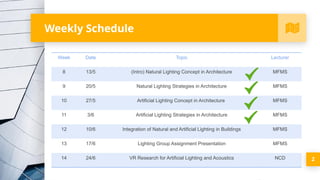
Week DateTopic Lecturer
8 13/5 (Intro) Natural Lighting Concept in Architecture MFMS
9 20/5 Natural Lighting Strategies in Architecture MFMS
10 27/5 Artificial Lighting Concept in Architecture MFMS
11 3/6 Artificial Lighting Strategies in Architecture MFMS
12 10/6 Integration of Natural and Artificial Lighting in Buildings MFMS
13 17/6 Lighting Group Assignment Presentation MFMS
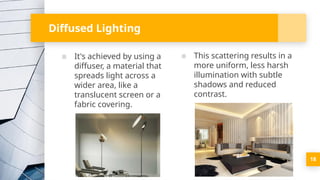
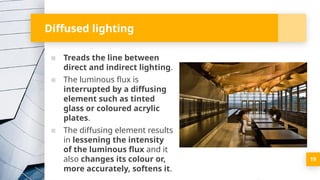
14 24/6 VR Research for Artificial Lighting and Acoustics NCD
3.
3
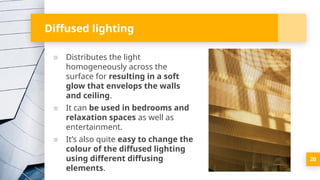
Learning Objectives
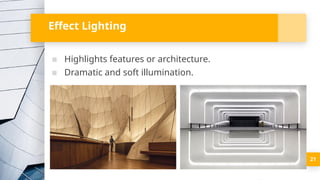
▪ Understandtypes of artificial lighting and their
effects on space.
▪ Explore layered lighting strategies.
▪ Analyze energy-efficient solutions.
▪ Integrate automation and daylight.
▪ Evaluate practical lighting design.
4.
4
Introduction to ArtificialLighting
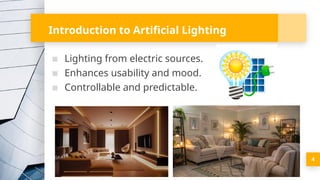
▪ Lighting from electric sources.
▪ Enhances usability and mood.
▪ Controllable and predictable.
5.
5
Types of ArtificialLighting
▪ Direct
▪ Indirect
▪ Diffused
▪ Effect
▪ Layered (Ambient, Task, Accent)
6.
6
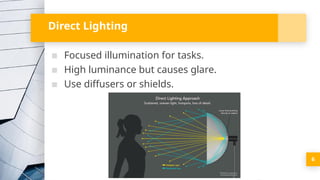
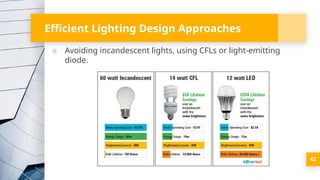
Direct Lighting
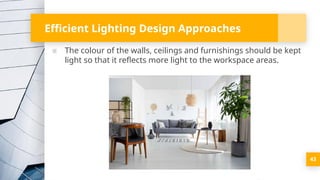
▪ Focusedillumination for tasks.
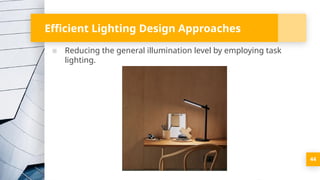
▪ High luminance but causes glare.
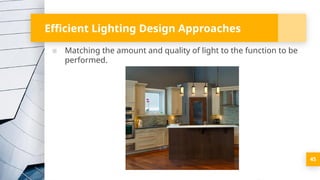
▪ Use diffusers or shields.
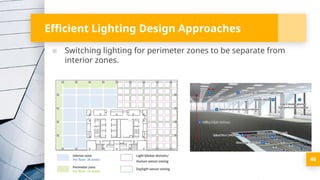
7.
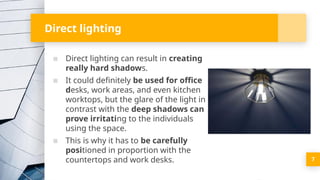
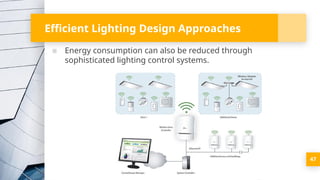
Direct lighting
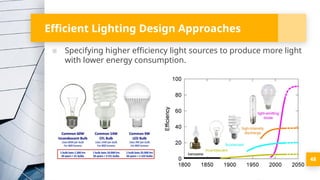
▪ Directlighting can result in creating
really hard shadows.
▪ It could definitely be used for office
desks, work areas, and even kitchen
worktops, but the glare of the light in
contrast with the deep shadows can
prove irritating to the individuals
using the space.
▪ This is why it has to be carefully
positioned in proportion with the
countertops and work desks. 7
8.
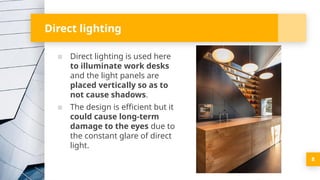
Direct lighting
▪ Directlighting is used here
to illuminate work desks
and the light panels are
placed vertically so as to
not cause shadows.
▪ The design is efficient but it
could cause long-term
damage to the eyes due to
the constant glare of direct
light.
8
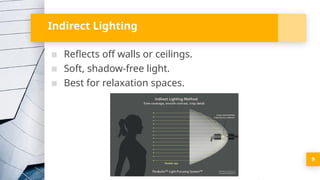
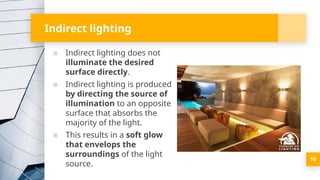
Indirect lighting
▪ Indirectlighting does not
illuminate the desired
surface directly.
▪ Indirect lighting is produced
by directing the source of
illumination to an opposite
surface that absorbs the
majority of the light.
▪ This results in a soft glow
that envelops the
surroundings of the light
source.
10
11.
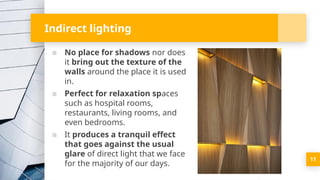
Indirect lighting
▪ Noplace for shadows nor does
it bring out the texture of the
walls around the place it is used
in.
▪ Perfect for relaxation spaces
such as hospital rooms,
restaurants, living rooms, and
even bedrooms.
▪ It produces a tranquil effect
that goes against the usual
glare of direct light that we face
for the majority of our days.
11
12.
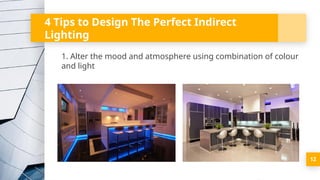
4 Tips toDesign The Perfect Indirect
Lighting
1. Alter the mood and atmosphere using combination of colour
and light
12
13.
4 Tips toDesign The Perfect Indirect
Lighting
2. Add subtle style with invisible fixtures
13
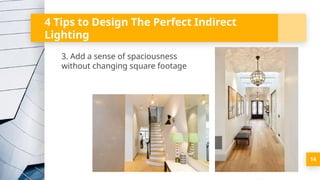
14.
4 Tips toDesign The Perfect Indirect
Lighting
3. Add a sense of spaciousness
without changing square footage
14
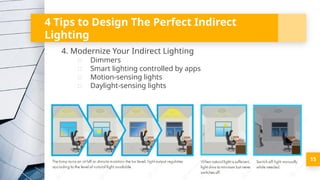
15.
4 Tips toDesign The Perfect Indirect
Lighting
4. Modernize Your Indirect Lighting
▫ Dimmers
▫ Smart lighting controlled by apps
▫ Motion-sensing lights
▫ Daylight-sensing lights
15
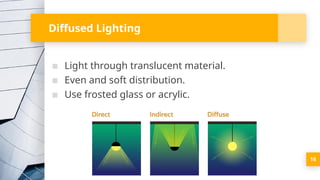
16.
16
Diffused Lighting
▪ Lightthrough translucent material.
▪ Even and soft distribution.
▪ Use frosted glass or acrylic.
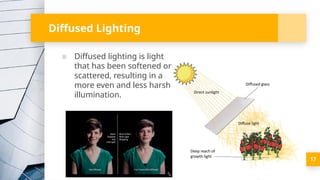
17.
▪ Diffused lightingis light
that has been softened or
scattered, resulting in a
more even and less harsh
illumination.
17
Diffused Lighting
18.
▪ It's achievedby using a
diffuser, a material that
spreads light across a
wider area, like a
translucent screen or a
fabric covering.
18
Diffused Lighting
▪ This scattering results in a
more uniform, less harsh
illumination with subtle
shadows and reduced
contrast.
19.
Diffused lighting
▪ Treadsthe line between
direct and indirect lighting.
▪ The luminous flux is
interrupted by a diffusing
element such as tinted
glass or coloured acrylic
plates.
▪ The diffusing element results
in lessening the intensity
of the luminous flux and it
also changes its colour or,
more accurately, softens it.
19
20.
Diffused lighting
▪ Distributesthe light
homogeneously across the
surface for resulting in a soft
glow that envelops the walls
and ceiling.
▪ It can be used in bedrooms and
relaxation spaces as well as
entertainment.
▪ It’s also quite easy to change the
colour of the diffused lighting
using different diffusing
elements.
20
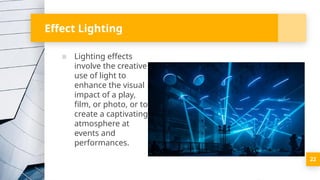
Effect Lighting
▪ Lightingeffects
involve the creative
use of light to
enhance the visual
impact of a play,
film, or photo, or to
create a captivating
atmosphere at
events and
performances.
22
23.
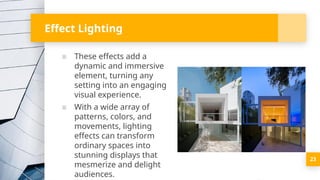
Effect Lighting
▪ Theseeffects add a
dynamic and immersive
element, turning any
setting into an engaging
visual experience.
▪ With a wide array of
patterns, colors, and
movements, lighting
effects can transform
ordinary spaces into
stunning displays that
mesmerize and delight
audiences.
23
24.
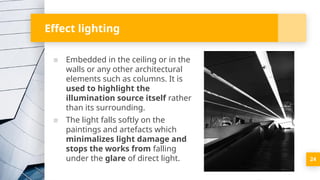
Effect lighting
▪ Embeddedin the ceiling or in the
walls or any other architectural
elements such as columns. It is
used to highlight the
illumination source itself rather
than its surrounding.
▪ The light falls softly on the
paintings and artefacts which
minimalizes light damage and
stops the works from falling
under the glare of direct light. 24
26
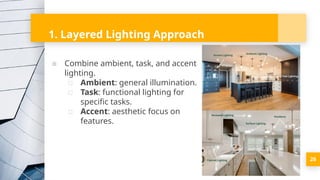
1. Layered LightingApproach
▪ Combine ambient, task, and accent
lighting.
▫ Ambient: general illumination.
▫ Task: functional lighting for
specific tasks.
▫ Accent: aesthetic focus on
features.
27.
27
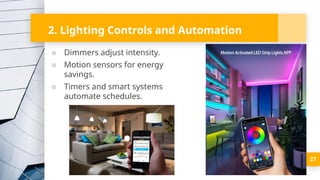
2. Lighting Controlsand Automation
▪ Dimmers adjust intensity.
▪ Motion sensors for energy
savings.
▪ Timers and smart systems
automate schedules.
28.
Lighting controls
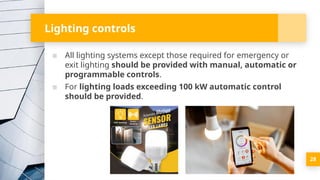
▪ Alllighting systems except those required for emergency or
exit lighting should be provided with manual, automatic or
programmable controls.
▪ For lighting loads exceeding 100 kW automatic control
should be provided.
28
29.
Lighting controls
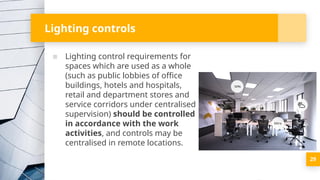
▪ Lightingcontrol requirements for
spaces which are used as a whole
(such as public lobbies of office
buildings, hotels and hospitals,
retail and department stores and
service corridors under centralised
supervision) should be controlled
in accordance with the work
activities, and controls may be
centralised in remote locations.
29
30.
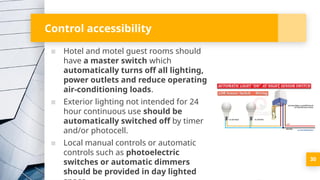
Control accessibility
▪ Hoteland motel guest rooms should
have a master switch which
automatically turns off all lighting,
power outlets and reduce operating
air-conditioning loads.
▪ Exterior lighting not intended for 24
hour continuous use should be
automatically switched off by timer
and/or photocell.
▪ Local manual controls or automatic
controls such as photoelectric
switches or automatic dimmers
should be provided in day lighted
30
31.
31
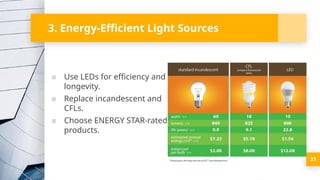
3. Energy-Efficient LightSources
▪ Use LEDs for efficiency and
longevity.
▪ Replace incandescent and
CFLs.
▪ Choose ENERGY STAR-rated
products.
32.
32
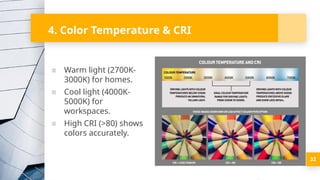
4. Color Temperature& CRI
▪ Warm light (2700K-
3000K) for homes.
▪ Cool light (4000K-
5000K) for
workspaces.
▪ High CRI (>80) shows
colors accurately.
33.
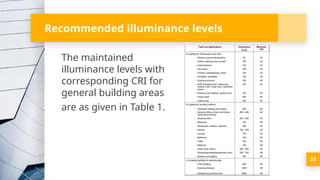
Recommended illuminance levels
Themaintained
illuminance levels with
corresponding CRI for
general building areas
are as given in Table 1.
33
34.
34
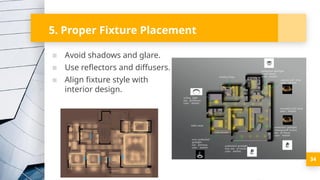
5. Proper FixturePlacement
▪ Avoid shadows and glare.
▪ Use reflectors and diffusers.
▪ Align fixture style with
interior design.
36
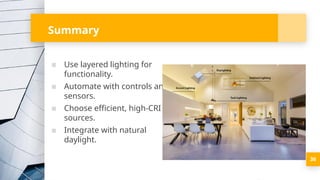
Summary
▪ Use layeredlighting for
functionality.
▪ Automate with controls and
sensors.
▪ Choose efficient, high-CRI
sources.
▪ Integrate with natural
daylight.
Sustainable Lighting
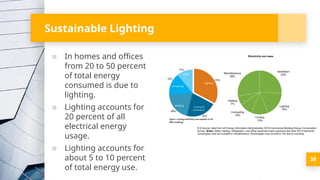
▪ Inhomes and offices
from 20 to 50 percent
of total energy
consumed is due to
lighting.
▪ Lighting accounts for
20 percent of all
electrical energy
usage.
▪ Lighting accounts for
about 5 to 10 percent
of total energy use.
38
39.
Sustainable Lighting
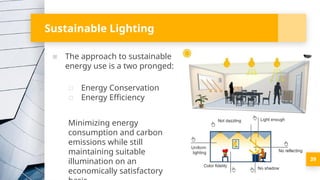
▪ Theapproach to sustainable
energy use is a two pronged:
▫ Energy Conservation
▫ Energy Efficiency
Minimizing energy
consumption and carbon
emissions while still
maintaining suitable
illumination on an
economically satisfactory
39
40.
Assessing a SustainableLighting Program
2. Lighting Design
▪ Lighting Performance
▪ Lighting Control
▪ Lighting Accessibility
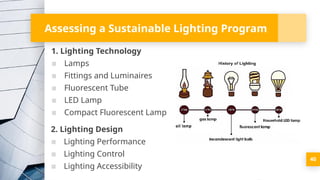
1. Lighting Technology
▪ Lamps
▪ Fittings and Luminaires
▪ Fluorescent Tube
▪ LED Lamp
▪ Compact Fluorescent Lamp
40
41.
Lighting performance
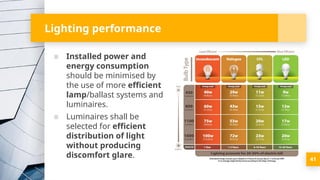
▪ Installedpower and
energy consumption
should be minimised by
the use of more efficient
lamp/ballast systems and
luminaires.
▪ Luminaires shall be
selected for efficient
distribution of light
without producing
discomfort glare. 41
42.
Efficient Lighting DesignApproaches
▪ Avoiding incandescent lights, using CFLs or light-emitting
diode.
42
43.
Efficient Lighting DesignApproaches
▪ The colour of the walls, ceilings and furnishings should be kept
light so that it reflects more light to the workspace areas.
43
44.
Efficient Lighting DesignApproaches
▪ Reducing the general illumination level by employing task
lighting.
44
45.
Efficient Lighting DesignApproaches
▪ Matching the amount and quality of light to the function to be
performed.
45
46.
Efficient Lighting DesignApproaches
▪ Switching lighting for perimeter zones to be separate from
interior zones.
46
47.
Efficient Lighting DesignApproaches
▪ Energy consumption can also be reduced through
sophisticated lighting control systems.
47
48.
Efficient Lighting DesignApproaches
▪ Specifying higher efficiency light sources to produce more light
with lower energy consumption.
48
Assessing a SustainableLighting Program
▪ Educate users on the need for
the change and the benefits of
sustainable lighting systems.
▪ Educating and training of users
to gain commitment to the
lighting project.
▪ Automatic shutdown of lights
after 6 or 7 pm, beyond which
local task lights can be used.
▪ Negotiating cleaning contracts
for day time, so that all lights
can be switched off after office
hours. 50
51.
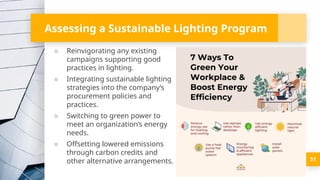
Assessing a SustainableLighting Program
▪ Reinvigorating any existing
campaigns supporting good
practices in lighting.
▪ Integrating sustainable lighting
strategies into the company’s
procurement policies and
practices.
▪ Switching to green power to
meet an organization’s energy
needs.
▪ Offsetting lowered emissions
through carbon credits and
other alternative arrangements. 51