Co-funded by the Intelligent Energy Europe
Programme of the European Union 1Introduction - Theory - Exercises - Business Case - Summary
Co-funded by the Intelligent Energy Europe
Programme of the European Union
Co-funded by the Intelligent Energy Europe
Programme of the European Union 2
Overview
 Introduction
 Theory
 Excercises
 Business Case
 Summary
Introduction - Theory - Exercises - Business Case - Summary
Co-funded by the Intelligent Energy Europe
Programme of the European Union 3Introduction - Theory - Exercises - Business Case - Summary
Co-funded by the Intelligent Energy Europe
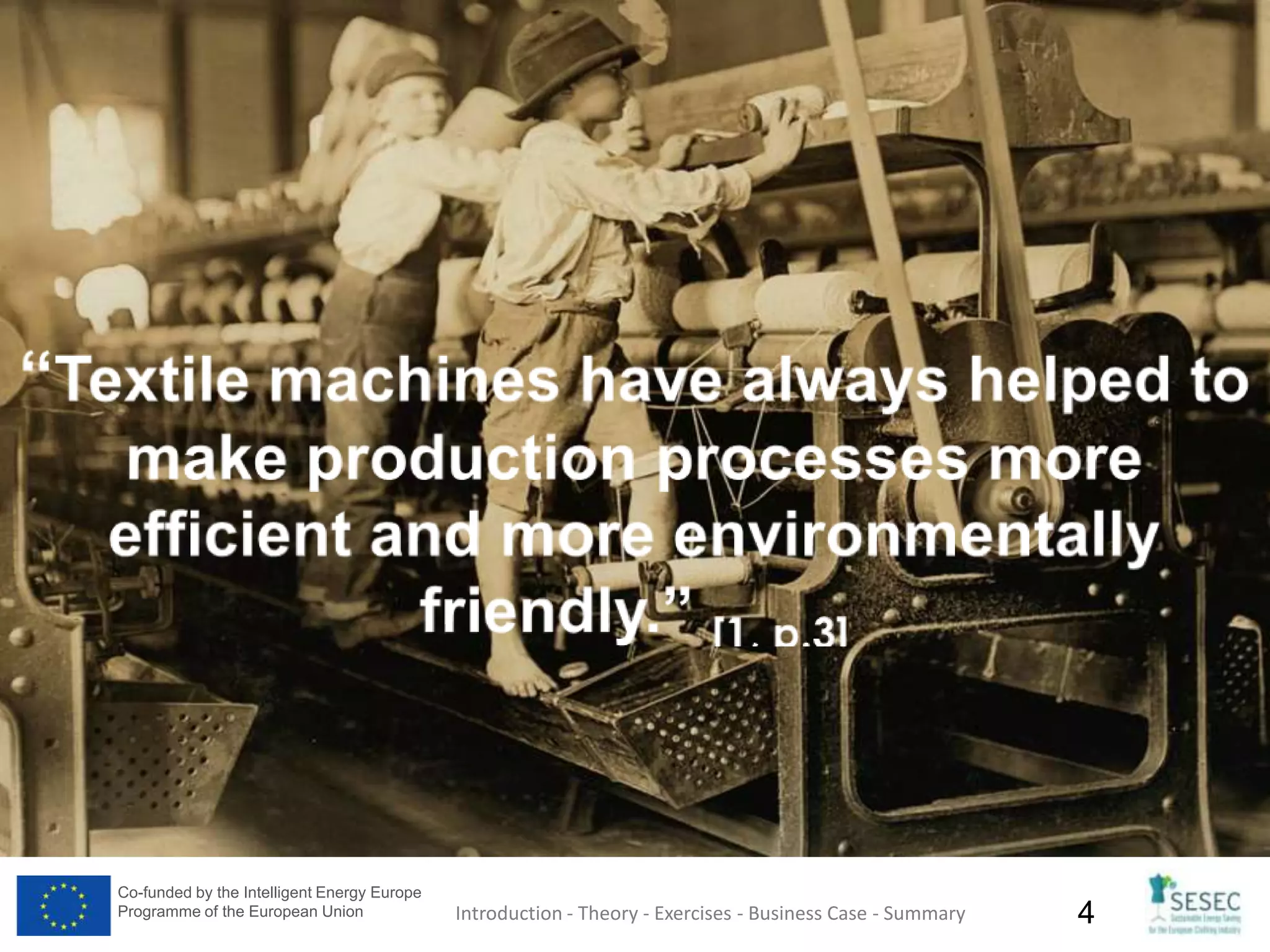
Programme of the European Union 4Introduction - Theory - Exercises - Business Case - Summary
Co-funded by the Intelligent Energy Europe
Programme of the European Union
Co-funded by the Intelligent Energy Europe
Programme of the European Union 5
The Situation
• Rising energy prices make it necessary to look for
alternatives like flexible energy prices
• Textile machines offer potential for energy savings
• “A classification of textile machines into energy
efficiency[…] is not readily feasible“ [1, p.7]
• Sustainably produced products become
increasingly important
• Plant operators have to follow the
EU guide lines(2010/75/EU)
Introduction - Theory - Exercises - Business Case - Summary
Co-funded by the Intelligent Energy Europe
Programme of the European Union 6Introduction - Theory - Exercises - Business Case - Summary
“The textile manufacturer, the demands on the
textile product, the material, the fibre supplier
and the manufacturer of the machines all have an
influence on energy efficiency.” [1, p.7]
It is a problem which affects the entire value added chain
Co-funded by the Intelligent Energy Europe
Programme of the European Union
Co-funded by the Intelligent Energy Europe
Programme of the European Union 7
Reasons for excess consumption
I. Excess consumption caused by
technical issues
II. Excess consumption caused by
behavioral/organizational issues
Introduction - Theory - Exercises - Business Case - Summary
Co-funded by the Intelligent Energy Europe
Programme of the European Union
Co-funded by the Intelligent Energy Europe
Programme of the European Union 8
Reasons for excess consumption
I. Excess consumption caused by
technical issues:
– Several times a day machines are turned on/off
– Degree of efficiency is used suboptimal
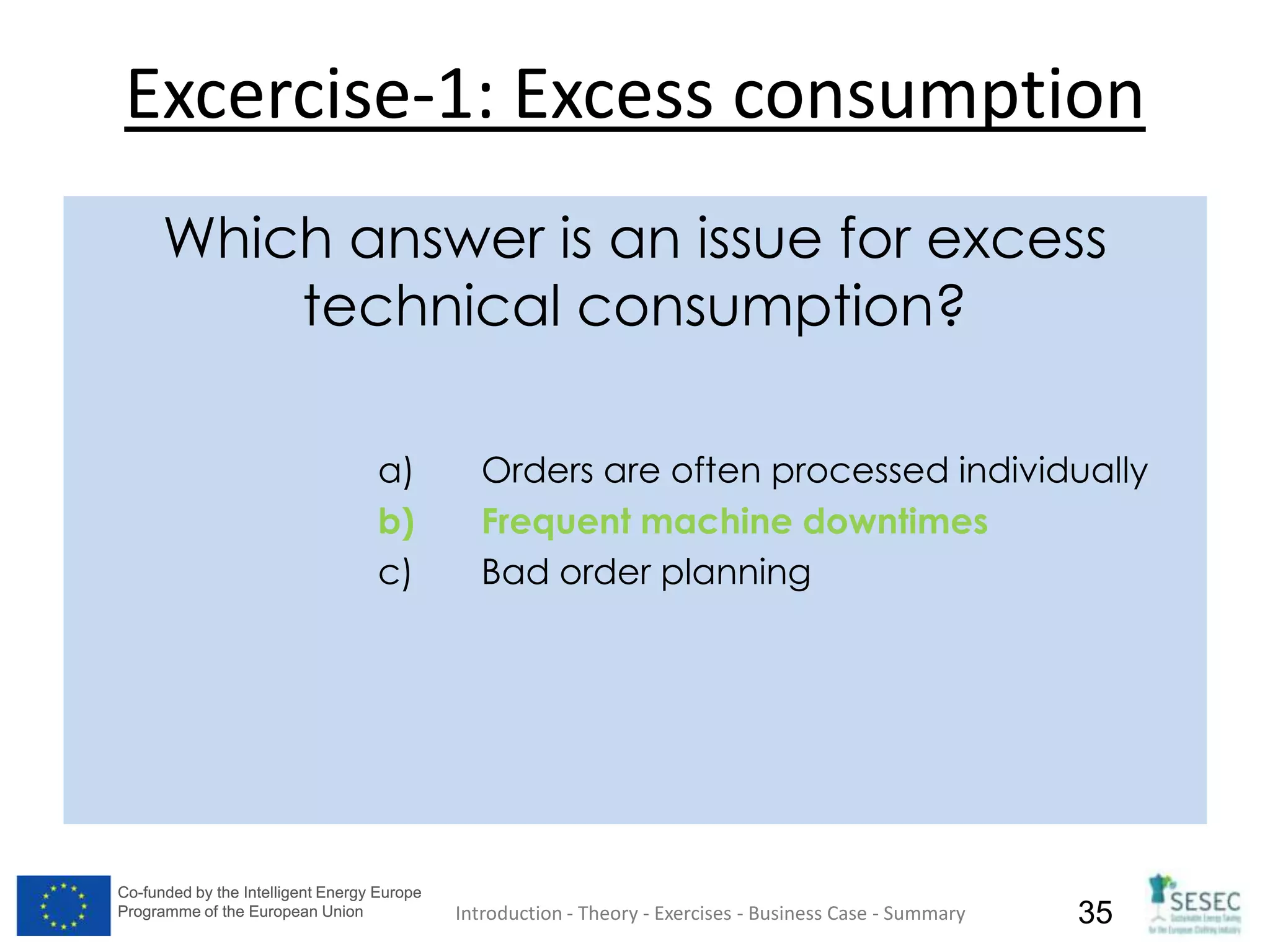
– Frequent machine downtimes
– Improper maintenance of machines
– Non optimal machine settings
– “The use of inferior wearing parts reduce the efficiency
of machinery and increase energy consumption.” [1, p.9]
Introduction - Theory - Exercises - Business Case - Summary
Co-funded by the Intelligent Energy Europe
Programme of the European Union
Co-funded by the Intelligent Energy Europe
Programme of the European Union 9
Reasons for excess consumption
I. Excess consumption caused by
technical issues (continued):
– Using motors in fixed speed
– Use of low efficiency motors
– Use of rewinded motors
– Use of direct start in motors
– Use star/triangle starter in larger engines
Uncompensated reactive energy
– Phase imbalance due to poor distribution of single-phase equipment
Introduction - Theory - Exercises - Business Case - Summary
Co-funded by the Intelligent Energy Europe
Programme of the European Union
Co-funded by the Intelligent Energy Europe
Programme of the European Union 10
Reasons for excess consumption
II. Excess consumption caused by
behavioral/organizational issues:
– Bad order planning
– Orders are often processed individually
– Production takes place at the time of the day when
energy costs reach the peak
– Machines running without being necessary
– Low load regimen
– Long downtimes between orders
Introduction - Theory - Exercises - Business Case - Summary
Co-funded by the Intelligent Energy Europe
Programme of the European Union 11Introduction - Theory - Exercises - Business Case - Summary
Co-funded by the Intelligent Energy Europe
Programme of the European Union 12Introduction - Theory - Exercises - Business Case - Summary
Co-funded by the Intelligent Energy Europe
Programme of the European Union
Co-funded by the Intelligent Energy Europe
Programme of the European Union 13
Political aspects
• “The climate and energy policy objectives of the
European Union faces new challenges […] By 2020,
the energy efficiency is to be improved by 20
percent” [17]
• The policy encourages the industry to devote
themselves strategically to the energy consumption
• Politics and business are also committed, amongst
other things, to the marking of the energy efficiency of
products
• In the European Union, the production permit is based
on Best Available Techniques (BAT)
Introduction - Theory - Exercises - Business Case - Summary
Co-funded by the Intelligent Energy Europe
Programme of the European Union
Co-funded by the Intelligent Energy Europe
Programme of the European Union 14
What needs to be done?
Introduction - Theory - Exercises - Business Case - Summary
Co-funded by the Intelligent Energy Europe
Programme of the European Union
Co-funded by the Intelligent Energy Europe
Programme of the European Union 15
Approach
I. Technical issues
II. Behavioral/organizational issues
Introduction - Theory - Exercises - Business Case - Summary
Co-funded by the Intelligent Energy Europe
Programme of the European Union
Co-funded by the Intelligent Energy Europe
Programme of the European Union 16
Approach
I. Technical issues:
1. Avoid on/off running of machines
2. Correct use of the machine
3. Avoid waste and reduce scrap rate
4. Avoid peak load
5. Use machines at optimal load
6. Upgrade existing systems
Introduction - Theory - Exercises - Business Case - Summary
Co-funded by the Intelligent Energy Europe
Programme of the European Union
Co-funded by the Intelligent Energy Europe
Programme of the European Union 17
Approach
II. Behavioral/organizational issues:
1. Use of work shifts
2. Train employees
3. Define indicators
4. Manage orders
Introduction - Theory - Exercises - Business Case - Summary
Co-funded by the Intelligent Energy Europe
Programme of the European Union
Co-funded by the Intelligent Energy Europe
Programme of the European Union 18
I. Technical issues
Introduction - Theory - Exercises - Business Case - Summary
Co-funded by the Intelligent Energy Europe
Programme of the European Union
Co-funded by the Intelligent Energy Europe
Programme of the European Union 19
1. Avoid on/off running of machines
• “Correct running coordination of on and
off times can cause:
– payback periods of less than one year
– profitability is accessible from more
than 20%” [13, p.1]
• Cost reduction and emission reduction
because of thermal consumption reduction
Introduction - Theory - Exercises - Business Case - Summary
Co-funded by the Intelligent Energy Europe
Programme of the European Union
Co-funded by the Intelligent Energy Europe
Programme of the European Union 20
2. Correct use of the machine
a) Accurate production
parameters
b) Proper, seasonable
machine care
c) Suitable spare parts
Introduction - Theory - Exercises - Business Case - Summary
Co-funded by the Intelligent Energy Europe
Programme of the European Union
Co-funded by the Intelligent Energy Europe
Programme of the European Union 21
2a. Production parameters
• Variable speed drives (VSDs) can lead to
significant energy savings
• An adaptation of the processing speed to the
current requirement is most efficiently over
variable-speed motors
• Associated to better process control, less wear in
the mechanical equipment and less acoustical
noise
• Lower temperature settings during non production
periods (programmable regulation)
Introduction - Theory - Exercises - Business Case - Summary
Co-funded by the Intelligent Energy Europe
Programme of the European Union
Co-funded by the Intelligent Energy Europe
Programme of the European Union 22
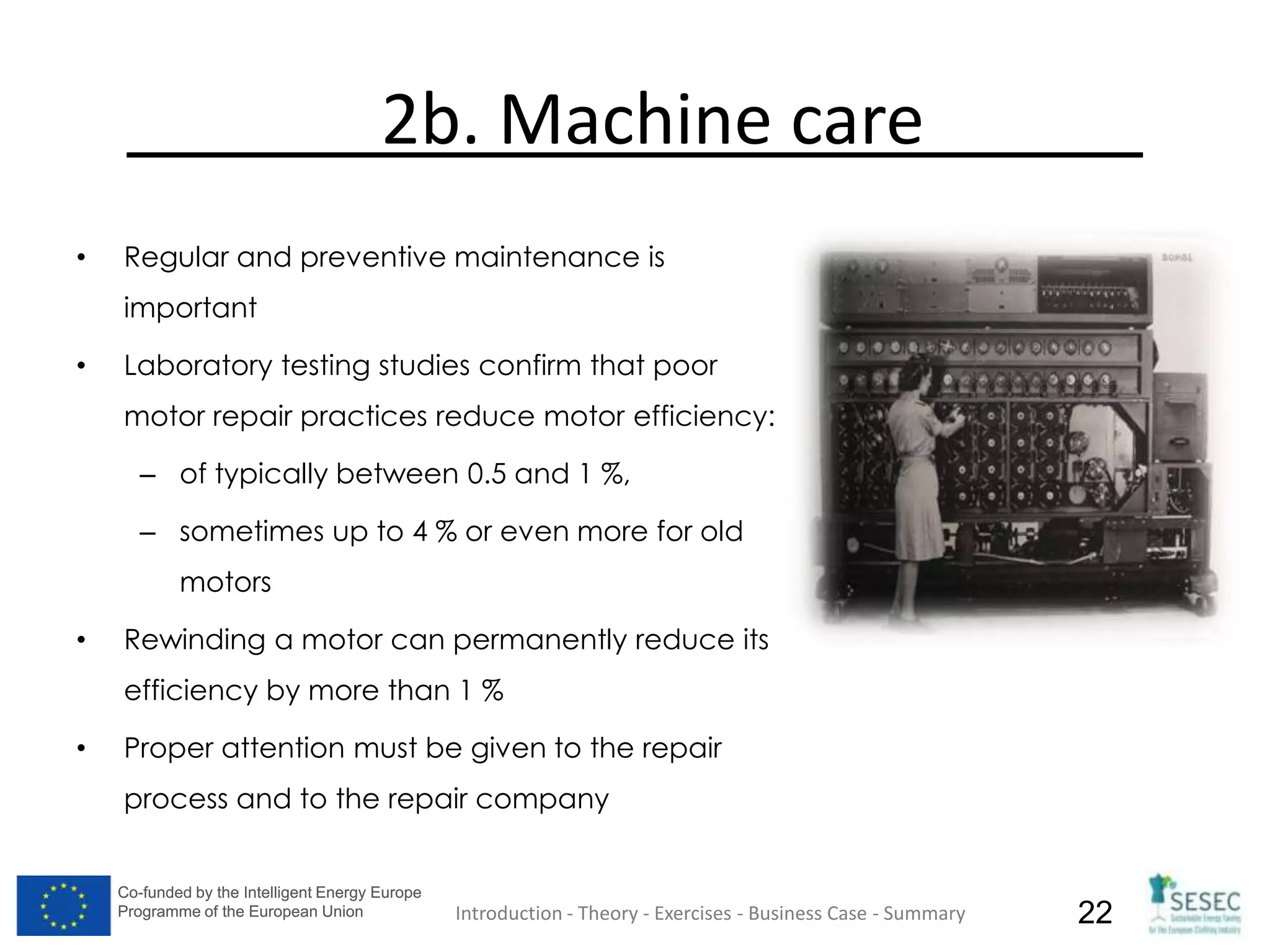
2b. Machine care
• Regular and preventive maintenance is
important
• Laboratory testing studies confirm that poor
motor repair practices reduce motor efficiency:
– of typically between 0.5 and 1 %,
– sometimes up to 4 % or even more for old
motors
• Rewinding a motor can permanently reduce its
efficiency by more than 1 %
• Proper attention must be given to the repair
process and to the repair company
Introduction - Theory - Exercises - Business Case - Summary
Co-funded by the Intelligent Energy Europe
Programme of the European Union
Co-funded by the Intelligent Energy Europe
Programme of the European Union 23
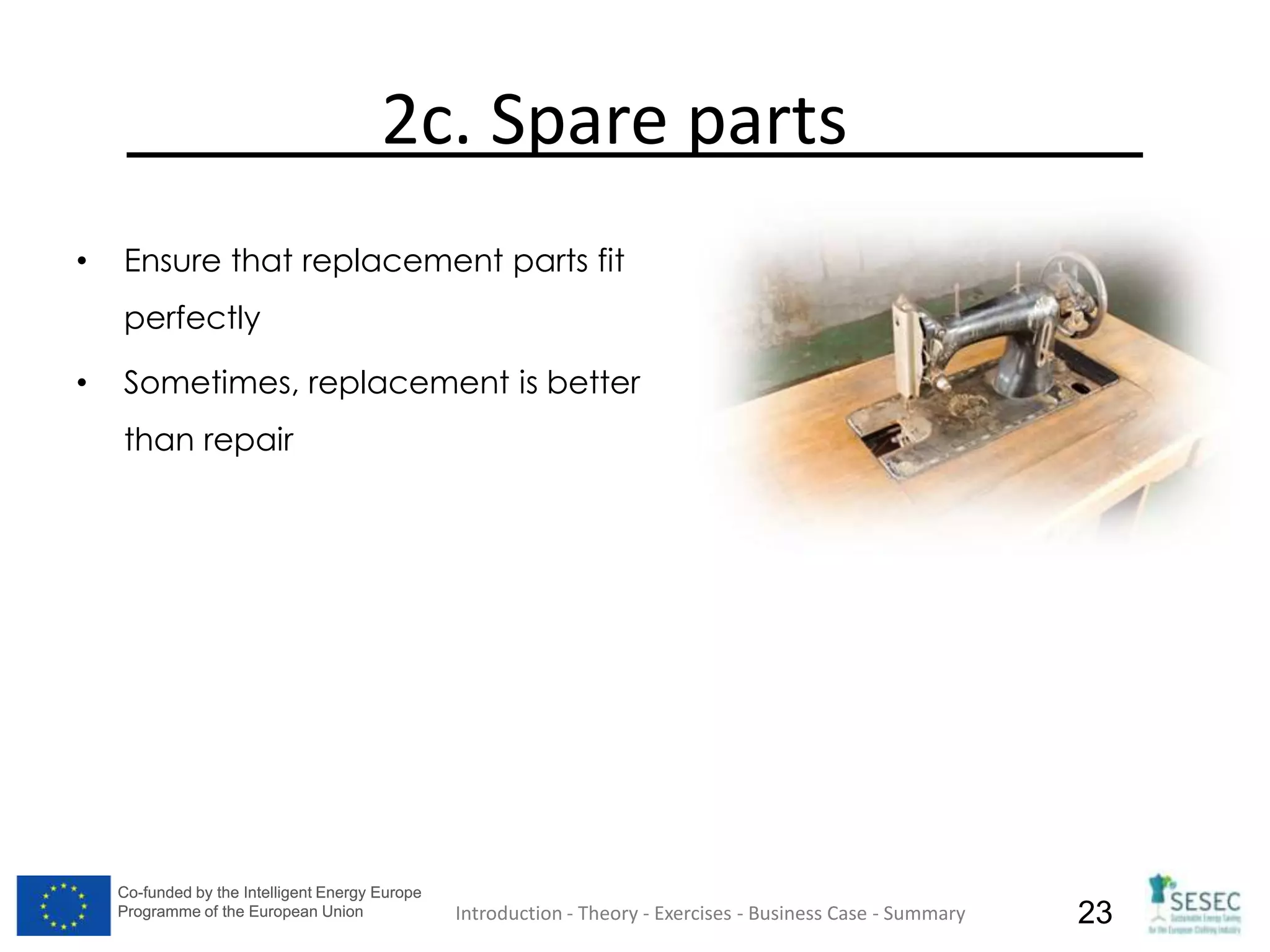
2c. Spare parts
• Ensure that replacement parts fit
perfectly
• Sometimes, replacement is better
than repair
Introduction - Theory - Exercises - Business Case - Summary
Co-funded by the Intelligent Energy Europe
Programme of the European Union
Co-funded by the Intelligent Energy Europe
Programme of the European Union 24
3. Avoid waste and reduce scrap rate
• Material efficiency also means energy
efficiency
• Design processes to avoid waste or
at least to reduce it
• “Any error that must be corrected
immediately after it occurs or in a
subsequent process step costs additional
energy“ [1, p.25]
Introduction - Theory - Exercises - Business Case - Summary
Co-funded by the Intelligent Energy Europe
Programme of the European Union
Co-funded by the Intelligent Energy Europe
Programme of the European Union 25
4. Avoid peak loads
• Load peaks are caused by
uncontrolled lead and elapse cycle
• Reduced electricity costs through
appropriate coordination of the lead
and elapse time
• ”Avoiding load peaks can redeem in
less than a year” [6, p.2]
Introduction - Theory - Exercises - Business Case - Summary
Co-funded by the Intelligent Energy Europe
Programme of the European Union
Co-funded by the Intelligent Energy Europe
Programme of the European Union 26
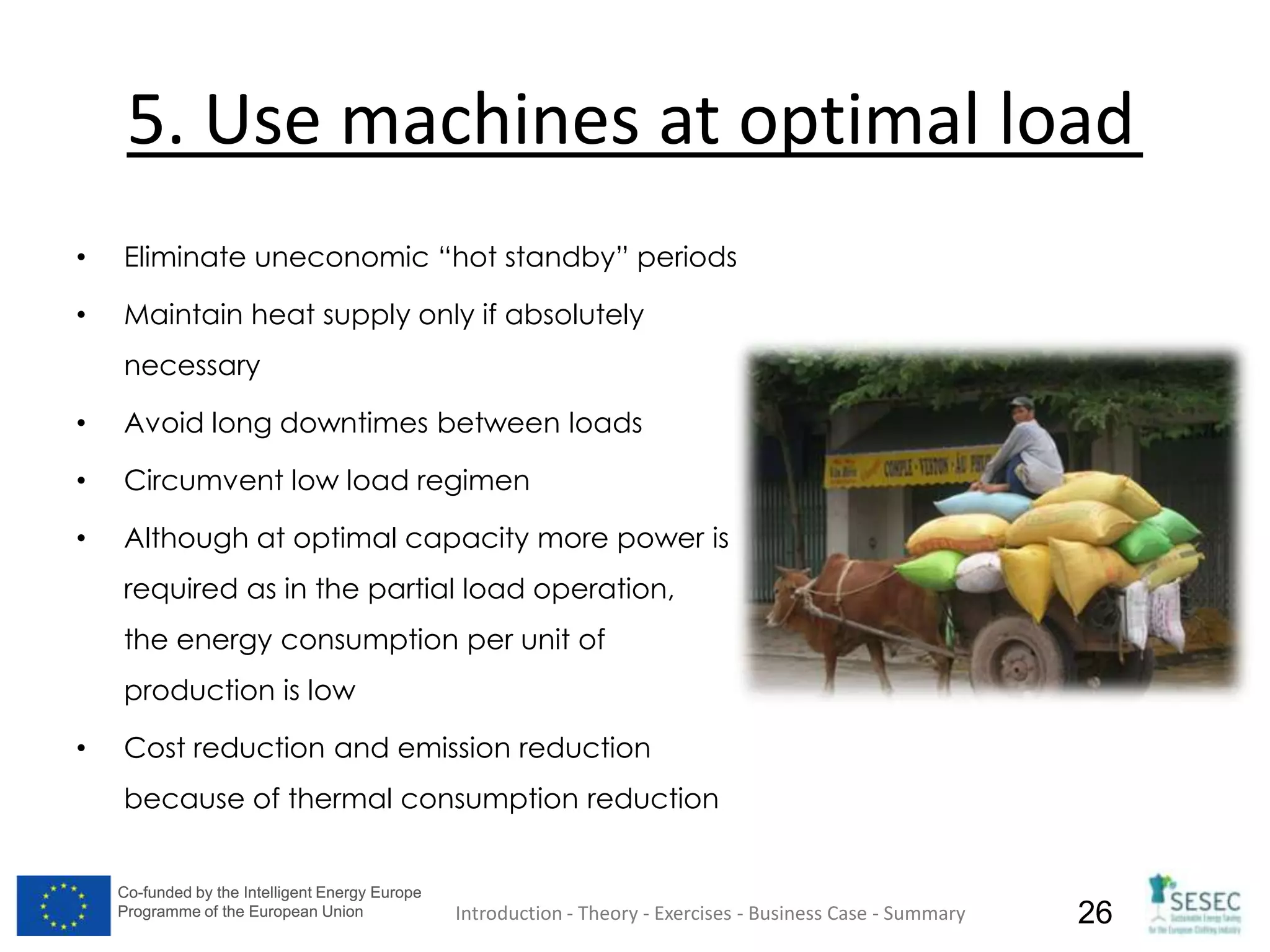
5. Use machines at optimal load
• Eliminate uneconomic “hot standby” periods
• Maintain heat supply only if absolutely
necessary
• Avoid long downtimes between loads
• Circumvent low load regimen
• Although at optimal capacity more power is
required as in the partial load operation,
the energy consumption per unit of
production is low
• Cost reduction and emission reduction
because of thermal consumption reduction
Introduction - Theory - Exercises - Business Case - Summary
Co-funded by the Intelligent Energy Europe
Programme of the European Union
Co-funded by the Intelligent Energy Europe
Programme of the European Union 27
6. Upgrade existing systems
• Efficient powertrains
• Use modern equipment
• Use of sensors and
measuring systems
“New investments or retrofits of existing facilities can be amortized in 2-3
years“ [13, p.1]
Introduction - Theory - Exercises - Business Case - Summary
Co-funded by the Intelligent Energy Europe
Programme of the European Union
Co-funded by the Intelligent Energy Europe
Programme of the European Union 28
II. Behavioral/organizational
issues.
Introduction - Theory - Exercises - Business Case - Summary
Co-funded by the Intelligent Energy Europe
Programme of the European Union
Co-funded by the Intelligent Energy Europe
Programme of the European Union 29
1. Use of work shifts
• Shifting of energivorous processes
towards lower price time slots
• Work shifts on the weekend
• Working at that time of the day
when energy costs are low
Introduction - Theory - Exercises - Business Case - Summary
Co-funded by the Intelligent Energy Europe
Programme of the European Union
Co-funded by the Intelligent Energy Europe
Programme of the European Union 30
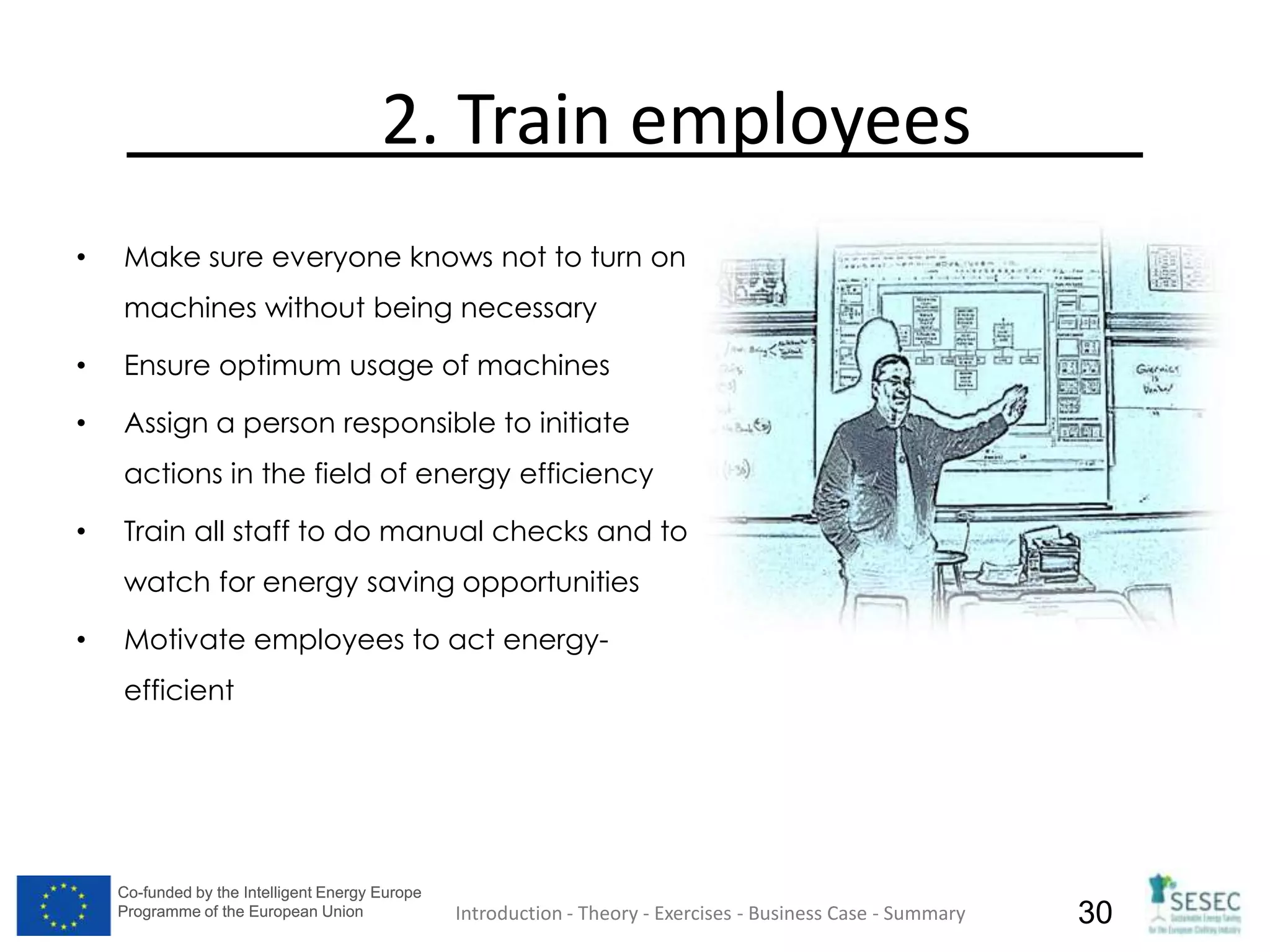
2. Train employees
• Make sure everyone knows not to turn on
machines without being necessary
• Ensure optimum usage of machines
• Assign a person responsible to initiate
actions in the field of energy efficiency
• Train all staff to do manual checks and to
watch for energy saving opportunities
• Motivate employees to act energy-
efficient
Introduction - Theory - Exercises - Business Case - Summary
Co-funded by the Intelligent Energy Europe
Programme of the European Union
Co-funded by the Intelligent Energy Europe
Programme of the European Union 31
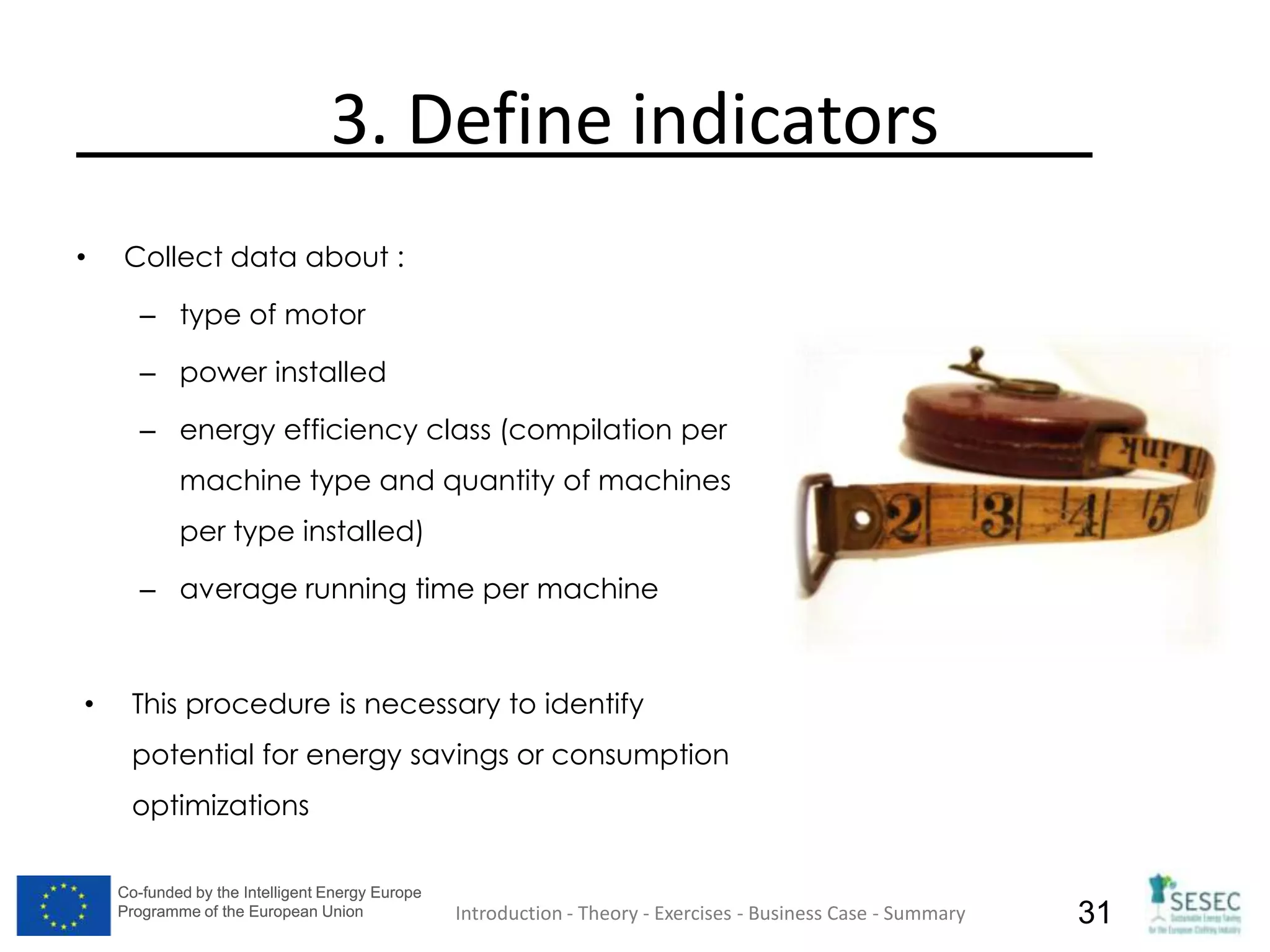
3. Define indicators
• Collect data about :
– type of motor
– power installed
– energy efficiency class (compilation per
machine type and quantity of machines
per type installed)
– average running time per machine
• This procedure is necessary to identify
potential for energy savings or consumption
optimizations
Introduction - Theory - Exercises - Business Case - Summary
Co-funded by the Intelligent Energy Europe
Programme of the European Union
Co-funded by the Intelligent Energy Europe
Programme of the European Union 32
4. Manage orders
• Combine orders if possible
• Optimize process sequence
• “While planning the production
processes consider the attendant
energy supply“ [11,p.10]
Introduction - Theory - Exercises - Business Case - Summary
Co-funded by the Intelligent Energy Europe
Programme of the European Union 33Introduction - Theory - Exercises - Business Case - Summary
Excercises.
Co-funded by the Intelligent Energy Europe
Programme of the European Union
Co-funded by the Intelligent Energy Europe
Programme of the European Union 34
Excercise 1: Excess consumption
Introduction - Theory - Exercises - Business Case - Summary
Which answer is an issue for excess
technical consumption?
a) Orders are often processed individually
b) Frequent machine downtimes
c) Bad order planning
Co-funded by the Intelligent Energy Europe
Programme of the European Union
Co-funded by the Intelligent Energy Europe
Programme of the European Union 35
Excercise-1: Excess consumption
Introduction - Theory - Exercises - Business Case - Summary
Which answer is an issue for excess
technical consumption?
a) Orders are often processed individually
b) Frequent machine downtimes
c) Bad order planning
Co-funded by the Intelligent Energy Europe
Programme of the European Union
Co-funded by the Intelligent Energy Europe
Programme of the European Union 36
Excercise-2: Machine running
Introduction - Theory - Exercises - Business Case - Summary
Is it efficient to turn machines off
during a short coffee break ?
a) Yes
b) No
Co-funded by the Intelligent Energy Europe
Programme of the European Union
Co-funded by the Intelligent Energy Europe
Programme of the European Union 37
Excercise-2: Machine running
Introduction - Theory - Exercises - Business Case - Summary
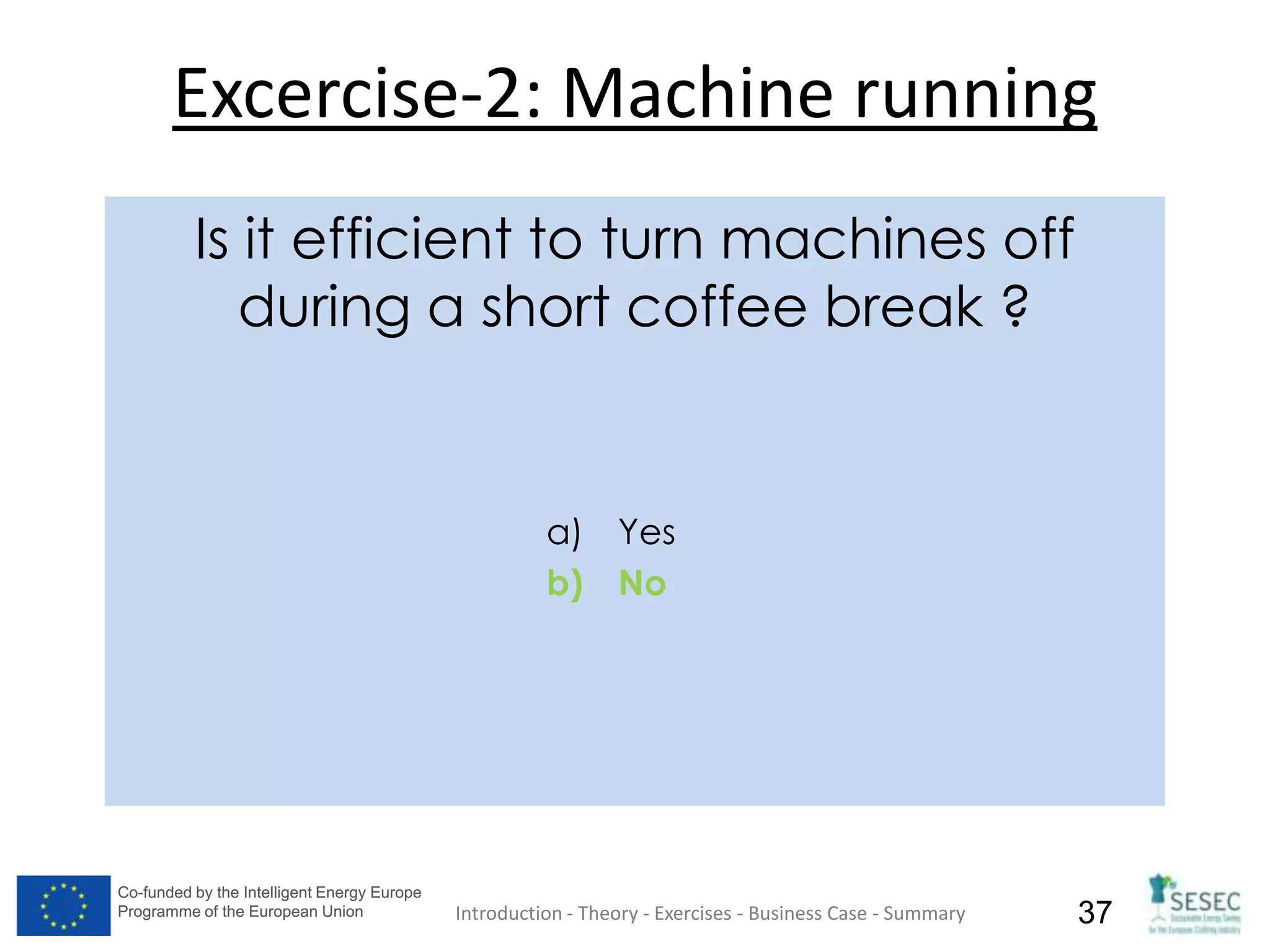
Is it efficient to turn machines off
during a short coffee break ?
a) Yes
b) No
Co-funded by the Intelligent Energy Europe
Programme of the European Union
Co-funded by the Intelligent Energy Europe
Programme of the European Union 38
Excercise-3: Machine care
Rewinding a motor can permanently?:
a) Reduce its efficiency by more than 1 %
b) Reduce its efficiency by more than 10 %
c) Improve its efficiency by more than 0,4 %
Introduction - Theory - Exercises - Business Case - Summary
Co-funded by the Intelligent Energy Europe
Programme of the European Union
Co-funded by the Intelligent Energy Europe
Programme of the European Union 39
Excercise-3: Machine care
Rewinding a motor can permanently?:
a) Reduce its efficiency by more than 1 %
b) Reduce its efficiency by more than 10 %
c) Improve its efficiency by more than 0,4 %
Introduction - Theory - Exercises - Business Case - Summary
Co-funded by the Intelligent Energy Europe
Programme of the European Union
Co-funded by the Intelligent Energy Europe
Programme of the European Union 40
Gap text
Enter the correct, missing words.
Energy efficiency is a problem which affects .
only companies only the government just the engine builder
the entire value added chain singly the industry
only the suppliers singly the consumer
Introduction - Theory - Exercises - Business Case - Summary
Co-funded by the Intelligent Energy Europe
Programme of the European Union
Co-funded by the Intelligent Energy Europe
Programme of the European Union 41
Gap text
Enter the correct, missing words.
Energy efficiency is a problem which affects
the entire value added chain .
only companies only the government just the engine builder
the entire value added chain singly the industry
only the suppliers singly the consumer
Introduction - Theory - Exercises - Business Case - Summary
Co-funded by the Intelligent Energy Europe
Programme of the European Union 42Introduction - Theory - Exercises - Business Case - Summary
Co-funded by the Intelligent Energy Europe
Programme of the European Union
Co-funded by the Intelligent Energy Europe
Programme of the European Union 43
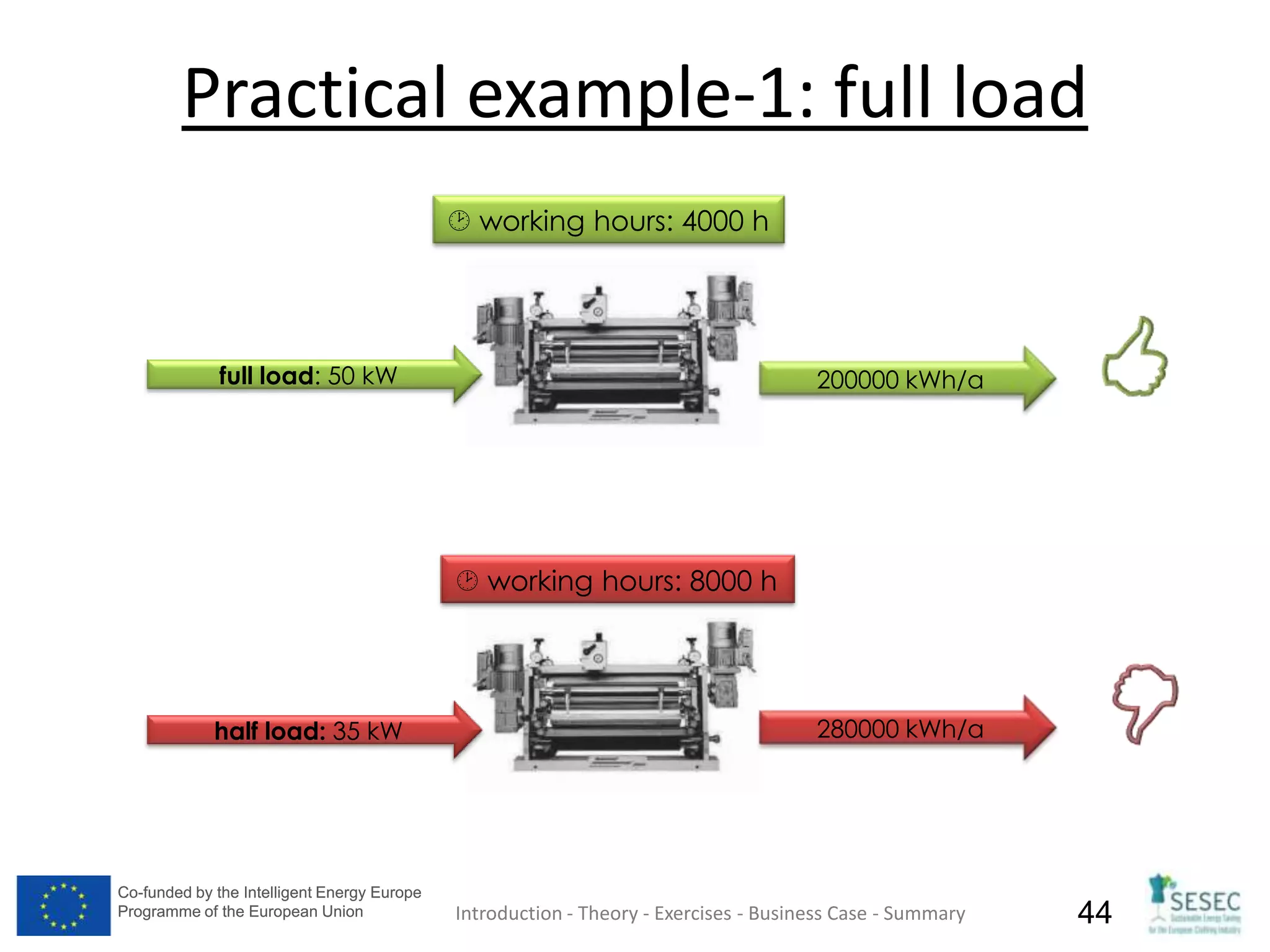
Practical example-1: full load
Energy efficiency through full load
 Not only less energy, but also less labor per unit of production
Source: http://www.swisstextiles.ch/cms/upload/dokumente/umwelt/energie_textil.pdf
Introduction - Theory - Exercises - Business Case - Summary
full load [kW] 50
or
half load [kW] 35
working hours [h] 4000 working hours [h] 8000
[kWh/a] 200000 [kWh/a] 280000
Co-funded by the Intelligent Energy Europe
Programme of the European Union
Co-funded by the Intelligent Energy Europe
Programme of the European Union 44
Practical example-1: full load
Introduction - Theory - Exercises - Business Case - Summary
full load: 50 kW 200000 kWh/a
 working hours: 4000 h
 working hours: 8000 h
half load: 35 kW 280000 kWh/a
Co-funded by the Intelligent Energy Europe
Programme of the European Union
Co-funded by the Intelligent Energy Europe
Programme of the European Union 45
Practical example-2: load peaks
Daily electrical power consumption profiles of a textile company [one month] [6, p.4]
• The analysis of the electricity demand profile provides information on peak load
times and provides the opportunity to reduce costs through load management
• The largest peak of demands consistently appear between 10 am to noon
• If possible, these processes should be shifted in the late afternoon
Source: Land und Wirtschaft NRW: Rationelle Energienutzung in der Textilindustrie
Introduction - Theory - Exercises - Business Case - Summary
Co-funded by the Intelligent Energy Europe
Programme of the European Union 46Introduction - Theory - Exercises - Business Case - Summary
Co-funded by the Intelligent Energy Europe
Programme of the European Union
Co-funded by the Intelligent Energy Europe
Programme of the European Union 47
Review
• Energy efficiency has long become a
political guideline
• Excess energy consumption through utilization
and production machines is caused by technical
as well as behavioral/organizational issues
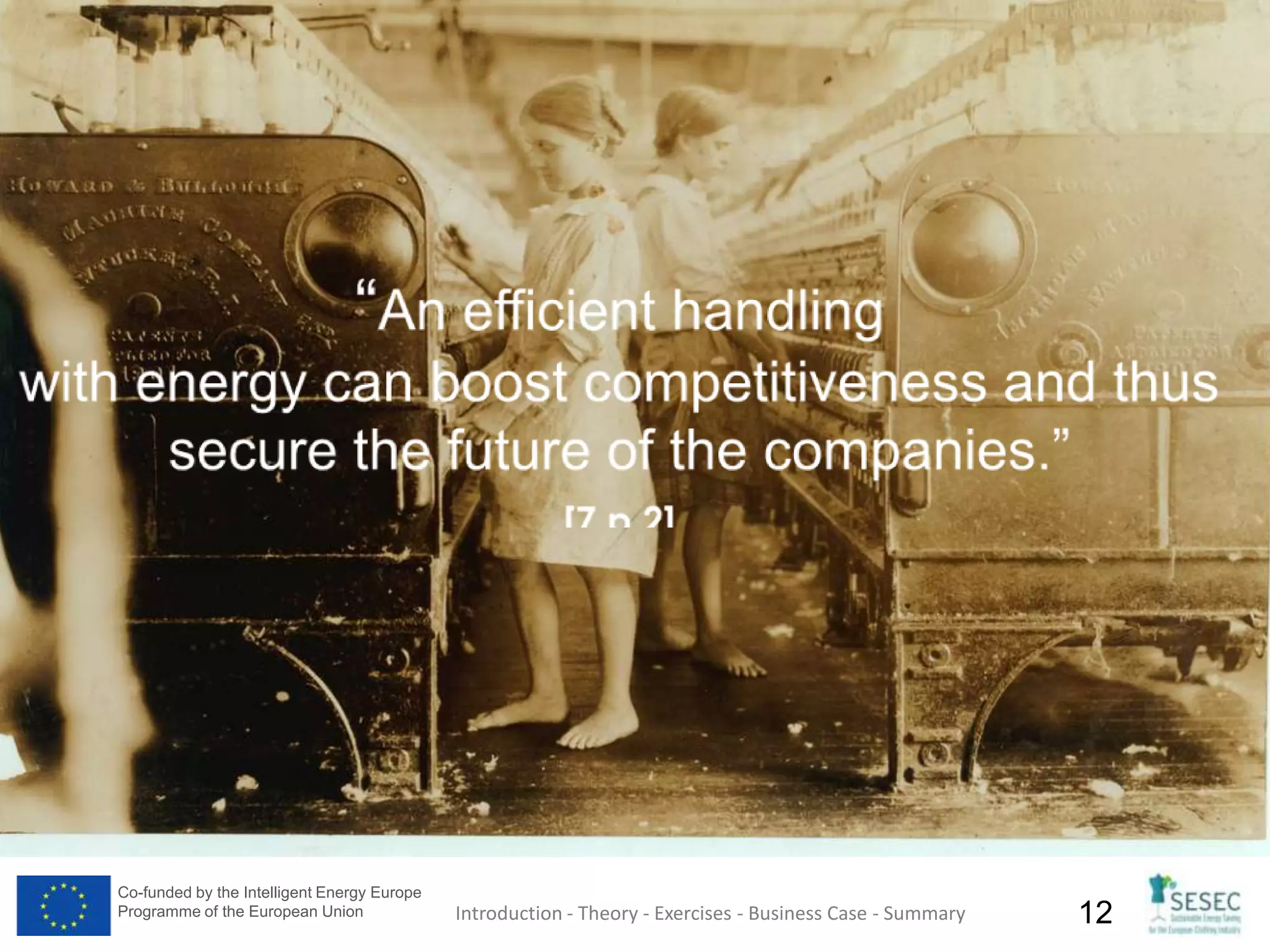
• “The efficient use of energy can boost
competitiveness and thus secure the future of
companies” [7,p.2]
• Small, effective saving measures can
be achieved in many places already by small
behavioral changes like reorganization with low
investment
Introduction - Theory - Exercises - Business Case - Summary
Co-funded by the Intelligent Energy Europe
Programme of the European Union
Co-funded by the Intelligent Energy Europe
Programme of the European Union 48
Readings-1
[1] VDMA Textile Machinery: Conserving resources – securing savings-potential. The comparison,
measuring and labellingof energy-efficient textile machinery.
[2] CITEVE (2013): Critical Energy Saving Points for the Clothing Manufacturing Process/Factory
Enviroment, Deliverable D3.1
[3] SESEC (2013): Savings potential, Deliverable D2.3
[4] SESEC (2013): Energy data, Deliverable D2.2 v0.2
[5] SESEC (2012): Energy Saving Methodology, Deliverable D2.1
[6] Land und Wirtschaft NRW: Rationelle Energienutzung in der Textilindustrie
[7] EnergieAgentur. NRW (2012): Leitfaden. Effiziente Energienutzung in der Textilveredlung
[8] SwissTextiles: Energie & Textil
URI: http://www.swisstextiles.ch/cms/upload/dokumente/umwelt/energie_textil.pdf
[9] Hasanbeigi, A.; Hasanabadi, A.; Abdorrazaghi, M.: Energy Efficiency Technologies and
Comparing the Energy Intensity in the Textile Industry
URI: http://www.aceee.org/files/proceedings/2011/data/papers/0085-000041.pdf
[10] Hasanbeigi, Ali (2010): Energy-Efficiency Improvement Opportunities for the Textile Industry
URI: http://escholarship.org/uc/item/6jw8s2gz#page-5
[11] Bayerisches Landesamt für Umwelt (LfU) (2009): Leitfaden für effiziente Energienutzung in
Industrie und Gewerbe
URI: http://www.muenchen.ihk.de/de/innovation/Anhaenge/Leitfaden-Energieeffizienz-in-
Industrie-und-Gewerbe.pdf
Introduction - Theory - Exercises - Business Case - Summary
Co-funded by the Intelligent Energy Europe
Programme of the European Union
Co-funded by the Intelligent Energy Europe
Programme of the European Union 49
Readings-2
[12] SUBRAMANIAM, S. K. ; HUSIN, S. H.; YUSOP, Y.; HAMIDON, A. H. : Machine efficiency and man
power utilization on production lines
URI: http://www.wseas.us/e-library/conferences/2008/tenerife/CD-CSECS/papers/CSECS05.pdf
[13] Rouette, H.K.; Tönsing, E. (1999): Rationelle Anwendung von Strom in der Textilindustrie
URI: mobile.energieverbraucher.de/files/download/file/0/1/0/230.pdf
[14] Amtsblattder EuropäischenUnion (2010): RICHTLINIE 2010/75/EU DES EUROPÄISCHEN PARLAMENTS
UND DES RATES
URI: http://eur-lex.europa.eu/LexUriServ/LexUriServ.do?uri=OJ:L:2010:334:0017:0119:de:PDF
[15] Umweltbundesamt (2011): UMWELTSTANDARDS IN DERTEXTIL- UND SCHUHBRANCHEEIN LEITFADEN
AUF BASIS DER BVT-MERKBLÄTTER DER EU
URI: http://www.umweltbundesamt.de/en/publikationen/umweltstandards-in-textil-
schuhbranche
[16] Europäische Kommission Generaldirektion Energie und Verkehr (2007): Vision 2020:
Energiesparen!
URI: http://ec.europa.eu/energy/action_plan_energy_efficiency/doc/2007_eeap_de.pdf
[17] Enterprise Europe Network:
URI: http://www.steinbeis-europa.de/optimes.html
Introduction - Theory - Exercises - Business Case - Summary
Co-funded by the Intelligent Energy Europe
Programme of the European Union
Co-funded by the Intelligent Energy Europe
Programme of the European Union 50
Pictures-1
• Slide 1
Thomas Totz: Vor dem Abriss - old factory
URI: http://www.flickr.com/photos/def110/2750709197/sizes/l/in/photostream/
License: CC BY-SA 2.0 (http://creativecommons.org/licenses/by-sa/2.0/)
• Slide 2
Calsidyrose: Vintage compass on a vintage map
URI: http://www.flickr.com/photos/calsidyrose/4925267732/sizes/l/in/photostream/
License: CC BY 2.0 (http://creativecommons.org/licenses/by/2.0/)
• Slide 3
Tony Hisgett: Old Engineering works bw
URI: http://www.flickr.com/photos/hisgett/3617901120/sizes/l/in/photostream/
License: CC BY 2.0 (http://creativecommons.org/licenses/by/2.0/deed.de)
• Slide 4
Children's Bureau Centennial: LC-DIG-nclc-01581
URI: http://www.flickr.com/photos/67331818@N03/8549485412/sizes/l/in/photostream/
License: CC BY 2.0 (http://creativecommons.org/licenses/by/2.0/)
• Slide 5
Flattop341: Guatemala tip #378 When there is a local demonstration blocking the highway follow the Chicken
Buses.
URI: http://www.flickr.com/photos/flattop341/12392909994/sizes/o/in/photostream/
License: CC BY 2.0 (http://creativecommons.org/licenses/by/2.0/)
Introduction - Theory - Exercises - Business Case - Summary
Co-funded by the Intelligent Energy Europe
Programme of the European Union
Co-funded by the Intelligent Energy Europe
Programme of the European Union 51
Pictures-2
• Slide 6
Children's Bureau Centennial: LC-DIG-nclc-02304 Boy Mill Doffer
URI: http://www.flickr.com/photos/67331818@N03/8548362217/
License: CC BY 2.0 (http://creativecommons.org/licenses/by/2.0/)
• Slide 7-10, 18+28
Ralphbijker: motion gears -team force
URI: http://www.flickr.com/photos/17258892@N05/2588347668/sizes/o/in/photostream/
License:CC BY 2.0 (http://creativecommons.org/licenses/by/2.0/)
Watchsmart: Post it Notes
URI: http://www.flickr.com/photos/watchsmart/3227691975/
License:CC BY 2.0 (http://creativecommons.org/licenses/by/2.0/)
• Slide 11
Children's Bureau Centennial: LC-DIG-nclc-01379 Child Labor Industrial
URI: http://www.flickr.com/photos/67331818@N03/8548222863/sizes/l/in/photostream/
License: CC BY 2.0 (http://creativecommons.org/licenses/by/2.0/)
• Slide 12
Children's Bureau Centennial: LC-DIG-nclc-02100 Girls Yarn Mill
URI: http://www.flickr.com/photos/67331818@N03/8548379255/sizes/l/in/photostream/
License: CC BY 2.0 (http://creativecommons.org/licenses/by/2.0/)
Introduction - Theory - Exercises - Business Case - Summary
Co-funded by the Intelligent Energy Europe
Programme of the European Union
Co-funded by the Intelligent Energy Europe
Programme of the European Union 52
Pictures-3
• Slide 13
MCAD Library: In Politics
URI: http://www.flickr.com/photos/69184488@N06/8091033790/sizes/l/in/photostream/
License: CC BY 2.0 (http://creativecommons.org/licenses/by/2.0/)
• Slide 14
Véronique Debord-Lazaro: What?
URI: http://www.flickr.com/photos/debord/4932655275/sizes/o/in/photostream/
License: CC BY 2.0 (http://creativecommons.org/licenses/by/2.0/)
• Slide 15-17
Boston Public Library: Tourist guide post at Sarasota, Florida
URI: http://www.flickr.com/photos/boston_public_library/8071411571/sizes/l/in/photostream/
License: CC BY 2.0 (http://creativecommons.org/licenses/by/2.0/)
• Slide 19
Cristian Menghi: ON-OFF
URI: http://www.flickr.com/photos/cmenghi/5600975060/sizes/l/in/photostream/
License: CC BY 2.0 (http://creativecommons.org/licenses/by/2.0/)
• Slide 20
Evan Hahn: Thumbs Up (simple)
URI: http://www.flickr.com/photos/evanhahn/5245014492/sizes/l/in/photostream/
License: CC BY 2.0 (http://creativecommons.org/licenses/by/2.0/)
Introduction - Theory - Exercises - Business Case - Summary
Co-funded by the Intelligent Energy Europe
Programme of the European Union
Co-funded by the Intelligent Energy Europe
Programme of the European Union 53
Pictures-4
• Slide 21
Andy Maguire: Numbers
URI: http://www.flickr.com/photos/andymag/9825503886/sizes/l/in/photostream/
License: CC BY 2.0 (http://creativecommons.org/licenses/by/2.0/)
• Slide 22
Brewbooks: US Navy Cryptanalytic Bombe
URI: http://www.flickr.com/photos/brewbooks/3318600273/sizes/l/in/photostream/
License: CC BY 2.0 (http://creativecommons.org/licenses/by/2.0/)
• Slide 23
Frédéric BISSON: Machine à coudre Novella
URI: http://www.flickr.com/photos/zigazou76/7859020502/sizes/l/in/photostream/
License: CC BY 2.0 (http://creativecommons.org/licenses/by/2.0/)
• Slide 24
Oatsy40: Rubbish
URI: http://www.flickr.com/photos/oatsy40/7631270960/sizes/l/in/photostream/
License: CC BY 2.0 (http://creativecommons.org/licenses/by/2.0/)
• Slide 25
Arthur Chapman: Buffalo road sign at Delta Junction, Alaska
URI: http://www.flickr.com/photos/arthur_chapman/3906188053/sizes/l/in/photostream/
License: CC BY 2.0 (http://creativecommons.org/licenses/by/2.0/)
Introduction - Theory - Exercises - Business Case - Summary
Co-funded by the Intelligent Energy Europe
Programme of the European Union
Co-funded by the Intelligent Energy Europe
Programme of the European Union 54
Pictures-5
• Slide 26
Greg Walters: Full Load
URI: http://www.flickr.com/photos/gregwalters/2069876851/sizes/l/in/photostream/
License: CC BY 2.0 (http://creativecommons.org/licenses/by/2.0/)
• Slide 27
Alex Roberts: System Update
URI: http://www.flickr.com/photos/bovinity/2125620107/sizes/o/in/photostream/
License: CC BY 2.0 (http://creativecommons.org/licenses/by/2.0/)
• Slide 29
Xiaojun Deng: Queue
URI: http://www.flickr.com/photos/hktang/4243300265/sizes/l/in/photostream/
License: CC BY 2.0 (http://creativecommons.org/licenses/by/2.0/)
• Slide 30
Daniel R. Blume: Teaching
URI: http://www.flickr.com/photos/drb62/2474763910/sizes/o/in/photostream/
License: CC BY 2.0 (http://creativecommons.org/licenses/by/2.0/)
• Slide 31
Aussiegall: Measuring time
URI: http://www.flickr.com/photos/aussiegall/286709039/sizes/o/in/photostream/
License: CC BY 2.0 (http://creativecommons.org/licenses/by/2.0/)
Introduction - Theory - Exercises - Business Case - Summary
Co-funded by the Intelligent Energy Europe
Programme of the European Union
Co-funded by the Intelligent Energy Europe
Programme of the European Union 55
Pictures-6
• Slide 32
Erix: A blessed appetit
URI: http://www.flickr.com/photos/erix/4770458552/sizes/l/in/photostream/
License: http://creativecommons.org/licenses/by/2.0/deed.de
• Slide 33
Olga Filonenko: 16/365 - Old armchairs and books
URI: http://www.flickr.com/photos/olfiika/7815553018/sizes/l/in/photostream/
License: CC BY-SA 2.0 (http://creativecommons.org/licenses/by-sa/2.0/)
• Slide 42
Julian Jensen: 24. 20º
URI: http://www.flickr.com/photos/lnight/4028151256/in/photolist-78Xk2J-7c19tz-7gzvc6-7gCsEx-7gFKjf-7gGoSL-
7gGoVL-7gGoZQ-i6ycVY-dahSFQ-bsaUTo-bumUM1-bpuN2F-bpun5Z-bpua4n-bpuSSt-bpuFrR-bpuYcp-bpuq8r-
bpv5VB-bpu4eM-bpuR3K-bpuRZD-e72r4y-bptUwi-bptWpa-bpuA2z-bpuYNZ-9RDvTj-bptTnr-bpuW44-j5MWyB-
bpuCMD-kUQ7DB-bpv4qB-bFajee-9RwXmX-9RzRcw-9RzRbA-9RzRdA-9mLpgF-9mPqVh-9mLpST-9mPqqb-9mPpT9-
9mLox4-9mPtSf-9mPoXm-9mPtwA-jftdGz-8XHEA6/
License: CC BY 2.0 (http://creativecommons.org/licenses/by/2.0/)
• Slide 44
Cherif, Chokri (2011): Textile Werkstoffe für den Leichtbau (p.493)
• Slide 45
Land und Wirtschaft NRW: Rationelle Energienutzung in der Textilindustrie (p.4)
Introduction - Theory - Exercises - Business Case - Summary
Co-funded by the Intelligent Energy Europe
Programme of the European Union
Co-funded by the Intelligent Energy Europe
Programme of the European Union 56
Pictures-7
• Slide 46
PhotoAtelier: Mission-Mill-8
URI: http://www.flickr.com/photos/glenbledsoe/5028109720/sizes/l/in/photolist-8EjnQU-brtt3L-8zGrko-8LjLGt-
aeq4yQ-aengrD-aengkc-8AuZ5G-aengyZ-a4NSy8-a4RKJ9-a4NSK4-a4RMky-a4RLrU-a4RKv7-dG7HK4-8Bmk9J-
eT4GMH-avtKTw-eTg6UL-9cCyfX-abBKKA-8XJqJC-gofyRf-bXgFmt-8aujgA-8JRhSm-dZxhcQ-dZrz8v-gT16aP-eUFki6-
eUSEuf-eUSEmE-eUSF8o-eUFken-eUFkQ6-eaLxVh-fYjb3V-aAmpVK-aAmwxe-aApdHQ-aAp6H5-aAmv7M-aAmxdc-
aApv7y-aAmL7K-aAmvGi-aApaSU-aAmxWF-aAmqFt-aAmz7i/
License: CC BY 2.0 (http://creativecommons.org/licenses/by/2.0/)
• Slide 47
Flattop341: Timeline
URI: http://www.flickr.com/photos/flattop341/352434831/sizes/o/in/photostream/
License: CC BY 2.0 (http://creativecommons.org/licenses/by/2.0/)
Introduction - Theory - Exercises - Business Case - Summary

SESEC Training Module 2: Utilization and Production machines

  • 1.
    Co-funded by theIntelligent Energy Europe Programme of the European Union 1Introduction - Theory - Exercises - Business Case - Summary
  • 2.
    Co-funded by theIntelligent Energy Europe Programme of the European Union Co-funded by the Intelligent Energy Europe Programme of the European Union 2 Overview  Introduction  Theory  Excercises  Business Case  Summary Introduction - Theory - Exercises - Business Case - Summary
  • 3.
    Co-funded by theIntelligent Energy Europe Programme of the European Union 3Introduction - Theory - Exercises - Business Case - Summary
  • 4.
    Co-funded by theIntelligent Energy Europe Programme of the European Union 4Introduction - Theory - Exercises - Business Case - Summary
  • 5.
    Co-funded by theIntelligent Energy Europe Programme of the European Union Co-funded by the Intelligent Energy Europe Programme of the European Union 5 The Situation • Rising energy prices make it necessary to look for alternatives like flexible energy prices • Textile machines offer potential for energy savings • “A classification of textile machines into energy efficiency[…] is not readily feasible“ [1, p.7] • Sustainably produced products become increasingly important • Plant operators have to follow the EU guide lines(2010/75/EU) Introduction - Theory - Exercises - Business Case - Summary
  • 6.
    Co-funded by theIntelligent Energy Europe Programme of the European Union 6Introduction - Theory - Exercises - Business Case - Summary “The textile manufacturer, the demands on the textile product, the material, the fibre supplier and the manufacturer of the machines all have an influence on energy efficiency.” [1, p.7] It is a problem which affects the entire value added chain
  • 7.
    Co-funded by theIntelligent Energy Europe Programme of the European Union Co-funded by the Intelligent Energy Europe Programme of the European Union 7 Reasons for excess consumption I. Excess consumption caused by technical issues II. Excess consumption caused by behavioral/organizational issues Introduction - Theory - Exercises - Business Case - Summary
  • 8.
    Co-funded by theIntelligent Energy Europe Programme of the European Union Co-funded by the Intelligent Energy Europe Programme of the European Union 8 Reasons for excess consumption I. Excess consumption caused by technical issues: – Several times a day machines are turned on/off – Degree of efficiency is used suboptimal – Frequent machine downtimes – Improper maintenance of machines – Non optimal machine settings – “The use of inferior wearing parts reduce the efficiency of machinery and increase energy consumption.” [1, p.9] Introduction - Theory - Exercises - Business Case - Summary
  • 9.
    Co-funded by theIntelligent Energy Europe Programme of the European Union Co-funded by the Intelligent Energy Europe Programme of the European Union 9 Reasons for excess consumption I. Excess consumption caused by technical issues (continued): – Using motors in fixed speed – Use of low efficiency motors – Use of rewinded motors – Use of direct start in motors – Use star/triangle starter in larger engines Uncompensated reactive energy – Phase imbalance due to poor distribution of single-phase equipment Introduction - Theory - Exercises - Business Case - Summary
  • 10.
    Co-funded by theIntelligent Energy Europe Programme of the European Union Co-funded by the Intelligent Energy Europe Programme of the European Union 10 Reasons for excess consumption II. Excess consumption caused by behavioral/organizational issues: – Bad order planning – Orders are often processed individually – Production takes place at the time of the day when energy costs reach the peak – Machines running without being necessary – Low load regimen – Long downtimes between orders Introduction - Theory - Exercises - Business Case - Summary
  • 11.
    Co-funded by theIntelligent Energy Europe Programme of the European Union 11Introduction - Theory - Exercises - Business Case - Summary
  • 12.
    Co-funded by theIntelligent Energy Europe Programme of the European Union 12Introduction - Theory - Exercises - Business Case - Summary
  • 13.
    Co-funded by theIntelligent Energy Europe Programme of the European Union Co-funded by the Intelligent Energy Europe Programme of the European Union 13 Political aspects • “The climate and energy policy objectives of the European Union faces new challenges […] By 2020, the energy efficiency is to be improved by 20 percent” [17] • The policy encourages the industry to devote themselves strategically to the energy consumption • Politics and business are also committed, amongst other things, to the marking of the energy efficiency of products • In the European Union, the production permit is based on Best Available Techniques (BAT) Introduction - Theory - Exercises - Business Case - Summary
  • 14.
    Co-funded by theIntelligent Energy Europe Programme of the European Union Co-funded by the Intelligent Energy Europe Programme of the European Union 14 What needs to be done? Introduction - Theory - Exercises - Business Case - Summary
  • 15.
    Co-funded by theIntelligent Energy Europe Programme of the European Union Co-funded by the Intelligent Energy Europe Programme of the European Union 15 Approach I. Technical issues II. Behavioral/organizational issues Introduction - Theory - Exercises - Business Case - Summary
  • 16.
    Co-funded by theIntelligent Energy Europe Programme of the European Union Co-funded by the Intelligent Energy Europe Programme of the European Union 16 Approach I. Technical issues: 1. Avoid on/off running of machines 2. Correct use of the machine 3. Avoid waste and reduce scrap rate 4. Avoid peak load 5. Use machines at optimal load 6. Upgrade existing systems Introduction - Theory - Exercises - Business Case - Summary
  • 17.
    Co-funded by theIntelligent Energy Europe Programme of the European Union Co-funded by the Intelligent Energy Europe Programme of the European Union 17 Approach II. Behavioral/organizational issues: 1. Use of work shifts 2. Train employees 3. Define indicators 4. Manage orders Introduction - Theory - Exercises - Business Case - Summary
  • 18.
    Co-funded by theIntelligent Energy Europe Programme of the European Union Co-funded by the Intelligent Energy Europe Programme of the European Union 18 I. Technical issues Introduction - Theory - Exercises - Business Case - Summary
  • 19.
    Co-funded by theIntelligent Energy Europe Programme of the European Union Co-funded by the Intelligent Energy Europe Programme of the European Union 19 1. Avoid on/off running of machines • “Correct running coordination of on and off times can cause: – payback periods of less than one year – profitability is accessible from more than 20%” [13, p.1] • Cost reduction and emission reduction because of thermal consumption reduction Introduction - Theory - Exercises - Business Case - Summary
  • 20.
    Co-funded by theIntelligent Energy Europe Programme of the European Union Co-funded by the Intelligent Energy Europe Programme of the European Union 20 2. Correct use of the machine a) Accurate production parameters b) Proper, seasonable machine care c) Suitable spare parts Introduction - Theory - Exercises - Business Case - Summary
  • 21.
    Co-funded by theIntelligent Energy Europe Programme of the European Union Co-funded by the Intelligent Energy Europe Programme of the European Union 21 2a. Production parameters • Variable speed drives (VSDs) can lead to significant energy savings • An adaptation of the processing speed to the current requirement is most efficiently over variable-speed motors • Associated to better process control, less wear in the mechanical equipment and less acoustical noise • Lower temperature settings during non production periods (programmable regulation) Introduction - Theory - Exercises - Business Case - Summary
  • 22.
    Co-funded by theIntelligent Energy Europe Programme of the European Union Co-funded by the Intelligent Energy Europe Programme of the European Union 22 2b. Machine care • Regular and preventive maintenance is important • Laboratory testing studies confirm that poor motor repair practices reduce motor efficiency: – of typically between 0.5 and 1 %, – sometimes up to 4 % or even more for old motors • Rewinding a motor can permanently reduce its efficiency by more than 1 % • Proper attention must be given to the repair process and to the repair company Introduction - Theory - Exercises - Business Case - Summary
  • 23.
    Co-funded by theIntelligent Energy Europe Programme of the European Union Co-funded by the Intelligent Energy Europe Programme of the European Union 23 2c. Spare parts • Ensure that replacement parts fit perfectly • Sometimes, replacement is better than repair Introduction - Theory - Exercises - Business Case - Summary
  • 24.
    Co-funded by theIntelligent Energy Europe Programme of the European Union Co-funded by the Intelligent Energy Europe Programme of the European Union 24 3. Avoid waste and reduce scrap rate • Material efficiency also means energy efficiency • Design processes to avoid waste or at least to reduce it • “Any error that must be corrected immediately after it occurs or in a subsequent process step costs additional energy“ [1, p.25] Introduction - Theory - Exercises - Business Case - Summary
  • 25.
    Co-funded by theIntelligent Energy Europe Programme of the European Union Co-funded by the Intelligent Energy Europe Programme of the European Union 25 4. Avoid peak loads • Load peaks are caused by uncontrolled lead and elapse cycle • Reduced electricity costs through appropriate coordination of the lead and elapse time • ”Avoiding load peaks can redeem in less than a year” [6, p.2] Introduction - Theory - Exercises - Business Case - Summary
  • 26.
    Co-funded by theIntelligent Energy Europe Programme of the European Union Co-funded by the Intelligent Energy Europe Programme of the European Union 26 5. Use machines at optimal load • Eliminate uneconomic “hot standby” periods • Maintain heat supply only if absolutely necessary • Avoid long downtimes between loads • Circumvent low load regimen • Although at optimal capacity more power is required as in the partial load operation, the energy consumption per unit of production is low • Cost reduction and emission reduction because of thermal consumption reduction Introduction - Theory - Exercises - Business Case - Summary
  • 27.
    Co-funded by theIntelligent Energy Europe Programme of the European Union Co-funded by the Intelligent Energy Europe Programme of the European Union 27 6. Upgrade existing systems • Efficient powertrains • Use modern equipment • Use of sensors and measuring systems “New investments or retrofits of existing facilities can be amortized in 2-3 years“ [13, p.1] Introduction - Theory - Exercises - Business Case - Summary
  • 28.
    Co-funded by theIntelligent Energy Europe Programme of the European Union Co-funded by the Intelligent Energy Europe Programme of the European Union 28 II. Behavioral/organizational issues. Introduction - Theory - Exercises - Business Case - Summary
  • 29.
    Co-funded by theIntelligent Energy Europe Programme of the European Union Co-funded by the Intelligent Energy Europe Programme of the European Union 29 1. Use of work shifts • Shifting of energivorous processes towards lower price time slots • Work shifts on the weekend • Working at that time of the day when energy costs are low Introduction - Theory - Exercises - Business Case - Summary
  • 30.
    Co-funded by theIntelligent Energy Europe Programme of the European Union Co-funded by the Intelligent Energy Europe Programme of the European Union 30 2. Train employees • Make sure everyone knows not to turn on machines without being necessary • Ensure optimum usage of machines • Assign a person responsible to initiate actions in the field of energy efficiency • Train all staff to do manual checks and to watch for energy saving opportunities • Motivate employees to act energy- efficient Introduction - Theory - Exercises - Business Case - Summary
  • 31.
    Co-funded by theIntelligent Energy Europe Programme of the European Union Co-funded by the Intelligent Energy Europe Programme of the European Union 31 3. Define indicators • Collect data about : – type of motor – power installed – energy efficiency class (compilation per machine type and quantity of machines per type installed) – average running time per machine • This procedure is necessary to identify potential for energy savings or consumption optimizations Introduction - Theory - Exercises - Business Case - Summary
  • 32.
    Co-funded by theIntelligent Energy Europe Programme of the European Union Co-funded by the Intelligent Energy Europe Programme of the European Union 32 4. Manage orders • Combine orders if possible • Optimize process sequence • “While planning the production processes consider the attendant energy supply“ [11,p.10] Introduction - Theory - Exercises - Business Case - Summary
  • 33.
    Co-funded by theIntelligent Energy Europe Programme of the European Union 33Introduction - Theory - Exercises - Business Case - Summary Excercises.
  • 34.
    Co-funded by theIntelligent Energy Europe Programme of the European Union Co-funded by the Intelligent Energy Europe Programme of the European Union 34 Excercise 1: Excess consumption Introduction - Theory - Exercises - Business Case - Summary Which answer is an issue for excess technical consumption? a) Orders are often processed individually b) Frequent machine downtimes c) Bad order planning
  • 35.
    Co-funded by theIntelligent Energy Europe Programme of the European Union Co-funded by the Intelligent Energy Europe Programme of the European Union 35 Excercise-1: Excess consumption Introduction - Theory - Exercises - Business Case - Summary Which answer is an issue for excess technical consumption? a) Orders are often processed individually b) Frequent machine downtimes c) Bad order planning
  • 36.
    Co-funded by theIntelligent Energy Europe Programme of the European Union Co-funded by the Intelligent Energy Europe Programme of the European Union 36 Excercise-2: Machine running Introduction - Theory - Exercises - Business Case - Summary Is it efficient to turn machines off during a short coffee break ? a) Yes b) No
  • 37.
    Co-funded by theIntelligent Energy Europe Programme of the European Union Co-funded by the Intelligent Energy Europe Programme of the European Union 37 Excercise-2: Machine running Introduction - Theory - Exercises - Business Case - Summary Is it efficient to turn machines off during a short coffee break ? a) Yes b) No
  • 38.
    Co-funded by theIntelligent Energy Europe Programme of the European Union Co-funded by the Intelligent Energy Europe Programme of the European Union 38 Excercise-3: Machine care Rewinding a motor can permanently?: a) Reduce its efficiency by more than 1 % b) Reduce its efficiency by more than 10 % c) Improve its efficiency by more than 0,4 % Introduction - Theory - Exercises - Business Case - Summary
  • 39.
    Co-funded by theIntelligent Energy Europe Programme of the European Union Co-funded by the Intelligent Energy Europe Programme of the European Union 39 Excercise-3: Machine care Rewinding a motor can permanently?: a) Reduce its efficiency by more than 1 % b) Reduce its efficiency by more than 10 % c) Improve its efficiency by more than 0,4 % Introduction - Theory - Exercises - Business Case - Summary
  • 40.
    Co-funded by theIntelligent Energy Europe Programme of the European Union Co-funded by the Intelligent Energy Europe Programme of the European Union 40 Gap text Enter the correct, missing words. Energy efficiency is a problem which affects . only companies only the government just the engine builder the entire value added chain singly the industry only the suppliers singly the consumer Introduction - Theory - Exercises - Business Case - Summary
  • 41.
    Co-funded by theIntelligent Energy Europe Programme of the European Union Co-funded by the Intelligent Energy Europe Programme of the European Union 41 Gap text Enter the correct, missing words. Energy efficiency is a problem which affects the entire value added chain . only companies only the government just the engine builder the entire value added chain singly the industry only the suppliers singly the consumer Introduction - Theory - Exercises - Business Case - Summary
  • 42.
    Co-funded by theIntelligent Energy Europe Programme of the European Union 42Introduction - Theory - Exercises - Business Case - Summary
  • 43.
    Co-funded by theIntelligent Energy Europe Programme of the European Union Co-funded by the Intelligent Energy Europe Programme of the European Union 43 Practical example-1: full load Energy efficiency through full load  Not only less energy, but also less labor per unit of production Source: http://www.swisstextiles.ch/cms/upload/dokumente/umwelt/energie_textil.pdf Introduction - Theory - Exercises - Business Case - Summary full load [kW] 50 or half load [kW] 35 working hours [h] 4000 working hours [h] 8000 [kWh/a] 200000 [kWh/a] 280000
  • 44.
    Co-funded by theIntelligent Energy Europe Programme of the European Union Co-funded by the Intelligent Energy Europe Programme of the European Union 44 Practical example-1: full load Introduction - Theory - Exercises - Business Case - Summary full load: 50 kW 200000 kWh/a  working hours: 4000 h  working hours: 8000 h half load: 35 kW 280000 kWh/a
  • 45.
    Co-funded by theIntelligent Energy Europe Programme of the European Union Co-funded by the Intelligent Energy Europe Programme of the European Union 45 Practical example-2: load peaks Daily electrical power consumption profiles of a textile company [one month] [6, p.4] • The analysis of the electricity demand profile provides information on peak load times and provides the opportunity to reduce costs through load management • The largest peak of demands consistently appear between 10 am to noon • If possible, these processes should be shifted in the late afternoon Source: Land und Wirtschaft NRW: Rationelle Energienutzung in der Textilindustrie Introduction - Theory - Exercises - Business Case - Summary
  • 46.
    Co-funded by theIntelligent Energy Europe Programme of the European Union 46Introduction - Theory - Exercises - Business Case - Summary
  • 47.
    Co-funded by theIntelligent Energy Europe Programme of the European Union Co-funded by the Intelligent Energy Europe Programme of the European Union 47 Review • Energy efficiency has long become a political guideline • Excess energy consumption through utilization and production machines is caused by technical as well as behavioral/organizational issues • “The efficient use of energy can boost competitiveness and thus secure the future of companies” [7,p.2] • Small, effective saving measures can be achieved in many places already by small behavioral changes like reorganization with low investment Introduction - Theory - Exercises - Business Case - Summary
  • 48.
    Co-funded by theIntelligent Energy Europe Programme of the European Union Co-funded by the Intelligent Energy Europe Programme of the European Union 48 Readings-1 [1] VDMA Textile Machinery: Conserving resources – securing savings-potential. The comparison, measuring and labellingof energy-efficient textile machinery. [2] CITEVE (2013): Critical Energy Saving Points for the Clothing Manufacturing Process/Factory Enviroment, Deliverable D3.1 [3] SESEC (2013): Savings potential, Deliverable D2.3 [4] SESEC (2013): Energy data, Deliverable D2.2 v0.2 [5] SESEC (2012): Energy Saving Methodology, Deliverable D2.1 [6] Land und Wirtschaft NRW: Rationelle Energienutzung in der Textilindustrie [7] EnergieAgentur. NRW (2012): Leitfaden. Effiziente Energienutzung in der Textilveredlung [8] SwissTextiles: Energie & Textil URI: http://www.swisstextiles.ch/cms/upload/dokumente/umwelt/energie_textil.pdf [9] Hasanbeigi, A.; Hasanabadi, A.; Abdorrazaghi, M.: Energy Efficiency Technologies and Comparing the Energy Intensity in the Textile Industry URI: http://www.aceee.org/files/proceedings/2011/data/papers/0085-000041.pdf [10] Hasanbeigi, Ali (2010): Energy-Efficiency Improvement Opportunities for the Textile Industry URI: http://escholarship.org/uc/item/6jw8s2gz#page-5 [11] Bayerisches Landesamt für Umwelt (LfU) (2009): Leitfaden für effiziente Energienutzung in Industrie und Gewerbe URI: http://www.muenchen.ihk.de/de/innovation/Anhaenge/Leitfaden-Energieeffizienz-in- Industrie-und-Gewerbe.pdf Introduction - Theory - Exercises - Business Case - Summary
  • 49.
    Co-funded by theIntelligent Energy Europe Programme of the European Union Co-funded by the Intelligent Energy Europe Programme of the European Union 49 Readings-2 [12] SUBRAMANIAM, S. K. ; HUSIN, S. H.; YUSOP, Y.; HAMIDON, A. H. : Machine efficiency and man power utilization on production lines URI: http://www.wseas.us/e-library/conferences/2008/tenerife/CD-CSECS/papers/CSECS05.pdf [13] Rouette, H.K.; Tönsing, E. (1999): Rationelle Anwendung von Strom in der Textilindustrie URI: mobile.energieverbraucher.de/files/download/file/0/1/0/230.pdf [14] Amtsblattder EuropäischenUnion (2010): RICHTLINIE 2010/75/EU DES EUROPÄISCHEN PARLAMENTS UND DES RATES URI: http://eur-lex.europa.eu/LexUriServ/LexUriServ.do?uri=OJ:L:2010:334:0017:0119:de:PDF [15] Umweltbundesamt (2011): UMWELTSTANDARDS IN DERTEXTIL- UND SCHUHBRANCHEEIN LEITFADEN AUF BASIS DER BVT-MERKBLÄTTER DER EU URI: http://www.umweltbundesamt.de/en/publikationen/umweltstandards-in-textil- schuhbranche [16] Europäische Kommission Generaldirektion Energie und Verkehr (2007): Vision 2020: Energiesparen! URI: http://ec.europa.eu/energy/action_plan_energy_efficiency/doc/2007_eeap_de.pdf [17] Enterprise Europe Network: URI: http://www.steinbeis-europa.de/optimes.html Introduction - Theory - Exercises - Business Case - Summary
  • 50.
    Co-funded by theIntelligent Energy Europe Programme of the European Union Co-funded by the Intelligent Energy Europe Programme of the European Union 50 Pictures-1 • Slide 1 Thomas Totz: Vor dem Abriss - old factory URI: http://www.flickr.com/photos/def110/2750709197/sizes/l/in/photostream/ License: CC BY-SA 2.0 (http://creativecommons.org/licenses/by-sa/2.0/) • Slide 2 Calsidyrose: Vintage compass on a vintage map URI: http://www.flickr.com/photos/calsidyrose/4925267732/sizes/l/in/photostream/ License: CC BY 2.0 (http://creativecommons.org/licenses/by/2.0/) • Slide 3 Tony Hisgett: Old Engineering works bw URI: http://www.flickr.com/photos/hisgett/3617901120/sizes/l/in/photostream/ License: CC BY 2.0 (http://creativecommons.org/licenses/by/2.0/deed.de) • Slide 4 Children's Bureau Centennial: LC-DIG-nclc-01581 URI: http://www.flickr.com/photos/67331818@N03/8549485412/sizes/l/in/photostream/ License: CC BY 2.0 (http://creativecommons.org/licenses/by/2.0/) • Slide 5 Flattop341: Guatemala tip #378 When there is a local demonstration blocking the highway follow the Chicken Buses. URI: http://www.flickr.com/photos/flattop341/12392909994/sizes/o/in/photostream/ License: CC BY 2.0 (http://creativecommons.org/licenses/by/2.0/) Introduction - Theory - Exercises - Business Case - Summary
  • 51.
    Co-funded by theIntelligent Energy Europe Programme of the European Union Co-funded by the Intelligent Energy Europe Programme of the European Union 51 Pictures-2 • Slide 6 Children's Bureau Centennial: LC-DIG-nclc-02304 Boy Mill Doffer URI: http://www.flickr.com/photos/67331818@N03/8548362217/ License: CC BY 2.0 (http://creativecommons.org/licenses/by/2.0/) • Slide 7-10, 18+28 Ralphbijker: motion gears -team force URI: http://www.flickr.com/photos/17258892@N05/2588347668/sizes/o/in/photostream/ License:CC BY 2.0 (http://creativecommons.org/licenses/by/2.0/) Watchsmart: Post it Notes URI: http://www.flickr.com/photos/watchsmart/3227691975/ License:CC BY 2.0 (http://creativecommons.org/licenses/by/2.0/) • Slide 11 Children's Bureau Centennial: LC-DIG-nclc-01379 Child Labor Industrial URI: http://www.flickr.com/photos/67331818@N03/8548222863/sizes/l/in/photostream/ License: CC BY 2.0 (http://creativecommons.org/licenses/by/2.0/) • Slide 12 Children's Bureau Centennial: LC-DIG-nclc-02100 Girls Yarn Mill URI: http://www.flickr.com/photos/67331818@N03/8548379255/sizes/l/in/photostream/ License: CC BY 2.0 (http://creativecommons.org/licenses/by/2.0/) Introduction - Theory - Exercises - Business Case - Summary
  • 52.
    Co-funded by theIntelligent Energy Europe Programme of the European Union Co-funded by the Intelligent Energy Europe Programme of the European Union 52 Pictures-3 • Slide 13 MCAD Library: In Politics URI: http://www.flickr.com/photos/69184488@N06/8091033790/sizes/l/in/photostream/ License: CC BY 2.0 (http://creativecommons.org/licenses/by/2.0/) • Slide 14 Véronique Debord-Lazaro: What? URI: http://www.flickr.com/photos/debord/4932655275/sizes/o/in/photostream/ License: CC BY 2.0 (http://creativecommons.org/licenses/by/2.0/) • Slide 15-17 Boston Public Library: Tourist guide post at Sarasota, Florida URI: http://www.flickr.com/photos/boston_public_library/8071411571/sizes/l/in/photostream/ License: CC BY 2.0 (http://creativecommons.org/licenses/by/2.0/) • Slide 19 Cristian Menghi: ON-OFF URI: http://www.flickr.com/photos/cmenghi/5600975060/sizes/l/in/photostream/ License: CC BY 2.0 (http://creativecommons.org/licenses/by/2.0/) • Slide 20 Evan Hahn: Thumbs Up (simple) URI: http://www.flickr.com/photos/evanhahn/5245014492/sizes/l/in/photostream/ License: CC BY 2.0 (http://creativecommons.org/licenses/by/2.0/) Introduction - Theory - Exercises - Business Case - Summary
  • 53.
    Co-funded by theIntelligent Energy Europe Programme of the European Union Co-funded by the Intelligent Energy Europe Programme of the European Union 53 Pictures-4 • Slide 21 Andy Maguire: Numbers URI: http://www.flickr.com/photos/andymag/9825503886/sizes/l/in/photostream/ License: CC BY 2.0 (http://creativecommons.org/licenses/by/2.0/) • Slide 22 Brewbooks: US Navy Cryptanalytic Bombe URI: http://www.flickr.com/photos/brewbooks/3318600273/sizes/l/in/photostream/ License: CC BY 2.0 (http://creativecommons.org/licenses/by/2.0/) • Slide 23 Frédéric BISSON: Machine à coudre Novella URI: http://www.flickr.com/photos/zigazou76/7859020502/sizes/l/in/photostream/ License: CC BY 2.0 (http://creativecommons.org/licenses/by/2.0/) • Slide 24 Oatsy40: Rubbish URI: http://www.flickr.com/photos/oatsy40/7631270960/sizes/l/in/photostream/ License: CC BY 2.0 (http://creativecommons.org/licenses/by/2.0/) • Slide 25 Arthur Chapman: Buffalo road sign at Delta Junction, Alaska URI: http://www.flickr.com/photos/arthur_chapman/3906188053/sizes/l/in/photostream/ License: CC BY 2.0 (http://creativecommons.org/licenses/by/2.0/) Introduction - Theory - Exercises - Business Case - Summary
  • 54.
    Co-funded by theIntelligent Energy Europe Programme of the European Union Co-funded by the Intelligent Energy Europe Programme of the European Union 54 Pictures-5 • Slide 26 Greg Walters: Full Load URI: http://www.flickr.com/photos/gregwalters/2069876851/sizes/l/in/photostream/ License: CC BY 2.0 (http://creativecommons.org/licenses/by/2.0/) • Slide 27 Alex Roberts: System Update URI: http://www.flickr.com/photos/bovinity/2125620107/sizes/o/in/photostream/ License: CC BY 2.0 (http://creativecommons.org/licenses/by/2.0/) • Slide 29 Xiaojun Deng: Queue URI: http://www.flickr.com/photos/hktang/4243300265/sizes/l/in/photostream/ License: CC BY 2.0 (http://creativecommons.org/licenses/by/2.0/) • Slide 30 Daniel R. Blume: Teaching URI: http://www.flickr.com/photos/drb62/2474763910/sizes/o/in/photostream/ License: CC BY 2.0 (http://creativecommons.org/licenses/by/2.0/) • Slide 31 Aussiegall: Measuring time URI: http://www.flickr.com/photos/aussiegall/286709039/sizes/o/in/photostream/ License: CC BY 2.0 (http://creativecommons.org/licenses/by/2.0/) Introduction - Theory - Exercises - Business Case - Summary
  • 55.
    Co-funded by theIntelligent Energy Europe Programme of the European Union Co-funded by the Intelligent Energy Europe Programme of the European Union 55 Pictures-6 • Slide 32 Erix: A blessed appetit URI: http://www.flickr.com/photos/erix/4770458552/sizes/l/in/photostream/ License: http://creativecommons.org/licenses/by/2.0/deed.de • Slide 33 Olga Filonenko: 16/365 - Old armchairs and books URI: http://www.flickr.com/photos/olfiika/7815553018/sizes/l/in/photostream/ License: CC BY-SA 2.0 (http://creativecommons.org/licenses/by-sa/2.0/) • Slide 42 Julian Jensen: 24. 20º URI: http://www.flickr.com/photos/lnight/4028151256/in/photolist-78Xk2J-7c19tz-7gzvc6-7gCsEx-7gFKjf-7gGoSL- 7gGoVL-7gGoZQ-i6ycVY-dahSFQ-bsaUTo-bumUM1-bpuN2F-bpun5Z-bpua4n-bpuSSt-bpuFrR-bpuYcp-bpuq8r- bpv5VB-bpu4eM-bpuR3K-bpuRZD-e72r4y-bptUwi-bptWpa-bpuA2z-bpuYNZ-9RDvTj-bptTnr-bpuW44-j5MWyB- bpuCMD-kUQ7DB-bpv4qB-bFajee-9RwXmX-9RzRcw-9RzRbA-9RzRdA-9mLpgF-9mPqVh-9mLpST-9mPqqb-9mPpT9- 9mLox4-9mPtSf-9mPoXm-9mPtwA-jftdGz-8XHEA6/ License: CC BY 2.0 (http://creativecommons.org/licenses/by/2.0/) • Slide 44 Cherif, Chokri (2011): Textile Werkstoffe für den Leichtbau (p.493) • Slide 45 Land und Wirtschaft NRW: Rationelle Energienutzung in der Textilindustrie (p.4) Introduction - Theory - Exercises - Business Case - Summary
  • 56.
    Co-funded by theIntelligent Energy Europe Programme of the European Union Co-funded by the Intelligent Energy Europe Programme of the European Union 56 Pictures-7 • Slide 46 PhotoAtelier: Mission-Mill-8 URI: http://www.flickr.com/photos/glenbledsoe/5028109720/sizes/l/in/photolist-8EjnQU-brtt3L-8zGrko-8LjLGt- aeq4yQ-aengrD-aengkc-8AuZ5G-aengyZ-a4NSy8-a4RKJ9-a4NSK4-a4RMky-a4RLrU-a4RKv7-dG7HK4-8Bmk9J- eT4GMH-avtKTw-eTg6UL-9cCyfX-abBKKA-8XJqJC-gofyRf-bXgFmt-8aujgA-8JRhSm-dZxhcQ-dZrz8v-gT16aP-eUFki6- eUSEuf-eUSEmE-eUSF8o-eUFken-eUFkQ6-eaLxVh-fYjb3V-aAmpVK-aAmwxe-aApdHQ-aAp6H5-aAmv7M-aAmxdc- aApv7y-aAmL7K-aAmvGi-aApaSU-aAmxWF-aAmqFt-aAmz7i/ License: CC BY 2.0 (http://creativecommons.org/licenses/by/2.0/) • Slide 47 Flattop341: Timeline URI: http://www.flickr.com/photos/flattop341/352434831/sizes/o/in/photostream/ License: CC BY 2.0 (http://creativecommons.org/licenses/by/2.0/) Introduction - Theory - Exercises - Business Case - Summary