
1. Introduction
2. How does LI-FI Works ?
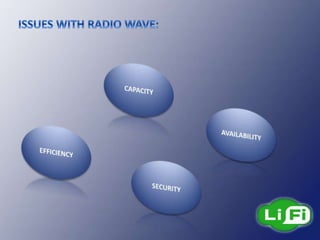
3. 4 issues with radio waves
4. Alternative for radio waves
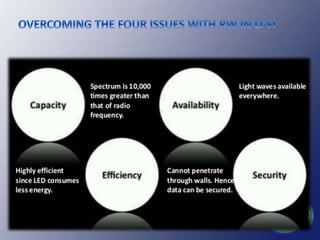
5. Overcoming the four issues with RW in LI-FI
6. Applications of LI-FI
7. Limitations of LI-FI
8. Conclusion.
FI
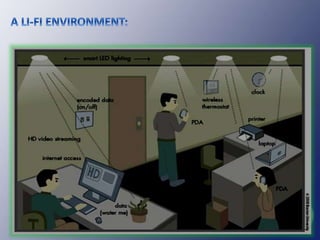
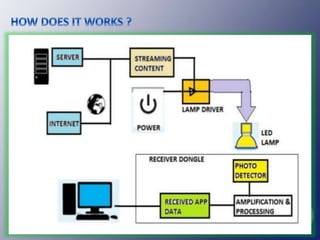
 LI-FI is a technology that uses the light emitting diodes to transmit the data
wirelessly.
 LI-FI is based on visible light communication(vlc).
 VLC is a data communication medium, which uses the visible light between
400 THz and 800 THz as optical carrier for data transmission
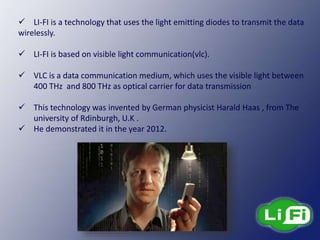
 This technology was invented by German physicist Harald Haas , from The
university of Rdinburgh, U.K .
 He demonstrated it in the year 2012.
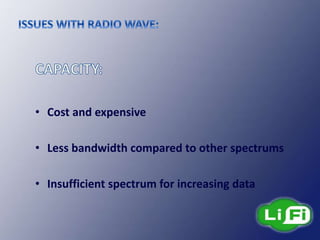
• Cost and expensive
• Less bandwidth compared to other spectrums
• Insufficient spectrum for increasing data
•Millions of base stations consume huge amount
of energy for:
1. Transmitting the radio waves
2. To cool the base station cabins
•5% Efficiency
•Available within the range of base stations
•Limited availability
•Unavailable in aircrafts
•Lesssecure (passes through the walls )
Mobiles, laptops, tablets, and other PDAs can easily
connect with each other. The short-range network of
Li-Fi can yield exceptionally high data rates and higher
security.
Unlike Wi-Fi, Li-Fi doesn’t emit any electromagnetic
interference. And so it will not interfere with or by
medical equipments like MRI scanners.
Using Li-Fi, aircraft passengers can access high-speed
internet via lights fitted over their seats. It can even
be used to integrate the passenger’s smartphones
with an In-flight Entertainment (IFE) system.
Li-Fi can also work underwater where Wi-Fi doesn’t
work at all. Thus Li-Fi has thrown open a world of
possibilities for military/navigation operations.
New generation vehicles are coming with LED
headlights and taillights. Street lights and traffic lights
are also shifting to energy-efficient LEDs. So, Li-Fi
technology can be easily used for vehicle-to-vehicle
and vehicle-to-roadside sensor communications for
road safety and traffic management system.
• Light can't pass through objects
• Interferences from external light sources like sun
light and normal bulbs will cause interruption in
the communication.
• High installation cost of the VLC systems
Although there’s still a long way to go to make this technology a
commercial success, it promises a great potential in the field of
wireless internet. In fact, as per MarketsandMarkets analysis,
the Li-Fi market is expected to be worth more than $6 billion by
2018. A significant number of researchers and companies are
currently working on this concept, which promises to solve the
problem of lack of spectrum space and low internet connection
speed. Plus, it will also allow internet access in those places or
fields where radio based wireless isn’t allowed. One thing’s for
sure, Li-Fi is the future of mobile internet.
LI-FI ( LIFI) TECHNOLOGY

LI-FI ( LIFI) TECHNOLOGY

  • 2.
    1. Introduction 2. Howdoes LI-FI Works ? 3. 4 issues with radio waves 4. Alternative for radio waves 5. Overcoming the four issues with RW in LI-FI 6. Applications of LI-FI 7. Limitations of LI-FI 8. Conclusion.
  • 3.
  • 4.
     LI-FI isa technology that uses the light emitting diodes to transmit the data wirelessly.  LI-FI is based on visible light communication(vlc).  VLC is a data communication medium, which uses the visible light between 400 THz and 800 THz as optical carrier for data transmission  This technology was invented by German physicist Harald Haas , from The university of Rdinburgh, U.K .  He demonstrated it in the year 2012.
  • 8.
    • Cost andexpensive • Less bandwidth compared to other spectrums • Insufficient spectrum for increasing data
  • 9.
    •Millions of basestations consume huge amount of energy for: 1. Transmitting the radio waves 2. To cool the base station cabins •5% Efficiency
  • 10.
    •Available within therange of base stations •Limited availability •Unavailable in aircrafts •Lesssecure (passes through the walls )
  • 13.
    Mobiles, laptops, tablets,and other PDAs can easily connect with each other. The short-range network of Li-Fi can yield exceptionally high data rates and higher security.
  • 14.
    Unlike Wi-Fi, Li-Fidoesn’t emit any electromagnetic interference. And so it will not interfere with or by medical equipments like MRI scanners.
  • 15.
    Using Li-Fi, aircraftpassengers can access high-speed internet via lights fitted over their seats. It can even be used to integrate the passenger’s smartphones with an In-flight Entertainment (IFE) system.
  • 16.
    Li-Fi can alsowork underwater where Wi-Fi doesn’t work at all. Thus Li-Fi has thrown open a world of possibilities for military/navigation operations.
  • 17.
    New generation vehiclesare coming with LED headlights and taillights. Street lights and traffic lights are also shifting to energy-efficient LEDs. So, Li-Fi technology can be easily used for vehicle-to-vehicle and vehicle-to-roadside sensor communications for road safety and traffic management system.
  • 18.
    • Light can'tpass through objects • Interferences from external light sources like sun light and normal bulbs will cause interruption in the communication. • High installation cost of the VLC systems
  • 19.
    Although there’s stilla long way to go to make this technology a commercial success, it promises a great potential in the field of wireless internet. In fact, as per MarketsandMarkets analysis, the Li-Fi market is expected to be worth more than $6 billion by 2018. A significant number of researchers and companies are currently working on this concept, which promises to solve the problem of lack of spectrum space and low internet connection speed. Plus, it will also allow internet access in those places or fields where radio based wireless isn’t allowed. One thing’s for sure, Li-Fi is the future of mobile internet.

Editor's Notes

  • #4 Every one of us have used and using Wi-Fi to access wireless internet. However, the biggest problem faced by the Wi-Fi users is that of slow Internet access speeds. Undue interference from other devices/equipments and loss of signal quality over the air are the main reasons for this issue. Keeping in mind these drawbacks, a new technology has been invented that allow use of the internet at the speed of light. It’s called Li-Fi (Light Fidelity)
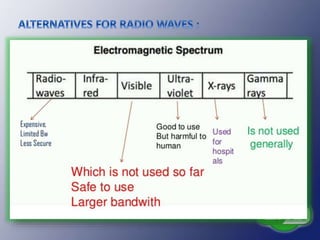
  • #12  Gama rays cant be used as they could be dangerous. X-rays have similar health issues. Ultraviolet light is good for place without people, but other wise dangerous for the human body. Infrared, due to eye safety regulation, can only bse used with low power.