Li-Fi Technology
A faster & brighter
light fidelity....
GROUP NUMBER : 1
ELECTRICAL III YEAR
CONTENTS
• Present approaches for the exchange of data
• Disadvantages of Wi-Fi
• Li-Fi over Wi-Fi
• What is Li-Fi?
• History of Li-Fi
• Benefits of light waves
• Working
• Application areas
• Research & Development
• Disadvantages
• Applications
• Ideas for more applications of this technology
PRESENT APPROACH TO
EXCHANGE DATA
(a) Copper (b) Optical Fiber (c) Wireless
Wire Cable Transmission
Fig 1: WAYS TO EXCHANGE DATA
WIRELESS FIDELITY
(WI-FI)
Fig 2:
ISSUES WITH WI-FI
• SIGNAL ATTENUATION
• DATA THEFT
• SLOW SPEED
• HIGH POWER CONSUMPTION Fig3 : DATA THEFT
GROWTH IN INTERNET USERS
(1993-2014)
Fig 4 : INTERNET LIVE STATS
SOURCE: (Elaboration of data by International Telecommunication
Union (ITU) and United Nations Population Division)
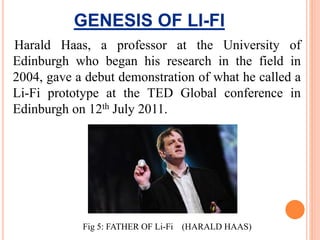
GENESIS OF LI-FI
Harald Haas, a professor at the University of
Edinburgh who began his research in the field in
2004, gave a debut demonstration of what he called a
Li-Fi prototype at the TED Global conference in
Edinburgh on 12th July 2011.
Fig 5: FATHER OF Li-Fi (HARALD HAAS)
WHAT IS LI-FI?
• Li-Fi is the transmission of data through illumination by
taking the fiber out of fiber optics by sending data
through a LED light bulb.
• This varies in intensity faster than human eye can follow.
• It is the fast and cheap wireless communication system
which is optical which is optical version of the Wi-Fi.
LI-FI VS WI-FI
HISTORY OF LI-FI
• The general term VLC(Visible Light Communication) whose
history dates back to the 1880s includes any use of the visible light
to transmit information.
• Technology truly began in 1990s in countries like Germany, Korea
and Japan where they discovered LEDs could be retrofitted to send
information.
• Harald Haas who is Professor at University of Edinburgh, U.K.
coined the term “LI-FI” at his TED Global Talk where he
introduced this idea of transmission.
HISTORY OF LI-FI (CONTD.)
• By the August 2013, data rates of over 1.6 Gbit/s were
demonstrated over a single colour LED.
• In April 2014, the Russian Company “Stins Coman”
announced the development of Li-Fi wireless local
network called Beam Caster which transfers data at 1.25
gigabytes/sec.
• In 2014 itself, a Mexican company Sisoft established
record by transferring data at speed of upto 10 Gbps.
Fig 6: HARALD HAAS
AT TED TALK 2011
BENEFITS OF LIGHT WAVES
Capacity
• Readily available form of energy and covers major
portion of EM spectrum.
• Visible light spectrum is 10000 times more compred
to radio wave spectrum.
Security
• Can’t pass through obstacle like wall which means
secure data transmission.
BENEFIT OF LIGHT WAVES (CONTD.)
Efficient
• Data transmission can reach upto thousand of gigabits per
second i.e. very rich data streaming.
• Data transmission for unit energy consumption is high in the
case of light waves.
Economic
• The tariff rates can be very cheap as light waves are a cheap
resources.
• Gama rays cant be used as they could be dangerous.
• X-rays have similar health issues.
• Ultraviolet light is good for place without people, but other
wise dangerous for the human body.
• Infrared, due to eye safety regulation, can only be used with
low power.
Radio
Waves
Infrared
Rays
Visible
Rays
Ultraviolet
Rays
X- Rays
Gama
Rays
WHY ONLY VLC?
WORKING PROCESS
• If the LED is ON, 1 is transmitted. If it is off, 0 is transmitted.
LEDs flicker at a very fast rate.
• A controller codes data into those LEDs. We have to just vary
the rate at which the LEDs flicker depending upon the data we
want to encode.
FIG 7: WORKING OF Li-Fi [2]
• Generally flickering lights are annoying but when they are
made to flicker at a very fast speed they can be a technological
asset.
• The amplitude of the light is varied at very high speed which
creates an impression that it is not actually blinking.
• Any LED light set if used along with a microchip inside it can
used to detect the changes in the light flickering thus helping in
converting light into data in its digital form.
• This very high speed blinking of the light enables the source to
transmit data in a rapid stream of binary code that, although
invisible to the naked eye, can be detected by a light sensitive
device.
• Thus every light emitting source can be used as a hub for data
transmission.
Fig 8: BLOCK DIAGRAM OF Li-Fi SYSTEM [1]
ARCHITECTURE OF LI-FI
• On one end all the data on the internet will be streamed to
a lamp driver.
• When the LED is turned on the microchip converts this
digital data in the form of light.
• On the other end this light is detected by photo sensitive
devices.
• Next this light is amplified and processed and then fed to
the device.
APPLICATION AREAS
Li Fi technology is still in its infancy . However some areas
where it seems perfectly applicable are:-
POTENTIAL APPLICATION OF LI-FI
1 . Traffic Lights :
Traffic lights can communicate
to the car and with each other.
Cars have LED-based
headlights, LED-based cack
lights, and cars can
communicate with each other
and prevent accidents in by
exchanging information.
TRAFFIC SCENARIO
• In traffic scenario, LIFI can be used to communicate
with the LED lights of cars .
• Cars can have LED-based headlights, backlights and can
communicate with each other.
• This might prevent accidents, by exchanging
information, when the vehicles are too close.
• Using LIFI, Street lights can be used to send information
about the road condition to the car.
2. Intrinsically Safe Environment :
Visible Light is more safe than RF, hence it can be used in
places where RF can't be used such as petrochemical plants .
3. Hospitals
(In Few Medical Equipment's) :
4. Airlines :
Whenever we travel through airways we face the problem in
communication media ,because the whole airways
communication are performed on the basis of radio waves. To
overcome this drawback on radioways , li-fi is introduced.
5. VLC SMARTPHONES
• The first VLC Smartphone was presented by Consumer
Electronics in January, 2014.
• The phone uses Wysips connect – a clear thin layer of
crystal glass is added to the small screens Smartphone
makes them solar powered.
• Smartphone could get 15% more battery life in a day
can communicate using Li-Fi.
6. LECTURE / SEMINAR HALLS
• Downloading notes from blogs of
teacher Often it is necessary to
download lecture notes from the
blogs of respective teachers. With
Li-Fi, the download can be done in
the hall itself Interactive classroom
with interconnected devices.
• The classroom will be more
interactive with the real-time
interconnectivity between 500
devices sharing views & queries
with the entire class.
• Each person’s queries, views and
clarifications can be shared not only
with the teacher, but with the entire
class.
7. On Ocean Beds :
Li-Fi can even wok underwater were Wi-Fi fails completely,
thereby throwing open endless opportunities for
military/navigation operations.
• There are millions of street lamps deployed around the world.
8. Street Lamps (As free Access Points) :
• Each of these street lamps could be a free access point.
A PROVEN TECHNOLOGY
• Harald has demonstrated Li-Fi
using an ordinary table lamp and a
computer located below the lamp.
• He successfully transmitted data at
speed exceeding 10Mbps using
light waves from LED light bulbs .
• Also he periodically blocked the
beam of light, causing the
connection to drop.
RESEARCH & DEVELOPMENT
• Harald Haas at TED Global
2015 demonstrated solar li-fi.
• He showed transmission
of video from a standard
off-the-shelf LED lamp to a
solar cell with laptop acting as
receiver.
FIG 9: HARALD HASS AT TED GLOBAL 2015
• Data is transported by light encoded in subtle changes of
brightness, if incoming light to solar cell fluctuates so does
energy harvested from solar cell.
• The fluctuations of energy harvested corresponds to data
transmitted.
• In lab, receiving speed of 50 mbps has been achieved by the
solar LI-FI.
• This is faster than most broadband connection these days.
• The point is to use existing infrastructure like solar panel
and LEDs to close the digital divide and to connect
billions of devices to internet .
• Thus solar panels used in the car roof, houses, street
lamp can now serve both the purposes of power source
as well as receiver.
• Light can't pass through objects
• Interferences from external light sources like sun light,
normal bulbs, and opaque materials in the path of
transmission will cause interruption in the communication.
• High installation cost of the VLC systems
• A major challenge facing Li-Fi is how the receiving
device will transmit back to transmitter.
LIMITATIONS OR CHALLENGES
STILL UNDER RESEARCH…
• What will be the effect of
interferences from external light
sources like sun light & normal
bulbs?
• What about the limited bandwidth
of the existing copper cables used
for electrical connections ?
• Where do the connections uplink,
how serious are the modifications
needed to the power grid ?
• How will other devices react if
you inject a high frequency into
mains ?
CONCLUSION
• Possibilities are numerous and can be explored further.
• It may offer a genuine and very efficient alternative to
radio based wireless.
• It also allows Internet where traditional radio-based
wireless is not allowed such as aircraft and hospitals.
• If this technology put into practical use, we will proceed
towards the cleaner, safer ,and brighter future.
REFERENCES
1. R. Sharma and A. Sanganal, "Li-fi Technology- Transmission of
data through light", IJCTA, vol. 5, no. 1, p. 5, 2014.
2. Chatterjee S, Agarwal S, Nath A. Scope and Challenges in Light
Fidelity(LiFi) Technology in Wireless Data Communication.
IJIRAE. 2015;2(6):9.
3. P. Sharma, "Comparative Study of Wi- fi", IJETAE, vol. 4, no. 5, p.
3, 2014.
4. TED Global Talk, "Wireless data from every light bulb". 2011.
5. TED Global Talk, "Forget Wi-Fi. Meet the new Li-Fi Internet".
2015.
6. Jyoti Rani, PrernaChauhan, RitikaTripathi, ?Li-Fi (Light Fidelity)-
The future technology In Wireless communication?, International
Journal of
7. Applied Engineering Research, ISSN 0973-4562 Vol.7 No.11
(2012).
8. R.Karthika, S.Balakrishnan “Wireless Communication using Li-Fi
Technology” SSRG International Journal of
9. Electronics and Communication Engineering (SSRG-IJECE)
volume 2 Issue 3 March 2015
10. Haas H, Yin L, Wang Y, Chen C. What is LiFi?. J Lightwave
Technol. 2015:1-1. doi:10.1109/jlt.2015.2510021.

Li-Fi

  • 1.
    Li-Fi Technology A faster& brighter light fidelity.... GROUP NUMBER : 1 ELECTRICAL III YEAR
  • 2.
    CONTENTS • Present approachesfor the exchange of data • Disadvantages of Wi-Fi • Li-Fi over Wi-Fi • What is Li-Fi? • History of Li-Fi • Benefits of light waves • Working • Application areas • Research & Development • Disadvantages • Applications • Ideas for more applications of this technology
  • 3.
    PRESENT APPROACH TO EXCHANGEDATA (a) Copper (b) Optical Fiber (c) Wireless Wire Cable Transmission Fig 1: WAYS TO EXCHANGE DATA
  • 4.
  • 5.
    ISSUES WITH WI-FI •SIGNAL ATTENUATION • DATA THEFT • SLOW SPEED • HIGH POWER CONSUMPTION Fig3 : DATA THEFT
  • 6.
    GROWTH IN INTERNETUSERS (1993-2014) Fig 4 : INTERNET LIVE STATS SOURCE: (Elaboration of data by International Telecommunication Union (ITU) and United Nations Population Division)
  • 7.
    GENESIS OF LI-FI HaraldHaas, a professor at the University of Edinburgh who began his research in the field in 2004, gave a debut demonstration of what he called a Li-Fi prototype at the TED Global conference in Edinburgh on 12th July 2011. Fig 5: FATHER OF Li-Fi (HARALD HAAS)
  • 8.
    WHAT IS LI-FI? •Li-Fi is the transmission of data through illumination by taking the fiber out of fiber optics by sending data through a LED light bulb. • This varies in intensity faster than human eye can follow. • It is the fast and cheap wireless communication system which is optical which is optical version of the Wi-Fi.
  • 9.
  • 10.
    HISTORY OF LI-FI •The general term VLC(Visible Light Communication) whose history dates back to the 1880s includes any use of the visible light to transmit information. • Technology truly began in 1990s in countries like Germany, Korea and Japan where they discovered LEDs could be retrofitted to send information. • Harald Haas who is Professor at University of Edinburgh, U.K. coined the term “LI-FI” at his TED Global Talk where he introduced this idea of transmission.
  • 11.
    HISTORY OF LI-FI(CONTD.) • By the August 2013, data rates of over 1.6 Gbit/s were demonstrated over a single colour LED. • In April 2014, the Russian Company “Stins Coman” announced the development of Li-Fi wireless local network called Beam Caster which transfers data at 1.25 gigabytes/sec. • In 2014 itself, a Mexican company Sisoft established record by transferring data at speed of upto 10 Gbps. Fig 6: HARALD HAAS AT TED TALK 2011
  • 12.
    BENEFITS OF LIGHTWAVES Capacity • Readily available form of energy and covers major portion of EM spectrum. • Visible light spectrum is 10000 times more compred to radio wave spectrum. Security • Can’t pass through obstacle like wall which means secure data transmission.
  • 13.
    BENEFIT OF LIGHTWAVES (CONTD.) Efficient • Data transmission can reach upto thousand of gigabits per second i.e. very rich data streaming. • Data transmission for unit energy consumption is high in the case of light waves. Economic • The tariff rates can be very cheap as light waves are a cheap resources.
  • 14.
    • Gama rayscant be used as they could be dangerous. • X-rays have similar health issues. • Ultraviolet light is good for place without people, but other wise dangerous for the human body. • Infrared, due to eye safety regulation, can only be used with low power. Radio Waves Infrared Rays Visible Rays Ultraviolet Rays X- Rays Gama Rays WHY ONLY VLC?
  • 15.
    WORKING PROCESS • Ifthe LED is ON, 1 is transmitted. If it is off, 0 is transmitted. LEDs flicker at a very fast rate. • A controller codes data into those LEDs. We have to just vary the rate at which the LEDs flicker depending upon the data we want to encode. FIG 7: WORKING OF Li-Fi [2]
  • 16.
    • Generally flickeringlights are annoying but when they are made to flicker at a very fast speed they can be a technological asset. • The amplitude of the light is varied at very high speed which creates an impression that it is not actually blinking. • Any LED light set if used along with a microchip inside it can used to detect the changes in the light flickering thus helping in converting light into data in its digital form.
  • 17.
    • This veryhigh speed blinking of the light enables the source to transmit data in a rapid stream of binary code that, although invisible to the naked eye, can be detected by a light sensitive device. • Thus every light emitting source can be used as a hub for data transmission.
  • 18.
    Fig 8: BLOCKDIAGRAM OF Li-Fi SYSTEM [1] ARCHITECTURE OF LI-FI
  • 19.
    • On oneend all the data on the internet will be streamed to a lamp driver. • When the LED is turned on the microchip converts this digital data in the form of light. • On the other end this light is detected by photo sensitive devices. • Next this light is amplified and processed and then fed to the device.
  • 20.
    APPLICATION AREAS Li Fitechnology is still in its infancy . However some areas where it seems perfectly applicable are:- POTENTIAL APPLICATION OF LI-FI 1 . Traffic Lights : Traffic lights can communicate to the car and with each other. Cars have LED-based headlights, LED-based cack lights, and cars can communicate with each other and prevent accidents in by exchanging information.
  • 21.
    TRAFFIC SCENARIO • Intraffic scenario, LIFI can be used to communicate with the LED lights of cars . • Cars can have LED-based headlights, backlights and can communicate with each other. • This might prevent accidents, by exchanging information, when the vehicles are too close. • Using LIFI, Street lights can be used to send information about the road condition to the car.
  • 22.
    2. Intrinsically SafeEnvironment : Visible Light is more safe than RF, hence it can be used in places where RF can't be used such as petrochemical plants .
  • 23.
    3. Hospitals (In FewMedical Equipment's) :
  • 24.
    4. Airlines : Wheneverwe travel through airways we face the problem in communication media ,because the whole airways communication are performed on the basis of radio waves. To overcome this drawback on radioways , li-fi is introduced.
  • 25.
    5. VLC SMARTPHONES •The first VLC Smartphone was presented by Consumer Electronics in January, 2014. • The phone uses Wysips connect – a clear thin layer of crystal glass is added to the small screens Smartphone makes them solar powered. • Smartphone could get 15% more battery life in a day can communicate using Li-Fi.
  • 26.
    6. LECTURE /SEMINAR HALLS • Downloading notes from blogs of teacher Often it is necessary to download lecture notes from the blogs of respective teachers. With Li-Fi, the download can be done in the hall itself Interactive classroom with interconnected devices. • The classroom will be more interactive with the real-time interconnectivity between 500 devices sharing views & queries with the entire class. • Each person’s queries, views and clarifications can be shared not only with the teacher, but with the entire class.
  • 27.
    7. On OceanBeds : Li-Fi can even wok underwater were Wi-Fi fails completely, thereby throwing open endless opportunities for military/navigation operations.
  • 28.
    • There aremillions of street lamps deployed around the world. 8. Street Lamps (As free Access Points) : • Each of these street lamps could be a free access point.
  • 29.
    A PROVEN TECHNOLOGY •Harald has demonstrated Li-Fi using an ordinary table lamp and a computer located below the lamp. • He successfully transmitted data at speed exceeding 10Mbps using light waves from LED light bulbs . • Also he periodically blocked the beam of light, causing the connection to drop.
  • 30.
    RESEARCH & DEVELOPMENT •Harald Haas at TED Global 2015 demonstrated solar li-fi. • He showed transmission of video from a standard off-the-shelf LED lamp to a solar cell with laptop acting as receiver. FIG 9: HARALD HASS AT TED GLOBAL 2015
  • 31.
    • Data istransported by light encoded in subtle changes of brightness, if incoming light to solar cell fluctuates so does energy harvested from solar cell. • The fluctuations of energy harvested corresponds to data transmitted. • In lab, receiving speed of 50 mbps has been achieved by the solar LI-FI. • This is faster than most broadband connection these days.
  • 32.
    • The pointis to use existing infrastructure like solar panel and LEDs to close the digital divide and to connect billions of devices to internet . • Thus solar panels used in the car roof, houses, street lamp can now serve both the purposes of power source as well as receiver.
  • 33.
    • Light can'tpass through objects • Interferences from external light sources like sun light, normal bulbs, and opaque materials in the path of transmission will cause interruption in the communication. • High installation cost of the VLC systems • A major challenge facing Li-Fi is how the receiving device will transmit back to transmitter. LIMITATIONS OR CHALLENGES
  • 34.
    STILL UNDER RESEARCH… •What will be the effect of interferences from external light sources like sun light & normal bulbs? • What about the limited bandwidth of the existing copper cables used for electrical connections ? • Where do the connections uplink, how serious are the modifications needed to the power grid ? • How will other devices react if you inject a high frequency into mains ?
  • 35.
    CONCLUSION • Possibilities arenumerous and can be explored further. • It may offer a genuine and very efficient alternative to radio based wireless. • It also allows Internet where traditional radio-based wireless is not allowed such as aircraft and hospitals. • If this technology put into practical use, we will proceed towards the cleaner, safer ,and brighter future.
  • 36.
    REFERENCES 1. R. Sharmaand A. Sanganal, "Li-fi Technology- Transmission of data through light", IJCTA, vol. 5, no. 1, p. 5, 2014. 2. Chatterjee S, Agarwal S, Nath A. Scope and Challenges in Light Fidelity(LiFi) Technology in Wireless Data Communication. IJIRAE. 2015;2(6):9. 3. P. Sharma, "Comparative Study of Wi- fi", IJETAE, vol. 4, no. 5, p. 3, 2014. 4. TED Global Talk, "Wireless data from every light bulb". 2011. 5. TED Global Talk, "Forget Wi-Fi. Meet the new Li-Fi Internet". 2015. 6. Jyoti Rani, PrernaChauhan, RitikaTripathi, ?Li-Fi (Light Fidelity)- The future technology In Wireless communication?, International Journal of 7. Applied Engineering Research, ISSN 0973-4562 Vol.7 No.11 (2012).
  • 37.
    8. R.Karthika, S.Balakrishnan“Wireless Communication using Li-Fi Technology” SSRG International Journal of 9. Electronics and Communication Engineering (SSRG-IJECE) volume 2 Issue 3 March 2015 10. Haas H, Yin L, Wang Y, Chen C. What is LiFi?. J Lightwave Technol. 2015:1-1. doi:10.1109/jlt.2015.2510021.