CONTENTS
 HISTORY
 INTRODUCTION TO LI-FI
 HOW DOES IT WORKS?
 COMPARISON WITH WI-FI
 OVERCOMING THE 4 ISSUES WITH
RADIOWAVE IN LI-FI
 APPLICATION OF LI-FI
 Advantages of LiFi
 Limitations of LiFi
 Conclusion
HISTORY
 The technology truly began during the 1990's in
countries like Germany, Korea, and Japan where they
discovered LED's could be retrofitted to send
information. Harald Haas continues to wow the world
with the potential to use light for communication.
 German physicist Dr. Harald Haas, has started
working on transmission of data using visible light
back in 2004.
 In the year 2011 he first introduced to the world this
new technology ,LI FI in the TED talk show.
 He envisions a future where data for laptops and
other mobile devices is transmitted through a light in a
room.
INTRODUCTION
 This technology was invented by GERMAN
PHYSICIST HARALD HAAS , from the university of
EDINBURGH ,U.K .
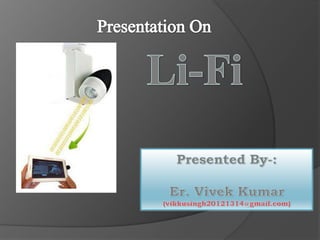
 LI-FI stands for LIGHT FIDELITY and LI-FI is
transmission technology of data through
ILLUMINATION.
 Based on VISIBLE LIGHT COMMUNICATION(VLC).
 VLC is a data communication medium, which uses the
visible light between 400 THz to 800 THz (375 nm) as
optical carrier for data transmission.
INTRODUCTION
 LI FI (light fidelity) is data through illumination-
taking the fiber out of fiber optics by sending
data through an LED light bulb that varies in
intensity faster than the human eye can notice.
 At the heart of this technology is a new
generation of high brightness LEDs.
 If the LED is on a digital 1 is transmitted, if the
LED is off then a digital 0 is transmitted.They
can be switched on and off in order to transmit
data continuously.
operational procedure is very simple, if the led is on,
you transmit a digital 1, if its off you transmit a 0. The
LEDs can be switched on and off very quickly, which
gives nice opportunities for transmitting data. Hence
all that us required is some LEDS and a controller that
code data into those LEDs. We have to just vary the
rate at which the LED’s
flicker depending upon the data we want to encode
Thus every light source will
works as a hub for data
transmission
HOW DOES LI-FI WORKS?
COMPARISON WITH WI-FI
Characteristic Wi-Fi Li-Fi
Frequency 5 GHz No frequency for light
Standard IEEE 802.11 IEEE 802.15
Range 100 meters Base on LED light
Primary application Wireless local area
networking
Cost Low Medium high
Wireless local area
networking
Data transfer rate 800 Kbps - 11 Mbps >1Gbps
Power consumption Medium Low
Cost Medium High
Security Its medium secure Its high secure
Characteristic Wi-Fi Li-Fi
Primary devices Notebook computers,
desktop
computers, servers, TV,
Latest Wi-Fi
mobiles.
Mobile phones, office and
industrial
automatic devices,
notebook
computers, desktop
computers, servers
computers, TV and latest
upcoming devices with
Li-Fi
Primary users Corporate campus users,
homes and
others public places
Traveling employees,
home users, others
public places ,office and
industrial workers
Usage location With in range of WLAN
infrastructure, usually
inside a Building
Where ever light is
available, it may
a public place ,home,
office and road
Etc
Development started 1990 2011
COMPARISON WITH WI-FI
OVERCOMING THE 4 ISSUES WITH
RADIOWAVE IN LI-FI
Capacity
Availability
Efficiency
Security
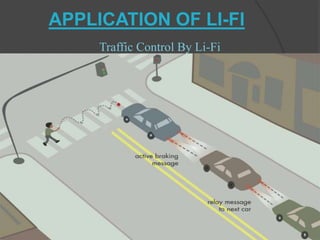
APPLICATION OF LI-FI
Traffic Control By Li-Fi
Airlines
Advantages of Li-Fi
 You Can Use Li-Fi In Hospitals And Aircrafts Also.
 Cheaper Then WiFi , Since Visible Light Spectrum Is A Free
Spectrum Band.
 No License Needed.
 Thousands And Millions Of Street Lamps Can Be Converted
To Li-fi Spots.
 Light Is Readily Available In Every Part Of The World.
 This Makes It Easy For People In Airplanes To Work On The
Internet.
 There Are An Estimated 14 Billion Light Sources On Earth
And Each Can Be Easily Converted Into A Li-Fi Hotspot.
Limitations of Li-Fi
 There should be line of sight between sender and receiver
 Visible light cannot penetrate through solid objects
 Interference with other electromagnetic waves makes the
transmitting data to distort
 Light cannot approach the range and penetration of radio waves
 High installation cost of the VLC systems
 A major challenge facing Li-Fi is how the receiving device will
transmit back to transmitter.
 Interferences from external light sources like sun light, normal
bulbs, and opaque materials in the path of transmission will cause
interruption in the communication.
The possibilities are numerous and can be explored
further. If this technology can be put into practical
use, every bulb can be used something like Wi-Fi
hotspot to transmit wireless data and we will
proceed onwards the..
Cleaner, Greener, Safer and Brighter future.
Conclusion
Li fi Technology

Li fi Technology

  • 2.
    CONTENTS  HISTORY  INTRODUCTIONTO LI-FI  HOW DOES IT WORKS?  COMPARISON WITH WI-FI  OVERCOMING THE 4 ISSUES WITH RADIOWAVE IN LI-FI  APPLICATION OF LI-FI  Advantages of LiFi  Limitations of LiFi  Conclusion
  • 3.
    HISTORY  The technologytruly began during the 1990's in countries like Germany, Korea, and Japan where they discovered LED's could be retrofitted to send information. Harald Haas continues to wow the world with the potential to use light for communication.  German physicist Dr. Harald Haas, has started working on transmission of data using visible light back in 2004.  In the year 2011 he first introduced to the world this new technology ,LI FI in the TED talk show.  He envisions a future where data for laptops and other mobile devices is transmitted through a light in a room.
  • 4.
    INTRODUCTION  This technologywas invented by GERMAN PHYSICIST HARALD HAAS , from the university of EDINBURGH ,U.K .  LI-FI stands for LIGHT FIDELITY and LI-FI is transmission technology of data through ILLUMINATION.  Based on VISIBLE LIGHT COMMUNICATION(VLC).  VLC is a data communication medium, which uses the visible light between 400 THz to 800 THz (375 nm) as optical carrier for data transmission.
  • 5.
    INTRODUCTION  LI FI(light fidelity) is data through illumination- taking the fiber out of fiber optics by sending data through an LED light bulb that varies in intensity faster than the human eye can notice.  At the heart of this technology is a new generation of high brightness LEDs.  If the LED is on a digital 1 is transmitted, if the LED is off then a digital 0 is transmitted.They can be switched on and off in order to transmit data continuously.
  • 6.
    operational procedure isvery simple, if the led is on, you transmit a digital 1, if its off you transmit a 0. The LEDs can be switched on and off very quickly, which gives nice opportunities for transmitting data. Hence all that us required is some LEDS and a controller that code data into those LEDs. We have to just vary the rate at which the LED’s flicker depending upon the data we want to encode Thus every light source will works as a hub for data transmission HOW DOES LI-FI WORKS?
  • 7.
  • 8.
    COMPARISON WITH WI-FI CharacteristicWi-Fi Li-Fi Frequency 5 GHz No frequency for light Standard IEEE 802.11 IEEE 802.15 Range 100 meters Base on LED light Primary application Wireless local area networking Cost Low Medium high Wireless local area networking Data transfer rate 800 Kbps - 11 Mbps >1Gbps Power consumption Medium Low Cost Medium High Security Its medium secure Its high secure
  • 9.
    Characteristic Wi-Fi Li-Fi Primarydevices Notebook computers, desktop computers, servers, TV, Latest Wi-Fi mobiles. Mobile phones, office and industrial automatic devices, notebook computers, desktop computers, servers computers, TV and latest upcoming devices with Li-Fi Primary users Corporate campus users, homes and others public places Traveling employees, home users, others public places ,office and industrial workers Usage location With in range of WLAN infrastructure, usually inside a Building Where ever light is available, it may a public place ,home, office and road Etc Development started 1990 2011 COMPARISON WITH WI-FI
  • 10.
    OVERCOMING THE 4ISSUES WITH RADIOWAVE IN LI-FI Capacity Availability Efficiency Security
  • 11.
  • 12.
  • 13.
    Advantages of Li-Fi You Can Use Li-Fi In Hospitals And Aircrafts Also.  Cheaper Then WiFi , Since Visible Light Spectrum Is A Free Spectrum Band.  No License Needed.  Thousands And Millions Of Street Lamps Can Be Converted To Li-fi Spots.  Light Is Readily Available In Every Part Of The World.  This Makes It Easy For People In Airplanes To Work On The Internet.  There Are An Estimated 14 Billion Light Sources On Earth And Each Can Be Easily Converted Into A Li-Fi Hotspot.
  • 14.
    Limitations of Li-Fi There should be line of sight between sender and receiver  Visible light cannot penetrate through solid objects  Interference with other electromagnetic waves makes the transmitting data to distort  Light cannot approach the range and penetration of radio waves  High installation cost of the VLC systems  A major challenge facing Li-Fi is how the receiving device will transmit back to transmitter.  Interferences from external light sources like sun light, normal bulbs, and opaque materials in the path of transmission will cause interruption in the communication.
  • 15.
    The possibilities arenumerous and can be explored further. If this technology can be put into practical use, every bulb can be used something like Wi-Fi hotspot to transmit wireless data and we will proceed onwards the.. Cleaner, Greener, Safer and Brighter future. Conclusion