
Chameli Devi School Of EngineeringChameli Devi School Of Engineering
Dept. Of Computer Science And EngineeringDept. Of Computer Science And Engineering
Submitted To : Mr. Chaitanya Singh Submitted By: Ankit Joshi
CSE 8th
sem
Guided By : Mr. Yashwant Patel (0832CS121016)
Presentation On :
Light Fidelity (Li-Fi)
CCONTENTS ::
 WHAT IS LI-FI
 HISTORY
 TIMELINE OF LIFI – THE LIFI STORY
 PRESENT SCENARIO
 HOW LIFI WORKS
 CONSTRUCTION
 LIFI V/S WIFI
 APPLICATIONS
 LIMITATIONS
 MYTHS
 CONCLUSION
 REFRENCES
What Is Lifi:
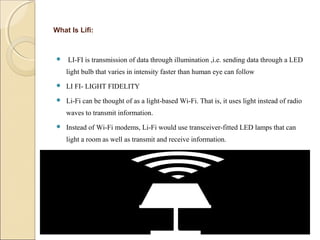
 LI-FI is transmission of data through illumination ,i.e. sending data through a LED
light bulb that varies in intensity faster than human eye can follow
 LI FI- LIGHT FIDELITY
 Li-Fi can be thought of as a light-based Wi-Fi. That is, it uses light instead of radio
waves to transmit information.
 Instead of Wi-Fi modems, Li-Fi would use transceiver-fitted LED lamps that can
light a room as well as transmit and receive information.
History :
 The technology truly began during the 1990's in countries like Germany, Korea, and Japan
where they discovered LED's could be retrofitted to send information. Harold Haas continues to
wow the world with the potential to use light for communication.
 on 12th July 2011. He used a table lamp with an LED bulb to transmit a video of blooming
flowers that was then projected onto a screen behind him. During the event he periodically
blocked the light from lamp to prove that the lamp was indeed the source of incoming data.
 At TED Global, Haas demonstrated a data rate of transmission of around 10Mbps -- comparable
to a fairly good UK broadband connection. Two months later he achieved 123Mbps.
 Back in 2011 German scientists succeeded in creating an800Mbps (Megabits per second)
capable wireless network by using nothing more than normal red, blue, green and yellow.
Present Scenario :
 Radio Spectrum is congested but the demand for wireless data double each year
.Every thing, it seems want to use wireless data but the capacity is drying up.
 Gama rays cant be used as they could be dangerous.
 X-rays have similar health issues.
 Ultraviolet light is good for place without people, but other wise dangerous for the
human body.
 Infrared, due to eye safety regulation, can only be used with low power.
How LI-FI Works?
 LED i.e. Light emitting diode can be switched on and off faster since operating speed of
LED is less than 1 μs, than the human eye can detect.
 This invisible on-off activity enables a kind of data transmission using binary codes. If the
led is on, you transmit a digital 1, if its off you transmit a 0.
 It is possible to encode data in the light by varying the rate at which LED’s flicker on and
off to give different strings of 1s and 0s.
 Modulation is so fast that human eye doesn’t notice.
 Hence all that us required is some LEDS and a controller that code data into those LEDs.
WORKING (Contd.):
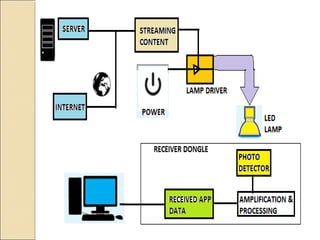
WORKING (DIAGRAMATIC) :
LI-FI CONSTRUCTION :
 The LI FI product consists of 4 primary sub-assemblies:
• Bulb
• RF power amplifier circuit (PA)
• Printed circuit board (PCB)
• Enclosure
 The PCB controls the electrical inputs and outputs of the lamp and houses the
microcontroller used to manage different lamp functions.
 An RF (radio-frequency) signal is generated by the solid-state PA and is guided into
an electric field about the bulb.
Comparison Between LI-FI And WI-FI:
Applications :
1. Traffic Lights & Vehicles :
In vehicles and traffic lights, reducing accidents and traffic congestion.
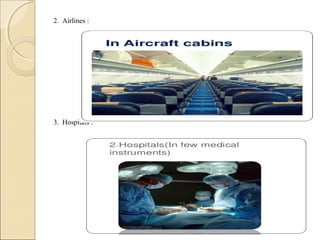
2. Airlines :
3. Hospitals :
4. Oceans And Seas :
 Li-Fi can even wok underwater were Wi-Fi fails completely, thereby throwing open
endless opportunities for military/navigation operations.
5. Street Lamps:
 There are millions of street lamps deployed around the world.
 Each of these street lamps could be a free access point.
Limitations :
 Light can't pass through objects.
 Interferences from external light sources like sun light, normal bulbs, and opaque
materials in the path of transmission will cause interruption in the communication.
 High installation cost of the VLC systems
 A major challenge facing Li-Fi is how the receiving device will transmit back to
transmitter.
Myths :
 LiFi is not “100x faster than WiFi.” The latest WiFi standard (IEEE 802.11ad) or
Wi-Gig supports data rates of 7 Gbps. LiFi has never achieved 700 Gbps.
 The type of light source (large LED light, smaller LED lights, laser LEDs, etc.)
directly impact the speed that can be achieved by a LiFi solution.
 Laboratory experiments have achieved 100 Gbps with laser LEDs. This impressive
result is over 10x faster than the fastest Wi-Gig.
 Internet speeds depend on the Internet Service Provider as much as your WiFi access
point. LiFi data rates will be limited by what is offered from the Internet Service
Providers.
CONCLUSION :
The possibilities are numerous and can be explored further. If this technology can be
put into practical use , every bulb can be used something like a Wi-Fi hotspots to
transmit wireless data. The easy availablity of lights as well as the fact that they are
not only safe, but also almost unlimited is another added benefit of using the lifi
technology. Though it is still being tested in the labs, but the results have been pretty
astonishing. As of now, a speed of almost 223 GB/sec have been achieved. At this
speed, Internet can be then our best friend.
REFRENCES :
1. Youtube: Li-Fi, 100X Faster Than Wi-Fi! | ColdFusion video
https://www.youtube.com/watch?v=wqH9KX9o0vg
2. Wikipedia:
https://en.wikipedia.org/wiki/Li-Fi
1. PureLifi – The Lifi Story
http://purelifi.com/what_is_li-fi/the-lifi-story/
THANKTHANK
YOUYOU
ANY QUERIES?ANY QUERIES?

Lifi

  • 1.
    Chameli Devi SchoolOf EngineeringChameli Devi School Of Engineering Dept. Of Computer Science And EngineeringDept. Of Computer Science And Engineering Submitted To : Mr. Chaitanya Singh Submitted By: Ankit Joshi CSE 8th sem Guided By : Mr. Yashwant Patel (0832CS121016) Presentation On : Light Fidelity (Li-Fi)
  • 2.
    CCONTENTS ::  WHATIS LI-FI  HISTORY  TIMELINE OF LIFI – THE LIFI STORY  PRESENT SCENARIO  HOW LIFI WORKS  CONSTRUCTION  LIFI V/S WIFI  APPLICATIONS  LIMITATIONS  MYTHS  CONCLUSION  REFRENCES
  • 3.
    What Is Lifi: LI-FI is transmission of data through illumination ,i.e. sending data through a LED light bulb that varies in intensity faster than human eye can follow  LI FI- LIGHT FIDELITY  Li-Fi can be thought of as a light-based Wi-Fi. That is, it uses light instead of radio waves to transmit information.  Instead of Wi-Fi modems, Li-Fi would use transceiver-fitted LED lamps that can light a room as well as transmit and receive information.
  • 4.
    History :  Thetechnology truly began during the 1990's in countries like Germany, Korea, and Japan where they discovered LED's could be retrofitted to send information. Harold Haas continues to wow the world with the potential to use light for communication.  on 12th July 2011. He used a table lamp with an LED bulb to transmit a video of blooming flowers that was then projected onto a screen behind him. During the event he periodically blocked the light from lamp to prove that the lamp was indeed the source of incoming data.  At TED Global, Haas demonstrated a data rate of transmission of around 10Mbps -- comparable to a fairly good UK broadband connection. Two months later he achieved 123Mbps.  Back in 2011 German scientists succeeded in creating an800Mbps (Megabits per second) capable wireless network by using nothing more than normal red, blue, green and yellow.
  • 6.
    Present Scenario : Radio Spectrum is congested but the demand for wireless data double each year .Every thing, it seems want to use wireless data but the capacity is drying up.  Gama rays cant be used as they could be dangerous.  X-rays have similar health issues.  Ultraviolet light is good for place without people, but other wise dangerous for the human body.  Infrared, due to eye safety regulation, can only be used with low power.
  • 7.
    How LI-FI Works? LED i.e. Light emitting diode can be switched on and off faster since operating speed of LED is less than 1 μs, than the human eye can detect.  This invisible on-off activity enables a kind of data transmission using binary codes. If the led is on, you transmit a digital 1, if its off you transmit a 0.  It is possible to encode data in the light by varying the rate at which LED’s flicker on and off to give different strings of 1s and 0s.  Modulation is so fast that human eye doesn’t notice.  Hence all that us required is some LEDS and a controller that code data into those LEDs.
  • 9.
  • 10.
  • 11.
    LI-FI CONSTRUCTION : The LI FI product consists of 4 primary sub-assemblies: • Bulb • RF power amplifier circuit (PA) • Printed circuit board (PCB) • Enclosure  The PCB controls the electrical inputs and outputs of the lamp and houses the microcontroller used to manage different lamp functions.  An RF (radio-frequency) signal is generated by the solid-state PA and is guided into an electric field about the bulb.
  • 12.
  • 13.
    Applications : 1. TrafficLights & Vehicles : In vehicles and traffic lights, reducing accidents and traffic congestion.
  • 14.
    2. Airlines : 3.Hospitals :
  • 15.
    4. Oceans AndSeas :  Li-Fi can even wok underwater were Wi-Fi fails completely, thereby throwing open endless opportunities for military/navigation operations. 5. Street Lamps:  There are millions of street lamps deployed around the world.  Each of these street lamps could be a free access point.
  • 16.
    Limitations :  Lightcan't pass through objects.  Interferences from external light sources like sun light, normal bulbs, and opaque materials in the path of transmission will cause interruption in the communication.  High installation cost of the VLC systems  A major challenge facing Li-Fi is how the receiving device will transmit back to transmitter.
  • 17.
    Myths :  LiFiis not “100x faster than WiFi.” The latest WiFi standard (IEEE 802.11ad) or Wi-Gig supports data rates of 7 Gbps. LiFi has never achieved 700 Gbps.  The type of light source (large LED light, smaller LED lights, laser LEDs, etc.) directly impact the speed that can be achieved by a LiFi solution.  Laboratory experiments have achieved 100 Gbps with laser LEDs. This impressive result is over 10x faster than the fastest Wi-Gig.  Internet speeds depend on the Internet Service Provider as much as your WiFi access point. LiFi data rates will be limited by what is offered from the Internet Service Providers.
  • 18.
    CONCLUSION : The possibilitiesare numerous and can be explored further. If this technology can be put into practical use , every bulb can be used something like a Wi-Fi hotspots to transmit wireless data. The easy availablity of lights as well as the fact that they are not only safe, but also almost unlimited is another added benefit of using the lifi technology. Though it is still being tested in the labs, but the results have been pretty astonishing. As of now, a speed of almost 223 GB/sec have been achieved. At this speed, Internet can be then our best friend.
  • 19.
    REFRENCES : 1. Youtube:Li-Fi, 100X Faster Than Wi-Fi! | ColdFusion video https://www.youtube.com/watch?v=wqH9KX9o0vg 2. Wikipedia: https://en.wikipedia.org/wiki/Li-Fi 1. PureLifi – The Lifi Story http://purelifi.com/what_is_li-fi/the-lifi-story/
  • 20.