Light
Light
Why is light important?
Light
• We see things every day, from the
moment we get up in the morning
until we go to sleep at night.
• We look at everything around us
using light.
• Without light, you wouldn't see
anything at all.
• There are two types of light: natural
light or artificial light.
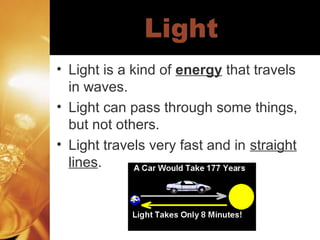
• Light travels VERY FAST – around
300,000 kilometres per second.

At this
speed it
can go
around the
world 8
times in
one
second.
Lightning
• Light travels faster than sound.
• That is why the lightning is seen
before the thunder is heard.
Natural Light
• The most important source of natural
light is the sun.
• The sun gives the earth light and
energy.
• The moon and stars receive light
from the sun and reflects it to the
earth.
• A firefly also produces light.
Artificial Light
• Artificial light is light that is made
by people, or man-made.
• This includes candles, kerosene
lamps, flashlights, and light bulbs.
Light
• Light is a kind of energy that travels
in waves.
• Light can pass through some things,
but not others.
• Light travels very fast and in straight
lines.
Transparent
• An object that lets all light pass
through it is called transparent.
• These objects are transparent: clear
glass, eyeglasses, window, fish tank,
clear plastics, and transparent tape.
Translucent
• An object that lets some light pass
through it is called translucent.
• These objects are translucent:
waxed paper, sunglasses, frosted
glass, and thin fabrics.
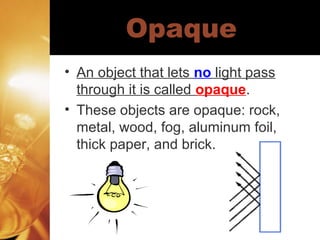
Opaque
• An object that lets no light pass
through it is called opaque.
• These objects are opaque: rock,
metal, wood, fog, aluminum foil,
thick paper, and brick.
Shadows
• Shadows are caused
by opaque objects
blocking the path of
light.
• Long shadows are
seen in early morning
and late afternoon.
• Shorter shadows are
seen at noon.
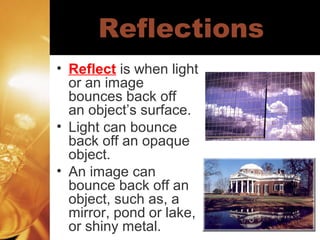
Reflections
• Reflect is when light
or an image
bounces back off
an object’s surface.
• Light can bounce
back off an opaque
object.
• An image can
bounce back off an
object, such as, a
mirror, pond or lake,
or shiny metal.
More Reflections
on

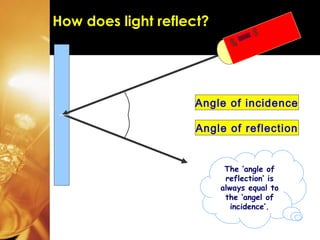
How does light reflect?
off

Angle of incidence
Angle of reflection

The ‘angle of
reflection’ is
always equal to
the ‘angel of
incidence’.
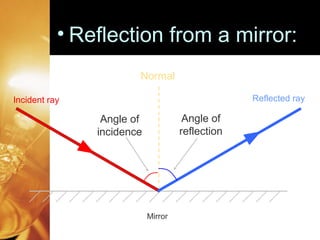
• Reflection from a mirror:
Normal
Reflected ray

Incident ray

Angle of
reflection

Angle of
incidence

Mirror
• The Law of Reflection
Angle of incidence = Angle of reflection
In other words, light gets reflected from a
surface at ____ _____ angle it hits it.
The same !!!
on

Light can only be reflected
in straight lines.
off
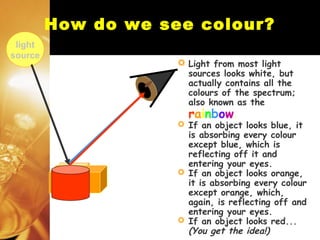
How do we see colour?
light
source

 Light







from most light
sources looks white, but
actually contains all the
colours of the spectrum;
also known as the
rainbow.
If an object looks blue, it
is absorbing every colour
except blue, which is
reflecting off it and
entering your eyes.
If an object looks orange,
it is absorbing every colour
except orange, which,
again, is reflecting off and
entering your eyes.
If an object looks red...
(You get the idea!)
Seeing colour
• The colour an object appears depends on the
colours of light it reflects.
For example, a red book only reflects red light:

White
light

Only red light
is reflected
Spectrum of Color
• When you look at a light, it appears to be white.
• Light is made up of many colors. These
colors can be seen when light is broken up.
• There are seven colors of light in a spectrum:
red, orange, yellow, green, blue, purple, and
violet.
• These colors are always seen in the same
order.
Rainbow
• A rainbow appears in the
sky when the sun shines
through droplets of water
in the air, creating a
spectrum of color.
• The white light is broken
up into many colors.
The colours of the rainbow:

• Red
• Orange
• Yellow
• Green
• Blue
• Indigo
• Violet
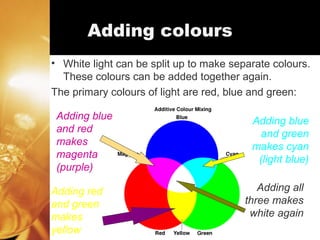
Adding colours
• White light can be split up to make separate colours.
These colours can be added together again.
The primary colours of light are red, blue and green:
Adding blue
and red
makes
magenta
(purple)
Adding red
and green
makes
yellow

Adding blue
and green
makes cyan
(light blue)
Adding all
three makes
white again
Light
Light

Light

  • 1.
  • 2.
  • 3.
    Light • We seethings every day, from the moment we get up in the morning until we go to sleep at night. • We look at everything around us using light. • Without light, you wouldn't see anything at all. • There are two types of light: natural light or artificial light.
  • 4.
    • Light travelsVERY FAST – around 300,000 kilometres per second. At this speed it can go around the world 8 times in one second.
  • 5.
    Lightning • Light travelsfaster than sound. • That is why the lightning is seen before the thunder is heard.
  • 6.
    Natural Light • Themost important source of natural light is the sun. • The sun gives the earth light and energy. • The moon and stars receive light from the sun and reflects it to the earth. • A firefly also produces light.
  • 7.
    Artificial Light • Artificiallight is light that is made by people, or man-made. • This includes candles, kerosene lamps, flashlights, and light bulbs.
  • 8.
    Light • Light isa kind of energy that travels in waves. • Light can pass through some things, but not others. • Light travels very fast and in straight lines.
  • 9.
    Transparent • An objectthat lets all light pass through it is called transparent. • These objects are transparent: clear glass, eyeglasses, window, fish tank, clear plastics, and transparent tape.
  • 10.
    Translucent • An objectthat lets some light pass through it is called translucent. • These objects are translucent: waxed paper, sunglasses, frosted glass, and thin fabrics.
  • 11.
    Opaque • An objectthat lets no light pass through it is called opaque. • These objects are opaque: rock, metal, wood, fog, aluminum foil, thick paper, and brick.
  • 12.
    Shadows • Shadows arecaused by opaque objects blocking the path of light. • Long shadows are seen in early morning and late afternoon. • Shorter shadows are seen at noon.
  • 13.
    Reflections • Reflect iswhen light or an image bounces back off an object’s surface. • Light can bounce back off an opaque object. • An image can bounce back off an object, such as, a mirror, pond or lake, or shiny metal.
  • 14.
  • 15.
    on How does lightreflect? off Angle of incidence Angle of reflection The ‘angle of reflection’ is always equal to the ‘angel of incidence’.
  • 16.
    • Reflection froma mirror: Normal Reflected ray Incident ray Angle of reflection Angle of incidence Mirror
  • 17.
    • The Lawof Reflection Angle of incidence = Angle of reflection In other words, light gets reflected from a surface at ____ _____ angle it hits it. The same !!!
  • 18.
    on Light can onlybe reflected in straight lines. off
  • 19.
    How do wesee colour? light source  Light    from most light sources looks white, but actually contains all the colours of the spectrum; also known as the rainbow. If an object looks blue, it is absorbing every colour except blue, which is reflecting off it and entering your eyes. If an object looks orange, it is absorbing every colour except orange, which, again, is reflecting off and entering your eyes. If an object looks red... (You get the idea!)
  • 20.
    Seeing colour • Thecolour an object appears depends on the colours of light it reflects. For example, a red book only reflects red light: White light Only red light is reflected
  • 21.
    Spectrum of Color •When you look at a light, it appears to be white. • Light is made up of many colors. These colors can be seen when light is broken up. • There are seven colors of light in a spectrum: red, orange, yellow, green, blue, purple, and violet. • These colors are always seen in the same order.
  • 22.
    Rainbow • A rainbowappears in the sky when the sun shines through droplets of water in the air, creating a spectrum of color. • The white light is broken up into many colors.
  • 23.
    The colours ofthe rainbow: • Red • Orange • Yellow • Green • Blue • Indigo • Violet
  • 24.
    Adding colours • Whitelight can be split up to make separate colours. These colours can be added together again. The primary colours of light are red, blue and green: Adding blue and red makes magenta (purple) Adding red and green makes yellow Adding blue and green makes cyan (light blue) Adding all three makes white again