LIGHT, SHADAOWS AND REFLECTIONS
How do we see things around us ?
 We see so many objects around us, colorful and
different. On the way to school we see things like
buses, cars, cycles, trees, animals and sometimes
flowers. How do you think, we see all these objects?
 can you imagine to see things in dark room?
What is light?
 Light is the form of energy that enables us to see
objects around us.
 Nothing is visible to us in dark room and unless an
object is lighted, its not visible to us.
Sources of light
 LUMINIOUS OBJECT: object that gives off light of their
own. For ex sun, stars etc.
 NON LUMINIOUS OBJECT: objects that do not give out
light of their own. For example table , chair, book,
pencil etc.
OPAQUE OBJECTS
 Opaque objects do not let any light to pass through
them.
 Examples: wood
TRANSPARENT OBJECTS
 Transparent object allow us to see clearly through
them.
 Examples: glass window
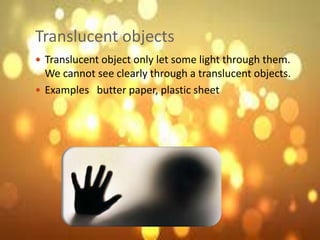
Translucent objects
 Translucent object only let some light through them.
We cannot see clearly through a translucent objects.
 Examples butter paper, plastic sheet
PROPOGATION OF LIGHT
 Light always travel in straight lines
 This property of light to travel in straight line called
rectilinear propagation of light
ACTVITY
 AIM: To verify that light travel in a straight line.
 Material needed: a rubber tube about 40-50 cm long, a colorful.
 Method:
 1 Place a candle in front of you , and now with the help of the rubber
tube, see the flame of lighted candle.
 2 What do you see?
 3 Now bend the tube and try to see the flame again. Would you able
to see the flame?
 OBSERVATION: This indicate that light travel in straight line.
SHADOW
 Any object can make a shadow if it blocks the light.
Properties of shadow
 A shadow is always dark and is formed only where there is bright
light.
 .The shadow is always formed in direction opposite to that of the
source of light.
 The shape and size of the shadow depends upon the source of light
and on object
Images
 When a beam of light falls on the polished surface it is
reflected back and we are able to see that image of
the object through our eyes.
Reflection
• Reflection is light bouncing off a very smooth surface.
• You look into the mirror and see your own face inside
the mirror. What you see is a reflection of your face in
the mirror.
 Mirror are smooth reflecting surfaces.
 Water also act as reflecting. It’s a regular or smooth
reflecting surface.
Now your turn
 Classify the given objects as luminous and non
luminous objects
 Moon, bulb, sun, candle, wood, stars, shoe, pencil,
table , book.
 Luminous Non luminous
 Bulb wood
 sun shoe
 candle pencil
 stars table ,book
Classify the objects in the table as the
transparent, translucent, and opaque.
 Objects classification
 Spectacle lens transparent
 Plastic sheet translucent
 Metal spoon opaque
 Clear water transparent
 Wooden door opaque
REFERENCE
 N.C.E.R.T CLASS 6
 JIWAN GLOBAL SCIENCE CLASS 6
 GOOGLE IMAGES
 WIKIPEDIA
 GOOGLE
THANKYOU

Manjeeta(019)

  • 1.
  • 2.
    How do wesee things around us ?  We see so many objects around us, colorful and different. On the way to school we see things like buses, cars, cycles, trees, animals and sometimes flowers. How do you think, we see all these objects?  can you imagine to see things in dark room?
  • 3.
    What is light? Light is the form of energy that enables us to see objects around us.  Nothing is visible to us in dark room and unless an object is lighted, its not visible to us.
  • 4.
    Sources of light LUMINIOUS OBJECT: object that gives off light of their own. For ex sun, stars etc.
  • 5.
     NON LUMINIOUSOBJECT: objects that do not give out light of their own. For example table , chair, book, pencil etc.
  • 6.
    OPAQUE OBJECTS  Opaqueobjects do not let any light to pass through them.  Examples: wood
  • 7.
    TRANSPARENT OBJECTS  Transparentobject allow us to see clearly through them.  Examples: glass window
  • 8.
    Translucent objects  Translucentobject only let some light through them. We cannot see clearly through a translucent objects.  Examples butter paper, plastic sheet
  • 9.
    PROPOGATION OF LIGHT Light always travel in straight lines  This property of light to travel in straight line called rectilinear propagation of light
  • 10.
    ACTVITY  AIM: Toverify that light travel in a straight line.  Material needed: a rubber tube about 40-50 cm long, a colorful.  Method:  1 Place a candle in front of you , and now with the help of the rubber tube, see the flame of lighted candle.  2 What do you see?  3 Now bend the tube and try to see the flame again. Would you able to see the flame?  OBSERVATION: This indicate that light travel in straight line.
  • 11.
    SHADOW  Any objectcan make a shadow if it blocks the light.
  • 12.
    Properties of shadow A shadow is always dark and is formed only where there is bright light.  .The shadow is always formed in direction opposite to that of the source of light.  The shape and size of the shadow depends upon the source of light and on object
  • 13.
    Images  When abeam of light falls on the polished surface it is reflected back and we are able to see that image of the object through our eyes.
  • 14.
    Reflection • Reflection islight bouncing off a very smooth surface. • You look into the mirror and see your own face inside the mirror. What you see is a reflection of your face in the mirror.
  • 15.
     Mirror aresmooth reflecting surfaces.  Water also act as reflecting. It’s a regular or smooth reflecting surface.
  • 16.
    Now your turn Classify the given objects as luminous and non luminous objects  Moon, bulb, sun, candle, wood, stars, shoe, pencil, table , book.  Luminous Non luminous  Bulb wood  sun shoe  candle pencil  stars table ,book
  • 17.
    Classify the objectsin the table as the transparent, translucent, and opaque.  Objects classification  Spectacle lens transparent  Plastic sheet translucent  Metal spoon opaque  Clear water transparent  Wooden door opaque
  • 18.
    REFERENCE  N.C.E.R.T CLASS6  JIWAN GLOBAL SCIENCE CLASS 6  GOOGLE IMAGES  WIKIPEDIA  GOOGLE
  • 19.