•We can see objects only if light from them or
bounces off from them enters your eyes.
Without light we cant see at all.
•Our main source of light is our Sun.
•Light is form of energy. All the organisms on
Earth need it to perform their activities.
Properties of light
a. Light is form of energy
a. Light travels extremely fast and has a speed of 3.0 x 10
(8) ms – 1 in air.
b. Light travels in straight lines within the same medium
c. Light can be reflected when it hits a surface.
d. Light can be refracted when it travels from one
transparent medium to another.
•The path along each which light travels is
called a ray. A ray of light is represented by a
straight line with an arrow to show its direction.
A ray of light
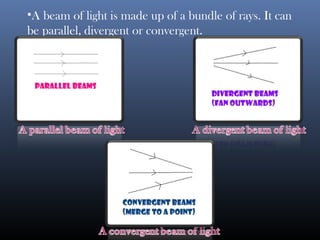
•A beam of light is made up of a bundle of rays. It can
be parallel, divergent or convergent.
Insert
image
Insert
image
•When light hits an
opaque objects, it may
be absorb or reflected.
•Reflection of light
occurs when light
bounces off the
surface of an object. Reflection of light
a. The incident ray is the ray of light that
approaches the light.
b. The reflected ray is the ray of light that bounces
off the surface.
• When the reflected light enters your eyes, we
can see the object.
• The amount and direction of the reflected light
depend on the nature of the surface it hits.
•Mirror sheets of glass and polished metals have
very smooth surfaces.
a.When a parallel beam of light hits a very
smooth surface, it is reflected as a parallel beam.
Regular reflection is said to occur.
b.If all the light that hits a surface is reflected
regularly, sharp images will be produced. That is
why we can see our image on very smooth
surface.
Insert
image
Regular reflection Diffuse reflection
•Objects such as paper, cloth and wood appear
smooth but they are actually quite rough.
a.When a parallel beam of light hits a rough
surface, it is scattered. The tiny bumps on the
surface cause the reflected light to head off in all
directions. This type of reflection is called
irregular or diffuse reflection.
b.This type of reflected light enables us to see
the object from any angle.
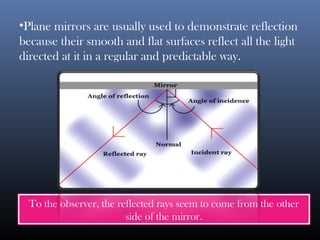
•Plane mirrors are usually used to demonstrate reflection
because their smooth and flat surfaces reflect all the light
directed at it in a regular and predictable way.
Insert image
To the observer, the reflected rays seem to come from the other
side of the mirror.
•The image on a plane mirror is
a.Upright
b.Laterally inverted (the left- hand side of the object
appears on the right – hand side of the image)
c.Virtual ( cannot be formed on a screen)
d.Equal in size as the object
e.At the same distance from the mirror as the object.
a. Plane mirrors are used at home in bathrooms
and bedrooms to help in dressing and
combing. They are also used as rear- view
mirror in cars.
b. Two plane mirrors are used in a periscope to
reflect and change the direction of light.
Periscope is used in a submarines to see above
water.
Periscope Kaleidoscope
c. A kaleidoscope is a tube containing two or more plane
mirrors. Small pieces of coloured objects are placed
between the mirrors. The light from the objects is
reflected from one mirror to another, forming beautiful
images.
d. Convex mirror produce a wider scope of view. They are
used as security mirrors in shops and wing mirrors of a
car. They are also used as blind corner mirrors on roads
to help users see approaching vehicles round a bend or a
blind corner.
e. Concave mirrors produce magnified images. They are
used as a dentist’s mirror, cosmetic mirrors and in
microscope and telescope.
•Light can pass through transparent media such as water,
air, glass and certain types of plastic.
•Light travels at different speeds in different media.
Therefore, when light passes from one transparent medium
into another, it may slow down or speed up. This change in
the speed of light causes the light to bend or change the
direction.
•The bending of the light ray when it enters a medium of
different density is known as a refraction of light.
•When the light travel from a less dense medium to a
denser denser medium, it slows down. The light is refracted
towards the normal.
Insert image
Light is refracted when it travels from air to glass
•When light is travel from a denser medium to a less
dense medium, it speeds up. The light is refracted away
from the normal.
Insert image
Light is refracted when it travels from air to water.
•If a light ray hits a transparent medium at a right
angle. The light passes through the medium in a
straight line. The light is not refracted at all.
Refraction does not occur when light hits the transparent medium at
a right angle.
Glass blockAir
Light ray
•Refraction of light gives us a false impression of
the dept and position of an object. Here are some
examples.
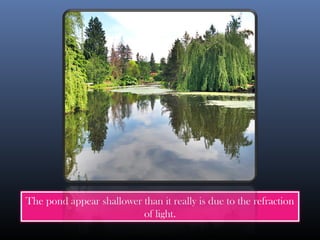
a. Ponds and swimming pools appear shallower
than they really are. This is because light from the
bottom of the pond is refracted as it moves out of
the water into the air. When the refracted light
enters the eyes of an observer, he sees an image of
the bottom of the pond that is swallower than the
real bottom of the pool.
Insert image
The pond appear shallower than it really is due to the refraction
of light.
b. Drinking straw in a glass
of water appears bent.
This is because light from
the straw is refracted as it
travels from the water into
the air. When the
refracted light enters the
eyes of the observer, she
sees the image of straw
somewhere above the
bottom of the glass. This
cause the straw to appear
bent.
Insert image
A partially submerged
drinking straw appears bent
due to the refraction of light.
•However, refraction of light can be useful
too.
a.Refraction of light in our eyes enable us to
see. Light that enters our eyes is refracted to
form sharp images on the retina.
b.Lenses make use of refraction of light.
Lenses are used in instruments such as
magnifying glasses, microscopes, telescopes
and overhead projectors.
•When a beam of white light passes through a prism, the
light spreads out of a band of colors in a certain order.
This band of colors is called spectrum. The colors in the
spectrum in order are red, orange, yellow, green, blue,
indigo and violet.
•Dispersion is the splitting or separating of white light
into its spectrum. This occurs because each color is
refracted slightly when it passes through the prism.
•Rainbow is a natural phenomenon due to the
dispersion of light by the tiny raindrops in the
air.
•The color of an opaque objects depends on
-The color of the light that shines on the object
-The color of the light that object absorbs
-The color of the light that the object reflects.
•The color of light that are not absorbed by the
object are reflected and transmitted to our eyes,
giving the objects its color.
A white object appears white in white light
because the object reflects all the colors in
the white light.
A black object appears black in any colored light
because it absorbs all the colors and reflects none.
•A red objects appears red in white light because it reflects
red light only and absorbs all other colors.
If a red rose is in ref light, it is seen as red because it
reflects the red light. However, if the red rose is in green
light, it appears black as it absorbs green light and reflect
none.
If yellow lemon is in blue light, it appears black as it
absorbs the blue light and reflects none.
Our main source of light is from the Sun. light
helps us to see things. Without light, we cannot see
anything. We will be in total darkness. Sunlight also
gives us heat energy and warms our Earth. Without
sunlight, our Earth will be too cold for us to live
Plants make use of the sunlight to produce their
own food through photosynthesis. They turn
carbon dioxide and water into glucose and oxygen.
This is an important process as it provides food to
all living things either directly or indirectly.
The oxygen produced as a by- product is released
into the environment, replenishing the oxygen
supply for the living things to breathe.
As not every place on Earth receives the same
amount of sunlight, they are not heated equally, the
hot air in warmer area will rise and the cold air
from a cooler area will rush in to replace the hot
air. This create winds and breezes.
The heat from the sunlight, besides drying our
clothes, also creates clouds and rains through
the rain cycle. This is very important as rains
cleanses the air and rejuvenate lives.
Sunlight also stimulates our skin to produce
vitamin D, which helps our body to keep the
right amount of calcium and phosphorous.
Deficiency in vitamin D can lead to
osteoporosis in adults and rickets in childrens.
•However, too many sunlight is bad for humans
too. Long exposure in the Sun can cause
sunburn and skin cancer. We should apply sun
protection lotion or cream and cover our skin
when we are in the Sun for too long. In the Sun
for too long without eye protection increases the
chances of developing eye disease such as
cataracts. Cataracts are a form of eye damage
that causes the lens to lose its transparency.
The patients will have cloudy visions.

Light

  • 2.
    •We can seeobjects only if light from them or bounces off from them enters your eyes. Without light we cant see at all. •Our main source of light is our Sun. •Light is form of energy. All the organisms on Earth need it to perform their activities.
  • 3.
    Properties of light a.Light is form of energy a. Light travels extremely fast and has a speed of 3.0 x 10 (8) ms – 1 in air. b. Light travels in straight lines within the same medium c. Light can be reflected when it hits a surface. d. Light can be refracted when it travels from one transparent medium to another.
  • 4.
    •The path alongeach which light travels is called a ray. A ray of light is represented by a straight line with an arrow to show its direction. A ray of light
  • 5.
    •A beam oflight is made up of a bundle of rays. It can be parallel, divergent or convergent. Insert image Insert image
  • 6.
    •When light hitsan opaque objects, it may be absorb or reflected. •Reflection of light occurs when light bounces off the surface of an object. Reflection of light
  • 7.
    a. The incidentray is the ray of light that approaches the light. b. The reflected ray is the ray of light that bounces off the surface. • When the reflected light enters your eyes, we can see the object. • The amount and direction of the reflected light depend on the nature of the surface it hits.
  • 8.
    •Mirror sheets ofglass and polished metals have very smooth surfaces. a.When a parallel beam of light hits a very smooth surface, it is reflected as a parallel beam. Regular reflection is said to occur. b.If all the light that hits a surface is reflected regularly, sharp images will be produced. That is why we can see our image on very smooth surface.
  • 9.
  • 10.
    •Objects such aspaper, cloth and wood appear smooth but they are actually quite rough. a.When a parallel beam of light hits a rough surface, it is scattered. The tiny bumps on the surface cause the reflected light to head off in all directions. This type of reflection is called irregular or diffuse reflection. b.This type of reflected light enables us to see the object from any angle.
  • 11.
    •Plane mirrors areusually used to demonstrate reflection because their smooth and flat surfaces reflect all the light directed at it in a regular and predictable way. Insert image To the observer, the reflected rays seem to come from the other side of the mirror.
  • 12.
    •The image ona plane mirror is a.Upright b.Laterally inverted (the left- hand side of the object appears on the right – hand side of the image) c.Virtual ( cannot be formed on a screen) d.Equal in size as the object e.At the same distance from the mirror as the object.
  • 13.
    a. Plane mirrorsare used at home in bathrooms and bedrooms to help in dressing and combing. They are also used as rear- view mirror in cars. b. Two plane mirrors are used in a periscope to reflect and change the direction of light. Periscope is used in a submarines to see above water.
  • 14.
  • 15.
    c. A kaleidoscopeis a tube containing two or more plane mirrors. Small pieces of coloured objects are placed between the mirrors. The light from the objects is reflected from one mirror to another, forming beautiful images. d. Convex mirror produce a wider scope of view. They are used as security mirrors in shops and wing mirrors of a car. They are also used as blind corner mirrors on roads to help users see approaching vehicles round a bend or a blind corner. e. Concave mirrors produce magnified images. They are used as a dentist’s mirror, cosmetic mirrors and in microscope and telescope.
  • 16.
    •Light can passthrough transparent media such as water, air, glass and certain types of plastic. •Light travels at different speeds in different media. Therefore, when light passes from one transparent medium into another, it may slow down or speed up. This change in the speed of light causes the light to bend or change the direction. •The bending of the light ray when it enters a medium of different density is known as a refraction of light.
  • 17.
    •When the lighttravel from a less dense medium to a denser denser medium, it slows down. The light is refracted towards the normal. Insert image Light is refracted when it travels from air to glass
  • 18.
    •When light istravel from a denser medium to a less dense medium, it speeds up. The light is refracted away from the normal. Insert image Light is refracted when it travels from air to water.
  • 19.
    •If a lightray hits a transparent medium at a right angle. The light passes through the medium in a straight line. The light is not refracted at all. Refraction does not occur when light hits the transparent medium at a right angle. Glass blockAir Light ray
  • 20.
    •Refraction of lightgives us a false impression of the dept and position of an object. Here are some examples. a. Ponds and swimming pools appear shallower than they really are. This is because light from the bottom of the pond is refracted as it moves out of the water into the air. When the refracted light enters the eyes of an observer, he sees an image of the bottom of the pond that is swallower than the real bottom of the pool.
  • 21.
    Insert image The pondappear shallower than it really is due to the refraction of light.
  • 22.
    b. Drinking strawin a glass of water appears bent. This is because light from the straw is refracted as it travels from the water into the air. When the refracted light enters the eyes of the observer, she sees the image of straw somewhere above the bottom of the glass. This cause the straw to appear bent. Insert image A partially submerged drinking straw appears bent due to the refraction of light.
  • 23.
    •However, refraction oflight can be useful too. a.Refraction of light in our eyes enable us to see. Light that enters our eyes is refracted to form sharp images on the retina. b.Lenses make use of refraction of light. Lenses are used in instruments such as magnifying glasses, microscopes, telescopes and overhead projectors.
  • 24.
    •When a beamof white light passes through a prism, the light spreads out of a band of colors in a certain order. This band of colors is called spectrum. The colors in the spectrum in order are red, orange, yellow, green, blue, indigo and violet. •Dispersion is the splitting or separating of white light into its spectrum. This occurs because each color is refracted slightly when it passes through the prism.
  • 25.
    •Rainbow is anatural phenomenon due to the dispersion of light by the tiny raindrops in the air.
  • 26.
    •The color ofan opaque objects depends on -The color of the light that shines on the object -The color of the light that object absorbs -The color of the light that the object reflects. •The color of light that are not absorbed by the object are reflected and transmitted to our eyes, giving the objects its color.
  • 27.
    A white objectappears white in white light because the object reflects all the colors in the white light.
  • 28.
    A black objectappears black in any colored light because it absorbs all the colors and reflects none.
  • 29.
    •A red objectsappears red in white light because it reflects red light only and absorbs all other colors.
  • 30.
    If a redrose is in ref light, it is seen as red because it reflects the red light. However, if the red rose is in green light, it appears black as it absorbs green light and reflect none. If yellow lemon is in blue light, it appears black as it absorbs the blue light and reflects none.
  • 31.
    Our main sourceof light is from the Sun. light helps us to see things. Without light, we cannot see anything. We will be in total darkness. Sunlight also gives us heat energy and warms our Earth. Without sunlight, our Earth will be too cold for us to live Plants make use of the sunlight to produce their own food through photosynthesis. They turn carbon dioxide and water into glucose and oxygen. This is an important process as it provides food to all living things either directly or indirectly.
  • 32.
    The oxygen producedas a by- product is released into the environment, replenishing the oxygen supply for the living things to breathe. As not every place on Earth receives the same amount of sunlight, they are not heated equally, the hot air in warmer area will rise and the cold air from a cooler area will rush in to replace the hot air. This create winds and breezes.
  • 34.
    The heat fromthe sunlight, besides drying our clothes, also creates clouds and rains through the rain cycle. This is very important as rains cleanses the air and rejuvenate lives. Sunlight also stimulates our skin to produce vitamin D, which helps our body to keep the right amount of calcium and phosphorous. Deficiency in vitamin D can lead to osteoporosis in adults and rickets in childrens.
  • 35.
    •However, too manysunlight is bad for humans too. Long exposure in the Sun can cause sunburn and skin cancer. We should apply sun protection lotion or cream and cover our skin when we are in the Sun for too long. In the Sun for too long without eye protection increases the chances of developing eye disease such as cataracts. Cataracts are a form of eye damage that causes the lens to lose its transparency. The patients will have cloudy visions.