

11
LIFE SKILLSLIFE SKILLS
BYBY
Dr. Jagannath K DangeDr. Jagannath K Dange
P.G. Department of EducationP.G. Department of Education
Kuvempu UniversityKuvempu University
22
DIFFERENCE BETWEEN LSE & ME/VEDIFFERENCE BETWEEN LSE & ME/VE
• Life skill educationLife skill education
• ExaminesExamines
alternatives andalternatives and
possibilitiespossibilities
• Allows for makingAllows for making
choices.choices.
• Leads to personalLeads to personal
empowermentempowerment
• Moral/Value educationMoral/Value education
• Gives guidelines-Gives guidelines-
right /wrong; good /badright /wrong; good /bad
• Set of prescriptions toSet of prescriptions to
be compulsorilybe compulsorily
followed.followed.
• Makes one, duty boundMakes one, duty bound
WHAT ARE LIFE SKILLS ?WHAT ARE LIFE SKILLS ?
• WHOWHO DEFINITION:DEFINITION:
• AbilitiesAbilities forfor adaptive and positive behaviouradaptive and positive behaviour thatthat
enables individualsenables individuals to deal effectivelyto deal effectively with thewith the
demands and challengesdemands and challenges of everyday life.of everyday life.
• Living skills toLiving skills to face the realities of lifeface the realities of life ..
44
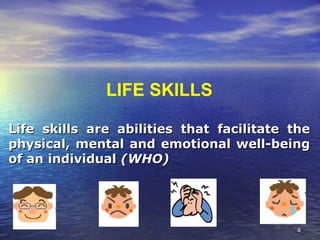
LIFE SKILLS
Life skills are abilities that facilitate theLife skills are abilities that facilitate the
physical, mental and emotional well-beingphysical, mental and emotional well-being
of an individualof an individual (WHO)(WHO)
THE EARLY INITIATIVES…THE EARLY INITIATIVES…
• 1993-WORLD HEALTH ORGANIZATION recognized1993-WORLD HEALTH ORGANIZATION recognized
the need for such a programme.the need for such a programme.
• WHY?WHY?
• WHO`S VIEW OF HEALTH:WHO`S VIEW OF HEALTH:
• ““The state of complete physical, mental and social wellThe state of complete physical, mental and social well
being.”being.”
• 1997-UNICEF recognized several levels of LSE1997-UNICEF recognized several levels of LSE
• Spreads in several countries after 1998- including India.Spreads in several countries after 1998- including India.
• People of Bharat culture is known forPeople of Bharat culture is known for
its life skills.its life skills.
66
• SELF AWARENESSSELF AWARENESS
• PROBLEM SOLVINGPROBLEM SOLVING
• DECISION MAKINGDECISION MAKING
• CRITICAL THINKINGCRITICAL THINKING
• CREATIVE THINKINGCREATIVE THINKING
• INTERPERSONAL RELATIONSINTERPERSONAL RELATIONS
• COMMUNICATION SKILLSCOMMUNICATION SKILLS
• EMPATHYEMPATHY
• COPING WITH STRESSCOPING WITH STRESS
• COPING WITH EMOTIONSCOPING WITH EMOTIONS
77
• NEGOTIATION SKILLSNEGOTIATION SKILLS
• SOCIAL SKILLSSOCIAL SKILLS
• LISTENING SKILLSLISTENING SKILLS
• ASSERTIVE SKILLSASSERTIVE SKILLS
• DAILY LIVING SKILLSDAILY LIVING SKILLS
88
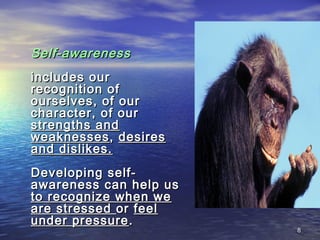
Self-awarenessSelf-awareness
includes ourincludes our
recognition ofrecognition of
ourselves, of ourourselves, of our
character, of ourcharacter, of our
strengths andstrengths and
weaknessesweaknesses,, desiresdesires
and dislikes.and dislikes.
Developing self-Developing self-
awareness can help usawareness can help us
to recognize when weto recognize when we
are stressedare stressed oror feelfeel
under pressureunder pressure ..
99
1010
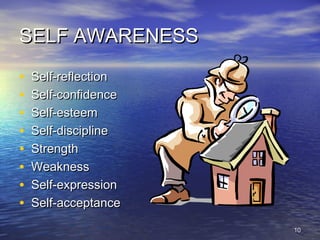
SELF AWARENESSSELF AWARENESS
• Self-reflectionSelf-reflection
• Self-confidenceSelf-confidence
• Self-esteemSelf-esteem
• Self-disciplineSelf-discipline
• StrengthStrength
• WeaknessWeakness
• Self-expressionSelf-expression
• Self-acceptanceSelf-acceptance
1111
Problem solvingProblem solving
enables us toenables us to dealdeal
constructively withconstructively with
problemsproblems in our lives.in our lives.
Significant problems thatSignificant problems that
areare left unresolved canleft unresolved can
cause mental stresscause mental stress andand
give rise togive rise to accompanyingaccompanying
physical strainphysical strain..
1212
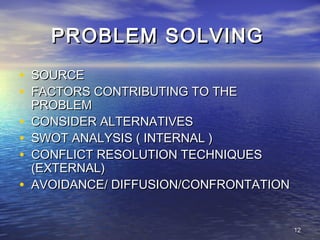
PROBLEM SOLVINGPROBLEM SOLVING
• SOURCESOURCE
• FACTORS CONTRIBUTING TO THEFACTORS CONTRIBUTING TO THE
PROBLEMPROBLEM
• CONSIDER ALTERNATIVESCONSIDER ALTERNATIVES
• SWOT ANALYSIS ( INTERNAL )SWOT ANALYSIS ( INTERNAL )
• CONFLICT RESOLUTION TECHNIQUESCONFLICT RESOLUTION TECHNIQUES
(EXTERNAL)(EXTERNAL)
• AVOIDANCE/ DIFFUSION/CONFRONTATIONAVOIDANCE/ DIFFUSION/CONFRONTATION
1313
Decision-makingDecision-making helps us to dealhelps us to deal
constructively withconstructively with decisions about ourdecisions about our
lives.lives.
HealthHealth
Job/Career/CourseJob/Career/Course
FriendsFriends
FamilyFamily
SocietySociety
others,others,
1414
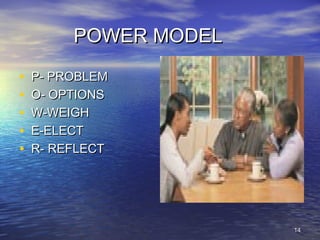
POWER MODELPOWER MODEL
• P- PROBLEMP- PROBLEM
• O- OPTIONSO- OPTIONS
• W-WEIGHW-WEIGH
• E-ELECTE-ELECT
• R- REFLECTR- REFLECT
1515
DECISION MAKINGDECISION MAKING
•IDENTIFFICATION OF RESOURSE.IDENTIFFICATION OF RESOURSE.
•COLLECTION OF INFORMATION.COLLECTION OF INFORMATION.
•ALTERNATIVESALTERNATIVES
•BEST CHOICEBEST CHOICE
•MAKE HONEST DECISIONSMAKE HONEST DECISIONS
•IMPLEMENTATIONIMPLEMENTATION
•APPRAISEAPPRAISE
•TAKE RESPONSIBILITYTAKE RESPONSIBILITY
1616
Critical ThinkingCritical Thinking
Critical thinkingCritical thinking is an ability tois an ability to analyzeanalyze
information and experiencesinformation and experiences in anin an
objectiveobjective manner.manner.
 Critical thinking canCritical thinking can contributecontribute toto
health by helping us tohealth by helping us to recognize andrecognize and
assess the factorsassess the factors that influencethat influence
attitudes and behaviorattitudes and behavior, such as values,, such as values,
peer pressure, and the mediapeer pressure, and the media..
1717
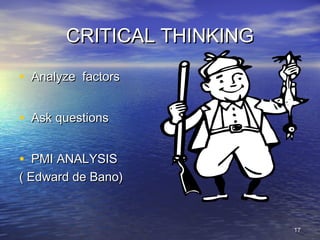
CRITICAL THINKINGCRITICAL THINKING
• Analyze factorsAnalyze factors
• Ask questionsAsk questions
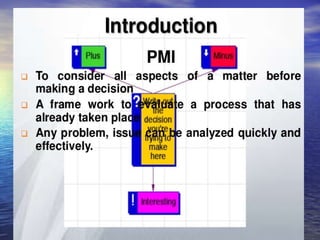
• PMI ANALYSISPMI ANALYSIS
( Edward de Bano)( Edward de Bano)
1818
1919
Creative thinkingCreative thinking
contributes tocontributes to bothboth
decision making anddecision making and
problem solvingproblem solving byby
enabling usenabling us toto
explore.explore.
The availableThe available
alternativesalternatives andand
various consequencesvarious consequences
of our actions orof our actions or
non-action.non-action.
2020
• CREATIVE THINKINGCREATIVE THINKING
It Is Nothing ButIt Is Nothing But Innovative Problem SolvingInnovative Problem Solving..
A Consequence Of Methodical Thinking.A Consequence Of Methodical Thinking.
Two Processes: exploration & Application.Two Processes: exploration & Application.
It Is TheIt Is The Heart Of Intelligence.Heart Of Intelligence.
Get Out Of The Box &Get Out Of The Box & Think In New WThink In New Ways.ays.
2121
Interpersonal relationship skillsInterpersonal relationship skills
This may mean beingThis may mean being able to make and keep friendlyable to make and keep friendly
relationshipsrelationships, which can be of great importance to our mental, which can be of great importance to our mental
and social well being.and social well being.
It may meanIt may mean keeping good relations with family memberskeeping good relations with family members,,
which are an important source of social support.which are an important source of social support.
It may also mean being able to end relationshipsIt may also mean being able to end relationships
constructively.constructively.
2222
INTER PERSONALINTER PERSONAL
RELATIONSRELATIONS
• Building up relationsBuilding up relations
• Co-operative living .Co-operative living .
• Respect for other`s sentimentsRespect for other`s sentiments
• Appreciation for othersAppreciation for others
• Generosity in encouragingGenerosity in encouraging
• Living upto others expectations.Living upto others expectations.
• Sense of humorSense of humor
2323
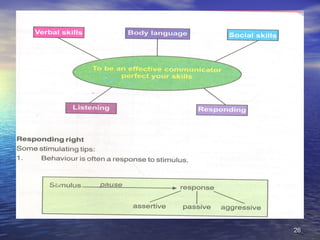
Effective communicationEffective communication
means that we are ablemeans that we are able to express ourselvesto express ourselves,, bothboth
verbally and non-verballyverbally and non-verbally, in ways that are, in ways that are appropriateappropriate
to our cultures and situationsto our cultures and situations..
This means being able toThis means being able to express opinions and deexpress opinions and desires,sires,
but alsobut also needs and feneeds and fears. And it may mean being ablears. And it may mean being able
toto ask for advice and helpask for advice and help in a time of need.in a time of need.
2424
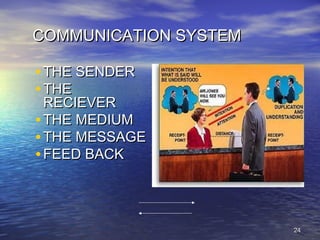
COMMUNICATION SYSTEMCOMMUNICATION SYSTEM
• THE SENDERTHE SENDER
• THETHE
RECIEVERRECIEVER
• THE MEDIUMTHE MEDIUM
• THE MESSAGETHE MESSAGE
• FEED BACKFEED BACK
2525
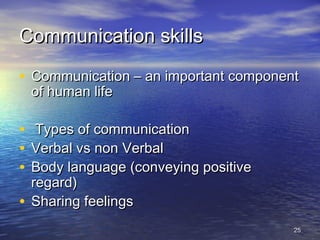
Communication skillsCommunication skills
• Communication – an important componentCommunication – an important component
of human lifeof human life
• Types of communicationTypes of communication
• Verbal vs non VerbalVerbal vs non Verbal
• Body language (conveying positiveBody language (conveying positive
regard)regard)
• Sharing feelingsSharing feelings
2626
2727
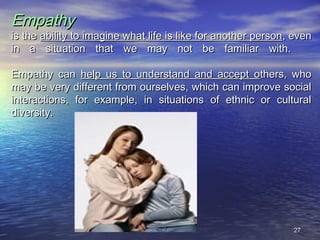
EmpathyEmpathy
is theis the ability to imagine what life is like for another personability to imagine what life is like for another person, even, even
in a situation that we may not be familiar with.in a situation that we may not be familiar with.
Empathy canEmpathy can help us to understand and accept ohelp us to understand and accept others, whothers, who
may be very different from ourselves, which can improve socialmay be very different from ourselves, which can improve social
interactions, for example, in situations of ethnic or culturalinteractions, for example, in situations of ethnic or cultural
diversity.diversity.
2828
EMPATHYEMPATHY
• PUTTING ONESELF IN OTHERS`SHOESPUTTING ONESELF IN OTHERS`SHOES
• SEEING OTHERS` PROBLEM THRO` THEIRSEEING OTHERS` PROBLEM THRO` THEIR
EYES.EYES.
• ANTICIPATE & DESCRIBE THE FEELING OFANTICIPATE & DESCRIBE THE FEELING OF
OTHERS.OTHERS.
• ACKNOWLEDGING THE FEELING OF OTHERS.ACKNOWLEDGING THE FEELING OF OTHERS.
• EMPATHY / SYMPATHY.EMPATHY / SYMPATHY.
2929
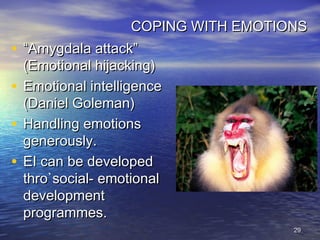
COPING WITH EMOTIONSCOPING WITH EMOTIONS
• ““Amygdala attack”Amygdala attack”
(Emotional hijacking)(Emotional hijacking)
• Emotional intelligenceEmotional intelligence
(Daniel Goleman)(Daniel Goleman)
• Handling emotionsHandling emotions
generously.generously.
• EI can be developedEI can be developed
thro`social- emotionalthro`social- emotional
developmentdevelopment
programmes.programmes.
3030
Managing Feelings and EmotionsManaging Feelings and Emotions
includes skills for increasing internal locus of controlincludes skills for increasing internal locus of control
forfor managing emotions, anger and stressmanaging emotions, anger and stress..
This may mean that weThis may mean that we take action to reduce thetake action to reduce the
sources of stress,sources of stress, for example,for example, learning how to relaxlearning how to relax,,
so that tensions created by unavoidable stress do notso that tensions created by unavoidable stress do not
give rise to health problems.give rise to health problems.
3131
COPING WITHCOPING WITH
STRESSSTRESS
• Identification of the stressors.Identification of the stressors.
• Identification of time wasters.Identification of time wasters.
• Identification of stressIdentification of stress
managersmanagers
• Identification of stressIdentification of stress
alternators.alternators.
• Living with stressLiving with stress
• Good stress vs Bad stressGood stress vs Bad stress
3232
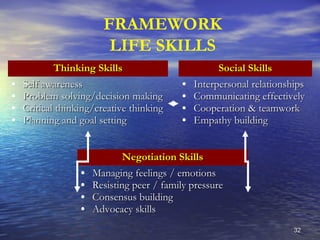
FRAMEWORK
LIFE SKILLS
Negotiation SkillsNegotiation Skills
• Managing feelings / emotionsManaging feelings / emotions
• Resisting peer / family pressureResisting peer / family pressure
• Consensus buildingConsensus building
• Advocacy skillsAdvocacy skills
Thinking SkillsThinking Skills
• Self awarenessSelf awareness
• Problem solving/decision makingProblem solving/decision making
• Critical thinking/creative thinkingCritical thinking/creative thinking
• Planning and goal settingPlanning and goal setting
Social SkillsSocial Skills
• Interpersonal relationshipsInterpersonal relationships
• Communicating effectivelyCommunicating effectively
• Cooperation & teamworkCooperation & teamwork
• Empathy buildingEmpathy building
3333
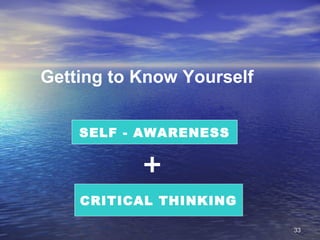
Getting to Know Yourself
+
SELF - AWARENESS
CRITICAL THINKING
3434
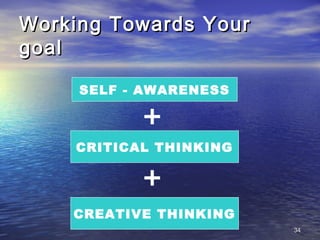
Working Towards YourWorking Towards Your
goalgoal
+
+
SELF - AWARENESS
CRITICAL THINKING
CREATIVE THINKING
3535
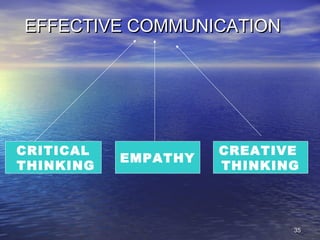
EFFECTIVE COMMUNICATIONEFFECTIVE COMMUNICATION
CRITICAL
THINKING
CREATIVE
THINKING
EMPATHY
3636
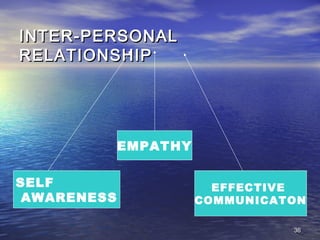
INTER-PERSONALINTER-PERSONAL
RELATIONSHIPRELATIONSHIP
EMPATHY
SELF
AWARENESS
EFFECTIVE
COMMUNICATON
3737
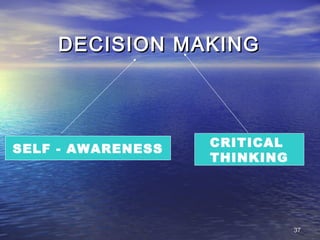
DECISION MAKINGDECISION MAKING
SELF - AWARENESS CRITICAL
THINKING
3838
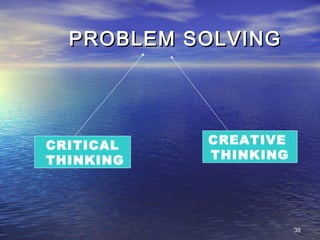
PROBLEM SOLVINGPROBLEM SOLVING
CRITICAL
THINKING
CREATIVE
THINKING
3939
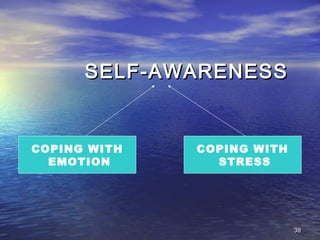
SELF-AWARENESSSELF-AWARENESS
COPING WITH
EMOTION
COPING WITH
STRESS
4040
• In every situation of life we useIn every situation of life we use
some skillssome skills
• Thinking “out of the box” can oftenThinking “out of the box” can often
find a solution to a seeminglyfind a solution to a seemingly
difficult problem.difficult problem.
• By critical thinking we can analyzeBy critical thinking we can analyze
all the pros and cons of anyall the pros and cons of any
situation.situation.
Key messagesKey messages
4141
• To negotiateTo negotiate
effectively at home,effectively at home,
school, place of workschool, place of work
we need to havewe need to have
thinking skills as wellthinking skills as well
as social skills.as social skills.
• Creative thinking isCreative thinking is
required when werequired when we
face difficultface difficult
situations. It is bestsituations. It is best
to make it a habitto make it a habit
4242
• Focusing on “positiveFocusing on “positive
self-esteem,” isself-esteem,” is
essential, it affectsessential, it affects
how we view others,how we view others,
and ourselves and theand ourselves and the
way we approachway we approach
almost every aspectalmost every aspect
of our life.of our life.
• People with low self-People with low self-
esteem often engageesteem often engage
in self-destructivein self-destructive
behaviour.behaviour.
4343
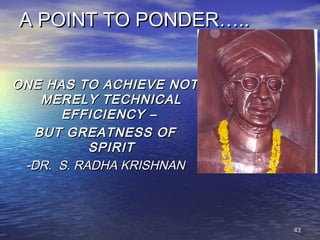
A POINT TO PONDER…..A POINT TO PONDER…..
ONE HAS TO ACHIEVE NOTONE HAS TO ACHIEVE NOT
MERELY TECHNICALMERELY TECHNICAL
EFFICIENCY –EFFICIENCY –
BUT GREATNESS OFBUT GREATNESS OF
SPIRITSPIRIT
-DR. S. RADHA KRISHNAN-DR. S. RADHA KRISHNAN
4444
BE ENLIGHTENED
CITIZENS OF A NEW
MILLENIUM
Thank YouThank You
Dr. Jagannath K. Dange
Department of Education
Kuvempu University
Shankaraghatta
Dist: Shimoga.
Karnataka.India.
jkdange@gmail.com
http://jkdange.blogspot.com

Life skills

  • 1.
    11 LIFE SKILLSLIFE SKILLS BYBY Dr.Jagannath K DangeDr. Jagannath K Dange P.G. Department of EducationP.G. Department of Education Kuvempu UniversityKuvempu University
  • 2.
    22 DIFFERENCE BETWEEN LSE& ME/VEDIFFERENCE BETWEEN LSE & ME/VE • Life skill educationLife skill education • ExaminesExamines alternatives andalternatives and possibilitiespossibilities • Allows for makingAllows for making choices.choices. • Leads to personalLeads to personal empowermentempowerment • Moral/Value educationMoral/Value education • Gives guidelines-Gives guidelines- right /wrong; good /badright /wrong; good /bad • Set of prescriptions toSet of prescriptions to be compulsorilybe compulsorily followed.followed. • Makes one, duty boundMakes one, duty bound
  • 3.
    WHAT ARE LIFESKILLS ?WHAT ARE LIFE SKILLS ? • WHOWHO DEFINITION:DEFINITION: • AbilitiesAbilities forfor adaptive and positive behaviouradaptive and positive behaviour thatthat enables individualsenables individuals to deal effectivelyto deal effectively with thewith the demands and challengesdemands and challenges of everyday life.of everyday life. • Living skills toLiving skills to face the realities of lifeface the realities of life ..
  • 4.
    44 LIFE SKILLS Life skillsare abilities that facilitate theLife skills are abilities that facilitate the physical, mental and emotional well-beingphysical, mental and emotional well-being of an individualof an individual (WHO)(WHO)
  • 5.
    THE EARLY INITIATIVES…THEEARLY INITIATIVES… • 1993-WORLD HEALTH ORGANIZATION recognized1993-WORLD HEALTH ORGANIZATION recognized the need for such a programme.the need for such a programme. • WHY?WHY? • WHO`S VIEW OF HEALTH:WHO`S VIEW OF HEALTH: • ““The state of complete physical, mental and social wellThe state of complete physical, mental and social well being.”being.” • 1997-UNICEF recognized several levels of LSE1997-UNICEF recognized several levels of LSE • Spreads in several countries after 1998- including India.Spreads in several countries after 1998- including India. • People of Bharat culture is known forPeople of Bharat culture is known for its life skills.its life skills.
  • 6.
    66 • SELF AWARENESSSELFAWARENESS • PROBLEM SOLVINGPROBLEM SOLVING • DECISION MAKINGDECISION MAKING • CRITICAL THINKINGCRITICAL THINKING • CREATIVE THINKINGCREATIVE THINKING • INTERPERSONAL RELATIONSINTERPERSONAL RELATIONS • COMMUNICATION SKILLSCOMMUNICATION SKILLS • EMPATHYEMPATHY • COPING WITH STRESSCOPING WITH STRESS • COPING WITH EMOTIONSCOPING WITH EMOTIONS
  • 7.
    77 • NEGOTIATION SKILLSNEGOTIATIONSKILLS • SOCIAL SKILLSSOCIAL SKILLS • LISTENING SKILLSLISTENING SKILLS • ASSERTIVE SKILLSASSERTIVE SKILLS • DAILY LIVING SKILLSDAILY LIVING SKILLS
  • 8.
    88 Self-awarenessSelf-awareness includes ourincludes our recognitionofrecognition of ourselves, of ourourselves, of our character, of ourcharacter, of our strengths andstrengths and weaknessesweaknesses,, desiresdesires and dislikes.and dislikes. Developing self-Developing self- awareness can help usawareness can help us to recognize when weto recognize when we are stressedare stressed oror feelfeel under pressureunder pressure ..
  • 9.
  • 10.
    1010 SELF AWARENESSSELF AWARENESS •Self-reflectionSelf-reflection • Self-confidenceSelf-confidence • Self-esteemSelf-esteem • Self-disciplineSelf-discipline • StrengthStrength • WeaknessWeakness • Self-expressionSelf-expression • Self-acceptanceSelf-acceptance
  • 11.
    1111 Problem solvingProblem solving enablesus toenables us to dealdeal constructively withconstructively with problemsproblems in our lives.in our lives. Significant problems thatSignificant problems that areare left unresolved canleft unresolved can cause mental stresscause mental stress andand give rise togive rise to accompanyingaccompanying physical strainphysical strain..
  • 12.
    1212 PROBLEM SOLVINGPROBLEM SOLVING •SOURCESOURCE • FACTORS CONTRIBUTING TO THEFACTORS CONTRIBUTING TO THE PROBLEMPROBLEM • CONSIDER ALTERNATIVESCONSIDER ALTERNATIVES • SWOT ANALYSIS ( INTERNAL )SWOT ANALYSIS ( INTERNAL ) • CONFLICT RESOLUTION TECHNIQUESCONFLICT RESOLUTION TECHNIQUES (EXTERNAL)(EXTERNAL) • AVOIDANCE/ DIFFUSION/CONFRONTATIONAVOIDANCE/ DIFFUSION/CONFRONTATION
  • 13.
    1313 Decision-makingDecision-making helps usto dealhelps us to deal constructively withconstructively with decisions about ourdecisions about our lives.lives. HealthHealth Job/Career/CourseJob/Career/Course FriendsFriends FamilyFamily SocietySociety others,others,
  • 14.
    1414 POWER MODELPOWER MODEL •P- PROBLEMP- PROBLEM • O- OPTIONSO- OPTIONS • W-WEIGHW-WEIGH • E-ELECTE-ELECT • R- REFLECTR- REFLECT
  • 15.
    1515 DECISION MAKINGDECISION MAKING •IDENTIFFICATIONOF RESOURSE.IDENTIFFICATION OF RESOURSE. •COLLECTION OF INFORMATION.COLLECTION OF INFORMATION. •ALTERNATIVESALTERNATIVES •BEST CHOICEBEST CHOICE •MAKE HONEST DECISIONSMAKE HONEST DECISIONS •IMPLEMENTATIONIMPLEMENTATION •APPRAISEAPPRAISE •TAKE RESPONSIBILITYTAKE RESPONSIBILITY
  • 16.
    1616 Critical ThinkingCritical Thinking CriticalthinkingCritical thinking is an ability tois an ability to analyzeanalyze information and experiencesinformation and experiences in anin an objectiveobjective manner.manner.  Critical thinking canCritical thinking can contributecontribute toto health by helping us tohealth by helping us to recognize andrecognize and assess the factorsassess the factors that influencethat influence attitudes and behaviorattitudes and behavior, such as values,, such as values, peer pressure, and the mediapeer pressure, and the media..
  • 17.
    1717 CRITICAL THINKINGCRITICAL THINKING •Analyze factorsAnalyze factors • Ask questionsAsk questions • PMI ANALYSISPMI ANALYSIS ( Edward de Bano)( Edward de Bano)
  • 18.
  • 19.
    1919 Creative thinkingCreative thinking contributestocontributes to bothboth decision making anddecision making and problem solvingproblem solving byby enabling usenabling us toto explore.explore. The availableThe available alternativesalternatives andand various consequencesvarious consequences of our actions orof our actions or non-action.non-action.
  • 20.
    2020 • CREATIVE THINKINGCREATIVETHINKING It Is Nothing ButIt Is Nothing But Innovative Problem SolvingInnovative Problem Solving.. A Consequence Of Methodical Thinking.A Consequence Of Methodical Thinking. Two Processes: exploration & Application.Two Processes: exploration & Application. It Is TheIt Is The Heart Of Intelligence.Heart Of Intelligence. Get Out Of The Box &Get Out Of The Box & Think In New WThink In New Ways.ays.
  • 21.
    2121 Interpersonal relationship skillsInterpersonalrelationship skills This may mean beingThis may mean being able to make and keep friendlyable to make and keep friendly relationshipsrelationships, which can be of great importance to our mental, which can be of great importance to our mental and social well being.and social well being. It may meanIt may mean keeping good relations with family memberskeeping good relations with family members,, which are an important source of social support.which are an important source of social support. It may also mean being able to end relationshipsIt may also mean being able to end relationships constructively.constructively.
  • 22.
    2222 INTER PERSONALINTER PERSONAL RELATIONSRELATIONS •Building up relationsBuilding up relations • Co-operative living .Co-operative living . • Respect for other`s sentimentsRespect for other`s sentiments • Appreciation for othersAppreciation for others • Generosity in encouragingGenerosity in encouraging • Living upto others expectations.Living upto others expectations. • Sense of humorSense of humor
  • 23.
    2323 Effective communicationEffective communication meansthat we are ablemeans that we are able to express ourselvesto express ourselves,, bothboth verbally and non-verballyverbally and non-verbally, in ways that are, in ways that are appropriateappropriate to our cultures and situationsto our cultures and situations.. This means being able toThis means being able to express opinions and deexpress opinions and desires,sires, but alsobut also needs and feneeds and fears. And it may mean being ablears. And it may mean being able toto ask for advice and helpask for advice and help in a time of need.in a time of need.
  • 24.
    2424 COMMUNICATION SYSTEMCOMMUNICATION SYSTEM •THE SENDERTHE SENDER • THETHE RECIEVERRECIEVER • THE MEDIUMTHE MEDIUM • THE MESSAGETHE MESSAGE • FEED BACKFEED BACK
  • 25.
    2525 Communication skillsCommunication skills •Communication – an important componentCommunication – an important component of human lifeof human life • Types of communicationTypes of communication • Verbal vs non VerbalVerbal vs non Verbal • Body language (conveying positiveBody language (conveying positive regard)regard) • Sharing feelingsSharing feelings
  • 26.
  • 27.
    2727 EmpathyEmpathy is theis theability to imagine what life is like for another personability to imagine what life is like for another person, even, even in a situation that we may not be familiar with.in a situation that we may not be familiar with. Empathy canEmpathy can help us to understand and accept ohelp us to understand and accept others, whothers, who may be very different from ourselves, which can improve socialmay be very different from ourselves, which can improve social interactions, for example, in situations of ethnic or culturalinteractions, for example, in situations of ethnic or cultural diversity.diversity.
  • 28.
    2828 EMPATHYEMPATHY • PUTTING ONESELFIN OTHERS`SHOESPUTTING ONESELF IN OTHERS`SHOES • SEEING OTHERS` PROBLEM THRO` THEIRSEEING OTHERS` PROBLEM THRO` THEIR EYES.EYES. • ANTICIPATE & DESCRIBE THE FEELING OFANTICIPATE & DESCRIBE THE FEELING OF OTHERS.OTHERS. • ACKNOWLEDGING THE FEELING OF OTHERS.ACKNOWLEDGING THE FEELING OF OTHERS. • EMPATHY / SYMPATHY.EMPATHY / SYMPATHY.
  • 29.
    2929 COPING WITH EMOTIONSCOPINGWITH EMOTIONS • ““Amygdala attack”Amygdala attack” (Emotional hijacking)(Emotional hijacking) • Emotional intelligenceEmotional intelligence (Daniel Goleman)(Daniel Goleman) • Handling emotionsHandling emotions generously.generously. • EI can be developedEI can be developed thro`social- emotionalthro`social- emotional developmentdevelopment programmes.programmes.
  • 30.
    3030 Managing Feelings andEmotionsManaging Feelings and Emotions includes skills for increasing internal locus of controlincludes skills for increasing internal locus of control forfor managing emotions, anger and stressmanaging emotions, anger and stress.. This may mean that weThis may mean that we take action to reduce thetake action to reduce the sources of stress,sources of stress, for example,for example, learning how to relaxlearning how to relax,, so that tensions created by unavoidable stress do notso that tensions created by unavoidable stress do not give rise to health problems.give rise to health problems.
  • 31.
    3131 COPING WITHCOPING WITH STRESSSTRESS •Identification of the stressors.Identification of the stressors. • Identification of time wasters.Identification of time wasters. • Identification of stressIdentification of stress managersmanagers • Identification of stressIdentification of stress alternators.alternators. • Living with stressLiving with stress • Good stress vs Bad stressGood stress vs Bad stress
  • 32.
    3232 FRAMEWORK LIFE SKILLS Negotiation SkillsNegotiationSkills • Managing feelings / emotionsManaging feelings / emotions • Resisting peer / family pressureResisting peer / family pressure • Consensus buildingConsensus building • Advocacy skillsAdvocacy skills Thinking SkillsThinking Skills • Self awarenessSelf awareness • Problem solving/decision makingProblem solving/decision making • Critical thinking/creative thinkingCritical thinking/creative thinking • Planning and goal settingPlanning and goal setting Social SkillsSocial Skills • Interpersonal relationshipsInterpersonal relationships • Communicating effectivelyCommunicating effectively • Cooperation & teamworkCooperation & teamwork • Empathy buildingEmpathy building
  • 33.
    3333 Getting to KnowYourself + SELF - AWARENESS CRITICAL THINKING
  • 34.
    3434 Working Towards YourWorkingTowards Your goalgoal + + SELF - AWARENESS CRITICAL THINKING CREATIVE THINKING
  • 35.
  • 36.
  • 37.
    3737 DECISION MAKINGDECISION MAKING SELF- AWARENESS CRITICAL THINKING
  • 38.
  • 39.
  • 40.
    4040 • In everysituation of life we useIn every situation of life we use some skillssome skills • Thinking “out of the box” can oftenThinking “out of the box” can often find a solution to a seeminglyfind a solution to a seemingly difficult problem.difficult problem. • By critical thinking we can analyzeBy critical thinking we can analyze all the pros and cons of anyall the pros and cons of any situation.situation. Key messagesKey messages
  • 41.
    4141 • To negotiateTonegotiate effectively at home,effectively at home, school, place of workschool, place of work we need to havewe need to have thinking skills as wellthinking skills as well as social skills.as social skills. • Creative thinking isCreative thinking is required when werequired when we face difficultface difficult situations. It is bestsituations. It is best to make it a habitto make it a habit
  • 42.
    4242 • Focusing on“positiveFocusing on “positive self-esteem,” isself-esteem,” is essential, it affectsessential, it affects how we view others,how we view others, and ourselves and theand ourselves and the way we approachway we approach almost every aspectalmost every aspect of our life.of our life. • People with low self-People with low self- esteem often engageesteem often engage in self-destructivein self-destructive behaviour.behaviour.
  • 43.
    4343 A POINT TOPONDER…..A POINT TO PONDER….. ONE HAS TO ACHIEVE NOTONE HAS TO ACHIEVE NOT MERELY TECHNICALMERELY TECHNICAL EFFICIENCY –EFFICIENCY – BUT GREATNESS OFBUT GREATNESS OF SPIRITSPIRIT -DR. S. RADHA KRISHNAN-DR. S. RADHA KRISHNAN
  • 44.
  • 45.
    Thank YouThank You Dr.Jagannath K. Dange Department of Education Kuvempu University Shankaraghatta Dist: Shimoga. Karnataka.India. jkdange@gmail.com http://jkdange.blogspot.com

Editor's Notes

  • #7 HBBUHIUYIIROOEIUI