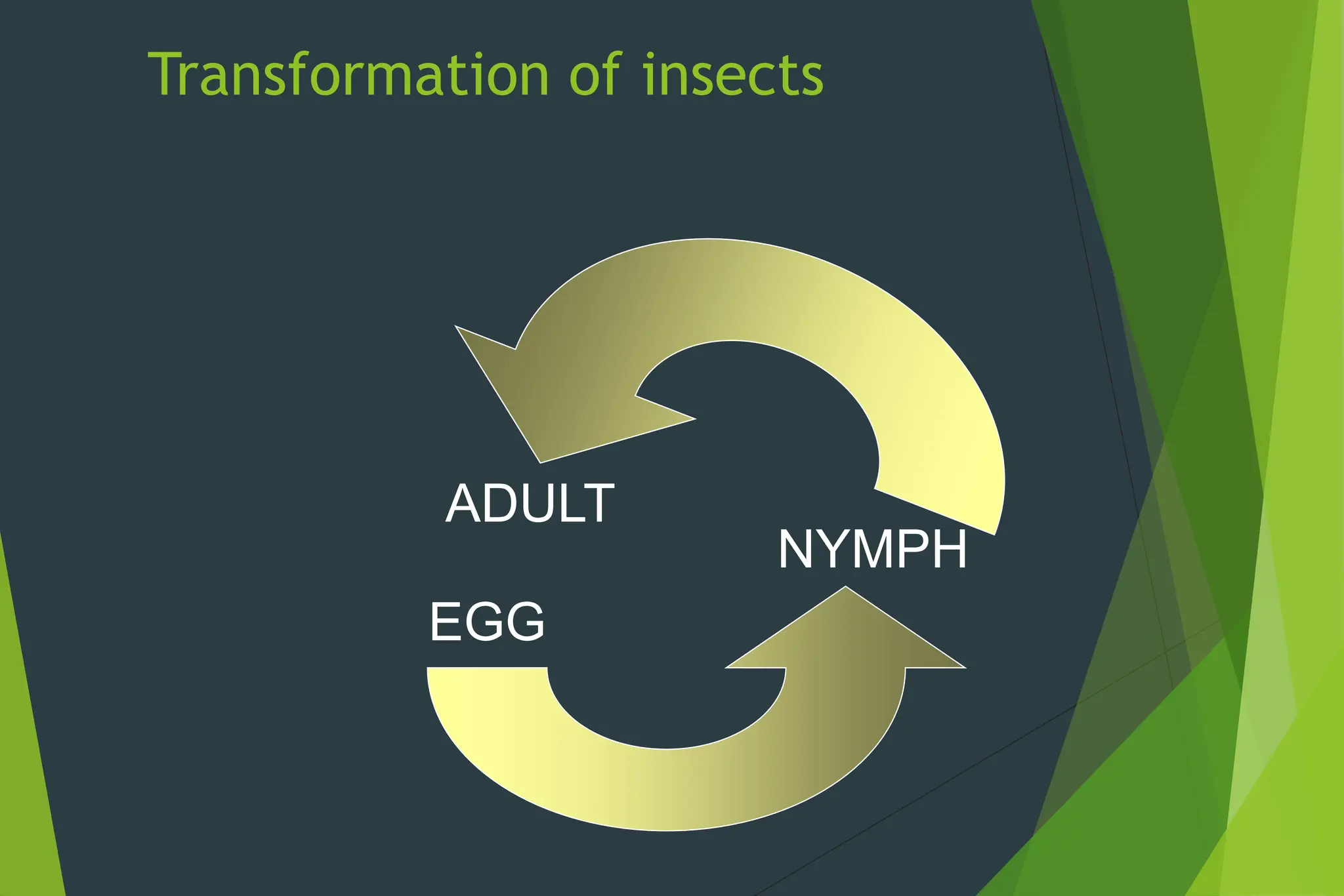
EGG
NYMPH
ADULT
Transformation of insects
1.Insect Growth
 2.Insect Metamorphosis
 3.Types of Insect Metamorphosis
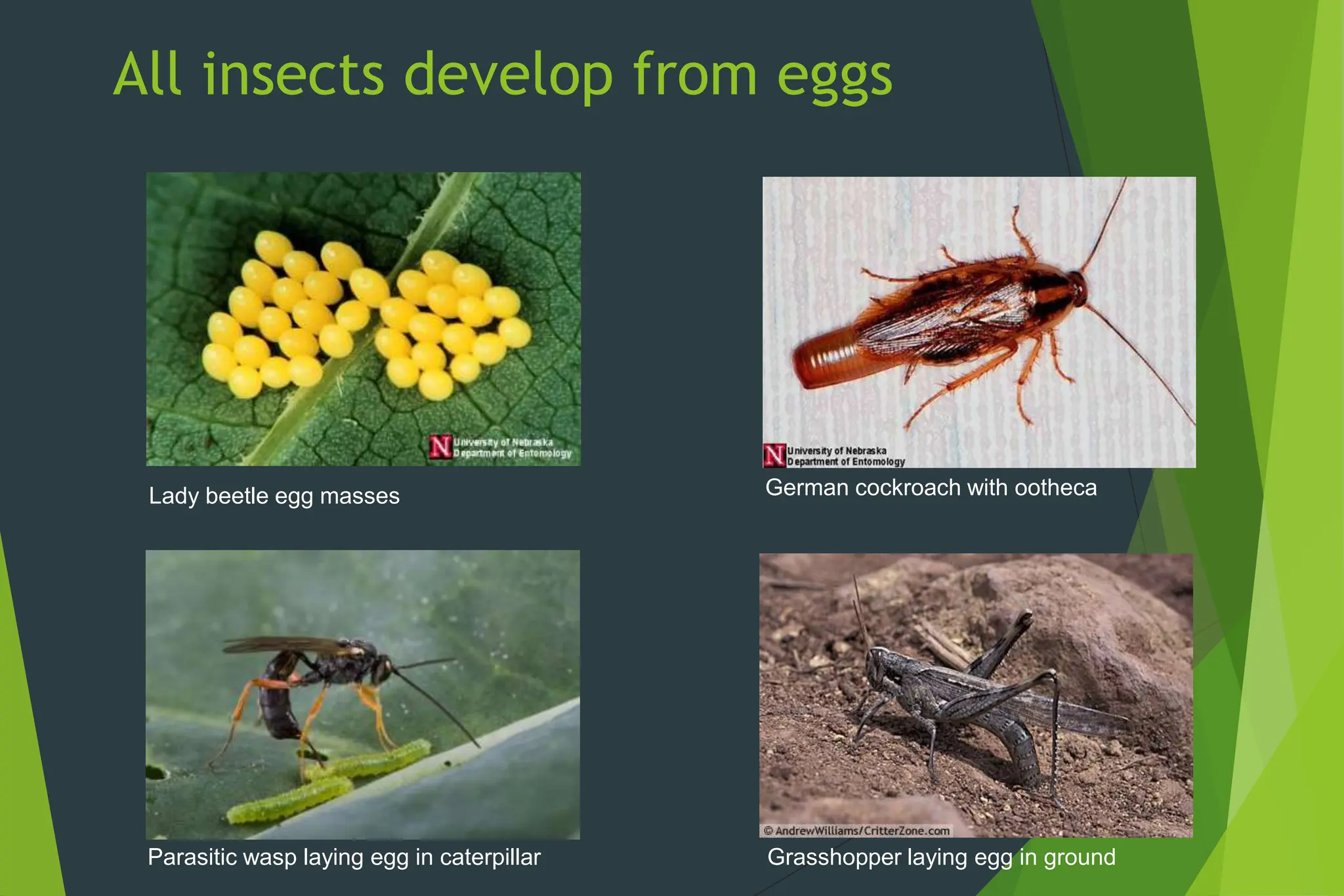
All insects develop from eggs
Lady beetle egg masses
Parasitic wasp laying egg in caterpillar
German cockroach with ootheca
Grasshopper laying egg in ground
 Most hatch from an egg after it has been laid
 Some are born alive from eggs that developed inside the female (e.g.,
Madagascar hissing roach) Some insects lay their eggs singly, others lay their
eggs in masses
 Some insects, such as the cockroach, lay their eggs in a capsule (ootheca)
 Some insects, such as the grasshopper and the June beetle, lay their eggs in
the ground
 Plant-feeding insects lay their eggs on plants and parasitic insects lay they eggs
on or in the body of the host.
Insect Growth
 With few exceptions (e.g., silverfish), only immature insects grow.
 In order to grow, an insect must molt:
 shed their old cuticle
 form a new cuticle
Hormones
HORMONE - a chemical formed in an organ or body tissue that
travels through the body and causes some effect on another body
part.
•The primary hormone controlling molting is ecdysone.
•Juvenile hormone (JH) is also involved in the molting process.
 The growth of an insect in each stage is limited by the space available to it
within its external skeleton. So in order to grow, an insect must molt. As the
insect develops, it lays down a new skeleton directly beneath the old one. The
old body wall splits down the back, and the next stage emerges and expands to
a larger size before the skeleton hardens again. This process is repeated 4 8
times in the average insect before it reaches adulthood. Some species,
however, may have as many as 20 or more molts
Hormone Production
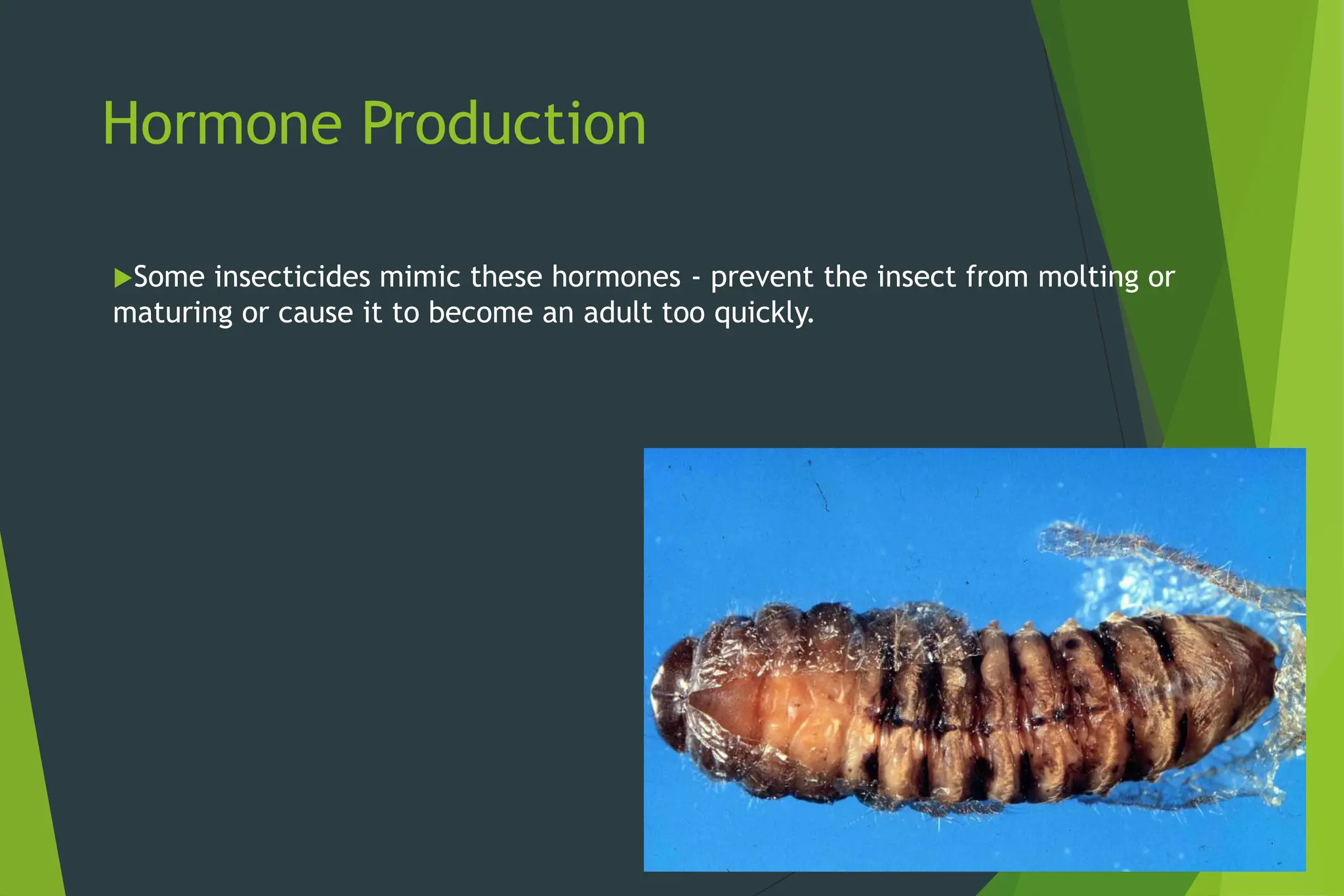
Some insecticides mimic these hormones - prevent the insect from molting or
maturing or cause it to become an adult too quickly.
8
REMEMBER: The outer layer of the exoskeleton is
called the cuticle. The cuticle contains the chemical
chitin.
9
Cuticle
Insect Growth
11
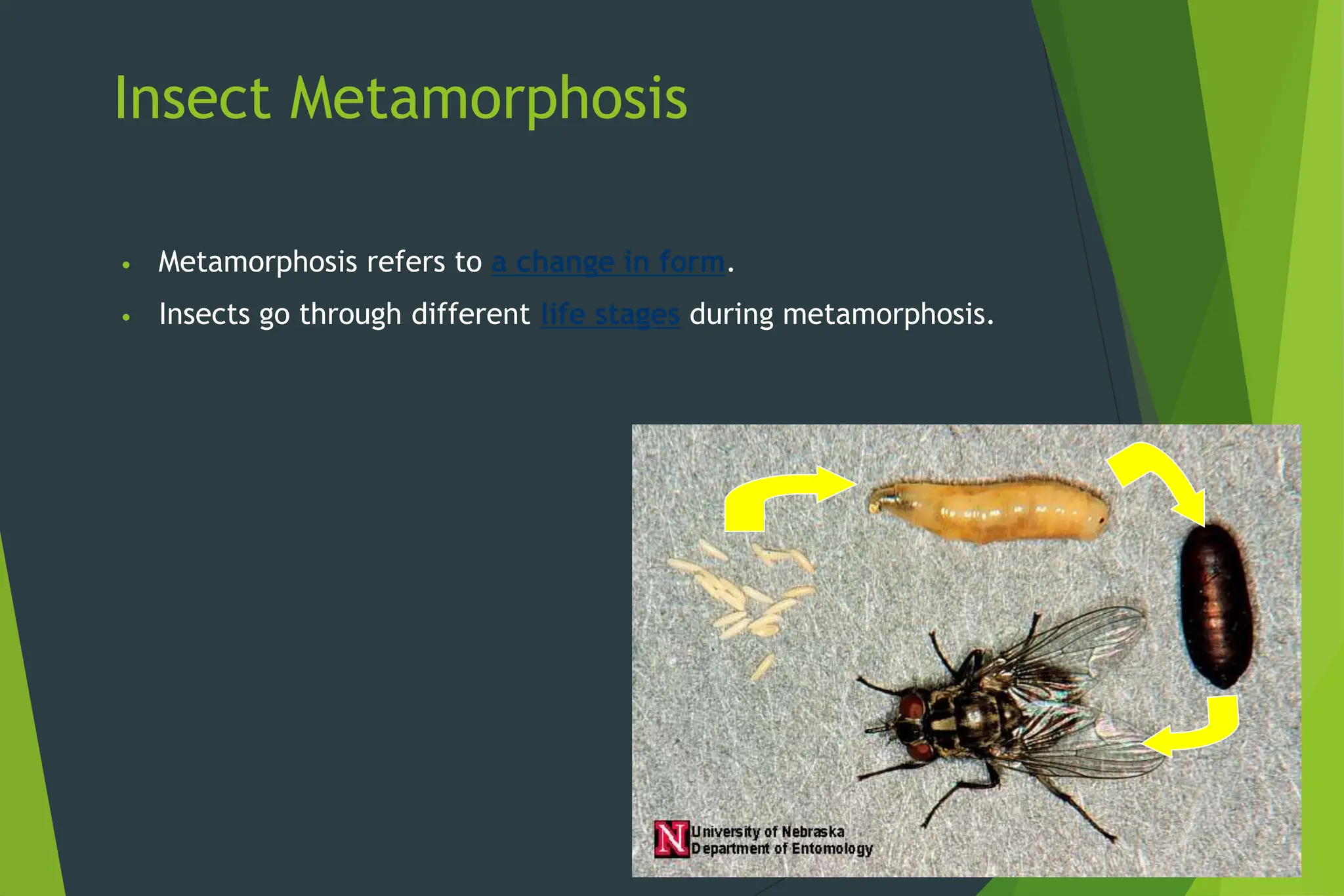
Insect Metamorphosis
• Metamorphosis refers to a change in form.
• Insects go through different life stages during metamorphosis.
12
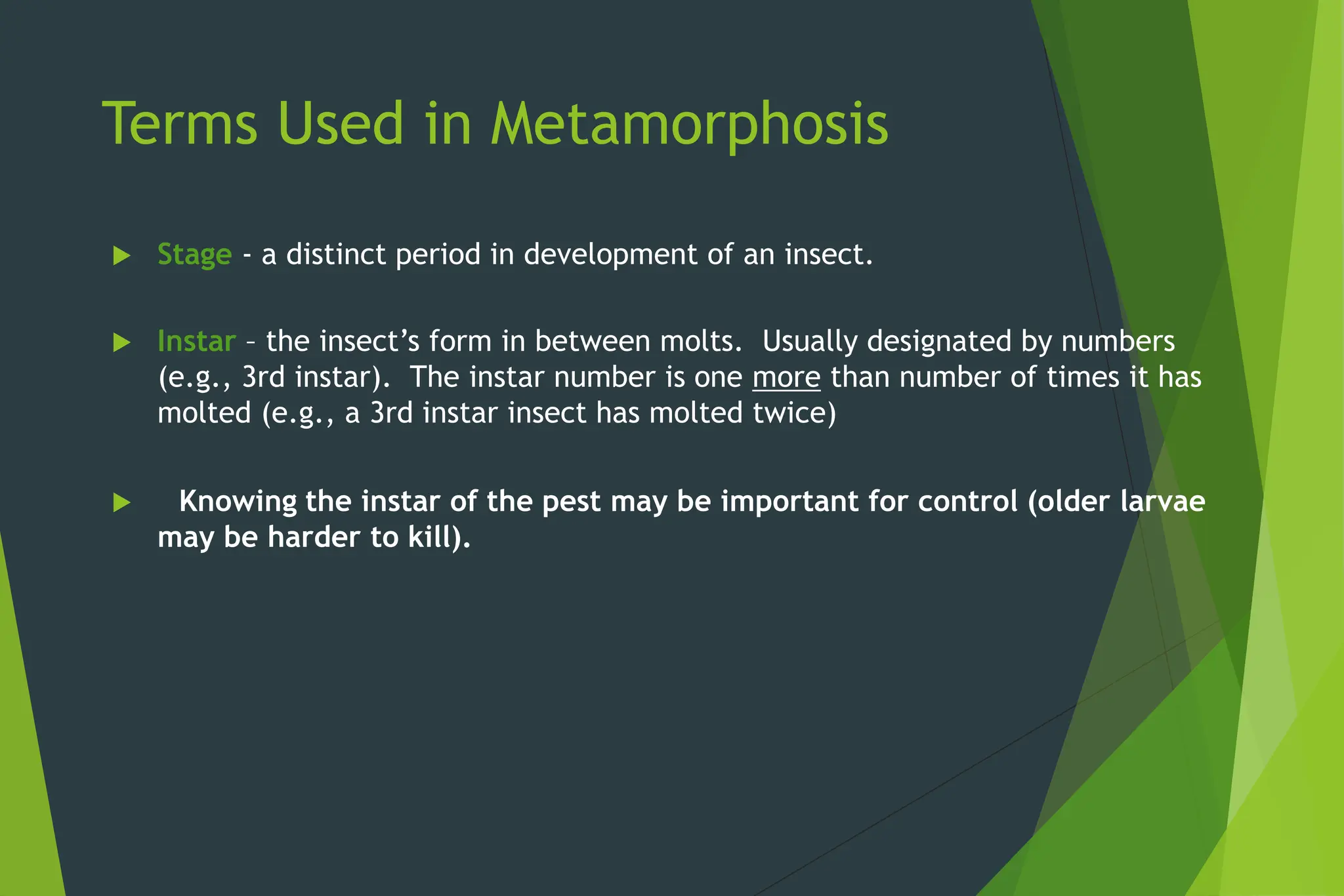
Terms Used in Metamorphosis
 Stage - a distinct period in development of an insect.
 Instar – the insect’s form in between molts. Usually designated by numbers
(e.g., 3rd instar). The instar number is one more than number of times it has
molted (e.g., a 3rd instar insect has molted twice)
 Knowing the instar of the pest may be important for control (older larvae
may be harder to kill).
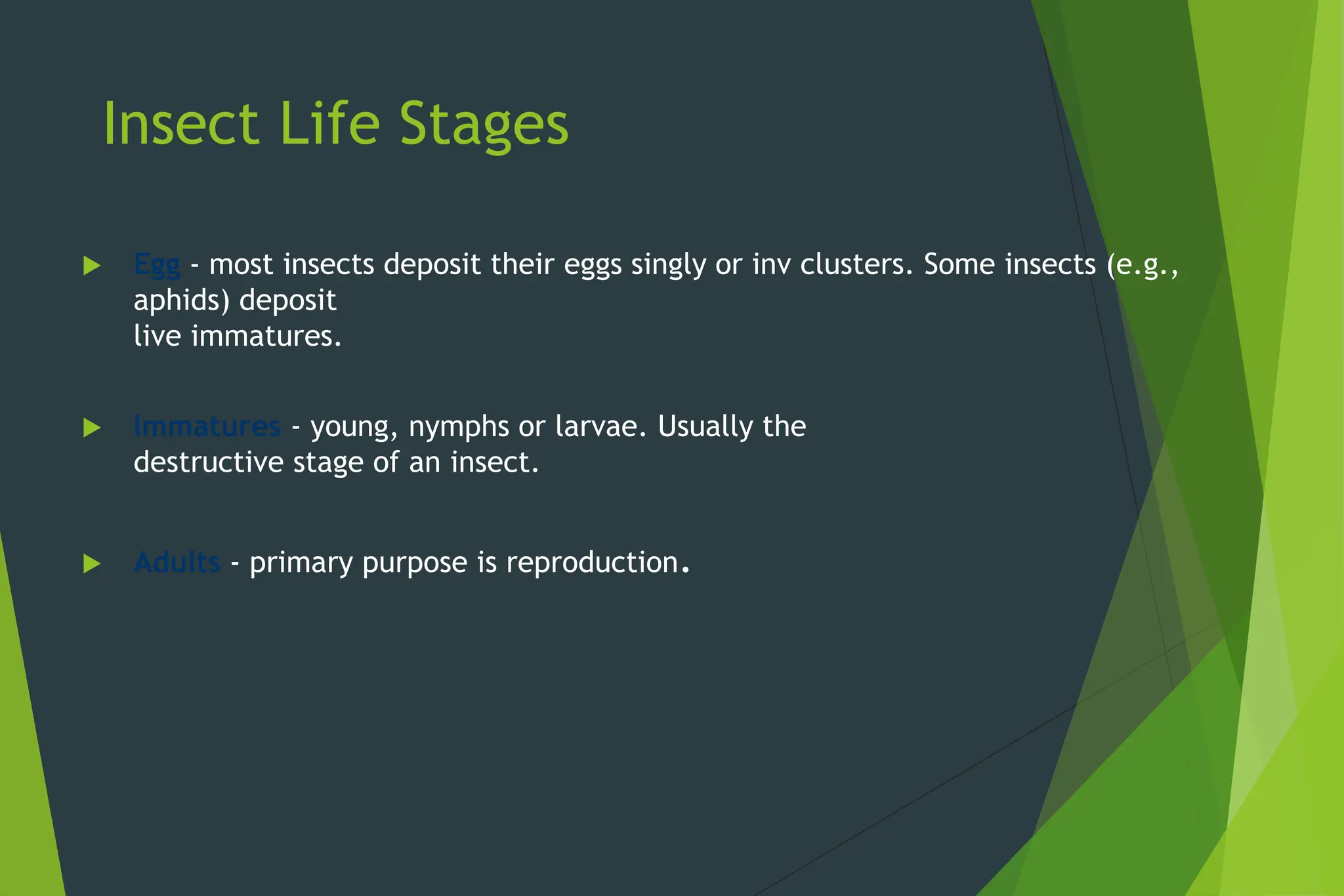
Insect Life Stages
 Egg - most insects deposit their eggs singly or inv clusters. Some insects (e.g.,
aphids) deposit
live immatures.
 Immatures - young, nymphs or larvae. Usually the
destructive stage of an insect.
 Adults - primary purpose is reproduction.
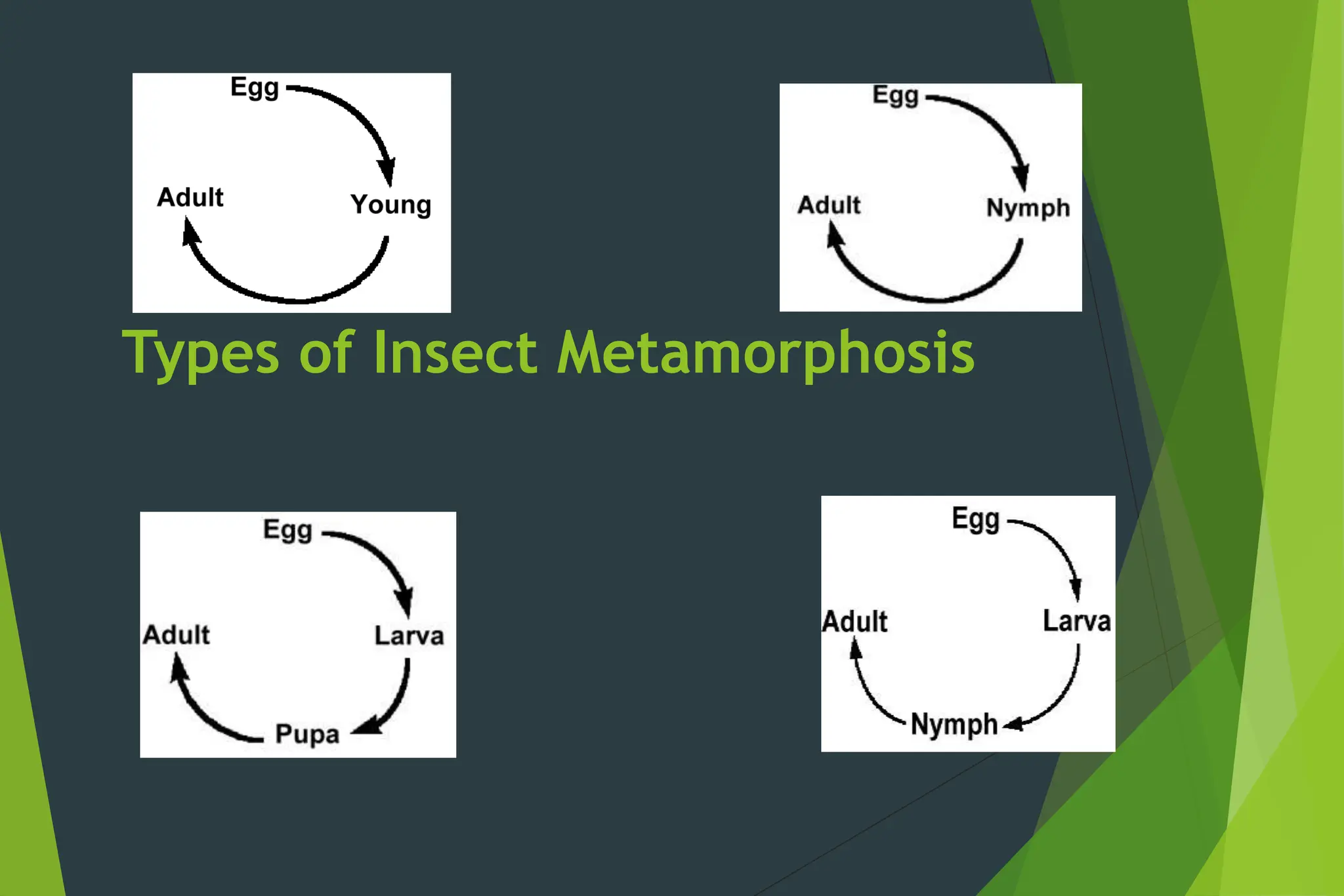
Types of Insect Metamorphosis
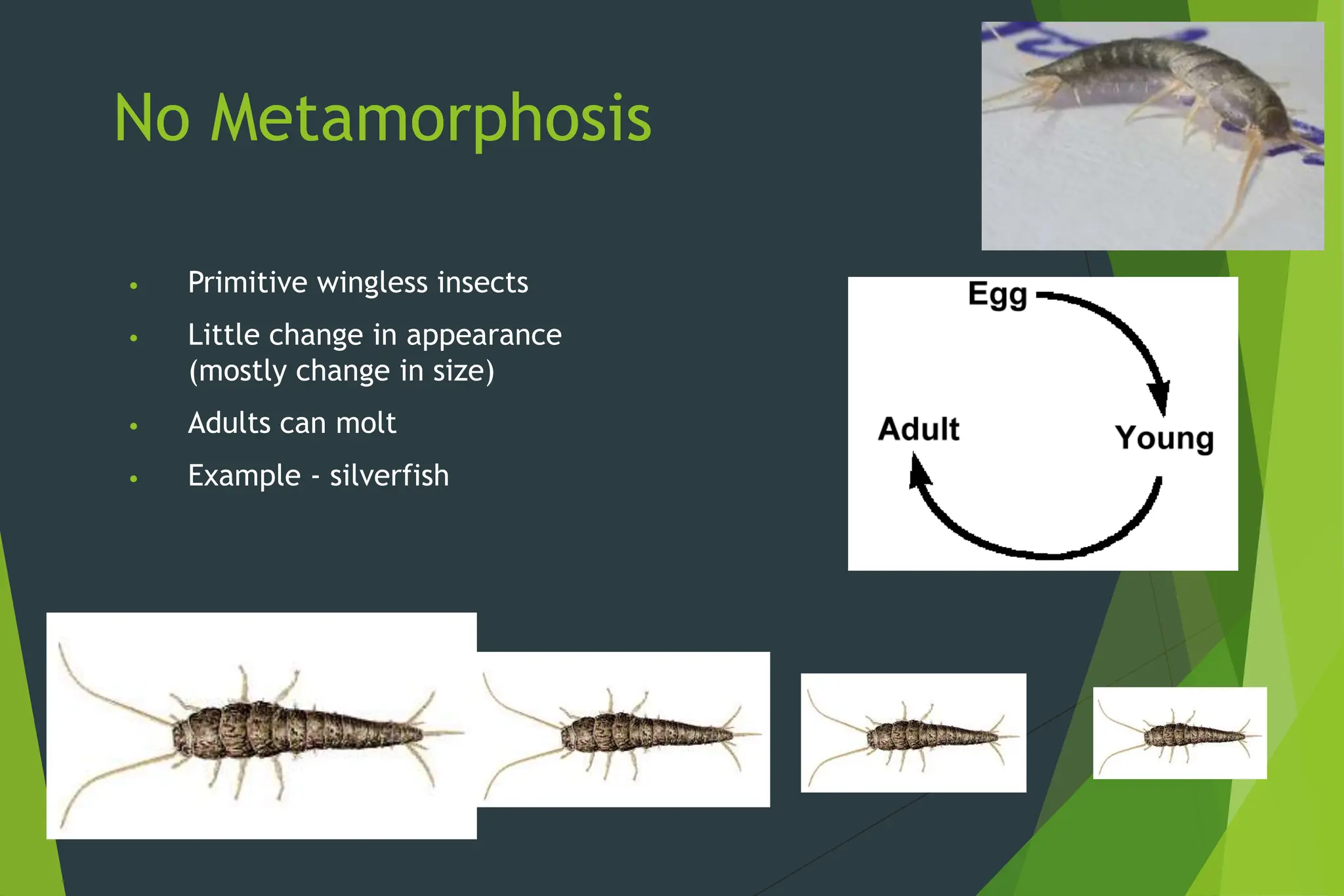
No Metamorphosis
• Primitive wingless insects
• Little change in appearance
(mostly change in size)
• Adults can molt
• Example - silverfish
Unit 3
 Adults of insects that don't undergo metamorphosis are like
their young in many ways. They share similar food,
environmental, and habitat preferences, meaning that all
stages of development will be found together in a structure.
Gradual Metamorphosis
• Gradual change in appearance
• Immatures (nymphs) and adults
usually have the same food
preferences.
• Most adults have wings; older
nymphs have wing buds
• Adults do not grow or molt.
• Examples – cockroaches, termites, bed bugs, crickets, aphids
Egg
Adult
Nymph
 Immature and adults share similar habits, food preferences,
and body form, but the development into the adult stage is
more distinctive. Reproductive organs and wing pads do not
begin to develop until the later instars of the nymph and
neither become functional until the insect reaches the adult
stage. The adult stages does not molt.
German Cockroach Life Stages
Complete Metamorphosis
• Distinct changes in the insect’s appearance.
• Immature = Larvae
 usually look very different from
adults
 usually have different food
preferences from adult.
• Examples – ants, wasps, fleas, flies, mosquitoes, butterflies &
moths
Egg
Adult
Pupa
Larva
Unit 3
Indianmeal moth larva Indianmeal moth adult
Ladybeetle larva Ladybeetle adult
Complete Metamorphosis
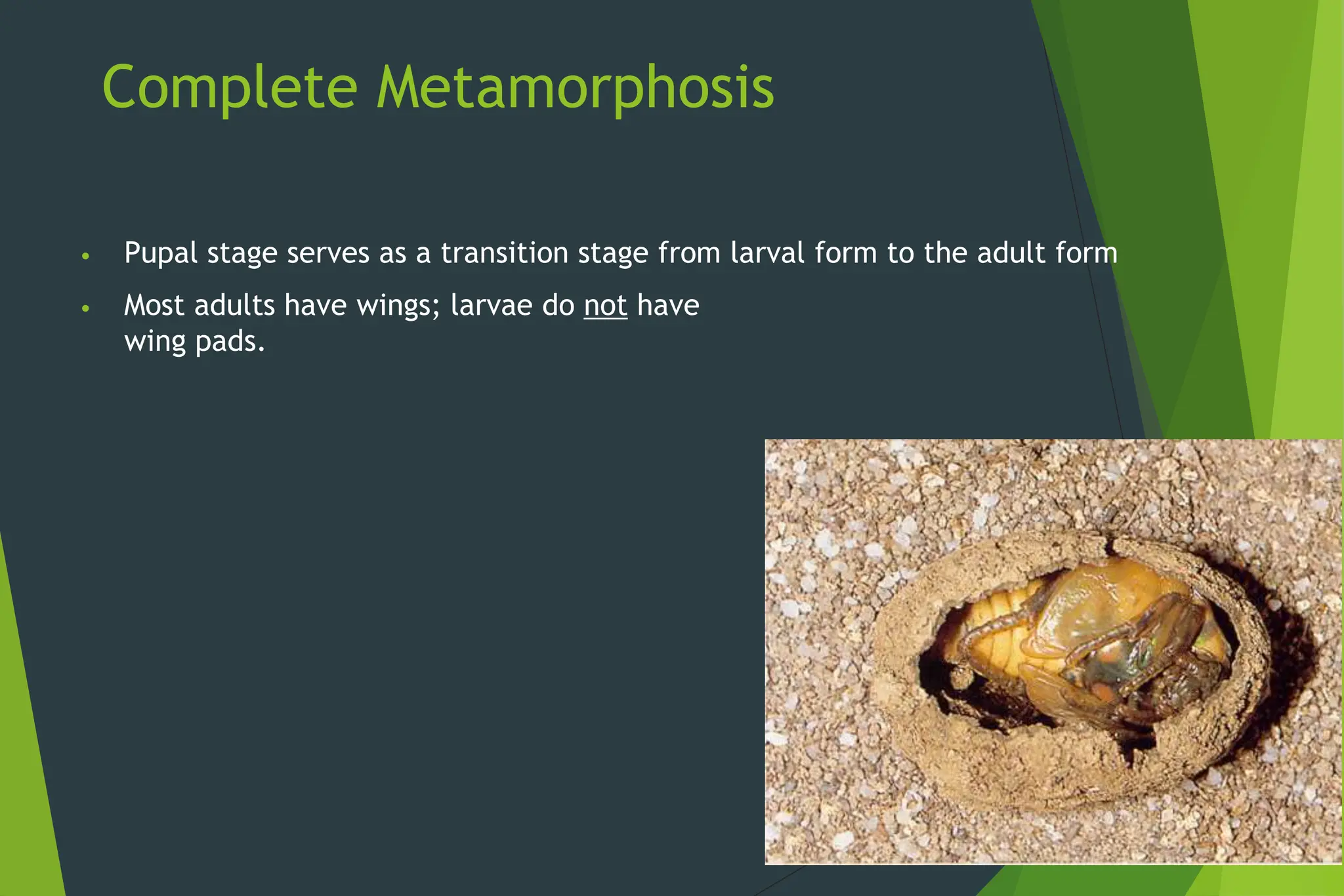
• Pupal stage serves as a transition stage from larval form to the adult form
• Most adults have wings; larvae do not have
wing pads.
23
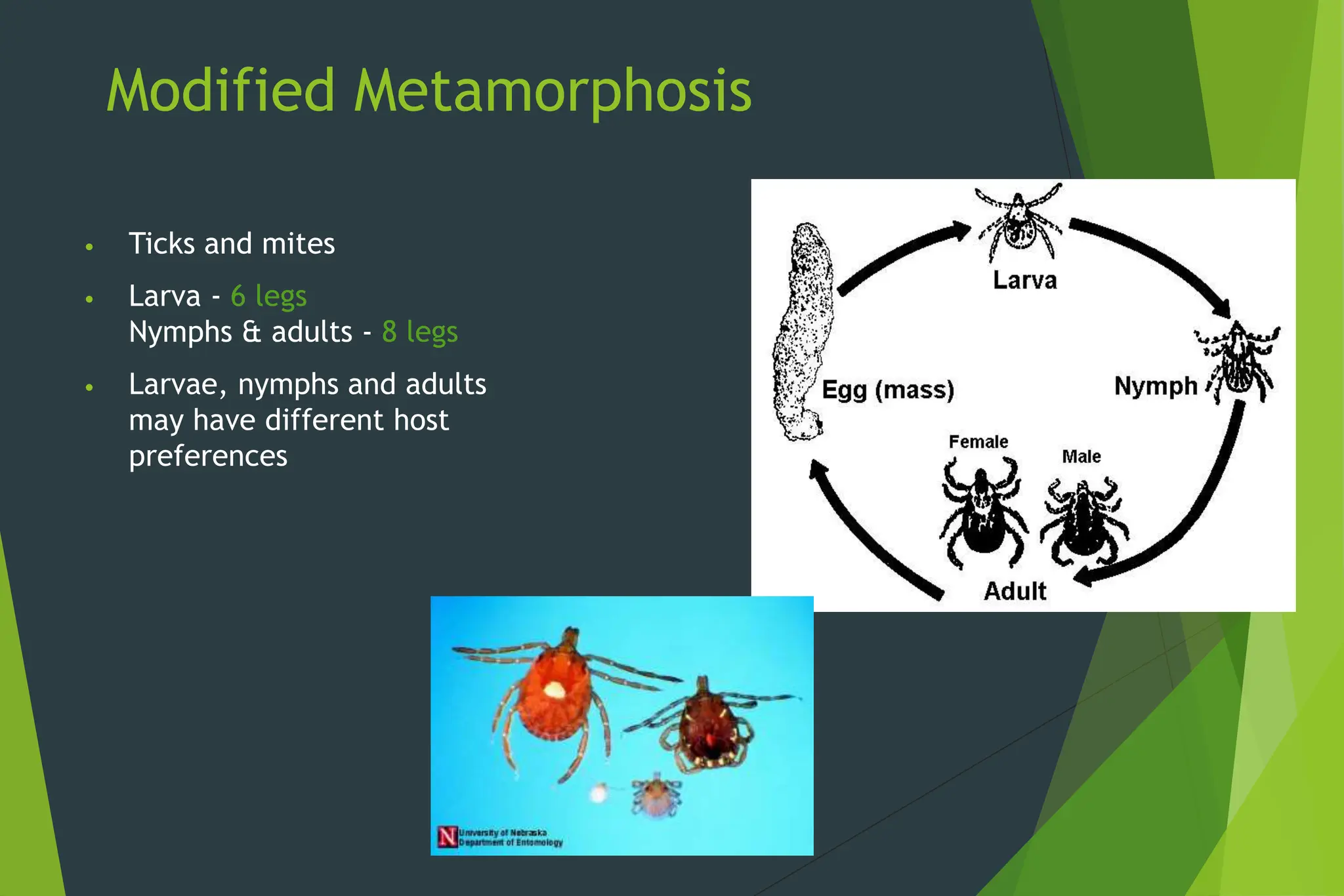
Modified Metamorphosis
• Ticks and mites
• Larva - 6 legs
Nymphs & adults - 8 legs
• Larvae, nymphs and adults
may have different host
preferences
Useful links
• https://justfunfacts.com/interesting-facts-about-
insects/11.10.22
• https://www.thoughtco.com/types-of-insect-metamorphosis-
1968347/12.10.22
• https://en.wikipedia.org/wiki/Evolution_of_insects 12.10.22
 Thank you for attention!

About insect growth and their metamorphosis

  • 1.
  • 2.
    1.Insect Growth  2.InsectMetamorphosis  3.Types of Insect Metamorphosis
  • 3.
    All insects developfrom eggs Lady beetle egg masses Parasitic wasp laying egg in caterpillar German cockroach with ootheca Grasshopper laying egg in ground
  • 4.
     Most hatchfrom an egg after it has been laid  Some are born alive from eggs that developed inside the female (e.g., Madagascar hissing roach) Some insects lay their eggs singly, others lay their eggs in masses  Some insects, such as the cockroach, lay their eggs in a capsule (ootheca)  Some insects, such as the grasshopper and the June beetle, lay their eggs in the ground  Plant-feeding insects lay their eggs on plants and parasitic insects lay they eggs on or in the body of the host.
  • 5.
    Insect Growth  Withfew exceptions (e.g., silverfish), only immature insects grow.  In order to grow, an insect must molt:  shed their old cuticle  form a new cuticle
  • 6.
    Hormones HORMONE - achemical formed in an organ or body tissue that travels through the body and causes some effect on another body part. •The primary hormone controlling molting is ecdysone. •Juvenile hormone (JH) is also involved in the molting process.
  • 7.
     The growthof an insect in each stage is limited by the space available to it within its external skeleton. So in order to grow, an insect must molt. As the insect develops, it lays down a new skeleton directly beneath the old one. The old body wall splits down the back, and the next stage emerges and expands to a larger size before the skeleton hardens again. This process is repeated 4 8 times in the average insect before it reaches adulthood. Some species, however, may have as many as 20 or more molts
  • 8.
    Hormone Production Some insecticidesmimic these hormones - prevent the insect from molting or maturing or cause it to become an adult too quickly. 8
  • 9.
    REMEMBER: The outerlayer of the exoskeleton is called the cuticle. The cuticle contains the chemical chitin. 9 Cuticle
  • 10.
  • 11.
  • 12.
    Insect Metamorphosis • Metamorphosisrefers to a change in form. • Insects go through different life stages during metamorphosis. 12
  • 13.
    Terms Used inMetamorphosis  Stage - a distinct period in development of an insect.  Instar – the insect’s form in between molts. Usually designated by numbers (e.g., 3rd instar). The instar number is one more than number of times it has molted (e.g., a 3rd instar insect has molted twice)  Knowing the instar of the pest may be important for control (older larvae may be harder to kill).
  • 14.
    Insect Life Stages Egg - most insects deposit their eggs singly or inv clusters. Some insects (e.g., aphids) deposit live immatures.  Immatures - young, nymphs or larvae. Usually the destructive stage of an insect.  Adults - primary purpose is reproduction.
  • 15.
    Types of InsectMetamorphosis
  • 16.
    No Metamorphosis • Primitivewingless insects • Little change in appearance (mostly change in size) • Adults can molt • Example - silverfish Unit 3
  • 17.
     Adults ofinsects that don't undergo metamorphosis are like their young in many ways. They share similar food, environmental, and habitat preferences, meaning that all stages of development will be found together in a structure.
  • 18.
    Gradual Metamorphosis • Gradualchange in appearance • Immatures (nymphs) and adults usually have the same food preferences. • Most adults have wings; older nymphs have wing buds • Adults do not grow or molt. • Examples – cockroaches, termites, bed bugs, crickets, aphids Egg Adult Nymph
  • 19.
     Immature andadults share similar habits, food preferences, and body form, but the development into the adult stage is more distinctive. Reproductive organs and wing pads do not begin to develop until the later instars of the nymph and neither become functional until the insect reaches the adult stage. The adult stages does not molt.
  • 20.
  • 21.
    Complete Metamorphosis • Distinctchanges in the insect’s appearance. • Immature = Larvae  usually look very different from adults  usually have different food preferences from adult. • Examples – ants, wasps, fleas, flies, mosquitoes, butterflies & moths Egg Adult Pupa Larva
  • 22.
    Unit 3 Indianmeal mothlarva Indianmeal moth adult Ladybeetle larva Ladybeetle adult
  • 23.
    Complete Metamorphosis • Pupalstage serves as a transition stage from larval form to the adult form • Most adults have wings; larvae do not have wing pads. 23
  • 24.
    Modified Metamorphosis • Ticksand mites • Larva - 6 legs Nymphs & adults - 8 legs • Larvae, nymphs and adults may have different host preferences
  • 25.
    Useful links • https://justfunfacts.com/interesting-facts-about- insects/11.10.22 •https://www.thoughtco.com/types-of-insect-metamorphosis- 1968347/12.10.22 • https://en.wikipedia.org/wiki/Evolution_of_insects 12.10.22
  • 26.
     Thank youfor attention!

Editor's Notes

  • #4 Most hatch from an egg after it has been laid Some are born alive from eggs that developed inside the female (e.g., Madagascar hissing roach) Some insects lay their eggs singly, others lay their eggs in masses Some insects, such as the cockroach, lay their eggs in a capsule (ootheca) Some insects, such as the grasshopper and the June beetle, lay their eggs in the ground Plant-feeding insects lay their eggs on plants and parasitic insects lay they eggs on or in the body of the host.
  • #6 The growth of an insect in each stage is limited by the space available to it within its external skeleton. So in order to grow, an insect must molt. As the insect develops, it lays down a new skeleton directly beneath the old one. The old body wall splits down the back, and the next stage emerges and expands to a larger size before the skeleton hardens again. This process is repeated 4 – 8 times in the average insect before it reaches adulthood. Some species, however, may have as many as 20 or more molts.
  • #7 In insects, the molting process involves numerous, complex interactions between hormones, enzymes, cell, and organs. Therefore, a detailed discussion is beyond the scope of this presentation. The primary hormone controlling molting is ecdysone. Ecdysone induces activation or production of the enzymes associated with molting. At high levels, JH keeps the insect in the juvenile stage. When it’s time to molt, JH levels decrease and molting begins. Other hormones (e.g., eclosion hormone) are associated with the process of shedding the old cuticle, and the formation and sclerotization (or hardening) of the new cuticle.
  • #9 Insect growth regulators (IGR’s) are chemicals that are currently used in pest management. Methoprene is an IGR that prevents immature insects from molting by mimicking JH. This type of IGR is referred to as a juvenile hormone analog.
  • #10 Approximately 50% of the dry weight of an insect’s exoskeleton is chitin. So, anything that depletes the formation of chitin will have a negative impact on the structural integrity of the exoskeleton. Some IGRs disrupt the laying down of new during new cuticle formation. These IGRs are called chitin synthesis inhibitors (CSIs). CSIs include hexaflumuron/noviflumeron (the AI in Sentricon, the termite bait) and lufenuron (the AI in Program).
  • #17 Adults of insects that don’t undergo metamorphosis are like their young in many ways. They share similar food, environmental, and habitat preferences, meaning that all stages of development will be found together in a structure.
  • #19 Immature and adults share similar habits, food preferences, and body form, but the development into the adult stage is more distinctive. Reproductive organs and wing pads do not begin to develop until the later instars of the nymph and neither become functional until the insect reaches the adult stage. The adult stages does not molt.
  • #22 Insects with complete metamorphosis have four distinct life stages: egg, larva, pupa, and adult. The impact of these factors on urban pest management are many. For some species, the larva itself could be the only stage that does economic damage (e.g., with some moths – Indianmeal moth). Or it could be a stage that has little to no impact on a person (as with fleas). If the larvae and adults do not share the same habitats, finding both habitats may be crucial to control, even if the non-damaging stage may not be noticed.
  • #24 The pupal stage is also an important consideration. For some species, it can provide protection from pesticides and environmental conditions and hamper control efforts. For insects with a delayed emergence from the pupal stage, there exists the potential for a new infestation long after the problem appears to be under control. When an adult emerges from the pupal case, it may or may not become a pest. The adult clothes moth, for example, does no damage; the larvae does all the damage. But with grain beetles, both the adult and larval stage feed on stored food products.