Rhonda Perrett
                          S0122845

               Teaching about the Living World
                        EDED19336

         Assessment Task 1-Electronic Learning Tool

           Date of submission-21st November 2008


“This assignment is solely the work of Rhonda Perrett. All ideas
      and views of other people included or referred to are
         acknowledged and appropriately referenced”.


                                           Start
Teachers P a g e


 LINK TO ESSENTIAL LEARNINGS

 REFERENCES


BACK                            Start
BACK   Start
Did you know?
                                       There are over
 A fly is an insect and insects are    40,000 known
 special animals. Flies go through     species of flies.
    a complete metamorphosis,         And you thought
     going from egg to larva or        there was only
    maggot, then pupa to adult          one kind, the
  stages within a week. They look     annoying kind.
  very different in each stage. All
  the stages together are called a
              life cycle.

        Lets find out more.
             Click GO

BACK                                              GO
Did you know?
                                   The fly regurgitates
                                     or vomits on the
                                   food to chemically
                                     break down the
                                    substance before
    The common house fly             sipping up their
 belongs to the group of flies     meal through their
  known as the filth fly. They           straw-like
   were given their name for           mouthparts.
their habit of laying their eggs       GROSS!!
  in moist, decaying organic
  matter, particularly manure
         and garbage.

 Now lets see how they grow.
          Click GO


BACK                                            GO
The adult female fly can lay
   up to 500 eggs in batches of
   75 to 100 over a period of 3      Did you know?
    to 4 days. If temperatures
                                       The common
    are high, eggs may hatch          house-fly only
   within 8 hours, otherwise it       lives for 15-25
     may take 1 to 2 days for              days
          them to hatch.

           Now lets look at the
       different stages of growth.
                Click GO.

BACK                                       GO
Stage One - First the adult
       female fly, which is bigger
       than the male fly, lays
       hundreds of tiny eggs.


BACK                                 GO
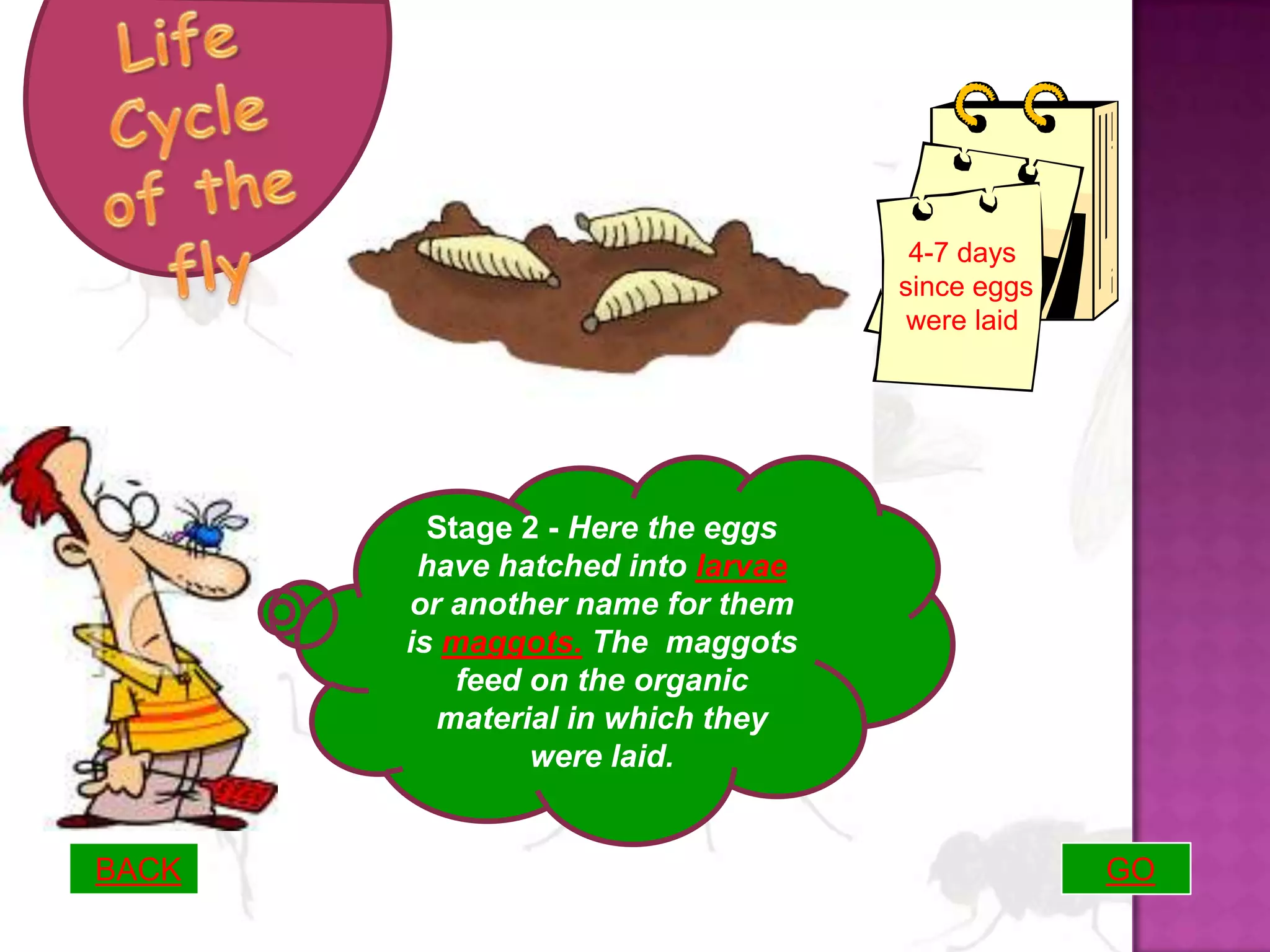
4-7 days
                                   since eggs
                                    were laid


         Stage 2 - Here the eggs
        have hatched into larvae
       or another name for them
       is maggots. The maggots
           feed on the organic
         material in which they
                were laid.


BACK                                            GO
10-20
                                           days since
                                           eggs were
                                              laid


       Stage 3 – When the maggots stop
       feeding they burrow into the dry
       surrounding areas for protection.
       This is where they pupate. During
       the pupa stage, change takes
        place.

BACK                                                    GO
.


           Stage 4 – When ready, the fully developed
           fly comes out of the pupa. The mature
           adult fly is now ready to reproduce and
           continue its life cycle.
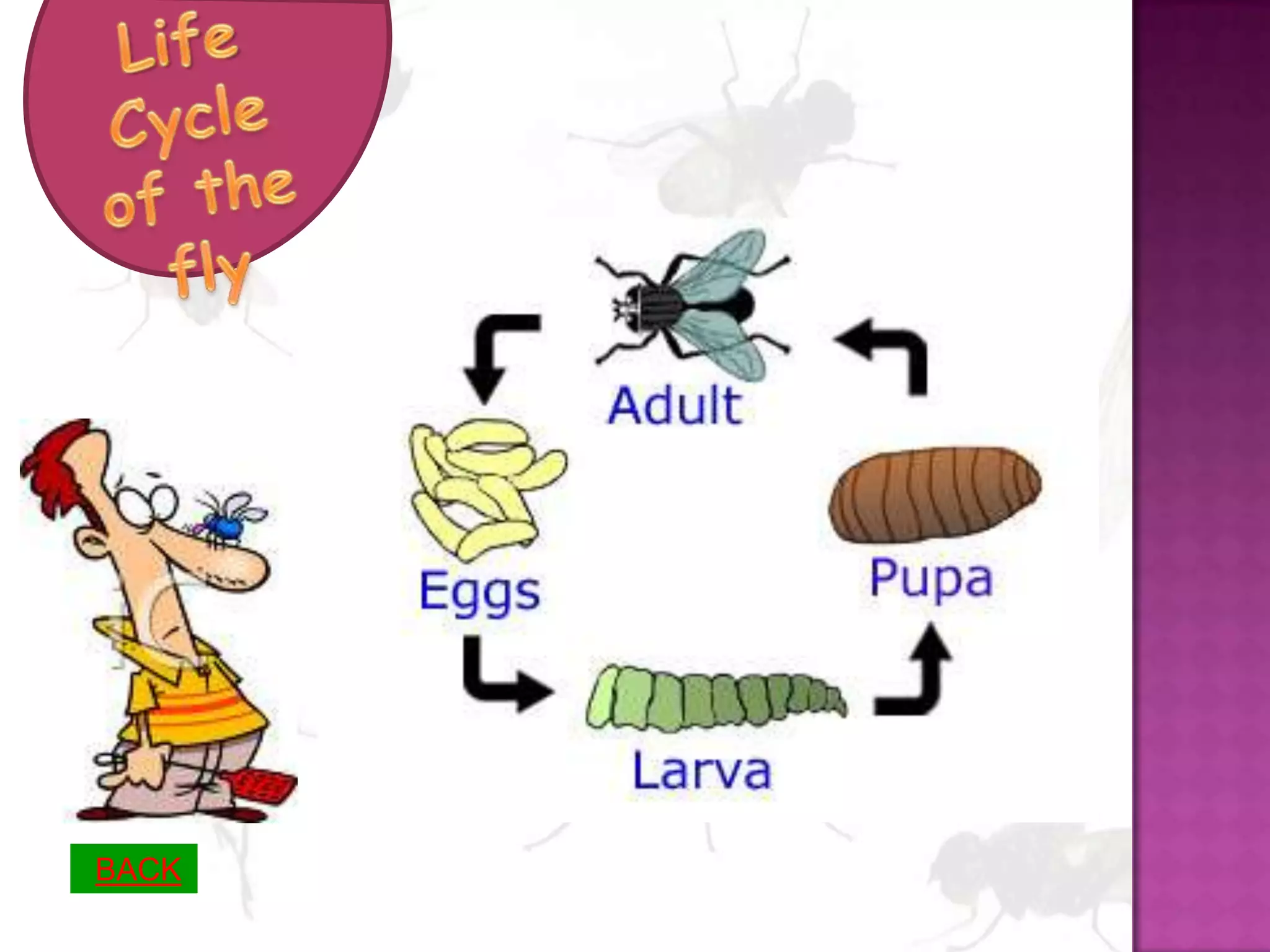
           Click here to see the full life cycle


BACK                                                   GO
BACK
The easiest way to keep flies out of your
       home is to keep things clean. Don’t leave
        food lying around, make sure to take out
       the garbage on a regular basis and wipe
                up messes straight away.


BACK
Life cycle: the series of changes of form
and activity that a living organism
undergoes from its beginning through to
maturity. Back
met·a·mor·phous

metamorphous: the transformation of an
insect from an immature form or larva to
an adult form in distinct stages. Back
lar-vae

larvae: the wingless immature worm-
shaped form of many insects that
develops into a pupa or chrysalis before
becoming an adult insect. Back
Mag-got

Maggot: the worm-shaped larva of
various members of the fly family, found
in decaying matter. Back
pyoo-pate

pupate: become a pupa, to develop from a
larva into a pupa Back
pyoo-pa

pupa: an insect at the stage between a
larva and an adult where the insect is in a
cocoon, stops feeding and undergoes
changes. Back
F-il-th

Filth: dirt or rubbish that is disgusting or
excessive. Back
Link to QCAR Essential Learnings Year 5

Ways of working
Students are able to
• draw conclusions that are supported by evidence, reproducible data and
established scientific concepts.
• reflect on learning to identify new understandings and future applications.

Knowledge and Understanding
• Scientific ideas can be used to explain the development and workings of
everyday items.

Life and living
Living things have features that determine their interactions with the
environment.
• Living things can be grouped according to their observable characteristics
e.g. flies are insects
• Reproductive processes and life cycles vary in different types of living things
e.g. flies develop through stages
• Living things have relationships with other living things and their environment
e.g. the relationship between a fly and its surroundings is mutually beneficial


 BACK
References:

Department of Education, Employment and Workplace Relations 2008, Primary
connections linking science and literacy: schoolyard safari, Australian Academy of
Science, Australia.

QSCC 1999, Years 1-10 source book: science, Qld Gov, Brisbane

The Readers Digest Association 2001, Word power dictionary, Oxford University
Press, London.

www.answers.com, first cited 15/11/08

www.creatures.ifas.ufl.edu/urban/flies/house_fly, first cited 10/11/08

www.images.google.com, first cited 10/11/08

www.office.microsoft.com/en-us/clipart/default, first cited 09/11/08

www.qsa.qld.edu.au/downloads/assessment/qcar_el_science_yr5, first cited
09/11/08


   BACK                                                       Continued
References:

www.sciencewithme.com/article_in_detail.php?cid=1&aid=7, first sited
10/11/08

www.the-piedpiper.co.uk, first sited 15/11/08

www.whatcom.wsu.edu/ag/homehort/pest/calliphoridae, first cited
16/11/08


  BACK

Life Cycle of the Fly

  • 1.
    Rhonda Perrett S0122845 Teaching about the Living World EDED19336 Assessment Task 1-Electronic Learning Tool Date of submission-21st November 2008 “This assignment is solely the work of Rhonda Perrett. All ideas and views of other people included or referred to are acknowledged and appropriately referenced”. Start
  • 2.
    Teachers P ag e  LINK TO ESSENTIAL LEARNINGS  REFERENCES BACK Start
  • 3.
    BACK Start
  • 4.
    Did you know? There are over A fly is an insect and insects are 40,000 known special animals. Flies go through species of flies. a complete metamorphosis, And you thought going from egg to larva or there was only maggot, then pupa to adult one kind, the stages within a week. They look annoying kind. very different in each stage. All the stages together are called a life cycle. Lets find out more. Click GO BACK GO
  • 5.
    Did you know? The fly regurgitates or vomits on the food to chemically break down the substance before The common house fly sipping up their belongs to the group of flies meal through their known as the filth fly. They straw-like were given their name for mouthparts. their habit of laying their eggs GROSS!! in moist, decaying organic matter, particularly manure and garbage. Now lets see how they grow. Click GO BACK GO
  • 6.
    The adult femalefly can lay up to 500 eggs in batches of 75 to 100 over a period of 3 Did you know? to 4 days. If temperatures The common are high, eggs may hatch house-fly only within 8 hours, otherwise it lives for 15-25 may take 1 to 2 days for days them to hatch. Now lets look at the different stages of growth. Click GO. BACK GO
  • 7.
    Stage One -First the adult female fly, which is bigger than the male fly, lays hundreds of tiny eggs. BACK GO
  • 8.
    4-7 days since eggs were laid Stage 2 - Here the eggs have hatched into larvae or another name for them is maggots. The maggots feed on the organic material in which they were laid. BACK GO
  • 9.
    10-20 days since eggs were laid Stage 3 – When the maggots stop feeding they burrow into the dry surrounding areas for protection. This is where they pupate. During the pupa stage, change takes place. BACK GO
  • 10.
    . Stage 4 – When ready, the fully developed fly comes out of the pupa. The mature adult fly is now ready to reproduce and continue its life cycle. Click here to see the full life cycle BACK GO
  • 11.
  • 12.
    The easiest wayto keep flies out of your home is to keep things clean. Don’t leave food lying around, make sure to take out the garbage on a regular basis and wipe up messes straight away. BACK
  • 13.
    Life cycle: theseries of changes of form and activity that a living organism undergoes from its beginning through to maturity. Back
  • 14.
    met·a·mor·phous metamorphous: the transformationof an insect from an immature form or larva to an adult form in distinct stages. Back
  • 15.
    lar-vae larvae: the winglessimmature worm- shaped form of many insects that develops into a pupa or chrysalis before becoming an adult insect. Back
  • 16.
    Mag-got Maggot: the worm-shapedlarva of various members of the fly family, found in decaying matter. Back
  • 17.
    pyoo-pate pupate: become apupa, to develop from a larva into a pupa Back
  • 18.
    pyoo-pa pupa: an insectat the stage between a larva and an adult where the insect is in a cocoon, stops feeding and undergoes changes. Back
  • 19.
    F-il-th Filth: dirt orrubbish that is disgusting or excessive. Back
  • 20.
    Link to QCAREssential Learnings Year 5 Ways of working Students are able to • draw conclusions that are supported by evidence, reproducible data and established scientific concepts. • reflect on learning to identify new understandings and future applications. Knowledge and Understanding • Scientific ideas can be used to explain the development and workings of everyday items. Life and living Living things have features that determine their interactions with the environment. • Living things can be grouped according to their observable characteristics e.g. flies are insects • Reproductive processes and life cycles vary in different types of living things e.g. flies develop through stages • Living things have relationships with other living things and their environment e.g. the relationship between a fly and its surroundings is mutually beneficial BACK
  • 21.
    References: Department of Education,Employment and Workplace Relations 2008, Primary connections linking science and literacy: schoolyard safari, Australian Academy of Science, Australia. QSCC 1999, Years 1-10 source book: science, Qld Gov, Brisbane The Readers Digest Association 2001, Word power dictionary, Oxford University Press, London. www.answers.com, first cited 15/11/08 www.creatures.ifas.ufl.edu/urban/flies/house_fly, first cited 10/11/08 www.images.google.com, first cited 10/11/08 www.office.microsoft.com/en-us/clipart/default, first cited 09/11/08 www.qsa.qld.edu.au/downloads/assessment/qcar_el_science_yr5, first cited 09/11/08 BACK Continued
  • 22.
    References: www.sciencewithme.com/article_in_detail.php?cid=1&aid=7, first sited 10/11/08 www.the-piedpiper.co.uk,first sited 15/11/08 www.whatcom.wsu.edu/ag/homehort/pest/calliphoridae, first cited 16/11/08 BACK