LICENCE TO ‘CLIL’
CLIL-ing an EFL course book to exemplify the process of
CLIL (Content Language Integrated Learning)
1
aliciartusi@gmail.com
http://englishmixsite.blogspot.com
PART 1 ON CLIL
PARAMETERS AND FEATURES
COMPARISON AND CONTRAST BETWEEN EFL AND CLIL
THE IMPORTANCE OF THINKING SKILLS
It’s competence-led
Content is a slave to illustrate language structures
It’s for an elite
It suits the mixed-ability phylosophy
Teachers do not transmit the content
Students learn concepts and skillsrequires extra time in the curriculum
Subjects are taught thru foreign language
requires high level of L2
Isolates language learning
It integrates content and language
2
3
4
5 6
Which numbers hide the truth about CLIL?
1
7
8
9
Skill-based focus of learning10
It provides reasons for learning11
13
Language mastery is assessed12
14Language is not assessed15
4
Definitions from the experts: Mehisto and Lucietto, 2010
http://www.ccn-clil.eu/index.php?name=File&nodeIDX=5060
5
https://sites.google.com/site/atriptoclil/what-is-clil
Definitions from the experts: Phil Ball
6
EFL CLIL
Draw a line to the corresponding box. Then complete the chart on the following slide.
http://www.kubbu.com/teacher/
7
EFL English as a foreign language CLIL Content language integrated learning
language-driven
 
language sequencing
 
language oriented
 
PPP Presentation Practice
Production
 
language Procedure Concept
 
topics are vehicles
 
content is accommodated to teach
the structure of the foreign language
 
accurate input accurate output
 
presents and transmits.
 
content-driven
 
conceptual sequencing
 
task –oriented.
 
PPP Production Practice Presentation
 
CPL Concept Procedure Language
 
language as a vehicle
 
dual-focus content and language are
accommodated
 
rough input and rough output
 
uses schemata.
 
Guess and click to disclose the information
8
drills and personalizes
 
works on study skills
 
uses visuals to illustrate vocabulary
or make the page attractive.
 
uses explicit scaffolds
 
Linguistic and communicative
competences
 
 may require social and learning
strategies, and cooperative work.
 
 may cater for the mixed-ability
nature of the classroom
Evaluation as evidence of the
mastery of the L2 (pass/fail
criterion) Summative assessment
prevails over formative assessment.
requires complex problem solving.
 
sharpens cognitive skills
 
uses visuals, models and diagrams in
order to make content understandable
 
uses of embedded or explicit scaffolds.
 
Competence-led
 
requires social skills and learning
strategies. Encourages cooperative
work.
tasks designed for the mixed-ability
nature of the class
  evaluation as basis for improvement.
Uses formative and summative ways of
collecting evidence or progress.
9
http://popplet.com/app/#/222029
Thinking Skills: cognitive strategies: mental manipulation of the material by
Kaufman and Crandall (2005) adapted concepts from Chamot &O’Malley (1987)
judging how well one has accomplished
and setting new goals.
planning the parts, sequence, ideas, language to be expressed.
Go through the material in order to preview
ideas and concepts.
checking one’s own performance, accuracy and
appropriateness of one’s own production.
10
Thinking Skills Metagognitive strategies
Planning and monitoring one’s production. Discover what it includes. Click on each
strategy.
Advanced organizing
Organizational planning
attending to specific aspects of input by scanning key
words, concepts and linguistic markers.
Self monitoring
Self evaluating
Selectively attending
11
Social affective strategies: interacting with another
person to assist a learning task.
Questioning for clarification
Cooperating
Self-affirming
Thinking Skills. Social affective strategies: interacting with
another person to assist a learning task.
Lower Order thinking (LO)
Remembering
Understanding
Appying
Higher order thinking (HO)
Analysing
Evaluating
Creating
=
Knowledge
12
The Cognitive Process
Anderson and Krathwohl (2000) revised version of Bloom’s Taxonomy
PART 2 CLIL MATERIAL
THE 4CS
INTO THE 4CS
EXPLORING A CLIL PROJECT
CLIL-ING A COURSEBOOK UNIT
ASSESSING THE OBJECTIVES
The 4 Cs framework
by Coyle, Hood and Marsh
15
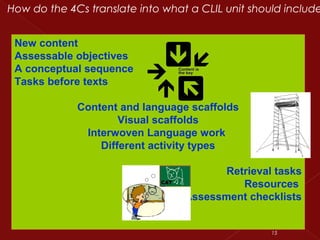
New content
Assessable objectives
A conceptual sequence
Tasks before texts
Content and language scaffolds
Visual scaffolds
Interwoven Language work
Different activity types
Retrieval tasks
Resources
Assessment checklists
How do the 4Cs translate into what a CLIL unit should include
16
EXPLORE
The World of Inventions Eleanitz English Teacher’s notes + part
of the class material and see:
Teacher’s notes
Didactic objectives
Sequence
Activity types – scaffolds
Assessment
Class material
How content is sequenced
How language structures are worked
EXPLORING A CLIL PROJECT: The World of Inventions
http://www.eleanitz.org/web/default.php
17
PART 3 CLIL-ing MATERIAL
CLIL-ING A COURSEBOOK UNIT
ASSESSING THE OBJECTIVES
18
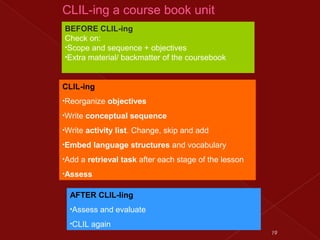
CLIL-ing a course book unit
Engage Level 3 Unit 4, Oxford University Press, 2008, See Appendix 5
19
BEFORE CLIL-ing
Check on:
•Scope and sequence + objectives
•Extra material/ backmatter of the coursebook
CLIL-ing
•Reorganize objectives
•Write conceptual sequence
•Write activity list. Change, skip and add
•Embed language structures and vocabulary
•Add a retrieval task after each stage of the lesson
•Assess
AFTER CLIL-ling
•Assess and evaluate
•CLIL again
CLIL-ing a course book unit
20
Assessing students’ progress
Formative assessment
Project work
Portfolios /e-portfolios
Interviews
Writing tasks
Oral reports
Self-evaluations
Summative assessment
tests
Assessing content + language
Possible criteria:
Content (factual, cultural, etc)
Language
Communication
Team work
General presentation and delivery
Possible Measuring standards:
Advanced Proficient Basic Minimal
21
Recommended websites
22
http://www.factworld.info/
http://www.eleanitz.org/web/default.php
24
http://www.ccn-clil.eu/index.php?name=Content&nodeIDX=5485
http://www.onestopenglish.com/

Licence to clil

  • 1.
    LICENCE TO ‘CLIL’ CLIL-ingan EFL course book to exemplify the process of CLIL (Content Language Integrated Learning) 1 aliciartusi@gmail.com http://englishmixsite.blogspot.com
  • 2.
    PART 1 ONCLIL PARAMETERS AND FEATURES COMPARISON AND CONTRAST BETWEEN EFL AND CLIL THE IMPORTANCE OF THINKING SKILLS
  • 3.
    It’s competence-led Content isa slave to illustrate language structures It’s for an elite It suits the mixed-ability phylosophy Teachers do not transmit the content Students learn concepts and skillsrequires extra time in the curriculum Subjects are taught thru foreign language requires high level of L2 Isolates language learning It integrates content and language 2 3 4 5 6 Which numbers hide the truth about CLIL? 1 7 8 9 Skill-based focus of learning10 It provides reasons for learning11 13 Language mastery is assessed12 14Language is not assessed15
  • 4.
    4 Definitions from theexperts: Mehisto and Lucietto, 2010 http://www.ccn-clil.eu/index.php?name=File&nodeIDX=5060
  • 5.
  • 6.
    6 EFL CLIL Draw aline to the corresponding box. Then complete the chart on the following slide. http://www.kubbu.com/teacher/
  • 7.
    7 EFL English asa foreign language CLIL Content language integrated learning language-driven   language sequencing   language oriented   PPP Presentation Practice Production   language Procedure Concept   topics are vehicles   content is accommodated to teach the structure of the foreign language   accurate input accurate output   presents and transmits.   content-driven   conceptual sequencing   task –oriented.   PPP Production Practice Presentation   CPL Concept Procedure Language   language as a vehicle   dual-focus content and language are accommodated   rough input and rough output   uses schemata.   Guess and click to disclose the information
  • 8.
    8 drills and personalizes   workson study skills   uses visuals to illustrate vocabulary or make the page attractive.   uses explicit scaffolds   Linguistic and communicative competences    may require social and learning strategies, and cooperative work.    may cater for the mixed-ability nature of the classroom Evaluation as evidence of the mastery of the L2 (pass/fail criterion) Summative assessment prevails over formative assessment. requires complex problem solving.   sharpens cognitive skills   uses visuals, models and diagrams in order to make content understandable   uses of embedded or explicit scaffolds.   Competence-led   requires social skills and learning strategies. Encourages cooperative work. tasks designed for the mixed-ability nature of the class   evaluation as basis for improvement. Uses formative and summative ways of collecting evidence or progress.
  • 9.
    9 http://popplet.com/app/#/222029 Thinking Skills: cognitivestrategies: mental manipulation of the material by Kaufman and Crandall (2005) adapted concepts from Chamot &O’Malley (1987)
  • 10.
    judging how wellone has accomplished and setting new goals. planning the parts, sequence, ideas, language to be expressed. Go through the material in order to preview ideas and concepts. checking one’s own performance, accuracy and appropriateness of one’s own production. 10 Thinking Skills Metagognitive strategies Planning and monitoring one’s production. Discover what it includes. Click on each strategy. Advanced organizing Organizational planning attending to specific aspects of input by scanning key words, concepts and linguistic markers. Self monitoring Self evaluating Selectively attending
  • 11.
    11 Social affective strategies:interacting with another person to assist a learning task. Questioning for clarification Cooperating Self-affirming Thinking Skills. Social affective strategies: interacting with another person to assist a learning task.
  • 12.
    Lower Order thinking(LO) Remembering Understanding Appying Higher order thinking (HO) Analysing Evaluating Creating = Knowledge 12 The Cognitive Process Anderson and Krathwohl (2000) revised version of Bloom’s Taxonomy
  • 13.
    PART 2 CLILMATERIAL THE 4CS INTO THE 4CS EXPLORING A CLIL PROJECT CLIL-ING A COURSEBOOK UNIT ASSESSING THE OBJECTIVES
  • 14.
    The 4 Csframework by Coyle, Hood and Marsh
  • 15.
    15 New content Assessable objectives Aconceptual sequence Tasks before texts Content and language scaffolds Visual scaffolds Interwoven Language work Different activity types Retrieval tasks Resources Assessment checklists How do the 4Cs translate into what a CLIL unit should include
  • 16.
    16 EXPLORE The World ofInventions Eleanitz English Teacher’s notes + part of the class material and see: Teacher’s notes Didactic objectives Sequence Activity types – scaffolds Assessment Class material How content is sequenced How language structures are worked EXPLORING A CLIL PROJECT: The World of Inventions http://www.eleanitz.org/web/default.php
  • 17.
    17 PART 3 CLIL-ingMATERIAL CLIL-ING A COURSEBOOK UNIT ASSESSING THE OBJECTIVES
  • 18.
    18 CLIL-ing a coursebook unit Engage Level 3 Unit 4, Oxford University Press, 2008, See Appendix 5
  • 19.
    19 BEFORE CLIL-ing Check on: •Scopeand sequence + objectives •Extra material/ backmatter of the coursebook CLIL-ing •Reorganize objectives •Write conceptual sequence •Write activity list. Change, skip and add •Embed language structures and vocabulary •Add a retrieval task after each stage of the lesson •Assess AFTER CLIL-ling •Assess and evaluate •CLIL again CLIL-ing a course book unit
  • 20.
    20 Assessing students’ progress Formativeassessment Project work Portfolios /e-portfolios Interviews Writing tasks Oral reports Self-evaluations Summative assessment tests Assessing content + language Possible criteria: Content (factual, cultural, etc) Language Communication Team work General presentation and delivery Possible Measuring standards: Advanced Proficient Basic Minimal
  • 21.
  • 22.
  • 23.
  • 24.
  • 25.

Editor's Notes

  • #4 Answers: 1,4,6,7,9,10,11,14 Read Appendix 1 and 2 What is CLIL and Defining CLIL parameters.
  • #5 http://www.ccn-clil.eu/index.php?name=File&nodeIDX=5060
  • #19 Some ideas for activity types at the orientation stage Associating, predicting, guessing, inferring, spotting sth different, finding similarities/differences, recognizing (circling, highliting, underlining, matching, numbering, removing) defining ( labeling, completing sentence starters, a chart), ticking/crossing out, ordering, classifying, completing, memorizing, recalling from memories and experiences, bringing personal photos/objects/pets/plants to class, finishing a sentence/drawing, miming, copying. Support porvided by teacher: Using BICS (Basic interpersonal communication skills) Eliciting, brainstorming, triggering,asking, prompting, repeating giving examples, using L1,ranking/sequencing key words, using graphs, using realia, miming, involving students in a hands-on self- explanatory activity, showing a video/ listening to music, supplying key words, visual support, suggested websites and ICTools.