
"Library, what's library?"
Creative library assessment
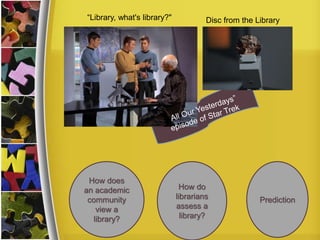
“Library, what's library?" Disc from the Library
How does
an academic
community
view a
library?
How do
librarians
assess a
library?
Prediction
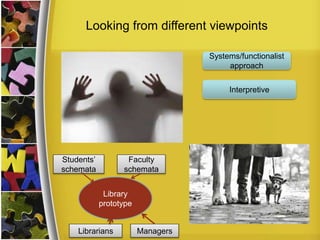
Looking from different viewpoints
Library
prototype
Students’
schemata
Faculty
schemata
Librarians
Systems/functionalist
approach
Managers
Interpretive
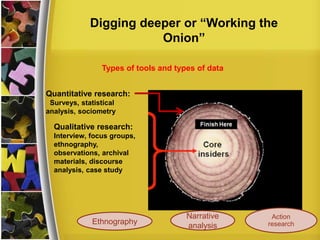
Digging deeper or “Working the
Onion”
Quantitative research:
Surveys, statistical
analysis, sociometry
Qualitative research:
Interview, focus groups,
ethnography,
observations, archival
materials, discourse
analysis, case study
Action
researchEthnography
Narrative
analysis
Types of tools and types of data
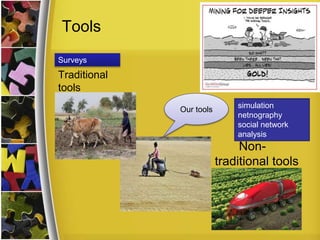
Tools
Traditional
tools
Non-
traditional tools
Our tools
Surveys
simulation
netnography
social network
analysis
Names Purpose Type
LibQual+ users' opinions of
service quality
survey
DigiQual user’s opinion of
digital services
survey
MINES for Libraries Purpose of use of
electronic resources
survey
Project COUNTER electronic resources
usage
ClimateQUAL staff perceptions
concerning the library
survey
Library/ ARL Assessment tools
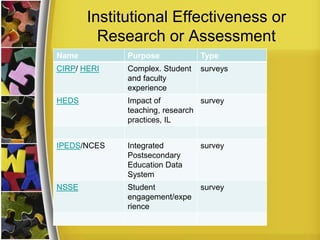
Institutional Effectiveness or
Research or Assessment
Name Purpose Type
CIRP/ HERI Complex. Student
and faculty
experience
surveys
HEDS Impact of
teaching, research
practices, IL
survey
IPEDS/NCES Integrated
Postsecondary
Education Data
System
survey
NSSE Student
engagement/expe
rience
survey
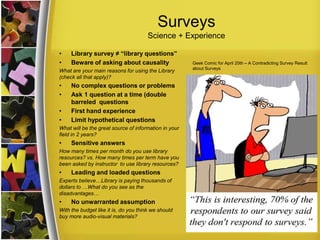
Surveys
Science + Experience
• Library survey ≠ “library questions”
• Beware of asking about causality
What are your main reasons for using the Library
(check all that apply)?
• No complex questions or problems
• Ask 1 question at a time (double
barreled questions
• First hand experience
• Limit hypothetical questions
What will be the great source of information in your
field in 2 years?
• Sensitive answers
How many times per month do you use library
resources? vs. How many times per term have you
been asked by instructor to use library resources?
• Leading and loaded questions
Experts believe…Library is paying thousands of
dollars to …What do you see as the
disadvantages…
• No unwarranted assumption
With the budget like it is, do you think we should
buy more audio-visual materials?
Geek Comic for April 20th – A Contradicting Survey Result
about Surveys
.
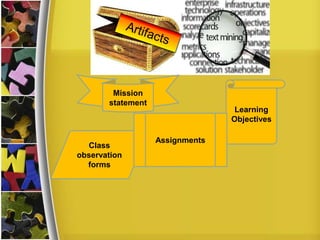
Mission
statement
Learning
Objectives
Class
observation
forms
Assignments
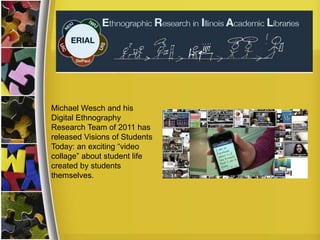
Michael Wesch and his
Digital Ethnography
Research Team of 2011 has
released Visions of Students
Today: an exciting “video
collage” about student life
created by students
themselves.
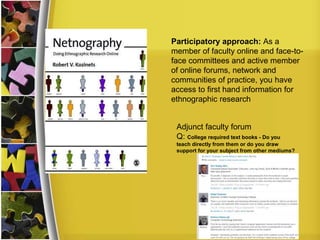
Participatory approach: As a
member of faculty online and face-to-
face committees and active member
of online forums, network and
communities of practice, you have
access to first hand information for
ethnographic research
Adjunct faculty forum
Q: College required text books - Do you
teach directly from them or do you draw
support for your subject from other mediums?
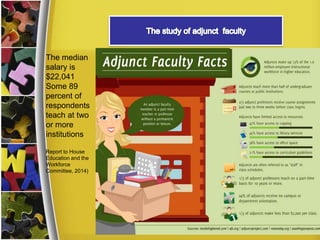
The median
salary is
$22,041
Some 89
percent of
respondents
teach at two
or more
institutions
Report to House
Education and the
Workforce
Committee, 2014)
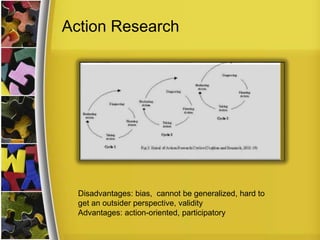
Action Research
Disadvantages: bias, cannot be generalized, hard to
get an outsider perspective, validity
Advantages: action-oriented, participatory
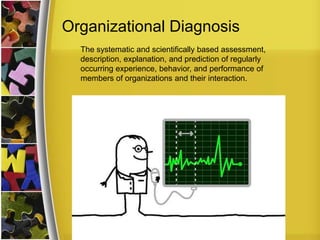
Organizational Diagnosis
The systematic and scientifically based assessment,
description, explanation, and prediction of regularly
occurring experience, behavior, and performance of
members of organizations and their interaction.
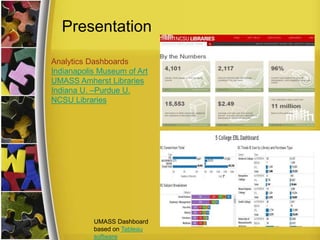
Presentation
Analytics Dashboards
Indianapolis Museum of Art
UMASS Amherst Libraries
Indiana U. –Purdue U.
NCSU Libraries
UMASS Dashboard
based on Tableau
software
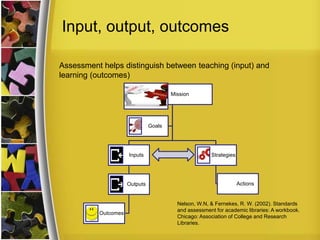
Input, output, outcomes
Assessment helps distinguish between teaching (input) and
learning (outcomes)
Nelson, W.N, & Fernekes, R. W. (2002). Standards
and assessment for academic libraries: A workbook.
Chicago: Association of College and Research
Libraries.
Mission
Inputs
Outputs
Outcomes
Strategies
Actions
Goals
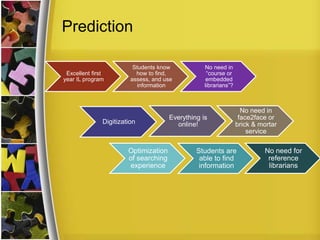
Prediction
Excellent first
year IL program
Students know
how to find,
assess, and use
information
No need in
“course or
embedded
librarians”?
Optimization
of searching
experience
Students are
able to find
information
No need for
reference
librarians
Digitization
Everything is
online!
No need in
face2face or
brick & mortar
service
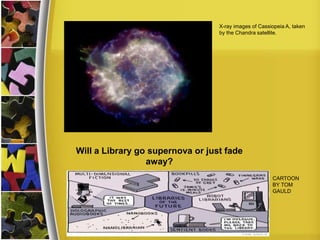
Will a Library go supernova or just fade
away?
X-ray images of Cassiopeia A, taken
by the Chandra satellite.
CARTOON
BY TOM
GAULD
References
Duke, L. M., & Asher, A. D. (2011). College libraries and student
culture: What we now know. Chicago: American Library
Association.
Gordon J. Hewitt, Hewitt R.T. (2010). Ability, Assistance, and
Collaboration in Academic Library Assessment. Library
Philosophy and Practice , 479 Retrieved from
http://digitalcommons.unl.edu/libphilprac/479
Nelson, W.N, & Fernekes, R. W. (2002). Standards and assessment
for academic libraries: A workbook. Chicago: Association of
College and Research Libraries
Kozinets, R. V. (2010). Netnography. Doing ethnographic research
online . Thousand Oaks, CA: Sage Publications.
Morton-Owens, E. & Hanson, K. (2012). Trends at a Glance: A
Management Dashboard of Library Statistics. Information
Technology and Libraries, 31 (3).
Oakleaf, M. J., Association of College and Research Libraries., &
American Library Association. (2010). The value of academic
libraries: A comprehensive research review and report. Chicago, IL:
Association of College and Research Libraries, American Library
Association. Retrieved from www.aclr.ala.org/value.
Rambler, L. K. (1982). Syllabus Study: Key to a Responsive Academic
Library. Journal of Academic Librarianship, 8(3), 155.

Library, what's Library? Creative Library Assessment

  • 1.
  • 2.
    “Library, what's library?"Disc from the Library How does an academic community view a library? How do librarians assess a library? Prediction
  • 3.
    Looking from differentviewpoints Library prototype Students’ schemata Faculty schemata Librarians Systems/functionalist approach Managers Interpretive
  • 4.
    Digging deeper or“Working the Onion” Quantitative research: Surveys, statistical analysis, sociometry Qualitative research: Interview, focus groups, ethnography, observations, archival materials, discourse analysis, case study Action researchEthnography Narrative analysis Types of tools and types of data
  • 5.
  • 6.
    Names Purpose Type LibQual+users' opinions of service quality survey DigiQual user’s opinion of digital services survey MINES for Libraries Purpose of use of electronic resources survey Project COUNTER electronic resources usage ClimateQUAL staff perceptions concerning the library survey Library/ ARL Assessment tools
  • 7.
    Institutional Effectiveness or Researchor Assessment Name Purpose Type CIRP/ HERI Complex. Student and faculty experience surveys HEDS Impact of teaching, research practices, IL survey IPEDS/NCES Integrated Postsecondary Education Data System survey NSSE Student engagement/expe rience survey
  • 8.
    Surveys Science + Experience •Library survey ≠ “library questions” • Beware of asking about causality What are your main reasons for using the Library (check all that apply)? • No complex questions or problems • Ask 1 question at a time (double barreled questions • First hand experience • Limit hypothetical questions What will be the great source of information in your field in 2 years? • Sensitive answers How many times per month do you use library resources? vs. How many times per term have you been asked by instructor to use library resources? • Leading and loaded questions Experts believe…Library is paying thousands of dollars to …What do you see as the disadvantages… • No unwarranted assumption With the budget like it is, do you think we should buy more audio-visual materials? Geek Comic for April 20th – A Contradicting Survey Result about Surveys .
  • 9.
  • 10.
    Michael Wesch andhis Digital Ethnography Research Team of 2011 has released Visions of Students Today: an exciting “video collage” about student life created by students themselves.
  • 11.
    Participatory approach: Asa member of faculty online and face-to- face committees and active member of online forums, network and communities of practice, you have access to first hand information for ethnographic research Adjunct faculty forum Q: College required text books - Do you teach directly from them or do you draw support for your subject from other mediums?
  • 12.
    The median salary is $22,041 Some89 percent of respondents teach at two or more institutions Report to House Education and the Workforce Committee, 2014)
  • 13.
    Action Research Disadvantages: bias,cannot be generalized, hard to get an outsider perspective, validity Advantages: action-oriented, participatory
  • 14.
    Organizational Diagnosis The systematicand scientifically based assessment, description, explanation, and prediction of regularly occurring experience, behavior, and performance of members of organizations and their interaction.
  • 15.
    Presentation Analytics Dashboards Indianapolis Museumof Art UMASS Amherst Libraries Indiana U. –Purdue U. NCSU Libraries UMASS Dashboard based on Tableau software
  • 16.
    Input, output, outcomes Assessmenthelps distinguish between teaching (input) and learning (outcomes) Nelson, W.N, & Fernekes, R. W. (2002). Standards and assessment for academic libraries: A workbook. Chicago: Association of College and Research Libraries. Mission Inputs Outputs Outcomes Strategies Actions Goals
  • 17.
    Prediction Excellent first year ILprogram Students know how to find, assess, and use information No need in “course or embedded librarians”? Optimization of searching experience Students are able to find information No need for reference librarians Digitization Everything is online! No need in face2face or brick & mortar service
  • 18.
    Will a Librarygo supernova or just fade away? X-ray images of Cassiopeia A, taken by the Chandra satellite. CARTOON BY TOM GAULD
  • 19.
    References Duke, L. M.,& Asher, A. D. (2011). College libraries and student culture: What we now know. Chicago: American Library Association. Gordon J. Hewitt, Hewitt R.T. (2010). Ability, Assistance, and Collaboration in Academic Library Assessment. Library Philosophy and Practice , 479 Retrieved from http://digitalcommons.unl.edu/libphilprac/479 Nelson, W.N, & Fernekes, R. W. (2002). Standards and assessment for academic libraries: A workbook. Chicago: Association of College and Research Libraries Kozinets, R. V. (2010). Netnography. Doing ethnographic research online . Thousand Oaks, CA: Sage Publications. Morton-Owens, E. & Hanson, K. (2012). Trends at a Glance: A Management Dashboard of Library Statistics. Information Technology and Libraries, 31 (3).
  • 20.
    Oakleaf, M. J.,Association of College and Research Libraries., & American Library Association. (2010). The value of academic libraries: A comprehensive research review and report. Chicago, IL: Association of College and Research Libraries, American Library Association. Retrieved from www.aclr.ala.org/value. Rambler, L. K. (1982). Syllabus Study: Key to a Responsive Academic Library. Journal of Academic Librarianship, 8(3), 155.

Editor's Notes

  • #6  We think we use tools that have been “approved” by scholars and protocols that have been validated, but do we? Surveys Collecting quantitative data: gate counts, log files, transactions, tallied data, ILL, Reserves Collecting qualitative data
  • #10 Rambler, L. K. (1982). Syllabus Study: Key to a Responsive Academic Library. Journal of Academic Librarianship, 8(3), 155.
  • #12 You do not ask questions such as: Do you use library? Do you teach information literacy? Do you refer to library resources?
  • #13 Faculty Survey Publisher : Higher Education Research Institute (HERI) at UCLA Contact : Higher Education Research Institute, UCLA Graduate School of Education and Information Studies, 3005 Moore Hall - Box 951521, Los Angeles, CA 90095-1521. Web URL : http://www.gseis.ucla.edu/heri/cirp.htm Details : The Faculty Survey collects information about the workload, teaching practices, job satisfaction, and professional activities of collegiate faculty and administrators. Database Reference : http://www.imir.iupui.edu/survey2/comparison.asp
  • #16 Key information should be obvious Visually engaging High-level data with patterns and trends over time
  • #17 Mission ACRL is the purpose statement in the “scholarly research” language. Strategies