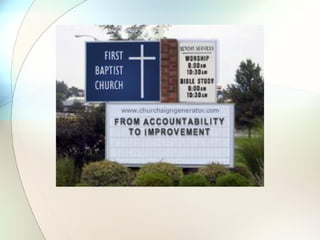
SCC/MLA 2007  Albuquerque, New Mexico Library Assessment:  From Accountability to Improvement
Introduction Instructors Agenda Objectives Attendees Tell us: Name What you do Where you work Complete this sentence: One year from today I will ………….
Pre-Test
Section 1:  Overview
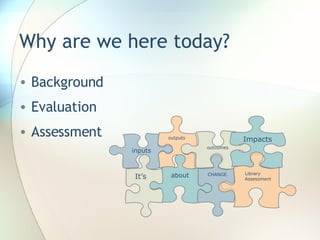
Why are we here today? Background Evaluation Assessment outputs about outcomes CHANGE. Impacts Library Assessment inputs It’s
Is it evaluation or is it assessment?
Program Evaluation Efficiency Effectiveness Accountability Inputs Outputs Outcomes Impact Is this Library Assessment? How do you measure your library’s success?  Is it circulation numbers?  Is it the number of patrons?  The number of searches of your electronic databases? – Stranton Lloyd
Outcomes Evaluation and  Outcomes Assessment Question has changed From  What have we done  to accomplish our goals  To  What has changed  as a result of our work
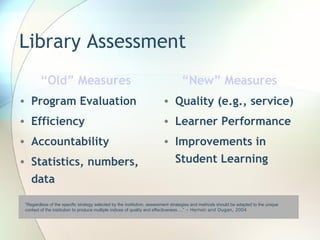
Library Assessment “ Old” Measures Program Evaluation Efficiency Accountability Statistics, numbers, data “ New” Measures Quality (e.g., service) Learner Performance Improvements in Student Learning “ Regardless of the specific strategy selected by the institution, assessment strategies and methods should be adapted to the unique context of the institution to produce multiple indices of quality and effectiveness….”  – Hernon and Dugan, 2004
“ Library assessment” is…. Definitions Perspectives Experts
Why should we care about assessment? Mouse cages  Ejournals
A Check :-/  confused >:/ bring it on
Break
Section II:  Library Assessment in Higher Education Primary performance indicator Differences among inputs, outputs, and outcomes
Activity 1
Student Learning Outcomes and Technology
Outcomes Assessment and Service Quality Assessing Organizations Assessment Tools LibQUAL+
LibQUAL+ ™ The LibQUAL+™ Premise What is service quality? Definition:  difference between what customers expect and their perceptions of the service performance.
Bar Charts
2007 Core Questions Dimensions Summary Affect of Service Dimension Information Control Library as Place 4 5 6 7 8 9 Mean Overall
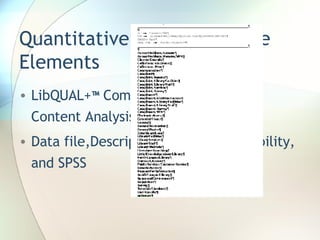
Quantitative and Qualitative Elements LibQUAL+ ™  Comments Content Analysis and Atlas.ti Data file,Descriptive Statistics,Reliability, and SPSS
 
A Tool “ LibQUAL+ ™  is ‘another tool in the box’…it complements other information you have about service performance and quality”  (Hiller) Note:   After the Radar Chart , Steve Hiller, 2002.
Collecting statistics  begins  the road trip.
Defusing Statistics
Developing an Assessment Plan Assessment Plan Columbia University Libraries 2007 through 2009
The Assessment Cycle Mission/Purposes and Objectives Repeat the assessment cycle after changes have been implemented. Source:  Hernon and Dugan, 2004 Interpret Evidence Implement Change Identify Outcomes Gather Evidence
Obstacles to Assessment No single model How do AHSL’s show impact?  Improved healthcare, reduced costs, increased access to health information? Lack of adequate data-gathering systems Hard to compare results from disparate data sources Lack of staff skills No support from library leadership
The Value of Information How do you quantify the value of information? What is the return on investment (ROI)? Worth Their Weight
Successful Assessment Staff training Technical support and systems Focus on processes/services, not individuals Select the appropriate measures Realistic scope and schedules Senior leadership support Results are used in decision-making
A Culture of Assessment Decision based on facts, research, and analysis Staff are informed about results Change occurs based on results
Pulling it Together The 21 st  Century Library is very different! User-centered libraries Outcomes assessment is complex Evaluation and assessment focus on user/customer outcomes Assessment Toolbox
 
Do you have a culture of assessment?
 
Resources Our Ning
By the end of this session you will be able to: Define “culture of assessment” Provide an example of an input, output, impact, and outcome Explain how assessment differs from evaluation List two examples of student learning objectives List two tools useful in library assessment Describe two obstacles to assessment List two elements to include in an assessment plan Be able to access the 2007 SCC/MLA CE Course  Ning
 
“ The information acquired through library assessment is used in an iterative manner to improve library programs and services and make libraries responsive to the needs of their communities.”   – Steve Hiller “… accountability has shifted from ‘are we spending our money efficiently and wisely’ to ‘what difference does the library make?’”    – Steve Hiller Photo source:  Charlotte Self
Thank you. Other resources URL for Ning:  http://libassess.ning.com/ Class Evaluation Survey

Library Assessment

  • 1.
    SCC/MLA 2007 Albuquerque, New Mexico Library Assessment: From Accountability to Improvement
  • 2.
    Introduction Instructors AgendaObjectives Attendees Tell us: Name What you do Where you work Complete this sentence: One year from today I will ………….
  • 3.
  • 4.
    Section 1: Overview
  • 5.
    Why are wehere today? Background Evaluation Assessment outputs about outcomes CHANGE. Impacts Library Assessment inputs It’s
  • 6.
    Is it evaluationor is it assessment?
  • 7.
    Program Evaluation EfficiencyEffectiveness Accountability Inputs Outputs Outcomes Impact Is this Library Assessment? How do you measure your library’s success? Is it circulation numbers? Is it the number of patrons? The number of searches of your electronic databases? – Stranton Lloyd
  • 8.
    Outcomes Evaluation and Outcomes Assessment Question has changed From What have we done to accomplish our goals To What has changed as a result of our work
  • 9.
    Library Assessment “Old” Measures Program Evaluation Efficiency Accountability Statistics, numbers, data “ New” Measures Quality (e.g., service) Learner Performance Improvements in Student Learning “ Regardless of the specific strategy selected by the institution, assessment strategies and methods should be adapted to the unique context of the institution to produce multiple indices of quality and effectiveness….” – Hernon and Dugan, 2004
  • 10.
    “ Library assessment”is…. Definitions Perspectives Experts
  • 11.
    Why should wecare about assessment? Mouse cages Ejournals
  • 12.
    A Check :-/ confused >:/ bring it on
  • 13.
  • 14.
    Section II: Library Assessment in Higher Education Primary performance indicator Differences among inputs, outputs, and outcomes
  • 15.
  • 16.
  • 17.
    Outcomes Assessment andService Quality Assessing Organizations Assessment Tools LibQUAL+
  • 18.
    LibQUAL+ ™ TheLibQUAL+™ Premise What is service quality? Definition: difference between what customers expect and their perceptions of the service performance.
  • 19.
  • 20.
    2007 Core QuestionsDimensions Summary Affect of Service Dimension Information Control Library as Place 4 5 6 7 8 9 Mean Overall
  • 21.
    Quantitative and QualitativeElements LibQUAL+ ™ Comments Content Analysis and Atlas.ti Data file,Descriptive Statistics,Reliability, and SPSS
  • 22.
  • 23.
    A Tool “LibQUAL+ ™ is ‘another tool in the box’…it complements other information you have about service performance and quality” (Hiller) Note: After the Radar Chart , Steve Hiller, 2002.
  • 24.
    Collecting statistics begins the road trip.
  • 25.
  • 26.
    Developing an AssessmentPlan Assessment Plan Columbia University Libraries 2007 through 2009
  • 27.
    The Assessment CycleMission/Purposes and Objectives Repeat the assessment cycle after changes have been implemented. Source: Hernon and Dugan, 2004 Interpret Evidence Implement Change Identify Outcomes Gather Evidence
  • 28.
    Obstacles to AssessmentNo single model How do AHSL’s show impact? Improved healthcare, reduced costs, increased access to health information? Lack of adequate data-gathering systems Hard to compare results from disparate data sources Lack of staff skills No support from library leadership
  • 29.
    The Value ofInformation How do you quantify the value of information? What is the return on investment (ROI)? Worth Their Weight
  • 30.
    Successful Assessment Stafftraining Technical support and systems Focus on processes/services, not individuals Select the appropriate measures Realistic scope and schedules Senior leadership support Results are used in decision-making
  • 31.
    A Culture ofAssessment Decision based on facts, research, and analysis Staff are informed about results Change occurs based on results
  • 32.
    Pulling it TogetherThe 21 st Century Library is very different! User-centered libraries Outcomes assessment is complex Evaluation and assessment focus on user/customer outcomes Assessment Toolbox
  • 33.
  • 34.
    Do you havea culture of assessment?
  • 35.
  • 36.
  • 37.
    By the endof this session you will be able to: Define “culture of assessment” Provide an example of an input, output, impact, and outcome Explain how assessment differs from evaluation List two examples of student learning objectives List two tools useful in library assessment Describe two obstacles to assessment List two elements to include in an assessment plan Be able to access the 2007 SCC/MLA CE Course Ning
  • 38.
  • 39.
    “ The informationacquired through library assessment is used in an iterative manner to improve library programs and services and make libraries responsive to the needs of their communities.” – Steve Hiller “… accountability has shifted from ‘are we spending our money efficiently and wisely’ to ‘what difference does the library make?’” – Steve Hiller Photo source: Charlotte Self
  • 40.
    Thank you. Otherresources URL for Ning: http://libassess.ning.com/ Class Evaluation Survey