By Kathryn Munson
Defining Library 2.0 “ The principles of Library 2.0 seek to put users in touch with information and entertainment wherever they may be, breaking down the barriers of space, time and outdated policy. It is a user-centered paradigm focusing on knowledge, experience, collaboration, the creation of new content and encouraging the heart.” Michael Stephens
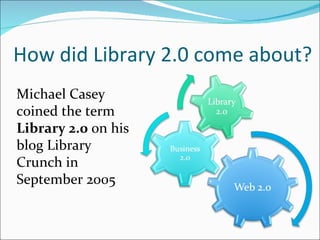
How did Library 2.0 come about? Michael Casey coined the term  Library 2.0  on his blog Library Crunch in September 2005
Basics of Library 2.0 Constant and Purposeful Change Be able to quickly respond to changing needs Not change for the sake of change User Participation = User Empowerment Reaching Current and Potential Users Continuing to provide services to the library’s base while reaching patrons who don’t typically use the library Serving the “Long Tail”
Library 2.0 goals  for the academic library Evaluate all services  on a regular basis. Implement purposeful change  driven by feedback from the university community. Practice constant learning  of professional best practices and new technologies . Recognize the social value of  the library  as a compliment to its academic purposes.
Access Services and Library 2.0 In each of the stated goals for Academic Library 2.0: Evaluating Services Implementing change Practicing constant learning Blending social and academic functions Access Services staff  will play an essential part!
Evaluating Services Necessary for instituting purposeful change. Access Services staff uniquely positioned to solicit feedback from users on:  Quality of collection- Circulation, ILL Media selections- Media Lab Web site and electronic resources usability- Computer Lab Integrated Learning Opportunities- Reserves General feedback- All staff Staff feedback is also essential to the evaluation process!
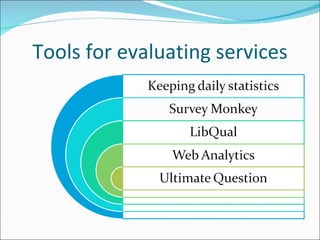
Tools for evaluating services
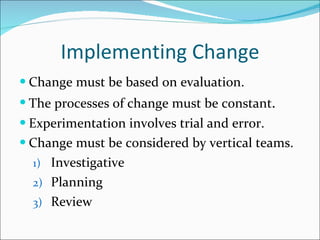
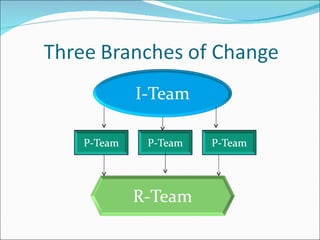
Implementing Change Change must be based on evaluation. The processes of change must be constant . Experimentation involves trial and error. Change must be considered by vertical teams. Investigative Planning  Review
 
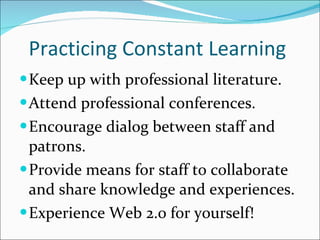
Practicing Constant Learning Keep up with professional literature. Attend professional conferences. Encourage dialog between staff and patrons. Provide means for staff to collaborate and share knowledge and experiences. Experience Web 2.0 for yourself!
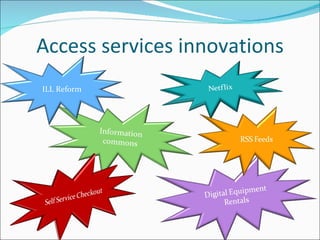
Access services innovations ILL Reform
Blending social and  academic functions Create a research tips wiki or discussion group for different academic departments. Encourage library staff to blog and create RSS feeds. Reach out to users on sites they already visit like YouTube, Flickr, or Facebook. Allow patrons to provide reviews or ratings within the OPAC or in course specific forums. Make the most of the library’s collaborative physical spaces and encourage patron interactions.
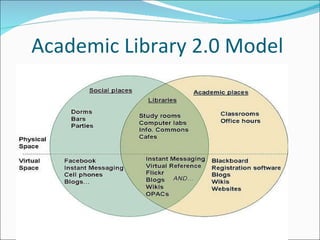
Academic Library 2.0 Model
A few considerations Library 2.0 entails radical trust. We can’t loose sight of DRM (digital rights management) and copyright restrictions. It’s not all about the technology, it’s all about the user. Many library users may still need our help with “the basics”.
So Remember… The path to Library 2.0 can be achieved by Constantly evaluating services Implementing purposeful change Practicing constant learning Blending social and academic functions Access Services plays a key role in implementing these four functions and staff must be empowered to take part in the Library 2.0 model and be involved in the decision-making process.
And just when you were  getting comfortable You say you’ve been hearing chatter  about Library 3.0 and Library4.0! Don’t worry about the terminology. If your prepared for constant change, you can handle anything.  That’s what the Library 2.0 model is all about.
Thank you! If you enjoyed this presentation and would like to see it again or pass it on to a colleague, link to my site at  http://www2.selu.edu/Academics/Faculty/kmunson/

Library 2.0: Implications for Access Services in the Academic Library

  • 1.
  • 2.
    Defining Library 2.0“ The principles of Library 2.0 seek to put users in touch with information and entertainment wherever they may be, breaking down the barriers of space, time and outdated policy. It is a user-centered paradigm focusing on knowledge, experience, collaboration, the creation of new content and encouraging the heart.” Michael Stephens
  • 3.
    How did Library2.0 come about? Michael Casey coined the term Library 2.0 on his blog Library Crunch in September 2005
  • 4.
    Basics of Library2.0 Constant and Purposeful Change Be able to quickly respond to changing needs Not change for the sake of change User Participation = User Empowerment Reaching Current and Potential Users Continuing to provide services to the library’s base while reaching patrons who don’t typically use the library Serving the “Long Tail”
  • 5.
    Library 2.0 goals for the academic library Evaluate all services on a regular basis. Implement purposeful change driven by feedback from the university community. Practice constant learning of professional best practices and new technologies . Recognize the social value of the library as a compliment to its academic purposes.
  • 6.
    Access Services andLibrary 2.0 In each of the stated goals for Academic Library 2.0: Evaluating Services Implementing change Practicing constant learning Blending social and academic functions Access Services staff will play an essential part!
  • 7.
    Evaluating Services Necessaryfor instituting purposeful change. Access Services staff uniquely positioned to solicit feedback from users on: Quality of collection- Circulation, ILL Media selections- Media Lab Web site and electronic resources usability- Computer Lab Integrated Learning Opportunities- Reserves General feedback- All staff Staff feedback is also essential to the evaluation process!
  • 8.
  • 9.
    Implementing Change Changemust be based on evaluation. The processes of change must be constant . Experimentation involves trial and error. Change must be considered by vertical teams. Investigative Planning Review
  • 10.
  • 11.
    Practicing Constant LearningKeep up with professional literature. Attend professional conferences. Encourage dialog between staff and patrons. Provide means for staff to collaborate and share knowledge and experiences. Experience Web 2.0 for yourself!
  • 12.
  • 13.
    Blending social and academic functions Create a research tips wiki or discussion group for different academic departments. Encourage library staff to blog and create RSS feeds. Reach out to users on sites they already visit like YouTube, Flickr, or Facebook. Allow patrons to provide reviews or ratings within the OPAC or in course specific forums. Make the most of the library’s collaborative physical spaces and encourage patron interactions.
  • 14.
  • 15.
    A few considerationsLibrary 2.0 entails radical trust. We can’t loose sight of DRM (digital rights management) and copyright restrictions. It’s not all about the technology, it’s all about the user. Many library users may still need our help with “the basics”.
  • 16.
    So Remember… Thepath to Library 2.0 can be achieved by Constantly evaluating services Implementing purposeful change Practicing constant learning Blending social and academic functions Access Services plays a key role in implementing these four functions and staff must be empowered to take part in the Library 2.0 model and be involved in the decision-making process.
  • 17.
    And just whenyou were getting comfortable You say you’ve been hearing chatter about Library 3.0 and Library4.0! Don’t worry about the terminology. If your prepared for constant change, you can handle anything. That’s what the Library 2.0 model is all about.
  • 18.
    Thank you! Ifyou enjoyed this presentation and would like to see it again or pass it on to a colleague, link to my site at http://www2.selu.edu/Academics/Faculty/kmunson/

Editor's Notes

  • #3 Squidoo, 2007.
  • #5 Points as defined by Casey and Savastinuk, 2007. “ Long Tail” service from Anderson, 2006.
  • #8 Casey and Savastinuk p. 43 “Frontline staff know you customers better than anyone else”
  • #9 Keeping statistics- Door counts, circulation statistics etc. Survey Monkey- Used in my own research. Free easy way to conduct surveys LibQual- Standard evaluation tool Web analytics- click density, web trends Ultimate Question- Book by Fred Reicheld Would you recommend us to a friend?
  • #10 Casey and Savastinuk Chapter 4 p. 37-57
  • #11 Casey and Savastinuk p.54
  • #13 Information Commons- University of South Florida, 2007. ILL Reform- Amazon, 2007. Netflix- Niagra University in Casey and Savastinuk, 2007. Self Service Checkout- Zeiher, 2006 RSS feeds- Calishain, 2007
  • #15 Habib, Michael. 2006
  • #16 Radical trust- Harris, 2006. Copyright- Minnow and Lipinski, 2006. Techology- Stephens, Michael. 2004. Teaching the Basics- Weatherly, 2005.
  • #18 Schultz, Wendy 2006. Schmidt, Eric Google CEO defined Web 3.0 at the Seoul Digital Forum