Assessing the Digital Media
Commons: Evaluating New
Library Spaces and Services at
UNC Greensboro
Southeastern Library Assessment Conference 2013
Chelsea DeAngio, Graduate Assistant 2012-2013
Kathryn Crowe, Associate Dean for Public Services
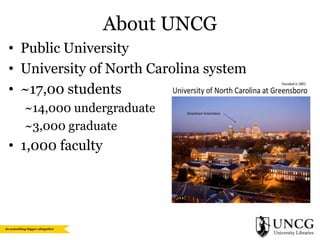
About UNCG
• Public University
• University of North Carolina system
• ~17,00 students
~14,000 undergraduate
~3,000 graduate

• 1,000 faculty
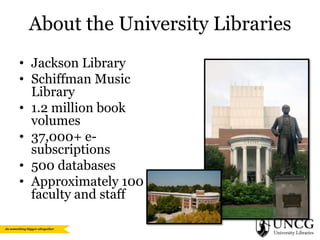
About the University Libraries
• Jackson Library
• Schiffman Music
Library
• 1.2 million book
volumes
• 37,000+ esubscriptions
• 500 databases
• Approximately 100
faculty and staff
First step: needs assessment!
• Survey of UNCG students in Spring 2010:
835 responses (22% response rate) from sample
120 had developed a video presentation for a class
60% did so because it was required
28.2% decided a video the best way to fulfill an
assignment
– 77.6% did not receive any assistance on campus
– 54% would have appreciated help with
multimedia production
–
–
–
–
Media assistance in 2010
• Cameras, voice recorders, tripods,
projectors in Libraries
• Media Studies lab for Media Studies
students only
BUT…….

• No office at UNCG provided assistance
in developing media (videos, blogs,
podcasts, PPT, etc.) for non-Media
Studies majors.
Why establish a Media Commons?
• Supports
• Supports Libraries’
University learning
goals of providing
goals for critical
learning spaces,
thinking,
supporting student
communication
research and
and information
partnering with
literacy
faculty
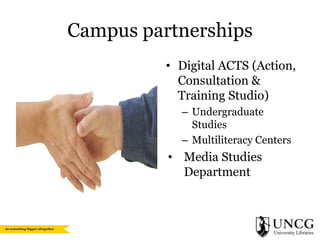
Campus partnerships
• Digital ACTS (Action,
Consultation &
Training Studio)
– Undergraduate
Studies
– Multiliteracy Centers

• Media Studies
Department
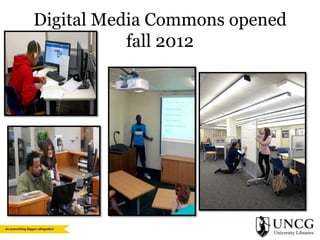
Digital Media Commons opened
fall 2012
DMC services
•
•
•
•
•

Identifying and evaluating media sources
Technical assistance with media projects
Consultation on communicating media
Technology, space and software
Faculty development and training
Assessment study outcomes
February – May 2013

• Staff will gain understanding of what
current practices are effective/ineffective
• Services will better support user needs
regarding hours of operation, materials,
and services
Assessment methods
Formal

•
•
•
•

Surveys
Desk Statistics
Focus Group
Usage Study

Informal

• Whiteboard photos
• Weekly poll
Surveys
• Developed among staff
• 100 distributed, 70% returned
• 10 questions
– Demographic information
– When did they visit DMC?
– Why did they choose DMC?
– How helpful was the staff?
– What is the awareness of DMC on campus?
– Open comments
Desk statistics
• Used LibAnalytics
• Entered information after each patron
interaction (in person, phone, instant
message or email)
• Recorded type of question (general info,
reference, technology). Recorded date and
time info
• Recorded date/time via Time Stamp
Focus group
• Low participation rate
• Offered incentive from film production
professor
• Discussed DMC policies, hours, services,
customer service
• Recorded and transcribed audio
Usage study
• App created by UNCG Libraries
technology services team
• Statistics taken 4x daily on iPad over one
week in March, April
• Number of patrons, noise level, activities,
materials used, food and drink
consumption were all tracked
Whiteboard photos
• Recorded types of studying happening in
DMC
• Indicated what subjects were most often
studied
• Used with permission of students
• Took photos at closing time
Weekly poll
• New questions about DMC and study
habits each Monday
• Captured by photo each Sunday evening
Limitations of assessments
• Most assessments completed by one staff
member
• Assessment took place over just one
semester
• Too many assessments without any one
being completely thorough
• Assessment only factored in current DMC
users
Survey results
• Average patron aged 19-21
• 12% were biology students
• 56% discovered DMC through word of
mouth
• Most visited days: Mon-Wed
• Saturdays least popular
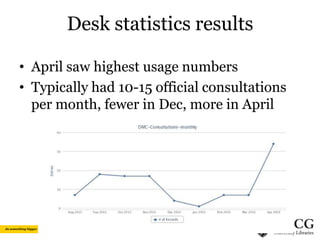
Desk statistics results
• April saw highest usage numbers
• Typically had 10-15 official consultations
per month, fewer in Dec, more in April
Focus group results
• Participants noted that services and
technology were great but “9 times out of
10, I’m just coming for a relaxing place to
work.”
• Participants agreed best thing about DMC
was comfort level
• Requested 24/5 services, like other parts
of the library
Usage study results
• Patrons most often sit in section closest to
service desk
• 1/3 of all patrons had personal laptops
with them
• 1/3 of all patrons had food or drinks with
them
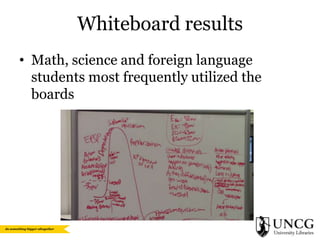
Whiteboard results
• Math, science and foreign language
students most frequently utilized the
boards
Poll results
• Students report visiting most frequently
from noon – 4 pm weekdays
• Presentations were the most common type
of multimedia project used for classes
• Requests made for 24/5 services, more
computers
Recommendations for Future
Assessment
• Continue desk statistics with clarified
language
• Year long usage study needed to properly
track trends
• Assessment team headed up by GA, recruit
student staff members to take larger role
• Focus groups with incentive to cast wider
net for both DMC users and non-users
• Impact of DMC on student learning
Questions?

Assessing the Digital Media Commons: Evaluating New Library Spaces and Services at UNC Greensboro

  • 1.
    Assessing the DigitalMedia Commons: Evaluating New Library Spaces and Services at UNC Greensboro Southeastern Library Assessment Conference 2013 Chelsea DeAngio, Graduate Assistant 2012-2013 Kathryn Crowe, Associate Dean for Public Services
  • 2.
    About UNCG • PublicUniversity • University of North Carolina system • ~17,00 students ~14,000 undergraduate ~3,000 graduate • 1,000 faculty
  • 3.
    About the UniversityLibraries • Jackson Library • Schiffman Music Library • 1.2 million book volumes • 37,000+ esubscriptions • 500 databases • Approximately 100 faculty and staff
  • 4.
    First step: needsassessment! • Survey of UNCG students in Spring 2010: 835 responses (22% response rate) from sample 120 had developed a video presentation for a class 60% did so because it was required 28.2% decided a video the best way to fulfill an assignment – 77.6% did not receive any assistance on campus – 54% would have appreciated help with multimedia production – – – –
  • 5.
    Media assistance in2010 • Cameras, voice recorders, tripods, projectors in Libraries • Media Studies lab for Media Studies students only BUT……. • No office at UNCG provided assistance in developing media (videos, blogs, podcasts, PPT, etc.) for non-Media Studies majors.
  • 6.
    Why establish aMedia Commons? • Supports • Supports Libraries’ University learning goals of providing goals for critical learning spaces, thinking, supporting student communication research and and information partnering with literacy faculty
  • 7.
    Campus partnerships • DigitalACTS (Action, Consultation & Training Studio) – Undergraduate Studies – Multiliteracy Centers • Media Studies Department
  • 8.
    Digital Media Commonsopened fall 2012
  • 9.
    DMC services • • • • • Identifying andevaluating media sources Technical assistance with media projects Consultation on communicating media Technology, space and software Faculty development and training
  • 10.
    Assessment study outcomes February– May 2013 • Staff will gain understanding of what current practices are effective/ineffective • Services will better support user needs regarding hours of operation, materials, and services
  • 11.
    Assessment methods Formal • • • • Surveys Desk Statistics FocusGroup Usage Study Informal • Whiteboard photos • Weekly poll
  • 12.
    Surveys • Developed amongstaff • 100 distributed, 70% returned • 10 questions – Demographic information – When did they visit DMC? – Why did they choose DMC? – How helpful was the staff? – What is the awareness of DMC on campus? – Open comments
  • 13.
    Desk statistics • UsedLibAnalytics • Entered information after each patron interaction (in person, phone, instant message or email) • Recorded type of question (general info, reference, technology). Recorded date and time info • Recorded date/time via Time Stamp
  • 14.
    Focus group • Lowparticipation rate • Offered incentive from film production professor • Discussed DMC policies, hours, services, customer service • Recorded and transcribed audio
  • 15.
    Usage study • Appcreated by UNCG Libraries technology services team • Statistics taken 4x daily on iPad over one week in March, April • Number of patrons, noise level, activities, materials used, food and drink consumption were all tracked
  • 16.
    Whiteboard photos • Recordedtypes of studying happening in DMC • Indicated what subjects were most often studied • Used with permission of students • Took photos at closing time
  • 17.
    Weekly poll • Newquestions about DMC and study habits each Monday • Captured by photo each Sunday evening
  • 18.
    Limitations of assessments •Most assessments completed by one staff member • Assessment took place over just one semester • Too many assessments without any one being completely thorough • Assessment only factored in current DMC users
  • 19.
    Survey results • Averagepatron aged 19-21 • 12% were biology students • 56% discovered DMC through word of mouth • Most visited days: Mon-Wed • Saturdays least popular
  • 20.
    Desk statistics results •April saw highest usage numbers • Typically had 10-15 official consultations per month, fewer in Dec, more in April
  • 21.
    Focus group results •Participants noted that services and technology were great but “9 times out of 10, I’m just coming for a relaxing place to work.” • Participants agreed best thing about DMC was comfort level • Requested 24/5 services, like other parts of the library
  • 22.
    Usage study results •Patrons most often sit in section closest to service desk • 1/3 of all patrons had personal laptops with them • 1/3 of all patrons had food or drinks with them
  • 23.
    Whiteboard results • Math,science and foreign language students most frequently utilized the boards
  • 24.
    Poll results • Studentsreport visiting most frequently from noon – 4 pm weekdays • Presentations were the most common type of multimedia project used for classes • Requests made for 24/5 services, more computers
  • 25.
    Recommendations for Future Assessment •Continue desk statistics with clarified language • Year long usage study needed to properly track trends • Assessment team headed up by GA, recruit student staff members to take larger role • Focus groups with incentive to cast wider net for both DMC users and non-users • Impact of DMC on student learning
  • 26.

Editor's Notes

  • #9 Includes service desk, small media rooms, consultation rooms, presentation practice space, open collaborative space
  • #15 Lasted 30 minutes