Teaching Information literacy: A Performance Based CycleAnnie Downey, University of North TexasGaylaByerly, University of North TexasSociety for Research into Higher Education Annual ConferenceDecember 2007
Basic Background FactsUniversity of North Texas Core curriculum = lists of electives
Required courses include:
Basic U.S. History
Political Science
Freshmen English (1310 & 1320)Basic Background FactsEnglish Library Instruction SessionsAverage about 90 sessions per academic year
Seven years of successful collaboration between the Libraries and the English departmentBasic Background Facts499 students tested in Fall 2005 and Spring 200676 students tested in Spring 2007Total of 575 students tested
Information Literacyto “recognize when information is needed and have the ability to locate, evaluate, and use effectively the needed information.” American Library Association
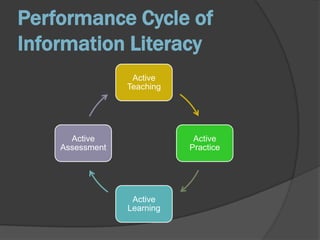
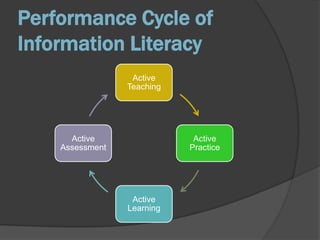
“students must be able to use technology to learn content and skills – so that they know how to learn, think critically, solve problems, use information, communicate, innovate, and collaborate.” EDUCAUSE Center for Applied ResearchPerformance Cycle of Information Literacy
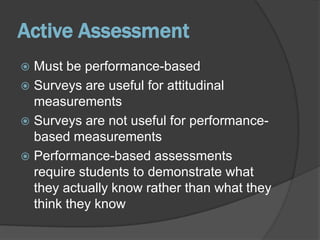
Active Teaching, Learning, & AssessingActive process of discoveryInformation literacy skills are performance task orientedNavigation is a central componentActively engaged with the informationAssessment must be performance based to evaluate information literacy skills
Student Navigation Skills94.7% of students report using online library resources an average of once a month81.6% of students report using online social networking dailyAssumed students had good navigation skillsResults from our study contradicted these assumptions
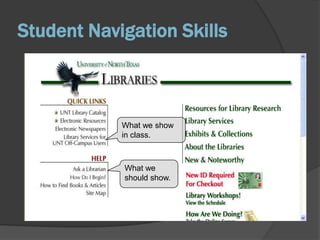
Student Navigation SkillsWhat we show in class.What we should show.
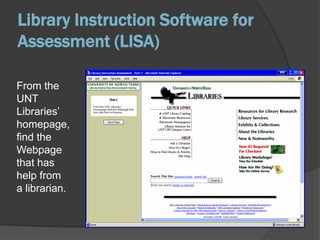
Library Instruction Software for Assessment (LISA)From theUNT Libraries’homepage,find the Webpagethat has help froma librarian.
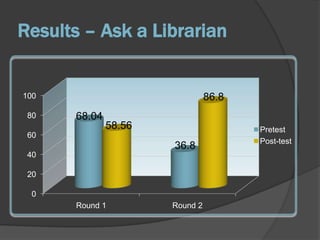
Results – Ask a Librarian
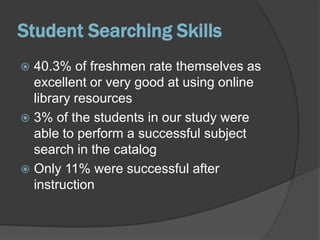
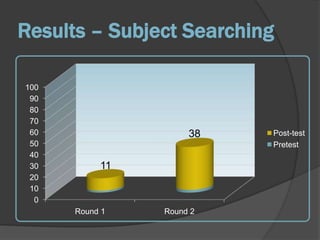
Student Searching Skills40.3% of freshmen rate themselves as excellent or very good at using online library resources3% of the students in our study were able to perform a successful subject search in the catalogOnly 11% were successful after instruction
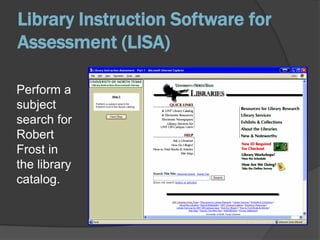
Library Instruction Software for Assessment (LISA)Perform a subject search forRobertFrost in the librarycatalog.
Adding Active LearningIn initial testing, students were following along with the librarian on their own computers while the librarian modeled proper searching techniques.Students were not engagedAdded a simple worksheet to increase engagement with the information
Results – Subject Searching

Teaching Information Literacy: A Performance Based Cycle

  • 1.
    Teaching Information literacy:A Performance Based CycleAnnie Downey, University of North TexasGaylaByerly, University of North TexasSociety for Research into Higher Education Annual ConferenceDecember 2007
  • 2.
    Basic Background FactsUniversityof North Texas Core curriculum = lists of electives
  • 3.
  • 4.
  • 5.
  • 6.
    Freshmen English (1310& 1320)Basic Background FactsEnglish Library Instruction SessionsAverage about 90 sessions per academic year
  • 7.
    Seven years ofsuccessful collaboration between the Libraries and the English departmentBasic Background Facts499 students tested in Fall 2005 and Spring 200676 students tested in Spring 2007Total of 575 students tested
  • 8.
    Information Literacyto “recognizewhen information is needed and have the ability to locate, evaluate, and use effectively the needed information.” American Library Association
  • 9.
    “students must beable to use technology to learn content and skills – so that they know how to learn, think critically, solve problems, use information, communicate, innovate, and collaborate.” EDUCAUSE Center for Applied ResearchPerformance Cycle of Information Literacy
  • 10.
    Active Teaching, Learning,& AssessingActive process of discoveryInformation literacy skills are performance task orientedNavigation is a central componentActively engaged with the informationAssessment must be performance based to evaluate information literacy skills
  • 11.
    Student Navigation Skills94.7%of students report using online library resources an average of once a month81.6% of students report using online social networking dailyAssumed students had good navigation skillsResults from our study contradicted these assumptions
  • 12.
    Student Navigation SkillsWhatwe show in class.What we should show.
  • 13.
    Library Instruction Softwarefor Assessment (LISA)From theUNT Libraries’homepage,find the Webpagethat has help froma librarian.
  • 14.
    Results – Aska Librarian
  • 15.
    Student Searching Skills40.3%of freshmen rate themselves as excellent or very good at using online library resources3% of the students in our study were able to perform a successful subject search in the catalogOnly 11% were successful after instruction
  • 16.
    Library Instruction Softwarefor Assessment (LISA)Perform a subject search forRobertFrost in the librarycatalog.
  • 17.
    Adding Active LearningIninitial testing, students were following along with the librarian on their own computers while the librarian modeled proper searching techniques.Students were not engagedAdded a simple worksheet to increase engagement with the information
  • 18.