Library of Congress Call Numbers:
A Guide for Non-Catalogers Who
Suddenly Find Themselves with a
Cataloging Job
Angela Kroeger
TED 4740/8746 Cataloging and Classification
University of Nebraska at Omaha/University of Missouri
Spring 2013
The purpose of this guide is to teach the basic
structure of a Library of Congress call number so
you can:
• Format spine labels correctly.
• Sort and file items accurately.
• Recognize when a call number is incomplete
or improperly formatted.
Classification and constructing new call numbers
are beyond the scope of this guide.
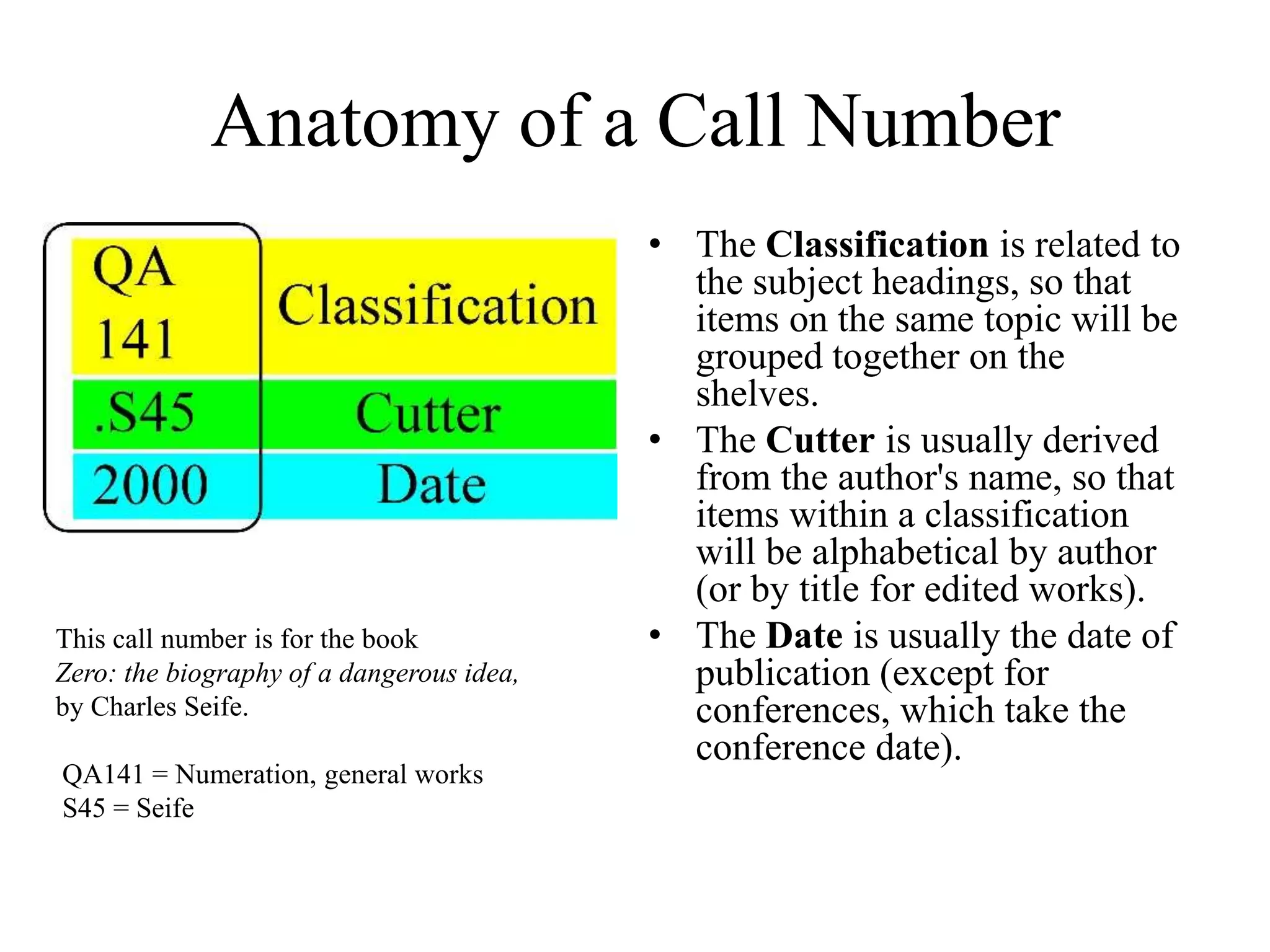
Anatomy of a Call Number
• The Classification is related to
the subject headings, so that
items on the same topic will be
grouped together on the
shelves.
• The Cutter is usually derived
from the author's name, so that
items within a classification
will be alphabetical by author
(or by title for edited works).
• The Date is usually the date of
publication (except for
conferences, which take the
conference date).
This call number is for the book
Zero: the biography of a dangerous idea,
by Charles Seife.
QA141 = Numeration, general works
S45 = Seife
Anatomy of a Call Number
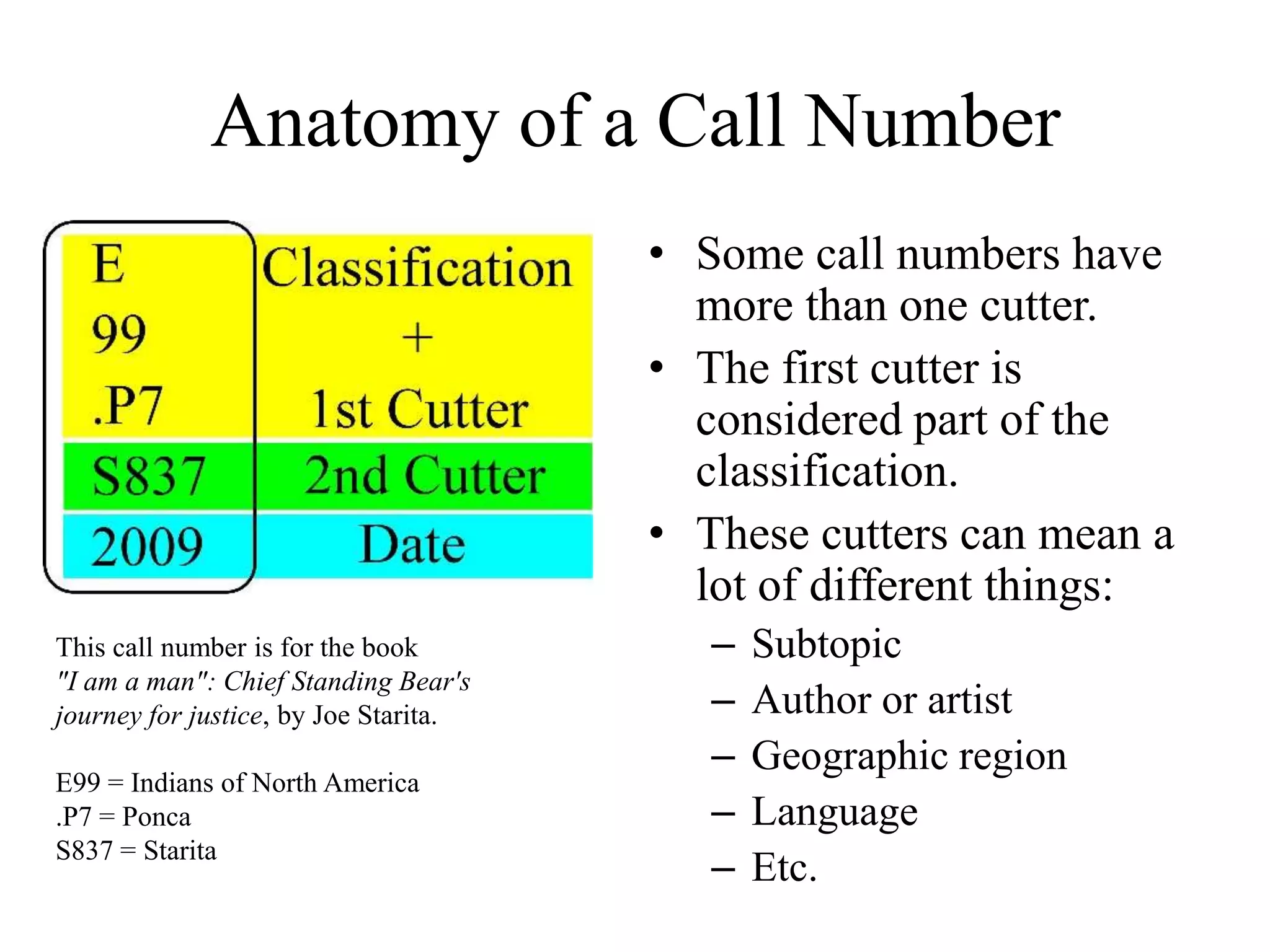
• Some call numbers have
more than one cutter.
• The first cutter is
considered part of the
classification.
• These cutters can mean a
lot of different things:
– Subtopic
– Author or artist
– Geographic region
– Language
– Etc.
This call number is for the book
"I am a man": Chief Standing Bear's
journey for justice, by Joe Starita.
E99 = Indians of North America
.P7 = Ponca
S837 = Starita
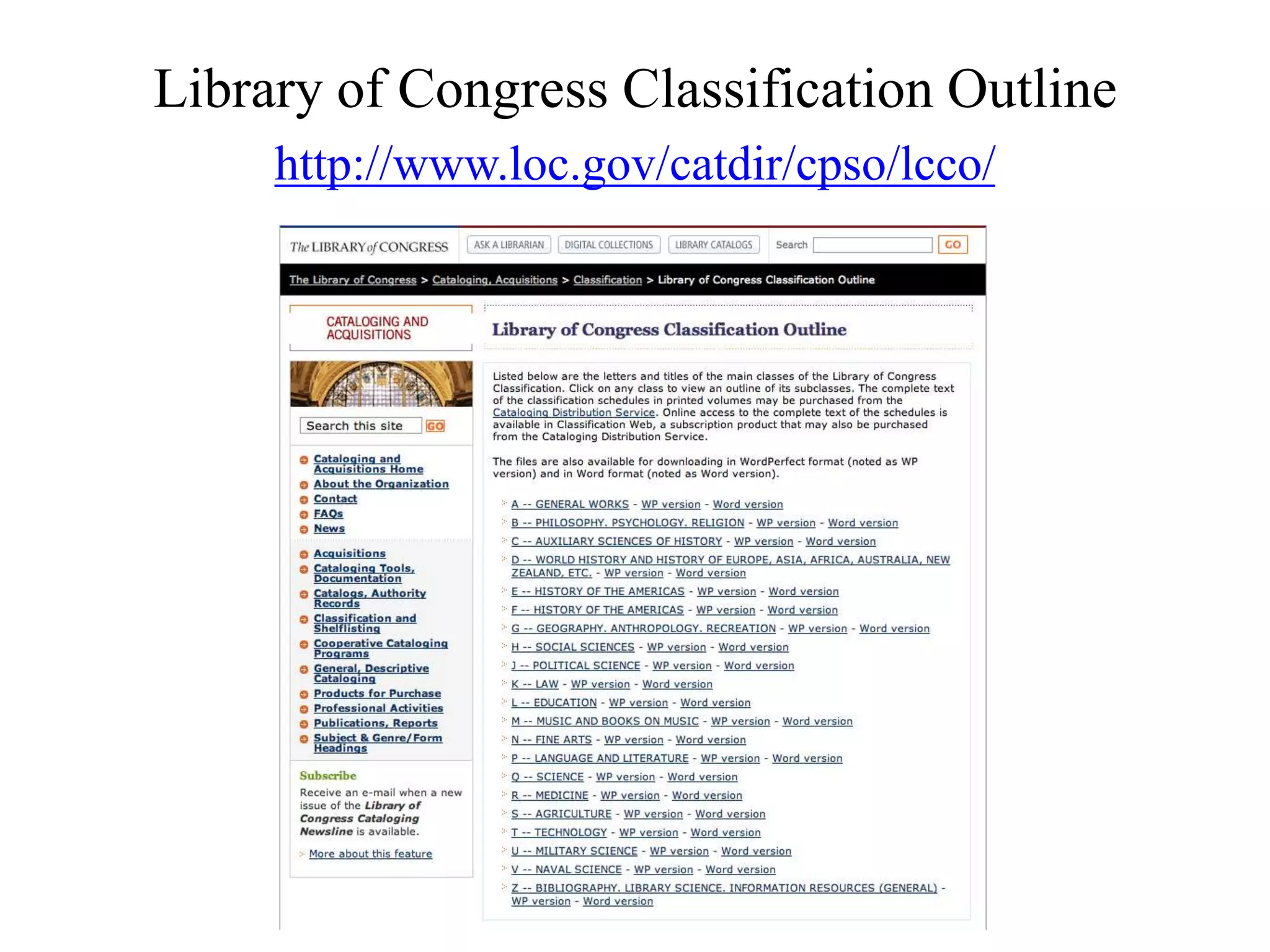
Library of Congress Classification Outline
http://www.loc.gov/catdir/cpso/lcco/
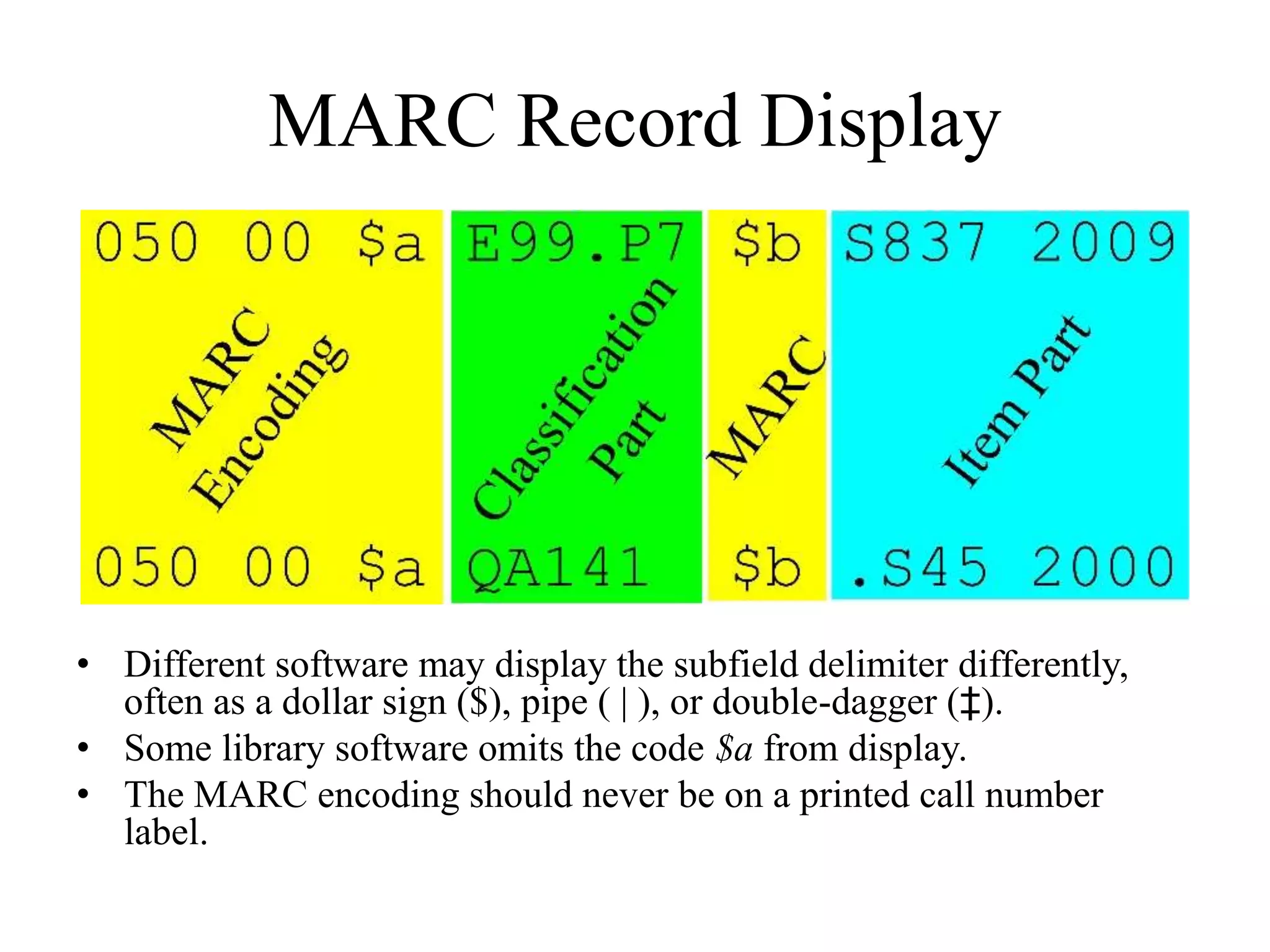
MARC Record Display
• Different software may display the subfield delimiter differently,
often as a dollar sign ($), pipe ( | ), or double-dagger (‡).
• Some library software omits the code $a from display.
• The MARC encoding should never be on a printed call number
label.
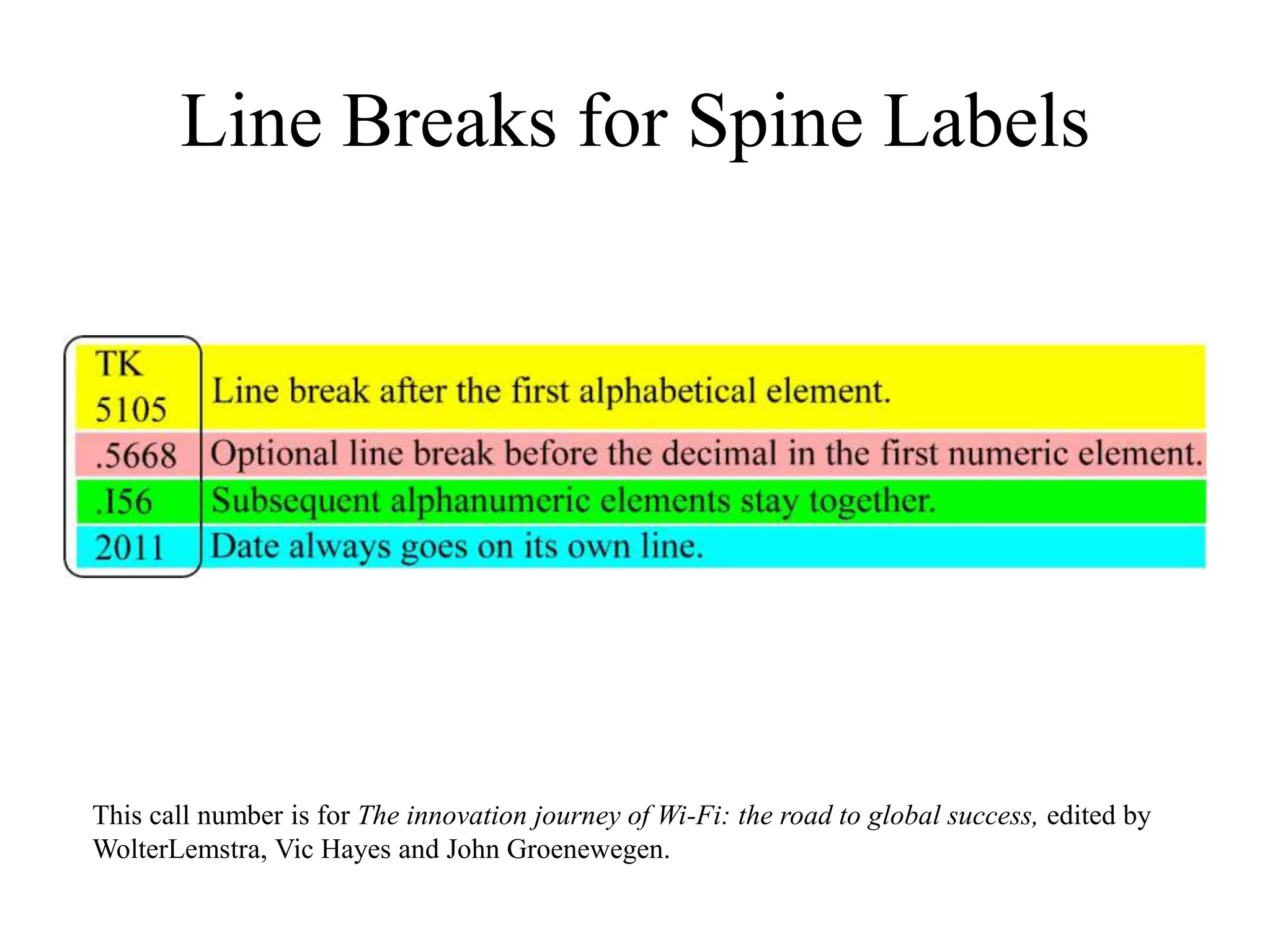
Line Breaks for Spine Labels
This call number is for The innovation journey of Wi-Fi: the road to global success, edited by
WolterLemstra, Vic Hayes and John Groenewegen.
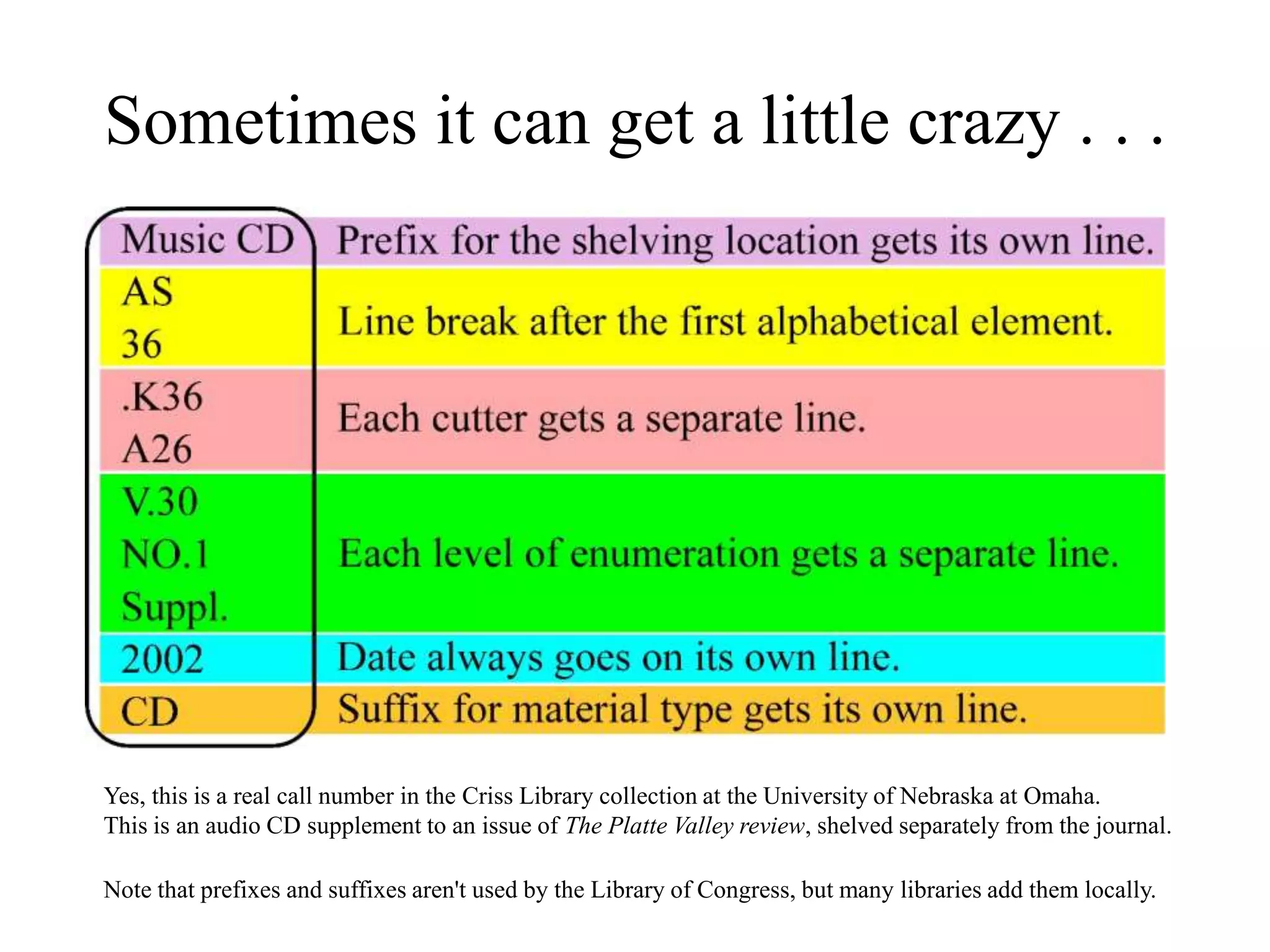
Sometimes it can get a little crazy . . .
Yes, this is a real call number in the Criss Library collection at the University of Nebraska at Omaha.
This is an audio CD supplement to an issue of The Platte Valley review, shelved separately from the journal.
Note that prefixes and suffixes aren't used by the Library of Congress, but many libraries add them locally.
Sorting: Take Each Letter or Number in Order
• Each alphanumeric character is significant.
• Sort letters according to the order of the English
language alphabet.
• Sort dates in ascending chronological order.
• Sort volume numbers and ordinals in sequential order.
• Sort all other numbers according to mathematics.
– The classification number is as it seems.
– All cutter numbers are decimals.
To elaborate . . .
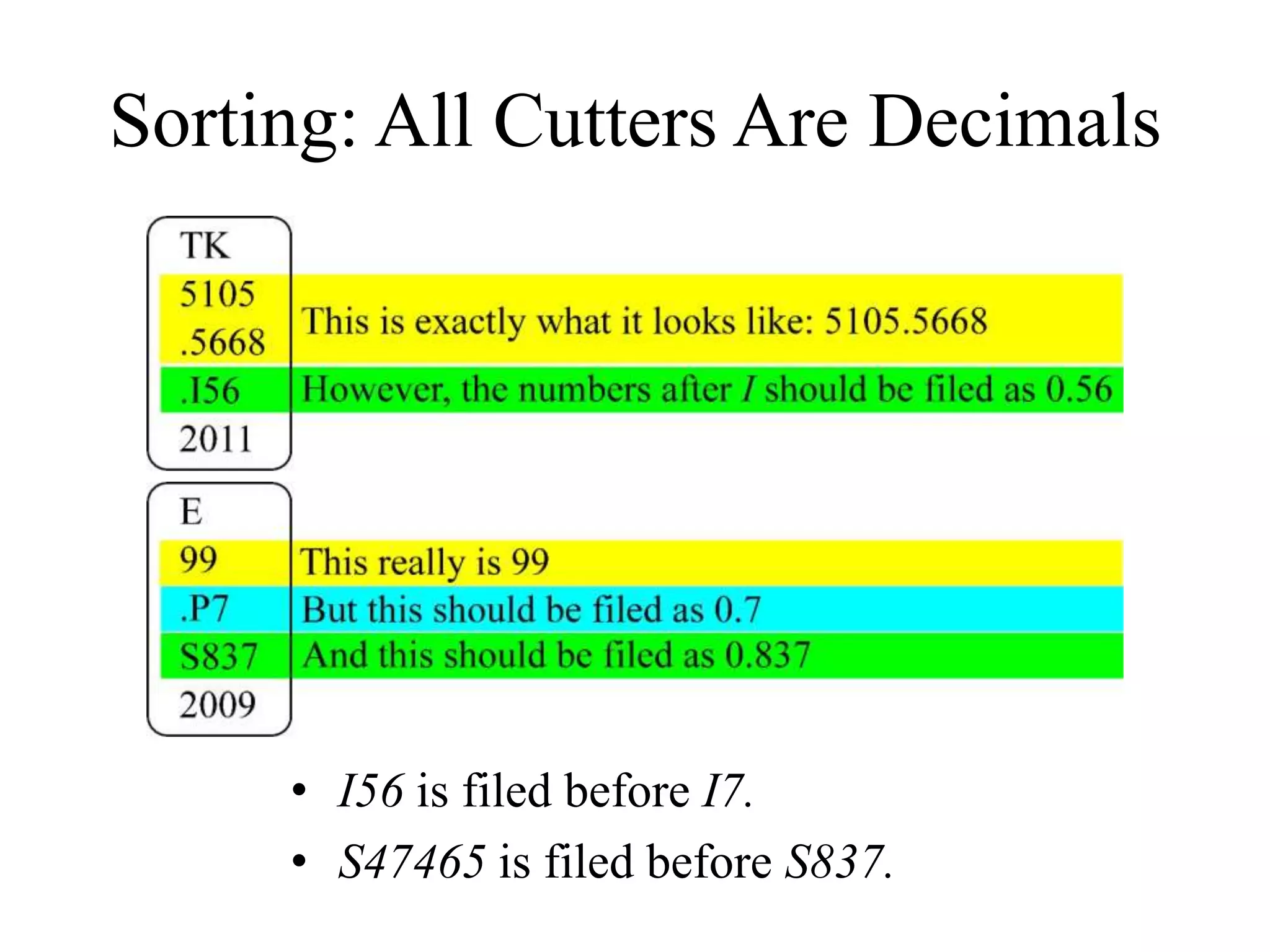
Sorting: All Cutters Are Decimals
• I56 is filed before I7.
• S47465 is filed before S837.
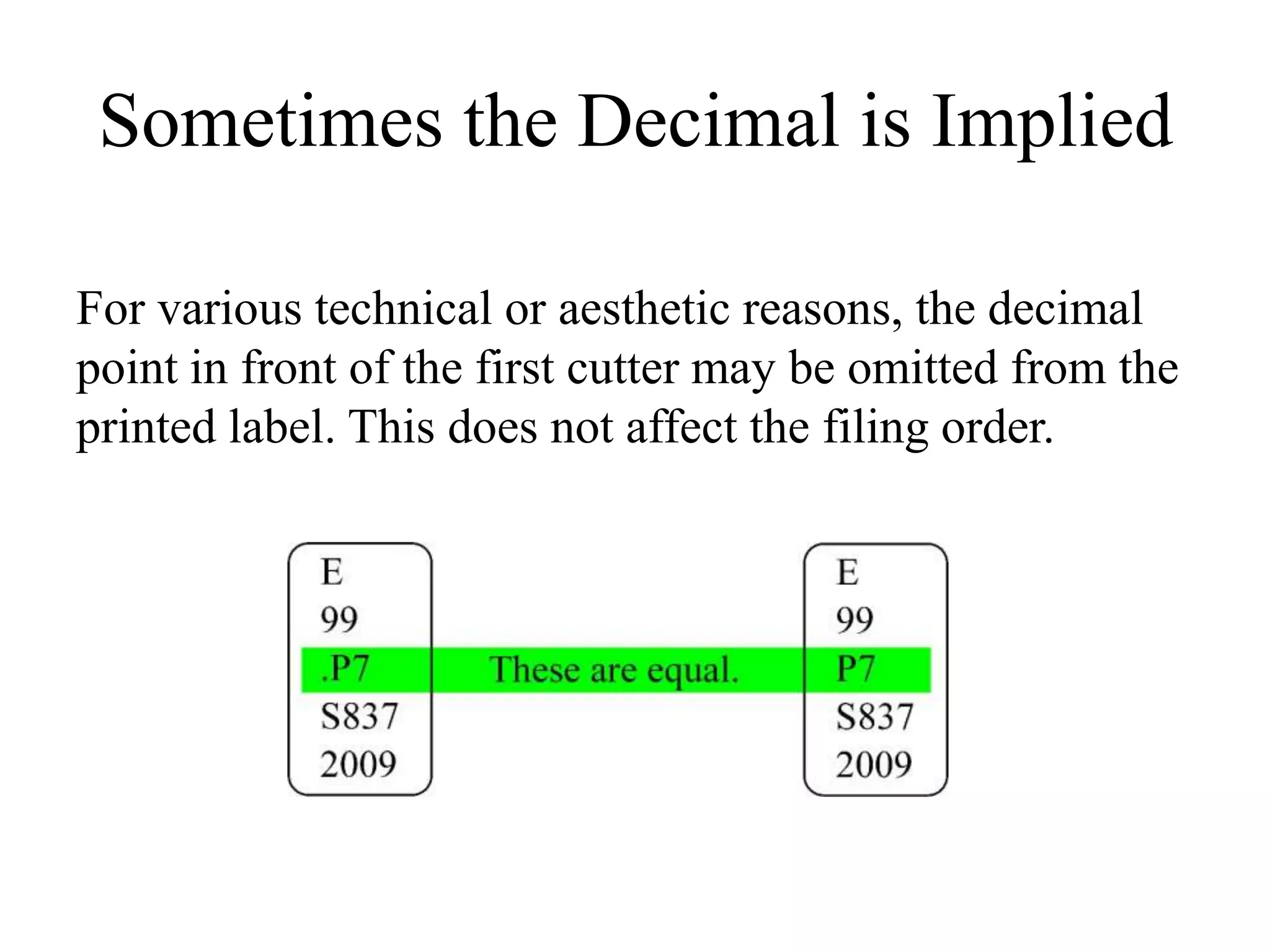
Sometimes the Decimal is Implied
For various technical or aesthetic reasons, the decimal
point in front of the first cutter may be omitted from the
printed label. This does not affect the filing order.
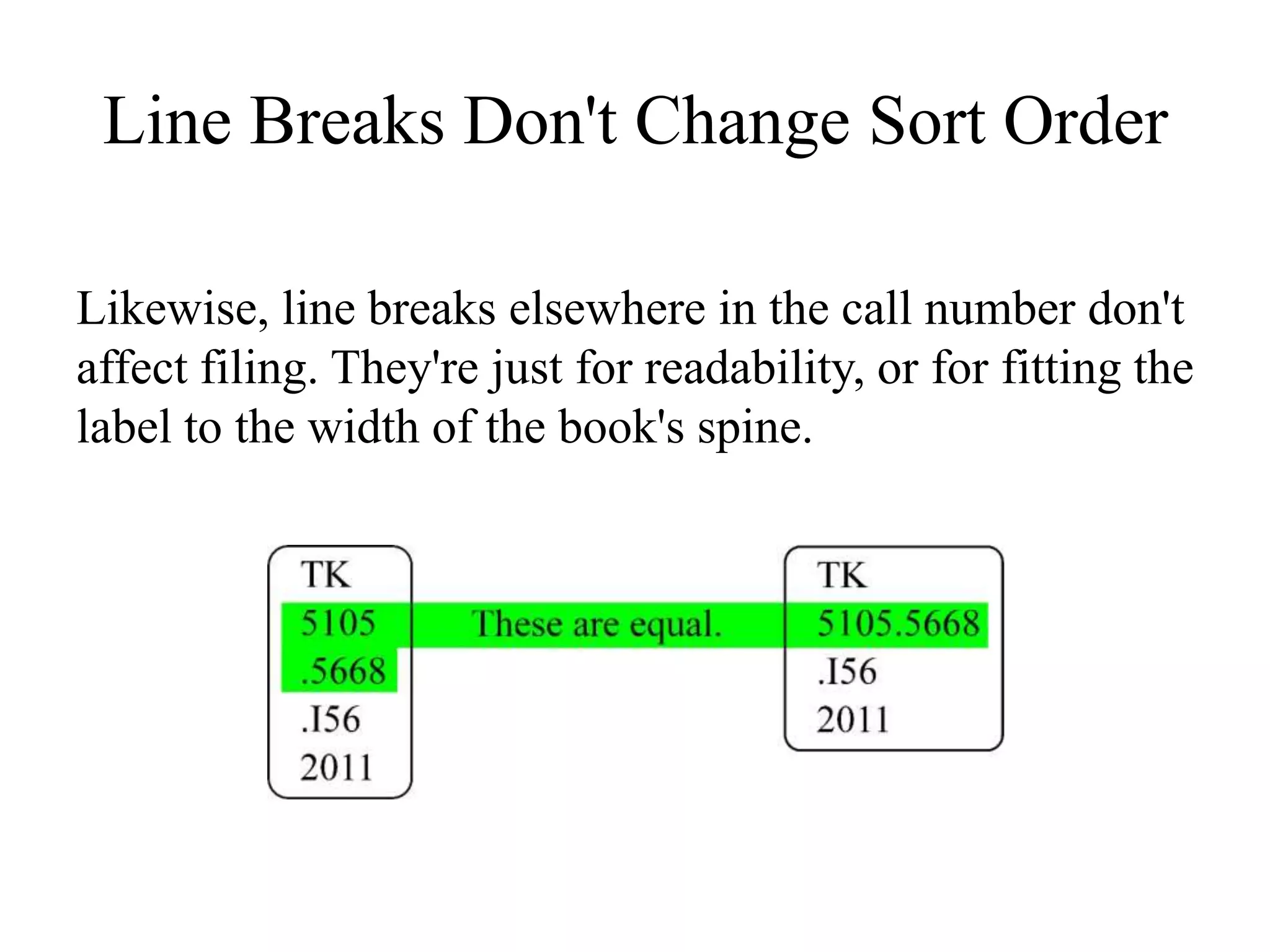
Line Breaks Don't Change Sort Order
Likewise, line breaks elsewhere in the call number don't
affect filing. They're just for readability, or for fitting the
label to the width of the book's spine.
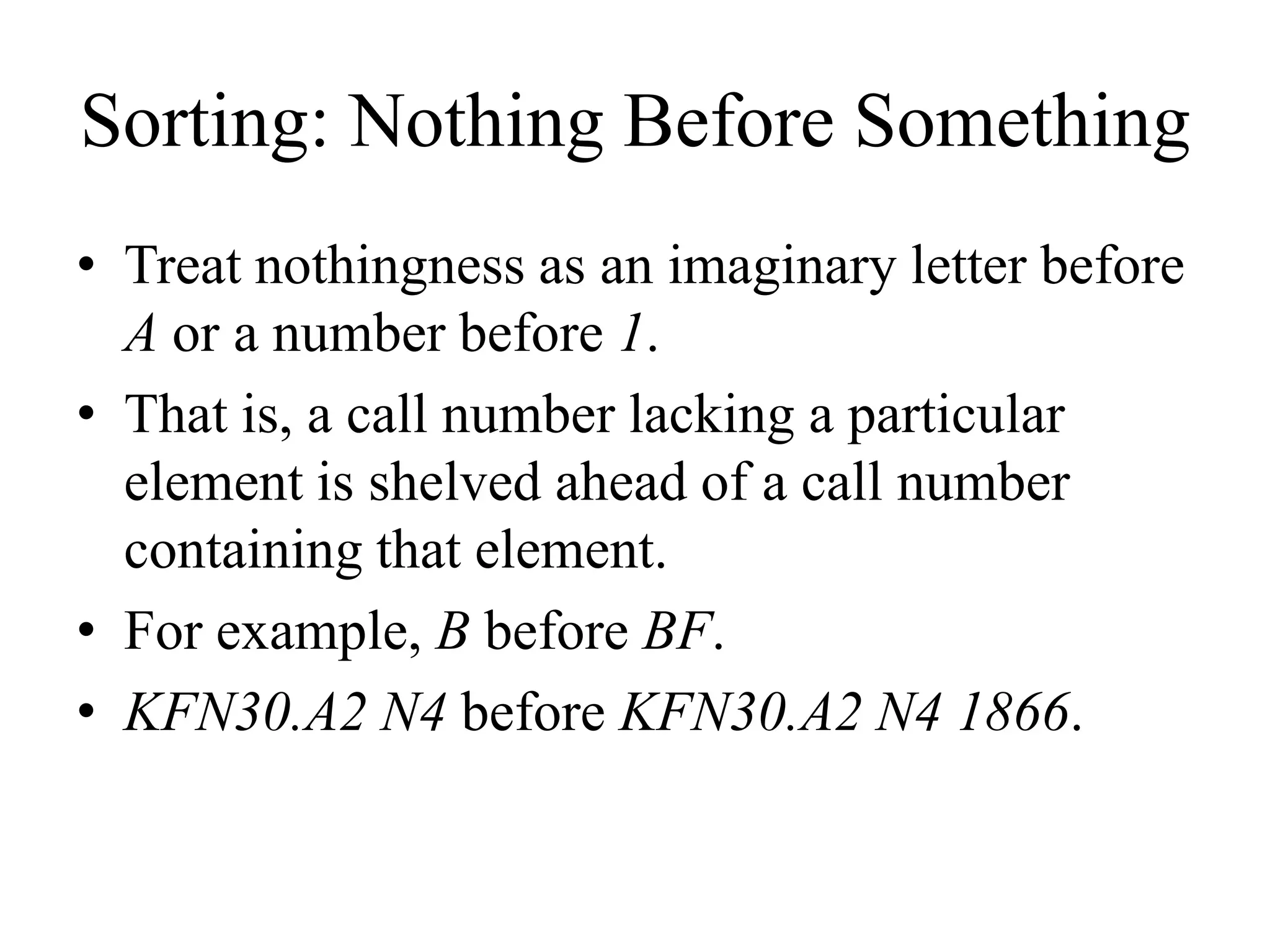
Sorting: Nothing Before Something
• Treat nothingness as an imaginary letter before
A or a number before 1.
• That is, a call number lacking a particular
element is shelved ahead of a call number
containing that element.
• For example, B before BF.
• KFN30.A2 N4 before KFN30.A2 N4 1866.
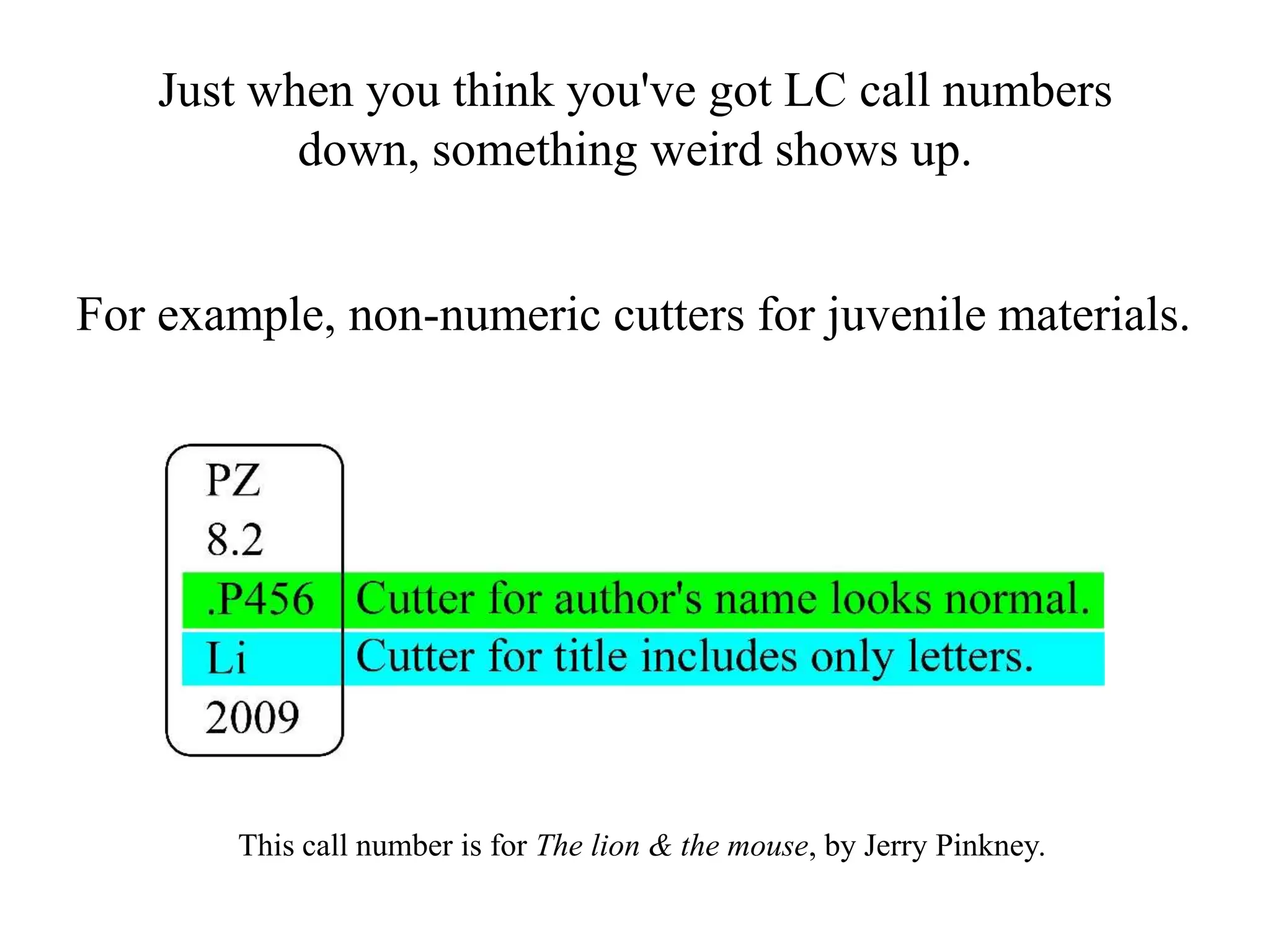
Just when you think you've got LC call numbers
down, something weird shows up.
For example, non-numeric cutters for juvenile materials.
This call number is for The lion & the mouse, by Jerry Pinkney.
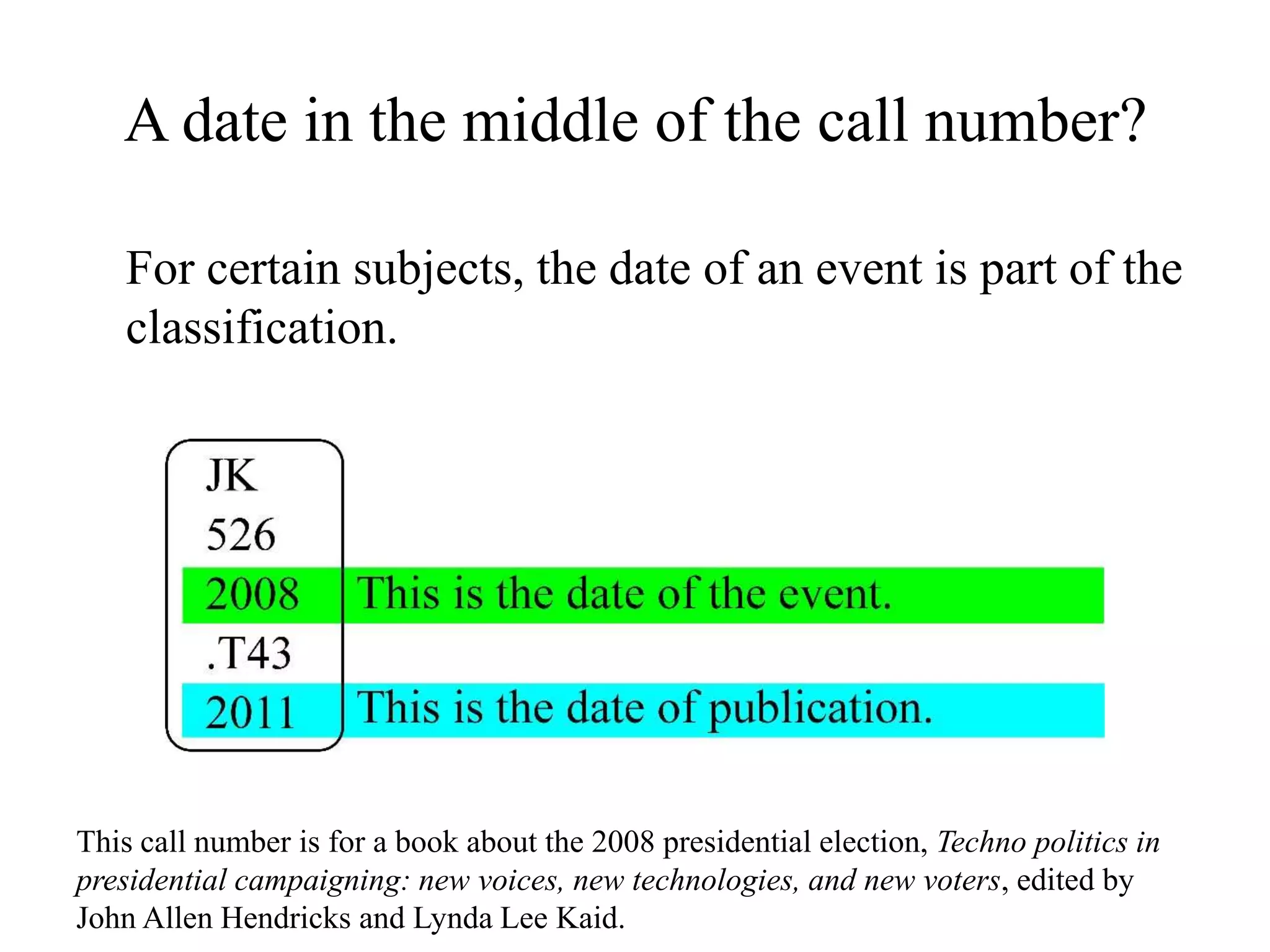
A date in the middle of the call number?
For certain subjects, the date of an event is part of the
classification.
This call number is for a book about the 2008 presidential election, Techno politics in
presidential campaigning: new voices, new technologies, and new voters, edited by
John Allen Hendricks and Lynda Lee Kaid.
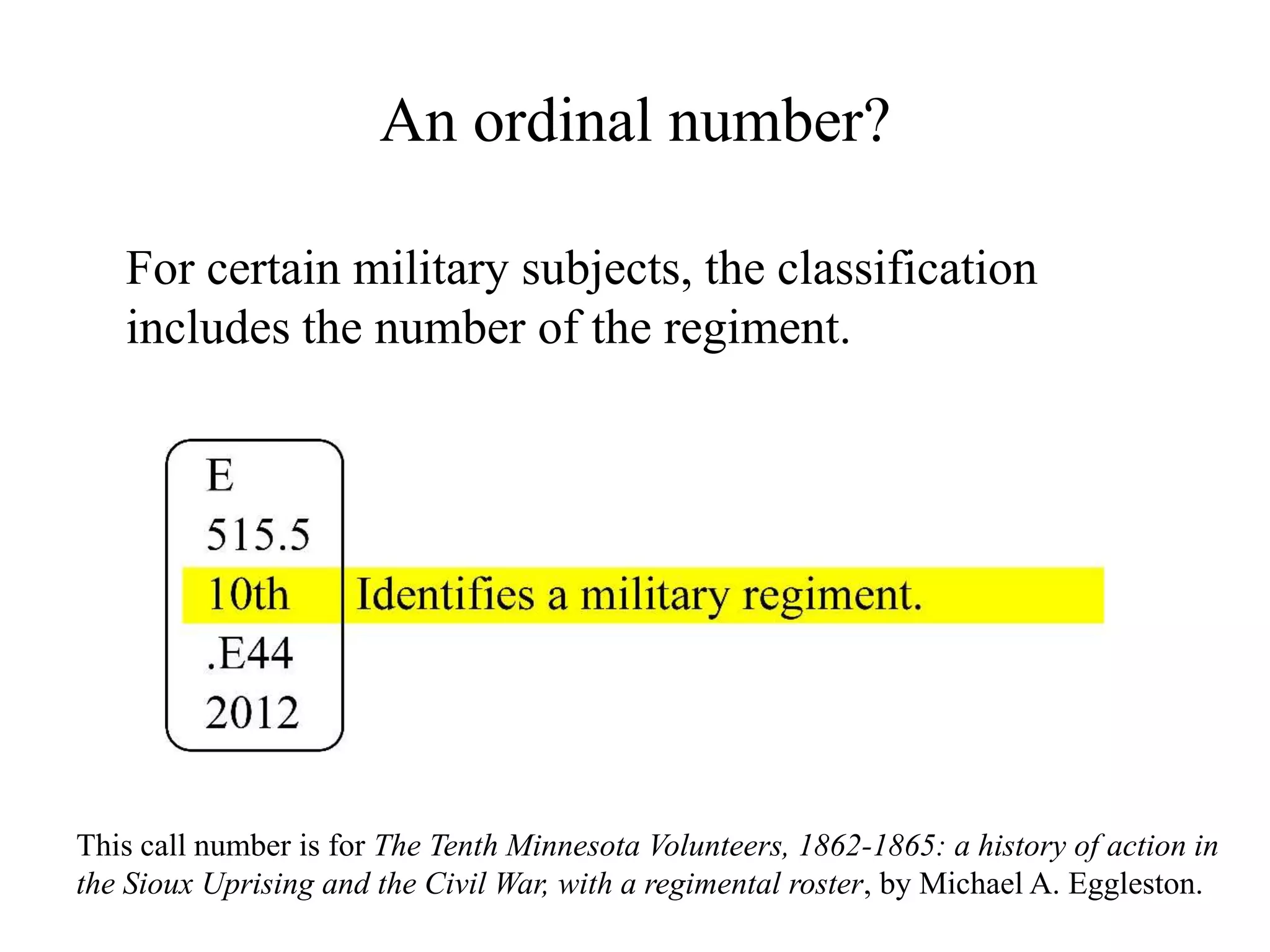
An ordinal number?
For certain military subjects, the classification
includes the number of the regiment.
This call number is for The Tenth Minnesota Volunteers, 1862-1865: a history of action in
the Sioux Uprising and the Civil War, with a regimental roster, by Michael A. Eggleston.
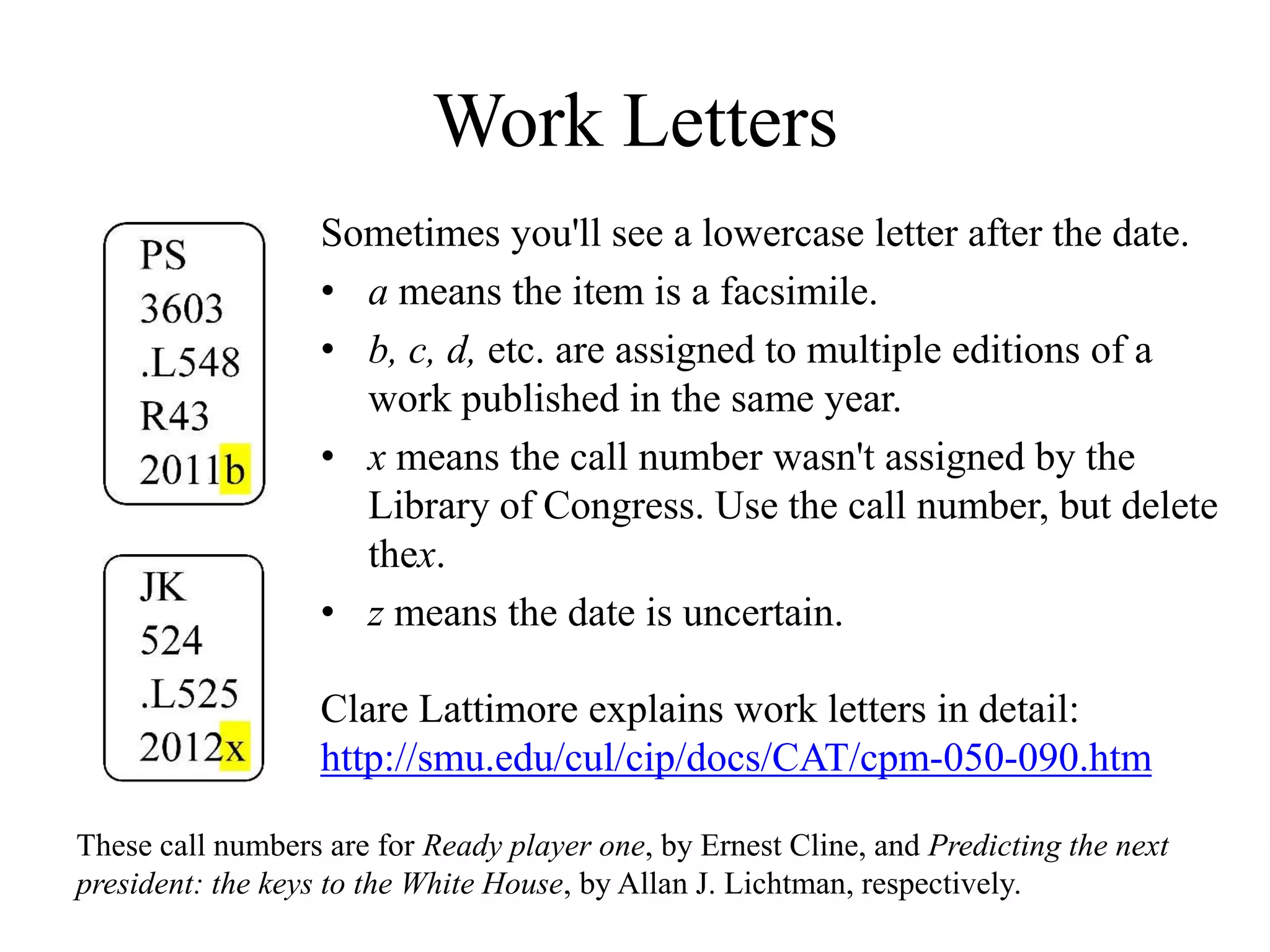
Work Letters
Sometimes you'll see a lowercase letter after the date.
• a means the item is a facsimile.
• b, c, d, etc. are assigned to multiple editions of a
work published in the same year.
• x means the call number wasn't assigned by the
Library of Congress. Use the call number, but delete
thex.
• z means the date is uncertain.
Clare Lattimore explains work letters in detail:
http://smu.edu/cul/cip/docs/CAT/cpm-050-090.htm
These call numbers are for Ready player one, by Ernest Cline, and Predicting the next
president: the keys to the White House, by Allan J. Lichtman, respectively.
In Summary . . .
• Call numbers serve as physical addresses for
an item.
• Call numbers also convey some information
about the item's subject and content.
• When sorting, file each element in order.
• Treat cutter numbers as decimals.
• File nothing before something.
References
American Museum and Natural History Research Library. (2013). Library of Congress
call numbers. Retrieved from: http://library.amnh.org/research-tools/tips-
tutorials/library-congress-call-numbers
Chan, L. M. (2007). Cataloging and classification: An introduction (3rd ed.). Lanham,
MD: Scarecrow Press.
Edmands, J. (1887, January-December). Rules for alfabeting. The Library Journal, 12,
326-331. Retrieved from:
http://books.google.com/books?id=QObgAAAAMAAJ&dq=library%20journal%2
012%20edmands%20rules%20for%20alfabeting&pg=PA326#v=onepage&q&f=fal
se
Lattimore, C. (2002). 050 & 090 Library of Congress call numbers. Retrieved from:
http://smu.edu/cul/cip/docs/CAT/cpm-050-090.htm
Library of Congress. (n.d.). ClassificationWeb. [Data file and online software.]
Retrieved from: http://classificationweb.net/
Library of Congress. (n.d.). Library of Congress classification outline. Retrieved from:
http://www.loc.gov/catdir/cpso/lcco/
National Information Standards Organization. (1999). Guidelines for alphabetical
arrangement of letters and sorting of numerals and other symbols [PDF document].
Bethesda, MD: NISO Press. Retrieved from:
http://www.niso.org/publications/tr/tr03.pdf
University of Georgia, Board of Regents, Online Library Learning Center. (n.d.). The
Library of Congress classification system (LC). Retrieved from:
http://www.usg.edu/galileo/skills/unit03/libraries03_04.phtml

Library of Congress Call Numbers: A Guide for Non-Catalogers Who Suddenly Find Themselves with a Cataloging Job

  • 1.
    Library of CongressCall Numbers: A Guide for Non-Catalogers Who Suddenly Find Themselves with a Cataloging Job Angela Kroeger TED 4740/8746 Cataloging and Classification University of Nebraska at Omaha/University of Missouri Spring 2013
  • 2.
    The purpose ofthis guide is to teach the basic structure of a Library of Congress call number so you can: • Format spine labels correctly. • Sort and file items accurately. • Recognize when a call number is incomplete or improperly formatted. Classification and constructing new call numbers are beyond the scope of this guide.
  • 3.
    Anatomy of aCall Number • The Classification is related to the subject headings, so that items on the same topic will be grouped together on the shelves. • The Cutter is usually derived from the author's name, so that items within a classification will be alphabetical by author (or by title for edited works). • The Date is usually the date of publication (except for conferences, which take the conference date). This call number is for the book Zero: the biography of a dangerous idea, by Charles Seife. QA141 = Numeration, general works S45 = Seife
  • 4.
    Anatomy of aCall Number • Some call numbers have more than one cutter. • The first cutter is considered part of the classification. • These cutters can mean a lot of different things: – Subtopic – Author or artist – Geographic region – Language – Etc. This call number is for the book "I am a man": Chief Standing Bear's journey for justice, by Joe Starita. E99 = Indians of North America .P7 = Ponca S837 = Starita
  • 5.
    Library of CongressClassification Outline http://www.loc.gov/catdir/cpso/lcco/
  • 6.
    MARC Record Display •Different software may display the subfield delimiter differently, often as a dollar sign ($), pipe ( | ), or double-dagger (‡). • Some library software omits the code $a from display. • The MARC encoding should never be on a printed call number label.
  • 7.
    Line Breaks forSpine Labels This call number is for The innovation journey of Wi-Fi: the road to global success, edited by WolterLemstra, Vic Hayes and John Groenewegen.
  • 8.
    Sometimes it canget a little crazy . . . Yes, this is a real call number in the Criss Library collection at the University of Nebraska at Omaha. This is an audio CD supplement to an issue of The Platte Valley review, shelved separately from the journal. Note that prefixes and suffixes aren't used by the Library of Congress, but many libraries add them locally.
  • 9.
    Sorting: Take EachLetter or Number in Order • Each alphanumeric character is significant. • Sort letters according to the order of the English language alphabet. • Sort dates in ascending chronological order. • Sort volume numbers and ordinals in sequential order. • Sort all other numbers according to mathematics. – The classification number is as it seems. – All cutter numbers are decimals. To elaborate . . .
  • 10.
    Sorting: All CuttersAre Decimals • I56 is filed before I7. • S47465 is filed before S837.
  • 11.
    Sometimes the Decimalis Implied For various technical or aesthetic reasons, the decimal point in front of the first cutter may be omitted from the printed label. This does not affect the filing order.
  • 12.
    Line Breaks Don'tChange Sort Order Likewise, line breaks elsewhere in the call number don't affect filing. They're just for readability, or for fitting the label to the width of the book's spine.
  • 13.
    Sorting: Nothing BeforeSomething • Treat nothingness as an imaginary letter before A or a number before 1. • That is, a call number lacking a particular element is shelved ahead of a call number containing that element. • For example, B before BF. • KFN30.A2 N4 before KFN30.A2 N4 1866.
  • 14.
    Just when youthink you've got LC call numbers down, something weird shows up. For example, non-numeric cutters for juvenile materials. This call number is for The lion & the mouse, by Jerry Pinkney.
  • 15.
    A date inthe middle of the call number? For certain subjects, the date of an event is part of the classification. This call number is for a book about the 2008 presidential election, Techno politics in presidential campaigning: new voices, new technologies, and new voters, edited by John Allen Hendricks and Lynda Lee Kaid.
  • 16.
    An ordinal number? Forcertain military subjects, the classification includes the number of the regiment. This call number is for The Tenth Minnesota Volunteers, 1862-1865: a history of action in the Sioux Uprising and the Civil War, with a regimental roster, by Michael A. Eggleston.
  • 17.
    Work Letters Sometimes you'llsee a lowercase letter after the date. • a means the item is a facsimile. • b, c, d, etc. are assigned to multiple editions of a work published in the same year. • x means the call number wasn't assigned by the Library of Congress. Use the call number, but delete thex. • z means the date is uncertain. Clare Lattimore explains work letters in detail: http://smu.edu/cul/cip/docs/CAT/cpm-050-090.htm These call numbers are for Ready player one, by Ernest Cline, and Predicting the next president: the keys to the White House, by Allan J. Lichtman, respectively.
  • 18.
    In Summary .. . • Call numbers serve as physical addresses for an item. • Call numbers also convey some information about the item's subject and content. • When sorting, file each element in order. • Treat cutter numbers as decimals. • File nothing before something.
  • 19.
    References American Museum andNatural History Research Library. (2013). Library of Congress call numbers. Retrieved from: http://library.amnh.org/research-tools/tips- tutorials/library-congress-call-numbers Chan, L. M. (2007). Cataloging and classification: An introduction (3rd ed.). Lanham, MD: Scarecrow Press. Edmands, J. (1887, January-December). Rules for alfabeting. The Library Journal, 12, 326-331. Retrieved from: http://books.google.com/books?id=QObgAAAAMAAJ&dq=library%20journal%2 012%20edmands%20rules%20for%20alfabeting&pg=PA326#v=onepage&q&f=fal se Lattimore, C. (2002). 050 & 090 Library of Congress call numbers. Retrieved from: http://smu.edu/cul/cip/docs/CAT/cpm-050-090.htm Library of Congress. (n.d.). ClassificationWeb. [Data file and online software.] Retrieved from: http://classificationweb.net/ Library of Congress. (n.d.). Library of Congress classification outline. Retrieved from: http://www.loc.gov/catdir/cpso/lcco/ National Information Standards Organization. (1999). Guidelines for alphabetical arrangement of letters and sorting of numerals and other symbols [PDF document]. Bethesda, MD: NISO Press. Retrieved from: http://www.niso.org/publications/tr/tr03.pdf University of Georgia, Board of Regents, Online Library Learning Center. (n.d.). The Library of Congress classification system (LC). Retrieved from: http://www.usg.edu/galileo/skills/unit03/libraries03_04.phtml