Create!: A Social Media Program for Young AdultsProject ProposaLAmy AshmoreLIBR 559MAugust 19, 2010
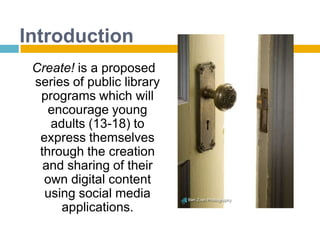
Introduction Create! is a proposed series of public library programs which will encourage young adults (13-18) to express themselves through the creation and sharing of their own digital content using social media applications. Image: http://www.flickr.com/photos/ben-zvan-photography/468487548/#/
This program will...Encourage young adults to use the libraryDevelop Library 2.0 services by encouraging young adults to see the library in a new way – a place where information can be found and produced using a vast array of toolsIntegrate Library 2.0 services within the physical library settingEncourage young adults to actively engage with the library as both producers and consumers of informationAllow young adults to learn about a variety of social media tools and applications
This program will...Allow young adults to share their knowledge of social media tools and applicationsAllow young adults to explore how social media tools can be used for information seeking, information sharing, and the creation of original contentHelp young adults to develop media literacy skillsEncourage young people to think about some of the issues and constraints of social media tools, including concerns about privacy and copyrightAllow young people the opportunity to create and share their own content using social media tools
Why a Social Media Program?This program will address 4 important needs:Involving teens in the library in a way that is meaningful to themPromoting media literacy awareness and competenciesDeveloping technological skillsEngaging teens as both seekers and creators of information
“This is not a download only world. It’s an upload world. It means that our students are going to be creating the media environment of the future. They are going to be creating the content and the value and the information of the future. So we really have to be thinking about how we prepare our students to create this world.” (Michael Wesch, 2008)
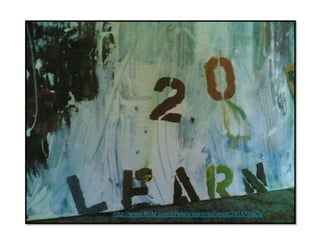
Image: http://www.flickr.com/photos/aaronschmidt/281619803/
Program Specifics4 sessions, 2 hours eachAt least 2 staff membersSet up should reflect the possibility for collaboration and working together – laptops if possible
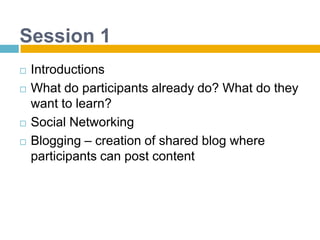
Session 1IntroductionsWhat do participants already do? What do they want to learn?Social NetworkingBlogging – creation of shared blog where participants can post content
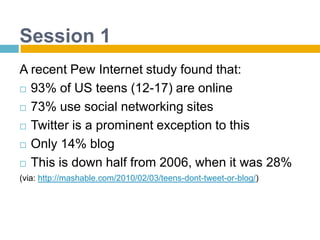
Session 1A recent Pew Internet study found that:93% of US teens (12-17) are online73% use social networking sitesTwitter is a prominent exception to thisOnly 14% blogThis is down half from 2006, when it was 28%(via: http://mashable.com/2010/02/03/teens-dont-tweet-or-blog/)
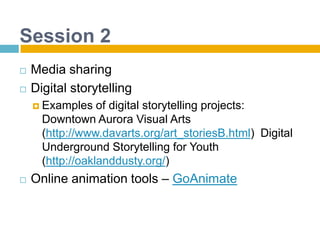
Session 2Media sharingDigital storytellingExamples of digital storytelling projects: Downtown Aurora Visual Arts (http://www.davarts.org/art_storiesB.html)  Digital Underground Storytelling for Youth (http://oaklanddusty.org/) Online animation tools – GoAnimate
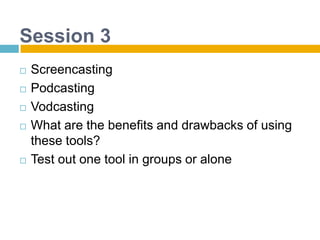
Session 3ScreencastingPodcastingVodcastingWhat are the benefits and drawbacks of using these tools?Test out one tool in groups or alone
Session 4Participants will create something using their tool of choiceCan be done alone or in groupsParticipants will share with others what they have createdContent can be posted on the library website and the shared blog
Evaluation and Follow-UpNumber of participantsReactions/discussion with participantsEvaluation formsA one-time pilot run of the series could be used to explore feasibility of offering the program series at regular intervals
ConclusionsThe public library has a role to play in fostering engaged, self-aware, competent young adultsThis means being able to use information and media effectivelyParticipants will be given a great deal of agency but also made aware of boundariesYoung adults can develop new skills, gain new knowledge, and express themselves
ReferencesAmerican Association for School Librarians and the Association for Educational Communications and Technology. (1998). Information Literacy Standards for Student Learning. Retrieved 12 August 2010 from http://www.ala.org/ala/mgrps/divs/aasl/guidelinesandstandards/informationpower/InformationLiteracyStandards_final.pdfBolan, K., Canada, M., and Cullin, R. (2007). Web, library, and teen services 2.0. Young Adult Library Services, Winter 2007, 40-43.Hamilton, B. (2010). Media 21 capstone project proposal and resources. The Unquiet Librarian [weblog].  Retrieved 12 August 2010 from http://theunquietlibrarian.wikispaces.com/media21capstone-buffyHolm, G., Daspit, T. and Young, A.J.K. (2006), ‘‘The sky is always falling’’, in Leccardi, C. and Ruspini, E. (Eds), A New Youth? Young People, Generations and Family Life. Ashgate, Aldershot, pp. 85-102.Livingstone, S., Bober, M., & Helsper, E. J. (2005). Active participation or just more information?: Young people's take-up of opportunities to act and interact on the internet. Information, Communication & Society, 8(3), 287-314.  Media Awareness Network. (2006). Media Awareness: Make it Happen! [booklet]. Retrieved 18 August 2010 from http://www.medialiteracyweek.ca/downloads/Media_Education.pdfParr, B. (2010, February 3). Teens just don’t blog or tweet [weblog]. Mashable. Retrieved 18 August 2010 from http://mashable.com/2010/02/03/teens-dont-tweet-or-blog/Snowball, C. (2008). Enticing teenagers into the library. Library Review, 57(1), 25-35.University of Houston. (2010). Educational uses of digital storytelling [website]. Retrieved 19 August 2010 from http://digitalstorytelling.coe.uh.edu/index.htmlWesch, M. (2008). A portal to media literacy [lecture video]. Retrieved 17 August 2010 from http://umanitoba.ca/ist/production/streaming/podcast_wesch.html
Further ReadingDaley, M. F. (2010). Free online tools for serving teens: Four verbs to live by and great technologies to try. Young Adult Library Services, 8(2), 23-25.McLean, C. D. (2010). Creating a curriculum unit on evaluation of social media. Knowledge Quest, 38(3), 18-27.Peowski, L. (2010). Where are all the teens? engaging and empowering them online. Young Adult Library Services, 8(2), 26-28.Stephens, Michael. (2010). Learning and teaching in flux. Tame The Web [blog]. Retrieved 18 August 2010 from http://tametheweb.com/2010/08/18/tech-trends-at-ala-techsource/

LIBR 559M Final Presentation

  • 1.
    Create!: A SocialMedia Program for Young AdultsProject ProposaLAmy AshmoreLIBR 559MAugust 19, 2010
  • 2.
    Introduction Create! isa proposed series of public library programs which will encourage young adults (13-18) to express themselves through the creation and sharing of their own digital content using social media applications. Image: http://www.flickr.com/photos/ben-zvan-photography/468487548/#/
  • 3.
    This program will...Encourageyoung adults to use the libraryDevelop Library 2.0 services by encouraging young adults to see the library in a new way – a place where information can be found and produced using a vast array of toolsIntegrate Library 2.0 services within the physical library settingEncourage young adults to actively engage with the library as both producers and consumers of informationAllow young adults to learn about a variety of social media tools and applications
  • 4.
    This program will...Allowyoung adults to share their knowledge of social media tools and applicationsAllow young adults to explore how social media tools can be used for information seeking, information sharing, and the creation of original contentHelp young adults to develop media literacy skillsEncourage young people to think about some of the issues and constraints of social media tools, including concerns about privacy and copyrightAllow young people the opportunity to create and share their own content using social media tools
  • 5.
    Why a SocialMedia Program?This program will address 4 important needs:Involving teens in the library in a way that is meaningful to themPromoting media literacy awareness and competenciesDeveloping technological skillsEngaging teens as both seekers and creators of information
  • 6.
    “This is nota download only world. It’s an upload world. It means that our students are going to be creating the media environment of the future. They are going to be creating the content and the value and the information of the future. So we really have to be thinking about how we prepare our students to create this world.” (Michael Wesch, 2008)
  • 7.
  • 8.
    Program Specifics4 sessions,2 hours eachAt least 2 staff membersSet up should reflect the possibility for collaboration and working together – laptops if possible
  • 9.
    Session 1IntroductionsWhat doparticipants already do? What do they want to learn?Social NetworkingBlogging – creation of shared blog where participants can post content
  • 10.
    Session 1A recentPew Internet study found that:93% of US teens (12-17) are online73% use social networking sitesTwitter is a prominent exception to thisOnly 14% blogThis is down half from 2006, when it was 28%(via: http://mashable.com/2010/02/03/teens-dont-tweet-or-blog/)
  • 11.
    Session 2Media sharingDigitalstorytellingExamples of digital storytelling projects: Downtown Aurora Visual Arts (http://www.davarts.org/art_storiesB.html) Digital Underground Storytelling for Youth (http://oaklanddusty.org/) Online animation tools – GoAnimate
  • 13.
    Session 3ScreencastingPodcastingVodcastingWhat arethe benefits and drawbacks of using these tools?Test out one tool in groups or alone
  • 14.
    Session 4Participants willcreate something using their tool of choiceCan be done alone or in groupsParticipants will share with others what they have createdContent can be posted on the library website and the shared blog
  • 15.
    Evaluation and Follow-UpNumberof participantsReactions/discussion with participantsEvaluation formsA one-time pilot run of the series could be used to explore feasibility of offering the program series at regular intervals
  • 16.
    ConclusionsThe public libraryhas a role to play in fostering engaged, self-aware, competent young adultsThis means being able to use information and media effectivelyParticipants will be given a great deal of agency but also made aware of boundariesYoung adults can develop new skills, gain new knowledge, and express themselves
  • 18.
    ReferencesAmerican Association forSchool Librarians and the Association for Educational Communications and Technology. (1998). Information Literacy Standards for Student Learning. Retrieved 12 August 2010 from http://www.ala.org/ala/mgrps/divs/aasl/guidelinesandstandards/informationpower/InformationLiteracyStandards_final.pdfBolan, K., Canada, M., and Cullin, R. (2007). Web, library, and teen services 2.0. Young Adult Library Services, Winter 2007, 40-43.Hamilton, B. (2010). Media 21 capstone project proposal and resources. The Unquiet Librarian [weblog]. Retrieved 12 August 2010 from http://theunquietlibrarian.wikispaces.com/media21capstone-buffyHolm, G., Daspit, T. and Young, A.J.K. (2006), ‘‘The sky is always falling’’, in Leccardi, C. and Ruspini, E. (Eds), A New Youth? Young People, Generations and Family Life. Ashgate, Aldershot, pp. 85-102.Livingstone, S., Bober, M., & Helsper, E. J. (2005). Active participation or just more information?: Young people's take-up of opportunities to act and interact on the internet. Information, Communication & Society, 8(3), 287-314. Media Awareness Network. (2006). Media Awareness: Make it Happen! [booklet]. Retrieved 18 August 2010 from http://www.medialiteracyweek.ca/downloads/Media_Education.pdfParr, B. (2010, February 3). Teens just don’t blog or tweet [weblog]. Mashable. Retrieved 18 August 2010 from http://mashable.com/2010/02/03/teens-dont-tweet-or-blog/Snowball, C. (2008). Enticing teenagers into the library. Library Review, 57(1), 25-35.University of Houston. (2010). Educational uses of digital storytelling [website]. Retrieved 19 August 2010 from http://digitalstorytelling.coe.uh.edu/index.htmlWesch, M. (2008). A portal to media literacy [lecture video]. Retrieved 17 August 2010 from http://umanitoba.ca/ist/production/streaming/podcast_wesch.html
  • 19.
    Further ReadingDaley, M.F. (2010). Free online tools for serving teens: Four verbs to live by and great technologies to try. Young Adult Library Services, 8(2), 23-25.McLean, C. D. (2010). Creating a curriculum unit on evaluation of social media. Knowledge Quest, 38(3), 18-27.Peowski, L. (2010). Where are all the teens? engaging and empowering them online. Young Adult Library Services, 8(2), 26-28.Stephens, Michael. (2010). Learning and teaching in flux. Tame The Web [blog]. Retrieved 18 August 2010 from http://tametheweb.com/2010/08/18/tech-trends-at-ala-techsource/