Done by,
Group-5
Swathiraj, Gayathri, Elsa, Ashwin,
Kavitha, Neeshma and Jismon.Jose
INTRODUCTION
Libor is defined as:
The rate at which an individual Contributor Panel bank could borrow funds,
were it to do so by asking for and then accepting inter-bank offers in
reasonable market size, just prior to 11.00 London time.
This definition is amplified as follows:
 The rate which each bank submits must be formed from that bank’s perception
of its cost of funds in the interbank market.
 Contributions must represent rates formed in London and not elsewhere.
 Contributions must be for the currency concerned, not the cost of producing
one currency by borrowing in another currency and accessing the required
currency via the foreign exchange markets.
 The rates must be submitted by members of staff at a bank
with primary responsibility for management of a bank’s cash,
rather than a bank’s derivative book.
 The definition of "funds" is: unsecured interbank cash or cash
raised through primary issuance of interbank Certificates of
Deposit
LIBOR
The London Interbank Offered Rate is the average of interest rates
estimated by each of the leading banks in London that it would be
charged were it to borrow from other banks.
It is usually abbreviated to Libor . It was formerly known as BBA Libor
(for British Bankers' Association Libor or the trademark bba libor) before
the responsibility for the administration was transferred to
Intercontinental Exchange. It is the primary benchmark, along with the
Euribor, for short-term interest rates around the world
SCOPE
The Libor is widely used as a reference rate for many financial
instruments in both financial markets and commercial fields. There are
three major classifications of interest rate fixings instruments,
including standard interbank products, commercial field products, and
hybrid products which often use the Libor as their reference rate
 Forward rate agreements
 short term interest rate future contracts
 interest rate swaps
 Floating rate notes
 Syndicated loans
 Variable rate mortgages
 currencies, especially the us $
RELEVANCE
Libor is viewed as the most important benchmark
in the world for short term interest rates.
Used in many derivatives transaction
Nearly $800 trillion in financial instruments—
including corporate debt, mortgages, student loans,
interest rate and other derivatives—reference
LIBOR in some form or other
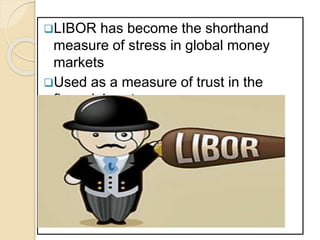
LIBOR has become the shorthand
measure of stress in global money
markets
Used as a measure of trust in the
financial system
HISTORY
 In 1984, it became apparent that an increasing number of banks
were trading actively in a variety of relatively new market
instruments, notably interest rate swaps, foreign currency
options and forward rate agreements
 While recognising that such instruments brought more business
and greater depth to the London Interbank market, bankers
worried that future growth could be inhibited unless a measure
of uniformity was introduced.
 In October 1984, the British Bankers' Association(BBA)—
working with other parties, such as the Bank of England—
established various working parties, which eventually
culminated in the production of the BBA standard for interest
rate swaps, or "BBAIRS" terms.
 Part of this standard included the fixing of BBA interest-
settlement rates, the predecessor of BBA Libor.
 From 2 September 1985, the BBAIRS terms became
standard market practice.
 BBA Libor fixings did not commence officially before 1
January 1986.
 Before that date, however, some rates were fixed for a trial
period commencing in December 1984.
 The first LIBOR rate was announced in 1986 for three
currencies: the U.S. Dollar, the British sterling and the
Japanese Yen
 Member banks are international in scope, with more than
sixty nations represented among its 223 members and 37
associated professional firms as of 2008. Eighteen banks
for example currently contribute to the fixing of US Dollar
Libor.
 The panel contains the following member banks:
Bank of America
Bank of Tokyo-Mitsubishi UFJ
Barclays Bank
BNP Paribas
Citibank NA
Credit Agricole CIB
Credit Suisse
Deutsche Bank
HSBC
JP Morgan Chase
Lloyds Banking Group
Rabobank
Royal Bank of Canada
Société Générale
Sumitomo Mitsui Banking Corporation Europe Ltd
Norinchukin Bank
Royal Bank of Scotland
UBS AG
SIGNIFICANCE
LIBOR is viewed as the most important benchmark in the
world for short-term interest rates.
On the professional financial markets LIBOR is used as
the base rate for a large number of financial products such
as futures, options and swaps.
Banks also use the LIBOR interest rates as the base rate
when setting the interest rates for loans, savings and
mortgages.
The fact that LIBOR is often treated as the base rate for
other products is the reason why LIBOR interest rates are
monitored with great interest by a large number of
professionals and private individuals worldwide.
PROCESS
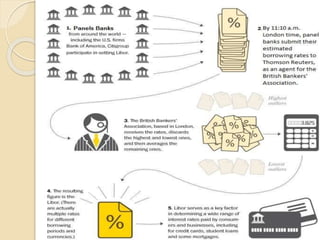
 A panel is made up for each currency consisting of at least 8 and a maximum of 16 banks
which are deemed to be representative for the London money market.
 Thomas Reuters: Thomson Reuters is the designated calculation agent for BBA (British
Bankers’Association) LIBOR. Data submitted by panel banks into the BBA LIBOR process
is received and processed by Thomson Reuters and the data is calculated using guidelines
provided by the "LIBOR Panel Banks and Users Group" ("LPBAUG").
 Each LIBOR contributor bank has an application installed allowing that institution to
confidentially submit rates which links directly to a rate setting team at Thomson Reuters.
 A bank cannot see other contributor rates during the submission window - this is only
possible after final publication of the BBA LIBOR data.
 Thomson Reuters run a collection of automated and manual tests on the submitted rates
before they are sent to the calculation engine, and after calculation the data is released to the
market via Thomson Reuters and other licensed data vendors. (the financial press, including
the wall street journal and financial times publish BBALIBOR data from the previous day
and Bloomberg etc).
LIBOR Currencies
Originally (in 1986) LIBOR was published for 3 currencies:
1. US dollar
2. pound sterling .
3. Japanese yen.
 The number of LIBOR currencies grew to a maximum of 16. A number of
these currencies merged into the euro in 2000. Now, there are 150 Libor
rates, spanning ten currencies. The 5 major currencies are given below:
American dollar - USD LIBOR
British pound sterling - GBP LIBOR
European euro - EUR LIBOR
Japanese yen - JPY LIBOR
Swiss franc - CHF LIBOR
HOW IT IS CALCULATED?
• Each LIBOR rate is calculated using the “trimmed mean”
of the contributing bank submission.
•Trimmed mean is calculated by discarding the top 25% and
bottom 25% of the submitted interest rates and then taking an
average of the remaining middle 50% (for example 18 banks
submit rates for the 30 day U.S.Dollar LIBOR rate, the top 4
and bottom 4 submission are discarded before an average is
taken of the middle 10 submissions).
• This calculation reduces the impact that any single
contributing bank can have on the final officially published
rate.
IMPORTANCE OF LIBOR
 Nearly $800 trillion in financial
instruments- including corporate debts,
mortgages, student loans, interest rate
and other derivatives- reference LIBOR
in some form or other.
 LIBOR is often used as the base for
variable- rate loans.
 LIBOR has become the shorthand
measure of stress in global money
markets.
 LIBOR rates are also used in many
derivatives transactions.
Libor Manipulation
 16th April 2008-the wall street journal released a
controversial article suggesting that some banks might have
understated borrowing costs they reported for the Libor
during 208 credit crunch.
 Two years ,later in April 2010, a study by economist ,
Snider and Youle, corroborated the result of the wall street
journal. They argued that banks did this because they
sought to make substantial profit on their large Libor
interest linked portfolios, ions of these banks
 In 2009 the Citi group reported that it would make $936
million in net Interest revenue if interest fall by .25% and
that they would make $1935 million if the interest rate fall
by 1%
 The governor and the deputy governor of the bank of England
where aware that because of industry concerns the Libor rate was
being under reported.
 A trade from royal bank of Scotland claimed that it was the
common practice among senior employees of the bank to make
request to the bank rate setters to appropriate Libor rate.
 The Federal Reserve Bank of a New York first received indication
of inaccurate Libor rate in the fall of 2007 as a part of its normal
market intelligence gathering process.
 Canadian branches of royal bank of Scotland /HSBC/Deutsche
bank/JB Morgan bank/Citibank were involved in this
 On 27th June 2012 –Barclays bank was the first to be fine $200
million by commodity futures trading commission/$160 million by
the US Department of justice-for attempting to manipulate Libor
rate in 2007-12

LIBOR

  • 1.
    Done by, Group-5 Swathiraj, Gayathri,Elsa, Ashwin, Kavitha, Neeshma and Jismon.Jose
  • 2.
    INTRODUCTION Libor is definedas: The rate at which an individual Contributor Panel bank could borrow funds, were it to do so by asking for and then accepting inter-bank offers in reasonable market size, just prior to 11.00 London time. This definition is amplified as follows:  The rate which each bank submits must be formed from that bank’s perception of its cost of funds in the interbank market.  Contributions must represent rates formed in London and not elsewhere.  Contributions must be for the currency concerned, not the cost of producing one currency by borrowing in another currency and accessing the required currency via the foreign exchange markets.
  • 3.
     The ratesmust be submitted by members of staff at a bank with primary responsibility for management of a bank’s cash, rather than a bank’s derivative book.  The definition of "funds" is: unsecured interbank cash or cash raised through primary issuance of interbank Certificates of Deposit
  • 4.
    LIBOR The London InterbankOffered Rate is the average of interest rates estimated by each of the leading banks in London that it would be charged were it to borrow from other banks. It is usually abbreviated to Libor . It was formerly known as BBA Libor (for British Bankers' Association Libor or the trademark bba libor) before the responsibility for the administration was transferred to Intercontinental Exchange. It is the primary benchmark, along with the Euribor, for short-term interest rates around the world
  • 5.
    SCOPE The Libor iswidely used as a reference rate for many financial instruments in both financial markets and commercial fields. There are three major classifications of interest rate fixings instruments, including standard interbank products, commercial field products, and hybrid products which often use the Libor as their reference rate  Forward rate agreements  short term interest rate future contracts  interest rate swaps  Floating rate notes  Syndicated loans  Variable rate mortgages  currencies, especially the us $
  • 6.
    RELEVANCE Libor is viewedas the most important benchmark in the world for short term interest rates. Used in many derivatives transaction Nearly $800 trillion in financial instruments— including corporate debt, mortgages, student loans, interest rate and other derivatives—reference LIBOR in some form or other
  • 7.
    LIBOR has becomethe shorthand measure of stress in global money markets Used as a measure of trust in the financial system
  • 8.
    HISTORY  In 1984,it became apparent that an increasing number of banks were trading actively in a variety of relatively new market instruments, notably interest rate swaps, foreign currency options and forward rate agreements  While recognising that such instruments brought more business and greater depth to the London Interbank market, bankers worried that future growth could be inhibited unless a measure of uniformity was introduced.  In October 1984, the British Bankers' Association(BBA)— working with other parties, such as the Bank of England— established various working parties, which eventually culminated in the production of the BBA standard for interest rate swaps, or "BBAIRS" terms.
  • 9.
     Part ofthis standard included the fixing of BBA interest- settlement rates, the predecessor of BBA Libor.  From 2 September 1985, the BBAIRS terms became standard market practice.  BBA Libor fixings did not commence officially before 1 January 1986.  Before that date, however, some rates were fixed for a trial period commencing in December 1984.  The first LIBOR rate was announced in 1986 for three currencies: the U.S. Dollar, the British sterling and the Japanese Yen  Member banks are international in scope, with more than sixty nations represented among its 223 members and 37 associated professional firms as of 2008. Eighteen banks for example currently contribute to the fixing of US Dollar Libor.
  • 10.
     The panelcontains the following member banks: Bank of America Bank of Tokyo-Mitsubishi UFJ Barclays Bank BNP Paribas Citibank NA Credit Agricole CIB Credit Suisse Deutsche Bank HSBC JP Morgan Chase Lloyds Banking Group Rabobank Royal Bank of Canada Société Générale Sumitomo Mitsui Banking Corporation Europe Ltd Norinchukin Bank Royal Bank of Scotland UBS AG
  • 11.
    SIGNIFICANCE LIBOR is viewedas the most important benchmark in the world for short-term interest rates. On the professional financial markets LIBOR is used as the base rate for a large number of financial products such as futures, options and swaps. Banks also use the LIBOR interest rates as the base rate when setting the interest rates for loans, savings and mortgages. The fact that LIBOR is often treated as the base rate for other products is the reason why LIBOR interest rates are monitored with great interest by a large number of professionals and private individuals worldwide.
  • 12.
    PROCESS  A panelis made up for each currency consisting of at least 8 and a maximum of 16 banks which are deemed to be representative for the London money market.  Thomas Reuters: Thomson Reuters is the designated calculation agent for BBA (British Bankers’Association) LIBOR. Data submitted by panel banks into the BBA LIBOR process is received and processed by Thomson Reuters and the data is calculated using guidelines provided by the "LIBOR Panel Banks and Users Group" ("LPBAUG").  Each LIBOR contributor bank has an application installed allowing that institution to confidentially submit rates which links directly to a rate setting team at Thomson Reuters.  A bank cannot see other contributor rates during the submission window - this is only possible after final publication of the BBA LIBOR data.  Thomson Reuters run a collection of automated and manual tests on the submitted rates before they are sent to the calculation engine, and after calculation the data is released to the market via Thomson Reuters and other licensed data vendors. (the financial press, including the wall street journal and financial times publish BBALIBOR data from the previous day and Bloomberg etc).
  • 14.
    LIBOR Currencies Originally (in1986) LIBOR was published for 3 currencies: 1. US dollar 2. pound sterling . 3. Japanese yen.  The number of LIBOR currencies grew to a maximum of 16. A number of these currencies merged into the euro in 2000. Now, there are 150 Libor rates, spanning ten currencies. The 5 major currencies are given below: American dollar - USD LIBOR British pound sterling - GBP LIBOR European euro - EUR LIBOR Japanese yen - JPY LIBOR Swiss franc - CHF LIBOR
  • 15.
    HOW IT ISCALCULATED? • Each LIBOR rate is calculated using the “trimmed mean” of the contributing bank submission. •Trimmed mean is calculated by discarding the top 25% and bottom 25% of the submitted interest rates and then taking an average of the remaining middle 50% (for example 18 banks submit rates for the 30 day U.S.Dollar LIBOR rate, the top 4 and bottom 4 submission are discarded before an average is taken of the middle 10 submissions). • This calculation reduces the impact that any single contributing bank can have on the final officially published rate.
  • 16.
    IMPORTANCE OF LIBOR Nearly $800 trillion in financial instruments- including corporate debts, mortgages, student loans, interest rate and other derivatives- reference LIBOR in some form or other.  LIBOR is often used as the base for variable- rate loans.  LIBOR has become the shorthand measure of stress in global money markets.  LIBOR rates are also used in many derivatives transactions.
  • 17.
    Libor Manipulation  16thApril 2008-the wall street journal released a controversial article suggesting that some banks might have understated borrowing costs they reported for the Libor during 208 credit crunch.  Two years ,later in April 2010, a study by economist , Snider and Youle, corroborated the result of the wall street journal. They argued that banks did this because they sought to make substantial profit on their large Libor interest linked portfolios, ions of these banks  In 2009 the Citi group reported that it would make $936 million in net Interest revenue if interest fall by .25% and that they would make $1935 million if the interest rate fall by 1%
  • 18.
     The governorand the deputy governor of the bank of England where aware that because of industry concerns the Libor rate was being under reported.  A trade from royal bank of Scotland claimed that it was the common practice among senior employees of the bank to make request to the bank rate setters to appropriate Libor rate.  The Federal Reserve Bank of a New York first received indication of inaccurate Libor rate in the fall of 2007 as a part of its normal market intelligence gathering process.  Canadian branches of royal bank of Scotland /HSBC/Deutsche bank/JB Morgan bank/Citibank were involved in this  On 27th June 2012 –Barclays bank was the first to be fine $200 million by commodity futures trading commission/$160 million by the US Department of justice-for attempting to manipulate Libor rate in 2007-12