Average rate at which banks loan to one another
 
It is a trimmed average of inter-bank deposit rates offered by designated contributor banks maturities ranging from overnight to one year LIBOR is calculated for 10 currencies   US dollar, Euro, Japanese Yen, Swiss Franc, Canadian dollar, Australian Dollar, Swedish Krona, Danish Krone and New Zealand dollar.
Not necessary Submitted by a panel with high credit ranking Bank with less standing may have to pay higher than published rate.
LIBOR rates are widely used as a reference rate for financial instruments such as:  Forward rate agreements short term interest rate future contracts Interest rate swaps Floating rate notes Syndicated loans Variable rate mortgages  currencies, especially the US $ They thus provide the basis for some of the world's most liquid and active interest rate markets.
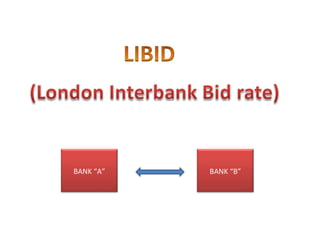
BANK “A” BANK “B”
This is the rate bid by banks on eurocurrecy deposits(i.e. the rate at which a bank is willing to borrow from other banks)  Rate to which many Eurodollar loans and deposits are tied. The bid rate that a Euromarket bank is willing to pay to attract a deposit from another Euromarket bank in London.  It is "the opposite" of the LIBOR (an offered, hence "ask" rate).
The interest rate that commercial banks charge their most credit-worthy customers.  Generally a bank's best customers consist of large corporations.  Even though banks frequently charge more and sometimes less than the quoted prime rate, it is a benchmark against which other rates are measured and often keyed.
 

Libor

  • 1.
    Average rate atwhich banks loan to one another
  • 2.
  • 3.
    It is atrimmed average of inter-bank deposit rates offered by designated contributor banks maturities ranging from overnight to one year LIBOR is calculated for 10 currencies   US dollar, Euro, Japanese Yen, Swiss Franc, Canadian dollar, Australian Dollar, Swedish Krona, Danish Krone and New Zealand dollar.
  • 4.
    Not necessary Submittedby a panel with high credit ranking Bank with less standing may have to pay higher than published rate.
  • 5.
    LIBOR rates arewidely used as a reference rate for financial instruments such as: Forward rate agreements short term interest rate future contracts Interest rate swaps Floating rate notes Syndicated loans Variable rate mortgages currencies, especially the US $ They thus provide the basis for some of the world's most liquid and active interest rate markets.
  • 6.
  • 7.
    This is therate bid by banks on eurocurrecy deposits(i.e. the rate at which a bank is willing to borrow from other banks) Rate to which many Eurodollar loans and deposits are tied. The bid rate that a Euromarket bank is willing to pay to attract a deposit from another Euromarket bank in London. It is "the opposite" of the LIBOR (an offered, hence "ask" rate).
  • 8.
    The interest ratethat commercial banks charge their most credit-worthy customers. Generally a bank's best customers consist of large corporations. Even though banks frequently charge more and sometimes less than the quoted prime rate, it is a benchmark against which other rates are measured and often keyed.
  • 9.