Interest Rate Derivatives:  The Standard Market Models Chapter 26
The Complications in Valuing Interest Rate Derivatives  (page 611)   We need a whole term structure to define the level of interest rates at any time The stochastic process for an interest rate is more complicated than that for a stock price Volatilities of different  points on the term structure are different Interest rates are used for discounting the payoff as well as for defining the payoff
Approaches to Pricing Interest Rate Options Use a variant  of Black’s model  Use a no-arbitrage (yield curve based) model
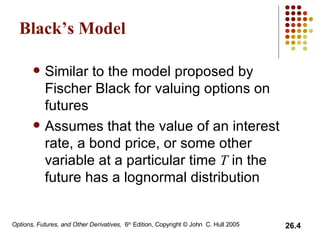
Black’s Model Similar to the model proposed by Fischer Black for valuing options on futures Assumes that the value of an interest rate, a bond price, or some other variable at a particular time  T  in the future has a lognormal distribution
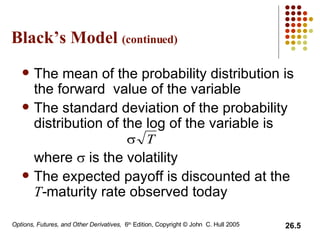
Black’s Model  (continued) The mean of the probability distribution is the forward  value of the variable The standard deviation of the probability distribution of the log of the variable is  where    is the volatility The expected payoff is discounted at the  T - maturity rate observed today
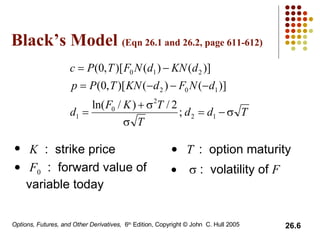
Black’s Model  (Eqn 26.1 and 26.2, page 611-612) K   :  strike price F 0   :  forward value of variable today T   :  option maturity    :  volatility of  F
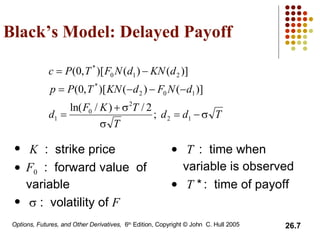
Black’s Model: Delayed Payoff K   :  strike price F 0   :  forward value  of variable    :  volatility of  F T   :  time when  variable is observed T  *   :  time of payoff
Validity of Black’s Model Two assumptions: 1. The expected value of the underlying variable is its forward price  2. We can discount expected payoffs at rate observed in the market today  It turns out that these assumptions offset each other in the applications of Black’s model that we will consider
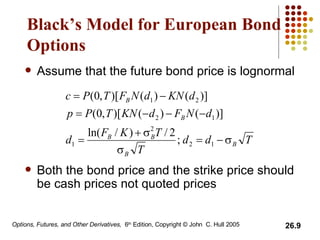
Black’s Model for European Bond Options Assume that the future bond price is lognormal Both the bond price and the strike price should be cash prices not quoted prices
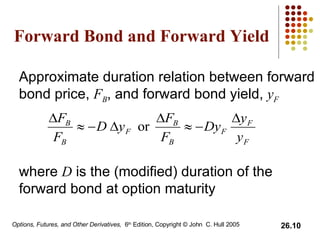
Forward Bond and Forward Yield Approximate duration relation between forward bond price,  F B , and forward bond yield,  y F where  D  is the (modified) duration of the forward bond at option maturity
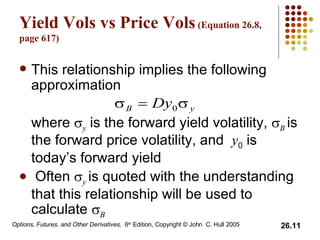
Yield Vols vs Price Vols  (Equation 26.8, page 617) This relationship implies the following approximation where   y  is the forward yield volatility,   B   is the forward price volatility, and  y 0  is today’s forward yield Often   y   is quoted with the understanding that this relationship will be used to calculate   B
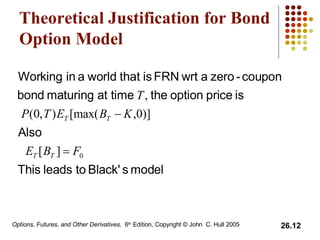
Theoretical Justification for Bond Option Model
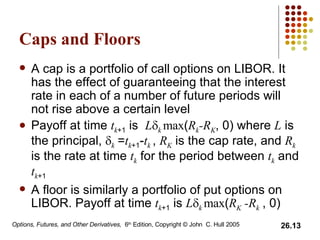
Caps and Floors A cap is a portfolio of call options on LIBOR. It has the effect of guaranteeing that the interest rate in each of a number of future periods will not rise above a certain level Payoff at time  t k +1  is  L  k  max ( R k -R K , 0) where  L  is the principal,   k  = t k +1 - t k   ,  R K  is the cap rate, and  R k  is the rate at time  t k  for the period between  t k  and  t k +1 A floor is similarly a portfolio of put options on LIBOR. Payoff at time  t k +1  is  L  k  max ( R K  -R k   , 0)
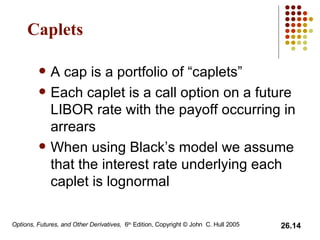
Caplets A cap is a portfolio of “caplets” Each caplet is a call option on a future LIBOR rate with the payoff occurring in arrears When using Black’s model we assume  that the interest rate underlying each caplet is lognormal
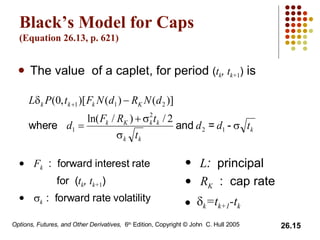
Black’s Model for Caps (Equation 26.13, p. 621) The value  of a caplet, for period  ( t k ,  t k+ 1 )  is F k   :  forward interest rate    for  ( t k ,  t k+ 1 )  k   :  forward rate volatility L :  principal R K   :  cap rate  k =t k+1 -t k
When Applying Black’s Model To Caps We Must ... EITHER Use spot volatilities Volatility different for each caplet OR Use flat volatilities Volatility same for each caplet within a particular cap but varies according to life of cap
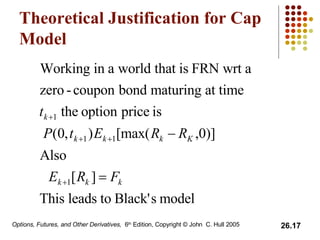
Theoretical Justification for Cap Model
Swaptions A swaption or swap option gives the holder the right to enter into an interest rate swap in the future Two kinds The right to pay a specified fixed rate and receive LIBOR The right to receive a specified fixed rate and pay LIBOR
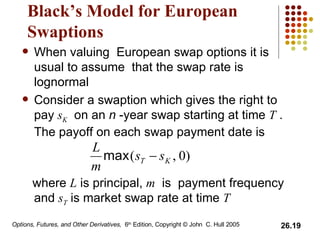
Black’s Model for European Swaptions When valuing  European swap options it is usual to assume  that the swap rate is lognormal Consider a swaption which gives the right to pay  s K   on an  n  -year swap starting at time  T  .  The payoff on each swap payment date is where  L  is principal,  m   is  payment frequency and  s T  is market swap rate at time  T
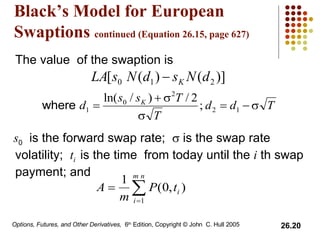
Black’s Model for European Swaptions  continued (Equation 26.15, page 627) The value  of the swaption is s 0   is the forward swap rate;    is the swap rate volatility;  t i  is the time  from today until the  i  th swap payment; and
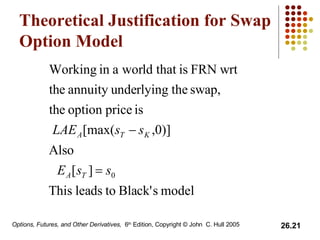
Theoretical Justification for Swap Option Model
Relationship Between Swaptions and Bond Options An interest rate swap can be regarded as the exchange of a fixed-rate bond for a floating-rate bond A swaption or swap option is therefore an option to exchange a fixed-rate bond for a floating-rate bond
Relationship Between Swaptions and Bond Options  (continued) At the start of the swap the floating-rate bond is worth par so that the swaption can be viewed as an option to exchange a fixed-rate bond for par An option on a swap where fixed is paid and floating is received is a put option on the bond with a strike price of par When floating is paid and fixed is received, it is a call option on the bond with a strike price of par
Deltas of Interest Rate Derivatives   Alternatives: Calculate a DV01 (the impact of a 1bps parallel shift in the zero curve) Calculate impact of small change in the quote for each instrument used to calculate the zero curve Divide zero curve (or forward curve) into buckets and calculate the impact of a shift in each bucket Carry out a principal components analysis for changes in the zero curve. Calculate delta with respect to each of the first two or three factors

Chap 26

  • 1.
    Interest Rate Derivatives: The Standard Market Models Chapter 26
  • 2.
    The Complications inValuing Interest Rate Derivatives (page 611) We need a whole term structure to define the level of interest rates at any time The stochastic process for an interest rate is more complicated than that for a stock price Volatilities of different points on the term structure are different Interest rates are used for discounting the payoff as well as for defining the payoff
  • 3.
    Approaches to PricingInterest Rate Options Use a variant of Black’s model Use a no-arbitrage (yield curve based) model
  • 4.
    Black’s Model Similarto the model proposed by Fischer Black for valuing options on futures Assumes that the value of an interest rate, a bond price, or some other variable at a particular time T in the future has a lognormal distribution
  • 5.
    Black’s Model (continued) The mean of the probability distribution is the forward value of the variable The standard deviation of the probability distribution of the log of the variable is where  is the volatility The expected payoff is discounted at the T - maturity rate observed today
  • 6.
    Black’s Model (Eqn 26.1 and 26.2, page 611-612) K : strike price F 0 : forward value of variable today T : option maturity  : volatility of F
  • 7.
    Black’s Model: DelayedPayoff K : strike price F 0 : forward value of variable  : volatility of F T : time when variable is observed T * : time of payoff
  • 8.
    Validity of Black’sModel Two assumptions: 1. The expected value of the underlying variable is its forward price 2. We can discount expected payoffs at rate observed in the market today It turns out that these assumptions offset each other in the applications of Black’s model that we will consider
  • 9.
    Black’s Model forEuropean Bond Options Assume that the future bond price is lognormal Both the bond price and the strike price should be cash prices not quoted prices
  • 10.
    Forward Bond andForward Yield Approximate duration relation between forward bond price, F B , and forward bond yield, y F where D is the (modified) duration of the forward bond at option maturity
  • 11.
    Yield Vols vsPrice Vols (Equation 26.8, page 617) This relationship implies the following approximation where  y is the forward yield volatility,  B is the forward price volatility, and y 0 is today’s forward yield Often  y is quoted with the understanding that this relationship will be used to calculate  B
  • 12.
  • 13.
    Caps and FloorsA cap is a portfolio of call options on LIBOR. It has the effect of guaranteeing that the interest rate in each of a number of future periods will not rise above a certain level Payoff at time t k +1 is L  k max ( R k -R K , 0) where L is the principal,  k  = t k +1 - t k , R K is the cap rate, and R k is the rate at time t k for the period between t k and t k +1 A floor is similarly a portfolio of put options on LIBOR. Payoff at time t k +1 is L  k max ( R K -R k , 0)
  • 14.
    Caplets A capis a portfolio of “caplets” Each caplet is a call option on a future LIBOR rate with the payoff occurring in arrears When using Black’s model we assume that the interest rate underlying each caplet is lognormal
  • 15.
    Black’s Model forCaps (Equation 26.13, p. 621) The value of a caplet, for period ( t k , t k+ 1 ) is F k : forward interest rate for ( t k , t k+ 1 )  k : forward rate volatility L : principal R K : cap rate  k =t k+1 -t k
  • 16.
    When Applying Black’sModel To Caps We Must ... EITHER Use spot volatilities Volatility different for each caplet OR Use flat volatilities Volatility same for each caplet within a particular cap but varies according to life of cap
  • 17.
  • 18.
    Swaptions A swaptionor swap option gives the holder the right to enter into an interest rate swap in the future Two kinds The right to pay a specified fixed rate and receive LIBOR The right to receive a specified fixed rate and pay LIBOR
  • 19.
    Black’s Model forEuropean Swaptions When valuing European swap options it is usual to assume that the swap rate is lognormal Consider a swaption which gives the right to pay s K on an n -year swap starting at time T . The payoff on each swap payment date is where L is principal, m is payment frequency and s T is market swap rate at time T
  • 20.
    Black’s Model forEuropean Swaptions continued (Equation 26.15, page 627) The value of the swaption is s 0 is the forward swap rate;  is the swap rate volatility; t i is the time from today until the i th swap payment; and
  • 21.
  • 22.
    Relationship Between Swaptionsand Bond Options An interest rate swap can be regarded as the exchange of a fixed-rate bond for a floating-rate bond A swaption or swap option is therefore an option to exchange a fixed-rate bond for a floating-rate bond
  • 23.
    Relationship Between Swaptionsand Bond Options (continued) At the start of the swap the floating-rate bond is worth par so that the swaption can be viewed as an option to exchange a fixed-rate bond for par An option on a swap where fixed is paid and floating is received is a put option on the bond with a strike price of par When floating is paid and fixed is received, it is a call option on the bond with a strike price of par
  • 24.
    Deltas of InterestRate Derivatives Alternatives: Calculate a DV01 (the impact of a 1bps parallel shift in the zero curve) Calculate impact of small change in the quote for each instrument used to calculate the zero curve Divide zero curve (or forward curve) into buckets and calculate the impact of a shift in each bucket Carry out a principal components analysis for changes in the zero curve. Calculate delta with respect to each of the first two or three factors