Copyright © 2010 by The McGraw-Hill Companies, Inc. All rights reserved.
Chapter
TREASURY ORGANIZATION AND
STRUCTURE
2
KP Gwachha, PhD(S)
Sainik College
Copyright © 2010 by The McGraw-Hill Companies, Inc. All rights reserved.
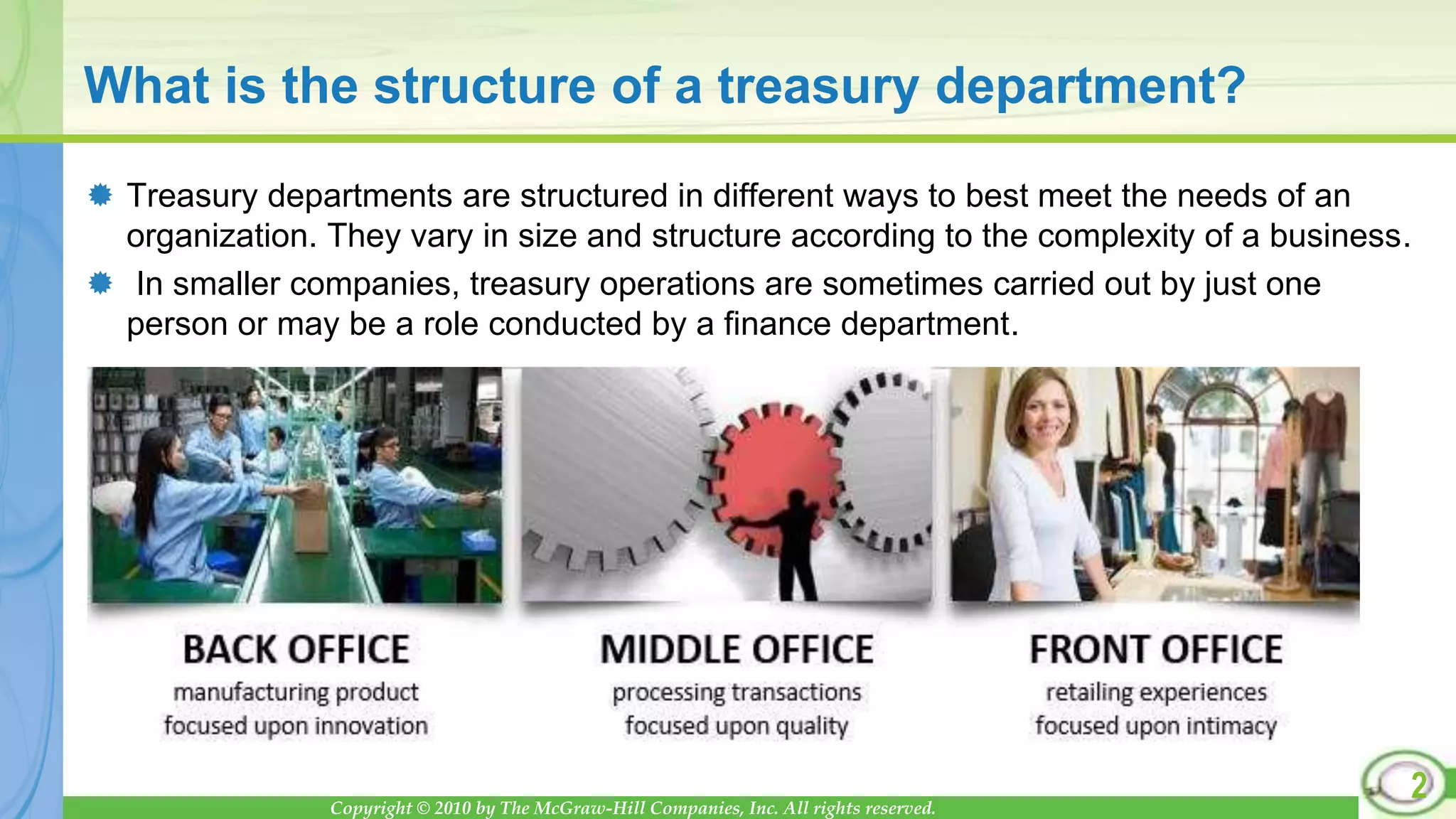
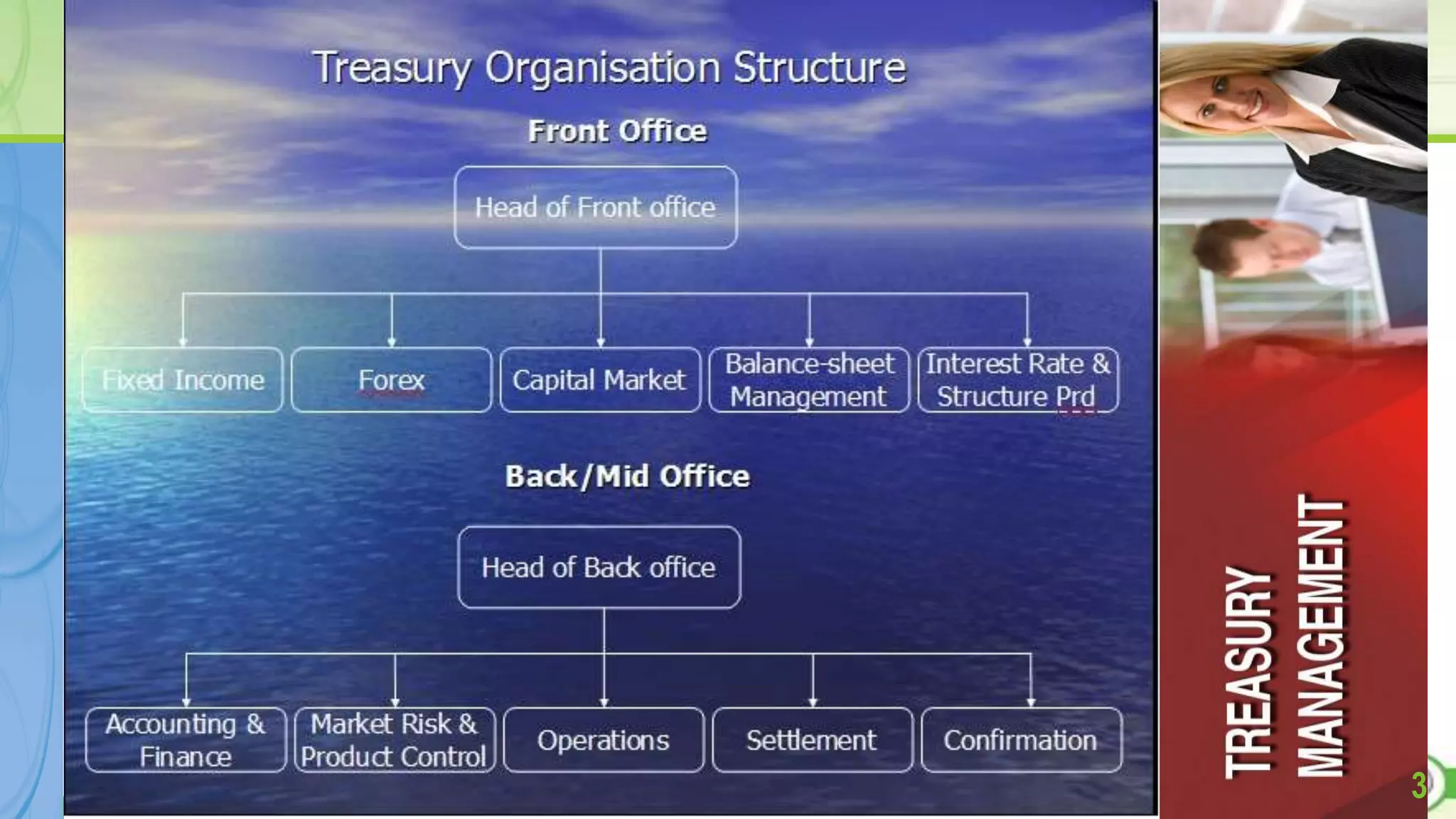
What is the structure of a treasury department?
 Treasury departments are structured in different ways to best meet the needs of an
organization. They vary in size and structure according to the complexity of a business.
 In smaller companies, treasury operations are sometimes carried out by just one
person or may be a role conducted by a finance department.
2
Copyright © 2010 by The McGraw-Hill Companies, Inc. All rights reserved.
3
Copyright © 2010 by The McGraw-Hill Companies, Inc. All rights reserved.
LO
1. FRONT OFFICE
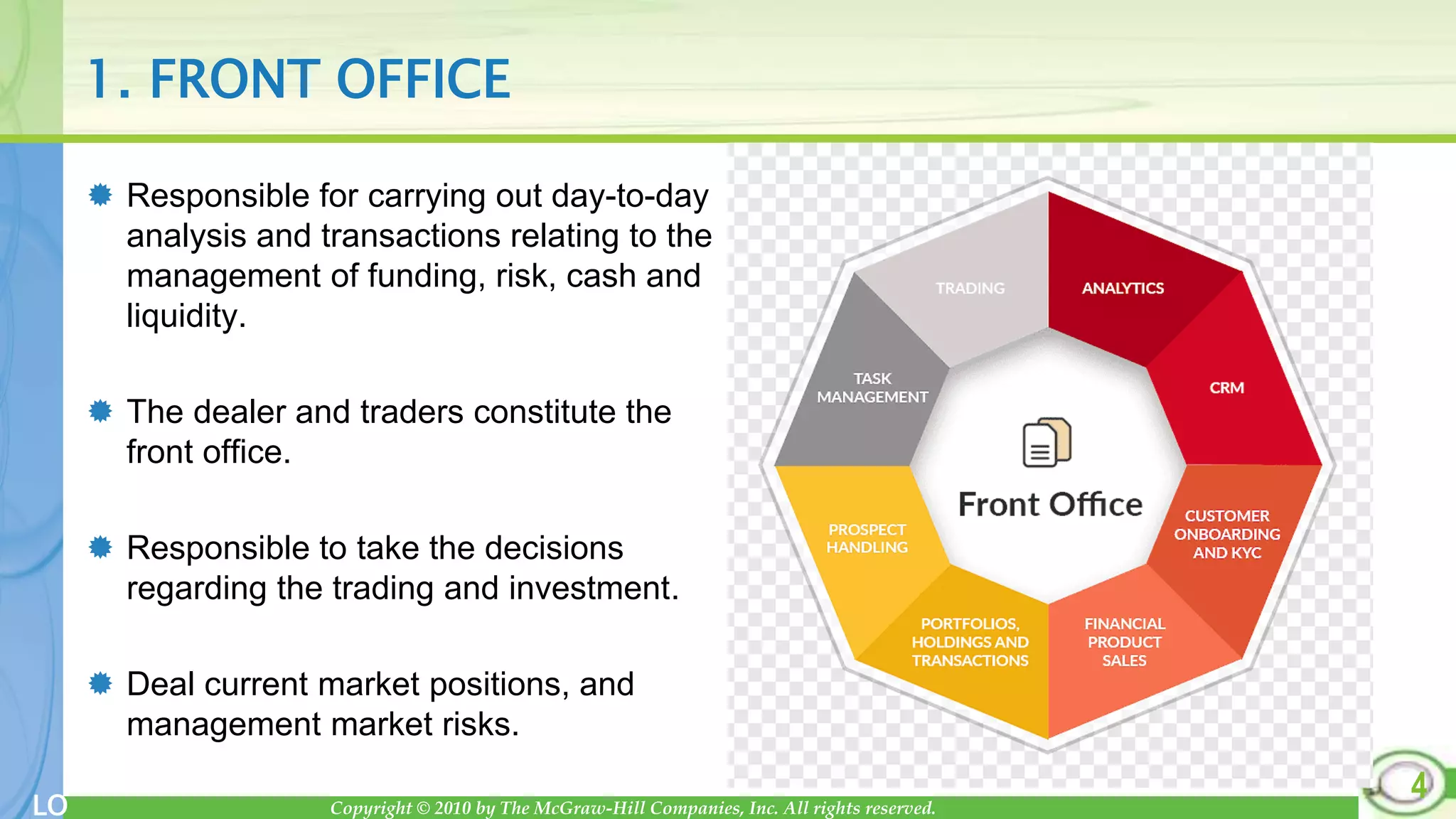
 Responsible for carrying out day-to-day
analysis and transactions relating to the
management of funding, risk, cash and
liquidity.
 The dealer and traders constitute the
front office.
 Responsible to take the decisions
regarding the trading and investment.
 Deal current market positions, and
management market risks.
4
Copyright © 2010 by The McGraw-Hill Companies, Inc. All rights reserved.
FRONT – OFFICE (Functions)
1. Performs the preliminary functions of treasury operation
2. Maintains the limit of individual deals and dealers.
3. Deals in interbank transactions, currency trading, placement decisions
and funds management.
4. Maintains the balance of position of currency.
5. Determination of exchange rate and interest rate for money and capital
market securities.
6. Maintain the liquidity position of the bank including cash reserve ratio
management.
7. Determination of the daily foreign exchange rate for cash, tom, spot and
forward transactions.
8. Assessment of periodic risk exposure.
5
Copyright © 2010 by The McGraw-Hill Companies, Inc. All rights reserved.
LO
2. MIDDLE OFFICE
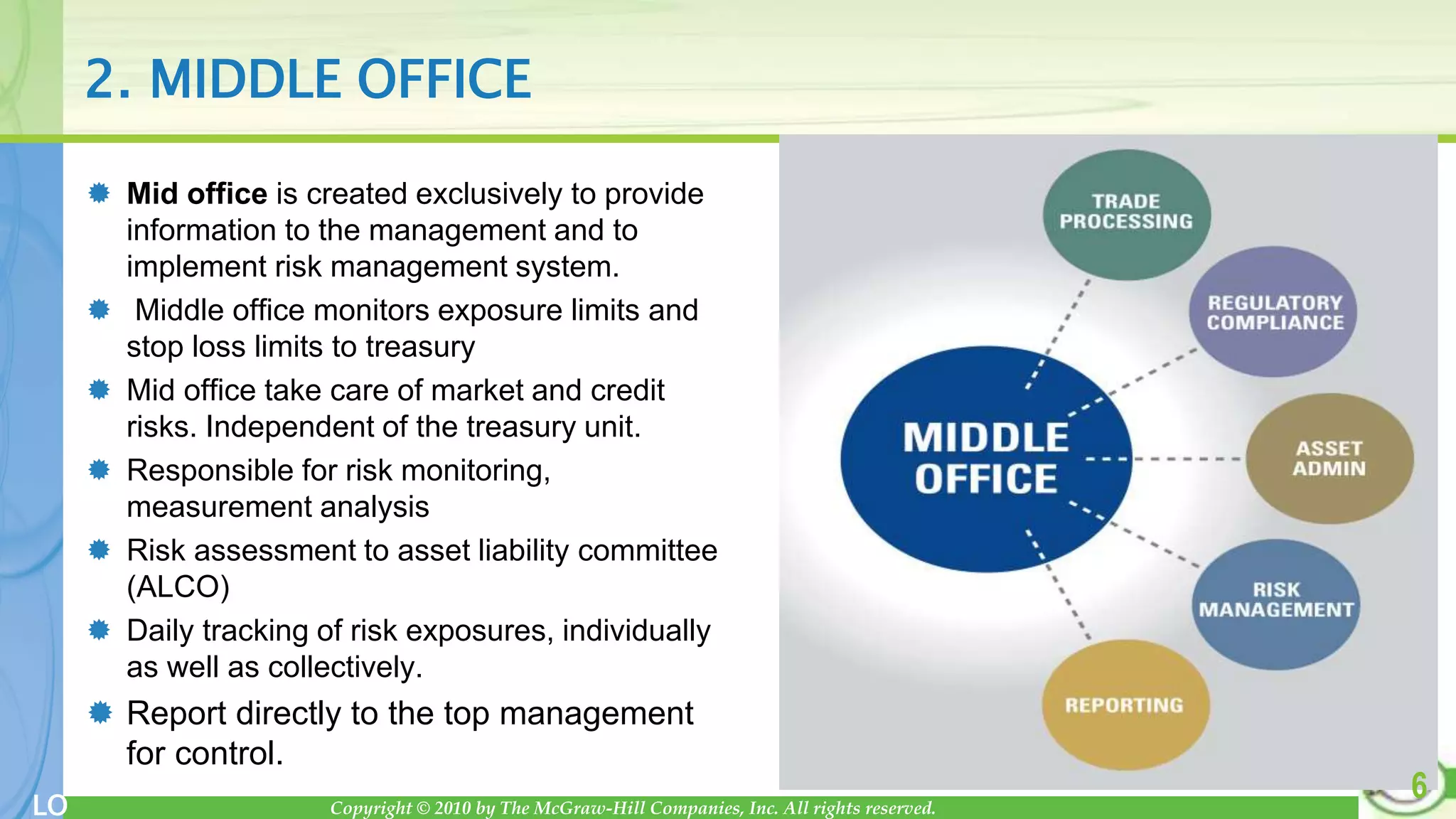
 Mid office is created exclusively to provide
information to the management and to
implement risk management system.
 Middle office monitors exposure limits and
stop loss limits to treasury
 Mid office take care of market and credit
risks. Independent of the treasury unit.
 Responsible for risk monitoring,
measurement analysis
 Risk assessment to asset liability committee
(ALCO)
 Daily tracking of risk exposures, individually
as well as collectively.
 Report directly to the top management
for control.
6
Copyright © 2010 by The McGraw-Hill Companies, Inc. All rights reserved.
MID – OFFICE (Functions)
1. Limit setting and monitoring exposures in relation to limits.
2. Assessing likely market movement based on internal assessments and
external/internal research.
3. Evolving hedging strategies for assets and liabilities.
4. Interacting with the bank’s risk management department.
5. Monitoring open currency position.
6. Calculating and reporting value at risk
7. Stress testing and back testing of investment and trading portfolio.
8. Risk and return analysis
9. Market open position to market to access unrealized gain and losses.
7
Copyright © 2010 by The McGraw-Hill Companies, Inc. All rights reserved.
LO
3. BACK OFFICE
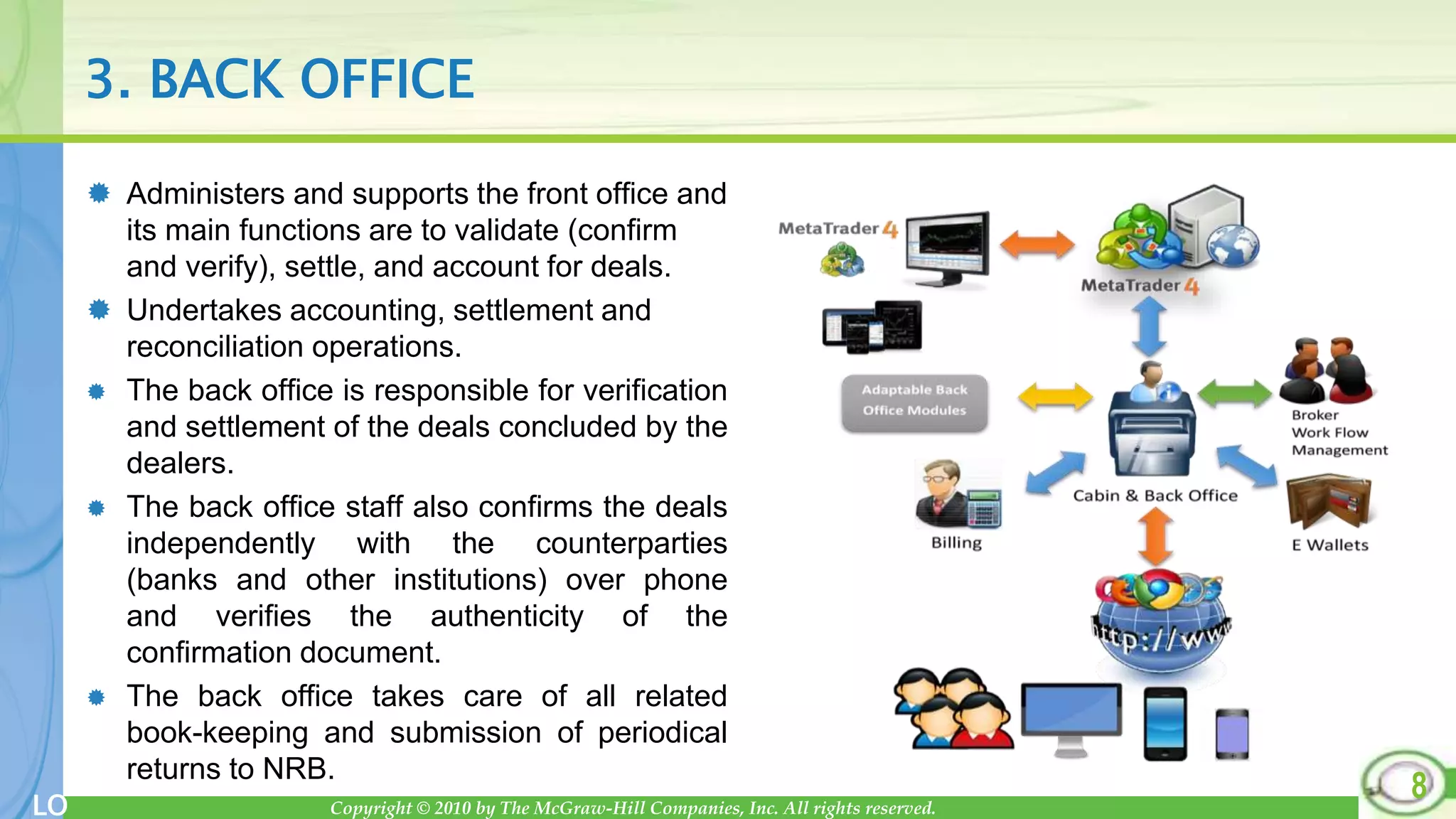
 Administers and supports the front office and
its main functions are to validate (confirm
and verify), settle, and account for deals.
 Undertakes accounting, settlement and
reconciliation operations.
 The back office is responsible for verification
and settlement of the deals concluded by the
dealers.
 The back office staff also confirms the deals
independently with the counterparties
(banks and other institutions) over phone
and verifies the authenticity of the
confirmation document.
 The back office takes care of all related
book-keeping and submission of periodical
returns to NRB.
8
Copyright © 2010 by The McGraw-Hill Companies, Inc. All rights reserved.
BACK – OFFICE (Functions)
1. Check the details of deal slip.
2. Issuance of deal confirmation to the counter party/obtain deal confirmation
from counter parties.
3. Match the deal confirmation received from counter party, if any alterations
immediately settle the differences.
4. Issuance of payment instructions.
5. Pass necessary accounting entries.
6. File the deal ticket, both confirmations issued by counter party and by
bank systematically.
7. Settlement on value date.
8. Keep track of payments made/received in Nostro Account.
9. Maintain up to date records and registers of all transaction.
9
Copyright © 2010 by The McGraw-Hill Companies, Inc. All rights reserved.
LO
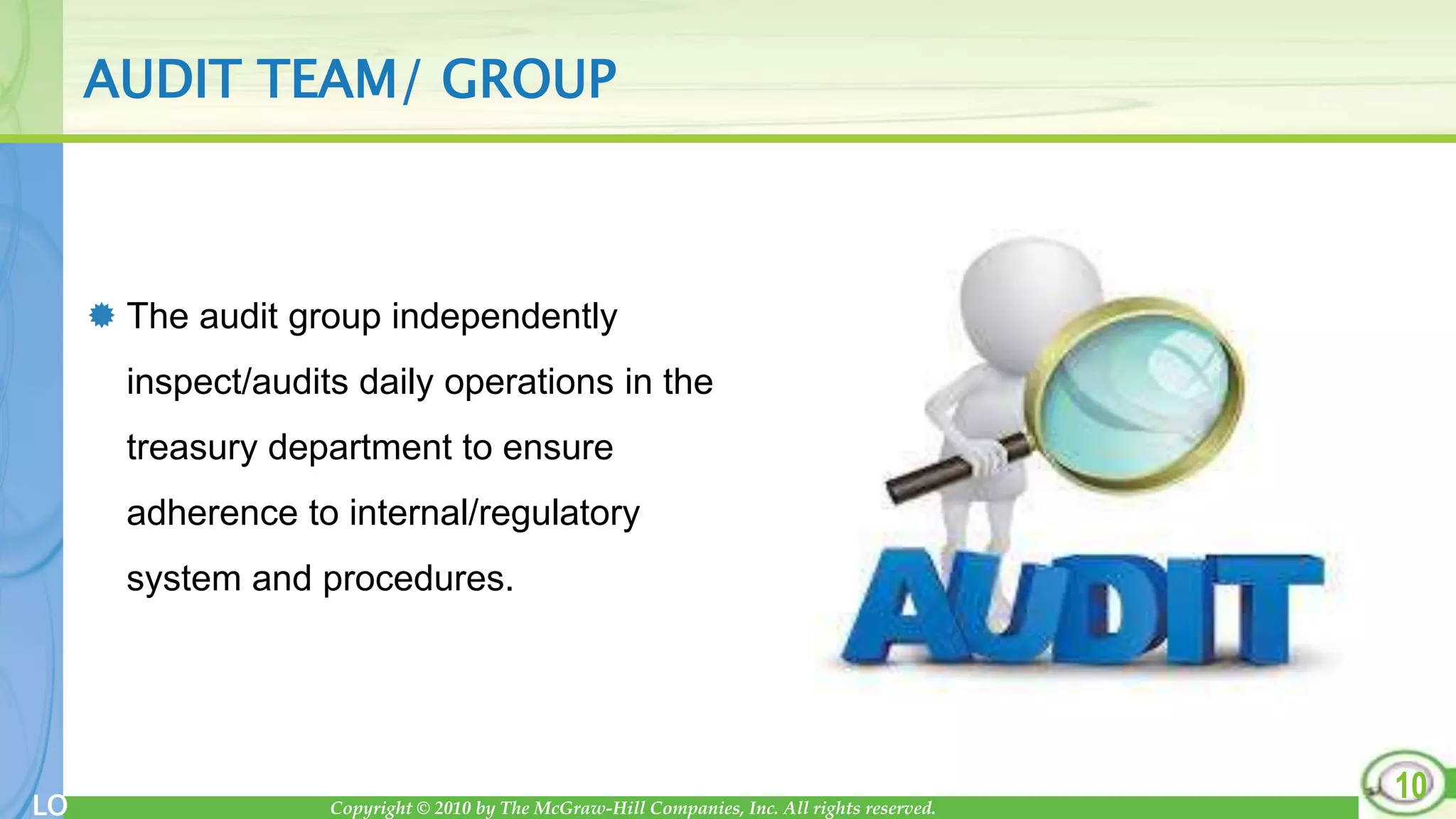
AUDIT TEAM/ GROUP
 The audit group independently
inspect/audits daily operations in the
treasury department to ensure
adherence to internal/regulatory
system and procedures.
10
Copyright © 2010 by The McGraw-Hill Companies, Inc. All rights reserved.
MEANING OF DEALERS
 Dealers do a host of transactions in different currencies in the interbank market or for
customers.
 In view of the large volumes, transactions offset one another leaving net open (uncovered)
positions in various currencies.
 The Treasury Front-Office maintains and manages all the forex positions of the bank.
 Dealers may or may not cover customer’s deals immediately, depending upon the market
situation, movements and dealers views on the markets.
 If not covered, they add to the bank’s open position.
 Thus, the forex deal book of the bank is the portfolio of long and short forex positions in different
currencies.
 These positions vary in amount and maturity.
 Spot deals mature in two working days (as of trade day) and forwards may mature any time up
to six months or even a year.
11
Copyright © 2010 by The McGraw-Hill Companies, Inc. All rights reserved.
ROLES AND RESPONSIBILITIES OF DEALERS
1. Maintains the limit of individual deals and dealers.
2. Deals in interbank transactions, currency trading, placement decisions and
funds management.
3. Maintains the balance of position of currency.
4. Determination of exchange rate and interest rate for money and capital
market securities.
5. Maintain the liquidity position of the bank including cash reserve ratio
management.
6. Determination of the daily foreign exchange rate for cash, tom, spot and
forward transactions. Tom contract is the delivery is to take place on the
next business day when the banks are open for business.
7. Maximizing returns on cash investments.
12
Copyright © 2010 by The McGraw-Hill Companies, Inc. All rights reserved.
LO
DEALERS ROOM
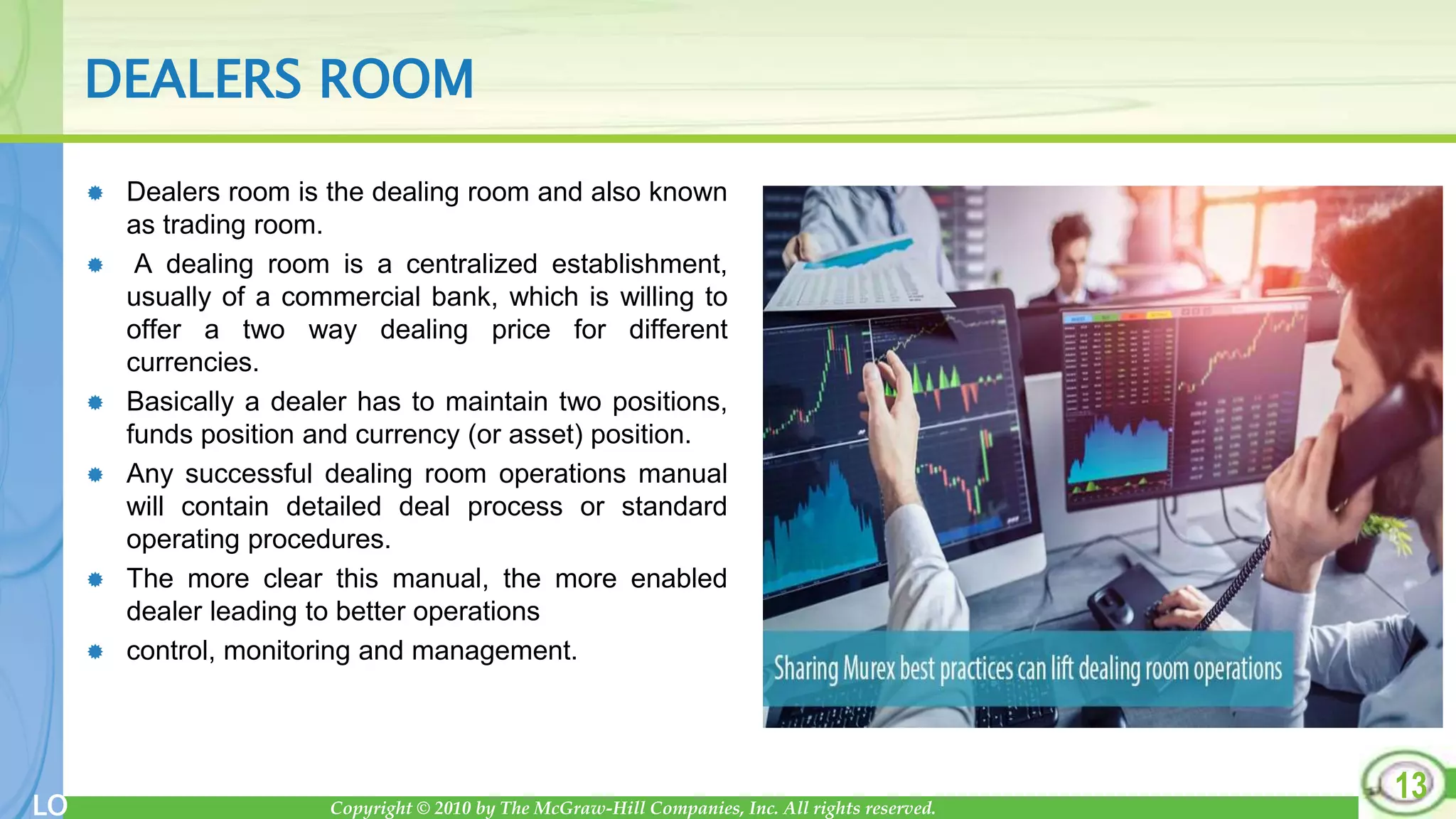
 Dealers room is the dealing room and also known
as trading room.
 A dealing room is a centralized establishment,
usually of a commercial bank, which is willing to
offer a two way dealing price for different
currencies.
 Basically a dealer has to maintain two positions,
funds position and currency (or asset) position.
 Any successful dealing room operations manual
will contain detailed deal process or standard
operating procedures.
 The more clear this manual, the more enabled
dealer leading to better operations
 control, monitoring and management.
13
Copyright © 2010 by The McGraw-Hill Companies, Inc. All rights reserved.
LO 5
14

Treasury organization & structure

  • 1.
    Copyright © 2010by The McGraw-Hill Companies, Inc. All rights reserved. Chapter TREASURY ORGANIZATION AND STRUCTURE 2 KP Gwachha, PhD(S) Sainik College
  • 2.
    Copyright © 2010by The McGraw-Hill Companies, Inc. All rights reserved. What is the structure of a treasury department?  Treasury departments are structured in different ways to best meet the needs of an organization. They vary in size and structure according to the complexity of a business.  In smaller companies, treasury operations are sometimes carried out by just one person or may be a role conducted by a finance department. 2
  • 3.
    Copyright © 2010by The McGraw-Hill Companies, Inc. All rights reserved. 3
  • 4.
    Copyright © 2010by The McGraw-Hill Companies, Inc. All rights reserved. LO 1. FRONT OFFICE  Responsible for carrying out day-to-day analysis and transactions relating to the management of funding, risk, cash and liquidity.  The dealer and traders constitute the front office.  Responsible to take the decisions regarding the trading and investment.  Deal current market positions, and management market risks. 4
  • 5.
    Copyright © 2010by The McGraw-Hill Companies, Inc. All rights reserved. FRONT – OFFICE (Functions) 1. Performs the preliminary functions of treasury operation 2. Maintains the limit of individual deals and dealers. 3. Deals in interbank transactions, currency trading, placement decisions and funds management. 4. Maintains the balance of position of currency. 5. Determination of exchange rate and interest rate for money and capital market securities. 6. Maintain the liquidity position of the bank including cash reserve ratio management. 7. Determination of the daily foreign exchange rate for cash, tom, spot and forward transactions. 8. Assessment of periodic risk exposure. 5
  • 6.
    Copyright © 2010by The McGraw-Hill Companies, Inc. All rights reserved. LO 2. MIDDLE OFFICE  Mid office is created exclusively to provide information to the management and to implement risk management system.  Middle office monitors exposure limits and stop loss limits to treasury  Mid office take care of market and credit risks. Independent of the treasury unit.  Responsible for risk monitoring, measurement analysis  Risk assessment to asset liability committee (ALCO)  Daily tracking of risk exposures, individually as well as collectively.  Report directly to the top management for control. 6
  • 7.
    Copyright © 2010by The McGraw-Hill Companies, Inc. All rights reserved. MID – OFFICE (Functions) 1. Limit setting and monitoring exposures in relation to limits. 2. Assessing likely market movement based on internal assessments and external/internal research. 3. Evolving hedging strategies for assets and liabilities. 4. Interacting with the bank’s risk management department. 5. Monitoring open currency position. 6. Calculating and reporting value at risk 7. Stress testing and back testing of investment and trading portfolio. 8. Risk and return analysis 9. Market open position to market to access unrealized gain and losses. 7
  • 8.
    Copyright © 2010by The McGraw-Hill Companies, Inc. All rights reserved. LO 3. BACK OFFICE  Administers and supports the front office and its main functions are to validate (confirm and verify), settle, and account for deals.  Undertakes accounting, settlement and reconciliation operations.  The back office is responsible for verification and settlement of the deals concluded by the dealers.  The back office staff also confirms the deals independently with the counterparties (banks and other institutions) over phone and verifies the authenticity of the confirmation document.  The back office takes care of all related book-keeping and submission of periodical returns to NRB. 8
  • 9.
    Copyright © 2010by The McGraw-Hill Companies, Inc. All rights reserved. BACK – OFFICE (Functions) 1. Check the details of deal slip. 2. Issuance of deal confirmation to the counter party/obtain deal confirmation from counter parties. 3. Match the deal confirmation received from counter party, if any alterations immediately settle the differences. 4. Issuance of payment instructions. 5. Pass necessary accounting entries. 6. File the deal ticket, both confirmations issued by counter party and by bank systematically. 7. Settlement on value date. 8. Keep track of payments made/received in Nostro Account. 9. Maintain up to date records and registers of all transaction. 9
  • 10.
    Copyright © 2010by The McGraw-Hill Companies, Inc. All rights reserved. LO AUDIT TEAM/ GROUP  The audit group independently inspect/audits daily operations in the treasury department to ensure adherence to internal/regulatory system and procedures. 10
  • 11.
    Copyright © 2010by The McGraw-Hill Companies, Inc. All rights reserved. MEANING OF DEALERS  Dealers do a host of transactions in different currencies in the interbank market or for customers.  In view of the large volumes, transactions offset one another leaving net open (uncovered) positions in various currencies.  The Treasury Front-Office maintains and manages all the forex positions of the bank.  Dealers may or may not cover customer’s deals immediately, depending upon the market situation, movements and dealers views on the markets.  If not covered, they add to the bank’s open position.  Thus, the forex deal book of the bank is the portfolio of long and short forex positions in different currencies.  These positions vary in amount and maturity.  Spot deals mature in two working days (as of trade day) and forwards may mature any time up to six months or even a year. 11
  • 12.
    Copyright © 2010by The McGraw-Hill Companies, Inc. All rights reserved. ROLES AND RESPONSIBILITIES OF DEALERS 1. Maintains the limit of individual deals and dealers. 2. Deals in interbank transactions, currency trading, placement decisions and funds management. 3. Maintains the balance of position of currency. 4. Determination of exchange rate and interest rate for money and capital market securities. 5. Maintain the liquidity position of the bank including cash reserve ratio management. 6. Determination of the daily foreign exchange rate for cash, tom, spot and forward transactions. Tom contract is the delivery is to take place on the next business day when the banks are open for business. 7. Maximizing returns on cash investments. 12
  • 13.
    Copyright © 2010by The McGraw-Hill Companies, Inc. All rights reserved. LO DEALERS ROOM  Dealers room is the dealing room and also known as trading room.  A dealing room is a centralized establishment, usually of a commercial bank, which is willing to offer a two way dealing price for different currencies.  Basically a dealer has to maintain two positions, funds position and currency (or asset) position.  Any successful dealing room operations manual will contain detailed deal process or standard operating procedures.  The more clear this manual, the more enabled dealer leading to better operations  control, monitoring and management. 13
  • 14.
    Copyright © 2010by The McGraw-Hill Companies, Inc. All rights reserved. LO 5 14