CASE: ETH-03
DATE: 11/07/13
Sheila Melvin and Professor Ken Shotts prepared this case as
the basis for class discussion rather than to illustrate
either effective or ineffective handling of an administrative
situation.
Copyright © 2013 by the Board of Trustees of the Leland
Stanford Junior University. Publically available cases are
distributed through Harvard Business Publishing at
hbsp.harvard.edu and European Case Clearing House at
ecch.com, please contact them to order copies and request
permission to reproduce materials. No part of this
publication may be reproduced, stored in a retrieval system,
used in a spreadsheet, or transmitted in any form or by
any means –– electronic, mechanical, photocopying, recording,
or otherwise –– without the permission of the
Stanford Graduate School of Business. Every effort has been
made to respect copyright and to contact copyright
holders as appropriate. If you are a copyright holder and have
concerns, please contact the Case Writing Office at
[email protected] or write to Case Writing Office, Stanford
Graduate School of Business, Knight Management
Center, 655 Knight Way, Stanford University, Stanford, CA
94305-5015.
BARCLAYS AND THE LIBOR:
ANATOMY OF A SCANDAL
Culture is difficult to define, I think it's even more difficult to
mandate—but for me the evidence of
culture is how people behave when no one is watching.
1
-Bob Diamond, (former) Barclays CEO
INTRODUCTION
On June 27, 2012, the storied British bank Barclays admitted
that it repeatedly attempted to rig
the London Interbank Offered Rate (LIBOR) over a four-year
period from 2005-2009. The
LIBOR was calculated daily, based on the rates at which 16
banks estimated they could borrow
money.
2
Barclays, as one of these banks, regularly submitted rates that
were either falsely
inflated or deflated, first with the aim of benefitting its trading
positions and later, during the
financial crisis, with the intention of projecting an image of
strength and solvency. Tracy
McDermott, acting director of enforcement and financial crime
at the United Kingdom (U.K.)
Financial Services Authority (FSA), stated: “Barclays’
misconduct was serious, widespread and
extended over a number of years…Barclays’ behavior
threatened the integrity of the rates with
the risk of serious harm to other market participants.”
3
In its settlement, Barclays agreed to pay
$453 million in fines and penalties to bank regulators in the
U.K. and U.S.
4
1
“Today Business Lecture” delivered in 2011, quoted in Fixing
LIBOR: some preliminary findings, Paragraph 111,
http://www.publications.parliament.uk/pa/cm201213/cmselect/c
mtreasy/481/48103.htm (September 19, 2013)
2
In 2012, the number of banks on the Libor Panel was increased
to 18.
3
House of Commons Treasury Committee, Fixing LIBOR: some
preliminary findings, Paragraph 7
http://www.publications.parliament.uk/pa/cm201213/cmselect/c
mtreasy/481/48103.htm (September 19, 2013).
4
This included a $200 million civil penalty levied by the U.S.
Commodity Futures Trading Commission; a $160
million penalty from the U.S. Department of Justice; and a
£59.5 million fine by the U.K. Financial Services
For the exclusive use of R. Ahmed, 2022.
This document is authorized for use only by Rashik Ahmed in
FIN 9858 Summer 2022 taught by RHONDA HALPERN, CUNY
- Baruch College from Jun 2022 to Jul 2022.
mailto:[email protected]
http://www.publications.parliament.uk/pa/cm201213/cmselect/c
mtreasy/481/48103.htm
http://www.publications.parliament.uk/pa/cm201213/cmselect/c
mtreasy/481/48103.htm
Barclays and the LIBOR: Anatomy of a Scandal ETH-03
p. 2
Barclays CEO Bob Diamond—who was in charge of Barclays
Capital from 2005-2009, the
period during which the breaches occurred—announced that he
and three other executives would
waive their annual bonuses, an act of contrition that was quickly
deemed inadequate, and even
dubbed “utterly pathetic” by one commentator.
5
On July 1, 2012, Prime Minister David Cameron
announced a full parliamentary inquiry into LIBOR rate rigging,
and raised the possibility of
criminal sanctions. During the next few days there was turmoil
in Barclays’ leadership,
culminating in Diamond’s resignation.
Newspapers decried Barclays’ rate-rigging efforts as “the
scandal of all scandals”
6
and
bemoaned the spread of “Wall Street sleaze.”
7
Numerous hearings, audits, and other post-
mortems were conducted in an attempt to understand how the
rigging had been carried out and
why it had gone undetected for so long. Barclays was credited
for cooperating with investigators
and agreeing to settle at an early stage; the fine levied by the
FSA was therefore reduced by 30
percent.
8
Throughout the process, Barclays insisted that it was not alone
in its manipulation of
the LIBOR. In a July 15, 2012 memo entitled “Restoring our
reputation, building our business,”
Barclays’ executive committee stated, “As other banks settl e
with authorities, and their details
become public, and various governments’ inquiries shed more
light, our situation will eventually
be put into perspective.”
9
By late 2012, dozens of other banks did indeed face LIBOR-
rigging
inquiries by regulators in various countries.
BACKGROUND
The LIBOR
The LIBOR was a cornerstone of global financial markets.
Roughly speaking, it was the interest
rate that banks charged each other for short-term loans. The
LIBOR was calculated for 10
different currencies and 15 borrowing periods. The person
submitting the daily LIBOR data for
a bank was supposed to submit the interest rate the bank would
have to pay on a loan for a
particular term in a particular currency. Often, a bank was not
in the market for a particular type
of loan, and in such situations the submitter was supposed to
give a good-faith estimate of the
interest rate his or her bank would pay were it seeking a loan
just prior to 11:00 a.m. GMT. The
estimated rates were sent to the British Bankers Association
(BBA), a trade group, and the
Authority. See George Gilligan, “The Libor Scandal: Another
Example of Neutralized and Routinized Deviance in
the Financial Services Sector?,” The University of New South
Wales, Centre for Law, Markets & Regulation,
http://www.clmr.unsw.edu.au/article/ethics/libor-
manipulation/libor-scandal-another-example-neutralised-and-
routinised-deviance-financial-services-sector (September 19,
2013).
5
“Agius takes the bullet,” The Economist, July 1, 2012
http://www.economist.com/blogs/schumpeter/2012/07/barclays-
and-libor (September 5, 2013).
6
Robert Reich, “The Wall Street Scandal of All Scandals,” July
7, 2012, http://www.huffingtonpost.com/robert-
reich/libor-wall-street_b_1656665.html (September 19, 2013).
7
Robert Reich, “Wall Street Sleaze Keeps Growing,” July 14,
2012, http://www.sfgate.com/opinion/article/Wall-
Street-sleaze-keeps-growing-3705814.php (September 19,
2013).
8
Financial Services Authority, “Final Notice, To Barclays Bank,
PLC,” Section 2, June 27, 2012,
http://www.fsa.gov.uk/static/pubs/final/barclays-jun12.pdf
(September 19, 2013).
9
“Rivals LIBOR woes to put Barclays’ in perspective: memo,”
Business Standard, July 15, 2012,
http://www.business-standard.com/article/international/rivals-
libor-woes-to-put-barclays-in-perspective-memo-
112071500061_1.html, (September 19, 2013).
For the exclusive use of R. Ahmed, 2022.
This document is authorized for use only by Rashik Ahmed in
FIN 9858 Summer 2022 taught by RHONDA HALPERN, CUNY
- Baruch College from Jun 2022 to Jul 2022.
http://www.clmr.unsw.edu.au/article/ethics/libor-
manipulation/libor-scandal-another-example-neutralised-and-
routinised-deviance-financial-services-sector
http://www.clmr.unsw.edu.au/article/e thics/libor-
manipulation/libor-scandal-another-example-neutralised-and-
routinised-deviance-financial-services-sector
http://www.economist.com/blogs/schumpeter/2012/07/barclays-
and-libor
http://www.huffingtonpost.com/robert-reich/libor-wall-
street_b_1656665.html
http://www.huffingtonpost.com/robert-reich/libor-wall-
street_b_1656665.html
http://www.sfgate.com/opinion/article/Wall-Street-sleaze-keeps-
growing-3705814.php
http://www.sfgate.com/opinion/article/Wall-Street-sleaze-keeps-
growing-3705814.php
http://www.fsa.gov.uk/static/pubs/final/barclays-jun12.pdf
Barclays and the LIBOR: Anatomy of a Scandal ETH-03
p. 3
LIBOR was calculated as the average of these submitted rates,
after the removal of high and low
outliers. In the case of the U.S. dollar LIBOR, the top four and
bottom four submissions were
eliminated and the middle eight were averaged to determine the
rate.
The LIBOR’s origins stem from the informal practices of a
clubby group of British gentlemen
bankers in the 1960s. Beginning in the 1980s, the process
became more formalized and was
taken over by the BBA. BBA regulations stated clearly that the
only factors to be considered in
submitting a rate were those related to the cost of borrowing
unsecured funds.
The LIBOR was used for hundreds of trillions of dollars of
financial transactions, including
consumer loans, mortgages, and much of the global trade in
financial derivatives. In 2012, The
New York Times reported that about 45 percent of prime and 80
percent of subprime mortgages
had interest rates based on the LIBOR; and about half of
variable rate student loans were set
according to the LIBOR.
10
The BBA estimated that $350 trillion of notional swaps and
$10
trillion of loans were indexed to the LIBOR.
11
Trying to determine who may have been
harmed—or helped—by the rate-rigging was described as a
“gargantuan task.”
12
Two Forms of Rate-Rigging
Two main forms of rate-rigging took place at Barclays. The
first occurred primarily between
2005 and 2007 and involved individual traders requesting the
submission of rates that would
benefit their transactions, rather than rates at which Barclays
actually believed it could borrow
money. The person who submitted a bank’s data for LIBOR
calculations could overstate or
understate the true rate that the bank would pay on short-term
loans. By doing so, he could help
traders who had taken positions that depended on the LIBOR
rate. For example, a Barclays’
trader in New York might take a position that would be highly
profitable if the LIBOR rate were
low, and then send an e-mail to the Barclays trader in London
who was in charge of submitting
rates, asking him to submit a low value. Exhibit 1 gives an
example of how a trader could
benefit from LIBOR rate-rigging.
The second form of rate-rigging occurred during the 2007-2008
credit crisis, when banks were
concerned about appearing strong. One indicator of a bank’s
strength was whether other banks
were willing to lend it money on favorable terms. Each bank
thus had an incentive to
underreport the rates it would have to pay if it sought loans.
According to British regulators,
high-level Barclays’ officials ordered subordinates to submit
lower LIBOR estimates to avoid
seeming weak. However, in testimony, a senior Barclays’
executive involved in the rate-rigging
said he was just trying to keep Barclays in good favor with
government officials, who were
unhappy when Barclays submitted high rates for LIBOR
calculations.
10
“Behind the LIBOR Scandal,” Business Day Deal Book, The
New York Times, July 10, 2012,
http://www.nytimes.com/interactive/2012/07/10/business/dealbo
ok/behind-the-libor-scandal.html (September 19,
2013).
11
Commodity Futures Trading Commission, “In the Matter of
Barclays PLC, Barclays Bank PLC, and Barclays
Capital Inc,”
http://www.cftc.gov/ucm/groups/public/@lrenforcementactions/
documents/legalpleading/enfbarclaysorder062712.p
df, p. 5 (September 19, 2013).
12
Kirsten Grind, “What Libor Means for You,” The Wall Street
Journal, August 3, 2012,
http://online.wsj.com/article/SB10000872396390443545504577
565120728037852.html (September 19, 2013).
For the exclusive use of R. Ahmed, 2022.
This document is authorized for use only by Rashik Ahmed in
FIN 9858 Summer 2022 taught by RHONDA HALPERN, CUNY
- Baruch College from Jun 2022 to Jul 2022.
http://www.nytimes.com/interactive/2012/07/10/business/dealbo
ok/behind-the-libor-scandal.html
http://www.cftc.gov/ucm/groups/public/@lrenforcementactions/
documents/legalpleading/enfbarclaysorder062712.pdf
http://www.cftc.gov/ucm/groups/public/@lrenforcementactions/
documents/legalpleading/enfbarclaysorder062712.pdf
http://online.wsj.com/article/SB10000872396390443545504577
565120728037852.html
Barclays and the LIBOR: Anatomy of a Scandal ETH-03
p. 4
HOW THE RATE-RIGGING WORKED
A ream of evidence was brought forth from the start of the FSA
investigation into Barclays
LIBOR rigging in 2010 to the settlement in 2012. The hearings
that followed Barclays’
settlement provided insights into the culture of the bank and the
psychology of the key actors.
The First Phase: Helping Traders
Efforts by individual Barclays traders to manipulate the LIBOR
rate were conducted with no
attempt at secrecy; on the contrary, they were made in person,
by e-mail, and via instant
messaging.
13
Traders sometimes made notes in their electronic calendars to
remind themselves
what request to submit the next day. One derivatives trader
shouted across the Euro Swaps Desk
to ensure his request did not conflict with those of his
colleagues.
14
Occasionally, traders
discussed specific requests with their desk managers.
15
The “vast majority” of requests came
from traders on Barclays’ New York Interest Rate Swaps Desk,
in New York and London, and
involved the U.S. dollar LIBOR.
16
A report by the U.S. Commodity Futures Trading
Commission (CFTC) concluded that “Barclays’ violative
conduct involved multiple desks,
traders, offices and currencies, including United States Dollar
(“U.S. Dollar”), Sterling, Euro and
Yen. The wrongful conduct spanned from at least 2005 through
at least 2009, and at times
occurred on an almost daily basis.”
17
Barclays’ derivatives traders also sometimes tried to influence
the LIBOR submissions of other
banks by asking external traders to pass on requests to their own
banks’ submitters.
18
Likewise,
traders helped colleagues who had left for other banks by
accepting a request to alter the LIBOR
rate and passing it on to Barclays’ submitters.
19
Sometimes the trades that led to requests for
specific LIBOR submissions were intended to benefit the
individual trader and sometimes they
were intended to benefit the bank.
Barclays’ LIBOR rate submissions were made through Barclays
Capital’s London Money
Market Desk. According to the CTFC, the senior LIBOR
submitter was considered an expert on
U.S. dollar money markets and had more than 25 years of
experience in this area.
The FSA cited the following examples of traders’ requests for
LIBOR manipulation:
Trader C requested low one-month and three-month US dollar
LIBOR
submissions at 10:52 am on 7 April 2006 (shortly before the
submissions were
due to be made); “If it’s not too late low 1m and 3m would be
nice, but please feel
free to say “no”... Coffees will be coming your way either way,
just to say thank
you for your help in the past few weeks.”
13
Commodity Futures Trading Commission, op. cit., p. 8
(September 19, 2013).
14
House of Commons Treasury Committee, Fixing LIBOR: some
preliminary findings, Section 35
http://www.publications.parliament.uk/pa/cm201213/cmselect/c
mtreasy/481/48103.htm (September 19, 2013).
15
Commodity Futures Trading Commission, op. cit., p. 8
(September 19, 2013).
16
Ibid.
17
Commodity Futures Trading Commission, op. cit., p. 2
(September 19, 2013).
18
House of Commons Treasury Committee, Fixing LIBOR: some
preliminary findings, Section 31,
http://www.publications.parliament.uk/pa/cm201213/cmselect/c
mtreasy/481/48103.htm (September 19, 2013).
19
Commodity Futures Trading Commission, op. cit., p. 3
(September 19, 2013).
For the exclusive use of R. Ahmed, 2022.
This document is authorized for use only by Rashik Ahmed in
FIN 9858 Summer 2022 taught by RHONDA HALPERN, CUNY
- Baruch College from Jun 2022 to Jul 2022.
http://www.publications.parliament.uk/pa/cm201213/cmselect/c
mtreasy/481/48103.htm
http://www.publications.parliament.uk/pa/cm201213/cmselect/c
mtreasy/481/48103.htm
Barclays and the LIBOR: Anatomy of a Scandal ETH-03
p. 5
On 26 October 2006, an external trader made a request for a
lower three-month
US dollar LIBOR submission. The external trader stated in an
email to Trader G
at Barclays “If it comes in unchanged I'm a dead man”. Trader
G responded that
he would “have a chat”. Barclays’ submission on that day for
three month US
dollar LIBOR was half a basis point lower than the day before,
rather than being
unchanged. The external trader thanked Trader G for Barclays’
LIBOR
submission later that day: “Dude. I owe you big time! Come
over one day after
work and I'm opening a bottle of Bollinger.”
20
However, for the most part, requests to manipulate the LIBOR
were evidently too ordinary to
merit champagne, or even coffee. The CFTC cited the
following internal emails in its report:
21
“WE HAVE TO GET KICKED OUT OF THE FIXINGS
TOMORROW!! We
need a 4.17 fix in 1m (low fix) We need a 4.41 fix in 3m (high
fix)”
- November 22, 2005, senior trader in New York to trader in
London
“Your annoying colleague again ... Would love to get a high 1m
Also if poss a
low 3m... if poss ... thanks”
-February 3, 2006, trader in London to submitter
Responses by the submitters, as reported by the CTFC, included
the following:
“Always happy to help, leave it with me, Sir.”
-March 20, 2006, submitter’s response to a request
“Done…for you big boy…”
-April 7, 2006, submitter’s response to swaps trader requests for
low one-
month and three-month U.S. dollar LIBOR
The FSA reported that on March 13, 2006, the following e-mail
exchange took place
between a trader and submitter:
22
Trader C: “The big day [has] arrived… My NYK are screaming
at me about an
unchanged 3m libor. As always, any help wd be greatly
appreciated. What do you
think you’ll go for 3m?
Submitter: “I am going 90 altho 91 is what I should be posting”.
Trader C: “[…] when I retire and write a book about this
business your name will
be written in golden letters […]”.
Submitter: “I would prefer this [to] not be in any book!”
The Second Phase: Appearing Strong During the Crisis
20
House of Commons Treasury Committee, Fixing LIBOR: some
preliminary findings, Section 32
http://www.publications.parliament.uk/pa/cm201213/cmselect/c
mtreasy/481/48103.htm (September 19, 2013).
21
Commodity Futures Trading Commission, op. cit., pp. 9-10
(September 19, 2013).
22
Financial Services Authority, “Final Notice, To Barclays Bank,
PLC,” op.cit., Section 59.
For the exclusive use of R. Ahmed, 2022.
This document is authorized for use only by Rashik Ahmed in
FIN 9858 Summer 2022 taught by RHONDA HALPERN, CUNY
- Baruch College from Jun 2022 to Jul 2022.
http://www.publications.parliament.uk/pa/cm201213/cmselect/c
mtreasy/481/48103.htm
Barclays and the LIBOR: Anatomy of a Scandal ETH-03
p. 6
The second phase of LIBOR manipulation occurred during the
credit crisis of 2007-2008, when
analysts began to look at banks’ LIBOR submissions as a means
of gauging their financial
health. On September 3, 2007, Bloomberg published an article
called “Barclays Takes a Money
Market Beating,” noting that Barclays’ LIBOR submissions
were high compared to other banks
and asking, “So what the hell is happening at Barclays and its
Barclays Capital securities unit
that is prompting its peers to charge it premium interest rates in
the money market?”
23
Barclays’
senior managers were unhappy about the negative publicity,
using the term “head above the
parapet” to describe what happened when Barclays’ LIBOR
submission was high relative to
other banks. According to former Barclays Chairman Martin
Agius, the concern was that
…people might falsely or incorrectly conclude that we were
having more trouble
funding than we actually were. And again, to put this into
context, anybody who
was not on the bridge of a bank during the financial crisis—and
many others
besides—who says it was not terrifying was not there. These
were very difficult
times and we were very nervous that we may be misinterpreted
by the market as
to our financial strength.
24
Submitters were thus instructed that Barclays should avoid
unwanted market and media scrutiny.
According to the FSA Final Notice, “Senior management’s
concerns in turn resulted in
instructions being given by less senior managers to Barclays’
submitters to reduce LIBOR
submissions in order to avoid further negative media comment.
The origin of these instructions
is unclear.”
25
Submitters were advised that Barclays’ rates should be within
ten basis points of
those made by other banks. Discussions regarding the rate to be
submitted were recorded in
numerous phone calls and emails.
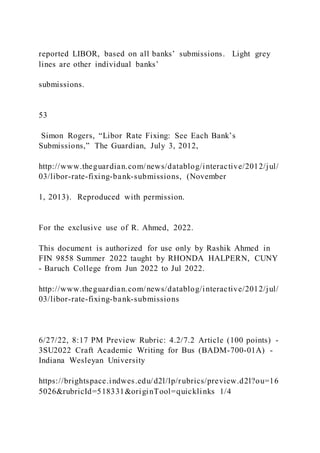
Exhibit 2, from The Guardian, shows for the time period 2007-
2008 Barclays’ LIBOR
submissions (in red) and the fix based on all banks’ submissions
(in blue). It shows that
Barclays’ submissions were typically a bit above the fix, and
noticeably higher in August and
December 2007, as well as during the height of the financial
crisis in late 2008.
WHO KNEW WHAT WHEN
Despite the extensive trail of e-mails and text messages
documenting LIBOR manipulation, there
was substantial disagreement about who within Barclays was
aware of what was happening, as
well as who bore ultimate responsibility. Another important
question was whether top Barclays
officials had failed to implement adequate internal controls to
prevent misconduct.
Oversight of Individual Traders
Barclays consistently denied that anyone in a senior position
was aware of the efforts made by its
derivatives traders to manipulate the LIBOR. In a letter to the
House of Commons Treasury
Committee, Diamond wrote “the authorities found no evidence
that anyone more senior than the
23
House of Commons Treasury Committee, Fixing LIBOR: some
preliminary findings, Section 42
http://www.publications.parliament.uk/pa/cm201213/cmselect/c
mtreasy/481/48103.htm (September 19, 2013).
24
House of Commons Treasury Committee, Fixing LIBOR: some
preliminary findings, Volume 2, Q649,
http://www.publications.parliament.uk/pa/cm201213/cmselect/c
mtreasy/481/481ii.pdf (September 19, 2013).
25
Financial Services Authority, “Final Notice, To Barclays Bank,
PLC,” op.cit.,Paragraph 14.
For the exclusive use of R. Ahmed, 2022.
This document is authorized for use only by Rashik Ahmed in
FIN 9858 Summer 2022 taught by RHONDA HALPERN, CUNY
- Baruch College from Jun 2022 to Jul 2022.
http://www.publications.parliament.uk/pa/cm201213/cmselect/c
mtreasy/481/48103.htm
http://www.publications.parliament.uk/pa/cm201213/cmselect/c
mtreasy/481/481ii.pdf
Barclays and the LIBOR: Anatomy of a Scandal ETH-03
p. 7
immediate desk supervisors was aware of the requests by
traders, at the time that they were
made.”
26
Some MPs expressed incredulity over this claim while
questioning Diamond:
John Mann: … Nobody came to you, not even those people who
had refused to
act criminally but had been asked to do so? You said to Mr.
Garnier that some did
and some didn’t. So even those who had refused to act
improperly did not come
and tell you—that never got to you during that three-year
period?
Bob Diamond: Well, they didn’t act improperly.
27
The FSA noted “LIBOR issues were escalated to Barclays’
Investment Banking compliance
function (“Compliance”) on three occasions during 2007 and
2008. In each case Compliance
failed to assess and address the issues effectively.”
28
An external review commissioned by
Barclays concluded that individual employees who were
concerned about Barclays’ practices
were expected to fend for themselves, and received little
backing from either human resources
officers or senior management.
During the Credit Crisis
Barclays did not argue that senior managers were unaware of
the second phase of manipulation
that occurred during the credit crisis. Indeed, suspicions existed
even outside Barclays.
On May 29, 2008, the Wall Street Journal (WSJ) published an
analysis of LIBOR rates, and
concluded that 15 of the 16 banks were understating their rates.
The banks’ rates appeared to be
artificially similar to each other, which was strange given the
fact that some of the banks were
much weaker than others, and thus at a higher risk of default.
The newspaper quoted Professor
Darrell Duffie of the Stanford GSB as calling the rates “far too
similar to be believed.” However,
in the study, Barclays was far from the worst offender—in fact,
according to the WSJ’s analysis,
two-thirds of the other banks’ rates were less believable than
those submitted by Barclays.
Government officials had prior warning of the problem. In a
December 17, 2007, phone call, an
unidentified Barclays’ official told unidentified New York
Federal Reserve Bank officials,
“LIBOR’s being set too low anyway.”
29
While that phone call contained no specifics, an April
11, 2008, phone conversation between the New York Fed
analyst Fabiola Ravazzolo and an
unidentified Barclays’ executive did. Indeed, the Barclays
executive acknowledged that the bank
was not honestly reporting its borrowing costs. In the following
conversation, “FR” indicates the
Federal Reserve and “B” the unidentified Barclays official:
B: We were putting in where we really thought we would be
able to borrow cash
in the interbank market and it was
FR: Mm hmm.
26
“Text: Bob Diamond Letter to Andrew Tyrie,” Financial Times,
June 28, 2012,
http://www.ft.com/intl/cms/s/0/1734757a-c157-11e1-8179-
00144feabdc0.html#axzz2jnPjoZLm (November 5,
2013).
27
House of Commons Treasury Committee, Fixing LIBOR: some
preliminary findings, Volume 2, Q268,
http://www.publications.parliament.uk/pa/cm201213/cmselect/c
mtreasy/481/481ii.pdf (September 19, 2013).
28
Financial Services Authority, “Final Notice, To Barclays Bank,
PLC,” op. cit., Paragraph 2.
29
Chris Isidore, “Barclays admitted false LIBOR reports to Fed
in ’08,” CNN Money, July 13, 2012,
http://money.cnn.com/2012/07/13/investing/geithner-libor-
barclays/index.htm (September 19, 2013).
For the exclusive use of R. Ahmed, 2022.
This document is authorized for use only by Rashik Ahmed in
FIN 9858 Summer 2022 taught by RHONDA HALPERN, CUNY
- Baruch College from Jun 2022 to Jul 2022.
http://www.newyorkfed.org/newsevents/news/markets/2012/libo
r/April_11_2008_transcript.pdf#page=7
http://www.newyorkfed.org/newsevents/news/markets/2012/libo
r/April_11_2008_transcript.pdf#page=7
http://www.ft.com/intl/cms/s/0/1734757a-c157-11e1-8179-
00144feabdc0.html#axzz2jnPjoZLm
http://www.publications.parliament.uk/pa/cm201213/cmselect/c
mtreasy/481/481ii.pdf
http://money.cnn.com/2012/07/13/investing/geithner-libor-
barclays/index.htm
Barclays and the LIBOR: Anatomy of a Scandal ETH-03
p. 8
B: Above where everyone else was publishing rates.
FR: Mm hmm.
B: And the next thing we knew, there was um, an article in the
Financial Times,
charting our LIBOR contributions and comparing it with other
banks and
inferring that this meant that we had a problem raising cash in
the interbank
market.
FR: Yeah.
B: And um, our share price went down.
FR: Yes.
B: So it’s never supposed to be the prerogative of a, a money
market dealer to
affect their company share value.
FR: Okay.
B: And so we just fit in with the rest of the crowd, if you like.
FR: Okay.
B: So, we know that we’re not posting um, an honest LIBOR.
FR: Okay.
30
According to a press release by the New York Fed,
“Immediately following this call, the analyst
notified senior management in the Markets Group that a contact
at Barclays had stated that
underreporting of LIBOR was prevalent in the market, and had
occurred at Barclays.”
31
On June
1, 2008, New York Fed President Timothy Geithner sent a
memorandum to Mervyn King, the
Governor of the Bank of England, on “Recommendations for
Enhancing the Credibility of
LIBOR,” one section of which was entitled “Eliminate incentive
to misreport.” This
memorandum was forwarded to the BBA.
British regulators also received information directly from
Barclays. On April 17, 2008, a
Barclays manager who was participating in a liquidity call with
the FSA made comments that
seemed to reveal the bank had been understating its LIBOR
submissions:
…we did stick our head above the parapet last year, got it shot
off, and put it back
down again. So, to the extent that, um, the LIBORs have been
understated, are we
guilty of being part of the pack? You could say we are. We’ve
always been at the
top end and therefore one of the four banks that’s been
eliminated. Um, so I
would, I would sort of express us maybe as not clean clean, but
clean in
principle.
32
Following Government Orders?
A third period of LIBOR manipulation arguably began on
October 29, 2008, when Bob Diamond
received a phone call from Paul Tucker, the deputy governor of
the Bank of England. Diamond
took notes on the call and circulated these by e-mail to John
Varley, who was then Barclays
CEO, and Jerry del Missier, then president of Barclays Capital.
The e-mail read:
30
New York Federal Reserve Bank, “Unofficial Transcript,”
April 11, 2008,
http://www.newyorkfed.org/newsevents/news/markets/2012/libo
r/April_11_2008_transcript.pdf, p. 5-6 (September
19, 2013).
31
House of Commons Treasury Committee, Fixing LIBOR: some
preliminary findings, Section 50,
http://www.publications.parliament.uk/pa/cm201213/cmselect/c
mtreasy/481/48103.htm (September 19, 2013).
32
Financial Services Authority, “Final Notice, To Barclays Bank,
PLC,” op. cit., Paragraph 131.
For the exclusive use of R. Ahmed, 2022.
This document is authorized for use only by Rashik Ahmed in
FIN 9858 Summer 2022 taught by RHONDA HALPERN, CUNY
- Baruch College from Jun 2022 to Jul 2022.
http://www.newyorkfed.org/newsevents/news/markets/2012/libo
r/April_11_2008_transcript.pdf
http://www.publications.parliament.uk/pa/cm201213/cmselect/c
mtreasy/481/48103.htm
Barclays and the LIBOR: Anatomy of a Scandal ETH-03
p. 9
Further to our last call, Mr. Tucker reiterated that he had
received calls from a
number of senior figures within Whitehall [i.e., the government]
to question why
Barclays was always toward the top end of the Libor pricing… I
asked if he could
relay the reality, that not all banks were providing quotes at the
levels that
represented real transactions, his response “oh, that would be
worse…”
Mr. Tucker stated the level of calls he was receiving from
Whitehall were ‘senior’
and that while he was certain we did not need advice, that it did
not always need
to be the case that we appeared as high as we have recently.
33
Diamond also spoke by phone with del Missier. According to
del Missier, Diamond said “the
Bank of England was getting pressure from Whitehall around
Barclays—the health of
Barclays—as a result of LIBOR rates, that we should get our
LIBOR rates down, and that we
should not be outliers.”
Del Missier testified that he perceived this to be an instruction,
which he in turn relayed to
Barclays’ money markets desk. Diamond, however, testified
that he did not believe the phone
call from Tucker had been an “instruction” to lower Barclays’
LIBOR submissions and that there
had been “a misunderstanding, or a miscommunication” that had
led del Missier to interpret it as
such.
34
Although Diamond evidently considered this post-phone call
period to be a third, and
distinct, period of LIBOR manipulation, for which government
officials were at least partially
responsible, the U.K. Treasury Committee did not accept this
interpretation. It concluded that:
The Committee found Mr. Diamond’s attempt to subdivide the
later period of
wrongdoing neither relevant nor convincing. It does not appear
that the
conversation between Mr. Tucker and Mr. Diamond made a
fundamental
difference to Barclays’ behavior, given the repeated instances of
‘low-balling’
submissions to the LIBOR fixing process by
Barclays….covering the year
running up to the phone call between Mr. Tucker and Mr.
Diamond.
35
WHO BENEFITED AT WHOSE EXPENSE
In a July 2, 2012, memo to Barclays’ staff, Diamond addressed
the question of impact. He wrote:
Our customers and clients are particularly concerned about the
potential impact of
this behavior on them. Let me be clear: it does not matter if this
was perpetrated
by one individual or a handful—it was wrong.
But we must help our customers and clients recognize that on
the majority of
days, no requests were made at all. Even when made, the
requests were not
33
House of Commons Treasury Committee, Fixing LIBOR: some
preliminary findings, Section 72,
http://www.publications.parliament.uk/pa/cm201213/cmselect/c
mtreasy/481/48106.htm (September 19, 2013).
34
House of Commons Treasury Committee, Fixing LIBOR: some
preliminary findings, Volume 2, Q87,
http://www.publications.parliament.uk/pa/cm201213/cmselect/c
mtreasy/481/481ii.pdf (September 19, 2013).
35
House of Commons Treasury Committee, Fixing LIBOR: some
preliminary findings, Section 207,
http://www.publications.parliament.uk/pa/cm201213/cmselect/c
mtreasy/481/48103.htm (September 19, 2013).
For the exclusive use of R. Ahmed, 2022.
This document is authorized for use only by Rashik Ahmed in
FIN 9858 Summer 2022 taught by RHONDA HALPERN, CUNY
- Baruch College from Jun 2022 to Jul 2022.
http://www.publications.parliament.uk/pa/cm201213/cmselect/c
mtreasy/481/48106.htm
http://www.publications.parliament.uk/pa/cm201213/cmselect/c
mtreasy/481/481ii.pdf
http://www.publications.parliament.uk/pa/cm201213/cmselect/c
mtreasy/481/48103.htm
Barclays and the LIBOR: Anatomy of a Scandal ETH-03
p. 10
always accepted by the submitter, and the attempted
adjustments were, on
average, small, typically less than one basis point.
When the ultimate rate was affected is a complex question,
especially given the
role of the other banks’ submissions. This helps explain why the
Department of
Justice concluded that the rate was affected only on “some
occasions.”
36
Regarding the first phase of manipulation, Diamond insisted
that participating traders were not
acting on behalf of Barclays when they submitted rates that
would benefit their books. He told a
member of the Treasury Committee, “You said that the traders
were acting on behalf of
Barclays. They were acting on behalf of themselves. It is
unclear whether it benefited Barclays
but I don’t think they had any interest in benefiting Barclays,
they were benefiting themselves.”
37
The chairman of Britain’s FSA, Lord Turner, testified that it
would be difficult—albeit not
impossible—to prove whether individual traders had benefitted
from the rate-rigging. “That
would be a very complicated thing to do,” he said, “because you
would have to work out what
they would have put in when they did not put this in, and then
you have to work out what that
would have done to the average.”
38
In relation to the second phase, Diamond stressed in his letter to
the Treasury Committee that,
“the authorities found that Barclays reduced its LIBOR
submissions to protect the reputation of
the bank from negative speculation during periods of acute
market stress.”
39
He emphasized that
speculation regarding Barclays’ liquidity was “unwarranted,”
“inaccurate,” and “created a real
and material risk that the bank and its shareholders would suffer
damage.” He concluded: “Even
taking into account of the abnormal market conditions at the
height of the financial crisis, and
that the motivation was to protect the bank, not to influence the
ultimate rate, I accept that the
decision to lower submissions was wrong.”
AFFIXING BLAME
There are many different viewpoints as to who—or what—is
ultimately responsible for the
LIBOR scandal.
According to an external review commissioned by Barclays, the
culture of the investment
banking division placed a strong emphasis on delivering
desirable results. “Many of our
interviewees told us,” the report said, “that while some
members of Barclays Capital’s
top team inspired and valued loyalty, the team disliked bad
news. This all combined to create an
36
“Bob Diamond’s memo to Barclays’ staff,” The Guardian, July
2, 2012,
http://www.guardian.co.uk/business/2012/jul/02/bob-diamond-
memo-to-barclays-staff (September 20, 2013).
37
House of Commons Treasury Committee, Fixing LIBOR: some
preliminary findings, Volume 2, Q122,
http://www.publications.parliament.uk/pa/cm201213/cmselect/c
mtreasy/481/481ii.pdf (September 19, 2013).
38
House of Commons Treasury Committee, Fixing LIBOR: some
preliminary findings, Section 28,
http://www.publications.parliament.uk/pa/cm201213/cmselect/c
mtreasy/481/48104.htm#n35 (September 19, 2013).
39
House of Commons Treasury Committee, “Fixing Libor:
Written Evidence,”(Letter to the Chairman from Bob
Diamond, Chief Executive, Barclays, June 28, 2012)
http://www.parliament.uk/documents/commons-
committees/treasury/Fixing%20LIBOR%20evidence%202.pdf
(September 20, 2013).
For the exclusive use of R. Ahmed, 2022.
This document is authorized for use only by Rashik Ahmed in
FIN 9858 Summer 2022 taught by RHONDA HALPERN, CUNY
- Baruch College from Jun 2022 to Jul 2022.
http://www.guardian.co.uk/business/2012/jul/0 2/bob-diamond-
memo-to-barclays-staff
http://www.publications.parliament.uk/pa/cm201213/cmselect/c
mtreasy/481/481ii.pdf
http://www.publications.parliament.uk/pa/cm201213/cmselect/c
mtreasy/481/48104.htm#n35
http://www.parliament.uk/documents/commons-
committees/treasury/Fixing%20LIBOR%20evidence%202.pdf
Barclays and the LIBOR: Anatomy of a Scandal ETH-03
p. 11
environment in which leaders were rarely effectively tested or
challenged, contributing to a sense
of ambiguity about what was considered right and wrong.”
40
Diamond, in his memo to Barclays’ staff, said “The events
revealed last week arose in large part
because we did not have appropriate controls in place. Frankly,
we misjudged the risk associated
with the underlying activity.”
41
In his testimony, former Barclays chairman Marcus Agius
emphasized that LIBOR submissions were long viewed as low -
risk because outliers were
removed and because the rate was historically quite stable.
42
The House of Commons Treasure Committee saw things quite
differently:
The attempted manipulation of Barclays’ LIBOR submissions
with the intention
of personal gain continued for four years. It is shocking that it
flourished for so
long. Any system may fail for a short period, but compliance at
Barclays was
persistently ineffective. Even when Barclays’ compliance had
indications that
something was awry, it failed to take the opportunity to
strengthen the bank’s
controls. Nor was there any pressure from senior executives
within Barclays to
ensure that effective LIBOR controls were in place... These are
serious failures of
governance within Barclays, for which the board is responsible.
43
In its own dissection of the scandal, the financial community
and press have put forth a variety of
explanations. Martin Wheatley, the top financial regulator in
Britain, argued that a code of
conduct with clear rules, overseen by a regulator with extensive
powers, would be sufficient to
correct the problem. The editors of Bloomberg blamed the
culture of finance and suggested the
key to changing this was aggressive prosecution of those who
had manipulated rates. Some
bankers suggested the scandal resulted from the actions of a few
bad individuals, and that once
these people were removed, the system would again function
smoothly. In contrast, financial
journalist Ian Fraser argued, “Many banks have sought to blame
LIBOR rigging on individual
‘rogue traders,’ many of whom have already been fired or
suspended. But there is strong
evidence to suggest that, in both phases of LIBOR rigging, the
traders were only obeying orders
from more senior investment banking colleagues.”
44
And James Surowiecki, writing in the New
Yorker, blamed pretty much everybody: “The most striking
thing about this scandal is that it was
predictable—the way LIBOR was designed practically invited
corruption—yet no one did
anything to stop it.”
45
40
Salz Review, “An Independent Review of Barclays’ Business
Practices, April 2013, Section 8.39,
https://www.salzreview.co.uk/c/document_library/get_file?uuid
=557994c9-9c7f-4037-887b-
8b5623bed25e&groupId=4705611 (September 19, 2013).
41
“Bob Diamond’s Memo to Barclays’ Staff,” The Guardian, July
2, 2012,
http://www.guardian.co.uk/business/2012/jul/02/bob-diamond-
memo-to-barclays-staff (September 20, 2013).
42
House of Commons Treasury Committee, Fixing LIBOR: some
preliminary findings, Volume 2, Q648,
http://www.publications.parliament.uk/pa/cm201213/cmselect/c
mtreasy/481/481ii.pdf (September 19, 2013).
43
House of Commons Treasury Committee, Fixing LIBOR: some
preliminary findings, Section 38,
http://www.publications.parliament.uk/pa/cm201213/cmselect/c
mtreasy/481/48103.htm (September 19, 2013).
44
Jamie Mann, “Rate Rigging Traders to be ‘Scapegoats’ as
Arrests Imminent,” The Scottish Times, July 23, 2012,
http://www.scottishtimes.com/rate_rigging_traders_to_be_scape
goats_as_arrests_imminent (September 20, 2013).
45
James Surowiecki, “Bankers Gone Wild,” The New Yorker, July
30, 2012,
http://www.newyorker.com/talk/financial/2012/07/30/120730ta_
talk_surowiecki (September 20, 2013).
For the exclusive use of R. Ahmed, 2022.
This document is authorized for use only by Rashik Ahmed in
FIN 9858 Summer 2022 taught by RHONDA HALPERN, CUNY
- Baruch College from Jun 2022 to Jul 2022.
https://www.salzreview.co.uk/c/document_library/get_file?uuid
=557994c9-9c7f-4037-887b-8b5623bed25e&groupId=4705611
https://www.salzreview.co.uk/c/document_library/get_file?uuid
=557994c9-9c7f-4037-887b-8b5623bed25e&groupId=4705611
http://www.publications.parliament.uk/pa/cm201213/cmselect/c
mtreasy/481/481ii.pdf
http://www.publications.parliament.uk/pa/cm201213/cmselect/c
mtreasy/481/48103.htm
http://www.scottishtimes.com/rate_rigging_traders_to_be_scape
goats_as_arrests_imminent
http://www.newyorker.com/talk/financial/2012/07/30/120730ta_
talk_surowiecki
Barclays and the LIBOR: Anatomy of a Scandal ETH-03
p. 12
In the wake of Barclays’ LIBOR settlement, Douglas Keenan, a
former trader at Morgan Stanley,
published an op-ed in the Financial Times in which he
suggested that misreporting of LIBOR
rates may have been common practice since 1991. “I talked
with some of my more experienced
colleagues about this,” Keenan wrote. “They told me banks
misreported the LIBOR rates in a
way that would generally bring them profits. I had been
unaware of that, as I was relatively new
to financial trading. My naivety seemed to be humorous to my
colleagues.”
46
AFTERMATH
Investigations into alleged manipulations of the LIBOR by other
banks continued after the
Barclays settlement. In December 2012, UBS agreed to pay a
$1.5 billion fine—the FSA
deemed UBS offenses “considerably more serious”
47
than Barclays’ offenses and two former
UBS traders were formally charged. In February 2013, Royal
Bank of Scotland was fined $612
million. As of autumn 2013, more than a dozen other banks
remained under investigation with
more charges, and settlements, expected to come.
Regulatory authority over the LIBOR was given to the U.K.’s
Financial Conduct Authority,
headed by Martin Wheatley, and the FSA was shut down.
Responsibility for setting the LIBOR
was taken from the BBA and awarded to NYSE Euronext.
48
While the LIBOR would continue to
be set by a surveyed panel of banks, Wheatley tasked Euronext
with finding a way to tie the rates
more closely to actual transactions. One possibility suggested
was the creation of two parallel
rates, one from surveys and the other transaction-based.
49
In February 2013, Antony Jenkins—Diamond’s successor as
Barclays CEO—told the
Parliamentary Commission on Banking Standards that he was
“shredding” Diamond’s legacy
and working to change Barclays “aggressive” and “self-serving”
culture.
50
In spring 2013,
Diamond was profiled in the New York Times Magazine. The
article, by Andrew Sorkin, called
Diamond’s role in the scandal “minimal, and perhaps wildly
overblown.”
51
In discussing the
LIBOR scandal, Diamond told Sorkin:
Do you want the truth? Up until all of this, I didn’t even know
the mechanics of
how Libor was set. If you asked me who at Barclays submitted
the rate every day,
46
Douglas Keenan, “My Thwarted Attempt to Tell of LIBOR
Shenanigans,” The Financial Times, July 26, 2012,
http://www.ft.com/intl/cms/s/0/dc5f49c2-d67b-11e1-ba60-
00144feabdc0.htm (September 20, 2013).
47
Jill Treanor, “Two Former UBS Employees Charged in US
Over LIBOR,” The Guardian, December 19, 2012,
http://www.theguardian.com/business/2012/dec/19/ubs-1bn-
libor-payments-to-brokers (September 20, 2013).
48
Brooke Masters and Philip Stafford, “Scandal-Plagued Libor
Moves to NYSE,” The Financial Times, July 9,
2013, http://www.ft.com/intl/cms/s/0/73332222-e87f-11e2-aead-
00144feabdc0.html#axzz2e2YlYvAh (September
20, 2013).
49
“Q&A What Next for LIBOR?” The Financial Times, July 9,
2013, http://www.ft.com/intl/cms/s/0/b861dc76-
e884-11e2-aead-00144feabdc0.html#axzz2e2YlYvAh
(September 20, 2013).
50
Martin Robinson, “Barclays will ‘shred’ Bob Diamond’s legacy
by slashing bonuses as it is forced to set aside
another £1bn for mis-selling scandals,” The Daily Mail,
February 5, 2013, http://www.dailymail.co.uk/news/article-
2273668/Barclays-shred-Bob-Diamonds-legacy-slash-bonuses-
forced-1bn-mis-selling.html (September 20, 2013).
51
Andrew Ross Sorkin, “Bob Diamond’s Next Life,” The New
York Times Magazine, May 2, 2013,
http://www.nytimes.com/2013/05/05/magazine/robert-diamonds-
next-life.html?pagewanted=all&_r=0 (September
20, 2013).
For the exclusive use of R. Ahmed, 2022.
This document is authorized for use only by Rashik Ahmed in
FIN 9858 Summer 2022 taught by RHONDA HALPERN, CUNY
- Baruch College from Jun 2022 to Jul 2022.
http://www.ft.com/intl/cms/s/0/dc5f49c2-d67b-11e1-ba60-
00144feabdc0.htm
http://www.theguardian.com/business/2012/dec/19/ubs-1bn-
libor-payments-to-brokers
http://www.ft.com/intl/cms/s/0/73332222-e87f-11e2-aead-
00144feabdc0.html#axzz2e2YlYvAh
http://www.ft.com/intl/cms/s/0/b861dc76-e884-11e2-aead-
00144feabdc0.html#axzz2e2YlYvAh
http://www.ft.com/intl/cms/s/0/b861dc76-e884-11e2-aead-
00144feabdc0.html#axzz2e2YlYvAh
http://www.dailymail.co.uk/news/article-2273668/Barclays-
shred-Bob-Diamonds-legacy-slash-bonuses-forced-1bn-mis-
selling.html
http://www.dailymail.co.uk/news/article-2273668/Barclays-
shred-Bob-Diamonds-legacy-slash-bonuses-forced-1bn-mis-
selling.html
http://www.nytimes.com/2013/05/05/magazine/robert-diamonds-
next-life.html?pagewanted=all&_r=0
Barclays and the LIBOR: Anatomy of a Scandal ETH-03
p. 13
I wouldn’t be able to tell you. I bet you if you asked any chief
executive of any
bank on the street, they would give you the same answer.
52
Study Questions
1. What aspect of the first phase of LIBOR manipulation was
most ethically problematic:
submissions?
submitters to gain an unfair
advantage?
whose mortgages or
investments were tied to the LIBOR?
-rigging could undermine public trust
in LIBOR and other
cornerstones of the global financial system?
2. At least some Barclays traders had good reason to believe
that other banks were manipulating
LIBOR submissions in 2005-2006. How do you think this
affected the Barclays traders’
behavior? Does it affect your ethical assessment of their
behavior?
3. Who is responsible for compliance in an institution in which
executives pressure subordinates
to deliver results but don’t monitor their actions? What is the
role of corporate culture in
ensuring compliance? How should a company handle internal
whistleblowing?
4. Is there any ethical distinction between individual traders’
manipulation of the LIBOR and
banks’ systematic submission of unrealistically low rates during
the credit crisis? Why or why
not?
5. Does the fact that governments may have condoned, or even
encouraged, banks to understate
their LIBOR submissions in 2007-2008 affect your ethical
assessment of Barclays’ behavior
during the credit crisis?
6. Can you think of other examples (in finance or in other
industries) that mirror the LIBOR
case? What are the common features of LIBOR manipulation
and your example?
52
Ibid.
For the exclusive use of R. Ahmed, 2022.
This document is authorized for use only by Rashik Ahmed in
FIN 9858 Summer 2022 taught by RHONDA HALPERN, CUNY
- Baruch College from Jun 2022 to Jul 2022.
Barclays and the LIBOR: Anatomy of a Scandal ETH-03
p. 14
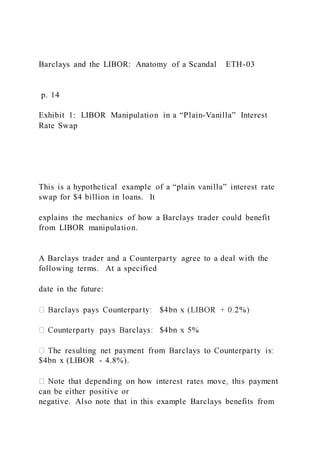
Exhibit 1: LIBOR Manipulation in a “Plain-Vanilla” Interest
Rate Swap
This is a hypothetical example of a “plain vanilla” interest rate
swap for $4 billion in loans. It
explains the mechanics of how a Barclays trader could benefit
from LIBOR manipulation.
A Barclays trader and a Counterparty agree to a deal with the
following terms. At a specified
date in the future:
$4bn x (LIBOR - 4.8%).
can be either positive or
negative. Also note that in this example Barclays benefits from
a low LIBOR.
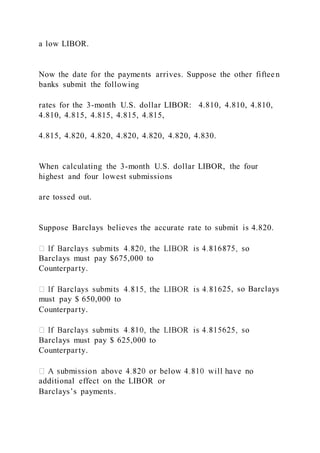
Now the date for the payments arrives. Suppose the other fifteen
banks submit the following
rates for the 3-month U.S. dollar LIBOR: 4.810, 4.810, 4.810,
4.810, 4.815, 4.815, 4.815, 4.815,
4.815, 4.820, 4.820, 4.820, 4.820, 4.820, 4.830.
When calculating the 3-month U.S. dollar LIBOR, the four
highest and four lowest submissions
are tossed out.
Suppose Barclays believes the accurate rate to submit is 4.820.
Barclays must pay $675,000 to
Counterparty.
25, so Barclays
must pay $ 650,000 to
Counterparty.
Barclays must pay $ 625,000 to
Counterparty.
additional effect on the LIBOR or
Barclays’s payments.
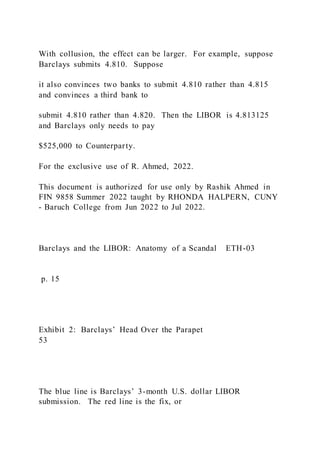
With collusion, the effect can be larger. For example, suppose
Barclays submits 4.810. Suppose
it also convinces two banks to submit 4.810 rather than 4.815
and convinces a third bank to
submit 4.810 rather than 4.820. Then the LIBOR is 4.813125
and Barclays only needs to pay
$525,000 to Counterparty.
For the exclusive use of R. Ahmed, 2022.
This document is authorized for use only by Rashik Ahmed in
FIN 9858 Summer 2022 taught by RHONDA HALPERN, CUNY
- Baruch College from Jun 2022 to Jul 2022.
Barclays and the LIBOR: Anatomy of a Scandal ETH-03
p. 15
Exhibit 2: Barclays’ Head Over the Parapet
53
The blue line is Barclays’ 3-month U.S. dollar LIBOR
submission. The red line is the fix, or
reported LIBOR, based on all banks’ submissions. Light grey
lines are other individual banks’
submissions.
53
Simon Rogers, “Libor Rate Fixing: See Each Bank’s
Submissions,” The Guardian, July 3, 2012,
http://www.theguardian.com/news/datablog/interactive/2012/jul/
03/libor-rate-fixing-bank-submissions, (November
1, 2013). Reproduced with permission.
For the exclusive use of R. Ahmed, 2022.
This document is authorized for use only by Rashik Ahmed in
FIN 9858 Summer 2022 taught by RHONDA HALPERN, CUNY
- Baruch College from Jun 2022 to Jul 2022.
http://www.theguardian.com/news/datablog/interactive/2012/jul/
03/libor-rate-fixing-bank-submissions
6/27/22, 8:17 PM Preview Rubric: 4.2/7.2 Article (100 points) -
3SU2022 Craft Academic Writing for Bus (BADM-700-01A) -
Indiana Wesleyan University
https://brightspace.indwes.edu/d2l/lp/rubrics/preview.d2l?ou=16
5026&rubricId=518331&originTool=quicklinks 1/4
4.2/7.2 Article (100 points)
Course: 3SU2022 Craft Academic Writing for Bus (BADM-700-
01A)
Criteria Excellent Competent
Needs
Improvement
Inadequate/Faili
ng
Criterion Score
Quality of
Article
Content
/ 5050 points
Information in
the article is
comprehensive
, accurate, and
relevant,
includes details
to add interest,
provide
examples, and
demonstrate
objective,
critical
thinking.
24.5 points
Information in
the article is
accurate and
relevant,
includes
adequate
details and
examples, and
demonstrated
objective,
critical
thinking.
19 points
Information in
the article is
limited, but
accurate and
relevant,
includes
minimal details
and examples,
and
demonstrates
some
objective,
critical
thinking.
16.5 points
Information in
the article
does not meet
minimal
criteria for
accuracy,
detail, or
demonstration
of critical
thinking.
6/27/22, 8:17 PM Preview Rubric: 4.2/7.2 Article (100 points) -
3SU2022 Craft Academic Writing for Bus (BADM-700-01A) -
Indiana Wesleyan University
https://brightspace.indwes.edu/d2l/lp/rubrics/preview.d2l?ou=16
5026&rubricId=518331&originTool=quicklinks 2/4
Criteria Excellent Competent
Needs
Improvement
Inadequate/Faili
ng
Criterion Score
Organization
of the Article
Content
/ 2020 points
The article is
organized
professionally
and effectively
and or
creatively with
inclusion of
the following:
Clear main
idea.
Logical
sequence of
topics.
Balanced
partition of
topics.
Use of
transitions and
summaries.
18 points
The article is
organized with
inclusion of
the following:
Clear main
idea.
Logical
sequence of
topics.
Balanced
partition of
topics.
Use of
transitions and
summaries.
16 points
The article
shows an
effort to be
organized, but
has some
disorganization
in the
following
areas:
Clear main
idea.
Logical
sequence of
topics.
Balanced
partition of
topics.
Use of
transitions and
summaries.
14 points
The article is
disorganized or
lacks cohesion,
flow, and
proportion in
the following
areas.
Clear main
idea.
Logical
sequence of
topics.
Balanced
partition of
topics.
Use of
transitions and
summaries.
6/27/22, 8:17 PM Preview Rubric: 4.2/7.2 Article (100 points) -
3SU2022 Craft Academic Writing for Bus (BADM-700-01A) -
Indiana Wesleyan University
https://brightspace.indwes.edu/d2l/lp/rubrics/preview.d2l?ou=16
5026&rubricId=518331&originTool=quicklinks 3/4
Criteria Excellent Competent
Needs
Improvement
Inadequate/Faili
ng
Criterion Score
Written
Communicati
on
/ 2020 points
The article is
written
professionally
and exhibits
excellent
communication
when applying
English
Grammar
Standards and
the 7 C's of
writing: clear,
concise,
complete,
correct,
correlated to
the research,
creative, and
critical
thinking.
18 points
The article is
written
competently
and evidences
proficient
communication
when applying
English
Grammar
Standards and
the 7 C's of
writing: clear,
concise,
complete,
correct,
correlated to
the research,
creative, and
critical
thinking.
16 points
The article is
readable and
demonstrates
emergent
communication
skills that are
in need of
improvement
in the
application of
English
Grammar
Standards and
the 7 C's of
writing: clear,
concise,
complete,
correct,
correlated to
the research,
creative, and
critical
thinking.
14 points
The article is
inadequate
and has
substantial
deficiencies in
communication
in the
application of
English
Grammar
Standards and
the 7 C's of
writing: clear,
concise,
complete,
correct,
correlated to
the research,
creative, and
critical
thinking.
6/27/22, 8:17 PM Preview Rubric: 4.2/7.2 Article (100 points) -
3SU2022 Craft Academic Writing for Bus (BADM-700-01A) -
Indiana Wesleyan University
https://brightspace.indwes.edu/d2l/lp/rubrics/preview.d2l?ou=16
5026&rubricId=518331&originTool=quicklinks 4/4
Total / 100
Overall Score
Criteria Excellent Competent
Needs
Improvement
Inadequate/Faili
ng
Criterion Score
APA
/ 1010 points
Excellent use
of APA
standards in
the format of
the document,
citations, and
references.
9 points
Proficient use
of APA
standards in
the format of
the document,
citations, and
references. A
few minor
errors are
present.
7 points
Needs
improvement
in the use of
APA standards
in the format
of the
document,
citations, and
references. A
number of
errors are
present.
6 points
Inadequate or
non-use of
APA standards
in the format
of the
document,
citations, and
references.
Several errors
exist and or
disregards
proper use
standards.
Excellent
92 points minimum
Competent
56 points minimum
Needs Improvement
49 points minimum
Inadequate/Failing
0 points minimum

CASE ETH-03 DATE 110713 Shei

  • 1.
    CASE: ETH-03 DATE: 11/07/13 SheilaMelvin and Professor Ken Shotts prepared this case as the basis for class discussion rather than to illustrate either effective or ineffective handling of an administrative situation. Copyright © 2013 by the Board of Trustees of the Leland Stanford Junior University. Publically available cases are distributed through Harvard Business Publishing at hbsp.harvard.edu and European Case Clearing House at ecch.com, please contact them to order copies and request permission to reproduce materials. No part of this publication may be reproduced, stored in a retrieval system, used in a spreadsheet, or transmitted in any form or by
  • 2.
    any means ––electronic, mechanical, photocopying, recording, or otherwise –– without the permission of the Stanford Graduate School of Business. Every effort has been made to respect copyright and to contact copyright holders as appropriate. If you are a copyright holder and have concerns, please contact the Case Writing Office at [email protected] or write to Case Writing Office, Stanford Graduate School of Business, Knight Management Center, 655 Knight Way, Stanford University, Stanford, CA 94305-5015. BARCLAYS AND THE LIBOR: ANATOMY OF A SCANDAL Culture is difficult to define, I think it's even more difficult to mandate—but for me the evidence of culture is how people behave when no one is watching. 1 -Bob Diamond, (former) Barclays CEO INTRODUCTION
  • 3.
    On June 27,2012, the storied British bank Barclays admitted that it repeatedly attempted to rig the London Interbank Offered Rate (LIBOR) over a four-year period from 2005-2009. The LIBOR was calculated daily, based on the rates at which 16 banks estimated they could borrow money. 2 Barclays, as one of these banks, regularly submitted rates that were either falsely inflated or deflated, first with the aim of benefitting its trading positions and later, during the financial crisis, with the intention of projecting an image of strength and solvency. Tracy McDermott, acting director of enforcement and financial crime at the United Kingdom (U.K.) Financial Services Authority (FSA), stated: “Barclays’ misconduct was serious, widespread and extended over a number of years…Barclays’ behavior threatened the integrity of the rates with the risk of serious harm to other market participants.” 3 In its settlement, Barclays agreed to pay $453 million in fines and penalties to bank regulators in the U.K. and U.S.
  • 4.
    4 1 “Today Business Lecture”delivered in 2011, quoted in Fixing LIBOR: some preliminary findings, Paragraph 111, http://www.publications.parliament.uk/pa/cm201213/cmselect/c mtreasy/481/48103.htm (September 19, 2013) 2 In 2012, the number of banks on the Libor Panel was increased to 18. 3 House of Commons Treasury Committee, Fixing LIBOR: some preliminary findings, Paragraph 7 http://www.publications.parliament.uk/pa/cm201213/cmselect/c mtreasy/481/48103.htm (September 19, 2013). 4 This included a $200 million civil penalty levied by the U.S. Commodity Futures Trading Commission; a $160 million penalty from the U.S. Department of Justice; and a £59.5 million fine by the U.K. Financial Services For the exclusive use of R. Ahmed, 2022. This document is authorized for use only by Rashik Ahmed in FIN 9858 Summer 2022 taught by RHONDA HALPERN, CUNY - Baruch College from Jun 2022 to Jul 2022. mailto:[email protected] http://www.publications.parliament.uk/pa/cm201213/cmselect/c mtreasy/481/48103.htm
  • 5.
    http://www.publications.parliament.uk/pa/cm201213/cmselect/c mtreasy/481/48103.htm Barclays and theLIBOR: Anatomy of a Scandal ETH-03 p. 2 Barclays CEO Bob Diamond—who was in charge of Barclays Capital from 2005-2009, the period during which the breaches occurred—announced that he and three other executives would waive their annual bonuses, an act of contrition that was quickly deemed inadequate, and even dubbed “utterly pathetic” by one commentator. 5 On July 1, 2012, Prime Minister David Cameron announced a full parliamentary inquiry into LIBOR rate rigging, and raised the possibility of criminal sanctions. During the next few days there was turmoil in Barclays’ leadership, culminating in Diamond’s resignation. Newspapers decried Barclays’ rate-rigging efforts as “the scandal of all scandals” 6 and
  • 6.
    bemoaned the spreadof “Wall Street sleaze.” 7 Numerous hearings, audits, and other post- mortems were conducted in an attempt to understand how the rigging had been carried out and why it had gone undetected for so long. Barclays was credited for cooperating with investigators and agreeing to settle at an early stage; the fine levied by the FSA was therefore reduced by 30 percent. 8 Throughout the process, Barclays insisted that it was not alone in its manipulation of the LIBOR. In a July 15, 2012 memo entitled “Restoring our reputation, building our business,” Barclays’ executive committee stated, “As other banks settl e with authorities, and their details become public, and various governments’ inquiries shed more light, our situation will eventually be put into perspective.” 9 By late 2012, dozens of other banks did indeed face LIBOR- rigging inquiries by regulators in various countries.
  • 7.
    BACKGROUND The LIBOR The LIBORwas a cornerstone of global financial markets. Roughly speaking, it was the interest rate that banks charged each other for short-term loans. The LIBOR was calculated for 10 different currencies and 15 borrowing periods. The person submitting the daily LIBOR data for a bank was supposed to submit the interest rate the bank would have to pay on a loan for a particular term in a particular currency. Often, a bank was not in the market for a particular type of loan, and in such situations the submitter was supposed to give a good-faith estimate of the interest rate his or her bank would pay were it seeking a loan just prior to 11:00 a.m. GMT. The estimated rates were sent to the British Bankers Association (BBA), a trade group, and the Authority. See George Gilligan, “The Libor Scandal: Another Example of Neutralized and Routinized Deviance in the Financial Services Sector?,” The University of New South Wales, Centre for Law, Markets & Regulation,
  • 8.
    http://www.clmr.unsw.edu.au/article/ethics/libor- manipulation/libor-scandal-another-example-neutralised-and- routinised-deviance-financial-services-sector (September 19, 2013). 5 “Agiustakes the bullet,” The Economist, July 1, 2012 http://www.economist.com/blogs/schumpeter/2012/07/barclays- and-libor (September 5, 2013). 6 Robert Reich, “The Wall Street Scandal of All Scandals,” July 7, 2012, http://www.huffingtonpost.com/robert- reich/libor-wall-street_b_1656665.html (September 19, 2013). 7 Robert Reich, “Wall Street Sleaze Keeps Growing,” July 14, 2012, http://www.sfgate.com/opinion/article/Wall- Street-sleaze-keeps-growing-3705814.php (September 19, 2013). 8 Financial Services Authority, “Final Notice, To Barclays Bank, PLC,” Section 2, June 27, 2012, http://www.fsa.gov.uk/static/pubs/final/barclays-jun12.pdf (September 19, 2013). 9 “Rivals LIBOR woes to put Barclays’ in perspective: memo,” Business Standard, July 15, 2012, http://www.business-standard.com/article/international/rivals- libor-woes-to-put-barclays-in-perspective-memo- 112071500061_1.html, (September 19, 2013).
  • 9.
    For the exclusiveuse of R. Ahmed, 2022. This document is authorized for use only by Rashik Ahmed in FIN 9858 Summer 2022 taught by RHONDA HALPERN, CUNY - Baruch College from Jun 2022 to Jul 2022. http://www.clmr.unsw.edu.au/article/ethics/libor- manipulation/libor-scandal-another-example-neutralised-and- routinised-deviance-financial-services-sector http://www.clmr.unsw.edu.au/article/e thics/libor- manipulation/libor-scandal-another-example-neutralised-and- routinised-deviance-financial-services-sector http://www.economist.com/blogs/schumpeter/2012/07/barclays- and-libor http://www.huffingtonpost.com/robert-reich/libor-wall- street_b_1656665.html http://www.huffingtonpost.com/robert-reich/libor-wall- street_b_1656665.html http://www.sfgate.com/opinion/article/Wall-Street-sleaze-keeps- growing-3705814.php http://www.sfgate.com/opinion/article/Wall-Street-sleaze-keeps- growing-3705814.php http://www.fsa.gov.uk/static/pubs/final/barclays-jun12.pdf Barclays and the LIBOR: Anatomy of a Scandal ETH-03 p. 3 LIBOR was calculated as the average of these submitted rates, after the removal of high and low outliers. In the case of the U.S. dollar LIBOR, the top four and
  • 10.
    bottom four submissionswere eliminated and the middle eight were averaged to determine the rate. The LIBOR’s origins stem from the informal practices of a clubby group of British gentlemen bankers in the 1960s. Beginning in the 1980s, the process became more formalized and was taken over by the BBA. BBA regulations stated clearly that the only factors to be considered in submitting a rate were those related to the cost of borrowing unsecured funds. The LIBOR was used for hundreds of trillions of dollars of financial transactions, including consumer loans, mortgages, and much of the global trade in financial derivatives. In 2012, The New York Times reported that about 45 percent of prime and 80 percent of subprime mortgages had interest rates based on the LIBOR; and about half of variable rate student loans were set according to the LIBOR. 10 The BBA estimated that $350 trillion of notional swaps and $10
  • 11.
    trillion of loanswere indexed to the LIBOR. 11 Trying to determine who may have been harmed—or helped—by the rate-rigging was described as a “gargantuan task.” 12 Two Forms of Rate-Rigging Two main forms of rate-rigging took place at Barclays. The first occurred primarily between 2005 and 2007 and involved individual traders requesting the submission of rates that would benefit their transactions, rather than rates at which Barclays actually believed it could borrow money. The person who submitted a bank’s data for LIBOR calculations could overstate or understate the true rate that the bank would pay on short-term loans. By doing so, he could help traders who had taken positions that depended on the LIBOR rate. For example, a Barclays’ trader in New York might take a position that would be highly profitable if the LIBOR rate were
  • 12.
    low, and thensend an e-mail to the Barclays trader in London who was in charge of submitting rates, asking him to submit a low value. Exhibit 1 gives an example of how a trader could benefit from LIBOR rate-rigging. The second form of rate-rigging occurred during the 2007-2008 credit crisis, when banks were concerned about appearing strong. One indicator of a bank’s strength was whether other banks were willing to lend it money on favorable terms. Each bank thus had an incentive to underreport the rates it would have to pay if it sought loans. According to British regulators, high-level Barclays’ officials ordered subordinates to submit lower LIBOR estimates to avoid seeming weak. However, in testimony, a senior Barclays’ executive involved in the rate-rigging said he was just trying to keep Barclays in good favor with government officials, who were unhappy when Barclays submitted high rates for LIBOR calculations. 10
  • 13.
    “Behind the LIBORScandal,” Business Day Deal Book, The New York Times, July 10, 2012, http://www.nytimes.com/interactive/2012/07/10/business/dealbo ok/behind-the-libor-scandal.html (September 19, 2013). 11 Commodity Futures Trading Commission, “In the Matter of Barclays PLC, Barclays Bank PLC, and Barclays Capital Inc,” http://www.cftc.gov/ucm/groups/public/@lrenforcementactions/ documents/legalpleading/enfbarclaysorder062712.p df, p. 5 (September 19, 2013). 12 Kirsten Grind, “What Libor Means for You,” The Wall Street Journal, August 3, 2012, http://online.wsj.com/article/SB10000872396390443545504577 565120728037852.html (September 19, 2013). For the exclusive use of R. Ahmed, 2022. This document is authorized for use only by Rashik Ahmed in FIN 9858 Summer 2022 taught by RHONDA HALPERN, CUNY - Baruch College from Jun 2022 to Jul 2022. http://www.nytimes.com/interactive/2012/07/10/business/dealbo ok/behind-the-libor-scandal.html
  • 14.
    http://www.cftc.gov/ucm/groups/public/@lrenforcementactions/ documents/legalpleading/enfbarclaysorder062712.pdf http://www.cftc.gov/ucm/groups/public/@lrenforcementactions/ documents/legalpleading/enfbarclaysorder062712.pdf http://online.wsj.com/article/SB10000872396390443545504577 565120728037852.html Barclays and theLIBOR: Anatomy of a Scandal ETH-03 p. 4 HOW THE RATE-RIGGING WORKED A ream of evidence was brought forth from the start of the FSA investigation into Barclays LIBOR rigging in 2010 to the settlement in 2012. The hearings that followed Barclays’ settlement provided insights into the culture of the bank and the psychology of the key actors. The First Phase: Helping Traders Efforts by individual Barclays traders to manipulate the LIBOR rate were conducted with no attempt at secrecy; on the contrary, they were made in person, by e-mail, and via instant messaging.
  • 15.
    13 Traders sometimes madenotes in their electronic calendars to remind themselves what request to submit the next day. One derivatives trader shouted across the Euro Swaps Desk to ensure his request did not conflict with those of his colleagues. 14 Occasionally, traders discussed specific requests with their desk managers. 15 The “vast majority” of requests came from traders on Barclays’ New York Interest Rate Swaps Desk, in New York and London, and involved the U.S. dollar LIBOR. 16 A report by the U.S. Commodity Futures Trading Commission (CFTC) concluded that “Barclays’ violative conduct involved multiple desks, traders, offices and currencies, including United States Dollar (“U.S. Dollar”), Sterling, Euro and Yen. The wrongful conduct spanned from at least 2005 through at least 2009, and at times
  • 16.
    occurred on analmost daily basis.” 17 Barclays’ derivatives traders also sometimes tried to influence the LIBOR submissions of other banks by asking external traders to pass on requests to their own banks’ submitters. 18 Likewise, traders helped colleagues who had left for other banks by accepting a request to alter the LIBOR rate and passing it on to Barclays’ submitters. 19 Sometimes the trades that led to requests for specific LIBOR submissions were intended to benefit the individual trader and sometimes they were intended to benefit the bank. Barclays’ LIBOR rate submissions were made through Barclays Capital’s London Money Market Desk. According to the CTFC, the senior LIBOR submitter was considered an expert on U.S. dollar money markets and had more than 25 years of experience in this area.
  • 17.
    The FSA citedthe following examples of traders’ requests for LIBOR manipulation: Trader C requested low one-month and three-month US dollar LIBOR submissions at 10:52 am on 7 April 2006 (shortly before the submissions were due to be made); “If it’s not too late low 1m and 3m would be nice, but please feel free to say “no”... Coffees will be coming your way either way, just to say thank you for your help in the past few weeks.” 13 Commodity Futures Trading Commission, op. cit., p. 8 (September 19, 2013). 14 House of Commons Treasury Committee, Fixing LIBOR: some preliminary findings, Section 35 http://www.publications.parliament.uk/pa/cm201213/cmselect/c mtreasy/481/48103.htm (September 19, 2013). 15 Commodity Futures Trading Commission, op. cit., p. 8 (September 19, 2013).
  • 18.
    16 Ibid. 17 Commodity Futures TradingCommission, op. cit., p. 2 (September 19, 2013). 18 House of Commons Treasury Committee, Fixing LIBOR: some preliminary findings, Section 31, http://www.publications.parliament.uk/pa/cm201213/cmselect/c mtreasy/481/48103.htm (September 19, 2013). 19 Commodity Futures Trading Commission, op. cit., p. 3 (September 19, 2013). For the exclusive use of R. Ahmed, 2022. This document is authorized for use only by Rashik Ahmed in FIN 9858 Summer 2022 taught by RHONDA HALPERN, CUNY - Baruch College from Jun 2022 to Jul 2022. http://www.publications.parliament.uk/pa/cm201213/cmselect/c mtreasy/481/48103.htm http://www.publications.parliament.uk/pa/cm201213/cmselect/c mtreasy/481/48103.htm Barclays and the LIBOR: Anatomy of a Scandal ETH-03 p. 5
  • 19.
    On 26 October2006, an external trader made a request for a lower three-month US dollar LIBOR submission. The external trader stated in an email to Trader G at Barclays “If it comes in unchanged I'm a dead man”. Trader G responded that he would “have a chat”. Barclays’ submission on that day for three month US dollar LIBOR was half a basis point lower than the day before, rather than being unchanged. The external trader thanked Trader G for Barclays’ LIBOR submission later that day: “Dude. I owe you big time! Come over one day after work and I'm opening a bottle of Bollinger.” 20 However, for the most part, requests to manipulate the LIBOR were evidently too ordinary to merit champagne, or even coffee. The CFTC cited the following internal emails in its report: 21
  • 20.
    “WE HAVE TOGET KICKED OUT OF THE FIXINGS TOMORROW!! We need a 4.17 fix in 1m (low fix) We need a 4.41 fix in 3m (high fix)” - November 22, 2005, senior trader in New York to trader in London “Your annoying colleague again ... Would love to get a high 1m Also if poss a low 3m... if poss ... thanks” -February 3, 2006, trader in London to submitter Responses by the submitters, as reported by the CTFC, included the following: “Always happy to help, leave it with me, Sir.” -March 20, 2006, submitter’s response to a request “Done…for you big boy…” -April 7, 2006, submitter’s response to swaps trader requests for low one- month and three-month U.S. dollar LIBOR The FSA reported that on March 13, 2006, the following e-mail
  • 21.
    exchange took place betweena trader and submitter: 22 Trader C: “The big day [has] arrived… My NYK are screaming at me about an unchanged 3m libor. As always, any help wd be greatly appreciated. What do you think you’ll go for 3m? Submitter: “I am going 90 altho 91 is what I should be posting”. Trader C: “[…] when I retire and write a book about this business your name will be written in golden letters […]”. Submitter: “I would prefer this [to] not be in any book!” The Second Phase: Appearing Strong During the Crisis 20 House of Commons Treasury Committee, Fixing LIBOR: some preliminary findings, Section 32 http://www.publications.parliament.uk/pa/cm201213/cmselect/c mtreasy/481/48103.htm (September 19, 2013).
  • 22.
    21 Commodity Futures TradingCommission, op. cit., pp. 9-10 (September 19, 2013). 22 Financial Services Authority, “Final Notice, To Barclays Bank, PLC,” op.cit., Section 59. For the exclusive use of R. Ahmed, 2022. This document is authorized for use only by Rashik Ahmed in FIN 9858 Summer 2022 taught by RHONDA HALPERN, CUNY - Baruch College from Jun 2022 to Jul 2022. http://www.publications.parliament.uk/pa/cm201213/cmselect/c mtreasy/481/48103.htm Barclays and the LIBOR: Anatomy of a Scandal ETH-03 p. 6 The second phase of LIBOR manipulation occurred during the credit crisis of 2007-2008, when analysts began to look at banks’ LIBOR submissions as a means of gauging their financial health. On September 3, 2007, Bloomberg published an article called “Barclays Takes a Money Market Beating,” noting that Barclays’ LIBOR submissions were high compared to other banks
  • 23.
    and asking, “Sowhat the hell is happening at Barclays and its Barclays Capital securities unit that is prompting its peers to charge it premium interest rates in the money market?” 23 Barclays’ senior managers were unhappy about the negative publicity, using the term “head above the parapet” to describe what happened when Barclays’ LIBOR submission was high relative to other banks. According to former Barclays Chairman Martin Agius, the concern was that …people might falsely or incorrectly conclude that we were having more trouble funding than we actually were. And again, to put this into context, anybody who was not on the bridge of a bank during the financial crisis—and many others besides—who says it was not terrifying was not there. These were very difficult times and we were very nervous that we may be misinterpreted by the market as to our financial strength. 24
  • 24.
    Submitters were thusinstructed that Barclays should avoid unwanted market and media scrutiny. According to the FSA Final Notice, “Senior management’s concerns in turn resulted in instructions being given by less senior managers to Barclays’ submitters to reduce LIBOR submissions in order to avoid further negative media comment. The origin of these instructions is unclear.” 25 Submitters were advised that Barclays’ rates should be within ten basis points of those made by other banks. Discussions regarding the rate to be submitted were recorded in numerous phone calls and emails. Exhibit 2, from The Guardian, shows for the time period 2007- 2008 Barclays’ LIBOR submissions (in red) and the fix based on all banks’ submissions (in blue). It shows that Barclays’ submissions were typically a bit above the fix, and noticeably higher in August and
  • 25.
    December 2007, aswell as during the height of the financial crisis in late 2008. WHO KNEW WHAT WHEN Despite the extensive trail of e-mails and text messages documenting LIBOR manipulation, there was substantial disagreement about who within Barclays was aware of what was happening, as well as who bore ultimate responsibility. Another important question was whether top Barclays officials had failed to implement adequate internal controls to prevent misconduct. Oversight of Individual Traders Barclays consistently denied that anyone in a senior position was aware of the efforts made by its derivatives traders to manipulate the LIBOR. In a letter to the House of Commons Treasury Committee, Diamond wrote “the authorities found no evidence that anyone more senior than the 23 House of Commons Treasury Committee, Fixing LIBOR: some
  • 26.
    preliminary findings, Section42 http://www.publications.parliament.uk/pa/cm201213/cmselect/c mtreasy/481/48103.htm (September 19, 2013). 24 House of Commons Treasury Committee, Fixing LIBOR: some preliminary findings, Volume 2, Q649, http://www.publications.parliament.uk/pa/cm201213/cmselect/c mtreasy/481/481ii.pdf (September 19, 2013). 25 Financial Services Authority, “Final Notice, To Barclays Bank, PLC,” op.cit.,Paragraph 14. For the exclusive use of R. Ahmed, 2022. This document is authorized for use only by Rashik Ahmed in FIN 9858 Summer 2022 taught by RHONDA HALPERN, CUNY - Baruch College from Jun 2022 to Jul 2022. http://www.publications.parliament.uk/pa/cm201213/cmselect/c mtreasy/481/48103.htm http://www.publications.parliament.uk/pa/cm201213/cmselect/c mtreasy/481/481ii.pdf Barclays and the LIBOR: Anatomy of a Scandal ETH-03 p. 7 immediate desk supervisors was aware of the requests by traders, at the time that they were
  • 27.
    made.” 26 Some MPs expressedincredulity over this claim while questioning Diamond: John Mann: … Nobody came to you, not even those people who had refused to act criminally but had been asked to do so? You said to Mr. Garnier that some did and some didn’t. So even those who had refused to act improperly did not come and tell you—that never got to you during that three-year period? Bob Diamond: Well, they didn’t act improperly. 27 The FSA noted “LIBOR issues were escalated to Barclays’ Investment Banking compliance function (“Compliance”) on three occasions during 2007 and 2008. In each case Compliance failed to assess and address the issues effectively.” 28 An external review commissioned by Barclays concluded that individual employees who were
  • 28.
    concerned about Barclays’practices were expected to fend for themselves, and received little backing from either human resources officers or senior management. During the Credit Crisis Barclays did not argue that senior managers were unaware of the second phase of manipulation that occurred during the credit crisis. Indeed, suspicions existed even outside Barclays. On May 29, 2008, the Wall Street Journal (WSJ) published an analysis of LIBOR rates, and concluded that 15 of the 16 banks were understating their rates. The banks’ rates appeared to be artificially similar to each other, which was strange given the fact that some of the banks were much weaker than others, and thus at a higher risk of default. The newspaper quoted Professor Darrell Duffie of the Stanford GSB as calling the rates “far too similar to be believed.” However, in the study, Barclays was far from the worst offender—in fact, according to the WSJ’s analysis,
  • 29.
    two-thirds of theother banks’ rates were less believable than those submitted by Barclays. Government officials had prior warning of the problem. In a December 17, 2007, phone call, an unidentified Barclays’ official told unidentified New York Federal Reserve Bank officials, “LIBOR’s being set too low anyway.” 29 While that phone call contained no specifics, an April 11, 2008, phone conversation between the New York Fed analyst Fabiola Ravazzolo and an unidentified Barclays’ executive did. Indeed, the Barclays executive acknowledged that the bank was not honestly reporting its borrowing costs. In the following conversation, “FR” indicates the Federal Reserve and “B” the unidentified Barclays official: B: We were putting in where we really thought we would be able to borrow cash in the interbank market and it was FR: Mm hmm. 26
  • 30.
    “Text: Bob DiamondLetter to Andrew Tyrie,” Financial Times, June 28, 2012, http://www.ft.com/intl/cms/s/0/1734757a-c157-11e1-8179- 00144feabdc0.html#axzz2jnPjoZLm (November 5, 2013). 27 House of Commons Treasury Committee, Fixing LIBOR: some preliminary findings, Volume 2, Q268, http://www.publications.parliament.uk/pa/cm201213/cmselect/c mtreasy/481/481ii.pdf (September 19, 2013). 28 Financial Services Authority, “Final Notice, To Barclays Bank, PLC,” op. cit., Paragraph 2. 29 Chris Isidore, “Barclays admitted false LIBOR reports to Fed in ’08,” CNN Money, July 13, 2012, http://money.cnn.com/2012/07/13/investing/geithner-libor- barclays/index.htm (September 19, 2013). For the exclusive use of R. Ahmed, 2022. This document is authorized for use only by Rashik Ahmed in FIN 9858 Summer 2022 taught by RHONDA HALPERN, CUNY - Baruch College from Jun 2022 to Jul 2022. http://www.newyorkfed.org/newsevents/news/markets/2012/libo r/April_11_2008_transcript.pdf#page=7 http://www.newyorkfed.org/newsevents/news/markets/2012/libo
  • 31.
    r/April_11_2008_transcript.pdf#page=7 http://www.ft.com/intl/cms/s/0/1734757a-c157-11e1-8179- 00144feabdc0.html#axzz2jnPjoZLm http://www.publications.parliament.uk/pa/cm201213/cmselect/c mtreasy/481/481ii.pdf http://money.cnn.com/2012/07/13/investing/geithner-libor- barclays/index.htm Barclays and theLIBOR: Anatomy of a Scandal ETH-03 p. 8 B: Above where everyone else was publishing rates. FR: Mm hmm. B: And the next thing we knew, there was um, an article in the Financial Times, charting our LIBOR contributions and comparing it with other banks and inferring that this meant that we had a problem raising cash in the interbank market. FR: Yeah. B: And um, our share price went down. FR: Yes. B: So it’s never supposed to be the prerogative of a, a money
  • 32.
    market dealer to affecttheir company share value. FR: Okay. B: And so we just fit in with the rest of the crowd, if you like. FR: Okay. B: So, we know that we’re not posting um, an honest LIBOR. FR: Okay. 30 According to a press release by the New York Fed, “Immediately following this call, the analyst notified senior management in the Markets Group that a contact at Barclays had stated that underreporting of LIBOR was prevalent in the market, and had occurred at Barclays.” 31 On June 1, 2008, New York Fed President Timothy Geithner sent a memorandum to Mervyn King, the Governor of the Bank of England, on “Recommendations for Enhancing the Credibility of LIBOR,” one section of which was entitled “Eliminate incentive
  • 33.
    to misreport.” This memorandumwas forwarded to the BBA. British regulators also received information directly from Barclays. On April 17, 2008, a Barclays manager who was participating in a liquidity call with the FSA made comments that seemed to reveal the bank had been understating its LIBOR submissions: …we did stick our head above the parapet last year, got it shot off, and put it back down again. So, to the extent that, um, the LIBORs have been understated, are we guilty of being part of the pack? You could say we are. We’ve always been at the top end and therefore one of the four banks that’s been eliminated. Um, so I would, I would sort of express us maybe as not clean clean, but clean in principle. 32 Following Government Orders?
  • 34.
    A third periodof LIBOR manipulation arguably began on October 29, 2008, when Bob Diamond received a phone call from Paul Tucker, the deputy governor of the Bank of England. Diamond took notes on the call and circulated these by e-mail to John Varley, who was then Barclays CEO, and Jerry del Missier, then president of Barclays Capital. The e-mail read: 30 New York Federal Reserve Bank, “Unofficial Transcript,” April 11, 2008, http://www.newyorkfed.org/newsevents/news/markets/2012/libo r/April_11_2008_transcript.pdf, p. 5-6 (September 19, 2013). 31 House of Commons Treasury Committee, Fixing LIBOR: some preliminary findings, Section 50, http://www.publications.parliament.uk/pa/cm201213/cmselect/c mtreasy/481/48103.htm (September 19, 2013). 32 Financial Services Authority, “Final Notice, To Barclays Bank, PLC,” op. cit., Paragraph 131.
  • 35.
    For the exclusiveuse of R. Ahmed, 2022. This document is authorized for use only by Rashik Ahmed in FIN 9858 Summer 2022 taught by RHONDA HALPERN, CUNY - Baruch College from Jun 2022 to Jul 2022. http://www.newyorkfed.org/newsevents/news/markets/2012/libo r/April_11_2008_transcript.pdf http://www.publications.parliament.uk/pa/cm201213/cmselect/c mtreasy/481/48103.htm Barclays and the LIBOR: Anatomy of a Scandal ETH-03 p. 9 Further to our last call, Mr. Tucker reiterated that he had received calls from a number of senior figures within Whitehall [i.e., the government] to question why Barclays was always toward the top end of the Libor pricing… I asked if he could relay the reality, that not all banks were providing quotes at the levels that represented real transactions, his response “oh, that would be worse…” Mr. Tucker stated the level of calls he was receiving from Whitehall were ‘senior’
  • 36.
    and that whilehe was certain we did not need advice, that it did not always need to be the case that we appeared as high as we have recently. 33 Diamond also spoke by phone with del Missier. According to del Missier, Diamond said “the Bank of England was getting pressure from Whitehall around Barclays—the health of Barclays—as a result of LIBOR rates, that we should get our LIBOR rates down, and that we should not be outliers.” Del Missier testified that he perceived this to be an instruction, which he in turn relayed to Barclays’ money markets desk. Diamond, however, testified that he did not believe the phone call from Tucker had been an “instruction” to lower Barclays’ LIBOR submissions and that there had been “a misunderstanding, or a miscommunication” that had led del Missier to interpret it as such. 34
  • 37.
    Although Diamond evidentlyconsidered this post-phone call period to be a third, and distinct, period of LIBOR manipulation, for which government officials were at least partially responsible, the U.K. Treasury Committee did not accept this interpretation. It concluded that: The Committee found Mr. Diamond’s attempt to subdivide the later period of wrongdoing neither relevant nor convincing. It does not appear that the conversation between Mr. Tucker and Mr. Diamond made a fundamental difference to Barclays’ behavior, given the repeated instances of ‘low-balling’ submissions to the LIBOR fixing process by Barclays….covering the year running up to the phone call between Mr. Tucker and Mr. Diamond. 35 WHO BENEFITED AT WHOSE EXPENSE In a July 2, 2012, memo to Barclays’ staff, Diamond addressed the question of impact. He wrote:
  • 38.
    Our customers andclients are particularly concerned about the potential impact of this behavior on them. Let me be clear: it does not matter if this was perpetrated by one individual or a handful—it was wrong. But we must help our customers and clients recognize that on the majority of days, no requests were made at all. Even when made, the requests were not 33 House of Commons Treasury Committee, Fixing LIBOR: some preliminary findings, Section 72, http://www.publications.parliament.uk/pa/cm201213/cmselect/c mtreasy/481/48106.htm (September 19, 2013). 34 House of Commons Treasury Committee, Fixing LIBOR: some preliminary findings, Volume 2, Q87, http://www.publications.parliament.uk/pa/cm201213/cmselect/c mtreasy/481/481ii.pdf (September 19, 2013). 35 House of Commons Treasury Committee, Fixing LIBOR: some preliminary findings, Section 207,
  • 39.
    http://www.publications.parliament.uk/pa/cm201213/cmselect/c mtreasy/481/48103.htm (September 19,2013). For the exclusive use of R. Ahmed, 2022. This document is authorized for use only by Rashik Ahmed in FIN 9858 Summer 2022 taught by RHONDA HALPERN, CUNY - Baruch College from Jun 2022 to Jul 2022. http://www.publications.parliament.uk/pa/cm201213/cmselect/c mtreasy/481/48106.htm http://www.publications.parliament.uk/pa/cm201213/cmselect/c mtreasy/481/481ii.pdf http://www.publications.parliament.uk/pa/cm201213/cmselect/c mtreasy/481/48103.htm Barclays and the LIBOR: Anatomy of a Scandal ETH-03 p. 10 always accepted by the submitter, and the attempted adjustments were, on average, small, typically less than one basis point. When the ultimate rate was affected is a complex question, especially given the role of the other banks’ submissions. This helps explain why the Department of Justice concluded that the rate was affected only on “some
  • 40.
    occasions.” 36 Regarding the firstphase of manipulation, Diamond insisted that participating traders were not acting on behalf of Barclays when they submitted rates that would benefit their books. He told a member of the Treasury Committee, “You said that the traders were acting on behalf of Barclays. They were acting on behalf of themselves. It is unclear whether it benefited Barclays but I don’t think they had any interest in benefiting Barclays, they were benefiting themselves.” 37 The chairman of Britain’s FSA, Lord Turner, testified that it would be difficult—albeit not impossible—to prove whether individual traders had benefitted from the rate-rigging. “That would be a very complicated thing to do,” he said, “because you would have to work out what they would have put in when they did not put this in, and then you have to work out what that would have done to the average.”
  • 41.
    38 In relation tothe second phase, Diamond stressed in his letter to the Treasury Committee that, “the authorities found that Barclays reduced its LIBOR submissions to protect the reputation of the bank from negative speculation during periods of acute market stress.” 39 He emphasized that speculation regarding Barclays’ liquidity was “unwarranted,” “inaccurate,” and “created a real and material risk that the bank and its shareholders would suffer damage.” He concluded: “Even taking into account of the abnormal market conditions at the height of the financial crisis, and that the motivation was to protect the bank, not to influence the ultimate rate, I accept that the decision to lower submissions was wrong.” AFFIXING BLAME There are many different viewpoints as to who—or what—is ultimately responsible for the
  • 42.
    LIBOR scandal. According toan external review commissioned by Barclays, the culture of the investment banking division placed a strong emphasis on delivering desirable results. “Many of our interviewees told us,” the report said, “that while some members of Barclays Capital’s top team inspired and valued loyalty, the team disliked bad news. This all combined to create an 36 “Bob Diamond’s memo to Barclays’ staff,” The Guardian, July 2, 2012, http://www.guardian.co.uk/business/2012/jul/02/bob-diamond- memo-to-barclays-staff (September 20, 2013). 37 House of Commons Treasury Committee, Fixing LIBOR: some preliminary findings, Volume 2, Q122, http://www.publications.parliament.uk/pa/cm201213/cmselect/c mtreasy/481/481ii.pdf (September 19, 2013). 38 House of Commons Treasury Committee, Fixing LIBOR: some preliminary findings, Section 28,
  • 43.
    http://www.publications.parliament.uk/pa/cm201213/cmselect/c mtreasy/481/48104.htm#n35 (September 19,2013). 39 House of Commons Treasury Committee, “Fixing Libor: Written Evidence,”(Letter to the Chairman from Bob Diamond, Chief Executive, Barclays, June 28, 2012) http://www.parliament.uk/documents/commons- committees/treasury/Fixing%20LIBOR%20evidence%202.pdf (September 20, 2013). For the exclusive use of R. Ahmed, 2022. This document is authorized for use only by Rashik Ahmed in FIN 9858 Summer 2022 taught by RHONDA HALPERN, CUNY - Baruch College from Jun 2022 to Jul 2022. http://www.guardian.co.uk/business/2012/jul/0 2/bob-diamond- memo-to-barclays-staff http://www.publications.parliament.uk/pa/cm201213/cmselect/c mtreasy/481/481ii.pdf http://www.publications.parliament.uk/pa/cm201213/cmselect/c mtreasy/481/48104.htm#n35 http://www.parliament.uk/documents/commons- committees/treasury/Fixing%20LIBOR%20evidence%202.pdf Barclays and the LIBOR: Anatomy of a Scandal ETH-03 p. 11 environment in which leaders were rarely effectively tested or
  • 44.
    challenged, contributing toa sense of ambiguity about what was considered right and wrong.” 40 Diamond, in his memo to Barclays’ staff, said “The events revealed last week arose in large part because we did not have appropriate controls in place. Frankly, we misjudged the risk associated with the underlying activity.” 41 In his testimony, former Barclays chairman Marcus Agius emphasized that LIBOR submissions were long viewed as low - risk because outliers were removed and because the rate was historically quite stable. 42 The House of Commons Treasure Committee saw things quite differently: The attempted manipulation of Barclays’ LIBOR submissions with the intention of personal gain continued for four years. It is shocking that it flourished for so
  • 45.
    long. Any systemmay fail for a short period, but compliance at Barclays was persistently ineffective. Even when Barclays’ compliance had indications that something was awry, it failed to take the opportunity to strengthen the bank’s controls. Nor was there any pressure from senior executives within Barclays to ensure that effective LIBOR controls were in place... These are serious failures of governance within Barclays, for which the board is responsible. 43 In its own dissection of the scandal, the financial community and press have put forth a variety of explanations. Martin Wheatley, the top financial regulator in Britain, argued that a code of conduct with clear rules, overseen by a regulator with extensive powers, would be sufficient to correct the problem. The editors of Bloomberg blamed the culture of finance and suggested the key to changing this was aggressive prosecution of those who had manipulated rates. Some bankers suggested the scandal resulted from the actions of a few
  • 46.
    bad individuals, andthat once these people were removed, the system would again function smoothly. In contrast, financial journalist Ian Fraser argued, “Many banks have sought to blame LIBOR rigging on individual ‘rogue traders,’ many of whom have already been fired or suspended. But there is strong evidence to suggest that, in both phases of LIBOR rigging, the traders were only obeying orders from more senior investment banking colleagues.” 44 And James Surowiecki, writing in the New Yorker, blamed pretty much everybody: “The most striking thing about this scandal is that it was predictable—the way LIBOR was designed practically invited corruption—yet no one did anything to stop it.” 45 40 Salz Review, “An Independent Review of Barclays’ Business Practices, April 2013, Section 8.39, https://www.salzreview.co.uk/c/document_library/get_file?uuid
  • 47.
    =557994c9-9c7f-4037-887b- 8b5623bed25e&groupId=4705611 (September 19,2013). 41 “Bob Diamond’s Memo to Barclays’ Staff,” The Guardian, July 2, 2012, http://www.guardian.co.uk/business/2012/jul/02/bob-diamond- memo-to-barclays-staff (September 20, 2013). 42 House of Commons Treasury Committee, Fixing LIBOR: some preliminary findings, Volume 2, Q648, http://www.publications.parliament.uk/pa/cm201213/cmselect/c mtreasy/481/481ii.pdf (September 19, 2013). 43 House of Commons Treasury Committee, Fixing LIBOR: some preliminary findings, Section 38, http://www.publications.parliament.uk/pa/cm201213/cmselect/c mtreasy/481/48103.htm (September 19, 2013). 44 Jamie Mann, “Rate Rigging Traders to be ‘Scapegoats’ as Arrests Imminent,” The Scottish Times, July 23, 2012, http://www.scottishtimes.com/rate_rigging_traders_to_be_scape goats_as_arrests_imminent (September 20, 2013). 45 James Surowiecki, “Bankers Gone Wild,” The New Yorker, July 30, 2012,
  • 48.
    http://www.newyorker.com/talk/financial/2012/07/30/120730ta_ talk_surowiecki (September 20,2013). For the exclusive use of R. Ahmed, 2022. This document is authorized for use only by Rashik Ahmed in FIN 9858 Summer 2022 taught by RHONDA HALPERN, CUNY - Baruch College from Jun 2022 to Jul 2022. https://www.salzreview.co.uk/c/document_library/get_file?uuid =557994c9-9c7f-4037-887b-8b5623bed25e&groupId=4705611 https://www.salzreview.co.uk/c/document_library/get_file?uuid =557994c9-9c7f-4037-887b-8b5623bed25e&groupId=4705611 http://www.publications.parliament.uk/pa/cm201213/cmselect/c mtreasy/481/481ii.pdf http://www.publications.parliament.uk/pa/cm201213/cmselect/c mtreasy/481/48103.htm http://www.scottishtimes.com/rate_rigging_traders_to_be_scape goats_as_arrests_imminent http://www.newyorker.com/talk/financial/2012/07/30/120730ta_ talk_surowiecki Barclays and the LIBOR: Anatomy of a Scandal ETH-03 p. 12 In the wake of Barclays’ LIBOR settlement, Douglas Keenan, a former trader at Morgan Stanley, published an op-ed in the Financial Times in which he suggested that misreporting of LIBOR rates may have been common practice since 1991. “I talked with some of my more experienced
  • 49.
    colleagues about this,”Keenan wrote. “They told me banks misreported the LIBOR rates in a way that would generally bring them profits. I had been unaware of that, as I was relatively new to financial trading. My naivety seemed to be humorous to my colleagues.” 46 AFTERMATH Investigations into alleged manipulations of the LIBOR by other banks continued after the Barclays settlement. In December 2012, UBS agreed to pay a $1.5 billion fine—the FSA deemed UBS offenses “considerably more serious” 47 than Barclays’ offenses and two former UBS traders were formally charged. In February 2013, Royal Bank of Scotland was fined $612 million. As of autumn 2013, more than a dozen other banks remained under investigation with more charges, and settlements, expected to come.
  • 50.
    Regulatory authority overthe LIBOR was given to the U.K.’s Financial Conduct Authority, headed by Martin Wheatley, and the FSA was shut down. Responsibility for setting the LIBOR was taken from the BBA and awarded to NYSE Euronext. 48 While the LIBOR would continue to be set by a surveyed panel of banks, Wheatley tasked Euronext with finding a way to tie the rates more closely to actual transactions. One possibility suggested was the creation of two parallel rates, one from surveys and the other transaction-based. 49 In February 2013, Antony Jenkins—Diamond’s successor as Barclays CEO—told the Parliamentary Commission on Banking Standards that he was “shredding” Diamond’s legacy and working to change Barclays “aggressive” and “self-serving” culture. 50 In spring 2013, Diamond was profiled in the New York Times Magazine. The article, by Andrew Sorkin, called
  • 51.
    Diamond’s role inthe scandal “minimal, and perhaps wildly overblown.” 51 In discussing the LIBOR scandal, Diamond told Sorkin: Do you want the truth? Up until all of this, I didn’t even know the mechanics of how Libor was set. If you asked me who at Barclays submitted the rate every day, 46 Douglas Keenan, “My Thwarted Attempt to Tell of LIBOR Shenanigans,” The Financial Times, July 26, 2012, http://www.ft.com/intl/cms/s/0/dc5f49c2-d67b-11e1-ba60- 00144feabdc0.htm (September 20, 2013). 47 Jill Treanor, “Two Former UBS Employees Charged in US Over LIBOR,” The Guardian, December 19, 2012, http://www.theguardian.com/business/2012/dec/19/ubs-1bn- libor-payments-to-brokers (September 20, 2013). 48 Brooke Masters and Philip Stafford, “Scandal-Plagued Libor Moves to NYSE,” The Financial Times, July 9,
  • 52.
    2013, http://www.ft.com/intl/cms/s/0/73332222-e87f-11e2-aead- 00144feabdc0.html#axzz2e2YlYvAh (September 20,2013). 49 “Q&A What Next for LIBOR?” The Financial Times, July 9, 2013, http://www.ft.com/intl/cms/s/0/b861dc76- e884-11e2-aead-00144feabdc0.html#axzz2e2YlYvAh (September 20, 2013). 50 Martin Robinson, “Barclays will ‘shred’ Bob Diamond’s legacy by slashing bonuses as it is forced to set aside another £1bn for mis-selling scandals,” The Daily Mail, February 5, 2013, http://www.dailymail.co.uk/news/article- 2273668/Barclays-shred-Bob-Diamonds-legacy-slash-bonuses- forced-1bn-mis-selling.html (September 20, 2013). 51 Andrew Ross Sorkin, “Bob Diamond’s Next Life,” The New York Times Magazine, May 2, 2013, http://www.nytimes.com/2013/05/05/magazine/robert-diamonds- next-life.html?pagewanted=all&_r=0 (September 20, 2013). For the exclusive use of R. Ahmed, 2022. This document is authorized for use only by Rashik Ahmed in FIN 9858 Summer 2022 taught by RHONDA HALPERN, CUNY - Baruch College from Jun 2022 to Jul 2022.
  • 53.
    http://www.ft.com/intl/cms/s/0/dc5f49c2-d67b-11e1-ba60- 00144feabdc0.htm http://www.theguardian.com/business/2012/dec/19/ubs-1bn- libor-payments-to-brokers http://www.ft.com/intl/cms/s/0/73332222-e87f-11e2-aead- 00144feabdc0.html#axzz2e2YlYvAh http://www.ft.com/intl/cms/s/0/b861dc76-e884-11e2-aead- 00144feabdc0.html#axzz2e2YlYvAh http://www.ft.com/intl/cms/s/0/b861dc76-e884-11e2-aead- 00144feabdc0.html#axzz2e2YlYvAh http://www.dailymail.co.uk/news/article-2273668/Barclays- shred-Bob-Diamonds-legacy-slash-bonuses-forced-1bn-mis- selling.html http://www.dailymail.co.uk/news/article-2273668/Barclays- shred-Bob-Diamonds-legacy-slash-bonuses-forced-1bn-mis- selling.html http://www.nytimes.com/2013/05/05/magazine/robert-diamonds- next-life.html?pagewanted=all&_r=0 Barclays and theLIBOR: Anatomy of a Scandal ETH-03 p. 13 I wouldn’t be able to tell you. I bet you if you asked any chief executive of any bank on the street, they would give you the same answer. 52
  • 54.
    Study Questions 1. Whataspect of the first phase of LIBOR manipulation was most ethically problematic: submissions? submitters to gain an unfair advantage? whose mortgages or investments were tied to the LIBOR? -rigging could undermine public trust in LIBOR and other cornerstones of the global financial system? 2. At least some Barclays traders had good reason to believe that other banks were manipulating LIBOR submissions in 2005-2006. How do you think this affected the Barclays traders’ behavior? Does it affect your ethical assessment of their behavior? 3. Who is responsible for compliance in an institution in which executives pressure subordinates to deliver results but don’t monitor their actions? What is the role of corporate culture in ensuring compliance? How should a company handle internal
  • 55.
    whistleblowing? 4. Is thereany ethical distinction between individual traders’ manipulation of the LIBOR and banks’ systematic submission of unrealistically low rates during the credit crisis? Why or why not? 5. Does the fact that governments may have condoned, or even encouraged, banks to understate their LIBOR submissions in 2007-2008 affect your ethical assessment of Barclays’ behavior during the credit crisis? 6. Can you think of other examples (in finance or in other industries) that mirror the LIBOR case? What are the common features of LIBOR manipulation and your example? 52 Ibid. For the exclusive use of R. Ahmed, 2022. This document is authorized for use only by Rashik Ahmed in FIN 9858 Summer 2022 taught by RHONDA HALPERN, CUNY - Baruch College from Jun 2022 to Jul 2022.
  • 56.
    Barclays and theLIBOR: Anatomy of a Scandal ETH-03 p. 14 Exhibit 1: LIBOR Manipulation in a “Plain-Vanilla” Interest Rate Swap This is a hypothetical example of a “plain vanilla” interest rate swap for $4 billion in loans. It explains the mechanics of how a Barclays trader could benefit from LIBOR manipulation. A Barclays trader and a Counterparty agree to a deal with the following terms. At a specified date in the future: $4bn x (LIBOR - 4.8%). can be either positive or negative. Also note that in this example Barclays benefits from
  • 57.
    a low LIBOR. Nowthe date for the payments arrives. Suppose the other fifteen banks submit the following rates for the 3-month U.S. dollar LIBOR: 4.810, 4.810, 4.810, 4.810, 4.815, 4.815, 4.815, 4.815, 4.815, 4.820, 4.820, 4.820, 4.820, 4.820, 4.830. When calculating the 3-month U.S. dollar LIBOR, the four highest and four lowest submissions are tossed out. Suppose Barclays believes the accurate rate to submit is 4.820. Barclays must pay $675,000 to Counterparty. 25, so Barclays must pay $ 650,000 to Counterparty. Barclays must pay $ 625,000 to Counterparty. additional effect on the LIBOR or Barclays’s payments.
  • 58.
    With collusion, theeffect can be larger. For example, suppose Barclays submits 4.810. Suppose it also convinces two banks to submit 4.810 rather than 4.815 and convinces a third bank to submit 4.810 rather than 4.820. Then the LIBOR is 4.813125 and Barclays only needs to pay $525,000 to Counterparty. For the exclusive use of R. Ahmed, 2022. This document is authorized for use only by Rashik Ahmed in FIN 9858 Summer 2022 taught by RHONDA HALPERN, CUNY - Baruch College from Jun 2022 to Jul 2022. Barclays and the LIBOR: Anatomy of a Scandal ETH-03 p. 15 Exhibit 2: Barclays’ Head Over the Parapet 53 The blue line is Barclays’ 3-month U.S. dollar LIBOR submission. The red line is the fix, or
  • 59.
    reported LIBOR, basedon all banks’ submissions. Light grey lines are other individual banks’ submissions. 53 Simon Rogers, “Libor Rate Fixing: See Each Bank’s Submissions,” The Guardian, July 3, 2012, http://www.theguardian.com/news/datablog/interactive/2012/jul/ 03/libor-rate-fixing-bank-submissions, (November 1, 2013). Reproduced with permission. For the exclusive use of R. Ahmed, 2022. This document is authorized for use only by Rashik Ahmed in FIN 9858 Summer 2022 taught by RHONDA HALPERN, CUNY - Baruch College from Jun 2022 to Jul 2022. http://www.theguardian.com/news/datablog/interactive/2012/jul/ 03/libor-rate-fixing-bank-submissions 6/27/22, 8:17 PM Preview Rubric: 4.2/7.2 Article (100 points) - 3SU2022 Craft Academic Writing for Bus (BADM-700-01A) - Indiana Wesleyan University https://brightspace.indwes.edu/d2l/lp/rubrics/preview.d2l?ou=16 5026&rubricId=518331&originTool=quicklinks 1/4
  • 60.
    4.2/7.2 Article (100points) Course: 3SU2022 Craft Academic Writing for Bus (BADM-700- 01A) Criteria Excellent Competent Needs Improvement Inadequate/Faili ng Criterion Score Quality of Article Content / 5050 points Information in the article is comprehensive , accurate, and relevant, includes details to add interest, provide
  • 61.
    examples, and demonstrate objective, critical thinking. 24.5 points Informationin the article is accurate and relevant, includes adequate details and examples, and demonstrated objective, critical thinking.
  • 62.
    19 points Information in thearticle is limited, but accurate and relevant, includes minimal details and examples, and demonstrates some objective, critical thinking. 16.5 points Information in the article
  • 63.
    does not meet minimal criteriafor accuracy, detail, or demonstration of critical thinking. 6/27/22, 8:17 PM Preview Rubric: 4.2/7.2 Article (100 points) - 3SU2022 Craft Academic Writing for Bus (BADM-700-01A) - Indiana Wesleyan University https://brightspace.indwes.edu/d2l/lp/rubrics/preview.d2l?ou=16 5026&rubricId=518331&originTool=quicklinks 2/4 Criteria Excellent Competent Needs Improvement Inadequate/Faili ng Criterion Score Organization
  • 64.
    of the Article Content /2020 points The article is organized professionally and effectively and or creatively with inclusion of the following: Clear main idea. Logical sequence of topics. Balanced partition of
  • 65.
    topics. Use of transitions and summaries. 18points The article is organized with inclusion of the following: Clear main idea. Logical sequence of topics. Balanced partition of topics. Use of
  • 66.
    transitions and summaries. 16 points Thearticle shows an effort to be organized, but has some disorganization in the following areas: Clear main idea. Logical sequence of topics. Balanced
  • 67.
    partition of topics. Use of transitionsand summaries. 14 points The article is disorganized or lacks cohesion, flow, and proportion in the following areas. Clear main idea. Logical sequence of topics.
  • 68.
    Balanced partition of topics. Use of transitionsand summaries. 6/27/22, 8:17 PM Preview Rubric: 4.2/7.2 Article (100 points) - 3SU2022 Craft Academic Writing for Bus (BADM-700-01A) - Indiana Wesleyan University https://brightspace.indwes.edu/d2l/lp/rubrics/preview.d2l?ou=16 5026&rubricId=518331&originTool=quicklinks 3/4 Criteria Excellent Competent Needs Improvement Inadequate/Faili ng Criterion Score Written Communicati on
  • 69.
    / 2020 points Thearticle is written professionally and exhibits excellent communication when applying English Grammar Standards and the 7 C's of writing: clear, concise, complete, correct, correlated to the research,
  • 70.
    creative, and critical thinking. 18 points Thearticle is written competently and evidences proficient communication when applying English Grammar Standards and the 7 C's of writing: clear, concise, complete,
  • 71.
    correct, correlated to the research, creative,and critical thinking. 16 points The article is readable and demonstrates emergent communication skills that are in need of improvement in the application of English
  • 72.
    Grammar Standards and the 7C's of writing: clear, concise, complete, correct, correlated to the research, creative, and critical thinking. 14 points The article is inadequate and has substantial deficiencies in
  • 73.
    communication in the application of English Grammar Standardsand the 7 C's of writing: clear, concise, complete, correct, correlated to the research, creative, and critical thinking. 6/27/22, 8:17 PM Preview Rubric: 4.2/7.2 Article (100 points) -
  • 74.
    3SU2022 Craft AcademicWriting for Bus (BADM-700-01A) - Indiana Wesleyan University https://brightspace.indwes.edu/d2l/lp/rubrics/preview.d2l?ou=16 5026&rubricId=518331&originTool=quicklinks 4/4 Total / 100 Overall Score Criteria Excellent Competent Needs Improvement Inadequate/Faili ng Criterion Score APA / 1010 points Excellent use of APA standards in the format of the document, citations, and references.
  • 75.
    9 points Proficient use ofAPA standards in the format of the document, citations, and references. A few minor errors are present. 7 points Needs improvement in the use of APA standards in the format of the
  • 76.
    document, citations, and references. A numberof errors are present. 6 points Inadequate or non-use of APA standards in the format of the document, citations, and references. Several errors exist and or disregards
  • 77.
    proper use standards. Excellent 92 pointsminimum Competent 56 points minimum Needs Improvement 49 points minimum Inadequate/Failing 0 points minimum