SME CREDIT
ASSESSMENT
Using an expert judgement
credit rating tool to improve
consistency, reliability, and
efficiency of SME credit
analysis and assessment.
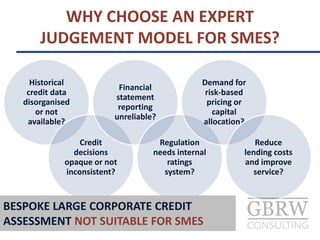
Historical
credit data
disorganised
or not
available?
Credit
decisions
opaque or
inconsistent?
Financial
statement
reporting
unreliable?
Regulation
needs internal
ratings
system?
Demand for
risk-based
pricing or
capital
allocation?
Reduce
lending costs
and improve
service?
WHY CHOOSE AN EXPERT
JUDGEMENT MODEL FOR SMES?
BESPOKE LARGE CORPORATE CREDIT
ASSESSMENT NOT SUITABLE FOR SMES
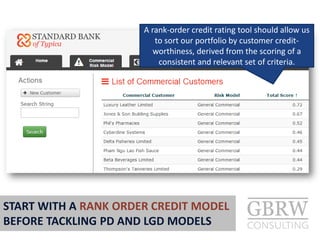
A rank-order credit rating tool should allow us
to sort our portfolio by customer credit-
worthiness, derived from the scoring of a
consistent and relevant set of criteria.
START WITH A RANK ORDER CREDIT MODEL
BEFORE TACKLING PD AND LGD MODELS
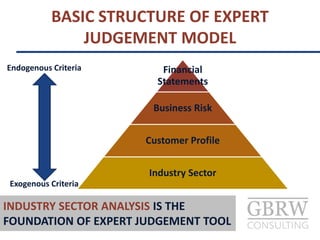
Financial
Statements
Business Risk
Customer Profile
Industry Sector
Endogenous Criteria
Exogenous Criteria
BASIC STRUCTURE OF EXPERT
JUDGEMENT MODEL
INDUSTRY SECTOR ANALYSIS IS THE
FOUNDATION OF EXPERT JUDGEMENT TOOL
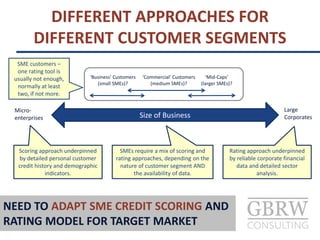
DIFFERENT APPROACHES FOR
DIFFERENT CUSTOMER SEGMENTS
Size of Business
Large
Corporates
Micro-
enterprises
‘Business’ Customers
(small SMEs)?
‘Commercial’ Customers
(medium SMEs)?
SME customers –
one rating tool is
usually not enough,
normally at least
two, if not more.
Rating approach underpinned
by reliable corporate financial
data and detailed sector
analysis.
Scoring approach underpinned
by detailed personal customer
credit history and demographic
indicators.
SMEs require a mix of scoring and
rating approaches, depending on the
nature of customer segment AND
the availability of data.
NEED TO ADAPT SME CREDIT SCORING AND
RATING MODEL FOR TARGET MARKET
‘Mid-Caps’
(larger SMEs)?
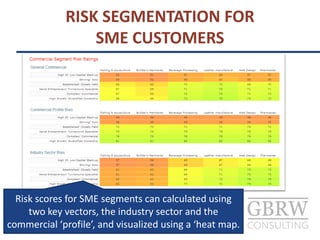
RISK SEGMENTATION FOR
SME CUSTOMERS
Risk scores for SME segments can calculated using
two key vectors, the industry sector and the
commercial ‘profile’, and visualized using a ‘heat map.
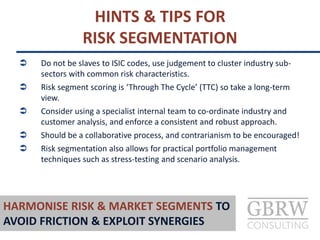
 Do not be slaves to ISIC codes, use judgement to cluster industry sub-
sectors with common risk characteristics.
 Risk segment scoring is ‘Through The Cycle’ (TTC) so take a long-term
view.
 Consider using a specialist internal team to co-ordinate industry and
customer analysis, and enforce a consistent and robust approach.
 Should be a collaborative process, and contrarianism to be encouraged!
 Risk segmentation also allows for practical portfolio management
techniques such as stress-testing and scenario analysis.
HINTS & TIPS FOR
RISK SEGMENTATION
HARMONISE RISK & MARKET SEGMENTS TO
AVOID FRICTION & EXPLOIT SYNERGIES
INDUSTRY SECTOR ECONOMIC
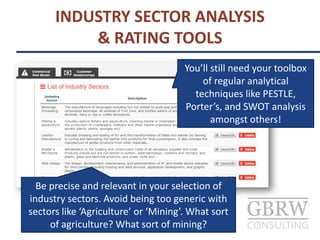
ANALYSIS & RATING TOOLS
Be precise and relevant in your selection of
industry sectors. Avoid being too generic with
sectors like ‘Agriculture’ or ‘Mining’. What sort
of agriculture? What sort of mining?
You’ll still need your toolbox
of regular analytical
techniques like PESTLE,
Porter’s, and SWOT analysis
amongst others!
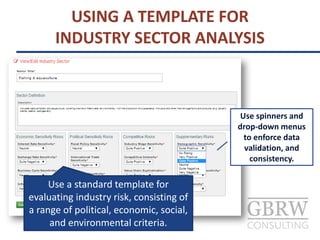
Use spinners and
drop-down menus
to enforce data
validation, and
consistency.
USING A TEMPLATE FOR INDUSTRY
SECTOR ECONOMIC ANALYSIS
Use a standard template for
evaluating industry risk, consisting of
a range of political, economic, social,
and environmental criteria.
USING A TEMPLATE FOR
CUSTOMER PROFILE ANALYSIS
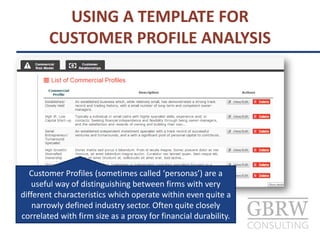
Customer Profiles (sometimes called ‘personas’) are a
useful way of distinguishing between firms with very
different characteristics which operate within even quite a
narrowly defined industry sector. Often quite closely
correlated with firm size as a proxy for financial durability.
APPLICATION OF MODEL
TO INDIVIDUAL CUSTOMERS
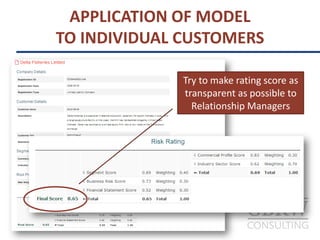
Try to make rating score as
transparent as possible to
Relationship Managers
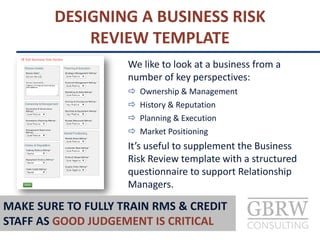
DESIGNING A BUSINESS RISK
REVIEW TEMPLATE
We like to look at a business from a
number of key perspectives:
 Ownership & Management
 History & Reputation
 Planning & Execution
 Market Positioning
It’s useful to supplement the Business
Risk Review template with a structured
questionnaire to support Relationship
Managers.
MAKE SURE TO FULLY TRAIN RMS & CREDIT
STAFF AS GOOD JUDGEMENT IS CRITICAL
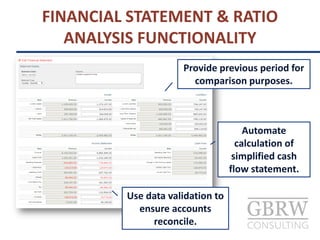
FINANCIAL STATEMENT & RATIO
ANALYSIS FUNCTIONALITY
Provide previous period for
comparison purposes.
Automate
calculation of
simplified cash
flow statement.
Use data validation to
ensure accounts
reconcile.
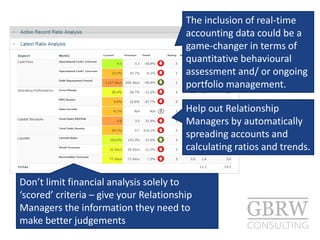
The inclusion of real-time
accounting data could be a
game-changer in terms of
quantitative behavioural
assessment and/ or ongoing
portfolio management.
Help out Relationship
Managers by automatically
spreading accounts and
calculating ratios and trends.
Don’t limit financial analysis solely to
‘scored’ criteria – give your Relationship
Managers the information they need to
make better judgements
 Concentrate on ratios that highlight the ability or otherwise
of the borrower to repay the obligation.
 Avoid duplication by eliminating criteria which do or are
likely to have high degrees of correlation.
 Prefer ratios which show a reasonable degree of variation –
i.e. are actually useful in discriminating between financial
performance.
 Discriminate a little against those which tend towards a
naturally high degree of variation in relation to growth.
HINTS & TIPS FOR SELECTING THE
RELEVANT ACCOUNTING RATIOS
REMEMBER THAT ‘CASH IS KING’ & MAKE
SURE TO EMPHASISE CASH-FLOW RATIOS
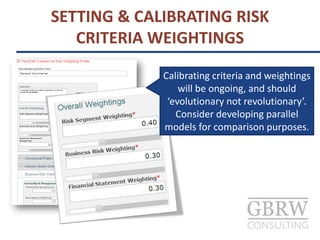
SETTING & CALIBRATING RISK
CRITERIA WEIGHTINGS
Calibrating criteria and weightings
will be ongoing, and should
‘evolutionary not revolutionary’.
Consider developing parallel
models for comparison purposes.
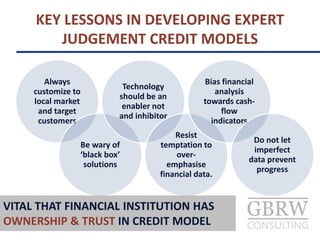
KEY LESSONS IN DEVELOPING EXPERT
JUDGEMENT CREDIT MODELS
Always
customize to
local market
and target
customers
Be wary of
‘black box’
solutions
Technology
should be an
enabler not
and inhibitor
Resist
temptation to
over-
emphasise
financial data.
Bias financial
analysis
towards cash-
flow
indicators
Do not let
imperfect
data prevent
progress
VITAL THAT FINANCIAL INSTITUTION HAS
OWNERSHIP & TRUST IN CREDIT MODEL
 Make sure to align credit policies and procedures with any model to
reinforce compliance with agreed approach.
 Supplement with a little technology and software development to
increase efficiency, and data accessibility, and data reliability
(remember ‘GIGO’).
 Consider enabling through a secure web application to allow
Relationship Managers to use it ‘on-the-road’.
 In the future, with sufficient data, it may be possible to implement a
quantitative solution based on financial data points, however unlikely
that this will entirely replace robust qualitative analysis overlay.
 A useful addition could be a segment ‘peer group’ ranking which we
have seen used before.
IMPLEMENTING AN EXPERT
CUSTOMER RATING TOOL
AS USUAL THE BIGGEST CHALLENGE WILL BE
OVERCOMING RESISTANCE TO CHANGE
Please feel free to suggest topics for future content. Some ideas
from our side include:
 How to overcome resistance to implementation of credit rating tools?
 What are the pros and pitfalls in implementing risk-based pricing?
 How to establish effective credit marketing limits using a risk rating
model?
 How to transpose rank order credit ratings into PD models?
 What is the potential application of peer group analysis to supplement
a rating model?
 How can we develop facility level EAD and LGD calculations?
 What is the potential for improved policies and processes to enhance
credit assessment and reduce costs?
SUGGESTIONS WELCOME
FOR FUTURE TOPICS…
CONTACT DETAILS &
FURTHER INFORMATION
Mike Coates, Director
 You can find out more about GBRW
Consulting by visiting our website on
http://www.gbrw.com
 Visit my LinkedIn profile at
http://uk.linkedin.com/in/mikecoates73
and feel free to connect
 Email us at mail@gbrw.com

Expert Judgement Credit Rating for SME & Commercial Customers

  • 1.
    SME CREDIT ASSESSMENT Using anexpert judgement credit rating tool to improve consistency, reliability, and efficiency of SME credit analysis and assessment.
  • 2.
    Historical credit data disorganised or not available? Credit decisions opaqueor inconsistent? Financial statement reporting unreliable? Regulation needs internal ratings system? Demand for risk-based pricing or capital allocation? Reduce lending costs and improve service? WHY CHOOSE AN EXPERT JUDGEMENT MODEL FOR SMES? BESPOKE LARGE CORPORATE CREDIT ASSESSMENT NOT SUITABLE FOR SMES
  • 3.
    A rank-order creditrating tool should allow us to sort our portfolio by customer credit- worthiness, derived from the scoring of a consistent and relevant set of criteria. START WITH A RANK ORDER CREDIT MODEL BEFORE TACKLING PD AND LGD MODELS
  • 4.
    Financial Statements Business Risk Customer Profile IndustrySector Endogenous Criteria Exogenous Criteria BASIC STRUCTURE OF EXPERT JUDGEMENT MODEL INDUSTRY SECTOR ANALYSIS IS THE FOUNDATION OF EXPERT JUDGEMENT TOOL
  • 5.
    DIFFERENT APPROACHES FOR DIFFERENTCUSTOMER SEGMENTS Size of Business Large Corporates Micro- enterprises ‘Business’ Customers (small SMEs)? ‘Commercial’ Customers (medium SMEs)? SME customers – one rating tool is usually not enough, normally at least two, if not more. Rating approach underpinned by reliable corporate financial data and detailed sector analysis. Scoring approach underpinned by detailed personal customer credit history and demographic indicators. SMEs require a mix of scoring and rating approaches, depending on the nature of customer segment AND the availability of data. NEED TO ADAPT SME CREDIT SCORING AND RATING MODEL FOR TARGET MARKET ‘Mid-Caps’ (larger SMEs)?
  • 6.
    RISK SEGMENTATION FOR SMECUSTOMERS Risk scores for SME segments can calculated using two key vectors, the industry sector and the commercial ‘profile’, and visualized using a ‘heat map.
  • 7.
     Do notbe slaves to ISIC codes, use judgement to cluster industry sub- sectors with common risk characteristics.  Risk segment scoring is ‘Through The Cycle’ (TTC) so take a long-term view.  Consider using a specialist internal team to co-ordinate industry and customer analysis, and enforce a consistent and robust approach.  Should be a collaborative process, and contrarianism to be encouraged!  Risk segmentation also allows for practical portfolio management techniques such as stress-testing and scenario analysis. HINTS & TIPS FOR RISK SEGMENTATION HARMONISE RISK & MARKET SEGMENTS TO AVOID FRICTION & EXPLOIT SYNERGIES
  • 8.
    INDUSTRY SECTOR ECONOMIC ANALYSIS& RATING TOOLS Be precise and relevant in your selection of industry sectors. Avoid being too generic with sectors like ‘Agriculture’ or ‘Mining’. What sort of agriculture? What sort of mining? You’ll still need your toolbox of regular analytical techniques like PESTLE, Porter’s, and SWOT analysis amongst others!
  • 9.
    Use spinners and drop-downmenus to enforce data validation, and consistency. USING A TEMPLATE FOR INDUSTRY SECTOR ECONOMIC ANALYSIS Use a standard template for evaluating industry risk, consisting of a range of political, economic, social, and environmental criteria.
  • 10.
    USING A TEMPLATEFOR CUSTOMER PROFILE ANALYSIS Customer Profiles (sometimes called ‘personas’) are a useful way of distinguishing between firms with very different characteristics which operate within even quite a narrowly defined industry sector. Often quite closely correlated with firm size as a proxy for financial durability.
  • 11.
    APPLICATION OF MODEL TOINDIVIDUAL CUSTOMERS Try to make rating score as transparent as possible to Relationship Managers
  • 12.
    DESIGNING A BUSINESSRISK REVIEW TEMPLATE We like to look at a business from a number of key perspectives:  Ownership & Management  History & Reputation  Planning & Execution  Market Positioning It’s useful to supplement the Business Risk Review template with a structured questionnaire to support Relationship Managers. MAKE SURE TO FULLY TRAIN RMS & CREDIT STAFF AS GOOD JUDGEMENT IS CRITICAL
  • 13.
    FINANCIAL STATEMENT &RATIO ANALYSIS FUNCTIONALITY Provide previous period for comparison purposes. Automate calculation of simplified cash flow statement. Use data validation to ensure accounts reconcile.
  • 14.
    The inclusion ofreal-time accounting data could be a game-changer in terms of quantitative behavioural assessment and/ or ongoing portfolio management. Help out Relationship Managers by automatically spreading accounts and calculating ratios and trends. Don’t limit financial analysis solely to ‘scored’ criteria – give your Relationship Managers the information they need to make better judgements
  • 15.
     Concentrate onratios that highlight the ability or otherwise of the borrower to repay the obligation.  Avoid duplication by eliminating criteria which do or are likely to have high degrees of correlation.  Prefer ratios which show a reasonable degree of variation – i.e. are actually useful in discriminating between financial performance.  Discriminate a little against those which tend towards a naturally high degree of variation in relation to growth. HINTS & TIPS FOR SELECTING THE RELEVANT ACCOUNTING RATIOS REMEMBER THAT ‘CASH IS KING’ & MAKE SURE TO EMPHASISE CASH-FLOW RATIOS
  • 16.
    SETTING & CALIBRATINGRISK CRITERIA WEIGHTINGS Calibrating criteria and weightings will be ongoing, and should ‘evolutionary not revolutionary’. Consider developing parallel models for comparison purposes.
  • 17.
    KEY LESSONS INDEVELOPING EXPERT JUDGEMENT CREDIT MODELS Always customize to local market and target customers Be wary of ‘black box’ solutions Technology should be an enabler not and inhibitor Resist temptation to over- emphasise financial data. Bias financial analysis towards cash- flow indicators Do not let imperfect data prevent progress VITAL THAT FINANCIAL INSTITUTION HAS OWNERSHIP & TRUST IN CREDIT MODEL
  • 18.
     Make sureto align credit policies and procedures with any model to reinforce compliance with agreed approach.  Supplement with a little technology and software development to increase efficiency, and data accessibility, and data reliability (remember ‘GIGO’).  Consider enabling through a secure web application to allow Relationship Managers to use it ‘on-the-road’.  In the future, with sufficient data, it may be possible to implement a quantitative solution based on financial data points, however unlikely that this will entirely replace robust qualitative analysis overlay.  A useful addition could be a segment ‘peer group’ ranking which we have seen used before. IMPLEMENTING AN EXPERT CUSTOMER RATING TOOL AS USUAL THE BIGGEST CHALLENGE WILL BE OVERCOMING RESISTANCE TO CHANGE
  • 19.
    Please feel freeto suggest topics for future content. Some ideas from our side include:  How to overcome resistance to implementation of credit rating tools?  What are the pros and pitfalls in implementing risk-based pricing?  How to establish effective credit marketing limits using a risk rating model?  How to transpose rank order credit ratings into PD models?  What is the potential application of peer group analysis to supplement a rating model?  How can we develop facility level EAD and LGD calculations?  What is the potential for improved policies and processes to enhance credit assessment and reduce costs? SUGGESTIONS WELCOME FOR FUTURE TOPICS…
  • 20.
    CONTACT DETAILS & FURTHERINFORMATION Mike Coates, Director  You can find out more about GBRW Consulting by visiting our website on http://www.gbrw.com  Visit my LinkedIn profile at http://uk.linkedin.com/in/mikecoates73 and feel free to connect  Email us at mail@gbrw.com