THE LEXICAL APPROACH
By: Katherine Varela
I.D.: 6-708-1337
WHAT IS LEXICAL APPROACH
The lexical approach is a way of analysing
and teaching language based on the idea
that it is made up of lexical units rather
than grammatical structures. The units
are words, chunks formed by
collocations, and fixed phrases.
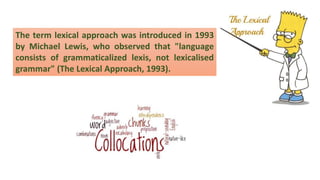
The term lexical approach was introduced in 1993
by Michael Lewis, who observed that "language
consists of grammaticalized lexis, not lexicalised
grammar" (The Lexical Approach, 1993).
The basic concept on which this
approach rests is the idea that an
important part of learning a
language consists of being able to
understand and produce lexical
phrases as chunks.
In the lexical approach, instruction focuses on
fixed expressions that occur frequently in
dialogues, which Lewis claims make up a larger
part of discourse than unique phrases and
sentences
In language teaching, a set of
principles based on the observation
that an understanding of words and
word combinations (chunks) is the
primary method of learning a
language. The idea is that rather
than have students memorize lists of
vocabulary they would learn
commonly used phrases.
METHODOLOGICAL IMPLICATIONS OF THE LEXICAL APPROACH
"The methodological implications of [Michael Lewis's] Lexical Approach (1993, pp. 194-195) are as
follows:
- Early emphasis on receptive skills, especially listening, is essential.
- De-contextualized vocabulary learning is a fully legitimate strategy.
- The role of grammar as a receptive skill must be recognized.
- The importance of contrast in language awareness must be recognized.
- Teachers should employ extensive, comprehensible language for
receptive purposes.
- Extensive writing should be delayed as long as possible.
- Nonlinear recording formats (e.g., mind maps, word trees) are
intrinsic to the Lexical Approach.
- Reformulation should be the natural response to student error.
- Teachers should always react primarily to the content of student
language.
- Pedagogical chunking should be a frequent classroom activity."

The lexical approach

  • 1.
    THE LEXICAL APPROACH By:Katherine Varela I.D.: 6-708-1337
  • 2.
    WHAT IS LEXICALAPPROACH The lexical approach is a way of analysing and teaching language based on the idea that it is made up of lexical units rather than grammatical structures. The units are words, chunks formed by collocations, and fixed phrases.
  • 3.
    The term lexicalapproach was introduced in 1993 by Michael Lewis, who observed that "language consists of grammaticalized lexis, not lexicalised grammar" (The Lexical Approach, 1993).
  • 4.
    The basic concepton which this approach rests is the idea that an important part of learning a language consists of being able to understand and produce lexical phrases as chunks. In the lexical approach, instruction focuses on fixed expressions that occur frequently in dialogues, which Lewis claims make up a larger part of discourse than unique phrases and sentences
  • 5.
    In language teaching,a set of principles based on the observation that an understanding of words and word combinations (chunks) is the primary method of learning a language. The idea is that rather than have students memorize lists of vocabulary they would learn commonly used phrases.
  • 6.
    METHODOLOGICAL IMPLICATIONS OFTHE LEXICAL APPROACH "The methodological implications of [Michael Lewis's] Lexical Approach (1993, pp. 194-195) are as follows: - Early emphasis on receptive skills, especially listening, is essential. - De-contextualized vocabulary learning is a fully legitimate strategy. - The role of grammar as a receptive skill must be recognized. - The importance of contrast in language awareness must be recognized.
  • 7.
    - Teachers shouldemploy extensive, comprehensible language for receptive purposes. - Extensive writing should be delayed as long as possible. - Nonlinear recording formats (e.g., mind maps, word trees) are intrinsic to the Lexical Approach. - Reformulation should be the natural response to student error. - Teachers should always react primarily to the content of student language. - Pedagogical chunking should be a frequent classroom activity."