1
Compiler Design (40-414)
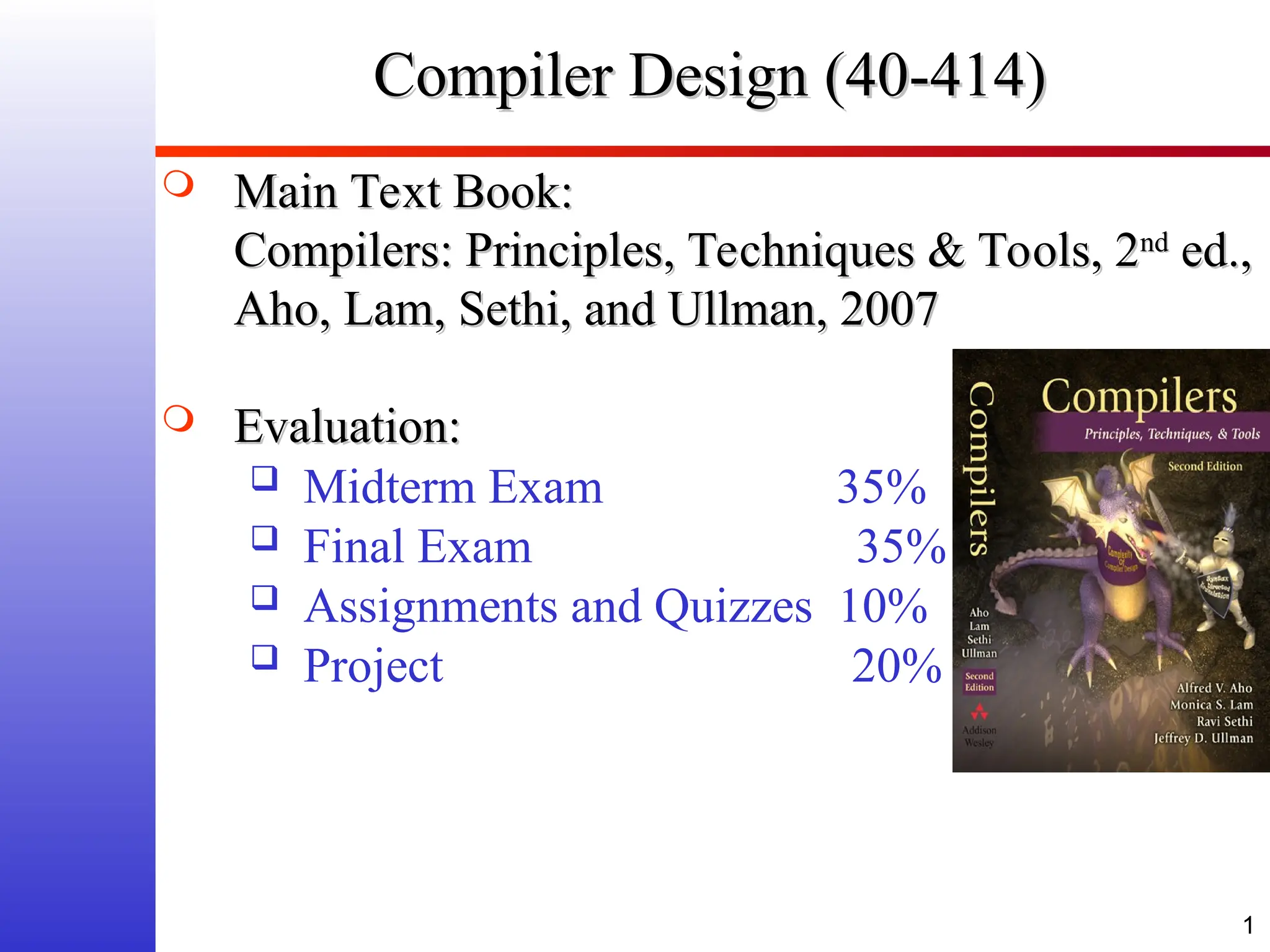
 Main Text Book:
Main Text Book:
Compilers: Principles, Techniques & Tools, 2
Compilers: Principles, Techniques & Tools, 2nd
nd
ed.,
ed.,
Aho, Lam, Sethi, and Ullman, 2007
 Evaluation:
Evaluation:
 Midterm Exam 35%
 Final Exam 35%
 Assignments and Quizzes 10%
 Project 20%
2
Compiler learning
Compiler learning
 Isn’t it an old discipline?
Isn’t it an old discipline?
 Yes, it is a well-established discipline
 Algorithms, methods and techniques were
developed in early stages of computer science
 There are many compilers around, and
 many tools to generate them automatically
 So, why we need to learn it?
So, why we need to learn it?
 Although you may never write a full compiler
 But the techniques we learn is useful in many tasks
like:
 writing an interpreter for a scripting language,
 validation checking for forms, and
 so on
3
Terminology
Terminology
 Compiler:
Compiler:
 a program that translates an executable program
in a source language (usually high level)
into an equivalent executable program in a
target language (usually low level)
 Interpreter:
Interpreter:
 a program that reads an executable program and
produces the results of running that program
 usually, this involves executing the source
program in some fashion
 Our course is mainly about compilers but many of
Our course is mainly about compilers but many of
the same issues arise in interpreters
4
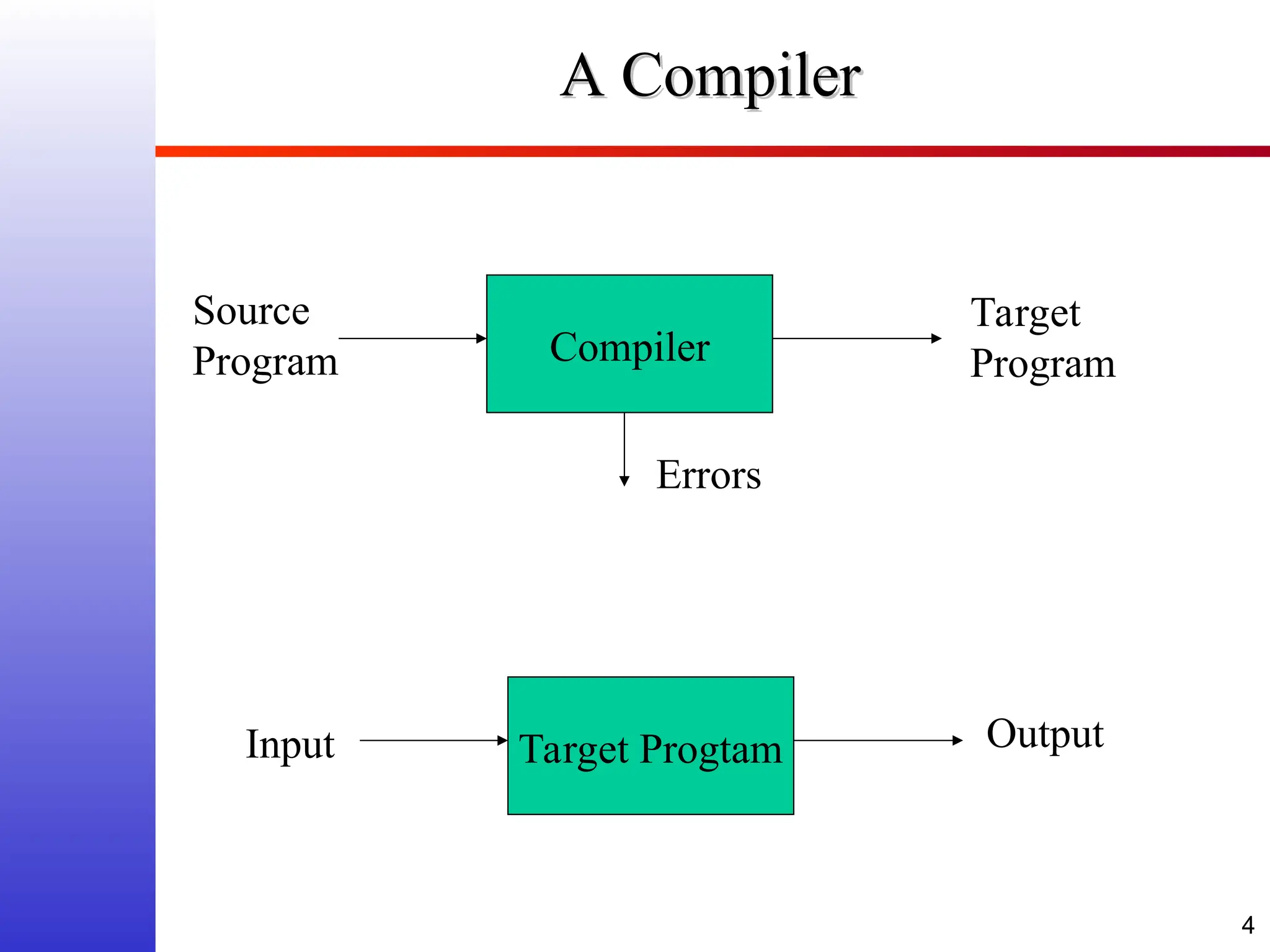
A Compiler
A Compiler
Compiler
Source
Program
Target
Program
Errors
Target Progtam
Input Output
5
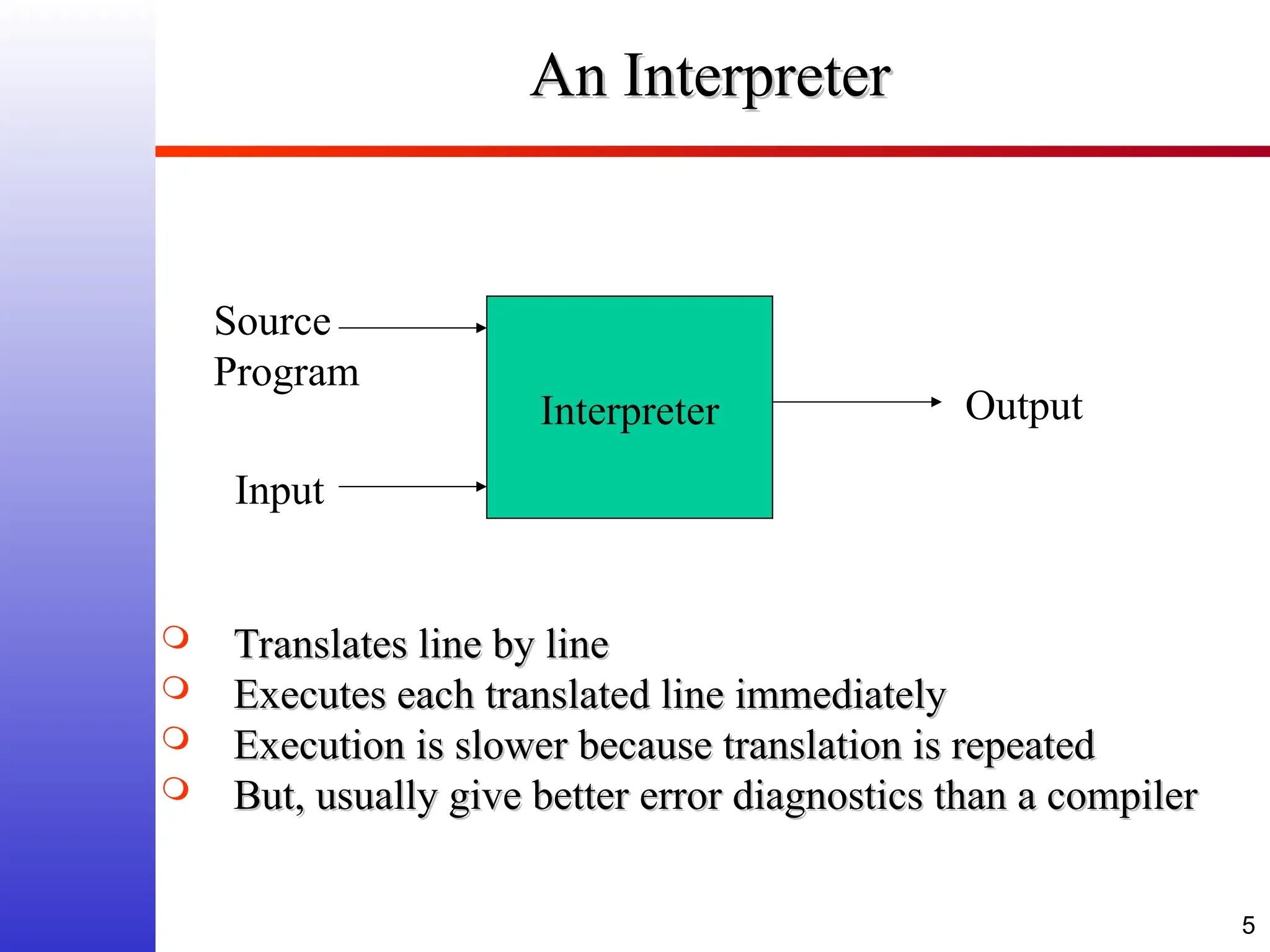
An Interpreter
An Interpreter
Interpreter
Input
Output
 Translates line by line
Translates line by line
 Executes each translated line immediately
Executes each translated line immediately
 Execution is slower because translation is repeated
Execution is slower because translation is repeated
 But, usually give better error diagnostics than a compiler
But, usually give better error diagnostics than a compiler
Source
Program
6
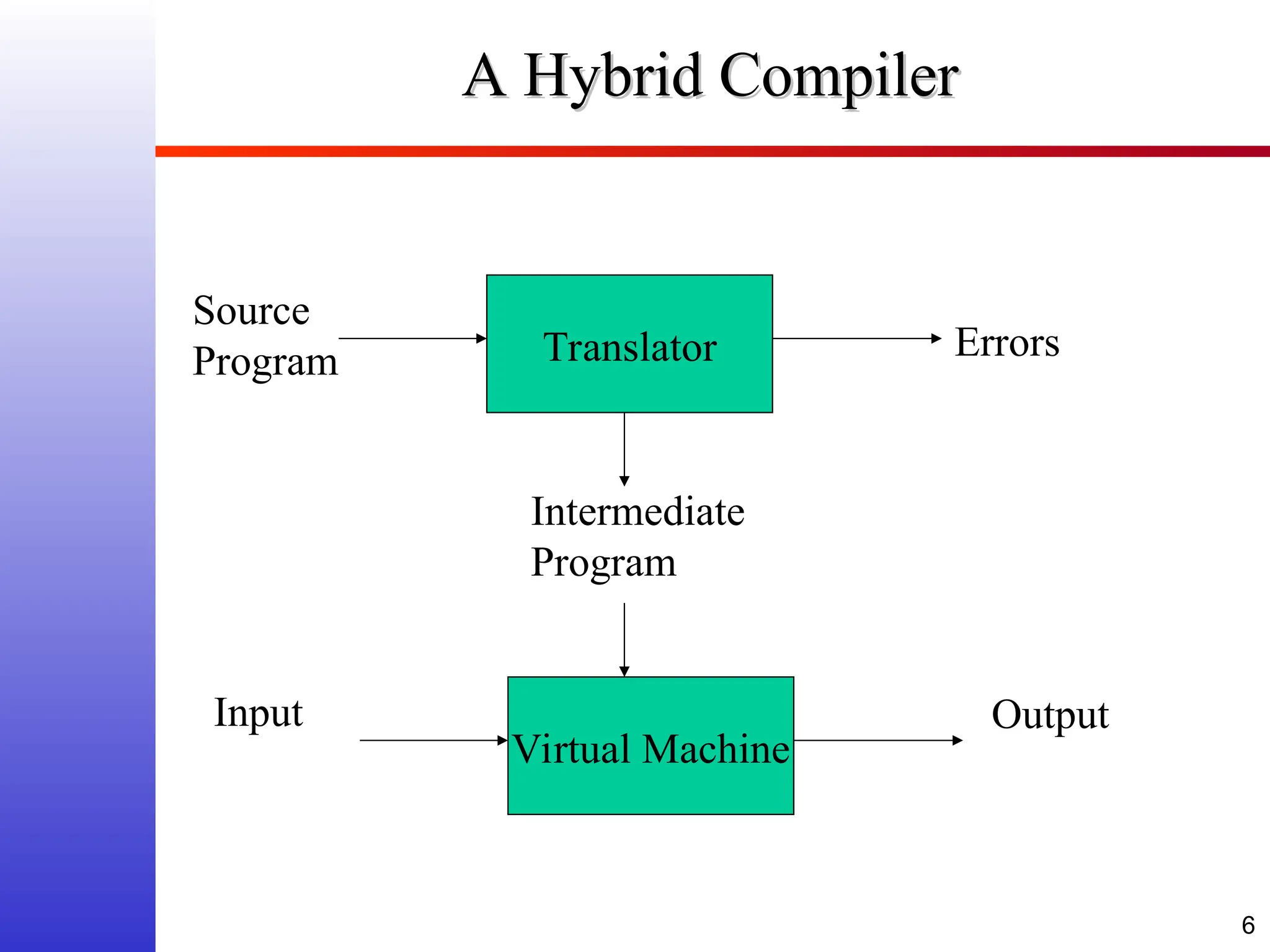
A Hybrid Compiler
A Hybrid Compiler
Translator
Source
Program
Intermediate
Program
Errors
Virtual Machine
Input Output
7
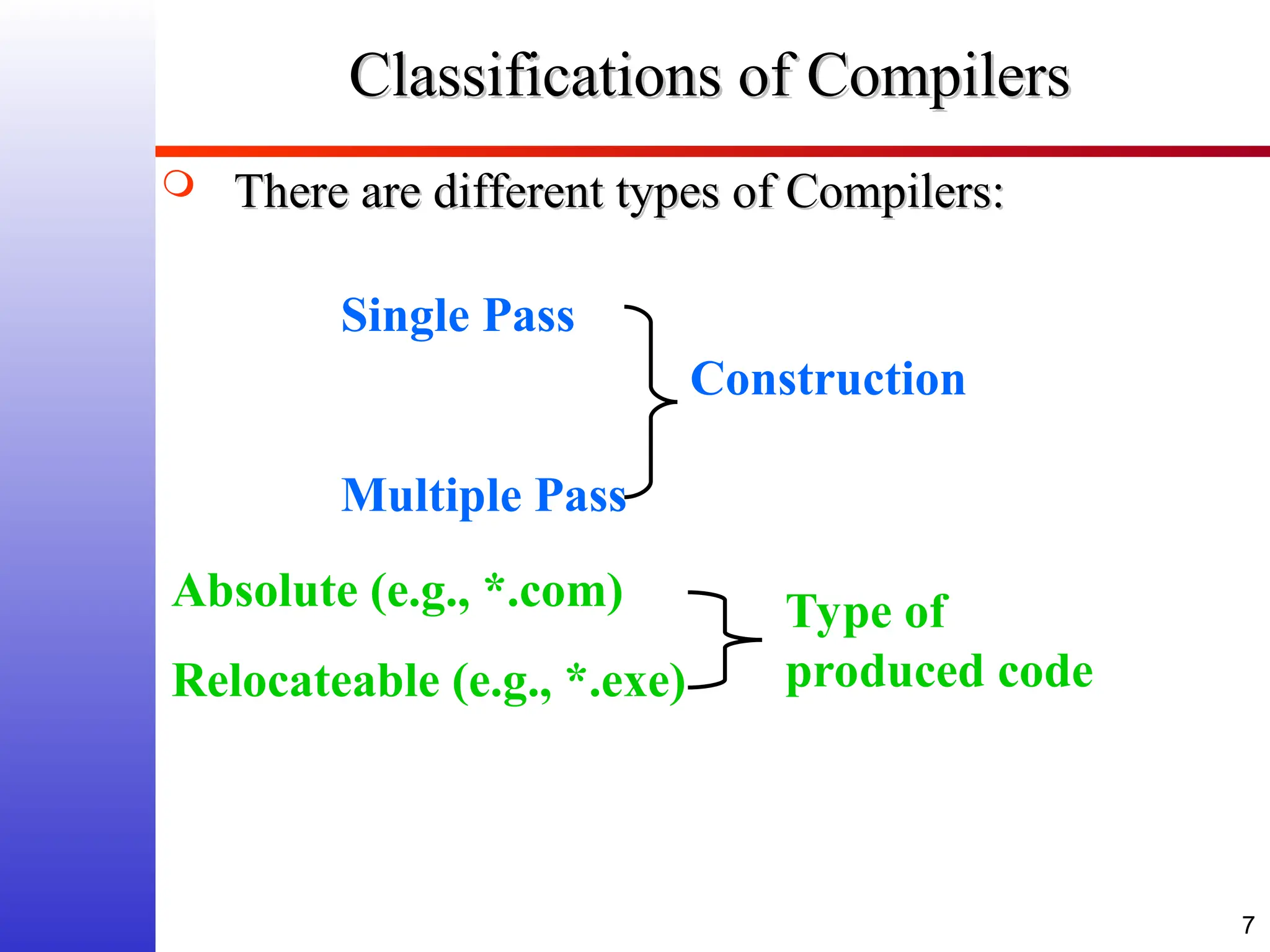
Classifications of Compilers
 There are different types of Compilers:
There are different types of Compilers:
Single Pass
Multiple Pass
Construction
Absolute (e.g., *.com)
Relocateable (e.g., *.exe)
Type of
produced code
8
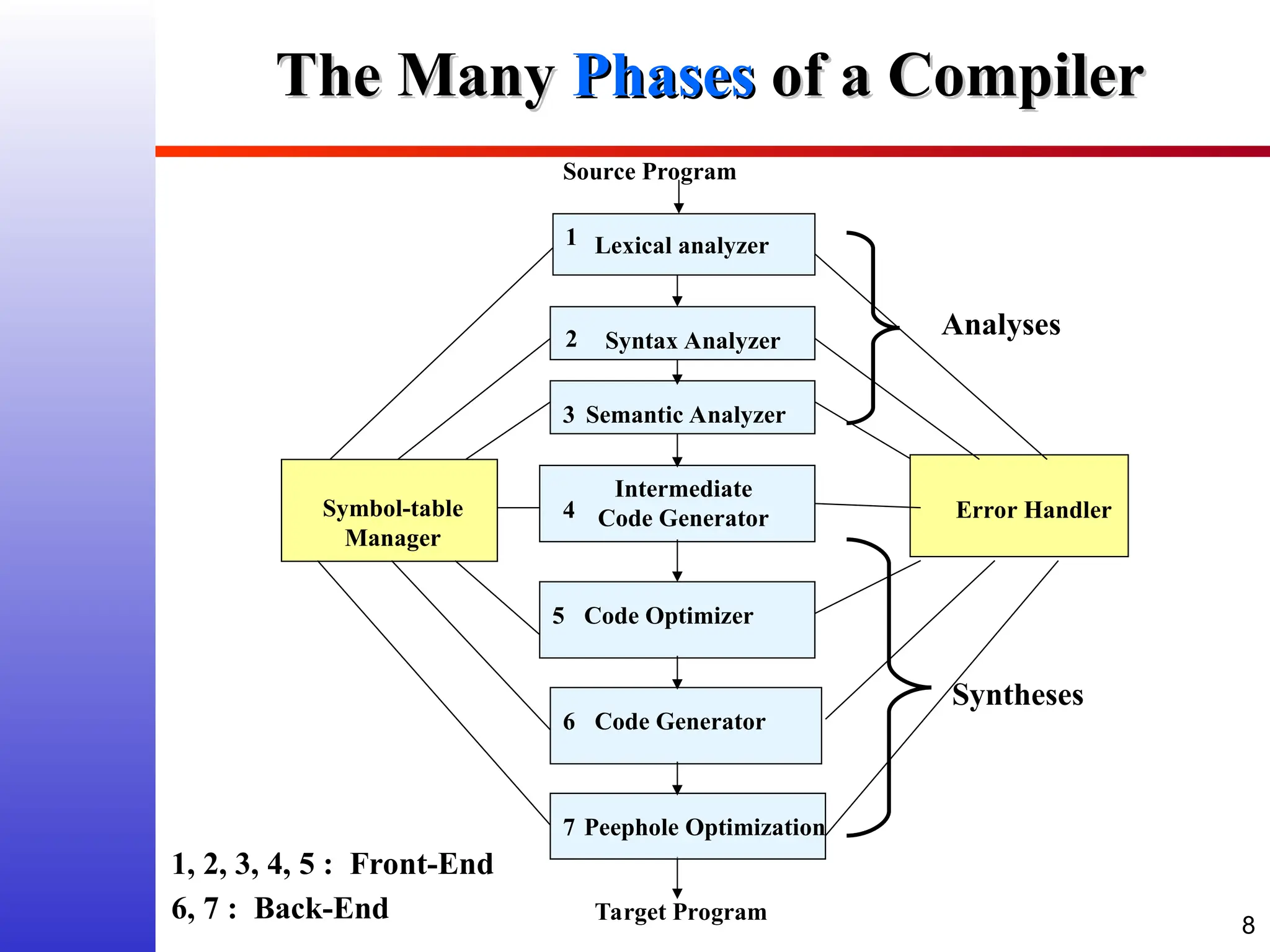
The Many
The Many Phases
Phases of a Compiler
of a Compiler
Source Program
Lexical analyzer
1
Syntax Analyzer
2
Semantic Analyzer
3
Intermediate
Code Generator
4
Code Optimizer
5
Code Generator
Target Program
Symbol-table
Manager
Error Handler
Analyses
Peephole Optimization
7
1, 2, 3, 4, 5 : Front-End
6, 7 : Back-End
6
Syntheses
9
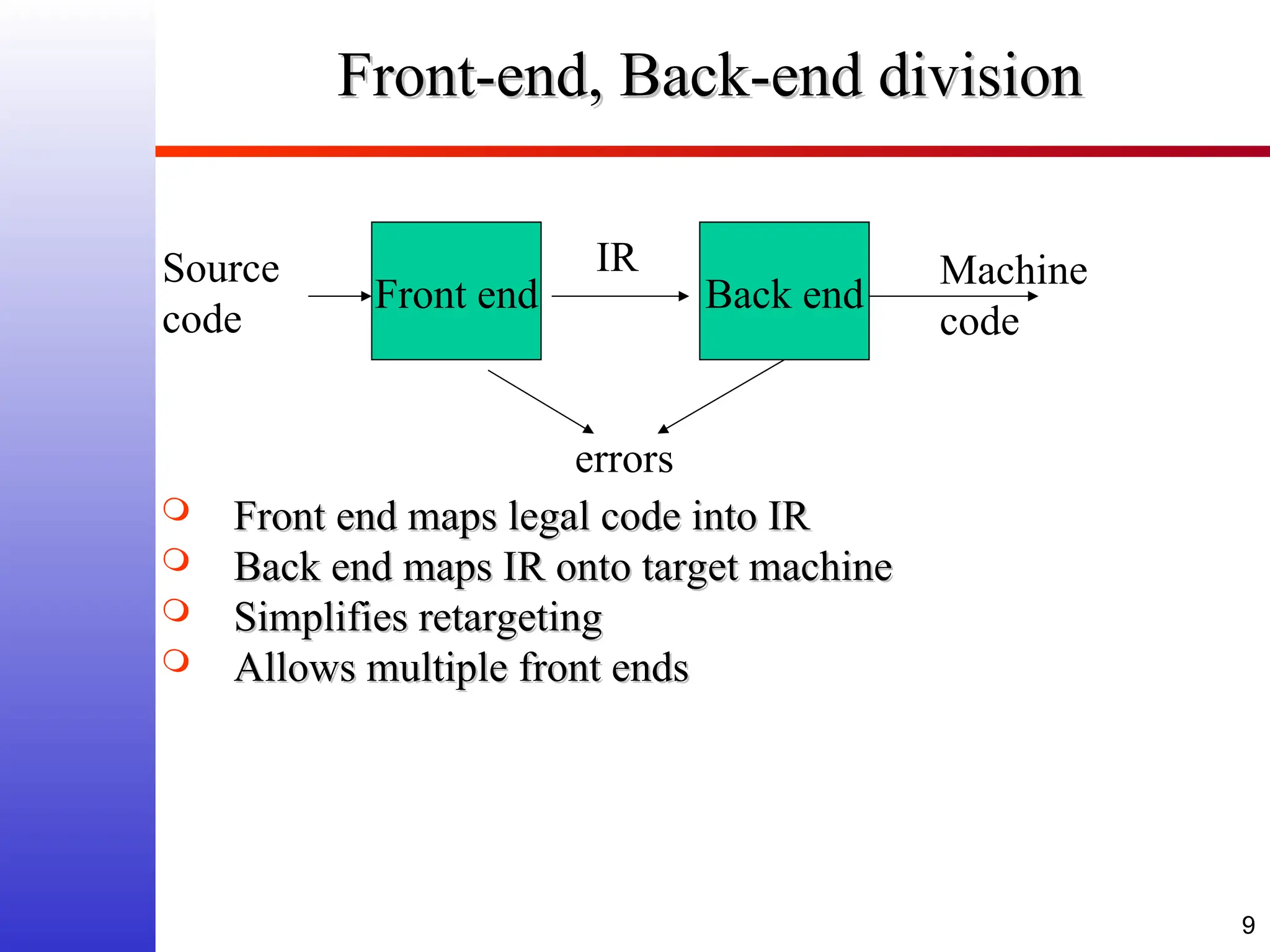
Front-end, Back-end division
 Front end maps legal code into IR
Front end maps legal code into IR
 Back end maps IR onto target machine
Back end maps IR onto target machine
 Simplifies retargeting
Simplifies retargeting
 Allows multiple front ends
Allows multiple front ends
Front end
Source
code
Machine
code
errors
IR
Back end
10
Front end
Front end
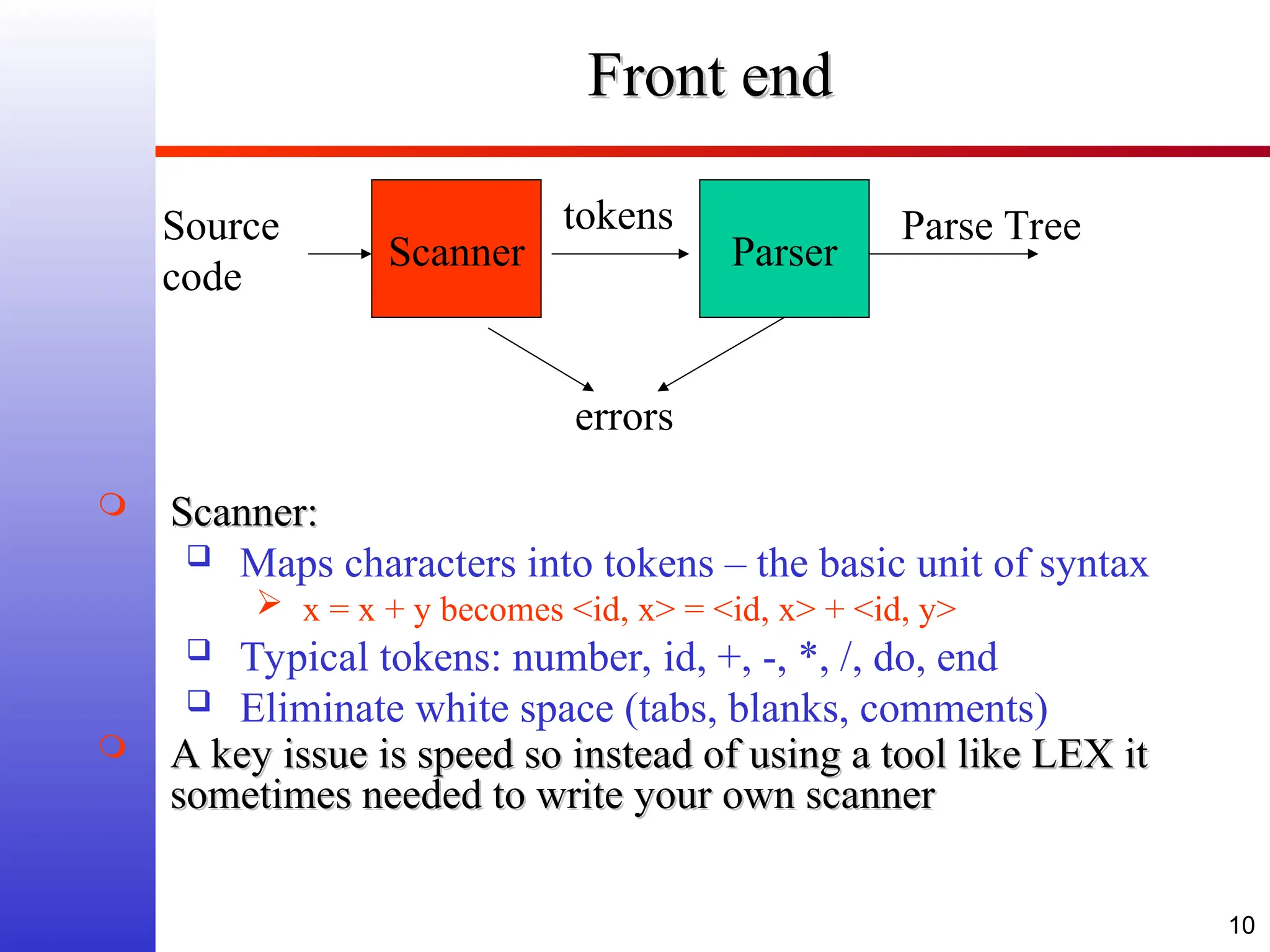
 Scanner:
Scanner:
 Maps characters into tokens – the basic unit of syntax
 x = x + y becomes <id, x> = <id, x> + <id, y>
 Typical tokens: number, id, +, -, *, /, do, end
 Eliminate white space (tabs, blanks, comments)
 A key issue is speed so instead of using a tool like LEX it
A key issue is speed so instead of using a tool like LEX it
sometimes needed to write your own scanner
Scanner
Source
code
Parse Tree
errors
tokens
Parser
11
Front end
Front end
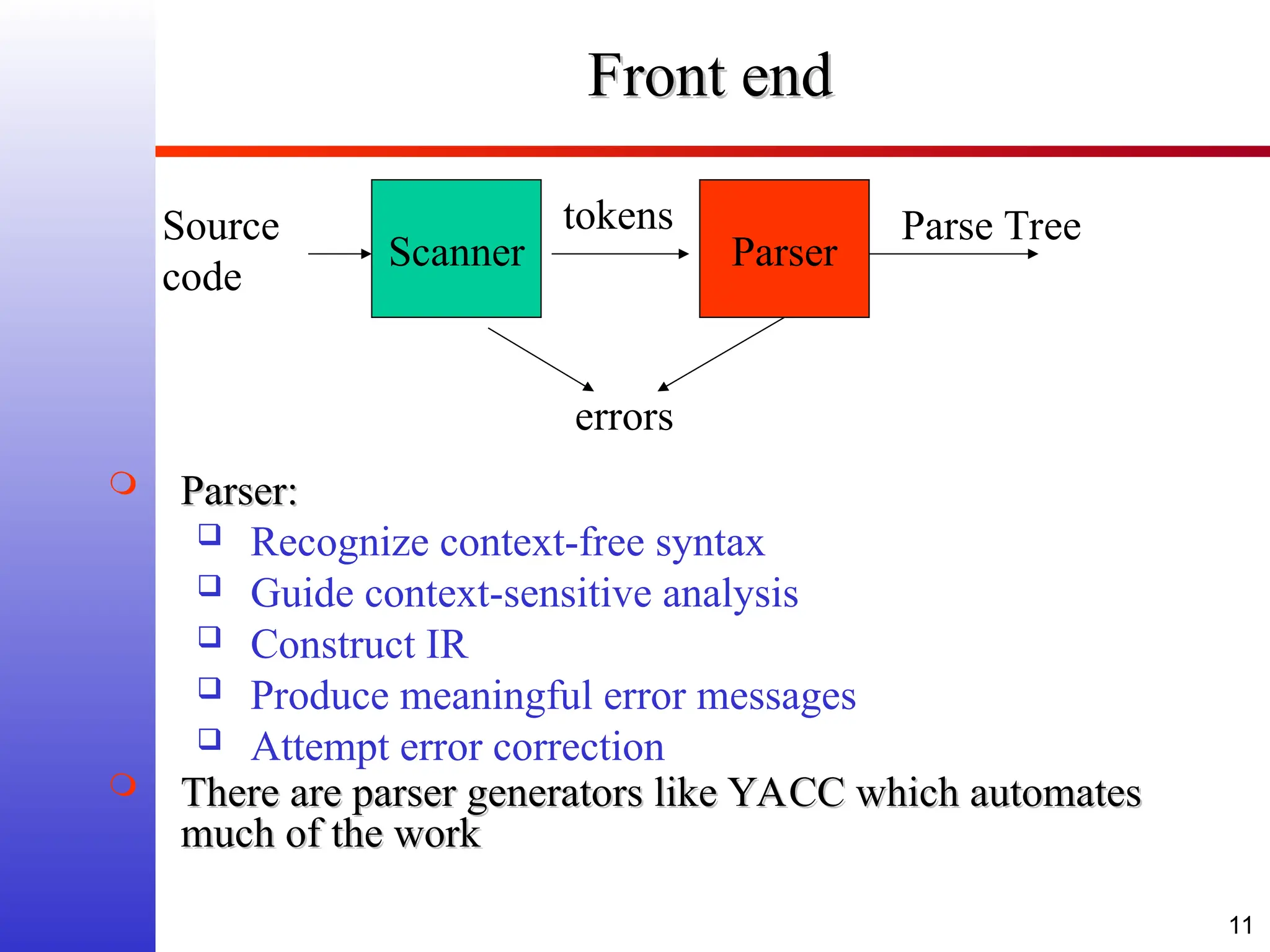
 Parser:
Parser:
 Recognize context-free syntax
 Guide context-sensitive analysis
 Construct IR
 Produce meaningful error messages
 Attempt error correction
 There are parser generators like YACC which automates
There are parser generators like YACC which automates
much of the work
much of the work
Scanner
Source
code
Parse Tree
errors
tokens
Parser
12
Front end
Front end
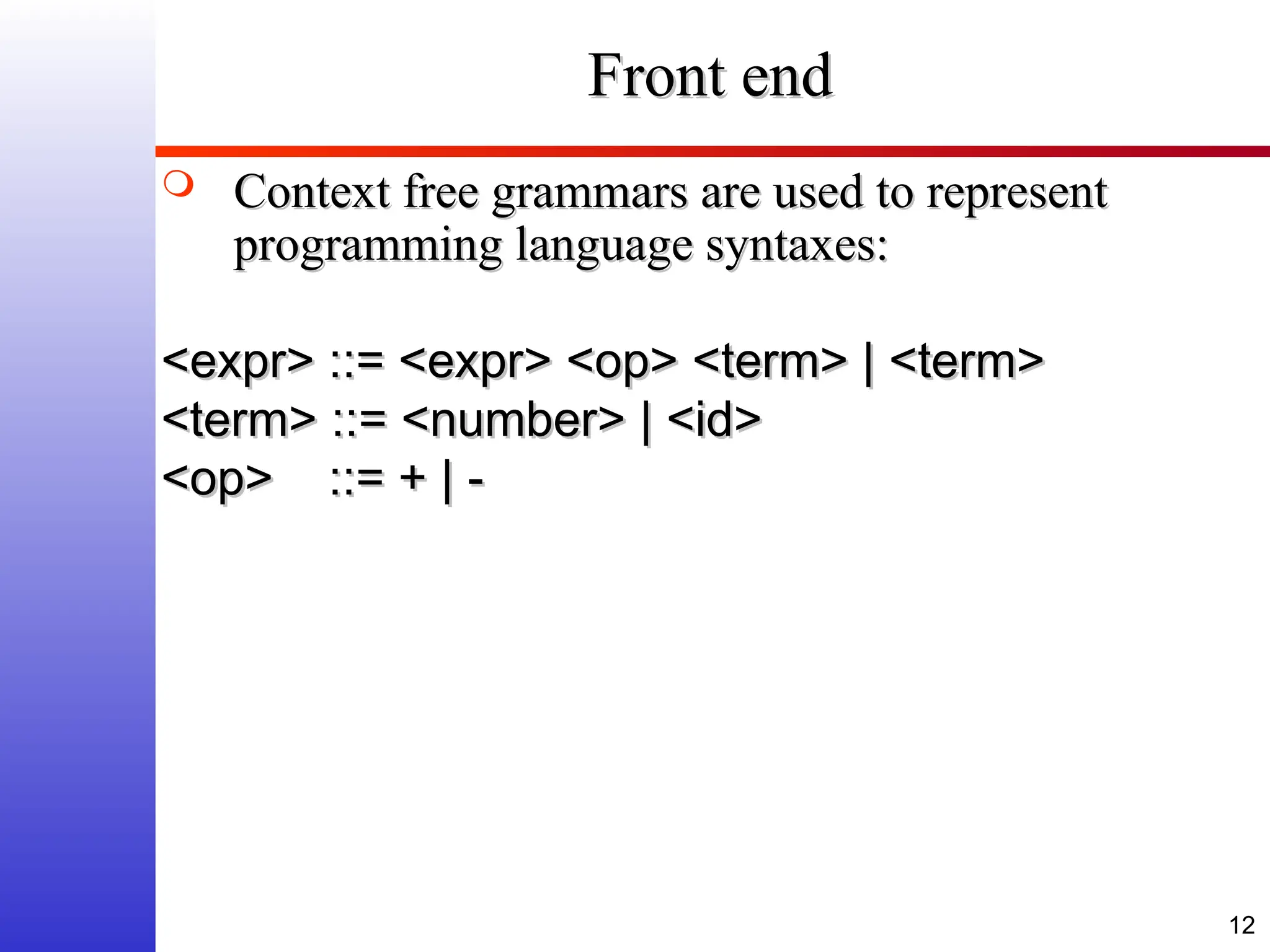
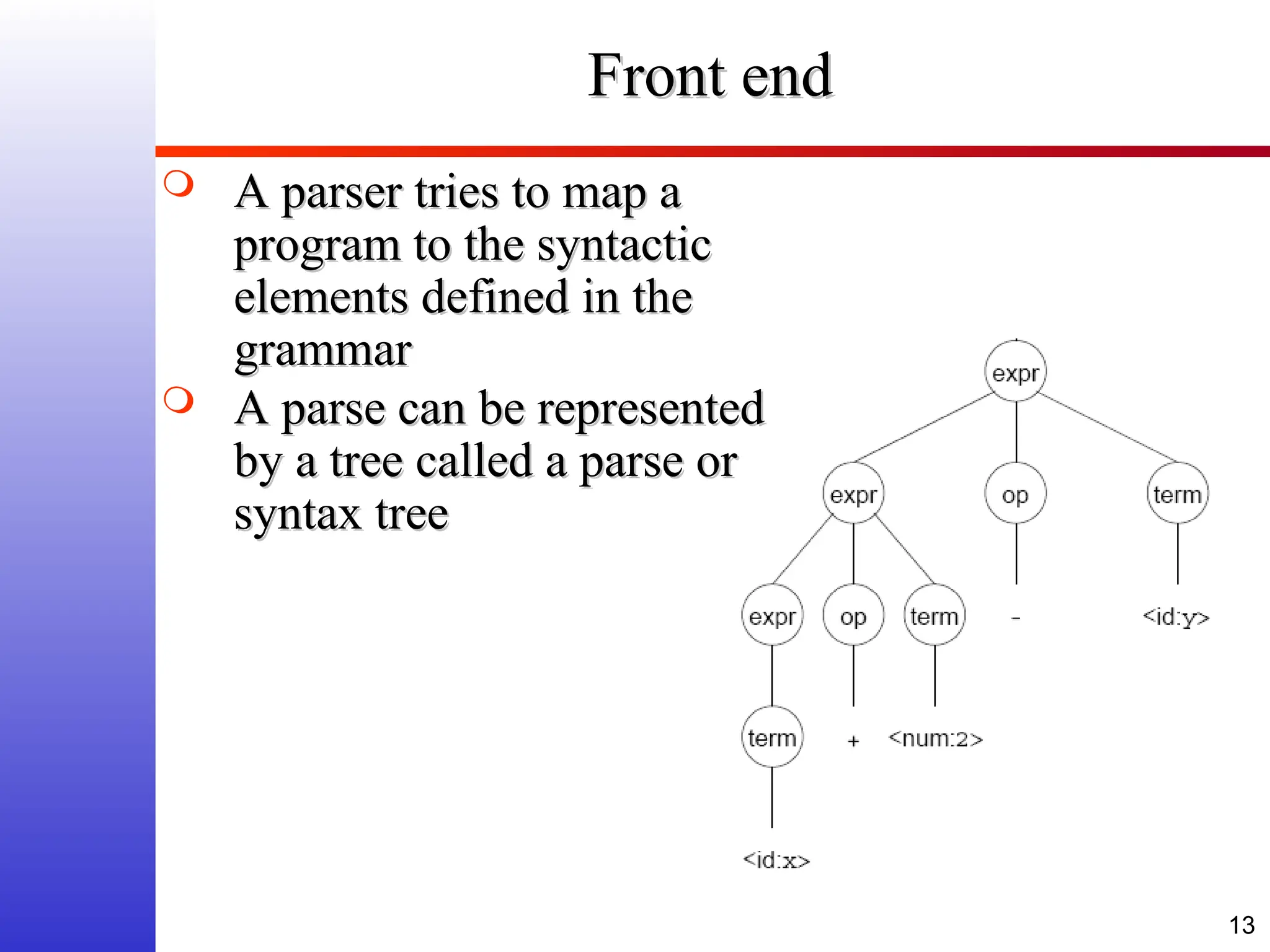
 Context free grammars are used to represent
Context free grammars are used to represent
programming language syntaxes:
<expr> ::= <expr> <op> <term> | <term>
<term> ::= <number> | <id>
<op> ::= + | -
<op> ::= + | -
13
Front end
Front end
 A parser tries to map a
A parser tries to map a
program to the syntactic
elements defined in the
grammar
grammar
 A parse can be represented
A parse can be represented
by a tree called a parse or
syntax tree
syntax tree
14
Front end
Front end
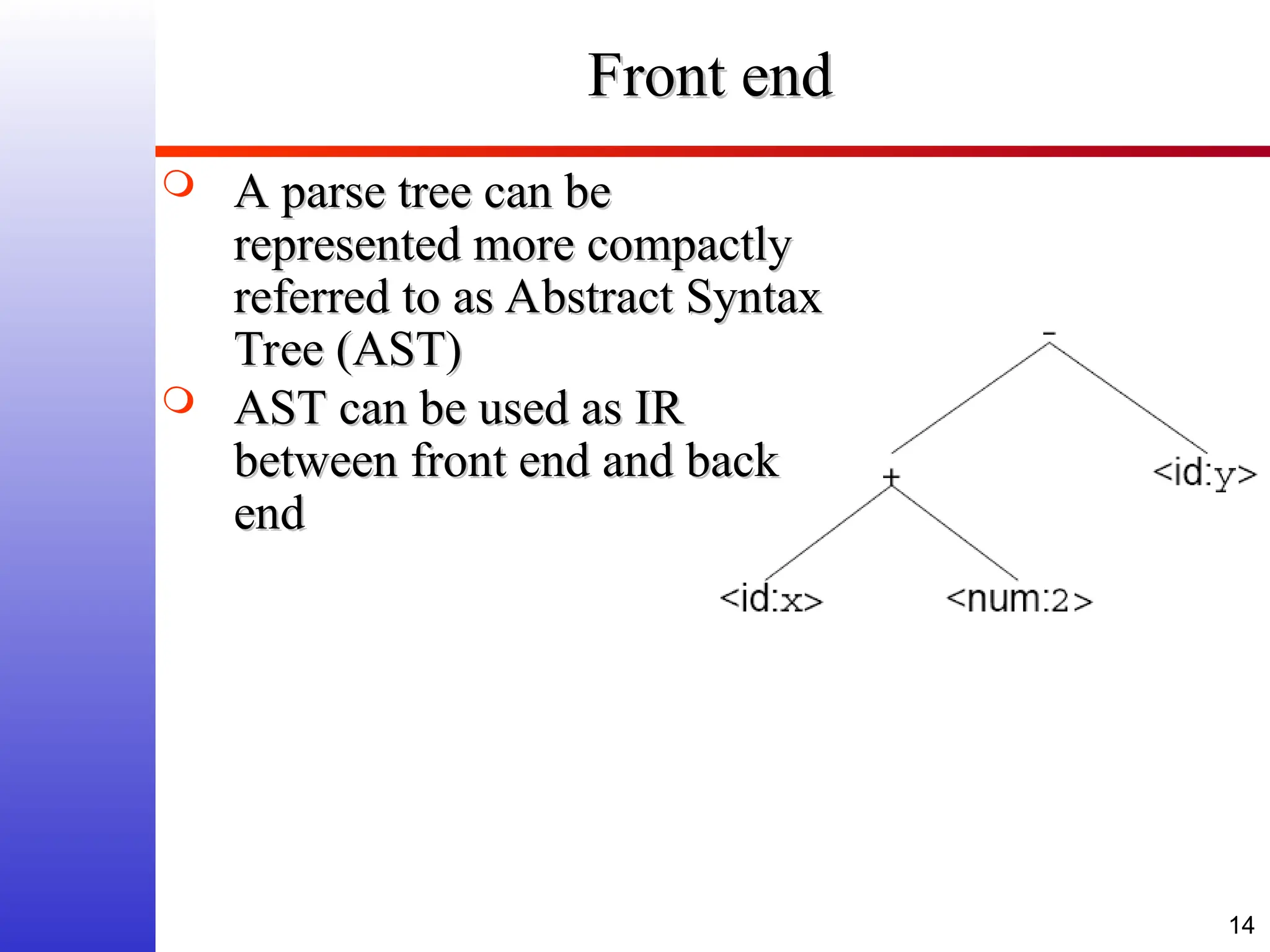
 A parse tree can be
A parse tree can be
represented more compactly
referred to as Abstract Syntax
Tree (AST)
Tree (AST)
 AST can be used as IR
AST can be used as IR
between front end and back
end
end
15
Back end
Back end
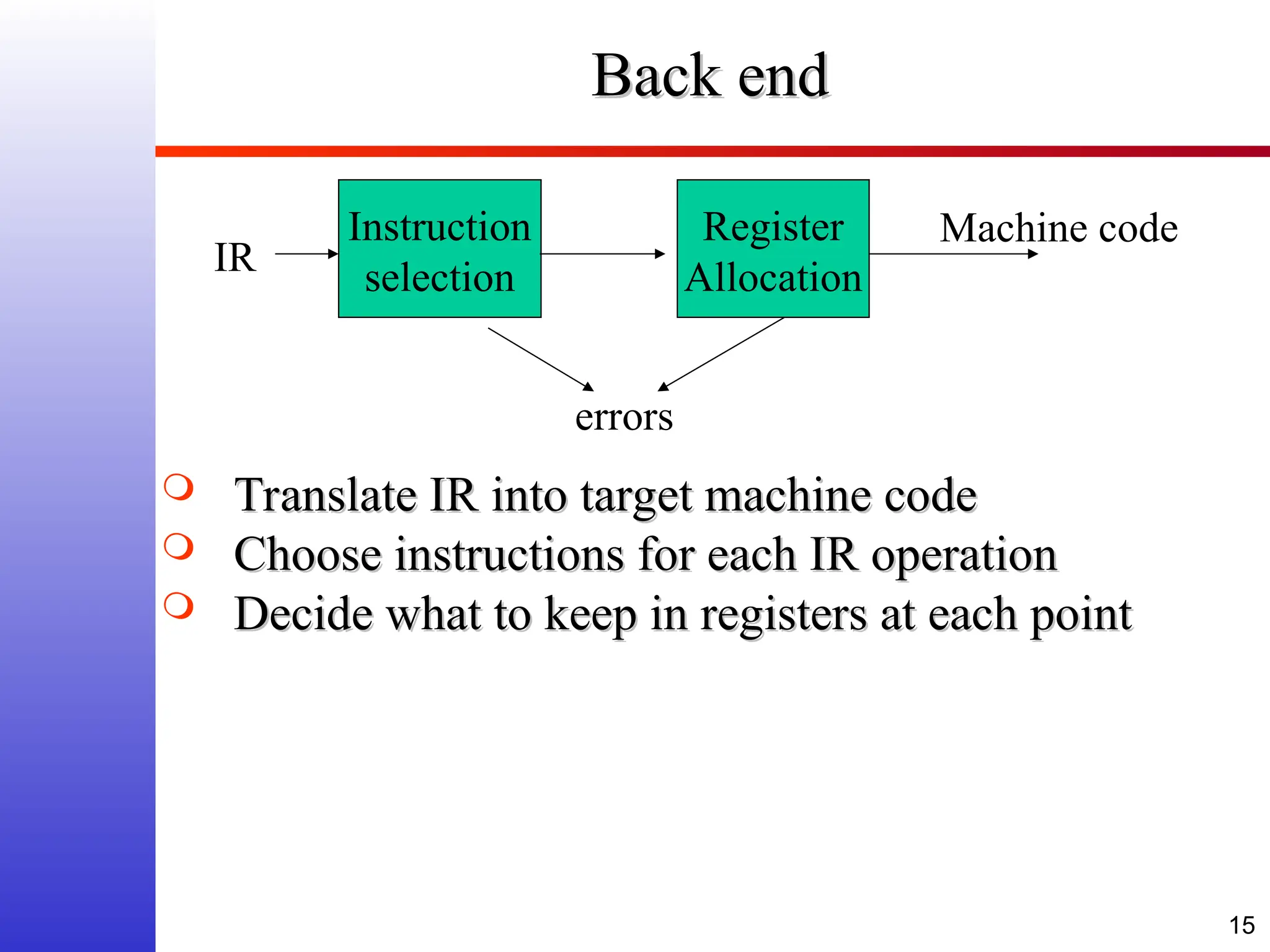
 Translate IR into target machine code
Translate IR into target machine code
 Choose instructions for each IR operation
Choose instructions for each IR operation
 Decide what to keep in registers at each point
Decide what to keep in registers at each point
Instruction
selection
IR
Machine code
errors
Register
Allocation
16
Back end
Back end
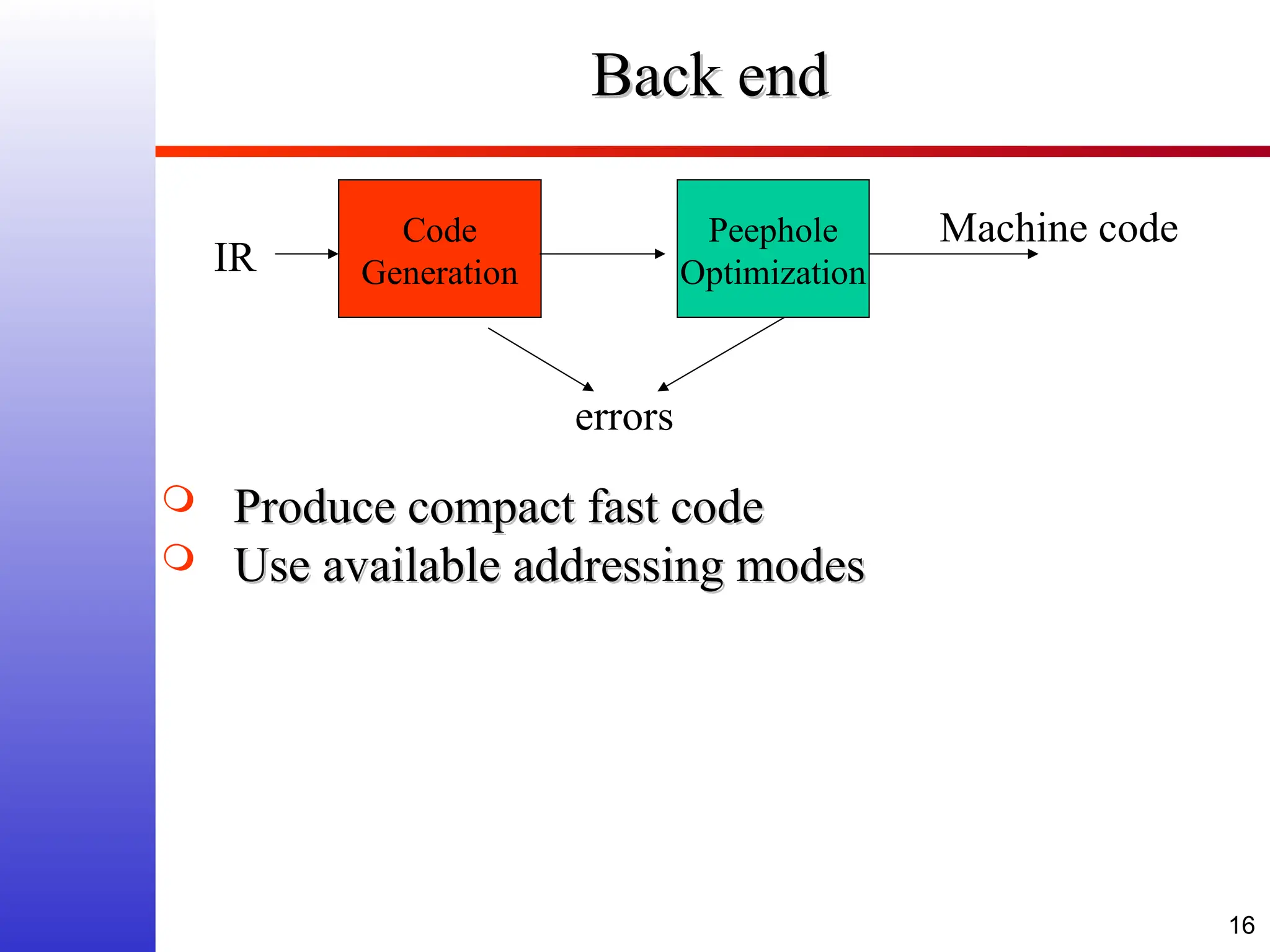
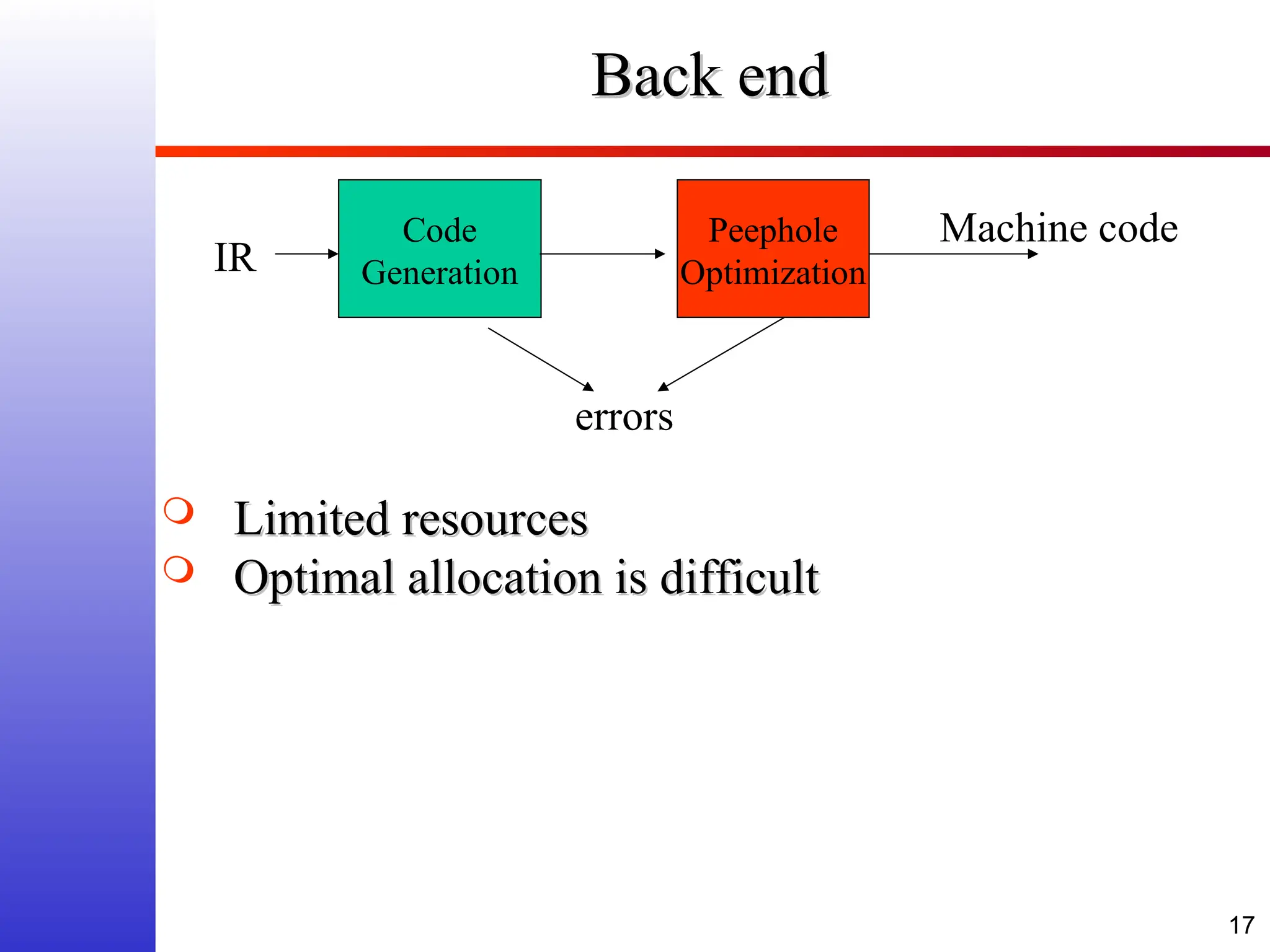
 Produce compact fast code
Produce compact fast code
 Use available addressing modes
Use available addressing modes
Code
Generation
IR
Machine code
errors
Peephole
Optimization
17
Back end
Back end
 Limited resources
Limited resources
 Optimal allocation is difficult
Optimal allocation is difficult
Code
Generation
IR
Machine code
errors
Peephole
Optimization
18
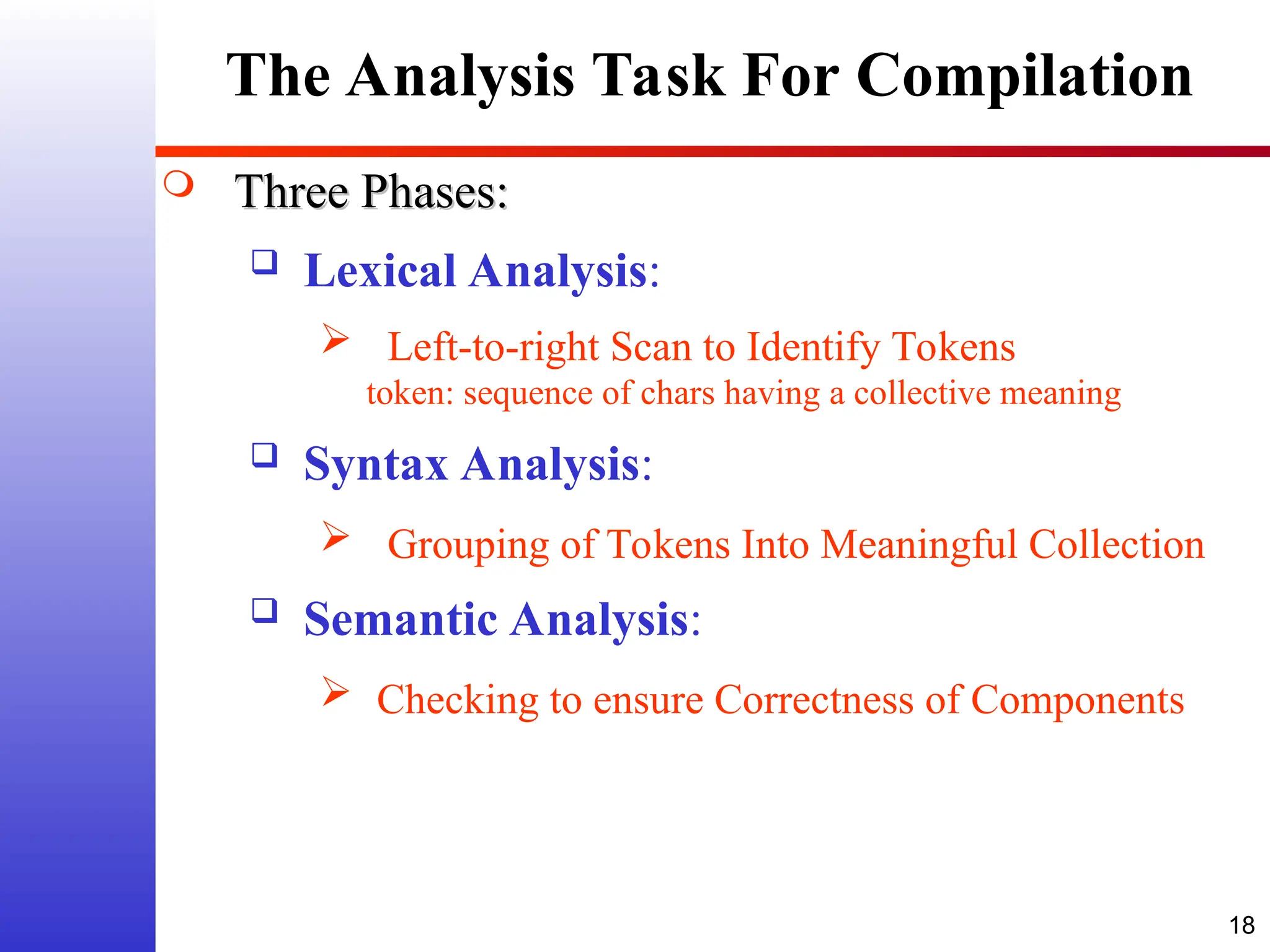
 Three Phases:
Three Phases:
 Lexical Analysis:
 Left-to-right Scan to Identify Tokens
token: sequence of chars having a collective meaning
 Syntax Analysis:
 Grouping of Tokens Into Meaningful Collection
 Semantic Analysis:
 Checking to ensure Correctness of Components
The Analysis Task For Compilation
19
Phase 1. Lexical Analysis
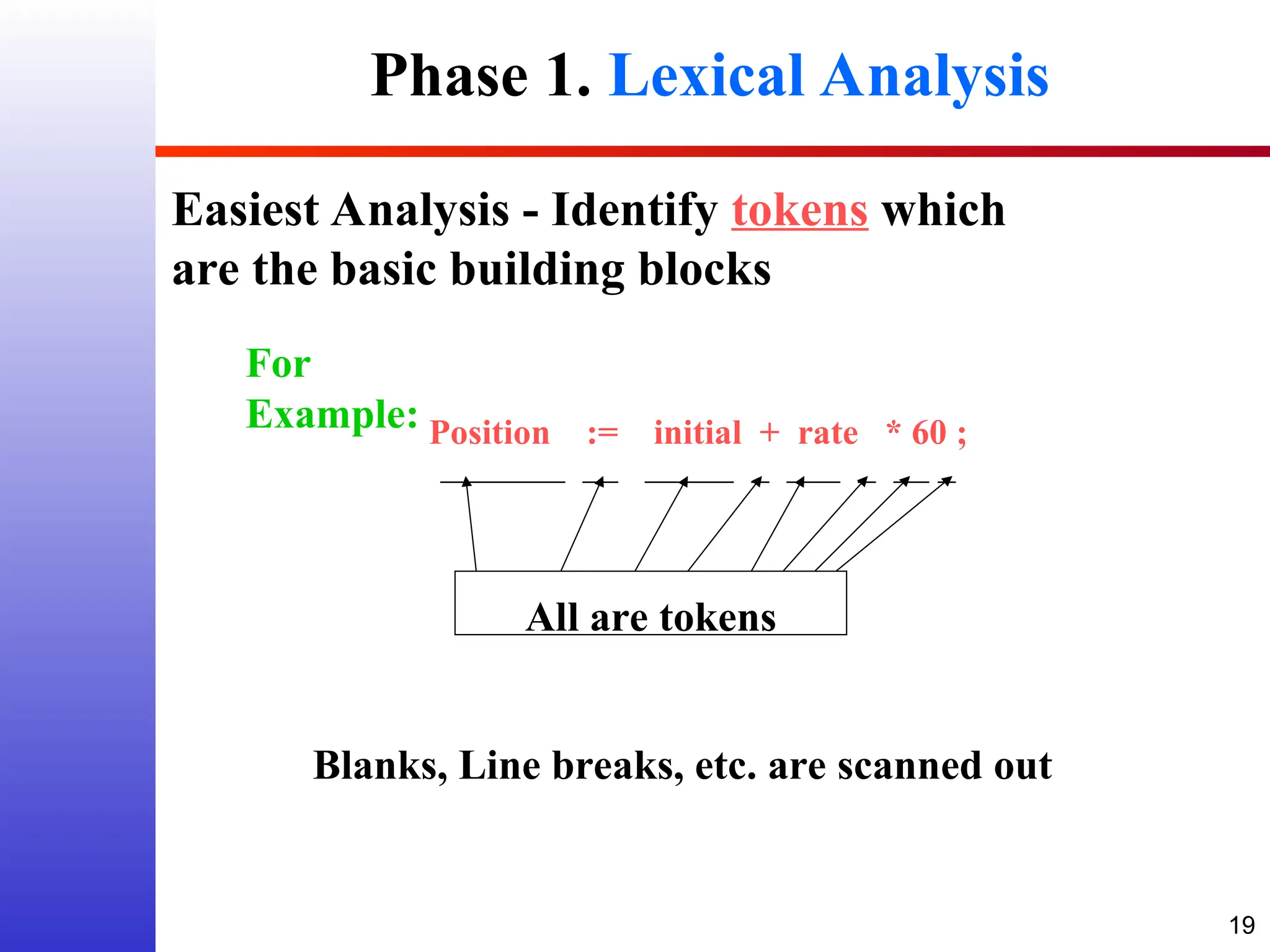
Easiest Analysis - Identify tokens which
are the basic building blocks
For
Example:
All are tokens
Blanks, Line breaks, etc. are scanned out
Position := initial + rate * 60 ;
_______ __ _____ _ ___ _ __ _
20
Phase 2.
Phase 2. Syntax Analysis
Syntax Analysis
or
or Parsing
Parsing
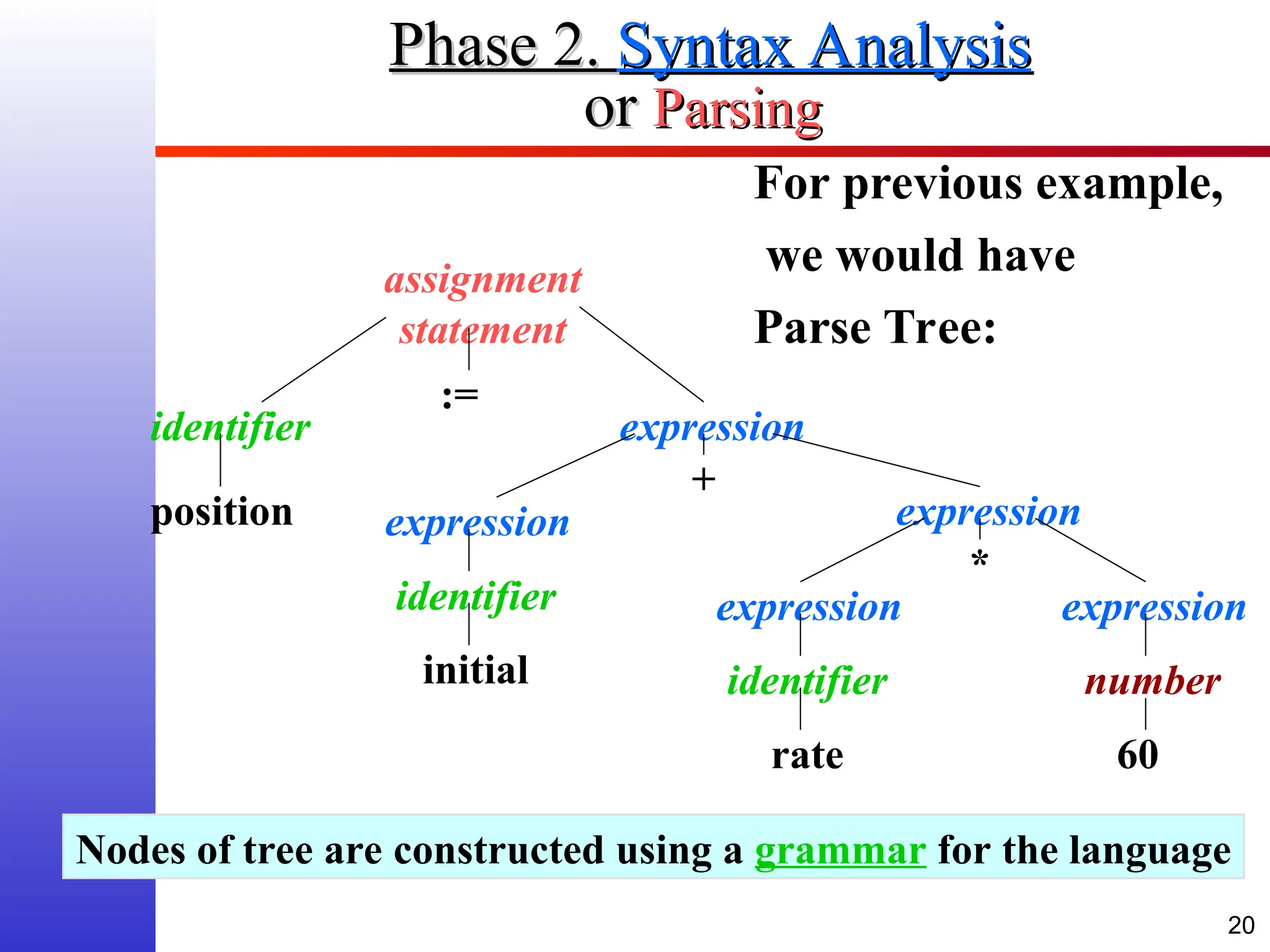
For previous example,
we would have
Parse Tree:
identifier
identifier
expression
identifier
expression
number
expression
expression
expression
assignment
statement
position
:=
+
*
60
initial
rate
Nodes of tree are constructed using a grammar for the language
21
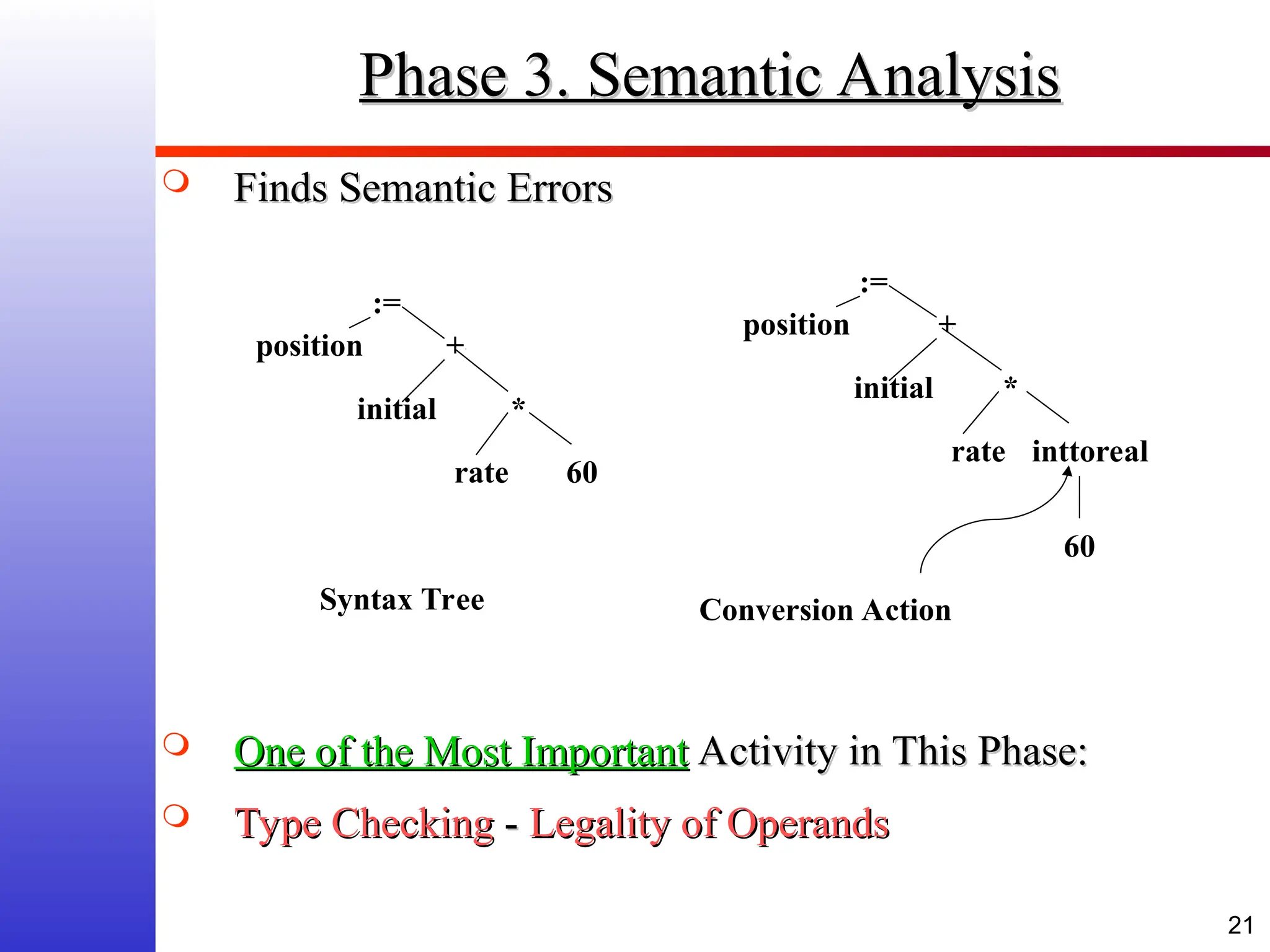
Phase 3. Semantic Analysis
 Finds Semantic Errors
Finds Semantic Errors
 One of the Most Important
One of the Most Important Activity in This Phase:
Activity in This Phase:
 Type Checking
Type Checking -
- Legality of Operands
Legality of Operands
position
initial
rate
:=
+
*
60
Syntax Tree
position
initial
rate
:=
+
*
inttoreal
60
Conversion Action
22
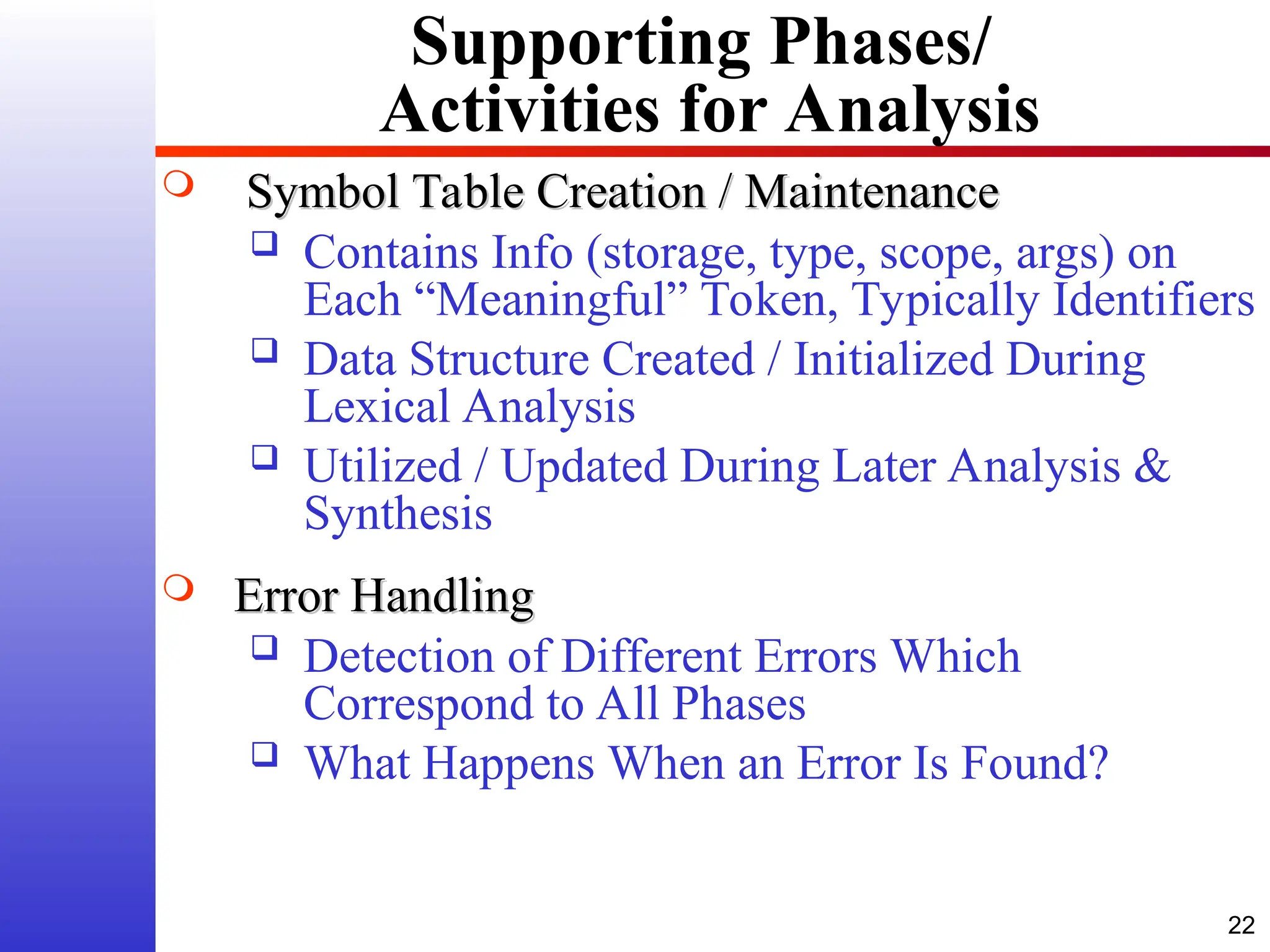
Supporting Phases/
Activities for Analysis
 Symbol Table Creation / Maintenance
Symbol Table Creation / Maintenance
 Contains Info (storage, type, scope, args) on
Each “Meaningful” Token, Typically Identifiers
 Data Structure Created / Initialized During
Lexical Analysis
 Utilized / Updated During Later Analysis &
Synthesis
 Error Handling
Error Handling
 Detection of Different Errors Which
Correspond to All Phases
 What Happens When an Error Is Found?
23
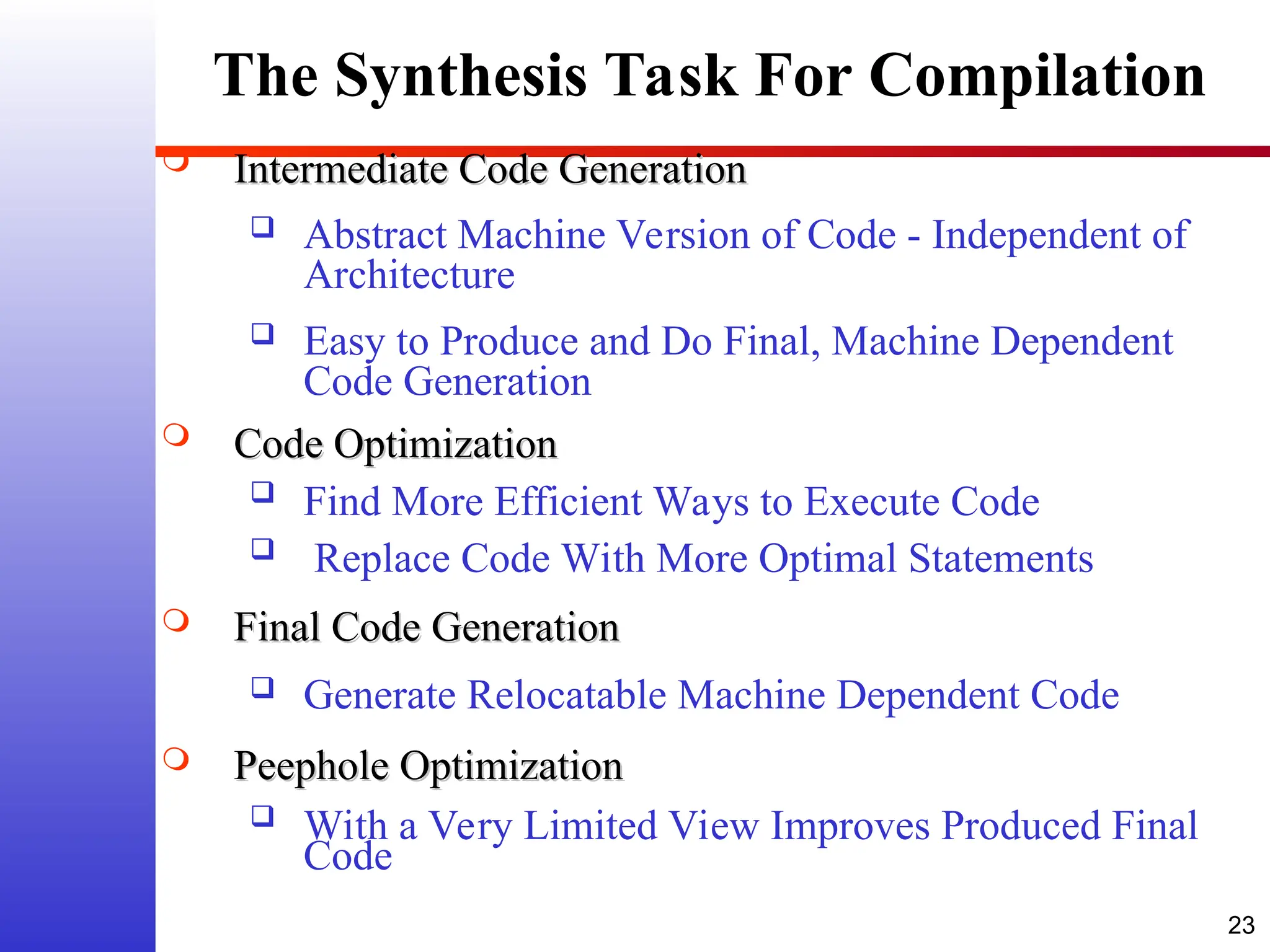
The Synthesis Task For Compilation
 Intermediate Code Generation
Intermediate Code Generation
 Abstract Machine Version of Code - Independent of
Architecture
 Easy to Produce and Do Final, Machine Dependent
Code Generation
 Code Optimization
Code Optimization
 Find More Efficient Ways to Execute Code
 Replace Code With More Optimal Statements
 Final Code Generation
Final Code Generation
 Generate Relocatable Machine Dependent Code
 Peephole Optimization
Peephole Optimization
 With a Very Limited View Improves Produced Final
Code
24
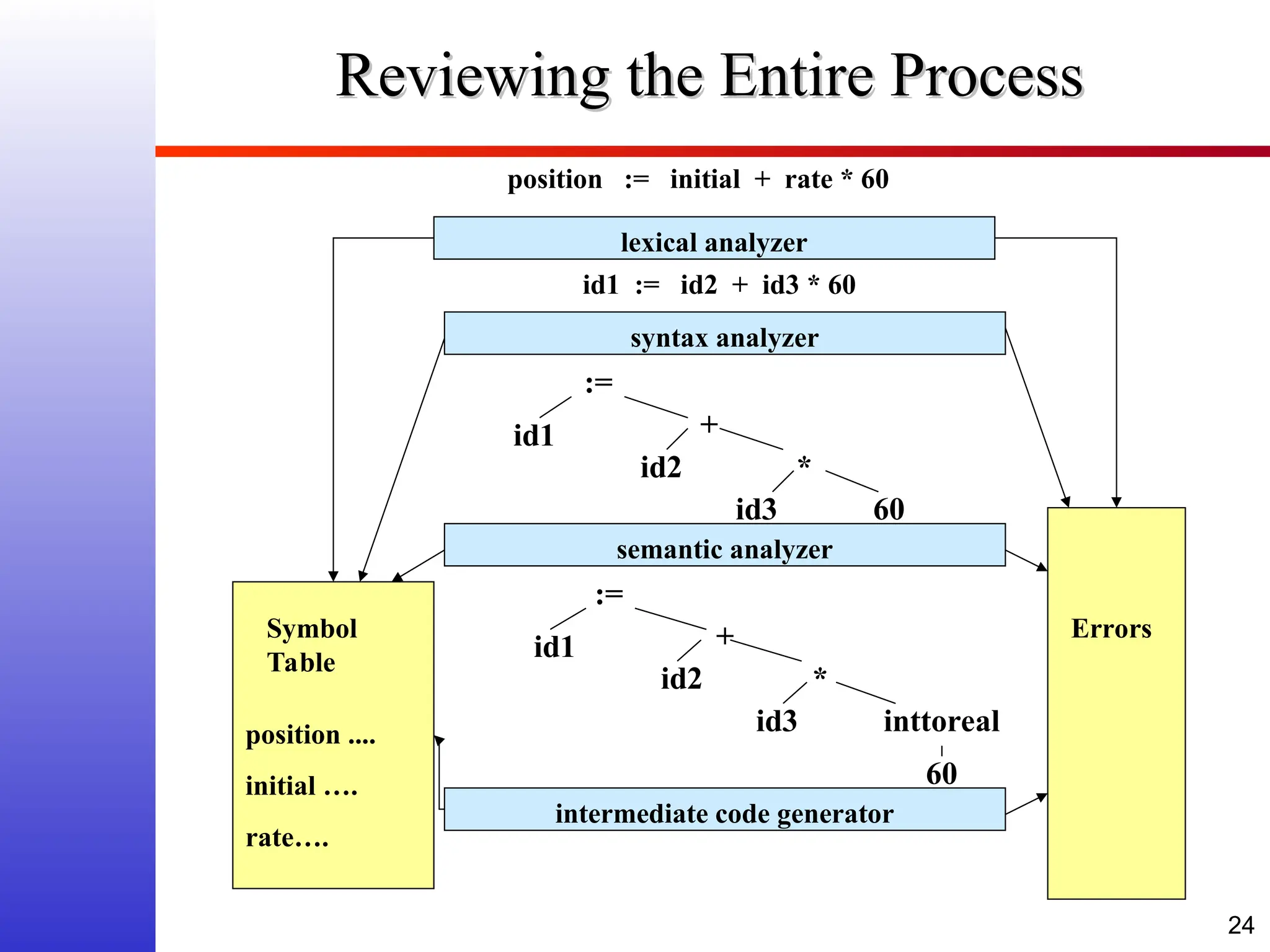
Reviewing the Entire Process
Errors
position := initial + rate * 60
lexical analyzer
syntax analyzer
semantic analyzer
intermediate code generator
id1 := id2 + id3 * 60
:=
id1
id2
id3
+
*
60
:=
id1
id2
id3
+
*
inttoreal
60
Symbol
Table
position ....
initial ….
rate….
25
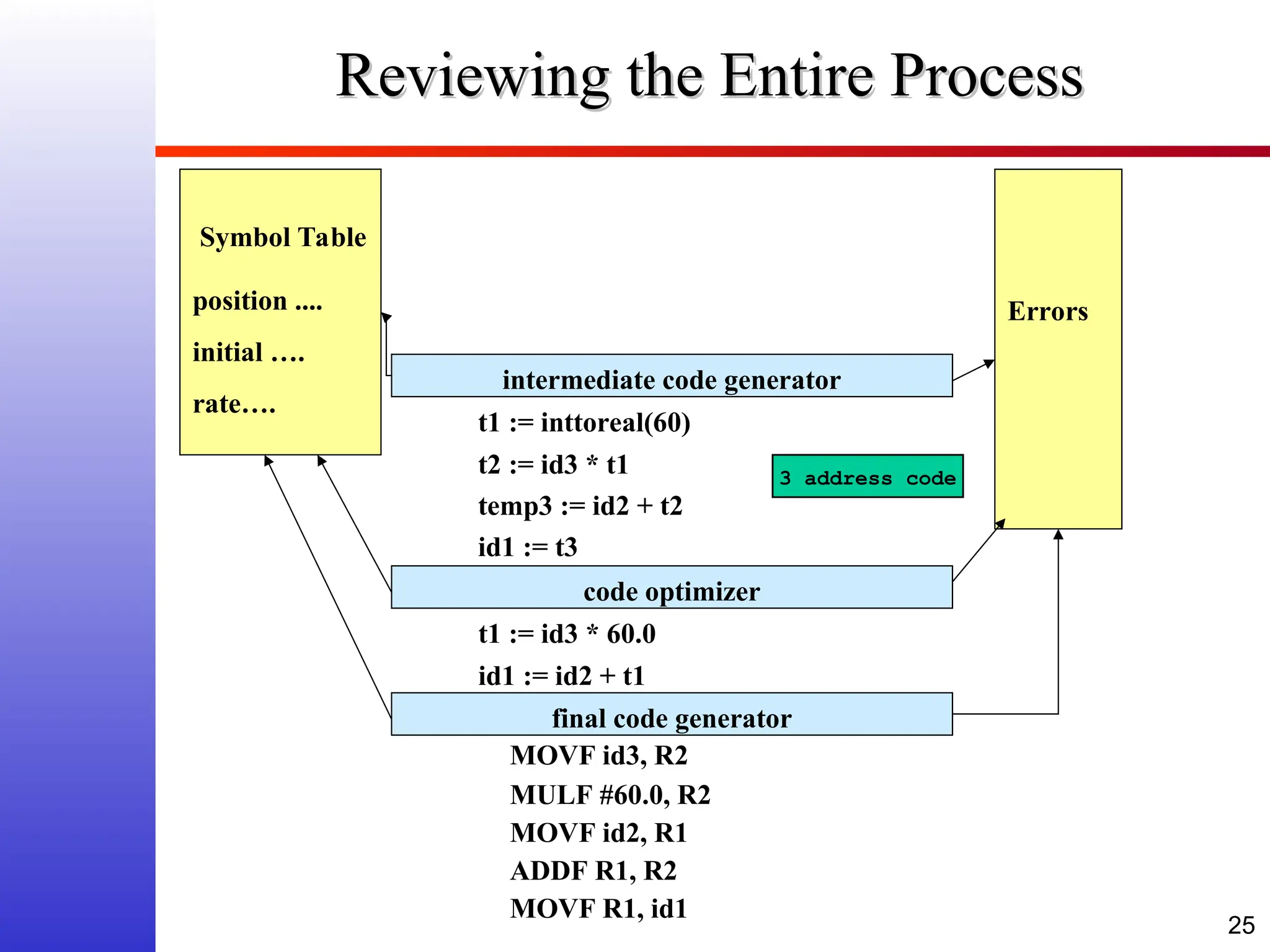
Reviewing the Entire Process
Errors
intermediate code generator
code optimizer
final code generator
t1 := inttoreal(60)
t2 := id3 * t1
temp3 := id2 + t2
id1 := t3
t1 := id3 * 60.0
id1 := id2 + t1
MOVF id3, R2
MULF #60.0, R2
MOVF id2, R1
ADDF R1, R2
MOVF R1, id1
position ....
initial ….
rate….
Symbol Table
3 address code

Compiler design computer science engineering.ppt

  • 1.
    1 Compiler Design (40-414) CompilerDesign (40-414)  Main Text Book: Main Text Book: Compilers: Principles, Techniques & Tools, 2 Compilers: Principles, Techniques & Tools, 2nd nd ed., ed., Aho, Lam, Sethi, and Ullman, 2007 Aho, Lam, Sethi, and Ullman, 2007  Evaluation: Evaluation:  Midterm Exam 35%  Final Exam 35%  Assignments and Quizzes 10%  Project 20%
  • 2.
    2 Compiler learning Compiler learning Isn’t it an old discipline? Isn’t it an old discipline?  Yes, it is a well-established discipline  Algorithms, methods and techniques were developed in early stages of computer science  There are many compilers around, and  many tools to generate them automatically  So, why we need to learn it? So, why we need to learn it?  Although you may never write a full compiler  But the techniques we learn is useful in many tasks like:  writing an interpreter for a scripting language,  validation checking for forms, and  so on
  • 3.
    3 Terminology Terminology  Compiler: Compiler:  aprogram that translates an executable program in a source language (usually high level) into an equivalent executable program in a target language (usually low level)  Interpreter: Interpreter:  a program that reads an executable program and produces the results of running that program  usually, this involves executing the source program in some fashion  Our course is mainly about compilers but many of Our course is mainly about compilers but many of the same issues arise in interpreters the same issues arise in interpreters
  • 4.
  • 5.
    5 An Interpreter An Interpreter Interpreter Input Output Translates line by line Translates line by line  Executes each translated line immediately Executes each translated line immediately  Execution is slower because translation is repeated Execution is slower because translation is repeated  But, usually give better error diagnostics than a compiler But, usually give better error diagnostics than a compiler Source Program
  • 6.
    6 A Hybrid Compiler AHybrid Compiler Translator Source Program Intermediate Program Errors Virtual Machine Input Output
  • 7.
    7 Classifications of Compilers Classificationsof Compilers  There are different types of Compilers: There are different types of Compilers: Single Pass Multiple Pass Construction Absolute (e.g., *.com) Relocateable (e.g., *.exe) Type of produced code
  • 8.
    8 The Many The ManyPhases Phases of a Compiler of a Compiler Source Program Lexical analyzer 1 Syntax Analyzer 2 Semantic Analyzer 3 Intermediate Code Generator 4 Code Optimizer 5 Code Generator Target Program Symbol-table Manager Error Handler Analyses Peephole Optimization 7 1, 2, 3, 4, 5 : Front-End 6, 7 : Back-End 6 Syntheses
  • 9.
    9 Front-end, Back-end division Front-end,Back-end division  Front end maps legal code into IR Front end maps legal code into IR  Back end maps IR onto target machine Back end maps IR onto target machine  Simplifies retargeting Simplifies retargeting  Allows multiple front ends Allows multiple front ends Front end Source code Machine code errors IR Back end
  • 10.
    10 Front end Front end Scanner: Scanner:  Maps characters into tokens – the basic unit of syntax  x = x + y becomes <id, x> = <id, x> + <id, y>  Typical tokens: number, id, +, -, *, /, do, end  Eliminate white space (tabs, blanks, comments)  A key issue is speed so instead of using a tool like LEX it A key issue is speed so instead of using a tool like LEX it sometimes needed to write your own scanner sometimes needed to write your own scanner Scanner Source code Parse Tree errors tokens Parser
  • 11.
    11 Front end Front end Parser: Parser:  Recognize context-free syntax  Guide context-sensitive analysis  Construct IR  Produce meaningful error messages  Attempt error correction  There are parser generators like YACC which automates There are parser generators like YACC which automates much of the work much of the work Scanner Source code Parse Tree errors tokens Parser
  • 12.
    12 Front end Front end Context free grammars are used to represent Context free grammars are used to represent programming language syntaxes: programming language syntaxes: <expr> ::= <expr> <op> <term> | <term> <expr> ::= <expr> <op> <term> | <term> <term> ::= <number> | <id> <term> ::= <number> | <id> <op> ::= + | - <op> ::= + | -
  • 13.
    13 Front end Front end A parser tries to map a A parser tries to map a program to the syntactic program to the syntactic elements defined in the elements defined in the grammar grammar  A parse can be represented A parse can be represented by a tree called a parse or by a tree called a parse or syntax tree syntax tree
  • 14.
    14 Front end Front end A parse tree can be A parse tree can be represented more compactly represented more compactly referred to as Abstract Syntax referred to as Abstract Syntax Tree (AST) Tree (AST)  AST can be used as IR AST can be used as IR between front end and back between front end and back end end
  • 15.
    15 Back end Back end Translate IR into target machine code Translate IR into target machine code  Choose instructions for each IR operation Choose instructions for each IR operation  Decide what to keep in registers at each point Decide what to keep in registers at each point Instruction selection IR Machine code errors Register Allocation
  • 16.
    16 Back end Back end Produce compact fast code Produce compact fast code  Use available addressing modes Use available addressing modes Code Generation IR Machine code errors Peephole Optimization
  • 17.
    17 Back end Back end Limited resources Limited resources  Optimal allocation is difficult Optimal allocation is difficult Code Generation IR Machine code errors Peephole Optimization
  • 18.
    18  Three Phases: ThreePhases:  Lexical Analysis:  Left-to-right Scan to Identify Tokens token: sequence of chars having a collective meaning  Syntax Analysis:  Grouping of Tokens Into Meaningful Collection  Semantic Analysis:  Checking to ensure Correctness of Components The Analysis Task For Compilation
  • 19.
    19 Phase 1. LexicalAnalysis Easiest Analysis - Identify tokens which are the basic building blocks For Example: All are tokens Blanks, Line breaks, etc. are scanned out Position := initial + rate * 60 ; _______ __ _____ _ ___ _ __ _
  • 20.
    20 Phase 2. Phase 2.Syntax Analysis Syntax Analysis or or Parsing Parsing For previous example, we would have Parse Tree: identifier identifier expression identifier expression number expression expression expression assignment statement position := + * 60 initial rate Nodes of tree are constructed using a grammar for the language
  • 21.
    21 Phase 3. SemanticAnalysis Phase 3. Semantic Analysis  Finds Semantic Errors Finds Semantic Errors  One of the Most Important One of the Most Important Activity in This Phase: Activity in This Phase:  Type Checking Type Checking - - Legality of Operands Legality of Operands position initial rate := + * 60 Syntax Tree position initial rate := + * inttoreal 60 Conversion Action
  • 22.
    22 Supporting Phases/ Activities forAnalysis  Symbol Table Creation / Maintenance Symbol Table Creation / Maintenance  Contains Info (storage, type, scope, args) on Each “Meaningful” Token, Typically Identifiers  Data Structure Created / Initialized During Lexical Analysis  Utilized / Updated During Later Analysis & Synthesis  Error Handling Error Handling  Detection of Different Errors Which Correspond to All Phases  What Happens When an Error Is Found?
  • 23.
    23 The Synthesis TaskFor Compilation  Intermediate Code Generation Intermediate Code Generation  Abstract Machine Version of Code - Independent of Architecture  Easy to Produce and Do Final, Machine Dependent Code Generation  Code Optimization Code Optimization  Find More Efficient Ways to Execute Code  Replace Code With More Optimal Statements  Final Code Generation Final Code Generation  Generate Relocatable Machine Dependent Code  Peephole Optimization Peephole Optimization  With a Very Limited View Improves Produced Final Code
  • 24.
    24 Reviewing the EntireProcess Reviewing the Entire Process Errors position := initial + rate * 60 lexical analyzer syntax analyzer semantic analyzer intermediate code generator id1 := id2 + id3 * 60 := id1 id2 id3 + * 60 := id1 id2 id3 + * inttoreal 60 Symbol Table position .... initial …. rate….
  • 25.
    25 Reviewing the EntireProcess Reviewing the Entire Process Errors intermediate code generator code optimizer final code generator t1 := inttoreal(60) t2 := id3 * t1 temp3 := id2 + t2 id1 := t3 t1 := id3 * 60.0 id1 := id2 + t1 MOVF id3, R2 MULF #60.0, R2 MOVF id2, R1 ADDF R1, R2 MOVF R1, id1 position .... initial …. rate…. Symbol Table 3 address code