
Compiler Construction: An
      Introduction


          Delivery By:
          Ms. Kavita Choudhary
          Assistant Professor (Sr.), CSE
Outline
•   Do we know……What is a compiler…?
•   Compilers… Why?
•   Is there any prerequisite?
•   Phases of Compiler
•   References
•   Queries???
Do we know……What is a compiler…?
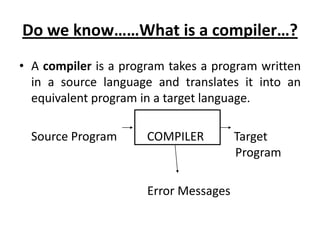
• A compiler is a program takes a program written
  in a source language and translates it into an
  equivalent program in a target language.

  Source Program      COMPILER         Target
                                       Program

                      Error Messages
Compilers…. Why ??
• Isn’t it a very old discipline?
   – Yes, it is a well-established discipline: Algorithms,
     methods and techniques are researched and
     developed in early stages of computer science growth.
   – Now, there are many compilers available around and
     many tools to generate them automatically.

• So, why do we need to learn it?
   – But the techniques we learn is useful in many tasks
     like writing an interpreter for a scripting language,
     validation checking for forms and so on.
                                              contd…
– Techniques used in a lexical analyzer can be used
  in text editors, information retrieval system, and
  pattern recognition programs.
– Techniques used in a parser can be used in a query
  processing system such as SQL.
– Many software having a complex front-end may
  need techniques used in compiler design.
– Most of the techniques used in compiler design
  can be used in Natural Language Processing (NLP)
  systems.
Is there any prerequisite…???

• Basic knowledge of Programming languages.
• Basic knowledge of FSA and CFG.
• An open perspective to visualize the concepts.
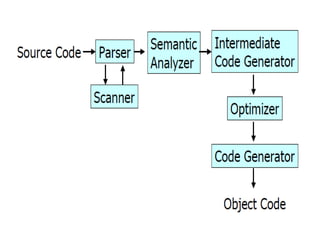
Phases of Compilers
• Analysis phase:
  An intermediate representation is created from
  the given source program.
  – Lexical Analyzer, Syntax Analyzer and Semantic
    Analyzer are the parts of this phase.
• Synthesis phase:
  The equivalent target program is created from
  the intermediate representation.
  – Intermediate Code Generator, Code Generator, and
    Code Optimizer are the parts of this phase.
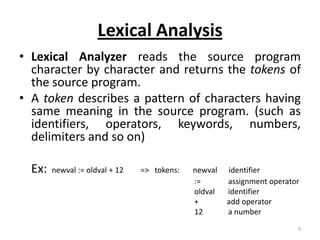
Lexical Analysis
• Lexical Analyzer reads the source program
  character by character and returns the tokens of
  the source program.
• A token describes a pattern of characters having
  same meaning in the source program. (such as
  identifiers, operators, keywords, numbers,
  delimiters and so on)

  Ex:   newval := oldval + 12   => tokens:   newval   identifier
                                             :=       assignment operator
                                             oldval   identifier
                                             +        add operator
                                             12       a number
                                                                        9
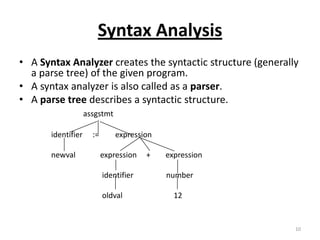
Syntax Analysis
• A Syntax Analyzer creates the syntactic structure (generally
  a parse tree) of the given program.
• A syntax analyzer is also called as a parser.
• A parse tree describes a syntactic structure.
                    assgstmt

       identifier     :=       expression

       newval              expression   +   expression

                           identifier       number

                           oldval             12


                                                             10
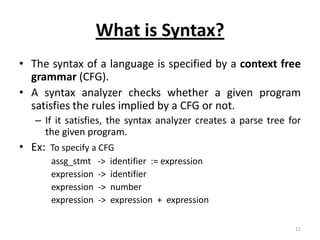
What is Syntax?
• The syntax of a language is specified by a context free
  grammar (CFG).
• A syntax analyzer checks whether a given program
  satisfies the rules implied by a CFG or not.
   – If it satisfies, the syntax analyzer creates a parse tree for
     the given program.
• Ex: To specify a CFG
       assg_stmt    ->   identifier := expression
       expression   ->   identifier
       expression   ->   number
       expression   ->   expression + expression

                                                                11
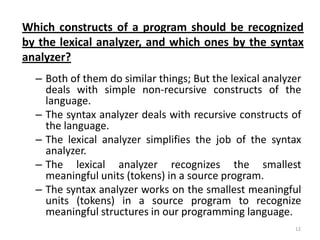
Which constructs of a program should be recognized
by the lexical analyzer, and which ones by the syntax
analyzer?
  – Both of them do similar things; But the lexical analyzer
    deals with simple non-recursive constructs of the
    language.
  – The syntax analyzer deals with recursive constructs of
    the language.
  – The lexical analyzer simplifies the job of the syntax
    analyzer.
  – The lexical analyzer recognizes the smallest
    meaningful units (tokens) in a source program.
  – The syntax analyzer works on the smallest meaningful
    units (tokens) in a source program to recognize
    meaningful structures in our programming language.
                                                          12
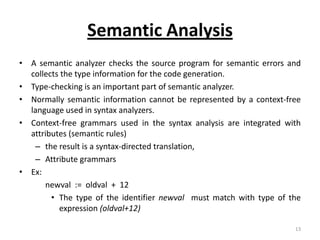
Semantic Analysis
• A semantic analyzer checks the source program for semantic errors and
  collects the type information for the code generation.
• Type-checking is an important part of semantic analyzer.
• Normally semantic information cannot be represented by a context-free
  language used in syntax analyzers.
• Context-free grammars used in the syntax analysis are integrated with
  attributes (semantic rules)
   – the result is a syntax-directed translation,
   – Attribute grammars
• Ex:
      newval := oldval + 12
        • The type of the identifier newval must match with type of the
          expression (oldval+12)

                                                                     13
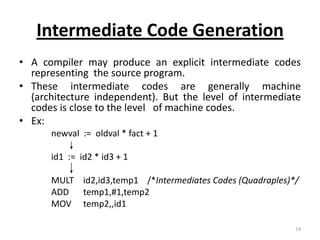
Intermediate Code Generation
• A compiler may produce an explicit intermediate codes
  representing the source program.
• These intermediate codes are generally machine
  (architecture independent). But the level of intermediate
  codes is close to the level of machine codes.
• Ex:
      newval := oldval * fact + 1

      id1 := id2 * id3 + 1

      MULT id2,id3,temp1 /*Intermediates Codes (Quadraples)*/
      ADD temp1,#1,temp2
      MOV temp2,,id1

                                                            14
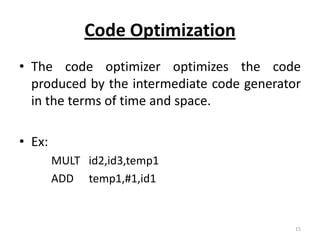
Code Optimization
• The code optimizer optimizes the code
  produced by the intermediate code generator
  in the terms of time and space.

• Ex:
        MULT id2,id3,temp1
        ADD temp1,#1,id1


                                            15
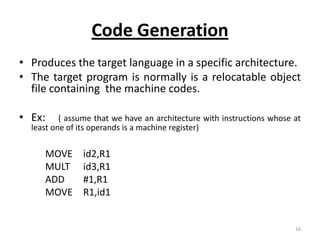
Code Generation
• Produces the target language in a specific architecture.
• The target program is normally is a relocatable object
  file containing the machine codes.

• Ex:     ( assume that we have an architecture with instructions whose at
  least one of its operands is a machine register)


     MOVE      id2,R1
     MULT      id3,R1
     ADD       #1,R1
     MOVE      R1,id1


                                                                        16
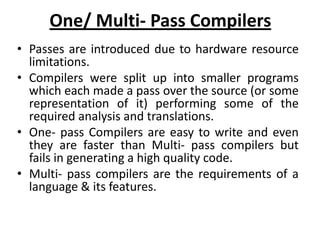
One/ Multi- Pass Compilers
• Passes are introduced due to hardware resource
  limitations.
• Compilers were split up into smaller programs
  which each made a pass over the source (or some
  representation of it) performing some of the
  required analysis and translations.
• One- pass Compilers are easy to write and even
  they are faster than Multi- pass compilers but
  fails in generating a high quality code.
• Multi- pass compilers are the requirements of a
  language & its features.
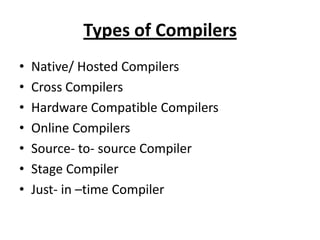
Types of Compilers
•   Native/ Hosted Compilers
•   Cross Compilers
•   Hardware Compatible Compilers
•   Online Compilers
•   Source- to- source Compiler
•   Stage Compiler
•   Just- in –time Compiler
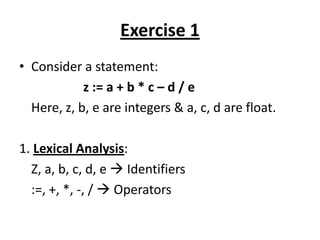
Exercise 1
• Consider a statement:
            z := a + b * c – d / e
  Here, z, b, e are integers & a, c, d are float.

1. Lexical Analysis:
  Z, a, b, c, d, e  Identifiers
  :=, +, *, -, /  Operators
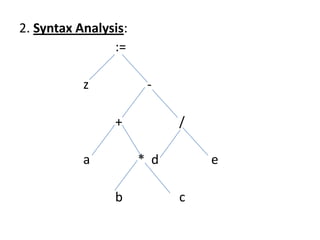
2. Syntax Analysis:
                :=

           z           -

                +           /

           a          * d       e

                b           c
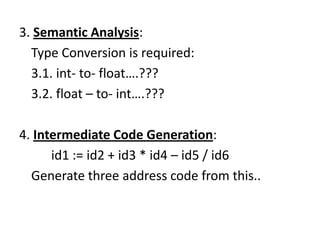
3. Semantic Analysis:
  Type Conversion is required:
  3.1. int- to- float….???
  3.2. float – to- int….???

4. Intermediate Code Generation:
      id1 := id2 + id3 * id4 – id5 / id6
  Generate three address code from this..
5. Code Optimization

6. Code Generation
References
• TextBook:
  “Compilers: Principles, Techniques, and Tools”
  Alfred V. Aho, Ravi Sethi, and Jeffrey D.
  Ullman, Addison-Wesley, 1986.
• Reference Books:
  “Basics of Compiler Design” Torben Ægidius
  Mogensen.
1 cc

1 cc

  • 1.
    Compiler Construction: An Introduction Delivery By: Ms. Kavita Choudhary Assistant Professor (Sr.), CSE
  • 2.
    Outline • Do we know……What is a compiler…? • Compilers… Why? • Is there any prerequisite? • Phases of Compiler • References • Queries???
  • 3.
    Do we know……Whatis a compiler…? • A compiler is a program takes a program written in a source language and translates it into an equivalent program in a target language. Source Program COMPILER Target Program Error Messages
  • 4.
    Compilers…. Why ?? •Isn’t it a very old discipline? – Yes, it is a well-established discipline: Algorithms, methods and techniques are researched and developed in early stages of computer science growth. – Now, there are many compilers available around and many tools to generate them automatically. • So, why do we need to learn it? – But the techniques we learn is useful in many tasks like writing an interpreter for a scripting language, validation checking for forms and so on. contd…
  • 5.
    – Techniques usedin a lexical analyzer can be used in text editors, information retrieval system, and pattern recognition programs. – Techniques used in a parser can be used in a query processing system such as SQL. – Many software having a complex front-end may need techniques used in compiler design. – Most of the techniques used in compiler design can be used in Natural Language Processing (NLP) systems.
  • 6.
    Is there anyprerequisite…??? • Basic knowledge of Programming languages. • Basic knowledge of FSA and CFG. • An open perspective to visualize the concepts.
  • 7.
    Phases of Compilers •Analysis phase: An intermediate representation is created from the given source program. – Lexical Analyzer, Syntax Analyzer and Semantic Analyzer are the parts of this phase. • Synthesis phase: The equivalent target program is created from the intermediate representation. – Intermediate Code Generator, Code Generator, and Code Optimizer are the parts of this phase.
  • 9.
    Lexical Analysis • LexicalAnalyzer reads the source program character by character and returns the tokens of the source program. • A token describes a pattern of characters having same meaning in the source program. (such as identifiers, operators, keywords, numbers, delimiters and so on) Ex: newval := oldval + 12 => tokens: newval identifier := assignment operator oldval identifier + add operator 12 a number 9
  • 10.
    Syntax Analysis • ASyntax Analyzer creates the syntactic structure (generally a parse tree) of the given program. • A syntax analyzer is also called as a parser. • A parse tree describes a syntactic structure. assgstmt identifier := expression newval expression + expression identifier number oldval 12 10
  • 11.
    What is Syntax? •The syntax of a language is specified by a context free grammar (CFG). • A syntax analyzer checks whether a given program satisfies the rules implied by a CFG or not. – If it satisfies, the syntax analyzer creates a parse tree for the given program. • Ex: To specify a CFG assg_stmt -> identifier := expression expression -> identifier expression -> number expression -> expression + expression 11
  • 12.
    Which constructs ofa program should be recognized by the lexical analyzer, and which ones by the syntax analyzer? – Both of them do similar things; But the lexical analyzer deals with simple non-recursive constructs of the language. – The syntax analyzer deals with recursive constructs of the language. – The lexical analyzer simplifies the job of the syntax analyzer. – The lexical analyzer recognizes the smallest meaningful units (tokens) in a source program. – The syntax analyzer works on the smallest meaningful units (tokens) in a source program to recognize meaningful structures in our programming language. 12
  • 13.
    Semantic Analysis • Asemantic analyzer checks the source program for semantic errors and collects the type information for the code generation. • Type-checking is an important part of semantic analyzer. • Normally semantic information cannot be represented by a context-free language used in syntax analyzers. • Context-free grammars used in the syntax analysis are integrated with attributes (semantic rules) – the result is a syntax-directed translation, – Attribute grammars • Ex: newval := oldval + 12 • The type of the identifier newval must match with type of the expression (oldval+12) 13
  • 14.
    Intermediate Code Generation •A compiler may produce an explicit intermediate codes representing the source program. • These intermediate codes are generally machine (architecture independent). But the level of intermediate codes is close to the level of machine codes. • Ex: newval := oldval * fact + 1 id1 := id2 * id3 + 1 MULT id2,id3,temp1 /*Intermediates Codes (Quadraples)*/ ADD temp1,#1,temp2 MOV temp2,,id1 14
  • 15.
    Code Optimization • Thecode optimizer optimizes the code produced by the intermediate code generator in the terms of time and space. • Ex: MULT id2,id3,temp1 ADD temp1,#1,id1 15
  • 16.
    Code Generation • Producesthe target language in a specific architecture. • The target program is normally is a relocatable object file containing the machine codes. • Ex: ( assume that we have an architecture with instructions whose at least one of its operands is a machine register) MOVE id2,R1 MULT id3,R1 ADD #1,R1 MOVE R1,id1 16
  • 17.
    One/ Multi- PassCompilers • Passes are introduced due to hardware resource limitations. • Compilers were split up into smaller programs which each made a pass over the source (or some representation of it) performing some of the required analysis and translations. • One- pass Compilers are easy to write and even they are faster than Multi- pass compilers but fails in generating a high quality code. • Multi- pass compilers are the requirements of a language & its features.
  • 18.
    Types of Compilers • Native/ Hosted Compilers • Cross Compilers • Hardware Compatible Compilers • Online Compilers • Source- to- source Compiler • Stage Compiler • Just- in –time Compiler
  • 19.
    Exercise 1 • Considera statement: z := a + b * c – d / e Here, z, b, e are integers & a, c, d are float. 1. Lexical Analysis: Z, a, b, c, d, e  Identifiers :=, +, *, -, /  Operators
  • 20.
    2. Syntax Analysis: := z - + / a * d e b c
  • 21.
    3. Semantic Analysis: Type Conversion is required: 3.1. int- to- float….??? 3.2. float – to- int….??? 4. Intermediate Code Generation: id1 := id2 + id3 * id4 – id5 / id6 Generate three address code from this..
  • 22.
    5. Code Optimization 6.Code Generation
  • 23.
    References • TextBook: “Compilers: Principles, Techniques, and Tools” Alfred V. Aho, Ravi Sethi, and Jeffrey D. Ullman, Addison-Wesley, 1986. • Reference Books: “Basics of Compiler Design” Torben Ægidius Mogensen.