Hello
The All-Flash Array for the
Next Generation Data Center
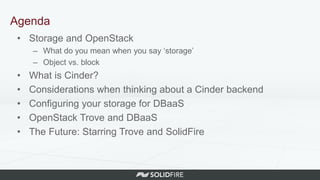
• Storage and OpenStack
– What do you mean when you say ‘storage’
– Object vs. block
• What is Cinder?
• Considerations when thinking about a Cinder backend
• Configuring your storage for DBaaS
• OpenStack Trove and DBaaS
• The Future: Starring Trove and SolidFire
Agenda
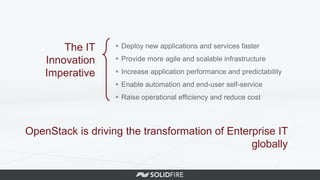
 Deploy new applications and services faster
 Provide more agile and scalable infrastructure
 Increase application performance and predictability
 Enable automation and end-user self-service
 Raise operational efficiency and reduce cost
The IT
Innovation
Imperative
OpenStack is driving the transformation of Enterprise IT
globally
Quick Poll:
● How many of you contribute to OpenStack?
● How many of you are end-users of OpenStack?
● How many of you are OpenStack Operators?
● How many of you work for Vendor Organizations that contribute to
OpenStack?
● How many are “all of the above”?
So…What do you mean when you say ‘storage’ ?
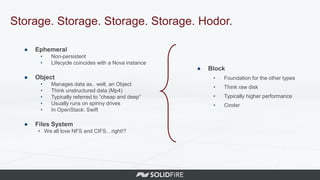
Storage. Storage. Storage. Storage. Hodor.
● Ephemeral
• Non-persistent
• Lifecycle coincides with a Nova instance
● Object
• Manages data as.. well, an Object
• Think unstructured data (Mp4)
• Typically referred to “cheap and deep”
• Usually runs on spinny drives
• In OpenStack: Swift
● Files System
• We all love NFS and CIFS…right!?
● Block
• Foundation for the other types
• Think raw disk
• Typically higher performance
• Cinder
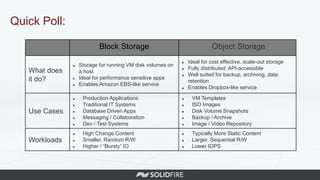
Quick Poll:
Block Storage Object Storage
What does
it do?
● Storage for running VM disk volumes on
a host
● Ideal for performance sensitive apps
● Enables Amazon EBS-like service
● Ideal for cost effective, scale-out storage
● Fully distributed, API-accessible
● Well suited for backup, archiving, data
retention
● Enables Dropbox-like service
Use Cases
● Production Applications
● Traditional IT Systems
● Database Driven Apps
● Messaging / Collaboration
● Dev / Test Systems
● VM Templates
● ISO Images
● Disk Volume Snapshots
● Backup / Archive
● Image / Video Repository
Workloads
● High Change Content
● Smaller, Random R/W
● Higher / “Bursty” IO
● Typically More Static Content
● Larger, Sequential R/W
● Lower IOPS
Let’s talk Cinder!
Cinder Mission Statement
To implement services and libraries to provide on demand, self-service access
to Block Storage resources. Provide Software Defined Block Storage via
abstraction and automation on top of various traditional backend block storage
devices.
Huh?
Very Simple.
Cinder is an API that allows you to
dynamically create/attach/detach disks
to your Nova instance.
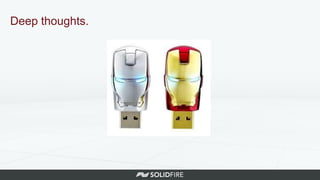
Deep thoughts.
How it works…
● Plugin architecture, use whatever storage backend you want
● Consistent API, agnostic to the infrastructure
● Expose differentiating features via custom volume-types and
extra-specs
Reference Implementation Included
 Includes code to provide a base implementation using LVM (just add disks)
 Great for POC and getting started
 Sometimes good enough
 Might be lacking for your performance, H/A and Scaling needs (it all depends)
 Can Scale by adding Nodes
 Cinder-Volume Node utilizes it’s local disks (allocate by creating an LVM VG)
 Cinder Volumes are LVM Logical Volumes, with an iSCSI target created for eac
 Typical max size recommendations per VG/Cinder-Volume backend ~ 5 TB
 No Redundancy (yet)
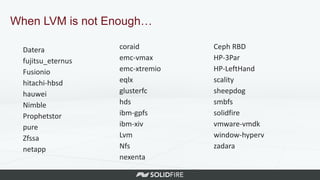
When LVM is not Enough…
Datera
fujitsu_eternus
Fusionio
hitachi-hbsd
hauwei
Nimble
Prophetstor
pure
Zfssa
netapp
coraid
emc-vmax
emc-xtremio
eqlx
glusterfc
hds
ibm-gpfs
ibm-xiv
Lvm
Nfs
nexenta
Ceph RBD
HP-3Par
HP-LeftHand
scality
sheepdog
smbfs
solidfire
vmware-vmdk
window-hyperv
zadara
Choosing a Vendor = the Hardest Part
 Ask yourself:
 Does it scale? How?
 Is it tested? Will it really work in OpenStack?
 How is it supported?
 How is performance and how does it handle noisy neighbors?
 Is the vendor active in the community?
 How easy is it to stand up?
Now…a word from our Sponsor
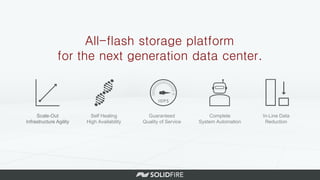
All-flash storage platform
for the next generation data center.
Scale-Out
Infrastructure Agility
Guaranteed
Quality of Service
Complete
System Automation
In-Line Data
Reduction
Self Healing
High Availability
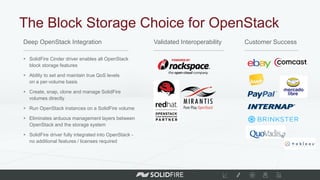
 SolidFire Cinder driver enables all OpenStack
block storage features
 Ability to set and maintain true QoS levels
on a per-volume basis
 Create, snap, clone and manage SolidFire
volumes directly
 Run OpenStack instances on a SolidFire volume
 Eliminates arduous management layers between
OpenStack and the storage system
 SolidFire driver fully integrated into OpenStack -
no additional features / licenses required
Customer SuccessDeep OpenStack Integration Validated Interoperability
The Block Storage Choice for OpenStack
SolidFire and Cinder
 SolidFire led the creation of Cinder (break out from Nova)
 Full SolidFire driver integration with every new OpenStack release
 Set and maintain true QoS levels on a per-volume basis
 Web-based API exposing all cluster functionality
 SolidFire integration with OpenStack Cinder can be configured in less than a
minute
 Seamless scaling after initial configuration
 Full multi-tenant isolation
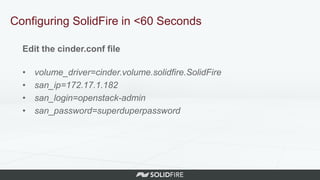
Configuring SolidFire in <60 Seconds
Edit the cinder.conf file
• volume_driver=cinder.volume.solidfire.SolidFire
• san_ip=172.17.1.182
• san_login=openstack-admin
• san_password=superduperpassword
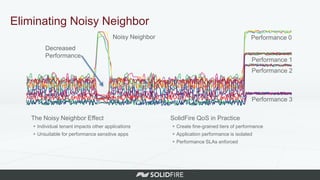
Eliminating Noisy Neighbor
The Noisy Neighbor Effect
 Individual tenant impacts other applications
 Unsuitable for performance sensitive apps
SolidFire QoS in Practice
 Create fine-grained tiers of performance
 Application performance is isolated
 Performance SLAs enforced
Noisy Neighbor Performance 0
Performance 1
Performance 2
Performance 3
Decreased
Performance
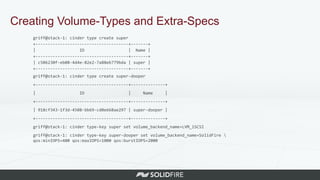
Creating Volume-Types and Extra-Specs
griff@stack-1: cinder type create super
+--------------------------------------+-------+
| ID | Name |
+--------------------------------------+-------+
| c506230f-eb08-4d4e-82e2-7a88eb779bda | super |
+--------------------------------------+-------+
griff@stack-1: cinder type create super-dooper
+--------------------------------------+--------------+
| ID | Name |
+--------------------------------------+--------------+
| 918cf343-1f3d-4508-bb69-cd0e668ae297 | super-dooper |
+--------------------------------------+--------------+
griff@stack-1: cinder type-key super set volume_backend_name=LVM_iSCSI
griff@stack-1: cinder type-key super-dooper set volume_backend_name=SolidFire 
qos:minIOPS=400 qos:maxIOPS=1000 qos:burstIOPS=2000
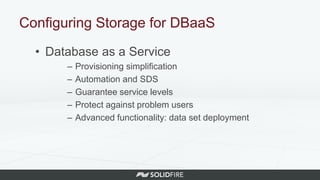
Configuring Storage for DBaaS
• Database as a Service
– Provisioning simplification
– Automation and SDS
– Guarantee service levels
– Protect against problem users
– Advanced functionality: data set deployment
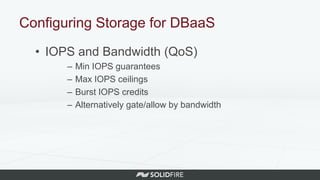
Configuring Storage for DBaaS
• IOPS and Bandwidth (QoS)
– Min IOPS guarantees
– Max IOPS ceilings
– Burst IOPS credits
– Alternatively gate/allow by bandwidth
Configuring Storage for DBaaS
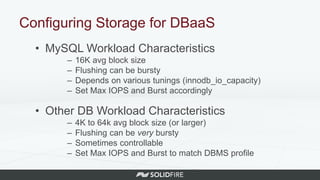
• MySQL Workload Characteristics
– 16K avg block size
– Flushing can be bursty
– Depends on various tunings (innodb_io_capacity)
– Set Max IOPS and Burst accordingly
• Other DB Workload Characteristics
– 4K to 64k avg block size (or larger)
– Flushing can be very bursty
– Sometimes controllable
– Set Max IOPS and Burst to match DBMS profile
Boom. Time for Tesora.
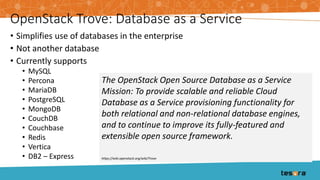
OpenStack Trove: Database as a Service
• Simplifies use of databases in the enterprise
• Not another database
• Currently supports
• MySQL
• Percona
• MariaDB
• PostgreSQL
• MongoDB
• CouchDB
• Couchbase
• Redis
• Vertica
• DB2 – Express
The OpenStack Open Source Database as a Service
Mission: To provide scalable and reliable Cloud
Database as a Service provisioning functionality for
both relational and non-relational database engines,
and to continue to improve its fully-featured and
extensible open source framework.
https://wiki.openstack.org/wiki/Trove
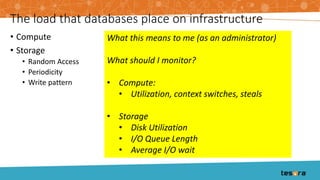
The load that databases place on infrastructure
• Compute
• Storage
• Random Access
• Periodicity
• Write pattern
What this means to me (as an administrator)
What should I monitor?
• Compute:
• Utilization, context switches, steals
• Storage
• Disk Utilization
• I/O Queue Length
• Average I/O wait
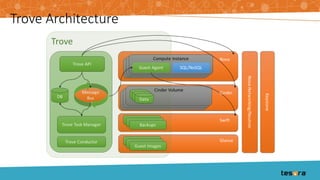
Trove Architecture
Storage Performance
• Why it matters
• Things databases do to improve storage performance
• What’s the ideal storage for a database?
Contact
• Amrith Kumar
• Founder & CTO, Tesora
• @amrithkumar
• IRC: amrith @freenode
• Tesora
• www.tesora.com
• @tesoracorp
• Sign up for Short Stack, our informative weekly newsletter about OpenStack
What’s next for DBaaS/Storage?
• Tighter integration between Cinder and Trove
• Up-level Cinder API call in Trove
• Surface more granular storage options
• Enable per-database storage customization
Thank You

Percona Live 4/14/15: Leveraging open stack cinder for peak application performance solidfire

  • 1.
  • 2.
    The All-Flash Arrayfor the Next Generation Data Center
  • 3.
    • Storage andOpenStack – What do you mean when you say ‘storage’ – Object vs. block • What is Cinder? • Considerations when thinking about a Cinder backend • Configuring your storage for DBaaS • OpenStack Trove and DBaaS • The Future: Starring Trove and SolidFire Agenda
  • 4.
     Deploy newapplications and services faster  Provide more agile and scalable infrastructure  Increase application performance and predictability  Enable automation and end-user self-service  Raise operational efficiency and reduce cost The IT Innovation Imperative OpenStack is driving the transformation of Enterprise IT globally
  • 5.
    Quick Poll: ● Howmany of you contribute to OpenStack? ● How many of you are end-users of OpenStack? ● How many of you are OpenStack Operators? ● How many of you work for Vendor Organizations that contribute to OpenStack? ● How many are “all of the above”?
  • 6.
    So…What do youmean when you say ‘storage’ ?
  • 7.
    Storage. Storage. Storage.Storage. Hodor. ● Ephemeral • Non-persistent • Lifecycle coincides with a Nova instance ● Object • Manages data as.. well, an Object • Think unstructured data (Mp4) • Typically referred to “cheap and deep” • Usually runs on spinny drives • In OpenStack: Swift ● Files System • We all love NFS and CIFS…right!? ● Block • Foundation for the other types • Think raw disk • Typically higher performance • Cinder
  • 8.
    Quick Poll: Block StorageObject Storage What does it do? ● Storage for running VM disk volumes on a host ● Ideal for performance sensitive apps ● Enables Amazon EBS-like service ● Ideal for cost effective, scale-out storage ● Fully distributed, API-accessible ● Well suited for backup, archiving, data retention ● Enables Dropbox-like service Use Cases ● Production Applications ● Traditional IT Systems ● Database Driven Apps ● Messaging / Collaboration ● Dev / Test Systems ● VM Templates ● ISO Images ● Disk Volume Snapshots ● Backup / Archive ● Image / Video Repository Workloads ● High Change Content ● Smaller, Random R/W ● Higher / “Bursty” IO ● Typically More Static Content ● Larger, Sequential R/W ● Lower IOPS
  • 9.
  • 10.
    Cinder Mission Statement Toimplement services and libraries to provide on demand, self-service access to Block Storage resources. Provide Software Defined Block Storage via abstraction and automation on top of various traditional backend block storage devices.
  • 11.
    Huh? Very Simple. Cinder isan API that allows you to dynamically create/attach/detach disks to your Nova instance.
  • 12.
  • 13.
    How it works… ●Plugin architecture, use whatever storage backend you want ● Consistent API, agnostic to the infrastructure ● Expose differentiating features via custom volume-types and extra-specs
  • 14.
    Reference Implementation Included Includes code to provide a base implementation using LVM (just add disks)  Great for POC and getting started  Sometimes good enough  Might be lacking for your performance, H/A and Scaling needs (it all depends)  Can Scale by adding Nodes  Cinder-Volume Node utilizes it’s local disks (allocate by creating an LVM VG)  Cinder Volumes are LVM Logical Volumes, with an iSCSI target created for eac  Typical max size recommendations per VG/Cinder-Volume backend ~ 5 TB  No Redundancy (yet)
  • 15.
    When LVM isnot Enough… Datera fujitsu_eternus Fusionio hitachi-hbsd hauwei Nimble Prophetstor pure Zfssa netapp coraid emc-vmax emc-xtremio eqlx glusterfc hds ibm-gpfs ibm-xiv Lvm Nfs nexenta Ceph RBD HP-3Par HP-LeftHand scality sheepdog smbfs solidfire vmware-vmdk window-hyperv zadara
  • 16.
    Choosing a Vendor= the Hardest Part  Ask yourself:  Does it scale? How?  Is it tested? Will it really work in OpenStack?  How is it supported?  How is performance and how does it handle noisy neighbors?  Is the vendor active in the community?  How easy is it to stand up?
  • 17.
    Now…a word fromour Sponsor
  • 18.
    All-flash storage platform forthe next generation data center. Scale-Out Infrastructure Agility Guaranteed Quality of Service Complete System Automation In-Line Data Reduction Self Healing High Availability
  • 19.
     SolidFire Cinderdriver enables all OpenStack block storage features  Ability to set and maintain true QoS levels on a per-volume basis  Create, snap, clone and manage SolidFire volumes directly  Run OpenStack instances on a SolidFire volume  Eliminates arduous management layers between OpenStack and the storage system  SolidFire driver fully integrated into OpenStack - no additional features / licenses required Customer SuccessDeep OpenStack Integration Validated Interoperability The Block Storage Choice for OpenStack
  • 20.
    SolidFire and Cinder SolidFire led the creation of Cinder (break out from Nova)  Full SolidFire driver integration with every new OpenStack release  Set and maintain true QoS levels on a per-volume basis  Web-based API exposing all cluster functionality  SolidFire integration with OpenStack Cinder can be configured in less than a minute  Seamless scaling after initial configuration  Full multi-tenant isolation
  • 21.
    Configuring SolidFire in<60 Seconds Edit the cinder.conf file • volume_driver=cinder.volume.solidfire.SolidFire • san_ip=172.17.1.182 • san_login=openstack-admin • san_password=superduperpassword
  • 22.
    Eliminating Noisy Neighbor TheNoisy Neighbor Effect  Individual tenant impacts other applications  Unsuitable for performance sensitive apps SolidFire QoS in Practice  Create fine-grained tiers of performance  Application performance is isolated  Performance SLAs enforced Noisy Neighbor Performance 0 Performance 1 Performance 2 Performance 3 Decreased Performance
  • 23.
    Creating Volume-Types andExtra-Specs griff@stack-1: cinder type create super +--------------------------------------+-------+ | ID | Name | +--------------------------------------+-------+ | c506230f-eb08-4d4e-82e2-7a88eb779bda | super | +--------------------------------------+-------+ griff@stack-1: cinder type create super-dooper +--------------------------------------+--------------+ | ID | Name | +--------------------------------------+--------------+ | 918cf343-1f3d-4508-bb69-cd0e668ae297 | super-dooper | +--------------------------------------+--------------+ griff@stack-1: cinder type-key super set volume_backend_name=LVM_iSCSI griff@stack-1: cinder type-key super-dooper set volume_backend_name=SolidFire qos:minIOPS=400 qos:maxIOPS=1000 qos:burstIOPS=2000
  • 24.
    Configuring Storage forDBaaS • Database as a Service – Provisioning simplification – Automation and SDS – Guarantee service levels – Protect against problem users – Advanced functionality: data set deployment
  • 25.
    Configuring Storage forDBaaS • IOPS and Bandwidth (QoS) – Min IOPS guarantees – Max IOPS ceilings – Burst IOPS credits – Alternatively gate/allow by bandwidth
  • 26.
    Configuring Storage forDBaaS • MySQL Workload Characteristics – 16K avg block size – Flushing can be bursty – Depends on various tunings (innodb_io_capacity) – Set Max IOPS and Burst accordingly • Other DB Workload Characteristics – 4K to 64k avg block size (or larger) – Flushing can be very bursty – Sometimes controllable – Set Max IOPS and Burst to match DBMS profile
  • 27.
  • 28.
    OpenStack Trove: Databaseas a Service • Simplifies use of databases in the enterprise • Not another database • Currently supports • MySQL • Percona • MariaDB • PostgreSQL • MongoDB • CouchDB • Couchbase • Redis • Vertica • DB2 – Express The OpenStack Open Source Database as a Service Mission: To provide scalable and reliable Cloud Database as a Service provisioning functionality for both relational and non-relational database engines, and to continue to improve its fully-featured and extensible open source framework. https://wiki.openstack.org/wiki/Trove
  • 29.
    The load thatdatabases place on infrastructure • Compute • Storage • Random Access • Periodicity • Write pattern What this means to me (as an administrator) What should I monitor? • Compute: • Utilization, context switches, steals • Storage • Disk Utilization • I/O Queue Length • Average I/O wait
  • 30.
  • 31.
    Storage Performance • Whyit matters • Things databases do to improve storage performance • What’s the ideal storage for a database?
  • 32.
    Contact • Amrith Kumar •Founder & CTO, Tesora • @amrithkumar • IRC: amrith @freenode • Tesora • www.tesora.com • @tesoracorp • Sign up for Short Stack, our informative weekly newsletter about OpenStack
  • 33.
    What’s next forDBaaS/Storage? • Tighter integration between Cinder and Trove • Up-level Cinder API call in Trove • Surface more granular storage options • Enable per-database storage customization
  • 35.