OpenStack Block Storage 101
How did we get to this point?
•  First there was virtualization…and it was
good
•  For smaller scale use cases it still is good
•  But, when scaling virtual environments…
•  Adding and deploying hypervisors
•  Storage performance degradation
•  Networking headaches
•  Management complexity
•  Something had to change
Graphic Source: http://crystaltec.com.au/services/virtualization
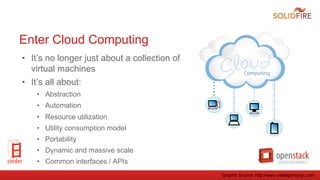
Enter Cloud Computing
•  It’s no longer just about a collection of
virtual machines
•  It’s all about:
•  Abstraction
•  Automation
•  Resource utilization
•  Utility consumption model
•  Portability
•  Dynamic and massive scale
•  Common interfaces / APIs
Graphic Source: http://www.intelligentitnyc.com
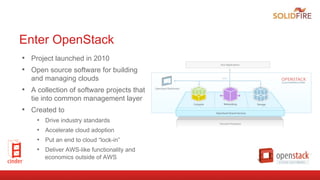
Enter OpenStack
•  Project launched in 2010
•  Open source software for building
and managing clouds
•  A collection of software projects that
tie into common management layer
•  Created to
•  Drive industry standards
•  Accelerate cloud adoption
•  Put an end to cloud “lock-in”
•  Deliver AWS-like functionality and
economics outside of AWS
So what does OpenStack really do?
•  Abstracted physical and virtualized resources tied into common
management layer
•  Virtual machines, Bare Metal, Storage, Networking, etc.
•  Easy to use REST-API
•  Self-service virtual environments for end users
•  Dynamic resource provisioning
•  Designed for massive scale
OpenStack Value Proposition
•  Manage virtualization across hypervisors
•  VMware, KVM, Hyper-V, Xen, etc.
•  Support the whole IaaS stack, not just compute
•  Storage, Networking, Security…
•  Drive greater resource utilization across infrastructure
•  Scale beyond the limitations of a hypervisor cluster
•  Pursuing compatibility between private & public clouds
•  Bringing “Software-Defined” Infrastructure vision to life
Early Use
Cases
•  Test & Development
•  Enterprise IT / DevOps / Continuous
Integration
•  Database
•  Relational (MySQL)
•  Non-Relational (MongoDB)
•  Internal Web Services
•  External Web Services
•  i.e. eCommerce, WebEx
OpenStack Community Momentum
•  Community of almost 10,000 people across 87
countries
•  >45 companies contributed to Grizzly release
•  >40 listed OpenStack case studies
•  >200 participating vendors across ecosystem
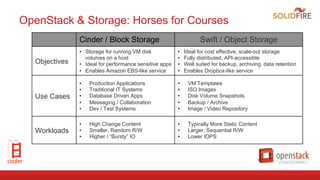
OpenStack & Storage: Horses for Courses
Cinder / Block Storage Swift / Object Storage
Objectives
•  Storage for running VM disk
volumes on a host
•  Ideal for performance sensitive apps
•  Enables Amazon EBS-like service
•  Ideal for cost effective, scale-out storage
•  Fully distributed, API-accessible
•  Well suited for backup, archiving, data retention
•  Enables Dropbox-like service
Use Cases
•  Production Applications
•  Traditional IT Systems
•  Database Driven Apps
•  Messaging / Collaboration
•  Dev / Test Systems
•  VM Templates
•  ISO Images
•  Disk Volume Snapshots
•  Backup / Archive
•  Image / Video Repository
Workloads
•  High Change Content
•  Smaller, Random R/W
•  Higher / “Bursty” IO
•  Typically More Static Content
•  Larger, Sequential R/W
•  Lower IOPS
OpenStack
Cinder
(Block Storage)
•  Architected to provide traditional block level
storage resources to other OpenStack
services
•  Presents persistent block level storage
volumes for use with OpenStack Nova
compute instances
•  Manages the creation, attaching and
detaching of these volumes between a storage
system like SolidFire and different host
servers
Cinder Base Features
•  create/delete volumes
•  specify custom "types/extra-specs"
•  clone
•  copy image to volume and volume to image
•  point in time copy (snapshots of volumes)
•  create volume from snapshot
•  backup volume (to object store, SWIFT and CEPH)
•  transfer volume ownership
•  customized scheduling filters
•  per tenant usage quotas
Vendor Unique Features
•  Exposed through custom types or extensions
•  Different back-ends for different use cases
•  Back-End selected by filter scheduler
•  Back-End is setup based on desired capabilities and
characteristics
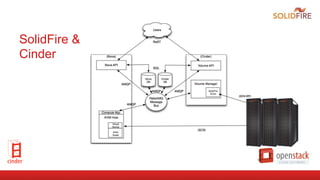
SolidFire &
Cinder
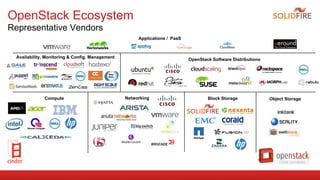
OpenStack Ecosystem
Representative Vendors
Compute Networking Object StorageBlock Storage
Availability, Monitoring & Config. Management
OpenStack Software Distributions
Applications / PaaS
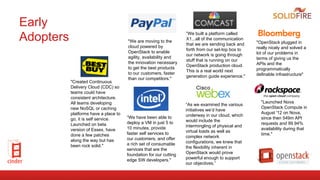
Early
Adopters "We are moving to the
cloud powered by
OpenStack to enable
agility, availability and
the innovation necessary
to get the best products
to our customers, faster
than our competitors."
“As we examined the various
initiatives we’d have
underway in our cloud, which
would include the
intermingling of physical and
virtual loads as well as
complex network
configurations, we knew that
the flexibility inherent in
OpenStack would prove
powerful enough to support
our objectives.”
“We have been able to
deploy a VM in just 5 to
10 minutes, provide
faster self services to
our customers, and offer
a rich set of consumable
services that are the
foundation for our cutting
edge SW developers."
”We built a platform called
X1...all of the communication
that we are sending back and
forth from our set-top box to
our network is going through
stuff that is running on our
OpenStack production cloud.
This is a real world next
generation guide experience."
"Created Continuous
Delivery Cloud (CDC) so
teams could have
consistent architecture.
All teams developing
new NoSQL or caching
platforms have a place to
go, it is self service.
Launched on beta
version of Essex, have
done a few patches
along the way but has
been rock solid."
"OpenStack plugged in
really nicely and solved a
lot of our problems in
terms of giving us the
APIs and the
programmatically
definable infrastructure"
"Launched Nova
OpenStack Compute in
August '12 on Nova,
since then 549m API
requests and 99.94%
availability during that
time."
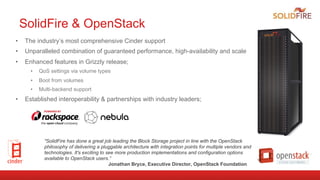
SolidFire & OpenStack
•  The industry’s most comprehensive Cinder support
•  Unparalleled combination of guaranteed performance, high-availability and scale
•  Enhanced features in Grizzly release;
•  QoS settings via volume types
•  Boot from volumes
•  Multi-backend support
•  Established interoperability & partnerships with industry leaders;
"SolidFire has done a great job leading the Block Storage project in line with the OpenStack
philosophy of delivering a pluggable architecture with integration points for multiple vendors and
technologies. It's exciting to see more production implementations and configuration options
available to OpenStack users.”
Jonathan Bryce, Executive Director, OpenStack Foundation
Related
Resources
•  OpenStack Solution Page
•  OpenStack Solution Brief
•  SolidFire/Cinder Reference Architecture
•  OpenStack Configuration Guide
•  SolidFire/Rackspace Private Cloud Implementation Guide
•  Video: Configuring OpenStack Block Storage w/SolidFire
•  Blogs
•  OpenStack Summit Recap: Mindshare Achieved, Market
Share Must Follow
•  Separating from the Pack
•  Why OpenStack Matters
How to get
involved?
•  It’s Easy, Start Here
•  https://wiki.openstack.org/wiki/
How_To_Contribute
•  Any questions?
•  Technical
•  john.griffith@solidfire.com
•  Partnership
•  mcclain.buggle@solidfire.com
•  Sales
•  sales@solidfire.com
1620 Pearl Street,
Boulder, Colorado 80302
Phone: 720.523.3278
Email: info@solidfire.com
www.solidfire.com

OpenStack Block Storage 101

  • 1.
  • 2.
    How did weget to this point? •  First there was virtualization…and it was good •  For smaller scale use cases it still is good •  But, when scaling virtual environments… •  Adding and deploying hypervisors •  Storage performance degradation •  Networking headaches •  Management complexity •  Something had to change Graphic Source: http://crystaltec.com.au/services/virtualization
  • 3.
    Enter Cloud Computing • It’s no longer just about a collection of virtual machines •  It’s all about: •  Abstraction •  Automation •  Resource utilization •  Utility consumption model •  Portability •  Dynamic and massive scale •  Common interfaces / APIs Graphic Source: http://www.intelligentitnyc.com
  • 4.
    Enter OpenStack •  Projectlaunched in 2010 •  Open source software for building and managing clouds •  A collection of software projects that tie into common management layer •  Created to •  Drive industry standards •  Accelerate cloud adoption •  Put an end to cloud “lock-in” •  Deliver AWS-like functionality and economics outside of AWS
  • 5.
    So what doesOpenStack really do? •  Abstracted physical and virtualized resources tied into common management layer •  Virtual machines, Bare Metal, Storage, Networking, etc. •  Easy to use REST-API •  Self-service virtual environments for end users •  Dynamic resource provisioning •  Designed for massive scale
  • 6.
    OpenStack Value Proposition • Manage virtualization across hypervisors •  VMware, KVM, Hyper-V, Xen, etc. •  Support the whole IaaS stack, not just compute •  Storage, Networking, Security… •  Drive greater resource utilization across infrastructure •  Scale beyond the limitations of a hypervisor cluster •  Pursuing compatibility between private & public clouds •  Bringing “Software-Defined” Infrastructure vision to life
  • 7.
    Early Use Cases •  Test& Development •  Enterprise IT / DevOps / Continuous Integration •  Database •  Relational (MySQL) •  Non-Relational (MongoDB) •  Internal Web Services •  External Web Services •  i.e. eCommerce, WebEx
  • 8.
    OpenStack Community Momentum • Community of almost 10,000 people across 87 countries •  >45 companies contributed to Grizzly release •  >40 listed OpenStack case studies •  >200 participating vendors across ecosystem
  • 9.
    OpenStack & Storage:Horses for Courses Cinder / Block Storage Swift / Object Storage Objectives •  Storage for running VM disk volumes on a host •  Ideal for performance sensitive apps •  Enables Amazon EBS-like service •  Ideal for cost effective, scale-out storage •  Fully distributed, API-accessible •  Well suited for backup, archiving, data retention •  Enables Dropbox-like service Use Cases •  Production Applications •  Traditional IT Systems •  Database Driven Apps •  Messaging / Collaboration •  Dev / Test Systems •  VM Templates •  ISO Images •  Disk Volume Snapshots •  Backup / Archive •  Image / Video Repository Workloads •  High Change Content •  Smaller, Random R/W •  Higher / “Bursty” IO •  Typically More Static Content •  Larger, Sequential R/W •  Lower IOPS
  • 10.
    OpenStack Cinder (Block Storage) •  Architectedto provide traditional block level storage resources to other OpenStack services •  Presents persistent block level storage volumes for use with OpenStack Nova compute instances •  Manages the creation, attaching and detaching of these volumes between a storage system like SolidFire and different host servers
  • 11.
    Cinder Base Features • create/delete volumes •  specify custom "types/extra-specs" •  clone •  copy image to volume and volume to image •  point in time copy (snapshots of volumes) •  create volume from snapshot •  backup volume (to object store, SWIFT and CEPH) •  transfer volume ownership •  customized scheduling filters •  per tenant usage quotas
  • 12.
    Vendor Unique Features • Exposed through custom types or extensions •  Different back-ends for different use cases •  Back-End selected by filter scheduler •  Back-End is setup based on desired capabilities and characteristics
  • 13.
  • 14.
    OpenStack Ecosystem Representative Vendors ComputeNetworking Object StorageBlock Storage Availability, Monitoring & Config. Management OpenStack Software Distributions Applications / PaaS
  • 15.
    Early Adopters "We aremoving to the cloud powered by OpenStack to enable agility, availability and the innovation necessary to get the best products to our customers, faster than our competitors." “As we examined the various initiatives we’d have underway in our cloud, which would include the intermingling of physical and virtual loads as well as complex network configurations, we knew that the flexibility inherent in OpenStack would prove powerful enough to support our objectives.” “We have been able to deploy a VM in just 5 to 10 minutes, provide faster self services to our customers, and offer a rich set of consumable services that are the foundation for our cutting edge SW developers." ”We built a platform called X1...all of the communication that we are sending back and forth from our set-top box to our network is going through stuff that is running on our OpenStack production cloud. This is a real world next generation guide experience." "Created Continuous Delivery Cloud (CDC) so teams could have consistent architecture. All teams developing new NoSQL or caching platforms have a place to go, it is self service. Launched on beta version of Essex, have done a few patches along the way but has been rock solid." "OpenStack plugged in really nicely and solved a lot of our problems in terms of giving us the APIs and the programmatically definable infrastructure" "Launched Nova OpenStack Compute in August '12 on Nova, since then 549m API requests and 99.94% availability during that time."
  • 16.
    SolidFire & OpenStack • The industry’s most comprehensive Cinder support •  Unparalleled combination of guaranteed performance, high-availability and scale •  Enhanced features in Grizzly release; •  QoS settings via volume types •  Boot from volumes •  Multi-backend support •  Established interoperability & partnerships with industry leaders; "SolidFire has done a great job leading the Block Storage project in line with the OpenStack philosophy of delivering a pluggable architecture with integration points for multiple vendors and technologies. It's exciting to see more production implementations and configuration options available to OpenStack users.” Jonathan Bryce, Executive Director, OpenStack Foundation
  • 17.
    Related Resources •  OpenStack SolutionPage •  OpenStack Solution Brief •  SolidFire/Cinder Reference Architecture •  OpenStack Configuration Guide •  SolidFire/Rackspace Private Cloud Implementation Guide •  Video: Configuring OpenStack Block Storage w/SolidFire •  Blogs •  OpenStack Summit Recap: Mindshare Achieved, Market Share Must Follow •  Separating from the Pack •  Why OpenStack Matters
  • 18.
    How to get involved? • It’s Easy, Start Here •  https://wiki.openstack.org/wiki/ How_To_Contribute •  Any questions? •  Technical •  john.griffith@solidfire.com •  Partnership •  mcclain.buggle@solidfire.com •  Sales •  sales@solidfire.com
  • 19.
    1620 Pearl Street, Boulder,Colorado 80302 Phone: 720.523.3278 Email: info@solidfire.com www.solidfire.com