A
 Presentation
      on
“Types of debt
   Security”


Presented by:
Patel Lalji (KIM-MBA-10-329)
Introduction
 What is security?
 A security is a negotiable financial instrument. Negotiability
  refers to the fact that its legal ownership is readily capable of
  being transferred from one owner to another by delivery or
  endorsement.

 What is debt security?
 A debt security is a negotiable financial instrument serving as
  indication of a debt.
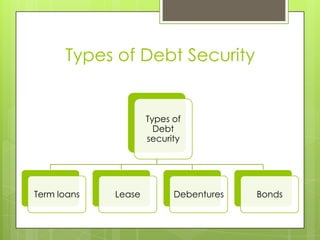
Types of Debt Security


                     Types of
                       Debt
                     security


Term loans   Lease         Debentures   Bonds
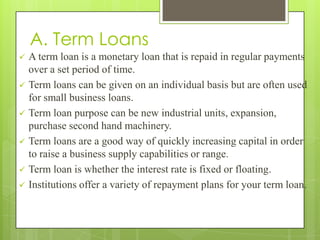
A. Term Loans
   A term loan is a monetary loan that is repaid in regular payments
    over a set period of time.
   Term loans can be given on an individual basis but are often used
    for small business loans.
   Term loan purpose can be new industrial units, expansion,
    purchase second hand machinery.
   Term loans are a good way of quickly increasing capital in order
    to raise a business supply capabilities or range.
   Term loan is whether the interest rate is fixed or floating.
   Institutions offer a variety of repayment plans for your term loan.
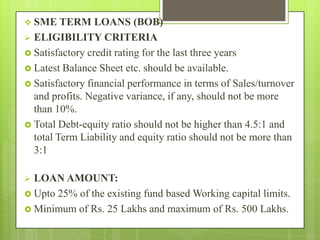
 SME    TERM LOANS (BOB)
 ELIGIBILITY CRITERIA
 Satisfactory credit rating for the last three years
 Latest Balance Sheet etc. should be available.
 Satisfactory financial performance in terms of Sales/turnover
  and profits. Negative variance, if any, should not be more
  than 10%.
 Total Debt-equity ratio should not be higher than 4.5:1 and
  total Term Liability and equity ratio should not be more than
  3:1

 LOAN AMOUNT:
 Upto 25% of the existing fund based Working capital limits.
 Minimum of Rs. 25 Lakhs and maximum of Rs. 500 Lakhs.
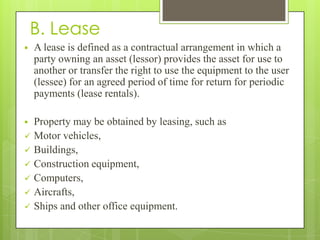
B. Lease
   A lease is defined as a contractual arrangement in which a
    party owning an asset (lessor) provides the asset for use to
    another or transfer the right to use the equipment to the user
    (lessee) for an agreed period of time for return for periodic
    payments (lease rentals).

   Property may be obtained by leasing, such as
   Motor vehicles,
   Buildings,
   Construction equipment,
   Computers,
   Aircrafts,
   Ships and other office equipment.
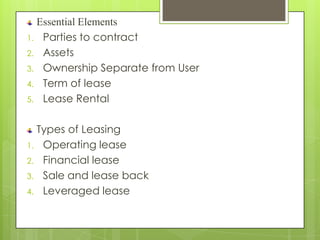
Essential Elements
1. Parties to contract
2. Assets
3. Ownership Separate from User
4. Term of lease
5. Lease Rental


  Types of Leasing
1. Operating lease
2. Financial lease
3. Sale and lease back
4. Leveraged lease
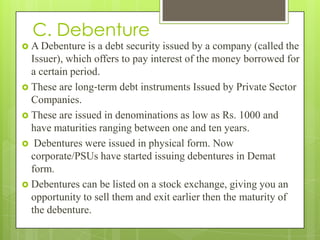
C. Debenture
 A Debenture   is a debt security issued by a company (called the
  Issuer), which offers to pay interest of the money borrowed for
  a certain period.
 These are long‐term debt instruments Issued by Private Sector
  Companies.
 These are issued in denominations as low as Rs. 1000 and
  have maturities ranging between one and ten years.
 Debentures were issued in physical form. Now
  corporate/PSUs have started issuing debentures in Demat
  form.
 Debentures can be listed on a stock exchange, giving you an
  opportunity to sell them and exit earlier then the maturity of
  the debenture.
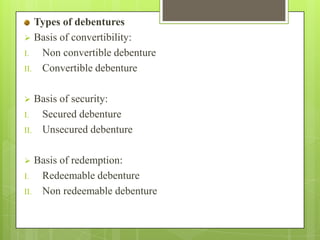
Types of debentures
 Basis of convertibility:
I.  Non convertible debenture
II. Convertible debenture


  Basis of security:
I.  Secured debenture
II. Unsecured debenture


  Basis of redemption:
I.  Redeemable debenture
II. Non redeemable debenture
D. Bond
 A debt  investment in which an investor loans money to an
  entity (corporate or governmental) that borrows the funds for
  a defined period of time at a fixed interest rate.
 Bonds are used by companies, municipalities, states and
  foreign governments to finance a variety of projects and
  activities.
 Bonds are referred to as fixed-income securities.
 Interest on bonds is usually paid every six months
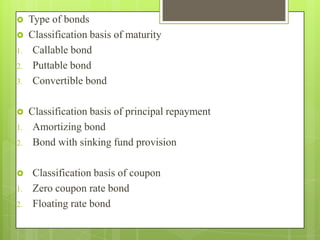
    Type of bonds
    Classification basis of maturity
1.    Callable bond
2.    Puttable bond
3.    Convertible bond

    Classification basis of principal repayment
1.    Amortizing bond
2.    Bond with sinking fund provision

    Classification basis of coupon
1.   Zero coupon rate bond
2.   Floating rate bond
Type of debt security

Type of debt security

  • 1.
    A Presentation on “Types of debt Security” Presented by: Patel Lalji (KIM-MBA-10-329)
  • 2.
    Introduction  What issecurity?  A security is a negotiable financial instrument. Negotiability refers to the fact that its legal ownership is readily capable of being transferred from one owner to another by delivery or endorsement.  What is debt security?  A debt security is a negotiable financial instrument serving as indication of a debt.
  • 3.
    Types of DebtSecurity Types of Debt security Term loans Lease Debentures Bonds
  • 4.
    A. Term Loans  A term loan is a monetary loan that is repaid in regular payments over a set period of time.  Term loans can be given on an individual basis but are often used for small business loans.  Term loan purpose can be new industrial units, expansion, purchase second hand machinery.  Term loans are a good way of quickly increasing capital in order to raise a business supply capabilities or range.  Term loan is whether the interest rate is fixed or floating.  Institutions offer a variety of repayment plans for your term loan.
  • 5.
     SME TERM LOANS (BOB)  ELIGIBILITY CRITERIA  Satisfactory credit rating for the last three years  Latest Balance Sheet etc. should be available.  Satisfactory financial performance in terms of Sales/turnover and profits. Negative variance, if any, should not be more than 10%.  Total Debt-equity ratio should not be higher than 4.5:1 and total Term Liability and equity ratio should not be more than 3:1  LOAN AMOUNT:  Upto 25% of the existing fund based Working capital limits.  Minimum of Rs. 25 Lakhs and maximum of Rs. 500 Lakhs.
  • 6.
    B. Lease  A lease is defined as a contractual arrangement in which a party owning an asset (lessor) provides the asset for use to another or transfer the right to use the equipment to the user (lessee) for an agreed period of time for return for periodic payments (lease rentals).  Property may be obtained by leasing, such as  Motor vehicles,  Buildings,  Construction equipment,  Computers,  Aircrafts,  Ships and other office equipment.
  • 7.
    Essential Elements 1. Partiesto contract 2. Assets 3. Ownership Separate from User 4. Term of lease 5. Lease Rental Types of Leasing 1. Operating lease 2. Financial lease 3. Sale and lease back 4. Leveraged lease
  • 8.
    C. Debenture  ADebenture is a debt security issued by a company (called the Issuer), which offers to pay interest of the money borrowed for a certain period.  These are long‐term debt instruments Issued by Private Sector Companies.  These are issued in denominations as low as Rs. 1000 and have maturities ranging between one and ten years.  Debentures were issued in physical form. Now corporate/PSUs have started issuing debentures in Demat form.  Debentures can be listed on a stock exchange, giving you an opportunity to sell them and exit earlier then the maturity of the debenture.
  • 9.
    Types of debentures Basis of convertibility: I. Non convertible debenture II. Convertible debenture  Basis of security: I. Secured debenture II. Unsecured debenture  Basis of redemption: I. Redeemable debenture II. Non redeemable debenture
  • 10.
    D. Bond  Adebt investment in which an investor loans money to an entity (corporate or governmental) that borrows the funds for a defined period of time at a fixed interest rate.  Bonds are used by companies, municipalities, states and foreign governments to finance a variety of projects and activities.  Bonds are referred to as fixed-income securities.  Interest on bonds is usually paid every six months
  • 11.
    Type of bonds  Classification basis of maturity 1. Callable bond 2. Puttable bond 3. Convertible bond  Classification basis of principal repayment 1. Amortizing bond 2. Bond with sinking fund provision  Classification basis of coupon 1. Zero coupon rate bond 2. Floating rate bond