"If you love your content, set it free" ?

Editor's Notes

  • #3 Head of Web at The Science Museum Before that, Web Production at Waterstone’s Online
  • #4 Before we get started...
  • #5 Address at the end Also - will hope to have at least 5 minutes for talking / questions
  • #8 ...instead, I’d like to think around the question - “riff” a bit on the theme
  • #9 The main point is to take a step back from the journals / publishing sector and look at the rest of the world for a moment
  • #10 Hopefully, this’ll be useful, and if not, thought provoking. And if not, just enjoy some time off :-)
  • #11 There is a LOT of detail, history and existing business models around online (journal) publishing. I don’t really want to spend too much time looking at this detail
  • #12 This is a complicated and emotive space. Business models, and hence jobs and futures are therefore obviously a part of the conversation Just remember, I’m not offering an answer, just posing some questions :-)
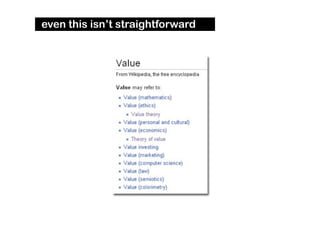
  • #13 So let’s ask a big question..
  • #17 ...if you have something which is valuable, and desired, hide it away
  • #18 ..and you can then create some form of capital (financial, social) out of your assets
  • #19 This is very familiar, very standard stuff. It is what drives commerce and businesses; from market stalls to the trading floor
  • #20 The emergence of the web - not “the internet”, but the web that we are starting to see today - a web that is absolutely ubiquitous to our lives and being
  • #21 ..things have changed beyond any kind of belief
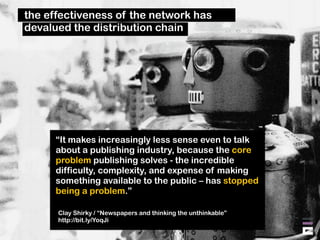
  • #22 Clay Shirky (author of seminal book “Here Comes Everybody”) focuses on the core issue of *content mobilisation* in this blog post
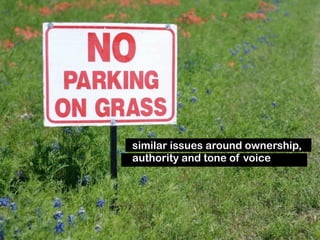
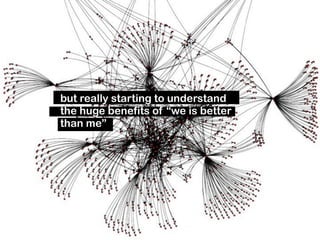
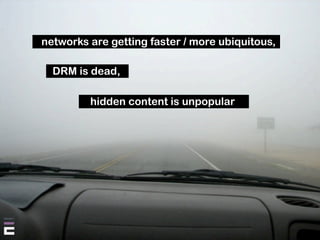
  • #23 ..three main points about this: first, the network is only getting faster, more accessible and usable. Second - DRM has been hunted down and shot dead in a ditch. Third - hidden content (we’ll look at this in some more detail) is unpopular
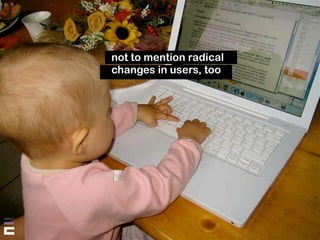
  • #24 Users are changing
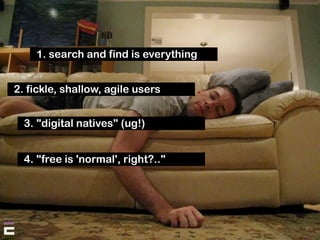
  • #25 ..also changing - the *way* that people use the web, and hence their content, too - search (mainly google, but in general) becomes the core starting point for...everything - users need rapid satisfaction - they are less likely to be faithful, more fickle - they are “natives” to the technology: absolutely familiar - it is “invisible”, as Tom Standage puts it
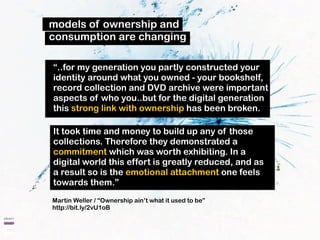
  • #26 one of the consequences is that the *model of ownership* has changed because of all this. And this is in a way that “us old people” probably don’t understand!
  • #27 One obvious place to look at this is in the music industry, which has suffered the digital generation more than most
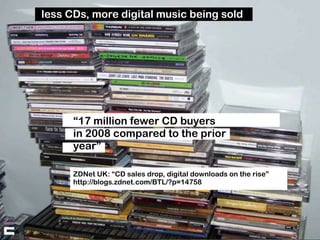
  • #28 Downloads are on the rise as the physicality of music drops off.
  • #29 and particularly in this space, we’re seeing huge numbers of alternative business models - subscription, freemium, costing based on popularity, free! (seeqpod), social...
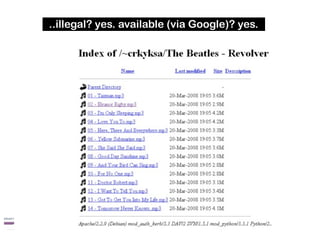
  • #30 ...not forgetting illegal! But bear in mind this particular screenshot isn’t from some dark internet backwater, it is just from a specially formatted google search. And *is* it illegal?
  • #31 ...more to the point - what does the industry DO about it? When everyone is a software pirate in (literally) two clicks of their mouse...
  • #32 Newspapers have come under similar scrutiny, and have responded in many different ways
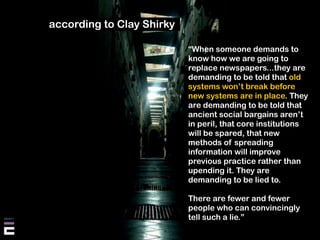
  • #33 Clay Shirky again - his angle is that this is, effectively, the END of newspapers as we know them. Maybe the important point in this quote is the highlighted bit - the changes are far too rapid to cope with them
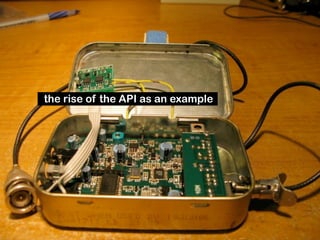
  • #34 The Guardian has recently been in the headlines for opening up their content and data store via a freely available API. This is radical for publishing, but the norm now online: Amazon, eBay, Flickr, Google, Yahoo! to name but a few. More on API’s later.
  • #35 Books are potentially in a similar space, although we still hang on to notions of physicality, and the fact that the content is more lasting than news makes them harder to let go of. I’ve got a wall full of books, and strongly resist thoughts of not. But we should still face up to the fact that this isn’t always going to be the same for everyone
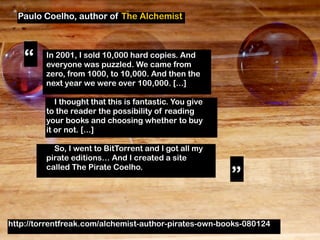
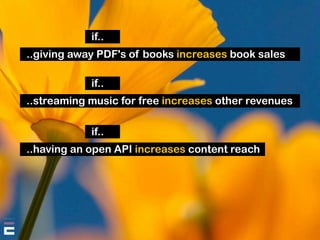
  • #36 Coelho, well known author of The Alchemist, did something interesting in this new climate. Much to his publishers’ horror, he put his books available for free on BitTorrent. And saw sales radically increase because of it...
  • #37 over in museums and galleries...
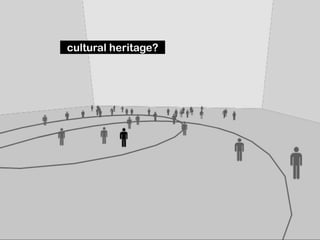
  • #38 very familiar landscape where the *authority* is what makes these places special
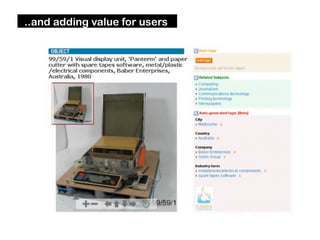
  • #39 object wikis, open api’s, tags, user comments, etc
  • #40 Powerhouse museum - use of API’s (and don’t forget the “Ray Oscilloscope” example)
  • #41 So what’s the point, really?
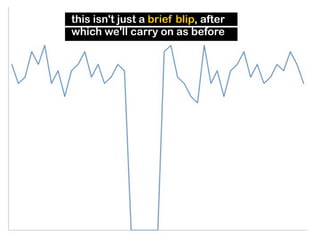
  • #42 Firstly, the most important thing I guess is that we need to recognise, however painful, the HUGE extent of this change
  • #44 REALLY huge..
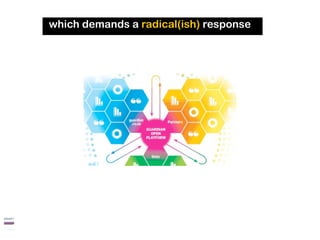
  • #45 and that we are truly living through a digital content revolution - one which requires radical, revolution style responses
  • #46 One of the most important hallmarks of this kind of change is *emergence*. The ideas which win through aren’t often the biggest or the best funded; they’re the ones which gain traction through ease of use. RSS is a prime example
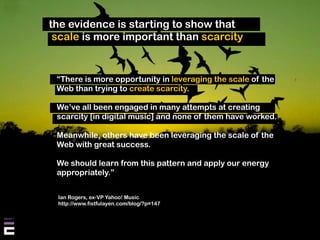
  • #48 In short: the evidence is starting to show, from many quarters, that providing more access to your content is actually beneficial from many, many angles. Startlingly, some of this evidence seems to show that more access = more sales...
  • #49 This means - letting go of your content, setting it free..
  • #50 I talk a lot about Web2, the “social web”. Mostly this is considered important because of the surface stuff - but under the hood, content is usually accessible, and this is arguably more important. Sometimes, 5-10 x the “surface” number of users are seeing content via an API
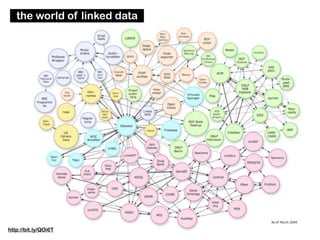
  • #51 The enabler here is open, linked data.
  • #56 This means not just from a “web usability’ perspective, but those that have been focused on the goals of individuals
  • #57 ...and not on the goals of specific, partisan players in the industry
  • #58 But these opportunities are *different*. They are challenging because they absolutely threaten the existing status quo. This is hugely unpopular, particularly where whole industries are in the frame
  • #59 Coming back to journals - I think it’s absolutely the case that there are lots of positive signs
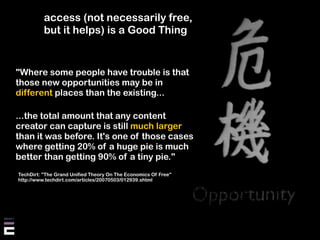
  • #60 ...and these are some of them
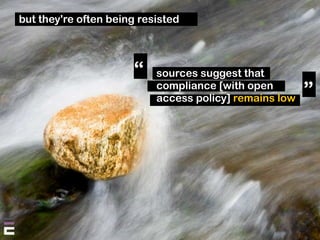
  • #61 ...albeit often resisted. This source (who’d rather remain anonymous) showed me a letter from a well known funder who recently wrote to universities warning that they’d be checking that OA guidelines were being followed...
  • #62 Good though the open angles are, they are (like any embedded, older industry) surrounded by treacle-like politics. And this often leads to *really* complicated business models. Example: pay at publication / pay at use / self archive...!
  • #63 Experience shows time and time again that complicated, “bolted-on” business models just don’t work.
  • #64 This is obviously naive! - but pushing for bigger-picture strategies that take on board user experience and expectation seem to me to be required
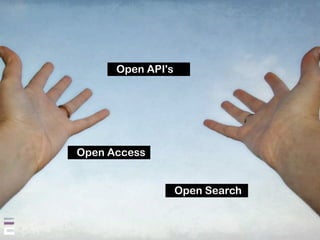
  • #65 At the very least, examine the pain points and try and simplify. Creation of open API’s would be a huge start!
  • #66 Small pieces, open (web) standards, distributed systems
  • #69 These are big ideas, and as such can be very challenging.
  • #71 Symposium - Identity - Cameron Neylon Open Science 21st May Evolution or revolution: The future of identity and access management for research