Letter Writing
(Types and elements of a letter)
Instructor: Sohail Ahmed Kalhoro
What is a letter?
 A letter is a handwritten or printed message that is sent to others for
conveying a certain message.
 It is a written conversation between two parties and is usually sent via
post or mail.
Objectives of letter writing
 A letter is usually written for the following purposes:
 To convey a message
 To bridge communication gap between two people
 To create awareness or to inform someone
 To express our feelings
Origin of Letter writing
 Letters date back to the time when ancient Egyptians wrote to the dead
asking for help.
 People separated by distance had only one way of communication back
when paper and pen were the only means.
Types of letters:
There are two types of letters:
Formal Letters
Informal letters
1. Informal Letters
 Informal letters are also known as personal letters.
 These letters are usually written to family, friends or relatives.
 These letters may or may not have a concrete reason of writing.
 They are just written to share an experience or to enquire about someone’s how
about.
Informal letters
 In these letters include:
Personal letters
 letters to family
 letters to relatives
 love letters
Social letters
 Letters to friends
 social invitations
 congratulatory/apology letters
 letters of condolence/sympathy, thank you letters
2. Formal Letters
 These letters are written to discuss business, apply for services, make requests,
file/register complaints etc.
 These letters are short and to the point.
 The formulation of formal letters, letters of application, official letters and letters
to the Editor.
Other types of letters:
 1. Appreciation letter
 2. application letter
 3. complaint letter
 4. order letter
 5. apology letter
 6. Acknowledge letter etc
Acknowledgment Letter
 Whenever you receive business documents, the letter that you send immediately
after the receipt is called an acknowledgement letter. It includes:
 Acknowledgement of Payment Letter
 Acknowledgement of Sales Letter
 Acknowledgement of Documents Letter
 Acknowledgement of Order Letter
 Acknowledgement of Change in Date Letter
Application Letter
 The Application letter is written when you:
 request for something
 ask permission for something
 apply for something
An application Includes:
 Job Application Letters
 Scholarship Application Letter
 Application for Leave of Absence/in Advance
 Application for a Seat in the Hostel
 Application Letter Seeking Permission
Cover Letter
 A cover letter is a short document letter that is sent with a resume or a CV.
 A cover letter provides additional information about your skills and experience.
 It includes:
 No Experience Cover Letter
 Data Analyst Cover Letter
 Software Engineer Cover Letter etc
Complaint Letter
 A complaint letter is written to the authorities to complain about or against
something or someone.
 It includes:
 Late Delivery Complaint Letter
 Pricing Complaint Letter
 Police Complaint Letter (e.g. FIR)
 Product Defect Complaint Letter
 Employee’s complaint letter
Appointment Letter
 An appointment letter is a document that is written by the employer requesting
the selected candidates to join in a specific position in their company.
 It Includes:
 Job Appointment Letter
 Contract Job Appointment Letter
 Part-time Appointment Letter
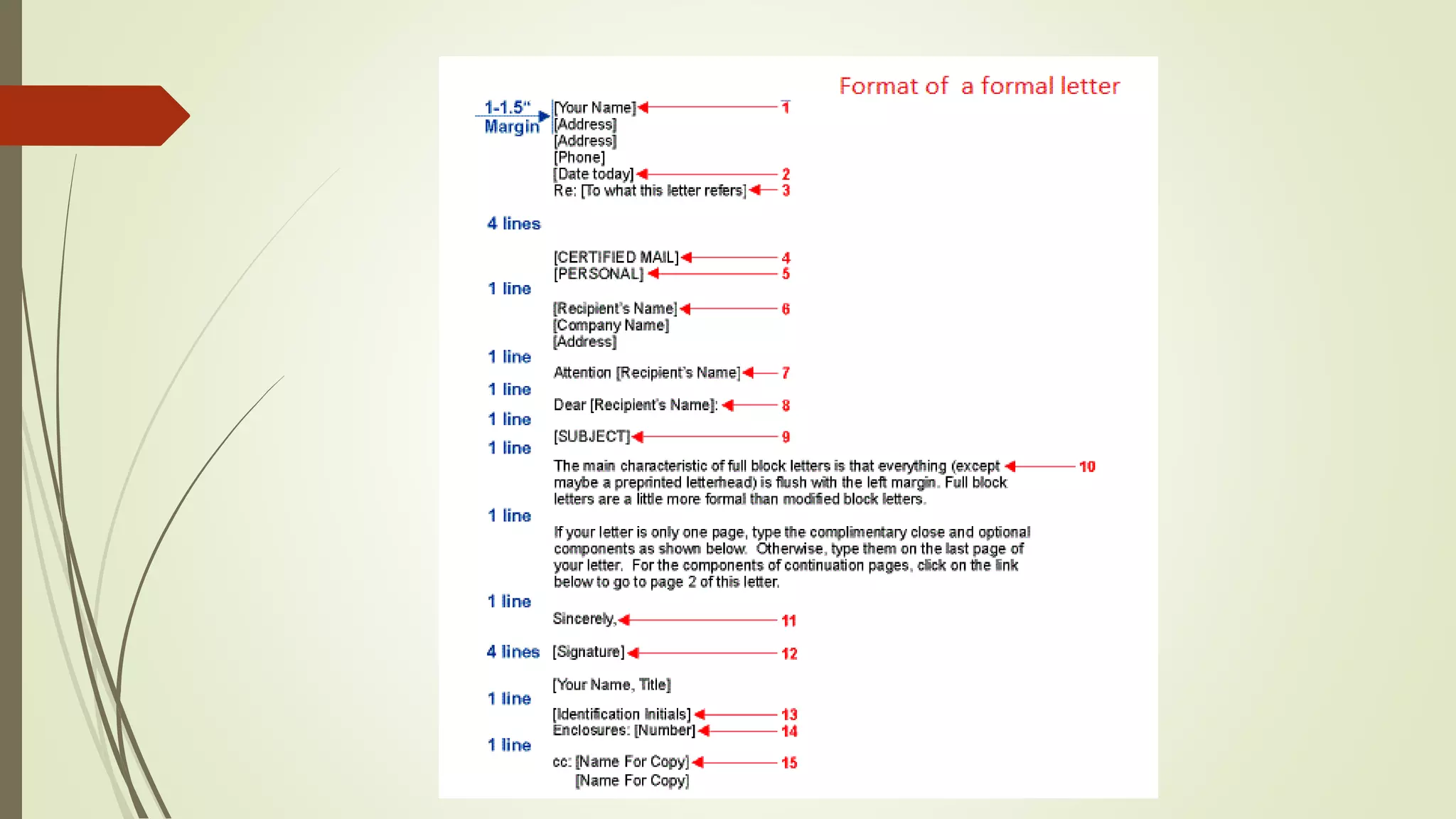
Format of a Letter
 A letter is Composed of various elements that may change depending upon the
nature of the letter.
 The main elements of a letter are given below:
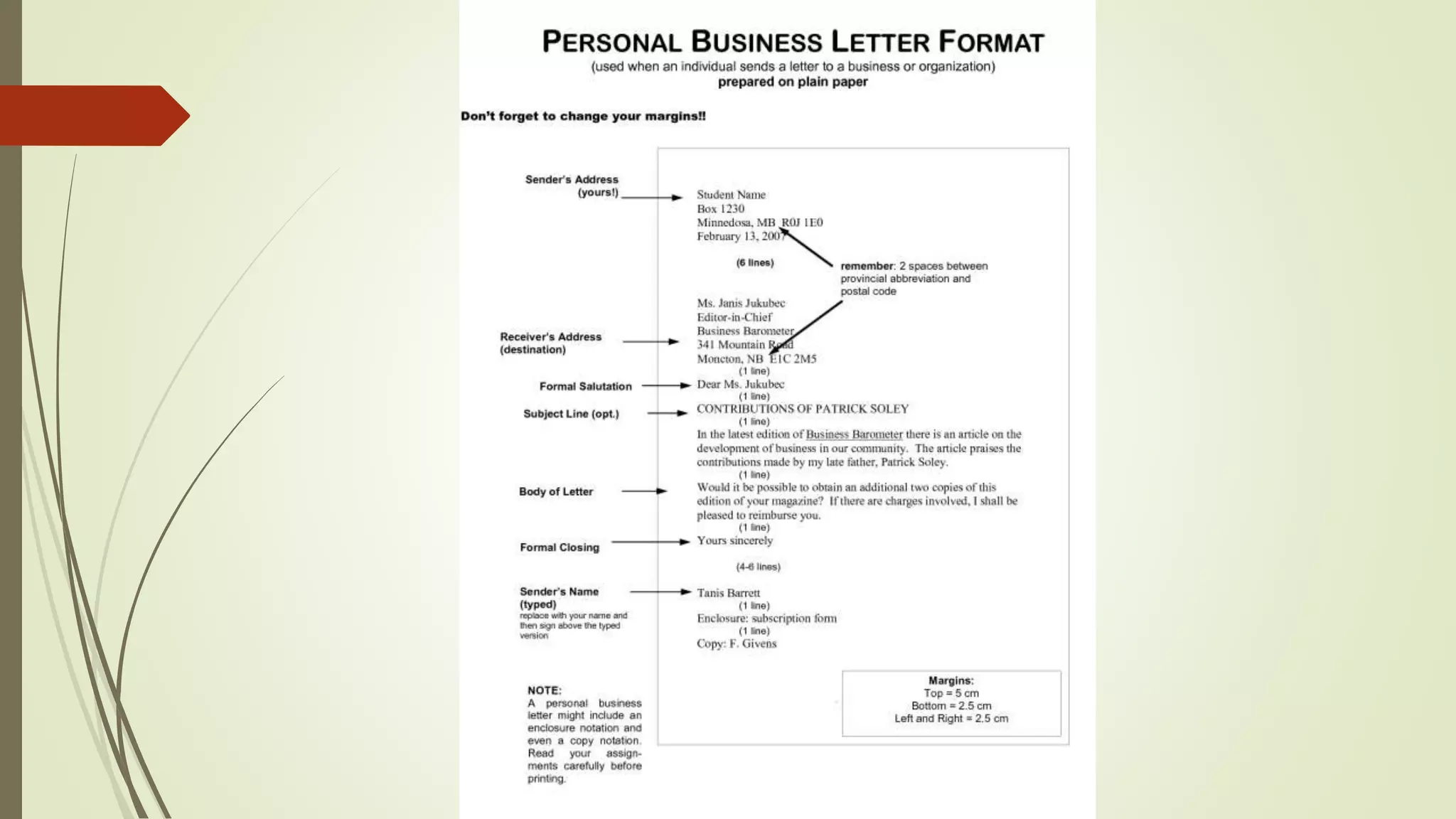
 Senders’ address
 Date
 Receivers’ address
 Subject
 Salutation
 Content-Specific, to the point
 Concluding lines
 Complimentary closure
 Signature along with designation or title
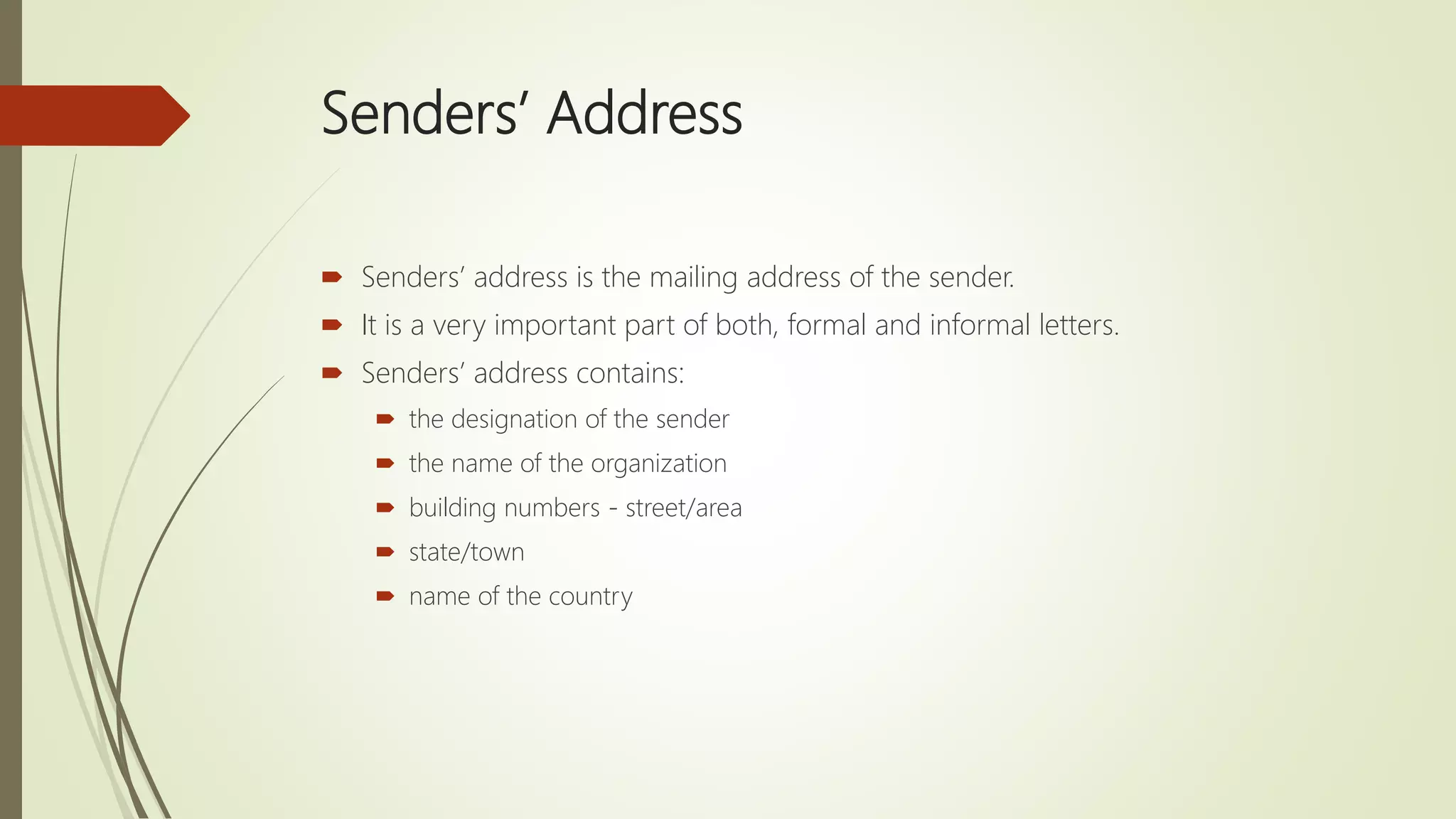
Senders’ Address
 Senders’ address is the mailing address of the sender.
 It is a very important part of both, formal and informal letters.
 Senders’ address contains:
 the designation of the sender
 the name of the organization
 building numbers - street/area
 state/town
 name of the country
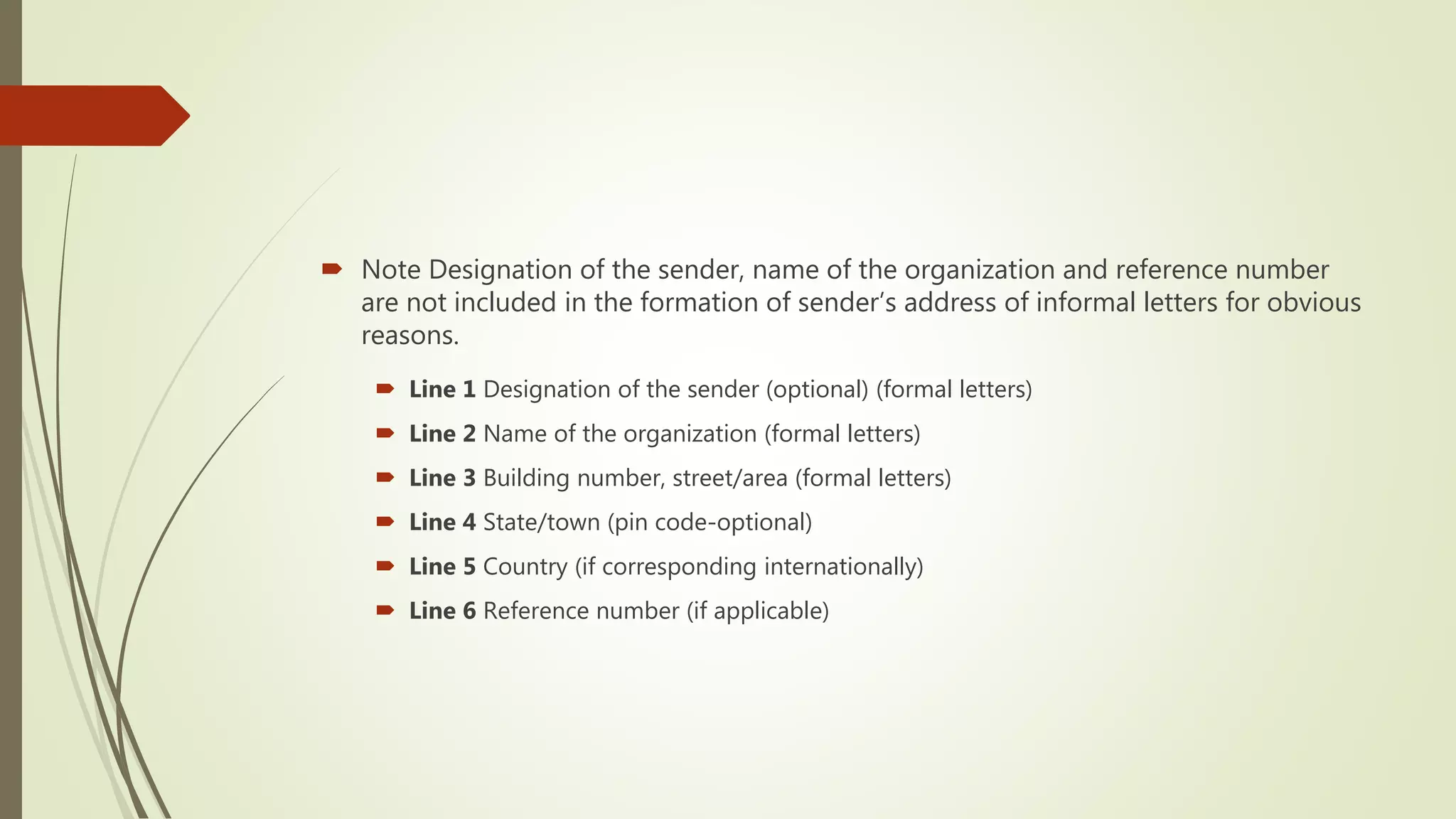
 Note Designation of the sender, name of the organization and reference number
are not included in the formation of sender’s address of informal letters for obvious
reasons.
 Line 1 Designation of the sender (optional) (formal letters)
 Line 2 Name of the organization (formal letters)
 Line 3 Building number, street/area (formal letters)
 Line 4 State/town (pin code-optional)
 Line 5 Country (if corresponding internationally)
 Line 6 Reference number (if applicable)
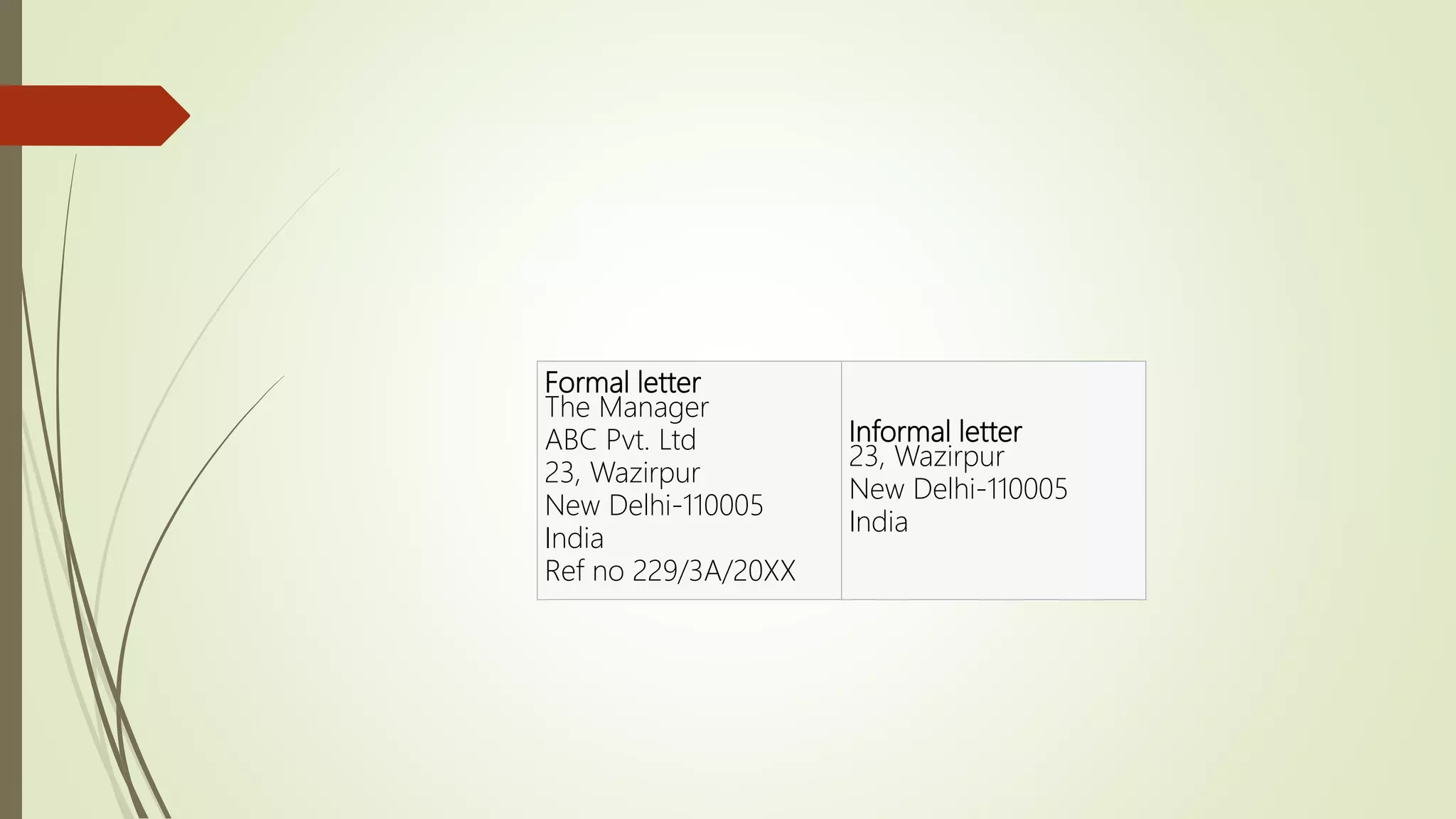
Formal letter
The Manager
ABC Pvt. Ltd
23, Wazirpur
New Delhi-110005
India
Ref no 229/3A/20XX
Informal letter
23, Wazirpur
New Delhi-110005
India
 Date
 Succeeding the space after the return address comes the date on which the letter
written/sent. One may opt any format out of the two stated below to record the
date in the letter.
 DD/MM/YY : 24th August, 20XX
 MM/DD/YY : August 24th, 20XX
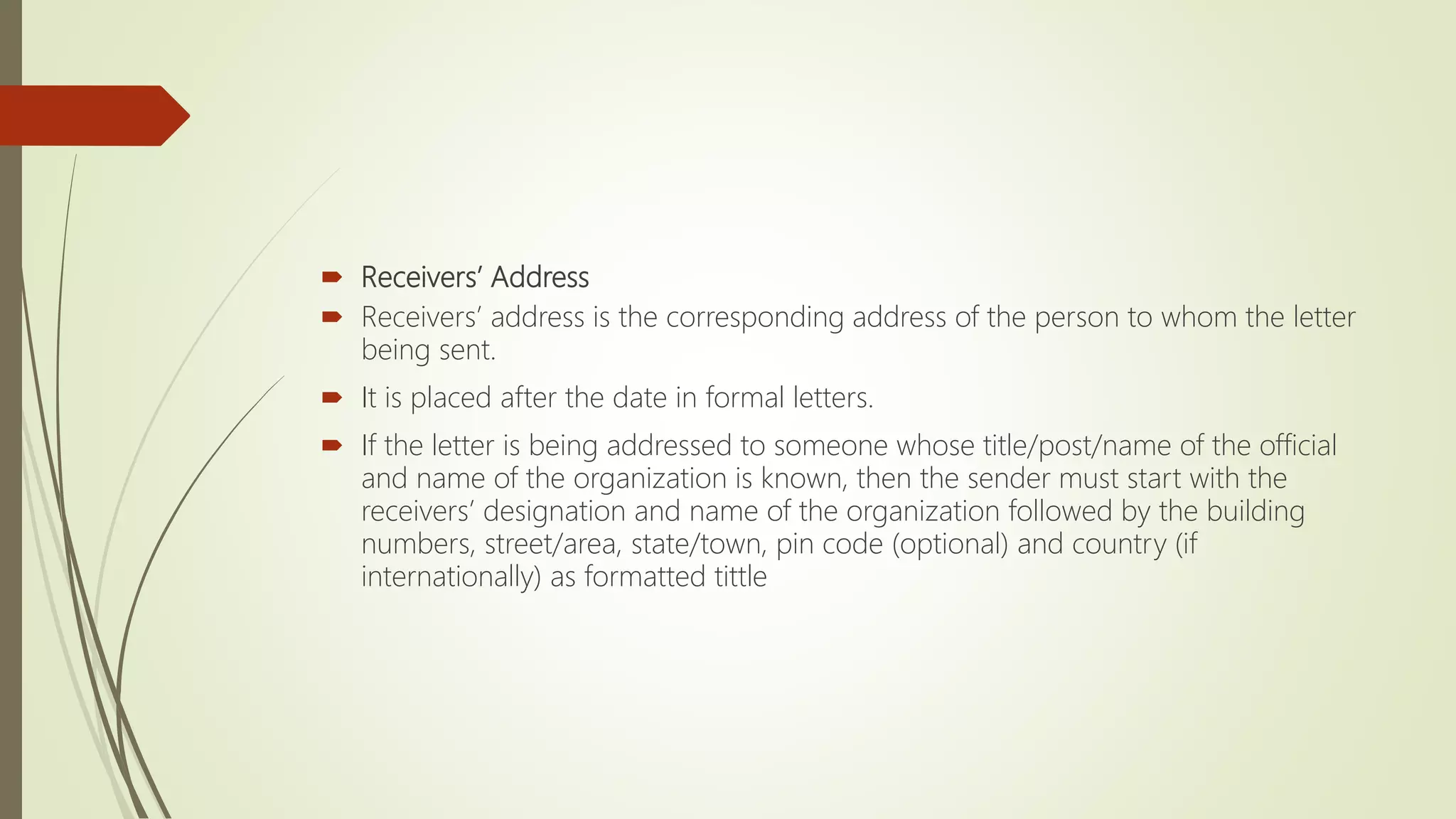
 Receivers’ Address
 Receivers’ address is the corresponding address of the person to whom the letter
being sent.
 It is placed after the date in formal letters.
 If the letter is being addressed to someone whose title/post/name of the official
and name of the organization is known, then the sender must start with the
receivers’ designation and name of the organization followed by the building
numbers, street/area, state/town, pin code (optional) and country (if
internationally) as formatted tittle
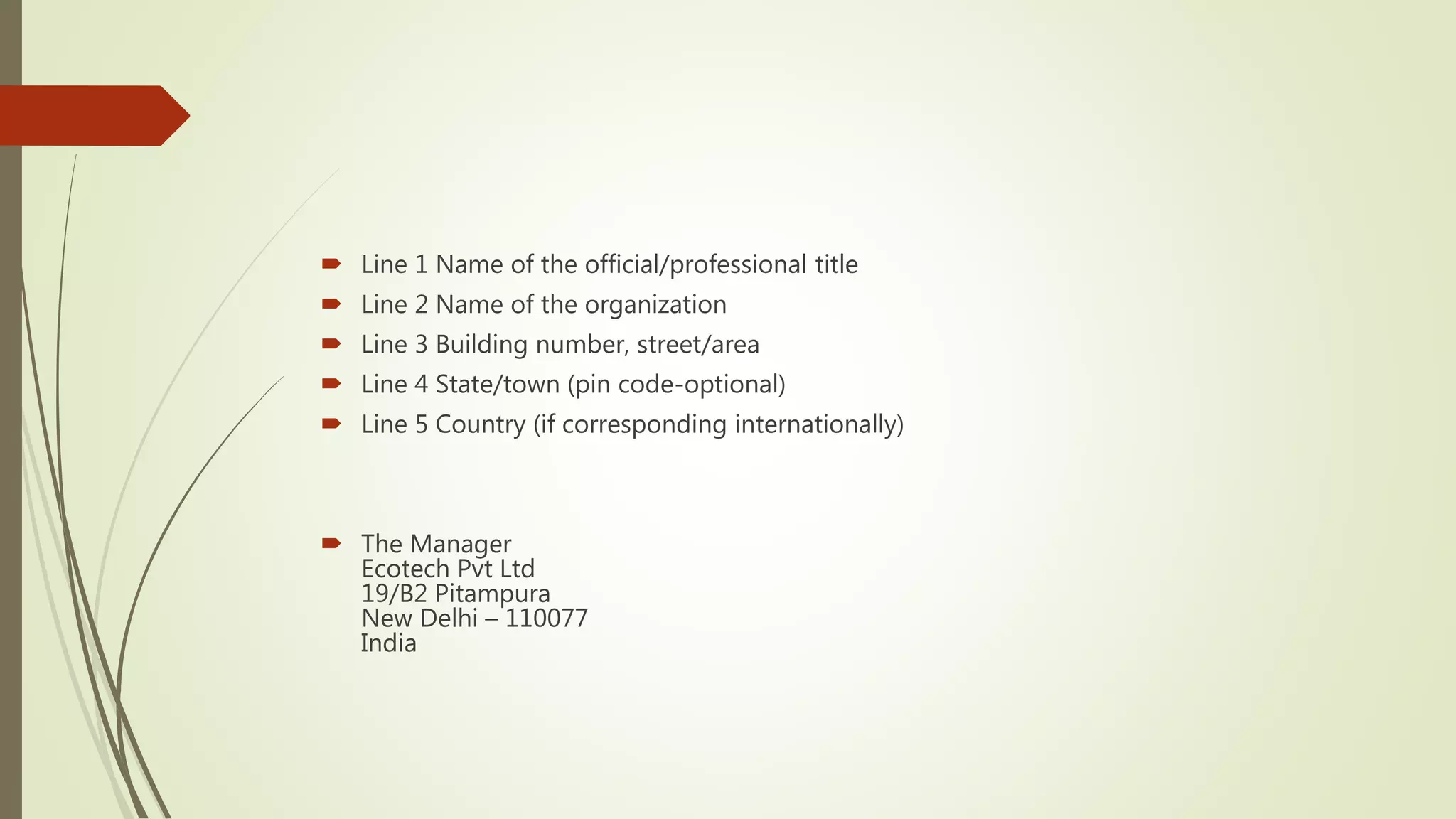
 Line 1 Name of the official/professional title
 Line 2 Name of the organization
 Line 3 Building number, street/area
 Line 4 State/town (pin code-optional)
 Line 5 Country (if corresponding internationally)
 The Manager
Ecotech Pvt Ltd
19/B2 Pitampura
New Delhi – 110077
India
Subject
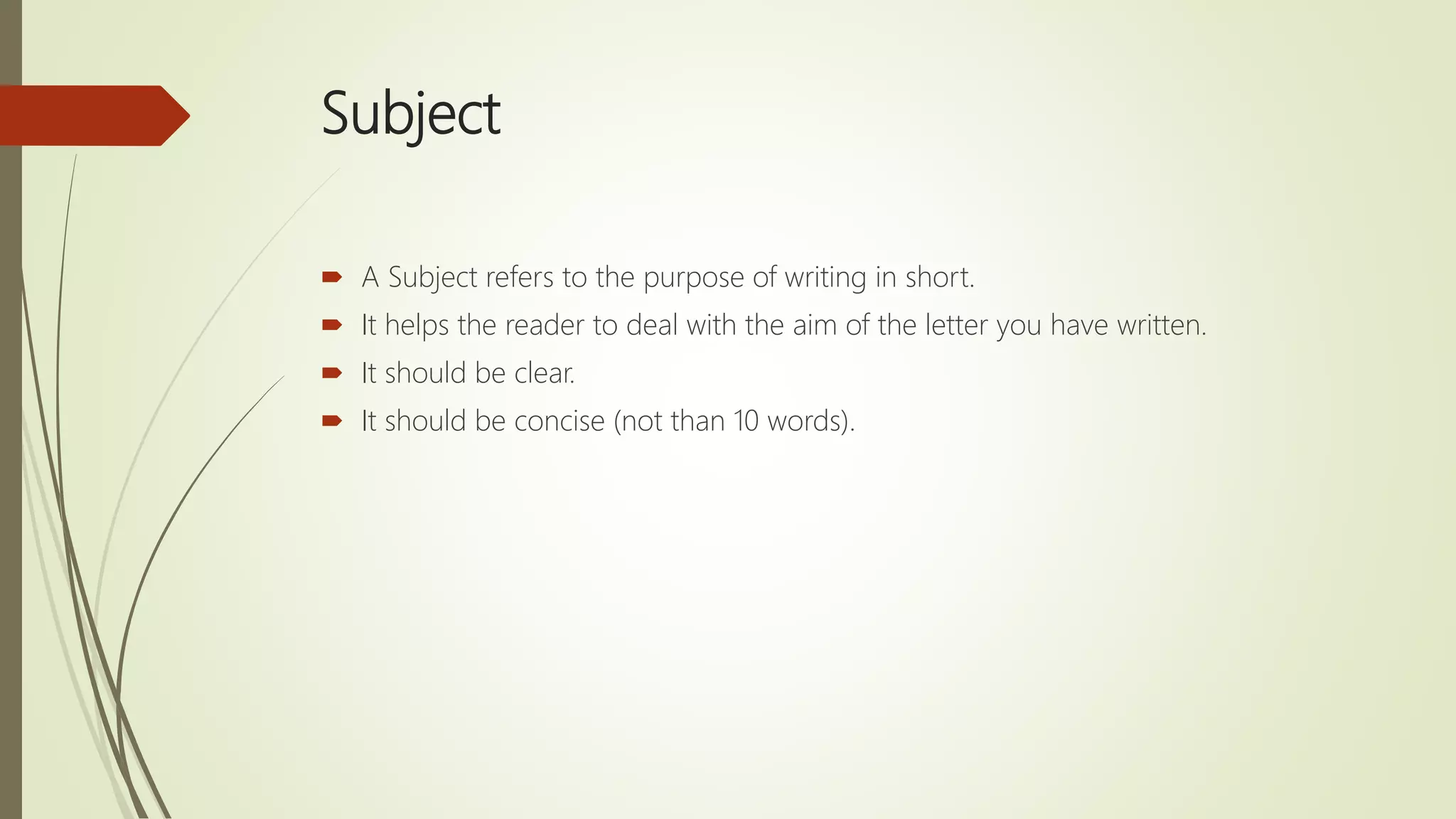
 A Subject refers to the purpose of writing in short.
 It helps the reader to deal with the aim of the letter you have written.
 It should be clear.
 It should be concise (not than 10 words).
Salutation
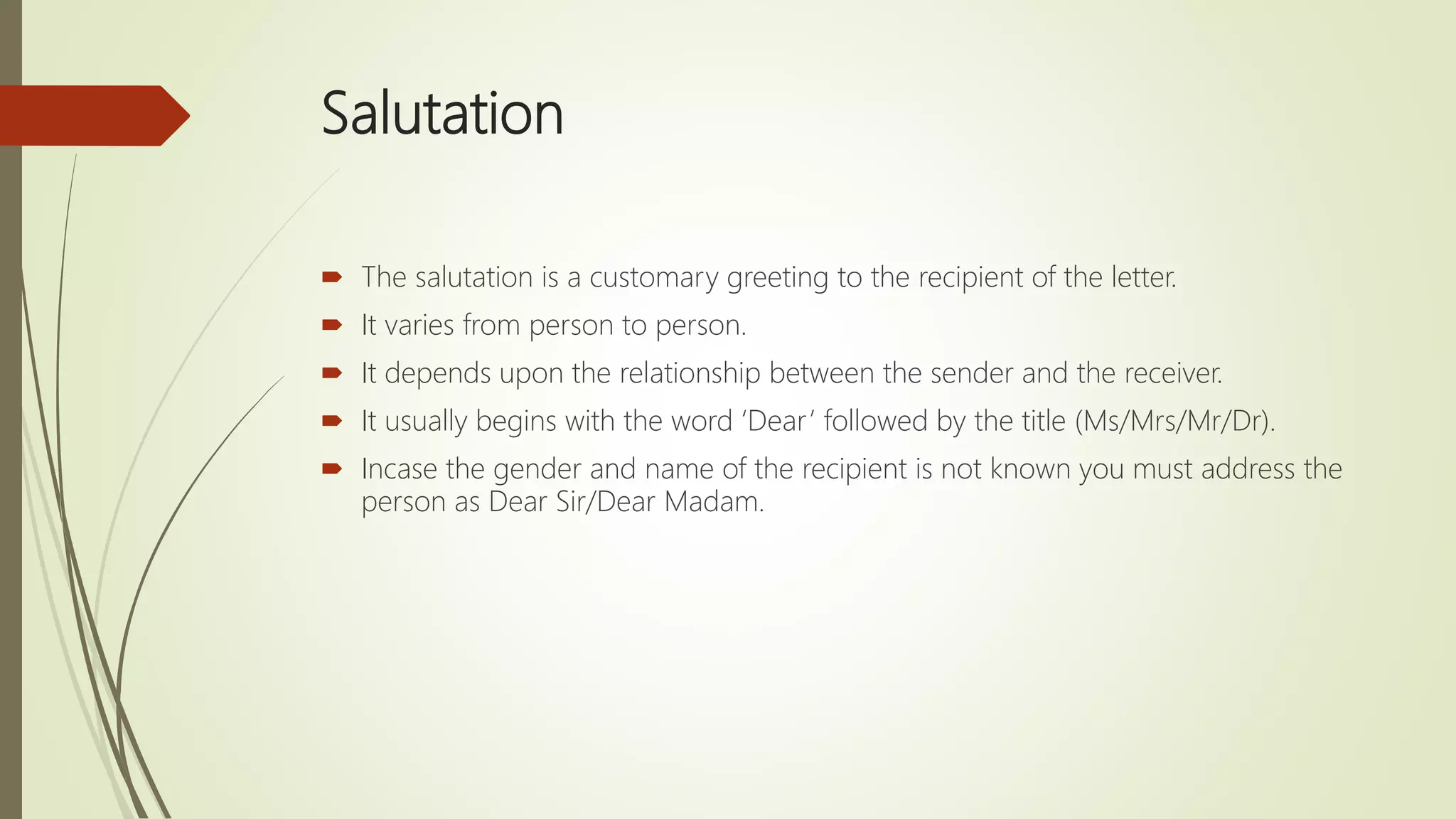
 The salutation is a customary greeting to the recipient of the letter.
 It varies from person to person.
 It depends upon the relationship between the sender and the receiver.
 It usually begins with the word ‘Dear’ followed by the title (Ms/Mrs/Mr/Dr).
 Incase the gender and name of the recipient is not known you must address the
person as Dear Sir/Dear Madam.
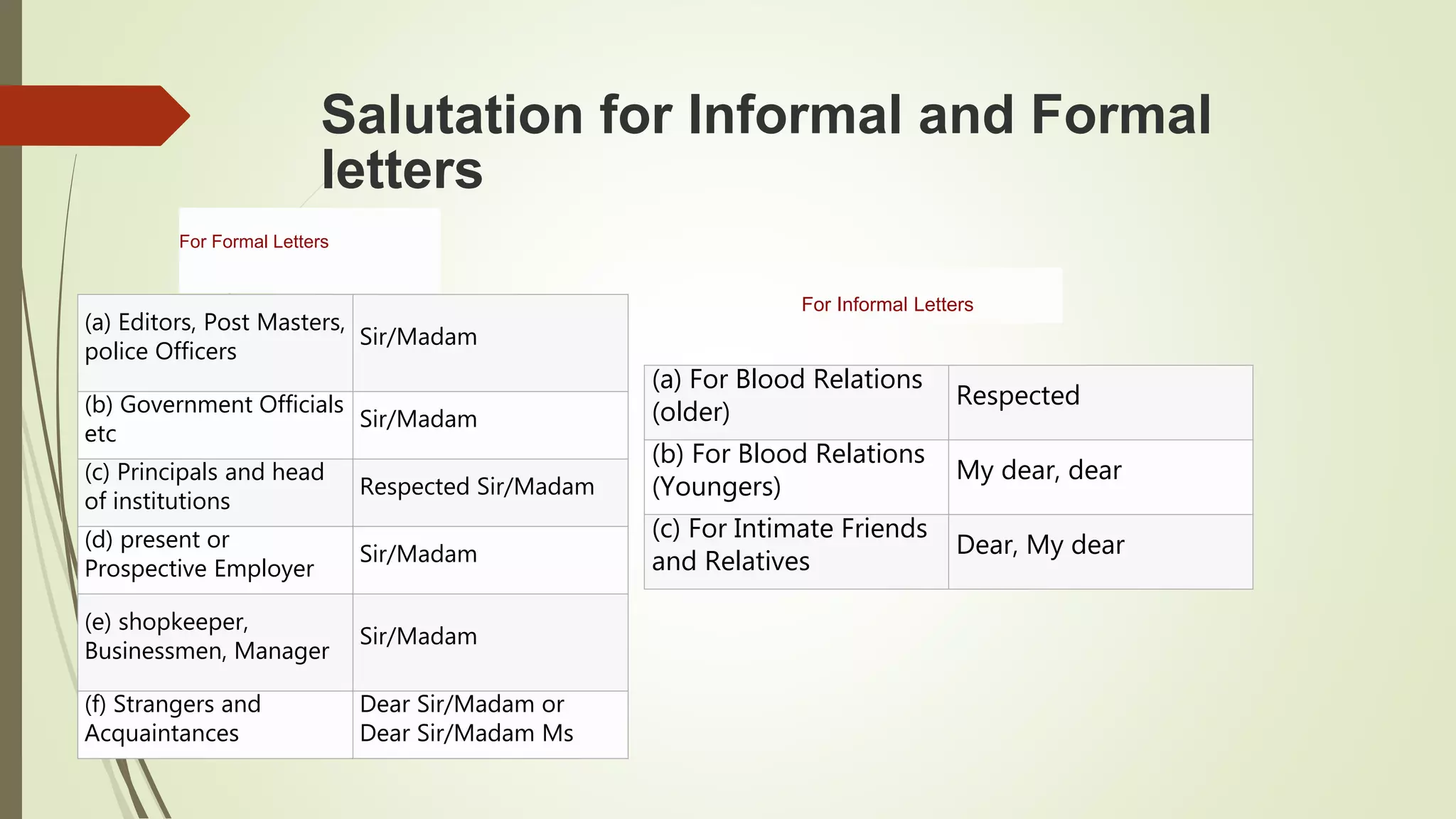
Salutation for Informal and Formal
letters
(a) For Blood Relations
(older)
Respected
(b) For Blood Relations
(Youngers)
My dear, dear
(c) For Intimate Friends
and Relatives
Dear, My dear
(a) Editors, Post Masters,
police Officers
Sir/Madam
(b) Government Officials
etc
Sir/Madam
(c) Principals and head
of institutions
Respected Sir/Madam
(d) present or
Prospective Employer
Sir/Madam
(e) shopkeeper,
Businessmen, Manager
Sir/Madam
(f) Strangers and
Acquaintances
Dear Sir/Madam or
Dear Sir/Madam Ms
For Formal Letters
For Informal Letters
 Body
 The body is the most important part of the letter.
 It includes the message the sender wants to convey.
 The body of a personal letter can be long and detailed. It contains many feelings,
experiences, advices, news etc
 The body of a formal letter is short, clear and logical.
 There can be three sub-parts of the body of a formal letter:
 an introductory paragraph
 middle paragraph
 a concluding paragraph
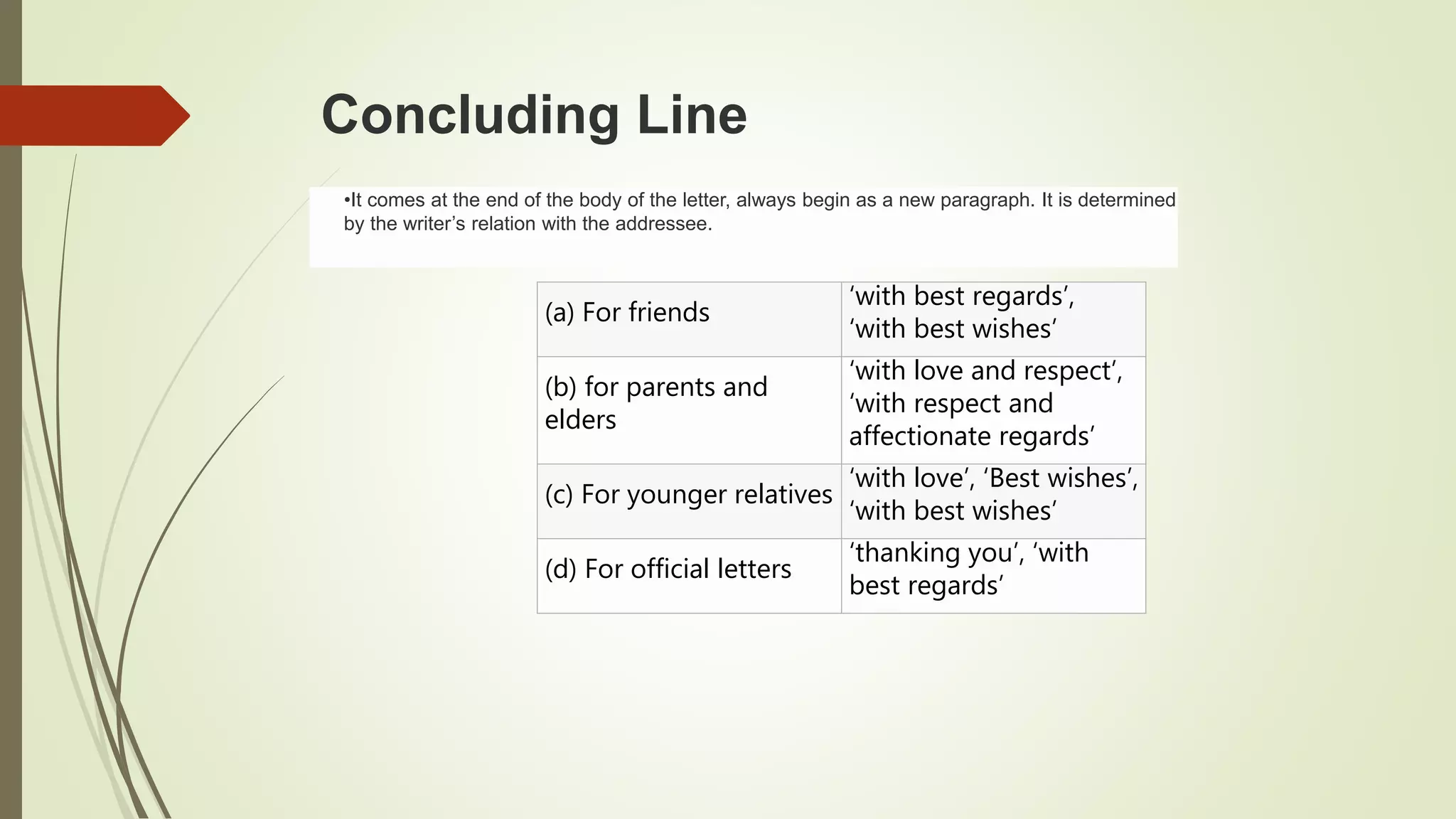
Concluding Line
(a) For friends
‘with best regards’,
‘with best wishes’
(b) for parents and
elders
‘with love and respect’,
‘with respect and
affectionate regards’
(c) For younger relatives
‘with love’, ‘Best wishes’,
‘with best wishes’
(d) For official letters
‘thanking you’, ‘with
best regards’
•It comes at the end of the body of the letter, always begin as a new paragraph. It is determined
by the writer’s relation with the addressee.
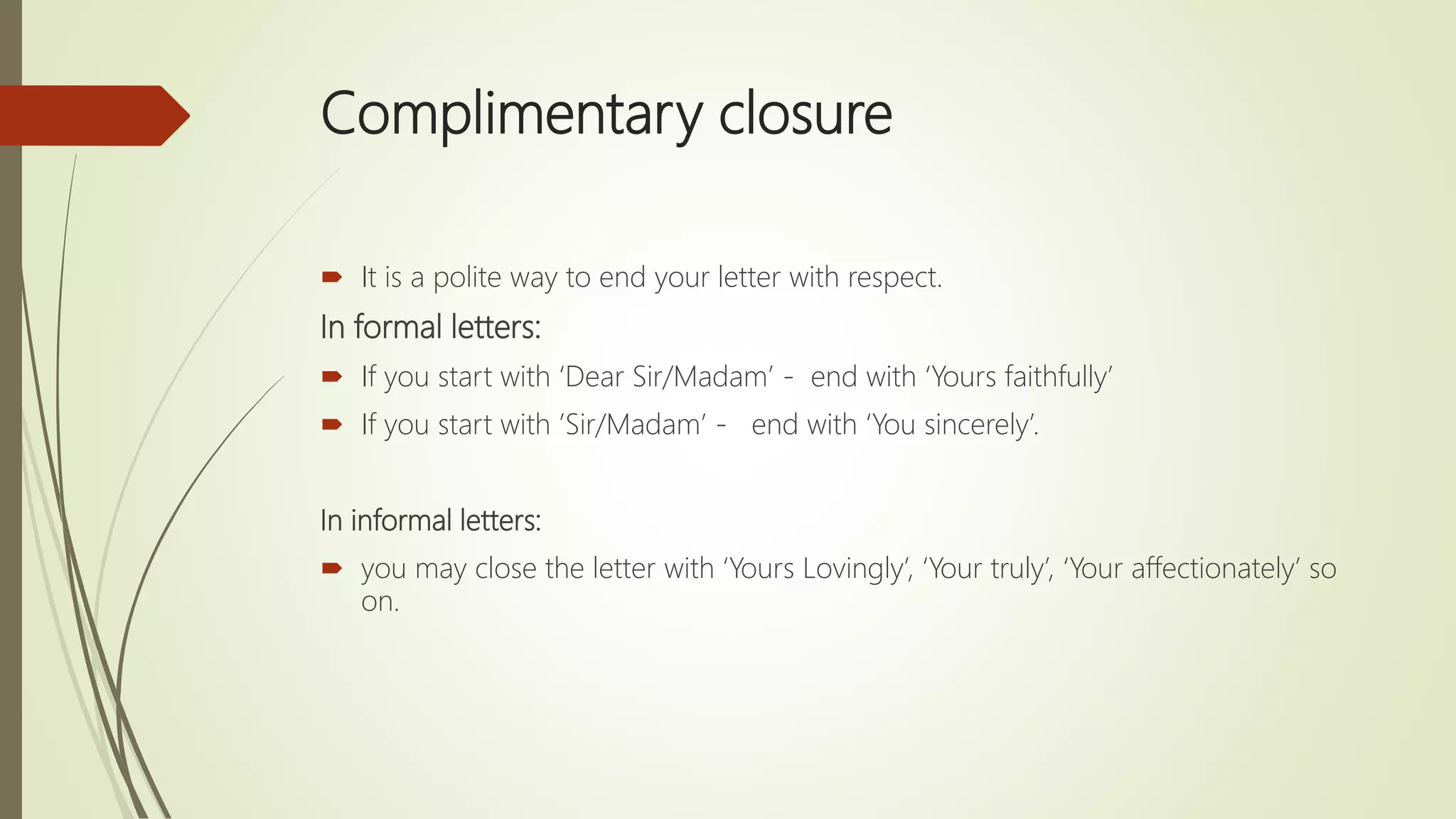
Complimentary closure
 It is a polite way to end your letter with respect.
In formal letters:
 If you start with ‘Dear Sir/Madam’ - end with ‘Yours faithfully’
 If you start with ’Sir/Madam’ - end with ‘You sincerely’.
In informal letters:
 you may close the letter with ‘Yours Lovingly’, ‘Your truly’, ‘Your affectionately’ so
on.
(a) For friends and
acquaintances
‘Your sincerely’,
‘Sincerely yours’
(b) for relatives and
friends
‘Yours affectionately’,
‘yours loving’ etc
(a) Principals,
Headmasters etc
‘yours obediently’
(b) Editors, Government
officials, Shopkeepers,
private firms etc
‘Yours faithfully’, ‘Your
truly’
(c) Strangers ‘Your faithfully’
(d) For employment
from one official to
another, complaints or
requests to officials
‘Your faithfully’
Signature Line
 It is the last part of the letter where the sender signs off with his/her first
and last name.
 The signature line may also included a second line in formal letters for
the title/post of the sender.
Key Points for a better Letter Writing
 Selection of Correct Words:
 Words are the writer’s tools and the writer need to put the right word and right
expression with precision. It should however be remembered that right words
become relevant only in the right context. For example an emotional or flowery
language has to be fully avoided in a business letter.
Key Points for a better Letter Writing
 To the Point content:
 Nothing more is harmful to good communication than confused state which may
result in not conveying the exact point.
 Before writing a letter one should ne sure of what one wants to convey.
 All the facts and methodically.
 One should not be vague about one’s objective.
Key Points for a better Letter Writing
 Conciseness: Formal letters must be concise. In formal letters specially one must
not write unnecessary sentences. To the point information or enquiry is
prerequisite of a business correspondence. Long illustrations and elaboration
must be avoided all costs.
Key Points for a better Letter Writing
 Courtesy:
 A letter reveals its writer’s personality and character.
 One must remain totally professional while writing a letter.
 Even while writing a complaint letter, care should be taken that it is couched in
polite and civilized language.
 Good judgment determines what and how a point has to be conveyed.
Key Points for a better Letter Writing
 Correct Use of Punctuation Marks:
 Use of punctuation marks, use of capital letters, commas or colons is must to
make our writing effective.
 Sometimes placement of comma or full stop at a wrong place may change the
meaning of the sentence can steal the effectiveness of a good letter.
 Hence utmost attention should be paid to punctuation while writing.
Key Points for a better Letter Writing
 Style:
 The conversational style is the most suitable one for letter writing.
 It is best to write in a simple, clear style maintaining a logical sequence of ideas.
 Every sentence should grow out of the preceding one.
 There should be no jumping from one idea to the another.
Elements of a Letter:
 Informal Letters
 Senders’ address
 Date
 Salutation
 Content required can be long and detailed
 Concluding line
 Complimentary closure
 Signature line
 Formal Letters
 Senders’ address
 Date
 Receivers’ address
 Subject
 Salutation
 Content-Specific, to the point
 Concluding lines
 Complimentary closure
 Signature along with designation or title
 Thank you for paying attention!
Acknowledgment
 The subject material of the slides is derived from different internet resources.
 The images are also takes from internet resources.
 References:
 https://www.google.com/search?q=letter+format&tbm=isch&chips=q:letter+format,g_1:busin
ess:n84M7KICP6s%3D&hl=en&ved=2ahUKEwi-7eOmovTpAhUU-4UKHQ2DA-
MQ4lYoAHoECAEQFA&biw=1519&bih=674#imgrc=blgewjlPjjXG4M
 https://www.google.com/search?sxsrf=ALeKk036PNn-
pLSaH15W1kDEdsbYmPf0bA%3A1591668123788&source=hp&ei=m-
3eXpnkLdThgwfzv46QBA&q=types+of+letter&oq=types+of+letter&gs_lcp=CgZwc3ktYWIQA
1CDDFjZJWCEK2gAcAB4AYABAIgBAJIBAJgBD6ABAaoBB2d3cy13aXo&sclient=psy-
ab&ved=0ahUKEwjZnffo0fPpAhXU8OAKHfOfA0IQ4dUDCAc&uact=5
 https://lettersamples.net/l/types-of-letters-with-examples

Letter and its types (letter writing)

  • 1.
    Letter Writing (Types andelements of a letter) Instructor: Sohail Ahmed Kalhoro
  • 2.
    What is aletter?  A letter is a handwritten or printed message that is sent to others for conveying a certain message.  It is a written conversation between two parties and is usually sent via post or mail.
  • 3.
    Objectives of letterwriting  A letter is usually written for the following purposes:  To convey a message  To bridge communication gap between two people  To create awareness or to inform someone  To express our feelings
  • 4.
    Origin of Letterwriting  Letters date back to the time when ancient Egyptians wrote to the dead asking for help.  People separated by distance had only one way of communication back when paper and pen were the only means.
  • 5.
    Types of letters: Thereare two types of letters: Formal Letters Informal letters
  • 6.
    1. Informal Letters Informal letters are also known as personal letters.  These letters are usually written to family, friends or relatives.  These letters may or may not have a concrete reason of writing.  They are just written to share an experience or to enquire about someone’s how about.
  • 7.
    Informal letters  Inthese letters include: Personal letters  letters to family  letters to relatives  love letters Social letters  Letters to friends  social invitations  congratulatory/apology letters  letters of condolence/sympathy, thank you letters
  • 8.
    2. Formal Letters These letters are written to discuss business, apply for services, make requests, file/register complaints etc.  These letters are short and to the point.  The formulation of formal letters, letters of application, official letters and letters to the Editor.
  • 9.
    Other types ofletters:  1. Appreciation letter  2. application letter  3. complaint letter  4. order letter  5. apology letter  6. Acknowledge letter etc
  • 10.
    Acknowledgment Letter  Wheneveryou receive business documents, the letter that you send immediately after the receipt is called an acknowledgement letter. It includes:  Acknowledgement of Payment Letter  Acknowledgement of Sales Letter  Acknowledgement of Documents Letter  Acknowledgement of Order Letter  Acknowledgement of Change in Date Letter
  • 11.
    Application Letter  TheApplication letter is written when you:  request for something  ask permission for something  apply for something An application Includes:  Job Application Letters  Scholarship Application Letter  Application for Leave of Absence/in Advance  Application for a Seat in the Hostel  Application Letter Seeking Permission
  • 12.
    Cover Letter  Acover letter is a short document letter that is sent with a resume or a CV.  A cover letter provides additional information about your skills and experience.  It includes:  No Experience Cover Letter  Data Analyst Cover Letter  Software Engineer Cover Letter etc
  • 13.
    Complaint Letter  Acomplaint letter is written to the authorities to complain about or against something or someone.  It includes:  Late Delivery Complaint Letter  Pricing Complaint Letter  Police Complaint Letter (e.g. FIR)  Product Defect Complaint Letter  Employee’s complaint letter
  • 14.
    Appointment Letter  Anappointment letter is a document that is written by the employer requesting the selected candidates to join in a specific position in their company.  It Includes:  Job Appointment Letter  Contract Job Appointment Letter  Part-time Appointment Letter
  • 15.
    Format of aLetter  A letter is Composed of various elements that may change depending upon the nature of the letter.  The main elements of a letter are given below:  Senders’ address  Date  Receivers’ address  Subject  Salutation  Content-Specific, to the point  Concluding lines  Complimentary closure  Signature along with designation or title
  • 17.
    Senders’ Address  Senders’address is the mailing address of the sender.  It is a very important part of both, formal and informal letters.  Senders’ address contains:  the designation of the sender  the name of the organization  building numbers - street/area  state/town  name of the country
  • 18.
     Note Designationof the sender, name of the organization and reference number are not included in the formation of sender’s address of informal letters for obvious reasons.  Line 1 Designation of the sender (optional) (formal letters)  Line 2 Name of the organization (formal letters)  Line 3 Building number, street/area (formal letters)  Line 4 State/town (pin code-optional)  Line 5 Country (if corresponding internationally)  Line 6 Reference number (if applicable)
  • 19.
    Formal letter The Manager ABCPvt. Ltd 23, Wazirpur New Delhi-110005 India Ref no 229/3A/20XX Informal letter 23, Wazirpur New Delhi-110005 India
  • 20.
     Date  Succeedingthe space after the return address comes the date on which the letter written/sent. One may opt any format out of the two stated below to record the date in the letter.  DD/MM/YY : 24th August, 20XX  MM/DD/YY : August 24th, 20XX
  • 21.
     Receivers’ Address Receivers’ address is the corresponding address of the person to whom the letter being sent.  It is placed after the date in formal letters.  If the letter is being addressed to someone whose title/post/name of the official and name of the organization is known, then the sender must start with the receivers’ designation and name of the organization followed by the building numbers, street/area, state/town, pin code (optional) and country (if internationally) as formatted tittle
  • 22.
     Line 1Name of the official/professional title  Line 2 Name of the organization  Line 3 Building number, street/area  Line 4 State/town (pin code-optional)  Line 5 Country (if corresponding internationally)  The Manager Ecotech Pvt Ltd 19/B2 Pitampura New Delhi – 110077 India
  • 23.
    Subject  A Subjectrefers to the purpose of writing in short.  It helps the reader to deal with the aim of the letter you have written.  It should be clear.  It should be concise (not than 10 words).
  • 24.
    Salutation  The salutationis a customary greeting to the recipient of the letter.  It varies from person to person.  It depends upon the relationship between the sender and the receiver.  It usually begins with the word ‘Dear’ followed by the title (Ms/Mrs/Mr/Dr).  Incase the gender and name of the recipient is not known you must address the person as Dear Sir/Dear Madam.
  • 25.
    Salutation for Informaland Formal letters (a) For Blood Relations (older) Respected (b) For Blood Relations (Youngers) My dear, dear (c) For Intimate Friends and Relatives Dear, My dear (a) Editors, Post Masters, police Officers Sir/Madam (b) Government Officials etc Sir/Madam (c) Principals and head of institutions Respected Sir/Madam (d) present or Prospective Employer Sir/Madam (e) shopkeeper, Businessmen, Manager Sir/Madam (f) Strangers and Acquaintances Dear Sir/Madam or Dear Sir/Madam Ms For Formal Letters For Informal Letters
  • 26.
     Body  Thebody is the most important part of the letter.  It includes the message the sender wants to convey.  The body of a personal letter can be long and detailed. It contains many feelings, experiences, advices, news etc  The body of a formal letter is short, clear and logical.  There can be three sub-parts of the body of a formal letter:  an introductory paragraph  middle paragraph  a concluding paragraph
  • 27.
    Concluding Line (a) Forfriends ‘with best regards’, ‘with best wishes’ (b) for parents and elders ‘with love and respect’, ‘with respect and affectionate regards’ (c) For younger relatives ‘with love’, ‘Best wishes’, ‘with best wishes’ (d) For official letters ‘thanking you’, ‘with best regards’ •It comes at the end of the body of the letter, always begin as a new paragraph. It is determined by the writer’s relation with the addressee.
  • 28.
    Complimentary closure  Itis a polite way to end your letter with respect. In formal letters:  If you start with ‘Dear Sir/Madam’ - end with ‘Yours faithfully’  If you start with ’Sir/Madam’ - end with ‘You sincerely’. In informal letters:  you may close the letter with ‘Yours Lovingly’, ‘Your truly’, ‘Your affectionately’ so on.
  • 29.
    (a) For friendsand acquaintances ‘Your sincerely’, ‘Sincerely yours’ (b) for relatives and friends ‘Yours affectionately’, ‘yours loving’ etc (a) Principals, Headmasters etc ‘yours obediently’ (b) Editors, Government officials, Shopkeepers, private firms etc ‘Yours faithfully’, ‘Your truly’ (c) Strangers ‘Your faithfully’ (d) For employment from one official to another, complaints or requests to officials ‘Your faithfully’
  • 30.
    Signature Line  Itis the last part of the letter where the sender signs off with his/her first and last name.  The signature line may also included a second line in formal letters for the title/post of the sender.
  • 31.
    Key Points fora better Letter Writing  Selection of Correct Words:  Words are the writer’s tools and the writer need to put the right word and right expression with precision. It should however be remembered that right words become relevant only in the right context. For example an emotional or flowery language has to be fully avoided in a business letter.
  • 32.
    Key Points fora better Letter Writing  To the Point content:  Nothing more is harmful to good communication than confused state which may result in not conveying the exact point.  Before writing a letter one should ne sure of what one wants to convey.  All the facts and methodically.  One should not be vague about one’s objective.
  • 33.
    Key Points fora better Letter Writing  Conciseness: Formal letters must be concise. In formal letters specially one must not write unnecessary sentences. To the point information or enquiry is prerequisite of a business correspondence. Long illustrations and elaboration must be avoided all costs.
  • 34.
    Key Points fora better Letter Writing  Courtesy:  A letter reveals its writer’s personality and character.  One must remain totally professional while writing a letter.  Even while writing a complaint letter, care should be taken that it is couched in polite and civilized language.  Good judgment determines what and how a point has to be conveyed.
  • 35.
    Key Points fora better Letter Writing  Correct Use of Punctuation Marks:  Use of punctuation marks, use of capital letters, commas or colons is must to make our writing effective.  Sometimes placement of comma or full stop at a wrong place may change the meaning of the sentence can steal the effectiveness of a good letter.  Hence utmost attention should be paid to punctuation while writing.
  • 36.
    Key Points fora better Letter Writing  Style:  The conversational style is the most suitable one for letter writing.  It is best to write in a simple, clear style maintaining a logical sequence of ideas.  Every sentence should grow out of the preceding one.  There should be no jumping from one idea to the another.
  • 37.
    Elements of aLetter:  Informal Letters  Senders’ address  Date  Salutation  Content required can be long and detailed  Concluding line  Complimentary closure  Signature line
  • 38.
     Formal Letters Senders’ address  Date  Receivers’ address  Subject  Salutation  Content-Specific, to the point  Concluding lines  Complimentary closure  Signature along with designation or title
  • 40.
     Thank youfor paying attention!
  • 41.
    Acknowledgment  The subjectmaterial of the slides is derived from different internet resources.  The images are also takes from internet resources.  References:  https://www.google.com/search?q=letter+format&tbm=isch&chips=q:letter+format,g_1:busin ess:n84M7KICP6s%3D&hl=en&ved=2ahUKEwi-7eOmovTpAhUU-4UKHQ2DA- MQ4lYoAHoECAEQFA&biw=1519&bih=674#imgrc=blgewjlPjjXG4M  https://www.google.com/search?sxsrf=ALeKk036PNn- pLSaH15W1kDEdsbYmPf0bA%3A1591668123788&source=hp&ei=m- 3eXpnkLdThgwfzv46QBA&q=types+of+letter&oq=types+of+letter&gs_lcp=CgZwc3ktYWIQA 1CDDFjZJWCEK2gAcAB4AYABAIgBAJIBAJgBD6ABAaoBB2d3cy13aXo&sclient=psy- ab&ved=0ahUKEwjZnffo0fPpAhXU8OAKHfOfA0IQ4dUDCAc&uact=5  https://lettersamples.net/l/types-of-letters-with-examples