Letter-writing
Credit to : Master Ayush Kr. Ojha, of class 11 ‘C’
K V no. 1 AFS Pune
LETTER-WRITING
• LETTER-WRITING is an important channel of communication
between people who are geographically distant from one
another. In earlier times when the telephone and e-mail were
not available, the only means of communication between
people was through letters.
• Letter-writing is a skill that has to be developed. In general
there are two types of letters: formal, that are written to
convey official business and information and informal, which
are personal letters to communicate with friends and family.
Formal letters are sent out when we need to write to various
public bodies or agencies for our requirements in civic life. For
example, we might have to ask for a certificate or to inform a
change in our address. A letter is usually one in a series of
exchanges between two people or parties.
Start with Formal Letters
Let us now examine some of the steps in writing formal letters.
1. (i) Introducing oneself if it is the first time you are writing
(ii) Referring to an earlier letter if you are responding to it.
2. Stating the purpose of the letter
3. (i) Stating action/information required from the addressee
(ii) Explaining action taken/supplying information
4. (i) Urging action to be taken
(ii) Offering assistance in future
This is the basic structure of a letter. It will have to be
modified according to the purpose for which it is written and
the person to whom it is addressed.
Format
1. Name and address of sender
Companies have printed letterheads with the name of the company printed on them. A
letterhead may also carry the name and designation of persons in responsible positions.
2. Name and address of addressee
3. Date
4. Mode of address or salutation
Salutation is the mode of addressing a person. We may have the following forms.
(i) Dear Sir/Madam (when we are writing to a total stranger whom we do not know at all).
(ii) Dear Mr/Ms/Dr/Professor + Surname as in: Dear Dr Sinha, (when it is a formal relationship
with the addressee and the writer does not know him or her personally).
(iii) Dear Sujata (when the writer knows the addressee personally and the two share a semi-
formal relationship).
5. Reference to previous correspondence, if any.
Most official letters carry a subject line just above the salutation. This is for quick reference to
the subject.
6. Content of letter
The content of the letter begins on the next line and is arranged in two or three paragraphs.
7. Complimentary close and signature
Letters usually end politely with the following phrases: Thank you, With regards, With best
wishes, Hope to see you soon, Hope to receive an early reply etc. The complimentary close is
followed by ‘Yours sincerely/ Yours truly’, and the writer’s signature in the next line.
An example of the format of a formal
letter
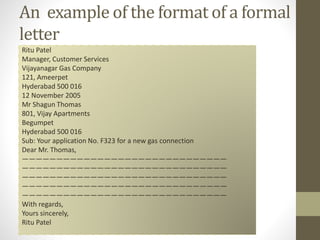
Ritu Patel
Manager, Customer Services
Vijayanagar Gas Company
121, Ameerpet
Hyderabad 500 016
12 November 2005
Mr Shagun Thomas
801, Vijay Apartments
Begumpet
Hyderabad 500 016
Sub: Your application No. F323 for a new gas connection
Dear Mr. Thomas,
——————————————————————————————
——————————————————————————————
——————————————————————————————
——————————————————————————————
——————————————————————————————
With regards,
Yours sincerely,
Ritu Patel
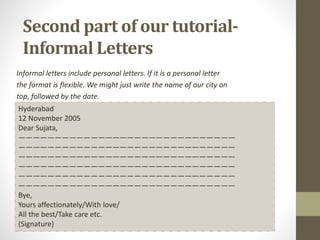
Second part of our tutorial-
Informal Letters
Informal letters include personal letters. If it is a personal letter
the format is flexible. We might just write the name of our city on
top, followed by the date.
Hyderabad
12 November 2005
Dear Sujata,
——————————————————————————————
——————————————————————————————
——————————————————————————————
——————————————————————————————
——————————————————————————————
——————————————————————————————
Bye,
Yours affectionately/With love/
All the best/Take care etc.
(Signature)
Format of the informal letter
1) Your address (but not your name) usually goes in the top
righthand corner, but may go on the left too.
2) The name and/or job title (if you know them) and the
address of the person you are writing to goes on the left.
3) To address someone whose name you do not know you can
write: Dear Sir, Dear Madam, Dear Sirs, Dear Sir/Madam.
4) To address someone by name, use their title and surname
e.g. Dear Dr Balakrishnan.
5) To end a letter, use ‘Yours sincerely’, if you have addressed
the person by name; ‘Yours faithfully’, if you have begun the
letter with ‘Dear Sir’ or ‘Madam’, etc.
Suggestions:
• Formal:
• I strongly recommend that…
• I would suggest that…
• I believe that the best course of action is..
• I would advise you to…
• You should… You ought to…
• If I were you I would….
• Informal:
• Why don’t you…
• You should…You ought to…
• It would be a good idea to…
• What you should do is…
• How about….? I think you should…
• The best advice I can give is…
Closing remarks
• Formal:
I trust you will accept this advice.
I hope this will be of help.
I would very much like to know if
this was helpful.
• Informal:
Hope this has helped.
Let me know what happens.
PARDON ME TO WASTE YOUR TIME,
BUT STILL THANKS TO SEE THIS
AND PLEASE TRY TO
TAKE MY ADVICES
I don’t use it anyway

Letter writing

  • 1.
    Letter-writing Credit to :Master Ayush Kr. Ojha, of class 11 ‘C’ K V no. 1 AFS Pune
  • 2.
    LETTER-WRITING • LETTER-WRITING isan important channel of communication between people who are geographically distant from one another. In earlier times when the telephone and e-mail were not available, the only means of communication between people was through letters. • Letter-writing is a skill that has to be developed. In general there are two types of letters: formal, that are written to convey official business and information and informal, which are personal letters to communicate with friends and family. Formal letters are sent out when we need to write to various public bodies or agencies for our requirements in civic life. For example, we might have to ask for a certificate or to inform a change in our address. A letter is usually one in a series of exchanges between two people or parties.
  • 3.
    Start with FormalLetters Let us now examine some of the steps in writing formal letters. 1. (i) Introducing oneself if it is the first time you are writing (ii) Referring to an earlier letter if you are responding to it. 2. Stating the purpose of the letter 3. (i) Stating action/information required from the addressee (ii) Explaining action taken/supplying information 4. (i) Urging action to be taken (ii) Offering assistance in future This is the basic structure of a letter. It will have to be modified according to the purpose for which it is written and the person to whom it is addressed.
  • 4.
    Format 1. Name andaddress of sender Companies have printed letterheads with the name of the company printed on them. A letterhead may also carry the name and designation of persons in responsible positions. 2. Name and address of addressee 3. Date 4. Mode of address or salutation Salutation is the mode of addressing a person. We may have the following forms. (i) Dear Sir/Madam (when we are writing to a total stranger whom we do not know at all). (ii) Dear Mr/Ms/Dr/Professor + Surname as in: Dear Dr Sinha, (when it is a formal relationship with the addressee and the writer does not know him or her personally). (iii) Dear Sujata (when the writer knows the addressee personally and the two share a semi- formal relationship). 5. Reference to previous correspondence, if any. Most official letters carry a subject line just above the salutation. This is for quick reference to the subject. 6. Content of letter The content of the letter begins on the next line and is arranged in two or three paragraphs. 7. Complimentary close and signature Letters usually end politely with the following phrases: Thank you, With regards, With best wishes, Hope to see you soon, Hope to receive an early reply etc. The complimentary close is followed by ‘Yours sincerely/ Yours truly’, and the writer’s signature in the next line.
  • 5.
    An example ofthe format of a formal letter Ritu Patel Manager, Customer Services Vijayanagar Gas Company 121, Ameerpet Hyderabad 500 016 12 November 2005 Mr Shagun Thomas 801, Vijay Apartments Begumpet Hyderabad 500 016 Sub: Your application No. F323 for a new gas connection Dear Mr. Thomas, —————————————————————————————— —————————————————————————————— —————————————————————————————— —————————————————————————————— —————————————————————————————— With regards, Yours sincerely, Ritu Patel
  • 6.
    Second part ofour tutorial- Informal Letters Informal letters include personal letters. If it is a personal letter the format is flexible. We might just write the name of our city on top, followed by the date. Hyderabad 12 November 2005 Dear Sujata, —————————————————————————————— —————————————————————————————— —————————————————————————————— —————————————————————————————— —————————————————————————————— —————————————————————————————— Bye, Yours affectionately/With love/ All the best/Take care etc. (Signature)
  • 7.
    Format of theinformal letter 1) Your address (but not your name) usually goes in the top righthand corner, but may go on the left too. 2) The name and/or job title (if you know them) and the address of the person you are writing to goes on the left. 3) To address someone whose name you do not know you can write: Dear Sir, Dear Madam, Dear Sirs, Dear Sir/Madam. 4) To address someone by name, use their title and surname e.g. Dear Dr Balakrishnan. 5) To end a letter, use ‘Yours sincerely’, if you have addressed the person by name; ‘Yours faithfully’, if you have begun the letter with ‘Dear Sir’ or ‘Madam’, etc.
  • 8.
    Suggestions: • Formal: • Istrongly recommend that… • I would suggest that… • I believe that the best course of action is.. • I would advise you to… • You should… You ought to… • If I were you I would…. • Informal: • Why don’t you… • You should…You ought to… • It would be a good idea to… • What you should do is… • How about….? I think you should… • The best advice I can give is…
  • 9.
    Closing remarks • Formal: Itrust you will accept this advice. I hope this will be of help. I would very much like to know if this was helpful. • Informal: Hope this has helped. Let me know what happens.
  • 10.
    PARDON ME TOWASTE YOUR TIME, BUT STILL THANKS TO SEE THIS AND PLEASE TRY TO TAKE MY ADVICES I don’t use it anyway